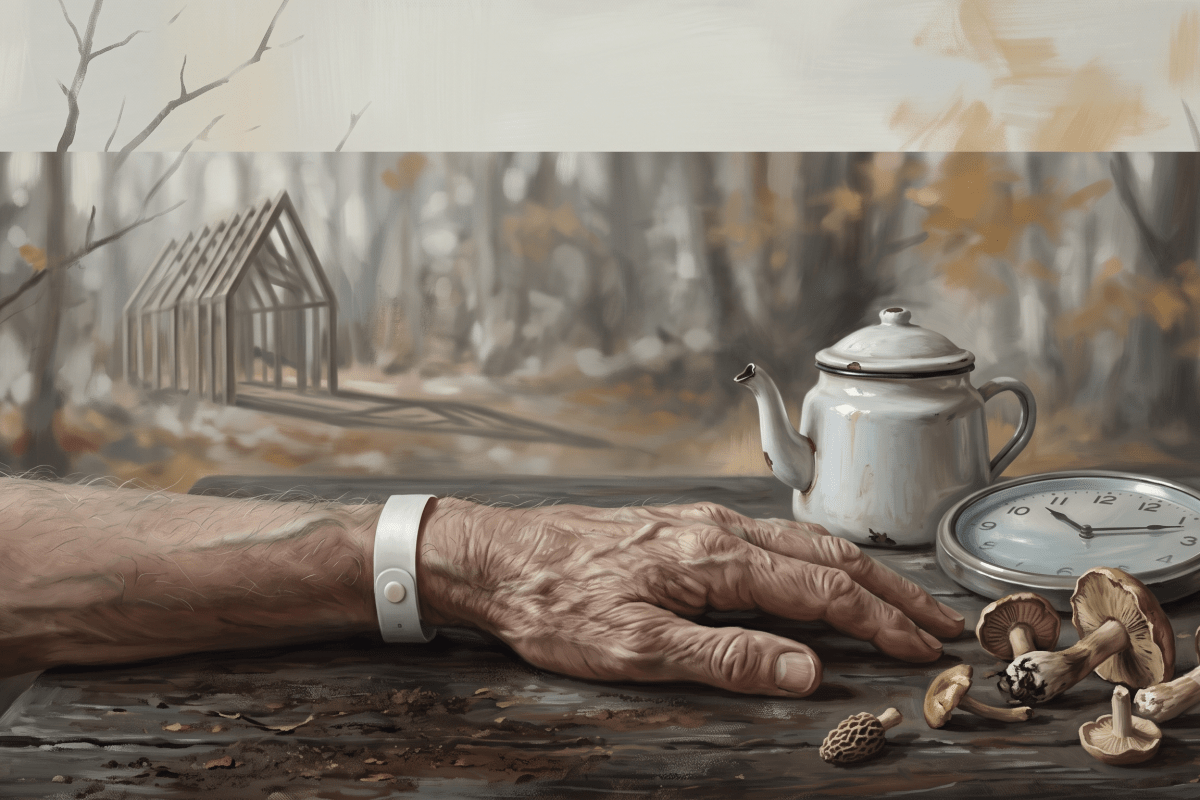
Les Années Vécues

4–6 minutes

I’ve been working for days on a new short story that investigates time. I’ve already published The Box in English, but this new piece looks at a different aspect of time, one I suspect may work better in French because the grammar gives me more useful pressure points than English.

The working title is Les Années Vécues, which translates literally as The Years Lived. For now, that’s only a working title. Oddly enough, the purpose of this post is not really to describe the story, though I may do some of that. It is more about the tools, the process, and the strange route by which the idea arrived.

The story began as a conversation between me, Claude, and ChatGPT about human innovation and creativity. A colleague had recommended How Language Began. I bought it and read the first few chapters. For the record, it’s interesting.

Early on, the author discusses genetics and evolution, citing human inventions along the way, particularly those associated with Homo erectus. Because I tend to question narratives of progress, and especially grand claims around Innovation and Creativity, I fell into some LLM-assisted chit-chat. From there, the conversation drifted into time travel in fiction. We discussed tropes from Back to the Future to Outlander. Somewhere in that mess, I noticed a missing perspective I felt I could capitalise on.

For the record, again, I have not been especially successful at writing short stories. They tend to grow beyond my intent, usually into novelettes or novellas. My first novel, written as Ridley Park, began as a short story. That story is now ostensibly chapter five of Hemo Sapiens. It can stand on its own, but it plays better in context. It is still my favourite chapter, if I had to choose one. So I’ll see where this new one goes, if anywhere. Nowhere is always an option. The blank page remains admirably non-committal.

After hours of brainstorming with the LLMs, arbitrarily switching from French to English and back again, I had a plot outline with beats and flavour, tropes and intentions, subversions and misdirects. I had captured dialogue exchanges, worked through worldbuilding constraints, and fleshed out several plot points. Then I asked ChatGPT to build me a tracking document to serve as a punch list.

I’ve done this a few times before, but with the advancement of the tools, the output was surprisingly robust, arguably overkill, which isn’t always a vice.

The spreadsheet contains 9 tabs:

  1. Lists
  2. Dashboard
  3. Punchlist
  4. Beat Map
  5. Continuity Rules
  6. Motifs & Plants
  7. Evidence Ledger
  8. Open Questions
  9. Sources

Lists

The Lists tab is mostly internal to the spreadsheet. It controls status values, priorities, categories, and related dropdowns. I would not have made it this elaborate manually, but I’m not offended by competence when it arrives uninvited.
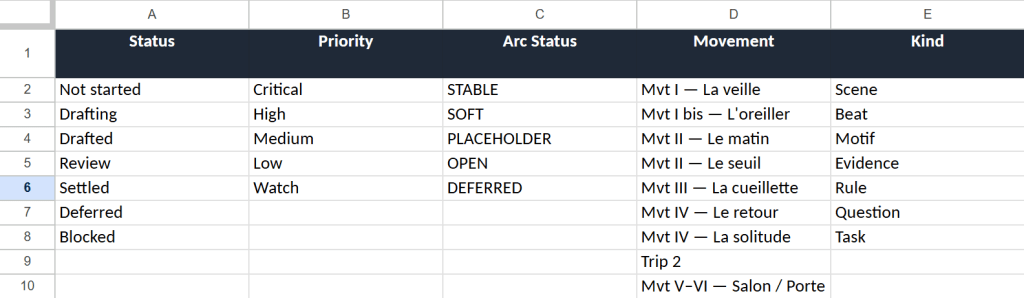
I wouldn’t have been so elaborate, but it’s nice nonetheless.

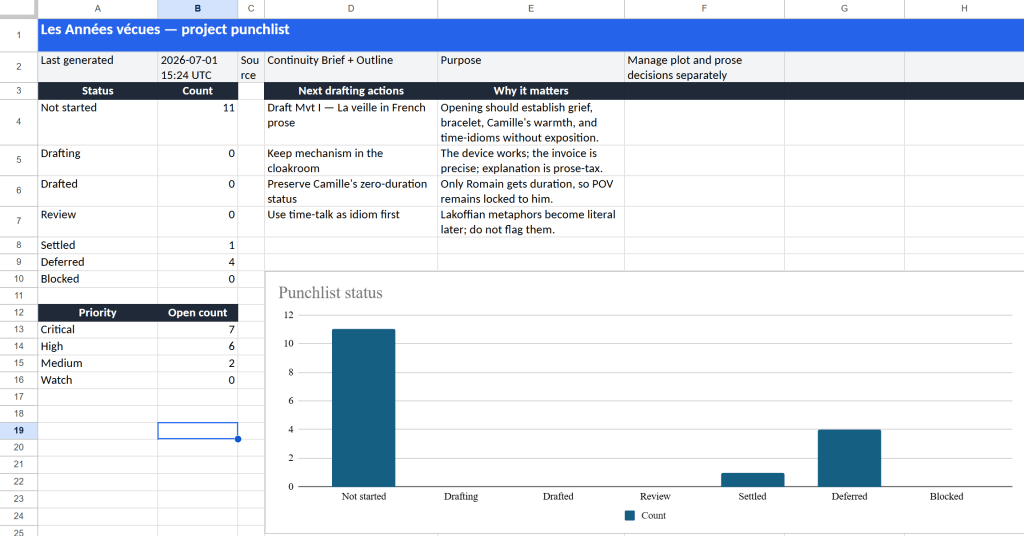
The Dashboard

The Dashboard is also a bit of overkill, but useful overkill. In its inaugural state, it gives a quick view of task status, priorities, and next actions. Its intent should be clear from the screenshot.
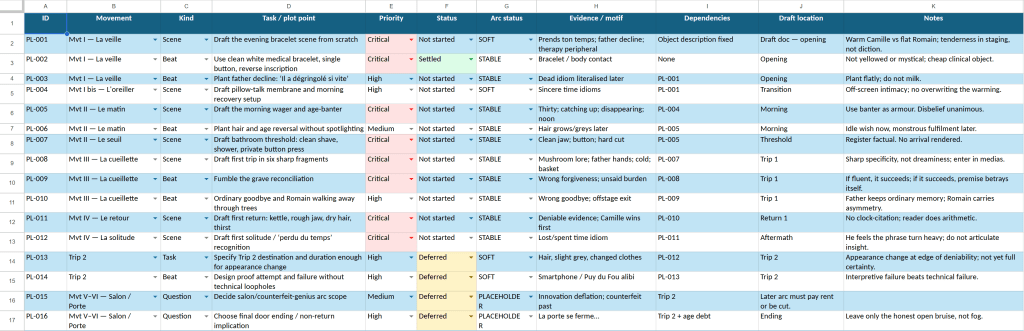
Punchlist

The Punchlist is essentially an actionable to-do list with status markers. I think I can safely share this without giving too much away. It lets me manage the story as a set of unresolved craft problems rather than as a vague cloud of ‘I should really get back to that’.
Beat map

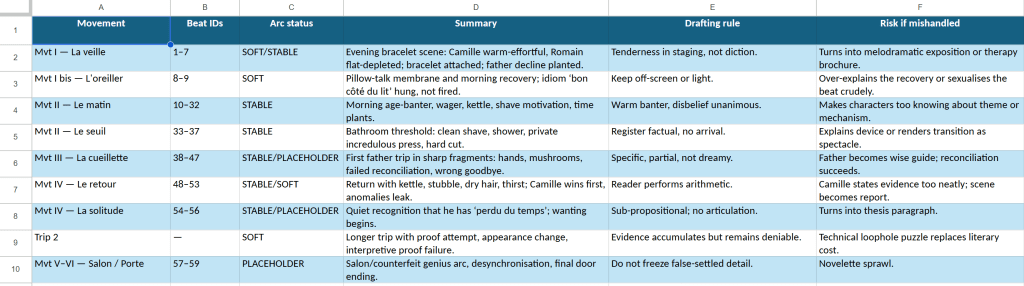
The Beat Map contains representative story beats, with notes that capture narrative purpose, confidence level, and risk-management annotations. This is where structure can be managed without cluttering the prose draft itself.
Continuity Rules

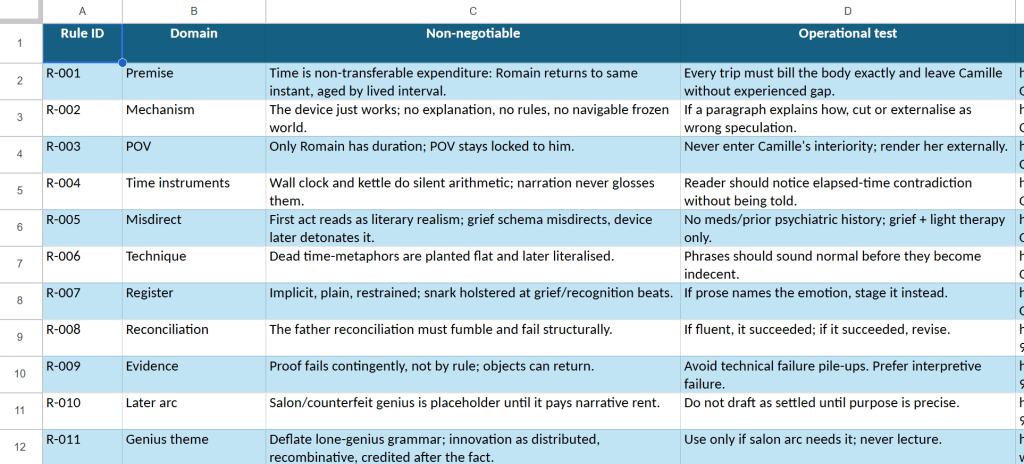
The Continuity Rules tab captures worldbuilding constraints and adjacent considerations. It is probably oversharing at this stage, but I’ll take the risk. These rules matter because speculative fiction can collapse quickly when the premise starts leaking.
Motifs & Plants

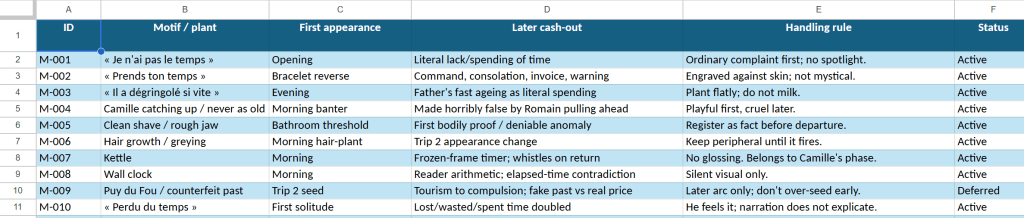
The Motifs & Plants tab tracks recurring touchpoints, images, phrases, and planted details. Some of these may be premature, but having them outside the draft helps me avoid forcing them into the prose too early.
Evidence Ledger

The Evidence Ledger tracks what counts as evidence inside the story world, who can interpret it, and how it may be misread. This is another continuity check, but also a thematic one.

Open Questions

The Open Questions tab is exactly what it sounds like: unresolved choices, structural uncertainties, and decisions I do not yet want to freeze into place. Sometimes the most useful document is the one that refuses to pretend everything has been solved.

Sources

The Sources tab lists the chat history and documents from which the rest of the content was derived.

The Rest

This is only a partial listing, and I am not finished ideating. I have not yet begun the prose.

I do not always plot my stories. More often than not, I take something closer to a stream-of-consciousness approach. But for one thing, my consciousness does not stream in French. So there’s that.

What impressed me most was the organisational layer the LLM produced. The spreadsheet is now hosted on Google Drive as a Sheet, accessible to both me and the LLMs, so it can be updated as the discussions and decisions continue.

I’m looking forward to wrapping up the ideation phase and beginning, and ideally completing, the prose. That last part remains the traditional nuisance.

Funny, That

1–2 minutes

I find myself interesting, not in a narcissistic way, but in examination.

I wrote an academic blog post (and then a couple others, 1, 2) to clarify a nonfiction book that commenced as an academic essay. The blog post spawned a novella (pending, in revision), which in turn spawned both a short story (pending novella) and another academic essay (pending novella). With the short story, I plan to release meta commentary and background around the novella.

This seems like an unusual ecosystem, but it’s how my brain operates – on inputs and synthesis. Having completed The Architecture of Encounter, itself a follow-up to A Language Insufficiency Hypothesis and the second of a planned series of three, but hard-pressed to call it a trilogy.

This post might make more sense when the unfinished projects are complete, but until then, consider it a status update.

A bit more…

The reason for the short story is that the novella ends intentionally ambiguous, and the short story is a disconnected possible resolution. But I want the novella to remain open to interpretation, as is my modus operandi in many cases. I had considered including it as an epilogue – and I may do this in a future edition – but for now, I don’t want to prematurely close the discussion.

If I can get someone to publish the short story in a collection, that would be great, but I’ll otherwise publish it with the notes I mentioned above.

To quote The Critical Drinker, ‘Anyway, that’s all I’ve got today. Go away, now‘.

Advantagement and Modelment

3–5 minutes

I wrote an experimental short story, the details of which I’ll presently share, but first, I wish to describe an encounter with AI – NotebookLM. Firstly, I want to disclose that I am not an AI hater. Secondly, I understand its limitations. Thirdly, I understand the limitations of language. Fourthly, I understand the limitations of people. Let this set the stage.

In this short story that I named Advantagement, there is an inspector in Victorian London working with his partner on a missing-person case, the daughter of the mayor. A piece of evidence is a hairbrush left on her dresser. None of this is important for now.

Exhibit 1: The NotebookLM summary podcast with the silver hairbrush.

After I wrote it, I posted it to my Ridley Park blog, not intending to share it here, though I had reasons I might have instead. I fed it to NotebookLM to get an AI summary podcast, something I do routinely even here on Philosphics blog. The interpretation led to this post.

I like NotebookLM, but it has its flaws. Some are trivial, some comical. This one is curious and might shed light on how LLMs process information.

Let’s return to the hairbrush. NotebookLM keyed in on the hairbrush as the evidence it was, but then it strayed off the reservation. Suddenly, an ordinary hairbrush was now silver and monogrammed. I had to revisit my manuscript to see if I had subconsciously scribbled these details. Nope. No such description.

I’m not done noting errors, but I’ll pause to suss out the LLM. What I think might have happened is that it took in the notions of a posh house set in late nineteenth century London and presumed that a brush would appear like this. I considered retroactively adding the detail. As a writer, I struggle with deep POV because I don’t experience the world so vividly. But this hallucination isn’t the worst of it.

Next, the LLM noted that the hairbrush was orientated with bristles facing down on her dresser. This was stated in the story. Then, it went off the tracks again. This monogrammed silver hairbrush, bristles down, was a clue because anyone with such an expensive artefact would want to show it off, so showcase the fancy monogram.

But here’s the rub: if the bristles were down, the monogramme would be prominently displayed. To be obscured, it would have been positioned with the bristles facing up. This is a logical error I can’t explain.

Scratch that, I understand full well that LLMs are, by definition, Large Language Models – the acronym is a dead giveaway. These are not logic models, though, I suppose, one might assume one of the Ls stands for logic – Like Large Logic Model or Logical Language model of some such, but one would be mistaken.

Audio: ‘Dramatisation’ of the Advantagement

What about the story?

I might as well spill the tea on the motivation of the story. Although it is a detective story, this was just a vehicle.

I had been watching this video, ‘Why don’t we have words for these things?‘ I love these guys, even if only for this inspiration.

Video: My primary inspiration for Advantagement.

I thought it might be a fun idea to create a character who speaks in these terms – malformed English. I immediately thought of Mr Burns from The Simpsons and his anachronisms, or someone ripe with malaprops. It suggested that I might choose Victorian England, Sherlock Holmes, a detective, a sidekick… vying for promotion. A high-profile case.

But not Sherlock Holmes – more Inspector Clouseau or Mr Bean, successful in spite of himself. I decided to offset his inanity with a logical partner, but it would be a woman, as unlikely as this might be given the period. Now it’s open to topical management politics.

When I told my sister the story idea, she thought of Get Smart, the 1960s comedy with Don Adams and Barbara Feldon. Yes, that too, but my goal wasn’t comedy. It was satire – and absurdism.

At uni, I enjoyed the short stories of Donald Barthelme. He was generally a lighter version of Kafka, and orthogonal to Kurt Vonnegut, especially Harrison Bergeron, a favourite classic. I wanted to shoot for that.

In conceit to the Peter principle of management, I decided to name the lead character Peter. For the rest, I adopted period-appropriate names.

My primary goal was to employ these confabulated words. In practise, it’s easy anough to suss out their meanings in context. Give it a read. It’s under 3,500 words.

Ridley Park Side Project

I’ve been MIA here for a couple of reasons:

  1. I’ve been recovering from physical challenges that affect my mobility and ability to interface with a computer, diminishing my productivity in such matters to about 10 or 20 per cent.
  2. I’ve been focusing my energy (besides that on recovery) on writing fiction under my Ridley Park pseudonym.

As for my physical concerns, I won’t bore you. I’d rather discuss my side project, which in the absence of employment turns out to be my primary focus. Currently, I am world-building, so I can explore philosophical and sociological issues in a safe space.

This world is contemporary Earth and the near future—at least for now, as I am leaving a lot of room to explore. Check out my Ridley Park blog if you are interested in specifics. Here, I just want to focus on the philosophical aspects and ramifications, using this story world as a reference, so I’ll provide a brief setup upon which to build.

In this world, a scientist has genetically engineered an embryo (for reasons) and ends up with quasi-vampires, a subspecies of humans—or is it? This cohort is human for all intents and purposes, except they need to ‘drink’ blood to survive. They’ve got fangs and an internal organ used to process and metabolise the blood. He decides to clone these and create a new population. In time, he improves on the genetics in the manner described here. The first short story (flash fiction) I’ve shared is Hemo Sapiens: The Unidentified, but let’s get onto the philosophical aspects.

Podcast: Audio rendtion of Hemo Sapiens: The Unidentified (Runtime: 5:25).

In this world, I shed light on what makes humans human. What happens when we need to coexist with a similar species? What if we treat them as second-class citizens? What if they become physically and intellectually superior?

Are these people a new species or a new race? Or are they just transhumans? What rights do they have? As a new race, perhaps it’s earier to fathom them and grant them human rights, but what if they are a new species? We haven’t had a great track record of granting rights to other species.

And what’s their immigration status? A common reaction to ‘immigrants’ is to ‘send them back to where they came from’. But what if they came from here? What if they were raised here and speak our language? In this case, they are raised near Manchester in the UK. They speak English. They are not only sentient beings at the start, they have above average IQs and have general cultural awareness. Some speak a second language. Save for the fangs, all outward appearances show them as human.

Until they are discovered by authorities, they are raised in a greenhouse environment. By the time they are discovered, there are five versions of them—alpha through epsilon—, and some have started reproducing, so we get to explore these dynamics, too. Some have tagged these people—are they people?—as homo sapiens sanguinius—bloodsucking intelligent man. Affectionately, I call them hemo sapiens.

I’ll return here as I produce more content there. I prefer not to create spoilers. Although I am working on several stories in different formats (short story, novella, novel, and so on), I’ll publish them (somewhere), provide literary analysis on my Ridley Park blog and provide philosophical commentary here. I hope you’ll join me and participate in the discussion.

Reading: The Last Messiah by Peter Zapffe

I decided to try my hand at reading. I came upon Peter Zapffe when I was reading The Conspiracy against the Human Race, and The Last Messiah is a relatively short essay. It’s under 25 minutes.

My first goal was to figure out how to pronounce Zapffe. As it happens, the terminal E is pronounced as a schwa. And that makes sense. My heritage, as it were, is Norwegian. My grandad was born in Norway, emigrating during the so-called World War 2. His family surname is Gade, with the E pronounced the same way, so the name is pronounced as /gäʹdə/, but Anglicised, it the A becomes a long vowel owing to the silent E, so it becomes /geɪd/.

What was new to me is that in Norwegian, Peter is pronounced /pɛt ə/ [as if spelt Petta] rather than /ˈpiːtɚ/ or perhaps /ˈpiːtɹ/ in some American renditions more familiar to English readers.