So glad I took time out to watch a short exchange between Rick Beato and Justin Hawkins on whether music is becoming content rather than art. The question is framed in musical terms, but it hardly stops there. The same corrosion is visible in writing, visual art, criticism, and now, with grim inevitability, in AI-mediated production more broadly. The disease is not confined to music. Music merely makes the symptoms easier to hear.
For music, my aversion to pop music goes back to my youth. I was a kid when the Beatles practically invented pop music, but they left it to grow and continued exploring. Sadly, as solo artists, they mainly – not always – failed and rested on their laurels in pop. It’s not that their version or any pop music is inherently unlistenable. Surely, it’s not, if only by the aspiration of the pop moniker, but it has no depth, no soul, as it were. Some make this argument for Organic food. In essence, it involves an appeal to nature fallacy.
My own aversion to much pop music begins there. It is not that pop is necessarily bad, nor even that it is always shallow. That would be too crude and too easy. The problem is that pop often presents itself less as an artistic act than as a consumption object engineered for immediate uptake: catchy, frictionless, emotionally legible, and just disposable enough to make room for the next one. It is built to circulate.
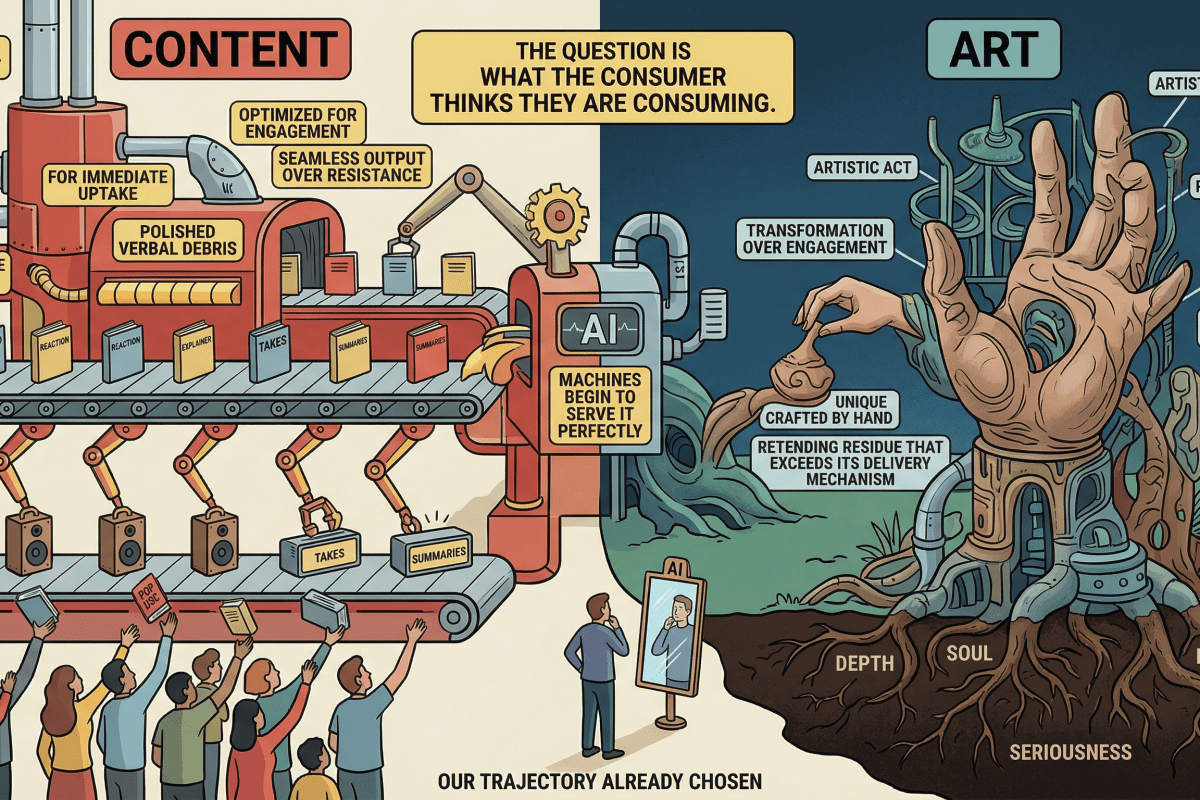
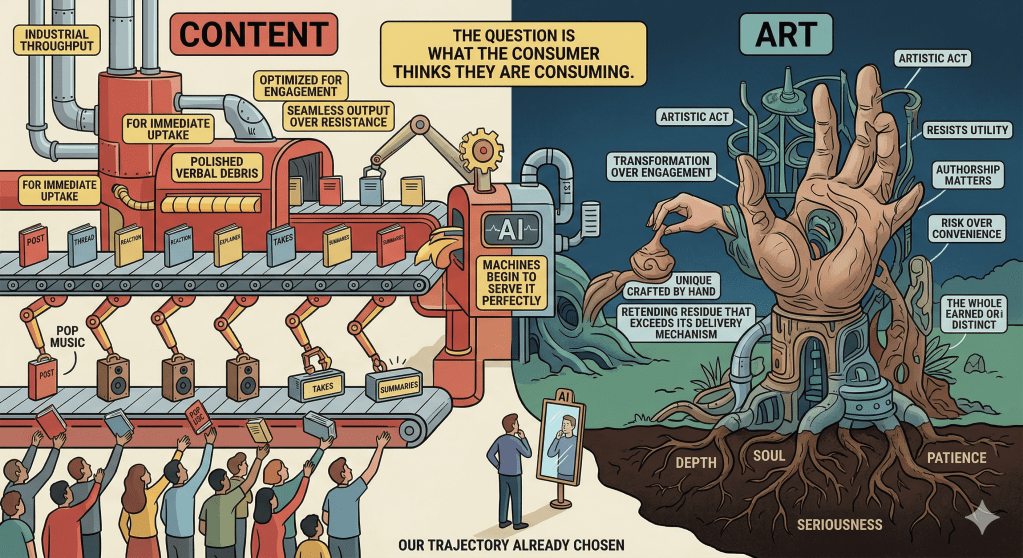
That, for me, is the difference between content and art. Art may be accessible, even popular, but it retains some residue that exceeds its delivery mechanism. It resists total reduction to utility. Content, by contrast, is made to be processed. It is optimised not for depth but for throughput. Its highest ambition is not transformation, but engagement.
This is why the question matters beyond music. Writing, too, now lives under the same pressure. One is increasingly expected to produce not essays, arguments, or works, but units of output: posts, threads, reactions, takes, summaries, explainers, and other forms of polished verbal debris. The point is no longer to say something worth dwelling on, but to remain visible within the churn.
The issue, then, is not simply whether one should consume AI-generated material. That framing is too pious and too easy. The more interesting question is what the consumer thinks they are consuming. If a reader, listener, or viewer wants only speed, familiarity, and surface competence, then AI content is not a scandal at all. It is the logical endpoint of a culture that has already demoted art into a deliverable.
This is where the fuss over labelling enters. Is it a principled demand for honesty, or merely a theatrical gesture by people who still want the aura of art whilst consuming content on industrial terms? Some of it is clearly protectionism. Some of it is virtue signalling. But not all of it is empty. The insistence on labelling betrays an intuition, however muddled, that authorship still matters, and that not all artefacts are equivalent merely because they occupy the same screen-space.
The deeper question is whether we still want art at all, or whether we merely want the aesthetic styling of art attached to things optimised for convenience. Once a culture learns to prefer seamless output over resistance, recognisability over risk, and quantity over form, it should not act surprised when machines begin to serve it perfectly. They are only completing a trajectory already chosen.
So no, the issue is not AI alone. AI is only the latest mirror held up to a public that has spent years confusing availability with value and polish with depth. The real question is not whether machines can make content. Plainly, they can. The question is whether we still possess the appetite, patience, and seriousness required for art.
 Philosophics