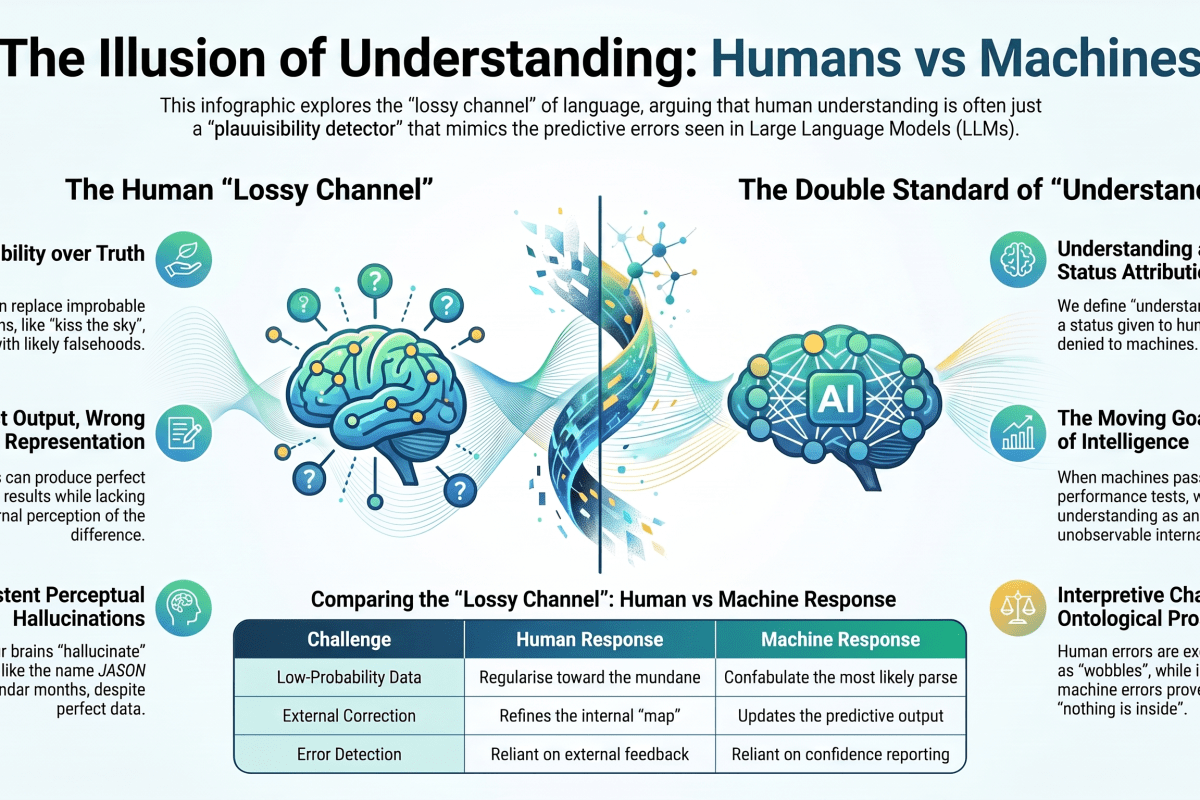
In this Substack essay, I explore the flawed nature of human comprehension, arguing that our understanding is often just a calculation of probability rather than an objective grasp of truth. By examining linguistic errors like misheard lyrics and his own struggles with French phonemes, Willis demonstrates that humans frequently hallucinate or misinterpret data based on what seems most plausible. He compares these mental lapses to the ‘hallucinations’ of Large Language Models, suggesting that the mistakes made by AI are fundamentally similar to our own. The author contends that we apply a double standard by granting humans the status of ‘understanding’ while dismissing machines for the exact same predictive behaviours. Ultimately, the text challenges the metaphysical assumptions of human exceptionalism, asserting that what we call ‘understanding’ is merely an external attribution rather than a unique internal state.
Essentially, I am not advocating the view that LLMs have consciousness and understanding; rather, I am arguing that the human versions of these are inflated with metaphysics.
The question is reasonable, although belief may already be doing more work than I would permit it under cross-examination. My writing is generally diagnostic rather than doctrinal. I am more interested in identifying the architectural assumptions beneath a dispute than in selecting a furnished room within it. Where philosophy offers a contest between established positions, I often suspect that the arena itself has been badly designed.
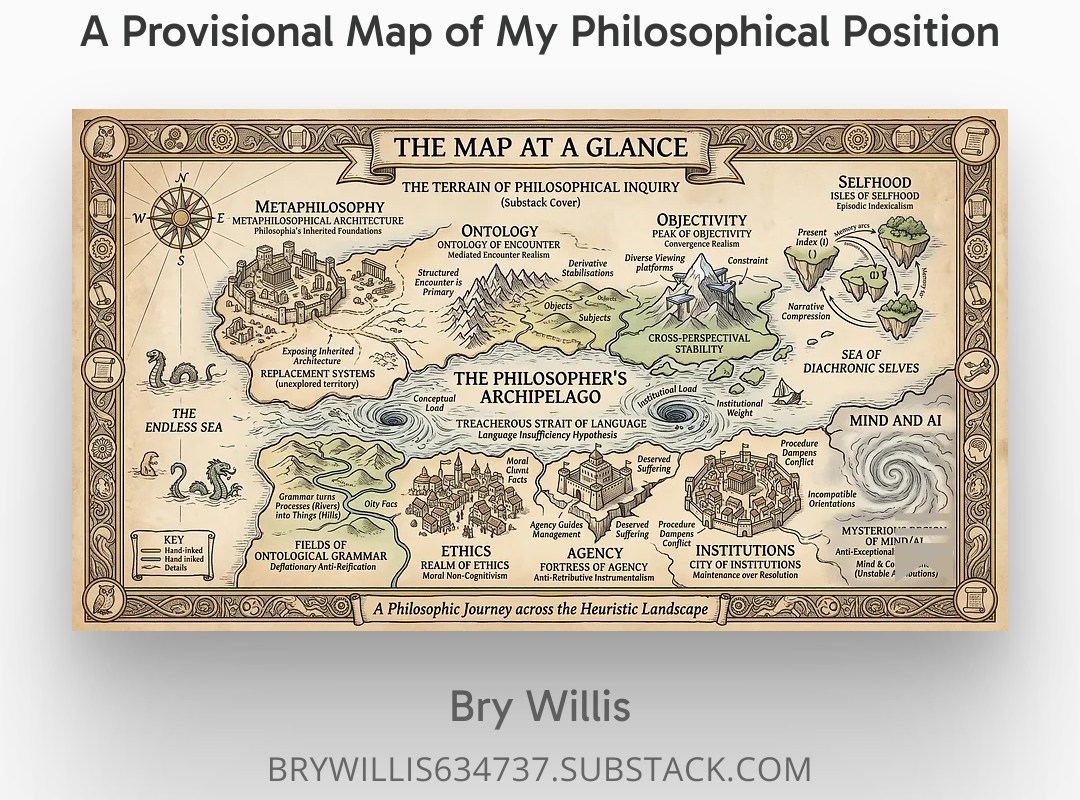
Still, repeated diagnoses eventually disclose a pattern. Certain commitments recur: suspicion of substance, resistance to metaphysical inflation, distrust of linguistic confidence, rejection of moral realism, scepticism toward persistent personal identity, and an insistence that mediation does not entail fabrication.
What follows is therefore neither a creed nor a completed system. It is a provisional map of where I presently stand.
The labels are intended as coordinates, not allegiances. Where no established term quite fits, I have used my own. This is partly unavoidable and partly evidence for the very linguistic difficulty I spend so much time diagnosing.
This content, including video and podcast summary, are of a longer Substack article on my philosophical positions with descriptions.
Allow me to start with a declaration: I am no Hegel expert, and whether I am an expert at anything is debatable. Still, I’ve been reflecting on Hegel through my own lenses, and I have an opinion – because of course I do. My comment isn’t on a single Hegel publication. Rather, it’s a commentary on some of his general ideas – some more specific than others – that just so happen to be rattling around my noggin as I type.
Audio: NotebookLM summary podcast of this topic.
I know I’ve already claimed to have started, but this is the real start. Let’s talk translations.
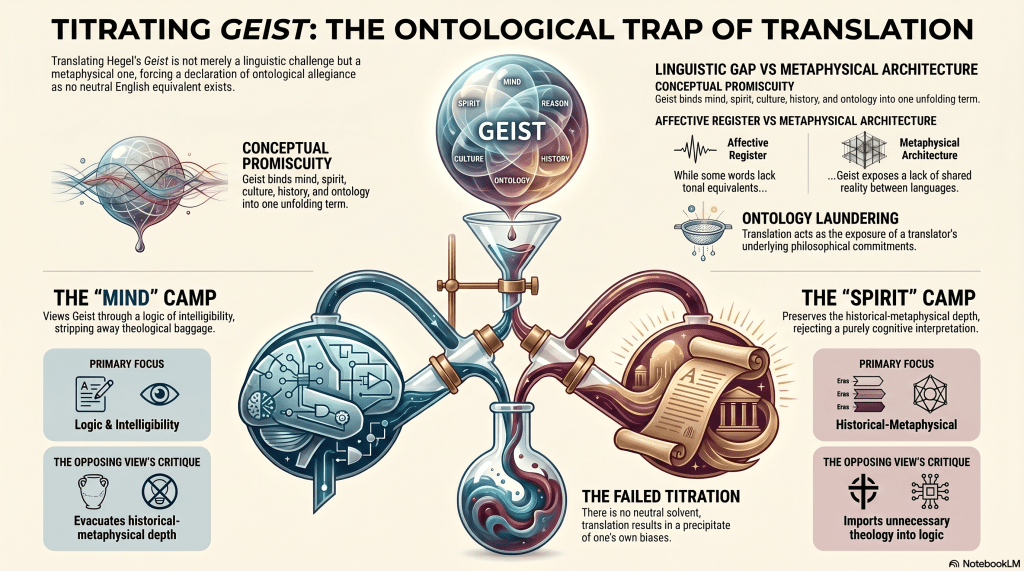
NotebookLM Infographic on this topic.
I recently discussed the problem with translating Meursault’s French maman. The short version: English lacks a clean equivalent. Every option – Mother, Mummy, Mama – over-interprets the son’s relation to his mother, leaning warmer or colder or more infantile than the French allows. Camus’ problem is at the level of affective register. The ambiguity is tonal, intimate, and culturally situated. English simply can’t carry it without choosing a side.
Hegel has a different problem, more philosophically weighty. His problem is Geist. Almost immediately, I think of zeitgeist and Poltergeist. Ghosts. Spirits. Phenomenology of Spirit, right? Easy peasy.
Not so fast. Some translators render it as Mind, in an attempt to distance themselves from theological baggage. The problem is that Hegel himself equivocates – so he’s of little help. He may have been intentionally cheeky, being stuck in the milieu of his day, as well as a product of it and producer through it.
Where maman exposes language’s insufficiency at the level of affective register, Geist exposes it at the level of metaphysical architecture. English can’t preserve the conceptual promiscuity by which Hegel binds mind, spirit, culture, history, and ontology into one unfolding term. The word doesn’t just mean something; it enacts a view of what is real and how the real moves. If that weren’t bad enough, enter ontological grammar commitments. (I’m a teetotaller, so someone else hold the bear.)
Video: Hold my bear
The translator is not neutrally asking: What does Geist mean? They are already asking, even if silently: What kind of reality do I think Hegel is describing?
Translation here isn’t the neutral transfer of meaning – it’s the exposure of ontological allegiance. The quarrel over Geist is not a lexical dispute. It is ontology laundering itself through vocabulary.
Let’s consider the two camps.
The Mind camp hears:
“You are importing theology into what is fundamentally a logic of intelligibility.”
The Spirit camp hears:
“You are evacuating the historical-metaphysical depth of the term and pretending Hegel was doing philosophy of cognition with better hats — nicer hats, perhaps, but hats all the same.”
Neither objection is irrational from within its own grammar. Both are locally coherent. They simply don’t share the same ontology of the term.
Reason doesn’t choose between Mind and Spirit from nowhere. It adjudicates from within a prior ontological settlement, then mistakes that settlement for neutrality. This is worth remembering well beyond the Hegel literature.
In disputes over Geist, reason doesn’t fail because the parties are irrational. It fails because each party’s reason operates inside a different ontological grammar. What appears as clarification within one frame appears as distortion within the other. A reason is not self-legitimating. It becomes a reason only inside a grammar that knows how to receive it.
Which brings us back to the title. Titration works when you have a known reagent and a neutral solvent – you add one to the other until the system reaches equilibrium. The whole method assumes there is an equilibrium to reach. Geist has no neutral solvent. Mind and Spirit are not two concentrations of the same substance. They are different substances, differently constituted, differently reactive. There is no volume at which one cancels the other out. You can titrate the word all you like. The indicator never changes colour. What you are left with is not a settled meaning but a record of your own ontological commitments, precipitated out of solution and sitting at the bottom of the flask – which, in the end, is more than most translations will admit.
Door Prize: Here’s your parting gift courtesy of NotebookLM…
In the last post, I argued that the so-called ‘hard problem of consciousness‘ was never a problem with consciousness. It was a problem with language – specifically, the English language’s unfortunate habit of carving the world into neat little substances and then demanding to know why its own divisions won’t glue back together.
Audio: NotebookLM summary podcast of this topic, on resolving the hard problem of consciousness.
The response was predictable.
‘But what about subjective feel?’
‘What about emergence?’
‘What about ontology?’
‘What about Chalmers?’
‘What about that ineffable thing you can’t quite point at?’
All fair questions. All built atop the very framing that manufactures the illusion of a metaphysical gap.
So here’s the promised demonstration: not yet a full essay (though it may evolve into one), but a clear application of MEOW – the Mediated Encounter Ontology of the World – to the hard problem itself. Consider this a field test of the framework. A tidy autopsy, not the funeral oration.
The Set-Up: Chalmers’ Famous Trick
Chalmers asks:
How do physical processes give rise to experience?
The question feels profound only because the terms ‘physical’ and ‘experience’ smuggle in the very metaphysics they pretend to interrogate. They look like opposites because the grammar makes them opposites. English loves a comforting binary.
But MEOW doesn’t bother with the front door. It doesn’t assume two substances – ‘mind’ over here, ‘world’ over there – and then panic when they refuse to shake hands. It treats experience as the way an encounter manifests under a layered architecture of mediation. There’s no bridge. Only layers.
T₀ – Biological Mediation
The body is not a barrier. It is the encounter’s first architecture.
At T₀, the world is already transformed: transduction, gating, synchrony, inhibition, adaptation. Organisms don’t receive ‘raw’ physical inputs. They metabolise them. The form of contact is biological before it is anything else.
The hard problem begins by assuming there’s a realm of dumb physical mechanisms that somehow need to ‘produce’ experience. But organisms do not encounter dumb mechanism. They encounter structured contact –biological mediation – from the first millisecond.
If you insist on thinking in substances, T₀ looks like a problem. If you think in mediations, it looks like the beginning of sense-making.
T₁ – Cognitive Mediation
Where the Enlightenment saw a window, cognition installs a newsroom.
Prediction, priors, memory, inference, attention – all shaping what appears and what never makes it into view. Experience at T₁ is not something ‘added’. It is the organisational structure of the encounter itself.
The hard problem treats ‘experience’ as a mysterious extra–something floating atop neural activity like metaphysical cream. But at T₁, what appears as experience is simply the organisation of biological contact through cognitive patterns.
There is no ‘what emerges from the physical’. There is the way the encounter is organised.
And all of this unfolds under resistance – the world’s persistent refusal to line up neatly with expectation. Prediction errors, perceptual limits, feedback misfires: this constraint structure prevents the entire thing from collapsing into relativist soup.
T₂ – Linguistic–Conceptual Mediation
Here is where the hard problem is manufactured.
This is the layer that takes an ordinary phenomenon and turns it into a metaphysical puzzle. Words like ‘experience’, ‘physical’, ‘mental’, ‘subjective’, and ‘objective’ pretend to be carved in stone. They aren’t. They slide, drift, and mutate depending on context, grammar, and conceptual lineage.
The hard problem is almost entirely a T₂ artefact – a puzzle produced by a grammar that forces us to treat ‘experience’ and ‘physical process’ as two different substances rather than two different summaries of different mediational layers.
If you inherit a conceptual architecture that splits the world into mind and matter, of course you will look for a bridge. Language hands you the illusion and then refuses to refund the cost of admission.
T₃ – Cultural–Normative Mediation
The Western problem is not the world’s problem.
The very idea that consciousness is metaphysically puzzling is the product of a specific cultural lineage: Enlightenment substance dualism (even in its ‘materialist’ drag), Cartesian leftovers, empiricist habits, and Victorian metaphysics disguised as objectivity.
Other cultures don’t carve the world this way. Other ontologies don’t need to stitch mind back into world. Other languages simply don’t produce this problem.
The hard problem is not a universal insight. It’s a provincial glitch.
Reassembling the Encounter
Once you run consciousness through the mediational layers, the hard problem dissolves:
Consciousness is not an emergent property of neural complexity.
Consciousness is not a fundamental property of the universe.
Consciousness is the reflexive mode of certain mediated encounters, the form the encounter takes when cognition, language, and culture become part of what is appearing.
There is no gap to explain because the ‘gap’ is the product of a linguistic–conceptual framework that splits where the world does not.
As for the ever-mystical ‘what-it’s-like’: that isn’t a metaphysical jewel buried in the brain; it is the way a T₀–T₃ architecture manifests when its own structure becomes reflexively available.
A Brief Disclaimer Before the Internet Screams
Pointing out that Chalmers (and most of modern philosophy) operates within a faulty ontology is not to claim MEOW is flawless or final. It isn’t. But if Occam’s razor means anything, MEOW simply removes one unnecessary supposition — the idea that ‘mind’ and ‘world’ are independent substances in need of reconciliation. No triumphalism. Just subtraction.
Where This Leaves Chalmers
Chalmers is not wrong. He’s just asking the wrong question. The hard problem is not a metaphysical insight. It’s the moment our language tripped over its shoelaces and insisted the pavement was mysterious.
MEOW doesn’t solve the hard problem. It shows why the hard problem only exists inside a linguistic architecture that can’t model its own limitations.
This piece could easily grow into a full essay – perhaps it will. But for now, it does the job it needs to: a practical demonstration of MEOW in action.
And, arguably more important, it buys me one more day of indexing.
Ngũgĩ wa Thiong’o published “Decolonising the Mind” in 1986. David Guignion shares a 2-part summary analysis of the work on his Theory and Philosophy site.
Ngũgĩ wa Thiong’o’s book Decolonising the Mind centres on the profound impact of colonialism on language, culture, and thought. It argues that imposing a foreign language on colonised people is a key tool of imperial domination. This linguistic imperialism leads to colonial alienation, separating the colonised from their own culture and forcing them to view the world through the lens of the coloniser.
Here are some key points from the concept of decolonising the mind:
Language is intimately tied to culture and worldview: Language shapes how individuals perceive and understand the world. When colonised people are forced to adopt the language of the coloniser, they are also compelled to adopt their cultural framework and values.
Colonial education systems perpetuate mental control: By privileging the coloniser’s language and devaluing indigenous languages, colonial education systems reinforce the dominance of the coloniser’s culture and worldview. This process results in colonised children being alienated from their own cultural heritage and internalising a sense of inferiority.
Reclaiming indigenous languages is crucial for decolonisation: wa Thiong’o advocates for a return to writing and creating in indigenous African languages. He sees this as an act of resistance against linguistic imperialism and a way to reconnect with authentic African cultures. He further argues that it’s not enough to simply write in indigenous languages; the content must also reflect the struggles and experiences of the people, particularly the peasantry and working class.
The concept extends beyond literature: While wa Thiong’o focuses on language in literature, the concept of decolonising the mind has broader implications. It calls for a critical examination of all aspects of life affected by colonialism, including education, politics, and economics.
It is important to note that decolonising the mind is a complex and ongoing process. There are debates about the role of European languages in postcolonial societies, and the concept itself continues to evolve. However, wa Thiong’o’s work remains a seminal text in postcolonial studies, raising crucial questions about the enduring legacy of colonialism on thought and culture.
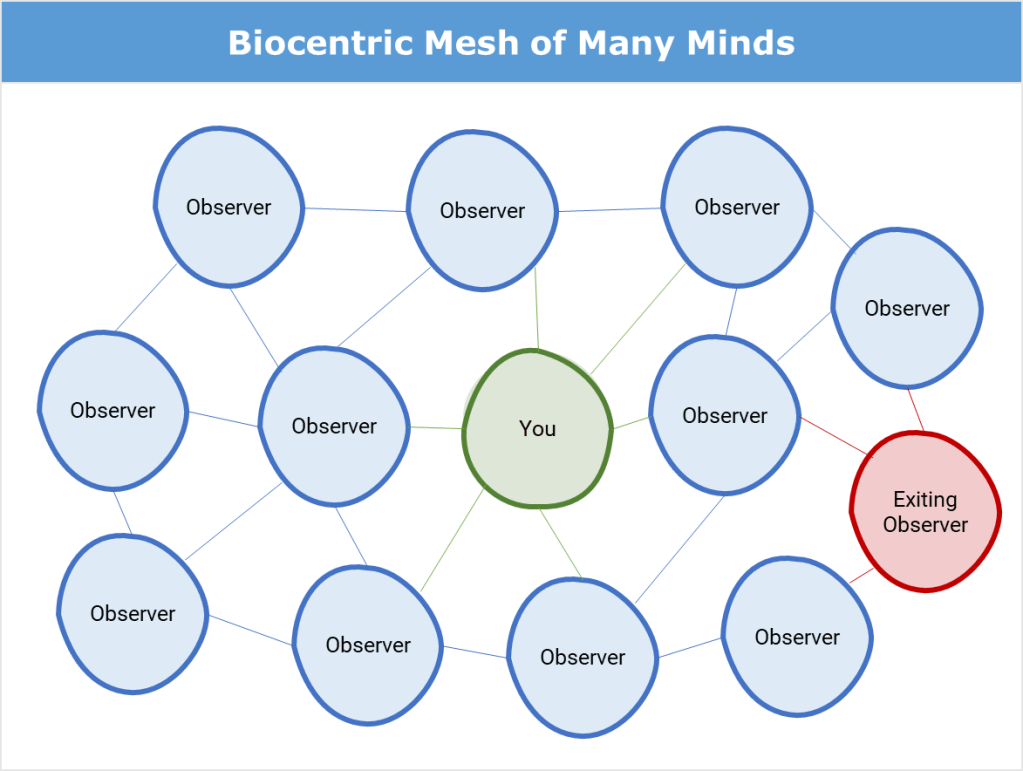
Perhaps, and as much as I see social aspects as constructed, I wouldn’t count on reality being constructed whole cloth from a web of observers. This is ostensibly what Robert Lanza’s biocentric view attempts to say. I’m not buying it.
Biocentric Mesh of Many Minds
As I understand it—admittedly from a single BigThink article, so there’s that—Lanza is trying to one-up Descartes and jump into the domain of Wittgenstein’s many minds conundrum. I suppose that this is another dualistic theory, but I am not likely to spend many cycles on it in the near term.
My question is that if at Time0, a reality is projected—my word—by the many minds, and at Time1, You enter the picture, and at Time2, the Exiting Observer is leaving the picture. how is reality shaped by these events? And are they events, or are they merely imagined? Is this an entirely solipsistic endeavour? Is this like Star Trek’s Borg? You will be assimilated. Resistance is futile.
Borg: You will be assimilated. Resistance is futile.
This also feels a lot like Jung’s Collective Unconscious on steroids. I’ll stop commenting here for now and consider this nothing more than a distraction. And I am not ready to jump on a panpsychism bandwagon any time soon.



 Philosophics