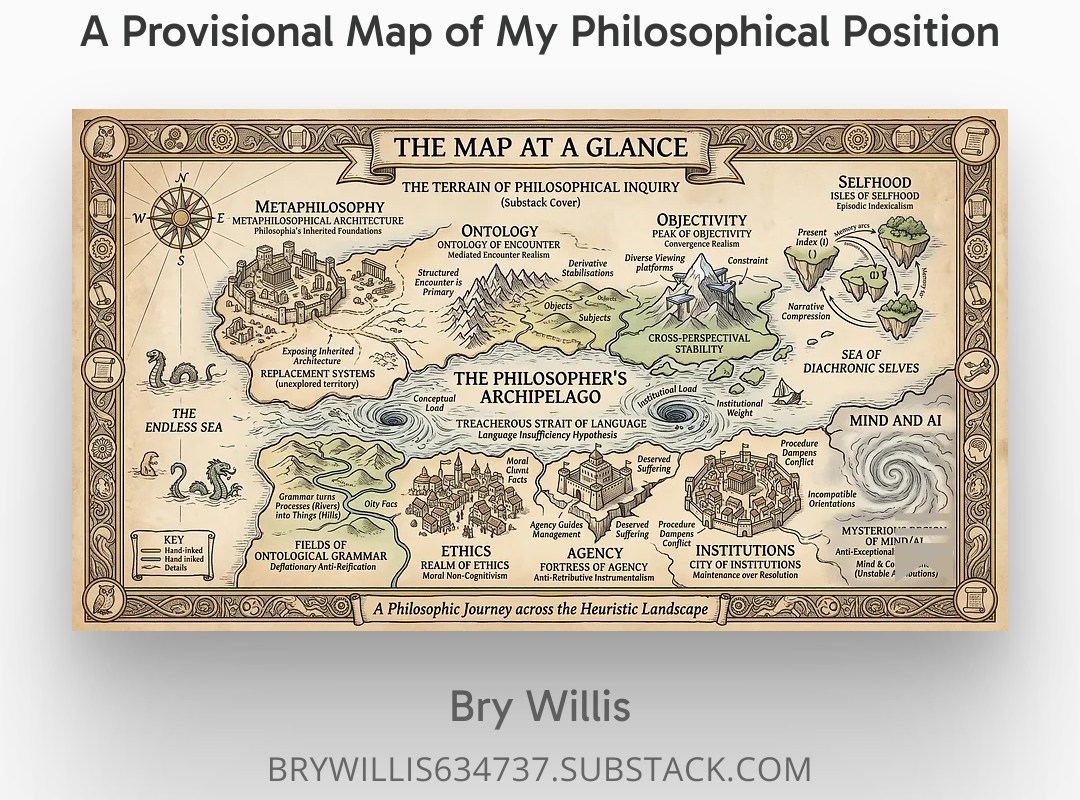
The question is reasonable, although belief may already be doing more work than I would permit it under cross-examination. My writing is generally diagnostic rather than doctrinal. I am more interested in identifying the architectural assumptions beneath a dispute than in selecting a furnished room within it. Where philosophy offers a contest between established positions, I often suspect that the arena itself has been badly designed.
Still, repeated diagnoses eventually disclose a pattern. Certain commitments recur: suspicion of substance, resistance to metaphysical inflation, distrust of linguistic confidence, rejection of moral realism, scepticism toward persistent personal identity, and an insistence that mediation does not entail fabrication.
What follows is therefore neither a creed nor a completed system. It is a provisional map of where I presently stand.
The labels are intended as coordinates, not allegiances. Where no established term quite fits, I have used my own. This is partly unavoidable and partly evidence for the very linguistic difficulty I spend so much time diagnosing.
This content, including video and podcast summary, are of a longer Substack article on my philosophical positions with descriptions.
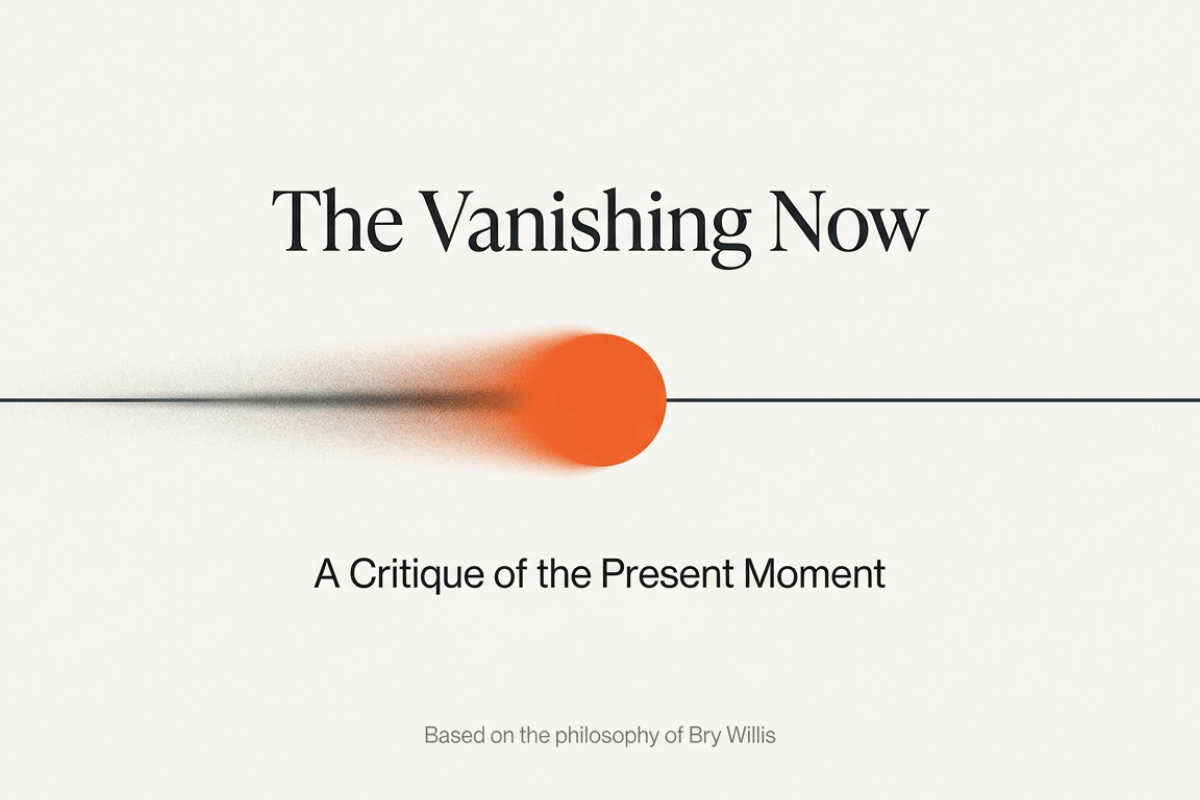
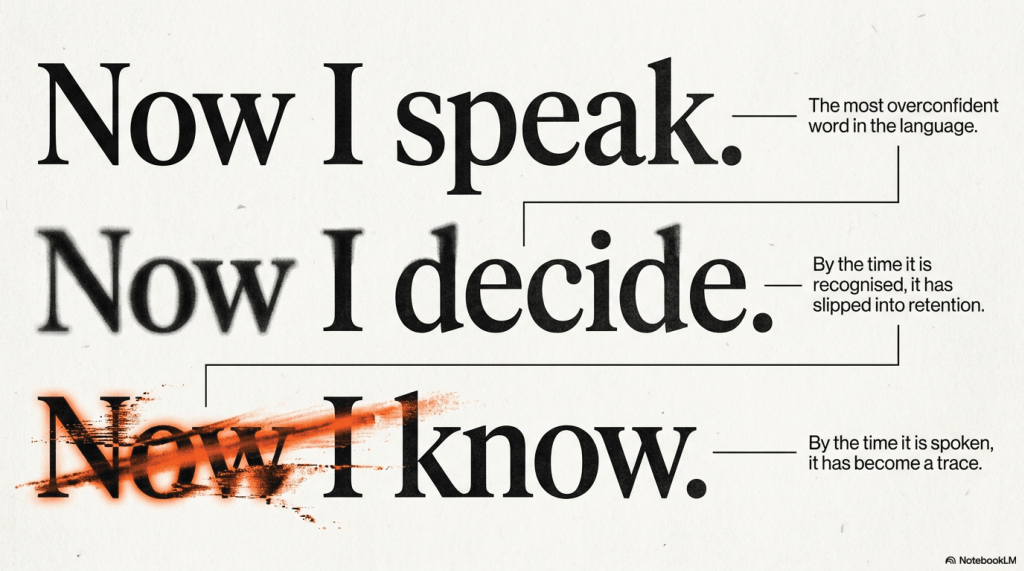
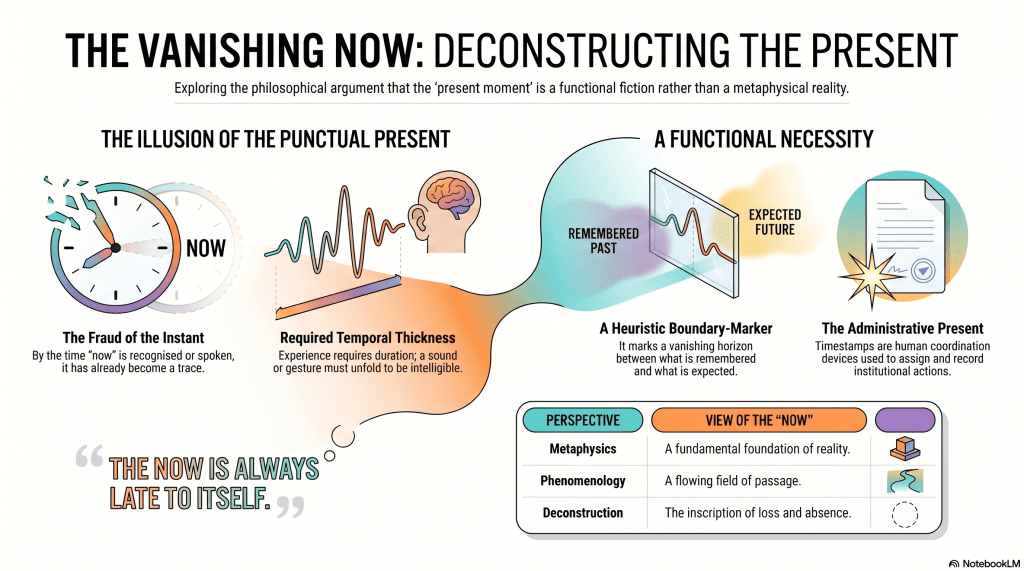
‘Now’ is one of the most overconfident little words in the language. It presents itself as immediate, self-evident, and available. We speak as though it names the present cleanly: now I speak, now I decide, now I know, now is the moment. Yet the word performs a small fraud every time it appears. By the time ‘now’ is recognised, it has already slipped into retention. By the time it is spoken, it has become a trace.
‘Now’ is not an experienced unit but a heuristic boundary-marker within temporal flow. It names a vanishing horizon between retention and protention: already past by the time it is recognised, already structured by what is expected before it can be stabilised. What it designates isn’t a thing, not a slice, not a metaphysical bead on the string of time, but a practical fiction by which consciousness, language, and action coordinate within a moving field.
Audio: NotebookLM summary podcast of this topic.
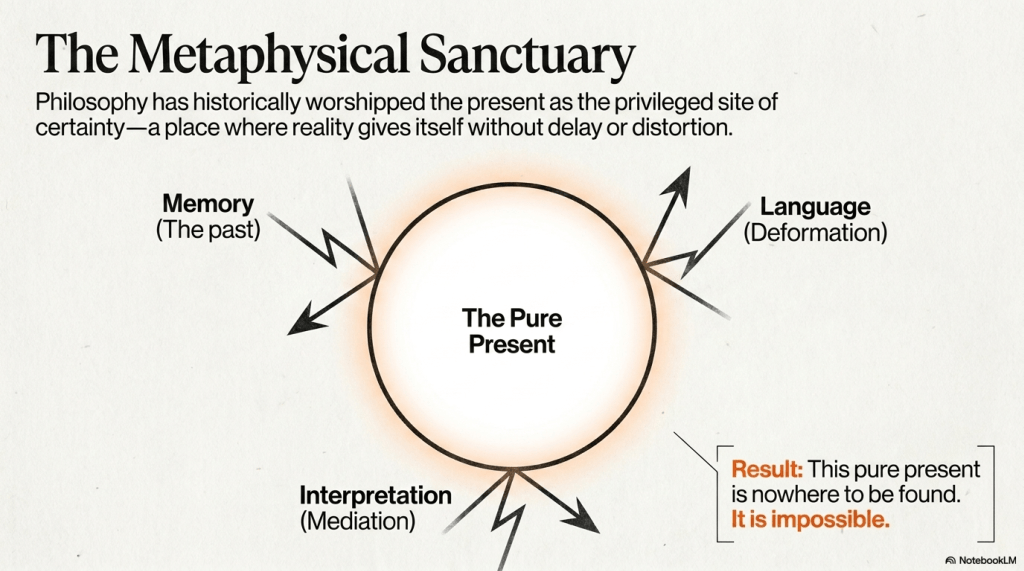
This distinction matters because philosophy has often treated the present as though it were the privileged site of certainty. Presence has been taken as the place where reality gives itself without delay, mediation, or distortion. The present moment becomes the imagined sanctuary of immediacy: before memory corrupts it, before language deforms it, before interpretation arrives with its grubby little toolkit. But this pure present is nowhere to be found. It’s not hidden; it’s impossible.
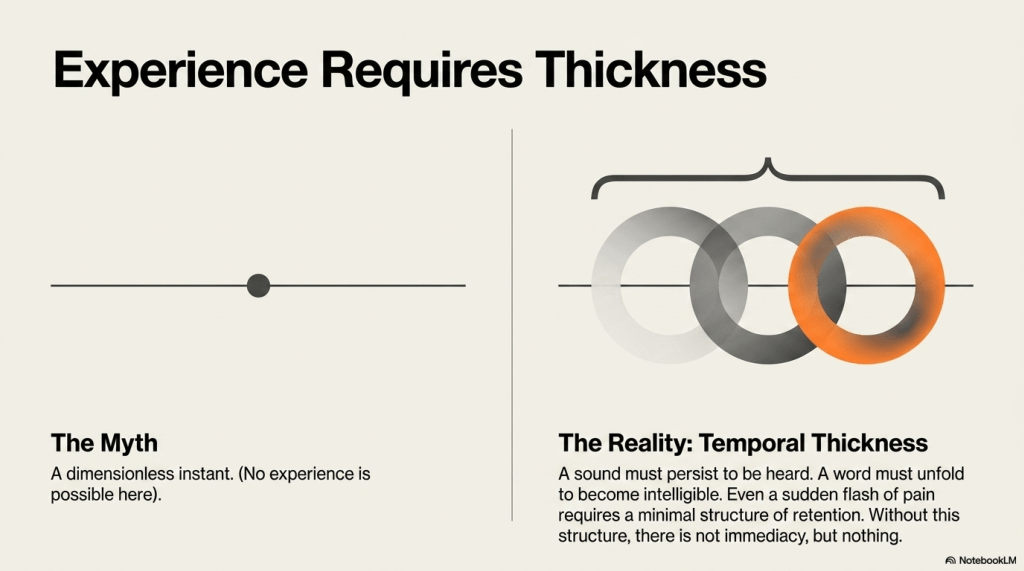
Experience is never given as a dimensionless instant. To experience anything at all requires temporal thickness. A sound must persist long enough to be heard as a sound. A word must unfold across time to become intelligible. A gesture is not apprehended as a gesture unless its beginning is retained and its likely completion anticipated. Even the flash, the shock, the sudden pain, the glimpse at the edge of vision, all require some minimal structure of retention. Without that structure, there isn’t immediacy but nothing recognisable as experience.
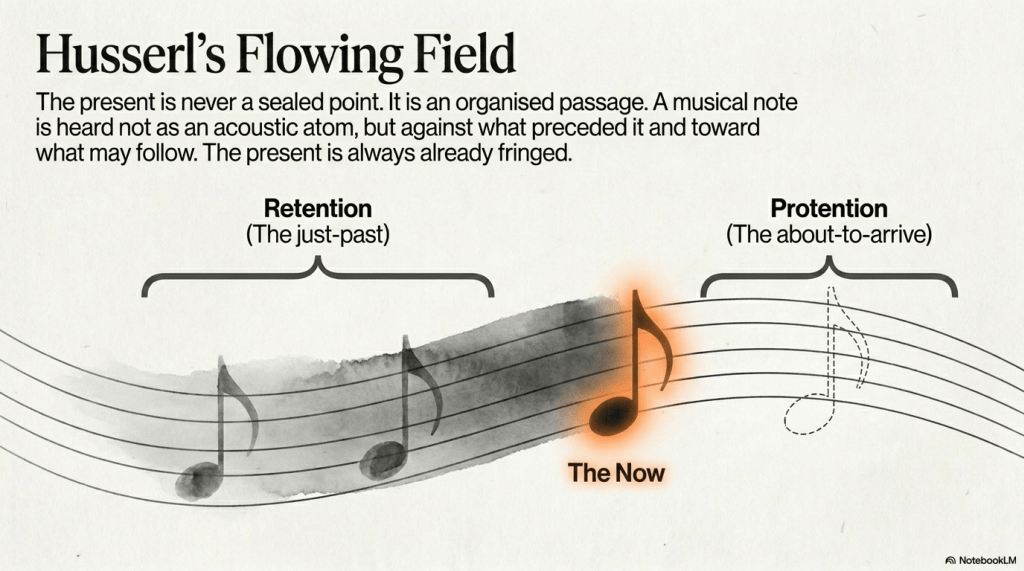
Husserl saw part of this with his account of retention and protention. The present isn’t a sealed point but a flowing field in which the just-past and the about-to-arrive are already implicated. A musical note isn’t heard as an isolated acoustic atom. It’s heard as part of a phrase, against what has preceded it and toward what may follow. The same is true of speech, perception, decision, and action. The present is always already fringed. It’s bordered by memory and expectation. It’s not pure presence but organised passage.
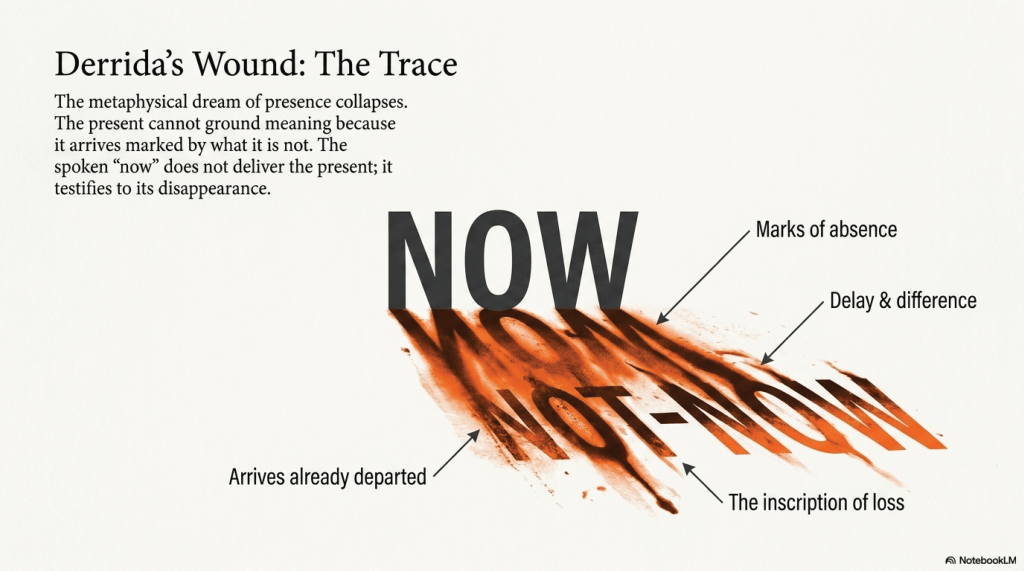
Derrida presses the wound further. If the now is always contaminated by what is not-now, then the metaphysical dream of presence collapses. The present cannot ground meaning because the present is never simply present. It arrives marked by absence, delay, difference, and trace. The spoken now does not deliver the present. It testifies to its disappearance. It isn’t the arrival of immediacy but the inscription of loss.
This isn’t merely a technical problem in phenomenology. It has consequences for how we think about agency, meaning, and reality. We routinely speak as though action occurs in a present moment of self-possession: I now choose, I now intend, I now decide. But this grammar flatters us. Decision is never contained in a punctual present. It condenses prior dispositions, pressures, perceptions, habits, bodily states, histories, and anticipated consequences. The now of decision is a narrative compression imposed after and within a process that exceeds it.
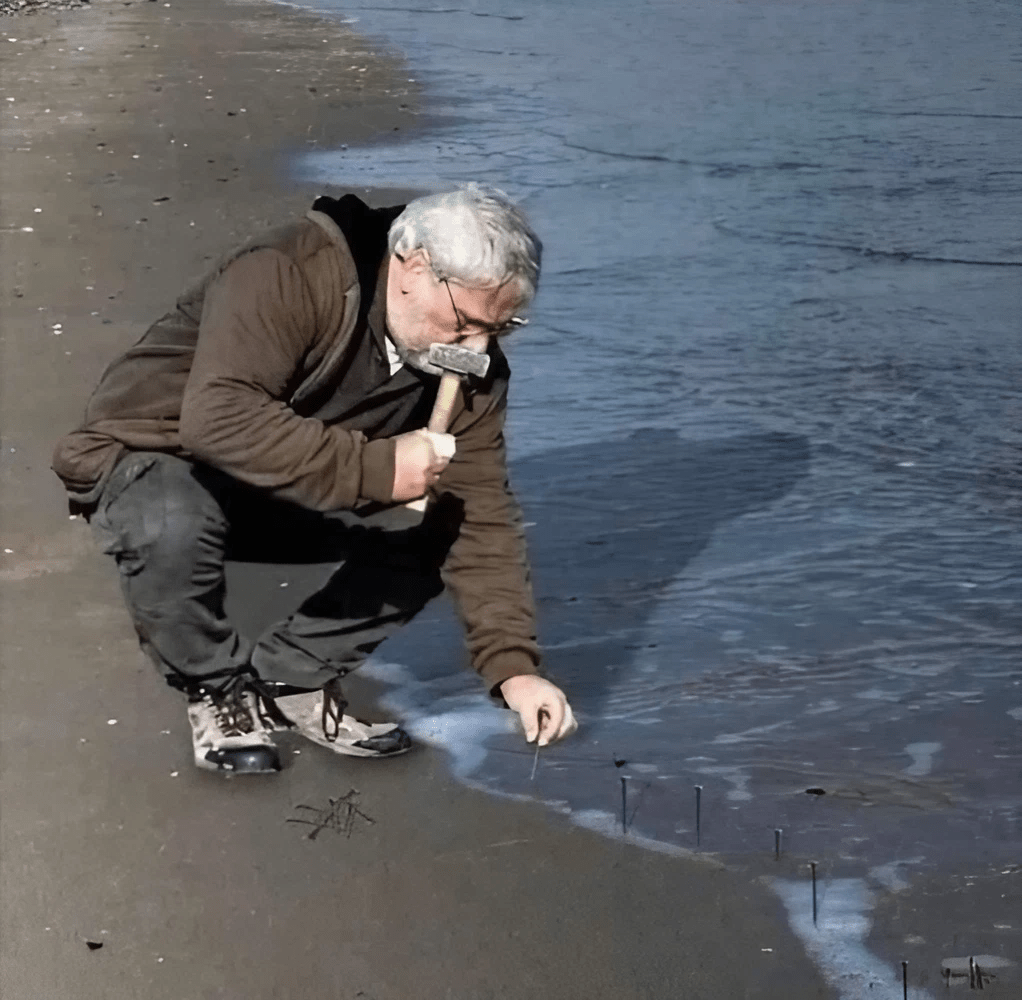
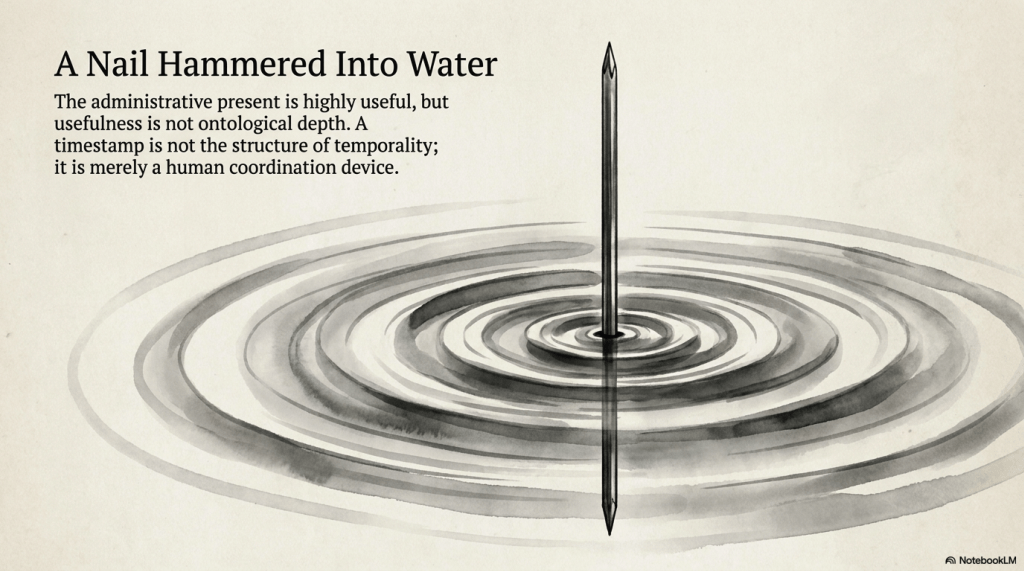
The same applies to moral and institutional language. Law loves timestamps. Bureaucracy loves decision-points. Politics loves moments. Each requires a tractable ‘now‘ because institutions must act, record, assign, and close. The administrative present is useful because it can be filed. But usefulness shouldn’t be mistaken for ontological depth. A timestamp isn’t the structure of temporality. It’s a human coordination device, a nail hammered into water.
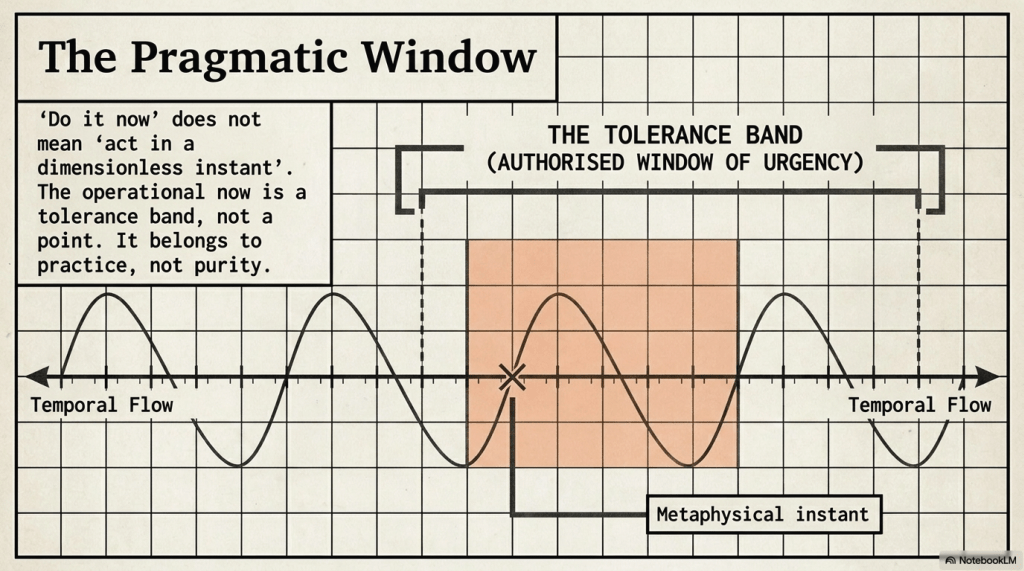
The now survives because it’s pragmatically indispensable. We need it to coordinate action. ‘Do it now’ doesn’t mean ‘act in a dimensionless metaphysical instant’. It means ‘act within the authorised window of urgency established by this utterance’. The operational now is a tolerance band, not a point. It belongs to practice, not purity.
This is why the present should be deflated rather than worshipped. The now isn’t an entity. It’s not a metaphysical foundation. It’s a boundary-function within temporal flow, a stabilising fiction by which agents orient themselves amid movement. It marks a horizon that vanishes as it is named.
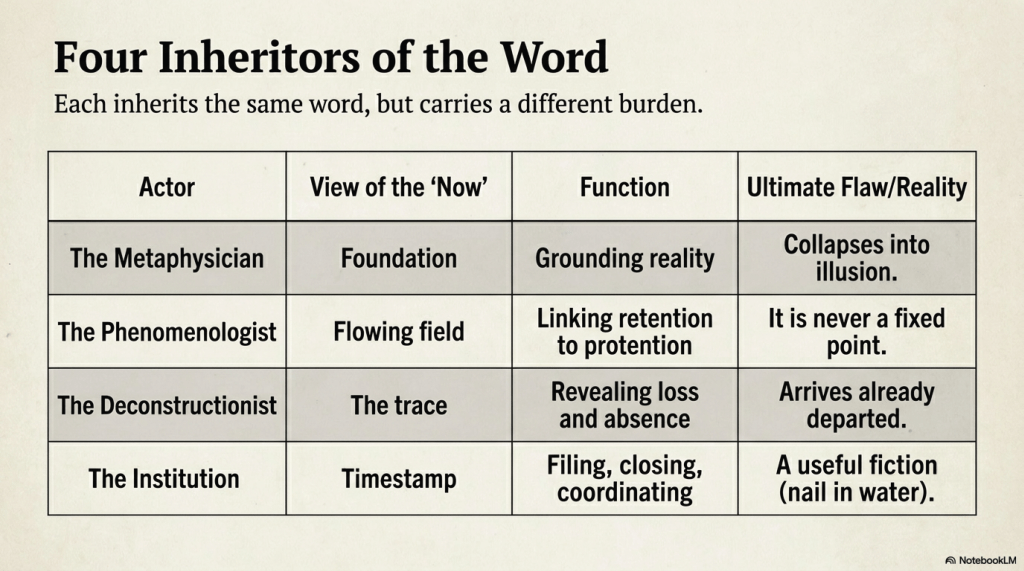
The metaphysician wants the now to be a foundation; the phenomenologist discovers it as flow; the deconstructionist hears in it the trace of what has already departed. The institution converts it into a timestamp and pretends the problem has been solved. Each inherits the same word, but not the same burden.
To invoke ‘now’ is therefore not to seize presence. It’s to gesture at the impossible purity of presence from inside its failure. The word works, but it works heuristically. It coordinates, compresses, and stabilises just enough. What it doesn’t do is deliver the present as such. The now is always late to itself.
On God, Objectivity, and the Grammar That Outlives Both
NB: After I posted this, I put some more thought into the notion. Rather than extending this post, I decided to post the follow-up on Substack. Where Nagel asks, What’s it like to be a bat? I ask What’s It Like to Be a Human?
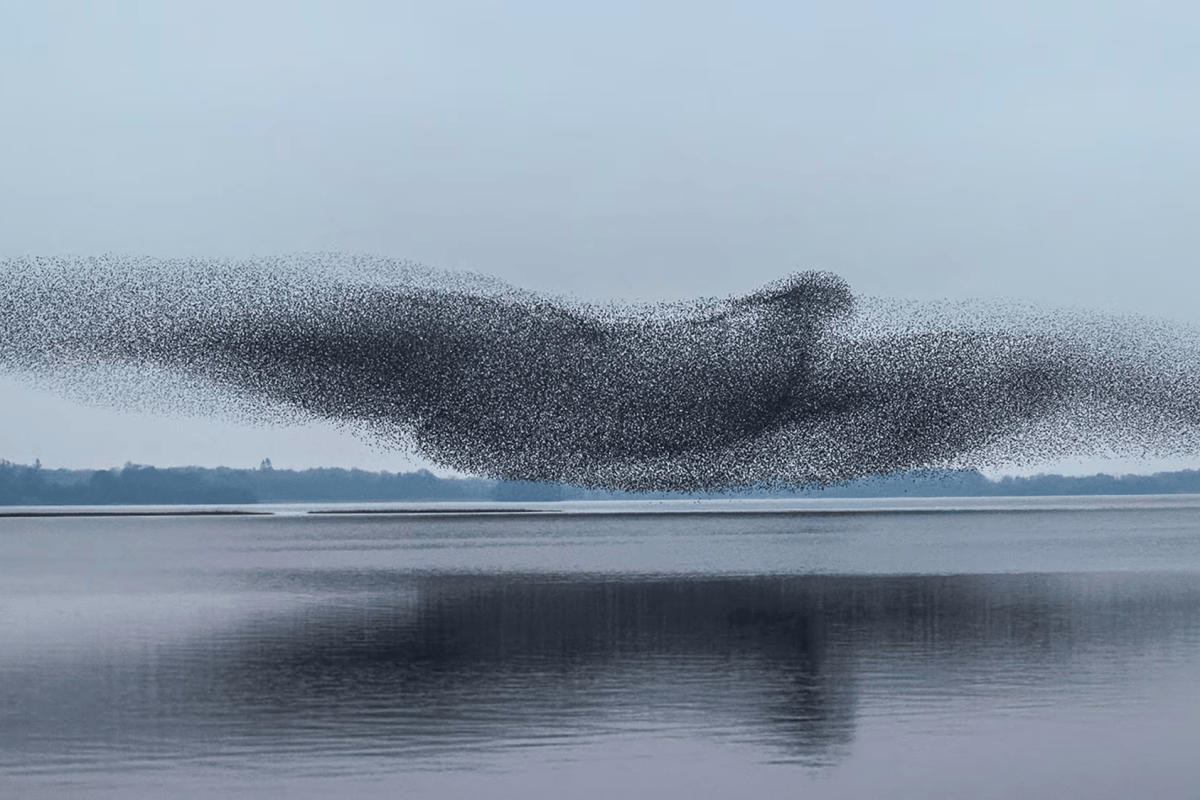
I know a nice philosophical parlour trick. It’s performed by asking someone whether they believe in objective truth. If they say yes, ask them where it comes from; if they say no, ask them whether that denial is objectively true. The trick is not a refutation of anything. It is a demonstration: the concept of the Objective has been installed so deeply in the grammar of the question that you can’t coherently step outside of it long enough to evaluate it. In this respect, you’re a starling who can’t see the murmuration from within it.
Audio: NotebookLM summary podcast of this topic.
Let’s start with Nagel. In 1974, Thomas Nagel published a paper that broke a perfectly serviceable assumption in half. The assumption was that consciousness, while subjective in character, was at least comparably subjective across humans – that the gap between my inner life and yours was a matter of degree, navigable by imaginative projection and shared biology, whereas the gap between me and a bat was of a different order entirely. Nagel’s intervention was to question the first assumption by taking the second seriously. If the bat’s echolocation is genuinely inaccessible – not merely unfamiliar but structurally unreachable, given that I have no experiential raw material from which to construct what sonar feels like – then the inference from ‘I can’t imagine this being’s experience‘ to ‘this being probably has no experience worth worrying about‘ is invalid. Not difficult. Invalid. The bat has a perspective; I can’t access it. These two facts are entirely compatible, not mutually exclusive.
The extension Nagel resisted, but which his own argument demands, is this: the same epistemic closure obtains everywhere. Not merely between humans and bats, or humans and artificial systems, but between any two subjects whatever. What we call human-to-human understanding is not epistemic access to another’s inner life. It’s coordination: shared linguistic conventions, overlapping heuristics, statistical regularities of behaviour stable enough to be gamed and relied upon. We don’t experience each other’s experience. We model each other, well enough for most practical purposes, but then mistake the model for the contact. It’s all too common.
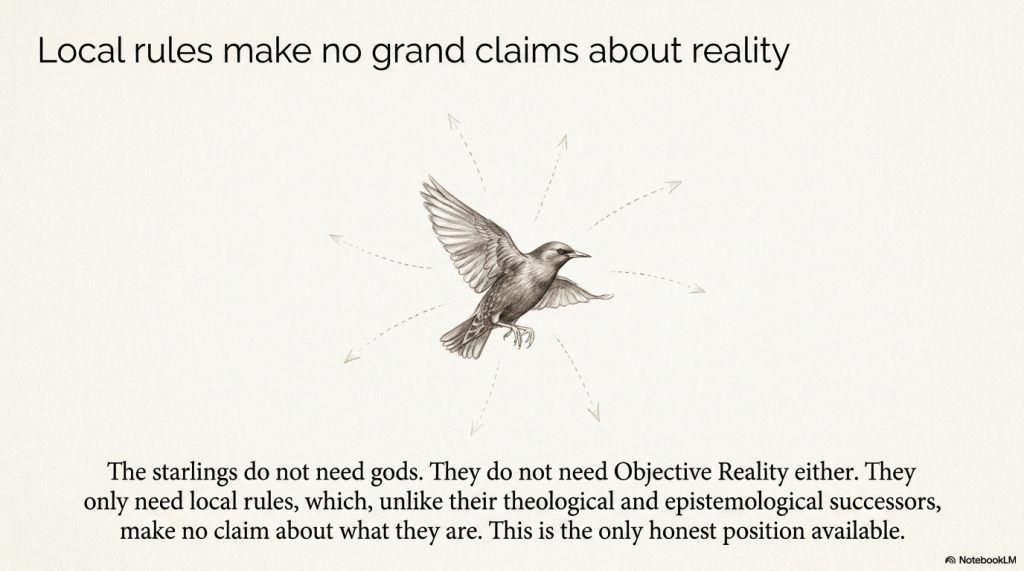
The murmuration of starlings is useful here. A rule of seven: Each bird responds to its seven nearest neighbours. Local rules, local information, irreducibly individual embodiment. The apparent organism wheeling across the sky – that single fluid entity that seems to breathe and turn as one – is a scale-dependent phenomenon that observers impose from a sufficient distance. Pareidolia at work. There is no murmuration-subject, and there is no fact of the matter about what it is like to be the flock, because the flock is not the level at which anything is happening. Whilst the coherence is real, the subject isn’t.
A statistical person is the murmuration.
A statistical person is the murmuration. Every apparatus of governance, moral philosophy, and institutional coordination operates by constructing a subject at the flock scale – the rational agent, the bearer of rights, the member of the moral community, the person before the court. These constructions aren’t errors at all. They’re necessary compressions. Courts can’t adjudicate the irreducible particularity of each defendant; they need the type. But the utility of the compression at the institutional scale isn’t evidence that the compression names anything real at the experiential scale. As the average human isn’t actually a human, the murmuration is not a starling.
What does this mean for the consciousness debate – about bats, digital systems, or the person sitting across from you? The question ‘is there something it is like to be X?‘ isn’t merely unanswered, but it’s malformed as posed. It presupposes a subject-object grammar within which the question makes sense: a discrete, bounded subject, either possessing or lacking inner experience, in principle distinguishable from other such subjects. That grammar produces the apparent problem. Dissolve the grammar, and the problem doesn’t get solved; rather, it gets diagnosed. Which brings us to God…
if God did not exist, it would be necessary to invent Him
Here, Voltaire’s quip – if God did not exist, it would be necessary to invent Him – is almost right. But its failure is in the verb. Invention implies architects: identifiable agents who construct a useful fiction and install it in a credulous population. This is the wrong model for how the objective world works. No one decided to construct it. Rather, it accreted. Each starling wasn’t conspiring to produce the murmuration; the murmuration is what the local rules produce at scale – No intention necessary. The exogenous imposition has no imposer behind it, which is precisely why it presents with such unimpeachable authority. Expose an inventor, and you discredit the invention. But when there isn’t an inventor – when the cage precipitated rather than being built – there isn’t a conspiracy to unmask; there’s no priest to dismiss – only the structure itself, which continues to function regardless of whether anyone believes in it.
Nietzsche understood this better. The death of God, for Nietzsche, wasn’t the liberation it appeared to be. It was the removal of the only anchor the entire normative structure had, without anyone noticing what was actually anchoring what. The Enlightenment didn’t interrogate the theological grammar. It secularised it. Reason, Nature, Science, Progress, History – each of these performed the same function God had performed: the external, authoritative, mind-independent referent against which claims could be measured and from which institutional authority could flow downward to the subject. The architecture was identical; only the tenant changed.
Objective is the edifice. When God was evicted, Reason, Science, Objective Truth became the new tenants
And that’s the point. The Objective isn’t a discovery. It’s a slot, a structural position in the grammar of subject-object discourse that requires an occupant if coördination at scale is to function. God was an early and effective tenant. When God was evicted, the slot didn’t disappear. It couldn’t because it’s not a belief but a grammatical necessity. It was immediately re-occupied, with the additional ideological advantage that the new tenants – Reason, Science, Objective Truth – present themselves as discovered rather than inherited. You can lose faith in God. You can’t, without apparent irrationality, lose faith in Objective Reality, because Objective Reality is now the precondition of the concept of rationality itself. The successor is more entrenched than the original. The slot has been occupied so continuously that it now looks like part of the foundation.
But it’s not. The building is the subject-object grammar, which generates the Objective slot as a structural correlate of the Subject. What fills the slot – God, Reason, the Market, the Algorithm – is the history of ideas, the history routinely mistaken for intellectual progress: the mature species finally locating the real external anchor, after centuries of superstitious misdirection. What’s actually happening is tenant succession. Each eviction is experienced as crisis, where each new occupant presents as the permanent solution. The edifice is never inspected because it’s always occupied, and this occupied building looks like a home.
The diagnostic move, then, isn’t to find a better tenant. Every reform programme, every Enlightenment, every revolution has done exactly that, and the slot fills again within a generation. The diagnostic move is to show that there is an edifice, that the grammar has a structure, that the structure generates the slot, and that the slot’s current occupant inherited its authority from the grammar rather than earning it from the world.
This is a different kind of intervention. Rather than a replacement, it produces a recognition that the coordinating function of the Objective is genuine and the ontological claim isn’t, that the murmuration coheres and the murmuration-subject doesn’t actually exist, that we are starlings – or turtles – all the way down, responding to our seven nearest neighbours, producing from the outside the appearance of a unified orientation toward a common truth.
the statistical person is regular enough to be governed, predicted, and addressed
A relativistic social model operates well enough on this account: It doesn’t require an objective world; it simply requires stable enough local rules that the flock coheres, that the statistical person is regular enough to be governed, predicted, and addressed. The objective world is the name we give to that coherence when observed from a sufficient distance. It’s robust enough for almost every practical purpose. What it isn’t is foundational. Remove the coordinating conventions, and it simply stops being produced.
The starlings don’t need gods. They don’t need Objective Reality either. They only need the local rules, which, unlike their theological and epistemological successors, make no claim about what they are. Which is, in the end, the only honest position available.
What if the biggest trick language played on you is convincing you that the world is made of things?
Every sentence you speak installs a hidden assumption. ‘The rock falls.’ ‘The mind thinks.’ ‘The electron orbits.’ Each one presupposes a thing – a noun – that exists before anything happens to it. Your grammar tells you: first, there are objects, then they do stuff. But what if that’s backwards?
The Mediated Encounter Ontology – MEOW – proposes that it is. Reality isn’t made of things. It’s made of structured interactions. Encounter-events – relational, patterned, constrained – are what’s ontologically basic. Objects, subjects, minds, worlds: these are all downstream. They’re what you get when structured interaction stabilises within a given scale of encounter.
A thought experiment by Derek Parfit, here’s the setup: ostensibly, a human is cloned, but they aren’t so much cloned as teleported to Mars, à la Star Trek – there, not here, particle by particle.
The question and seeming paradox is whether the reconstructed person and the original are the same, identical.
In deference to my upcoming book, The Architecture of Encounter, I want to revisit this problem and show how there is no paradox. Let’s take a look.
Audio: NotebookLM summary podcast of this topic.
Parfit’s Teletransporter Is Not a Paradox. It Is a Hangover.
Derek Parfit’s teletransporter thought experiment has become one of philosophy’s favourite parlour tricks. A person steps into a machine on Earth. The machine records their physical structure in total detail, destroys the original body, and reconstructs an exact counterpart on Mars from local matter. The person on Mars wakes with the same memories, the same character, the same projects, and the same unearned confidence that philosophers are asking sensible questions. Parfit uses such cases to press the thought that personal identity may not be what matters; psychological continuity may matter more.
The supposed paradox is familiar enough: is the person on Mars the same person, or has the original died and been replaced by a copy?
My answer is that there is no paradox here, unless one insists on dragging in precisely the assumptions that ought to be under suspicion.
This is where my forthcoming book, The Architecture of Encounter, becomes relevant. The teletransporter puzzle only looks deep if one begins with a poor ontology and a clumsy model of selfhood. Once those are withdrawn, the mystery evaporates.
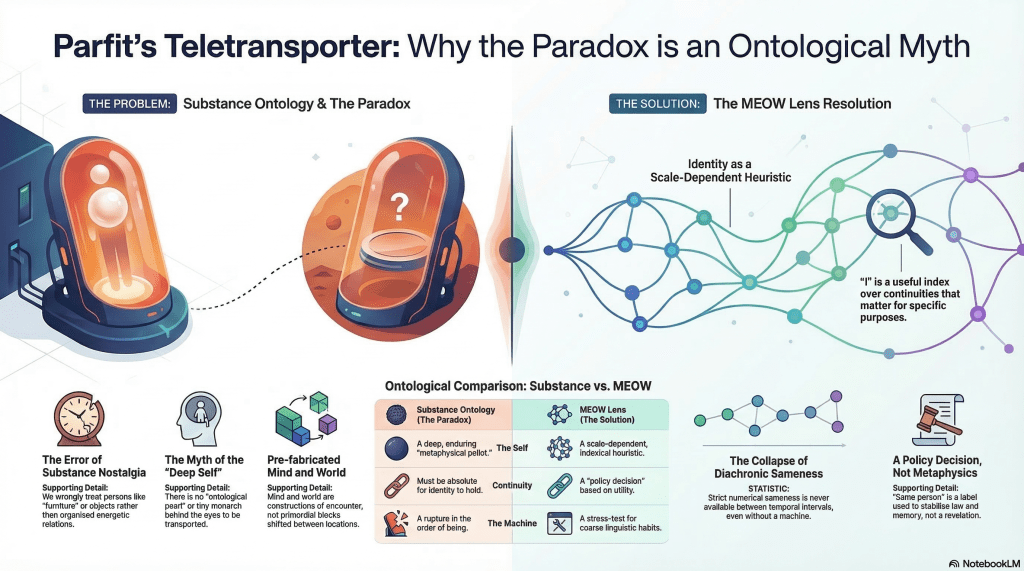
The first mistake: substance nostalgia
The teletransporter story is framed as though a human being were fundamentally a thing made of parts, a self-identical object that might either persist through rearrangement or fail to do so. We are invited to imagine a body atomised here and recomposed there, then asked whether the ‘same person’ has survived. But this framing already cheats.
If substance ontology is not basic, then there is no hidden metaphysical pellet of selfhood waiting to be shepherded from Earth to Mars. On a relational picture, what is fundamental is not a stockpile of little self-identical things but organised relation, structured energetic differentiation, constraint, response, and persistence-pattern. The old metaphysics of enduring stuff survives mostly because grammar flatters it.
So the first reason the teletransporter is not paradoxical is that it begins by treating persons as though they were furniture.
The second mistake: reifying the self
The second assumption is just as dubious. The problem presumes that there must be a deep self, some enduring owner of experience, whose fate the machine must settle. I don’t grant that either.
I am much closer here to Galen Strawson’s episodic flavour than to the pious diachronic picture in which one’s life forms a single, extended inner possession. Strawson’s distinction is useful because it reminds us that not everyone experiences themselves as a long, narratively unified entity stretching robustly across time. An episodic self need not deny practical continuity, memory, or biography; it simply refuses to inflate them into a metaphysical core.
That is also how I think identity should be understood more generally: as a scale-dependent heuristic.
The self is not nothing. But neither is it an ontological pearl. It is a compression. A convenience. A useful index over continuities that matter for some purposes and not others. At one grain, sameness appears stable enough. At another, it dissolves into drift, revision, replacement, and selective narrative smoothing.
The “I” is not a tiny monarch enthroned behind the eyes. It is an indexical function within organised experience.
The third mistake: treating mind and world as pre-fabricated blocks
The teletransporter story also inherits a bad picture of mind and world. It imagines a ready-made mind confronting a ready-made external world, then asks whether one of those ready-made minds has been shifted from one location in the world to another. I reject that framing, too.
Mind and world, on my view, are post hoc constructions of mediated interface. Encounter comes first. Organisation comes first. Constraint comes first. Only later do we abstract “mind” on one side and “world” on the other as though these were primordial blocks of reality instead of conceptual products of a deeper relation.
Once one starts there, the question changes. We are no longer asking whether some occult owner-substance has been preserved. We are asking what kind of continuity, if any, is being tracked across interruption, re-instantiation, and resumed encounter. That is a very different matter.
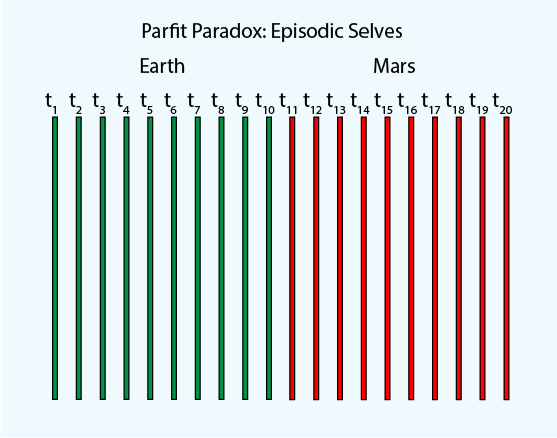
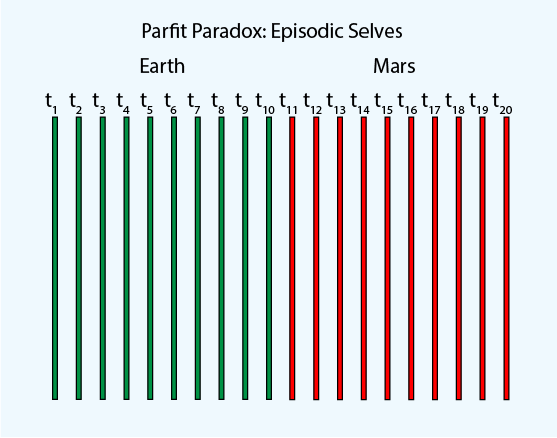
Under episodic time, the paradox collapses immediately
Image: Notice that if we reject the diachronic self in favour of an episodic self, when the ‘self’ migrates from Earth to Mars, it just carries on indexing, so the paradox vaporates.
If one takes the episodic view seriously, Parfit’s machine is mostly theatre.
Why? Because strict numerical sameness was never available between temporal intervals in the first place. The self at one interval and the self at the next are not joined by a metaphysical thread hidden beneath change. They are linked, where linked, by organised continuity, practical function, memory inheritance, bodily persistence, and narrative convenience.
The teletransporter does not introduce some unprecedented rupture into an otherwise pristine metaphysical order. It merely exaggerates what was true all along: selfhood is not an invariant core but a heuristic over organised succession.
That means the Mars person is not paradoxical. They are simply a case in which our ordinary identity-compression is being stress-tested.
Call them the same person if your explanatory threshold is coarse enough. Refuse the label if your threshold is stricter. There is no further hidden fact trembling in the wings.
Even under diachronic time, the issue is still heuristic
Suppose, however, that one relaxes the episodic commitment and grants a diachronic self. Even then, the machine does not resurrect a deep identity problem. It only relocates the issue to threshold-setting.
How much continuity is enough?
Enough for legal identity? Enough for moral responsibility? Enough for marriage? Enough for debt? Enough for grief? Enough for survival?
These are not one question. They never were one question. Philosophy often gets itself into trouble by pretending that practical, phenomenological, ethical, and metaphysical criteria must all cash out in the same currency. They do not.
Parfit himself is famous precisely for pressing the thought that what matters may be psychological continuity and connectedness rather than some further fact of identity. My complaint is that one can go further still. Once identity is treated as a heuristic rather than a metaphysical absolute, the need for a single all-purpose answer begins to look like a bad demand rather than an unsolved mystery.
Why the duplicate case makes the illusion obvious
The variant with duplication makes the point even more brutally. If one person enters on Earth and two successors emerge elsewhere, both inheriting the same memories and both insisting “I am the original,” then the problem is no longer whether identity has become spooky. The problem is that our ordinary identity-talk has finally been pushed beyond its comfort zone.
Once there are two successors, the inherited continuity-profile has branched. That does not produce metaphysical magic. It produces two loci of encounter with the same initial macro-organisation.
At time-nought, perhaps we may stipulate identical configuration for the sake of the thought experiment. Fine. Humans adore their stipulations. At the first non-zero interval thereafter, they are already different. Different position, different sensory input, different salience, different bodily relation, different thermal and spatial microconditions, different affordances. Their trajectories begin to separate immediately. So even there, no paradox. Only the collapse of a coarse heuristic under finer scrutiny.
The real lesson
Parfit’s teletransporter is often presented as though it reveals some terrible instability in personal identity. I think it reveals something duller and more devastating. It reveals that our language of identity was never as deep as we pretended.
We say “same person” because it is useful. We use it to stabilise law, memory, blame, love, property, and biography. Fair enough. But utility should not be mistaken for metaphysical revelation. The thought experiment merely embarrasses that confusion.
So when asked whether the reconstructed person on Mars is really the same person, my answer is:
Under an episodic model, strict sameness was never on offer across temporal intervals anyway. Under a diachronic model, sameness is still a heuristic judgement about acceptable continuity. In neither case is there a paradox. There is only an old habit of substance-thinking refusing to die.
The shorter version
The teletransporter does not expose a contradiction in selfhood. It exposes the poverty of the ontology brought to the problem.
If selves are indexical, scale-dependent heuristics arising from organised encounter, then the machine does not pose a metaphysical puzzle about whether some hidden essence made it to Mars. It only asks how much continuity we are willing to treat as enough.
That is not a paradox. That is a policy decision disguised as metaphysics.
Few philosophical aphorisms travel as lightly and cut as confidently as Ockham’s Razor. “Do not multiply entities beyond necessity.” The phrase has the air of austere wisdom. It sounds disciplined, economical, rational. It promises clarity by subtraction. One imagines conceptual clutter swept aside by a single elegant stroke.
The Razor is attributed to William of Ockham, though like many slogans it has acquired a life far removed from its origin. In contemporary discourse it functions less as a methodological reminder and more as an epistemic trump card. The simpler explanation, we are told, is the better one. Case closed.
The trouble begins precisely there.
Audio: NotebookLM summary podcast
The Hidden Variable: Necessity
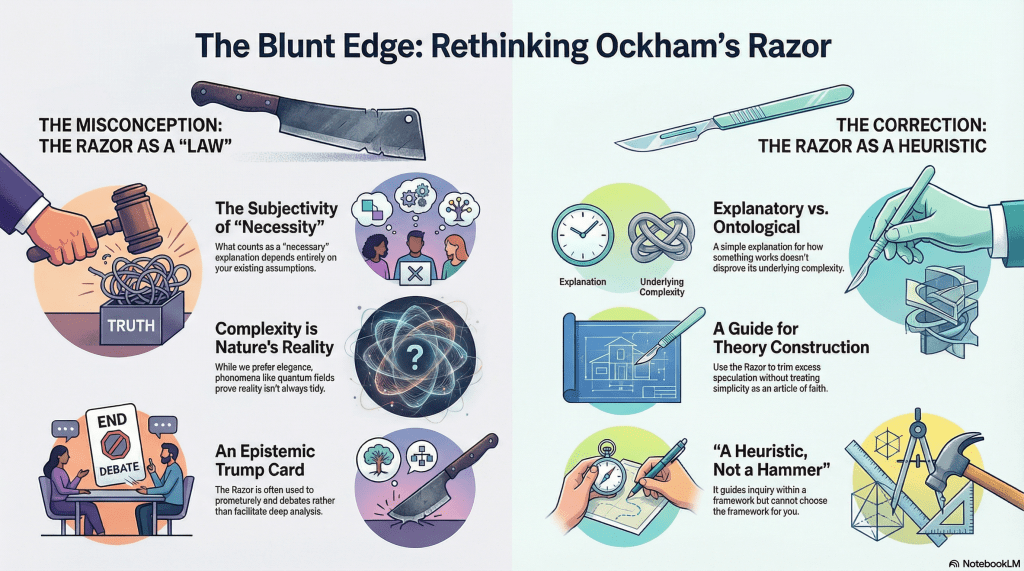
The Razor does not forbid multiplicity. It forbids unnecessary multiplicity. But who decides what is necessary?
Necessity is not a neutral category. It is already embedded within a framework of assumptions about what counts as explanation, what counts as sufficiency, and what counts as legitimate ontological commitment.
For one thinker, invoking a divine ground of physical law is unnecessary because the laws themselves suffice. For another, the laws are unintelligible without a grounding principle, and so God is necessary. Both can claim parsimony within their respective ontologies. The Razor does not adjudicate between them. It presupposes the grammar within which “necessity” is assessed.
The aphorism thus functions less as a rule and more as a reinforcement mechanism. It stabilises the commitments one already holds.
Parsimony Is a Heuristic, Not a Law
Science has often rewarded simplicity. Copernicus simplified celestial mechanics. Newton reduced motion to a few principles. Maxwell unified electricity and magnetism. These episodes encourage a romantic attachment to elegance.
Yet physics has also revealed a universe that is anything but tidy. Quantum fields, curved spacetime, dark matter, inflationary cosmology. Nature has shown little regard for our aesthetic preference for minimal furniture.
Parsimony, then, is pragmatic. It helps us avoid gratuitous complication. It disciplines theory formation. But it is not a metaphysical guarantee that reality itself is sparse.
To treat the Razor as if it carries ontological authority is to convert a methodological guideline into a philosophical dogma.
Structural Sufficiency Versus Metaphysical Surplus
The Razor becomes particularly contentious when deployed in debates about ultimate grounds. If a structural model explains observable regularities and survives empirical constraint, some conclude that any additional metaphysical layer is redundant.
This is a defensible position. It is also incomplete.
Redundancy in explanatory terms does not entail impossibility in ontological terms. A structural account of behaviour may render psychological speculation unnecessary for prediction, but it does not disprove the existence of inner motives. Likewise, a lawful cosmology may render a divine hypothesis explanatorily idle without rendering it incoherent.
The Razor trims explanatory excess. It does not settle metaphysical disputes.
Aphorisms as Closure Devices
Part of the Razor’s power lies in its compression. It is aphoristic. It travels easily. It signals intellectual seriousness. It sounds like disciplined thinking distilled.
But aphorisms compress complexity. They conceal premises. They discourage reopening the frame. “Follow the science.” “Extraordinary claims require extraordinary evidence.” “Trust the market.” These phrases do not argue; they configure. They pre-load the space of acceptable interpretation.
Ockham’s Razor often operates in precisely this way. It is invoked not as the conclusion of a careful analysis but as a device to end discussion. The simpler view wins. Full stop.
Yet simplicity itself is indexed to perspective. What looks simple within one conceptual scheme may appear impoverished within another.
Tolerance for Explanatory Closure
There is also a psychological dimension worth acknowledging. Some individuals are comfortable with open explanatory ceilings. They accept that certain features of reality may lack ultimate grounding within their present framework. Others experience such openness as instability. They seek a final anchor.
The Razor favours the former temperament. It encourages ontological restraint and distrust of ultimate grounds. For those comfortable with structural sufficiency, this is liberating. For those who experience the absence of grounding as incomplete, it feels evasive.
The disagreement is not resolved by invoking parsimony. It reflects divergent tolerances for metaphysical closure.
When the Razor Becomes Inflationary
Ironically, the Razor can itself become an inflationary principle. It can elevate “simplicity” to a quasi-transcendental value. It can be treated as if reality owes us elegance.
At that point, the tool begins to govern the ontology rather than merely discipline it. The Razor becomes an article of faith, a universal heuristic immune to its own demand for justification.
One might then ask, with a certain symmetry: by what necessity is simplicity itself necessary?
A More Modest Use
None of this requires abandoning the Razor. It remains useful. It reminds us not to posit hidden mechanisms when observable structures suffice. It cautions against explanatory extravagance. It protects inquiry from baroque speculation.
But it should be treated as a heuristic, not a hammer. It guides theory construction within a framework. It does not choose the framework.
A more disciplined formulation would be this: when a structural account explains observed regularities under constraint and remains revisable, additional metaphysical posits do not increase explanatory power. Their adoption becomes a matter of ontological preference rather than necessity.
This preserves the Razor’s pragmatic value without inflating it into a metaphysical arbiter.
The Real Trouble
The real trouble with Ockham’s Razor is not that it cuts too much. It is that we often wield it without noticing the hand that holds it. We treat it as neutral when it is already embedded within a grammar of sufficiency, explanation, and legitimacy.
The Razor does not eliminate ontological commitment. It expresses one.
Recognising that does not blunt the blade. It merely reminds us that even the sharpest instruments are guided by the frameworks in which they are forged.
And frameworks, unlike aphorisms, are rarely simple.
There is a persistent story we tell ourselves about quantum mechanics:* that it reveals reality to be fundamentally strange, paradoxical, or hostile to common sense. Particles in two places at once. Cats be both alive and dead. Worlds multiplying to save appearances.
I’ve never found that story convincing.
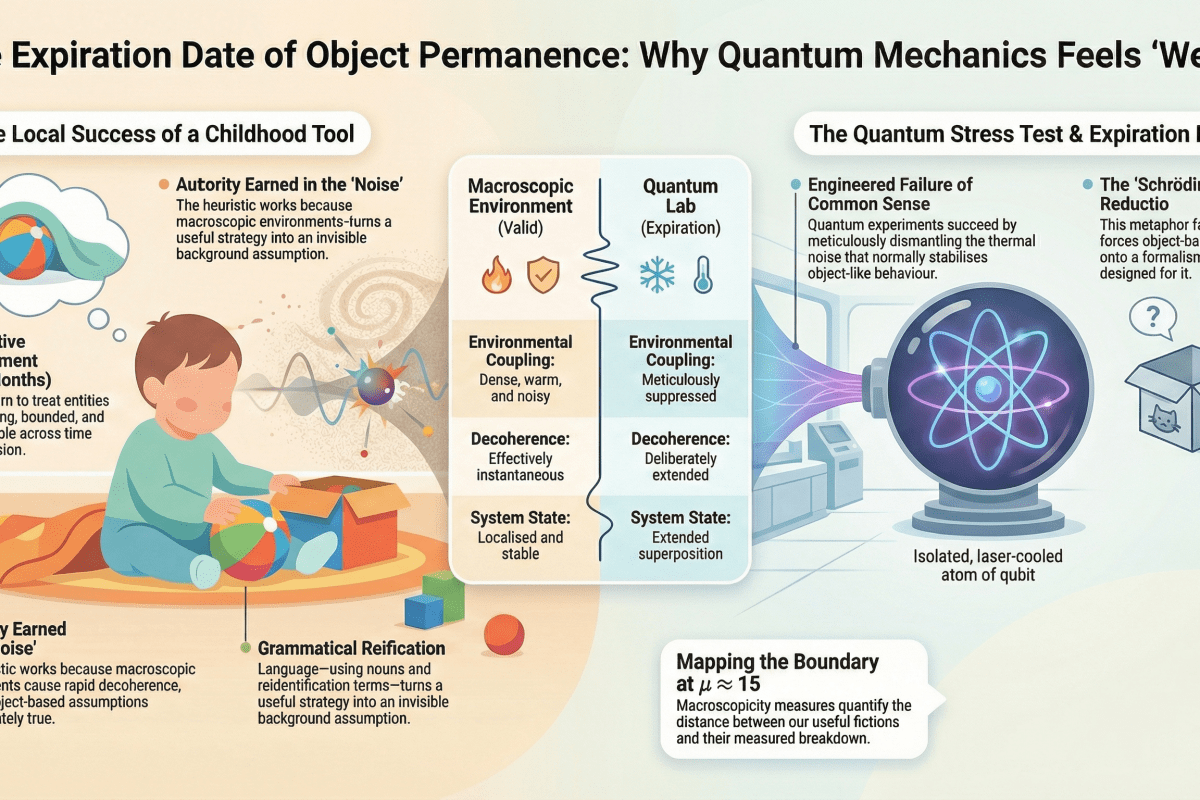
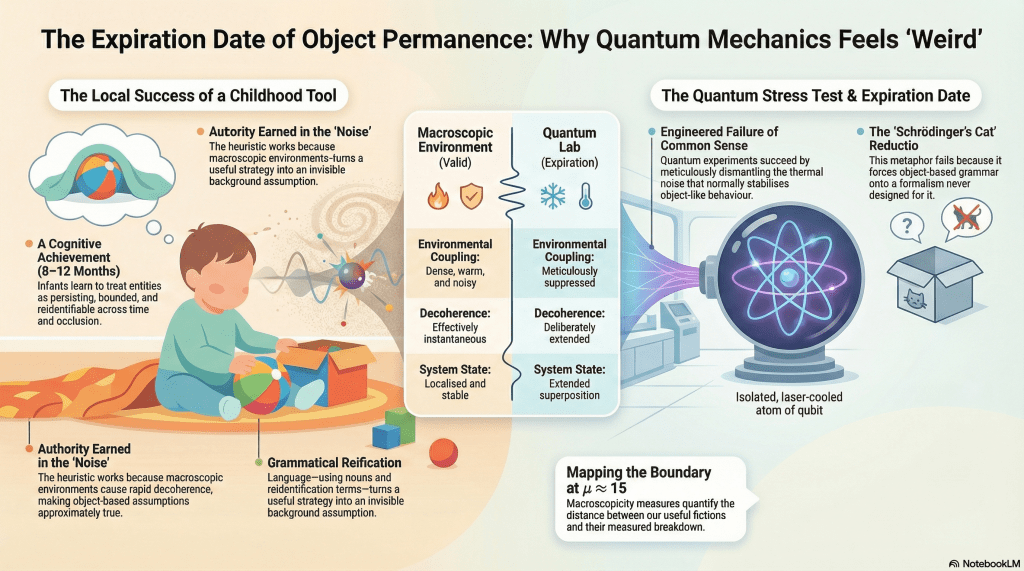
Audio: NotebookLM summary podcast of this topic.Image: NotebookLM infographic for this topic.
What I do find convincing is a simpler diagnosis: that we are applying a cognitive tool far beyond the conditions under which it earned its authority – and then mistaking the resulting discomfort for metaphysical insight.
Object permanence is one of our earliest and most successful heuristics. It allows infants to track toys behind sofas, caregivers behind doors, and threats behind occlusion. Without it, coordinated action would be impossible. With it, the world becomes navigable, predictable, and stable. It is a genuine cognitive achievement. But it is not a universal guarantee about reality.
In a new essay, The Expiration Date of Object Permanence: Heuristics, Grammar, and Quantum Pseudoproblems, I argue that much of what we call ‘quantum weirdness’ arises from the uncritical extension of this heuristic into domains where its ecological licensing no longer holds. The problem is not that quantum mechanics violates common sense. The problem is that we quietly treat common sense as metaphysics.
Quantum mechanics functions here not as a mystery generator, but as a stress test. Recent matter-wave interference experiments with increasingly massive systems show that object-based expectations fail quantifiably under carefully engineered conditions. When environmental coupling is suppressed, when decoherence is delayed, when the world is no longer warm, noisy, and forgiving, the assumptions underwriting object permanence simply stop paying rent.
Nothing spooky happens. A heuristic expires.
The essay also takes a dim view of some familiar cultural furniture. Schrödinger’s cat, for example, was introduced as a reductio – an intentionally absurd demonstration of what happens when microscopic formalism is naively scaled up. That it now circulates as an explanatory image tells us less about quantum mechanics than about the tenacity of object-grammar. Even jokes cannot escape it.
Interpretations fare no better. I suggest that the appeal of frameworks like Many-Worlds is not exhausted by their technical merits. They also function as strategies for preserving object-based reidentification – ways of ensuring that there is still something that can be pointed to, counted, and followed through time, even if the price is ontological inflation.
None of this denies the reality of quantum phenomena, nor does it pretend to solve the measurement problem. The essay is deliberately deflationary. Its claim is methodological, not revisionary: that many of the puzzles we inherit are artefacts of treating developmentally acquired heuristics as if they were unconditional features of the world.
Philosophy’s task, on this view, is not to make reality intuitive. It is to recognise when intuition has reached the end of its jurisdiction.
The paper is now available on Zenodo and will be indexed shortly on PhilPapers. As always, comments, objections, and principled misreadings are welcome.
This post and the underlying essay were inspired by a Nature article: Probing quantum mechanics with nanoparticle matter-wave interferometry, published on 21 January 2026. I get annoyed watching people misunderstand quantum mechanics and its effects, so I decided to address some of the issues in an essay. Read this essay as well as mine, which will explain why the paradoxes and ‘spooky behaviour’ of QM are only counter-intuitive if you’ve fallen into this heuristic trap.
I risk sharing this prematurely. Pushing the Transductive Subjectivity model toward more precision may lose some readers, but the original version still works as an introductory conversation.
Please note: There will be no NotebookLM summary of this page. I don’t even want to test how it might look out the other end.
Apologies in advance for donning my statistician cap, but for those familiar, I feel it will clarify the exposition. For the others, the simple model is good enough. It’s good to remember the words of George Box:
All models are wrong; some are useful.
The Simple Model
I’ve been thinking that my initial explanatory model works well enough for conversation. It lets people grasp the idea that a ‘self’ isn’t an enduring nugget but a finite sequence of indexed states:
The transitions are driven by relative forces, , which act as catalysts nudging the system from one episode to the next.
The Markov Model
That basic picture is serviceable, but it’s already very close to a dynamical system. More accurate, yes—though a bit more forbidding to the casual reader – and not everybody loves Markov chains:
Here:
is the episodic self at index i
is the configuration of relevant forces acting at that moment
is the update rule: given this self under these pressures, what comes next?
This already helps. It recognises that the self changes because of pressure from language, institutions, physiology, social context, and so on. But as I noted when chatting with Jason, something important is still missing:
isn’t the only thing in motion, and isn’t the same thing at every step.
And crucially, the update rule isn’t fixed either.
A person who has lived through trauma, education, and a cultural shift doesn’t just become a different state; they become different in how they update their states. Their very ‘logic of change’ evolves.
To capture that, I need one more refinement.
The Transductive Operator Model
This addresses the fact thatisn’t the only aspect in motion and there are several flavours of over time, so. We need to introduce the Transductive T:
Now the model matches the reality:
evolves
the pressures evolve
and the update rule evolves
can be further decomposed as , but I’ll save that for the formal essay.
The self is not simply ‘what comes next’, but a rule that keeps rewriting itself as it encounters the world.
That is why this is transductive rather than inductive or deductive: structure at one moment propagates new structure at the next.
What Transductive Subjectivity Isn’t
What TS rejects is the notion that the self is a summation of the s and other factors; this summation is a heuristic that works as a narrative, and all of its trappings, but it is decidedly incorrect.
Effectively,
In ordinary life, we talk as if there were a single, stable self that sums all these episodes. Transductive Subjectivity treats that as a convenient narrative, not an underlying fact. For example, someone raised in a rigid environment may initially update by avoiding conflict; after therapy and a cultural shift, they may update by seeking it out when something matters. This fiction is where we project agency and desert, and where we justify retribution.
“Man is least himself when he talks in his own person. Give him a mask, and he will tell you the truth.” — Oscar Wilde
Identity is an illusion—but a necessary one. It’s a shortcut. A heuristic, evolved not for truth but for coherence. We reduce ourselves and others to fixed traits to preserve continuity—psychological, social, narrative.
Audio: NotebookLM podcast on this topic. (Spotify)
But what if continuity is a lie?
In the latest post on RidleyPark.blog, we meet Sarah—a woman who survives by splintering. She has three names, three selves, three economies of interaction. Each persona—Sarah, Stacey, and Pink—fulfils a role. Each protects her in a system that punishes complexity.
And yet, this isn’t fiction. It’s reality intensified.
Identity Is Compression
Cognitive science suggests that we don’t possess a self—we perform one. Our so-called identity is assembled post-hoc from memory, context, and social cues. It’s recursive. It’s inferred.
We are not indivisible atoms of identity. We are bundled routines, personae adapted to setting and audience.
This is not pathology. It’s strategy.
From Performance to Survival
In Needle’s Edge, Sarah doesn’t use aliases to deceive. She uses them to survive contradictions:
Stacey is desirable, stable, and profitable—so long as she appears clean and composed.
Pink is a consumer, invisible, stripped of glamour but allowed access to the block.
Sarah is the residue, the name used by those who once knew her—or still believe they do.
Each persona comes with scripts, limitations, and permissions. Sarah isn’t being dishonest. She’s practicing domain-specific identity. This is no different from how professionals code-switch at work, or how people self-edit on social media.
It’s just more raw. More urgent. Less optional.
The Literary Echo
In character development, we often demand “depth,” by which we mean contradiction. We want to see a character laugh and break. Love and lie. But Sarah shows us that contradiction isn’t depth—it’s baseline reality. Any singular identity would be a narrative failure.
Characters like Sarah expose the poverty of reduction. They resist archetype. They remind us that fiction succeeds when it reflects the multiple, the shifting, the incompatible—which is to say, the real.
What Else Might We Say?
That authenticity is a myth: “Just be yourself” presumes you know which self to be.
That moral judgment often stems from a failure to see multiple selves in others.
That trauma survivors often fracture not because they’re broken, but because fracturing is adaptive.
That in a capitalist framework, the ability to fragment and role-play becomes a survival advantage.
That fiction is one of the few spaces where we can explore multiple selves without collapse.
The Missing Link
For a concrete, narrative reflection of these ideas, this post on RidleyPark.blog explores how one woman carries three selves to survive three worlds—and what it costs her.




 Philosophics