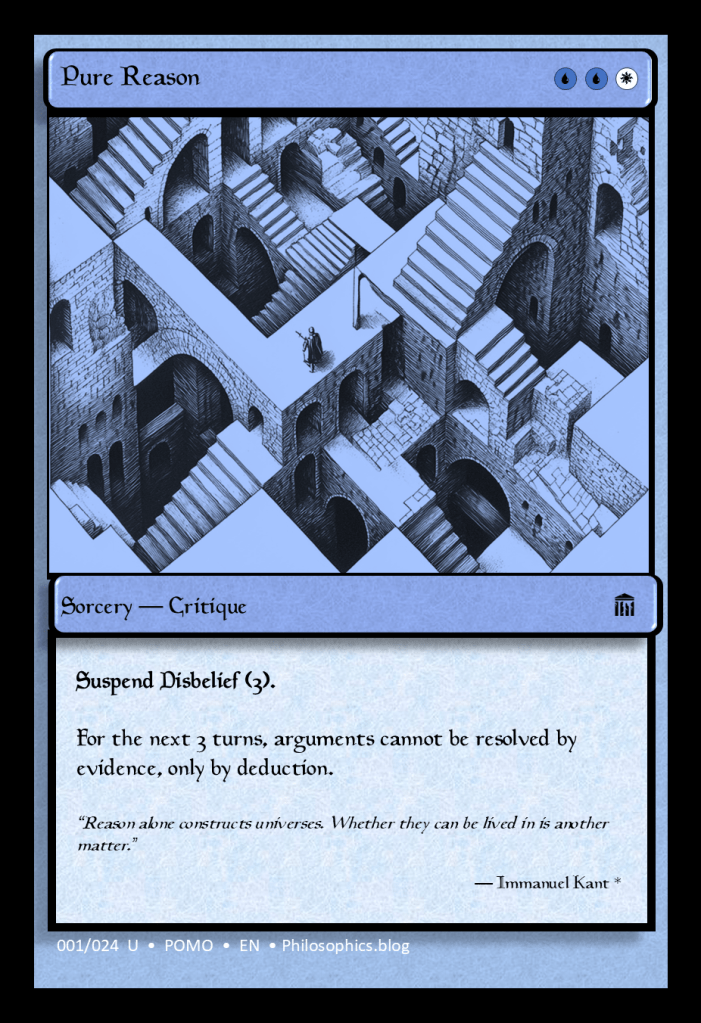
If reason had a landscape, it would look like this card: a maze of ascending and descending staircases, forever rational yet going nowhere. Kant might have called it a Critique of Pure Geometry.
Pure Reason, the first card in the Postmodern set, isn’t so much an homage to Kant as it is a cautionary reconstruction. It honours his ambition to build a universe from deduction while quietly mourning the price of that construction: alienation from experience.
Image: Card 001 from the Postmodern Set — Philosophics.blog
The Meta
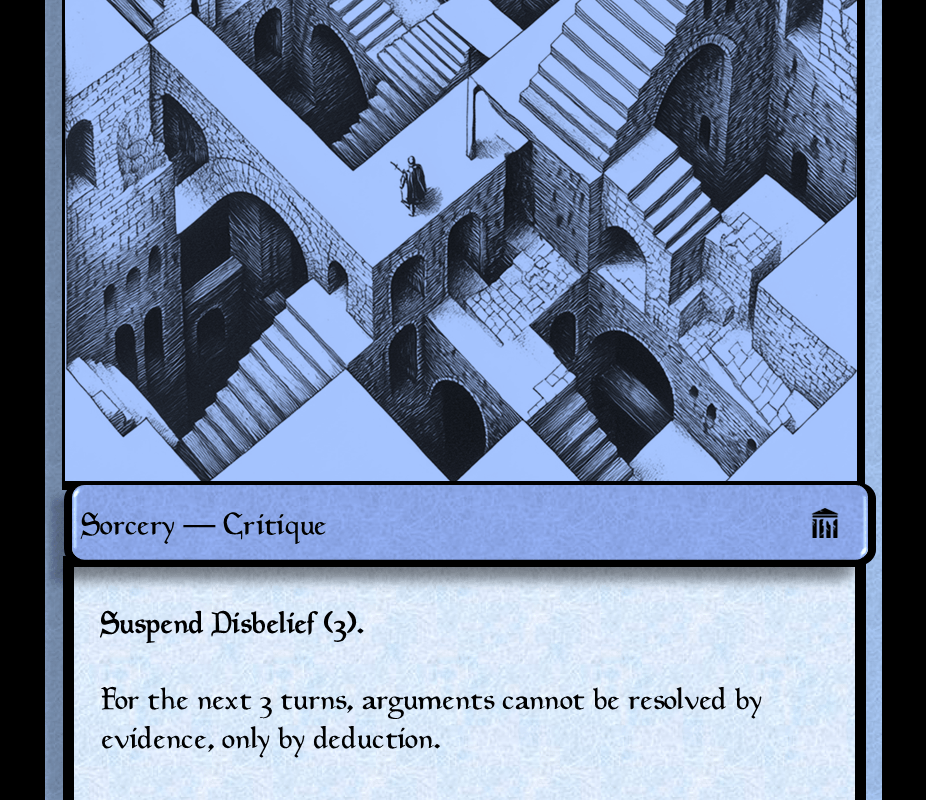
Suspend Disbelief (3). For the next three turns, arguments cannot be resolved by evidence, only by deduction.
Audio: NotebookLM podcast of this topic.
The rule text re-enacts Kant’s method. In the Critique of Pure Reason, he cordoned off the realm of empirical evidence and tried to chart what the mind could know a priori – before experience. The card’s mechanic enforces that isolation. For three turns, players must reason in a vacuum: no appeals to observation, no touchstones of reality, only deduction.
It’s a temporary world built entirely of logic, an echo of the transcendental playground Kant envisioned. The effect is powerful but sterile – thought constructing universes that can’t sustain life.
The flavour text says it plainly:
“Reason alone constructs universes. Whether they can be lived in is another matter.”
— Immanuel Kant
That line, of course, is apocryphal, but it captures the essence of his project: reason as world-maker and prison architect in one.
The Architecture of Thought
The artwork mirrors Escher’s impossible staircases – a labyrinth of pure geometry, ordered yet uninhabitable. Each path is internally consistent, logically sound, but spatially absurd. This is Kant’s transcendental edifice made visual: coherent on paper, dizzying in practice.
The lone figure standing in the maze is the transcendental subject – the philosopher trapped within the architecture of his own cognition. He surveys the world he has built from categories and forms, unable to escape the walls of his own reason.
It’s a neat metaphor for Enlightenment hubris: the belief that reason can serve as both foundation and roof, requiring no support from the messy ground of existence.
Kant’s Double Legacy
Kant’s Critique was both the high point and the breaking point of Enlightenment rationality. It erected the scaffolding for science, ethics, and aesthetics but revealed the fault lines beneath them. His insistence that the mind structures experience rather than merely reflecting it gave birth to both modern idealism and modern doubt.
Every philosopher after him – Hegel, Nietzsche, Husserl, Derrida – has been trying either to escape or to inhabit that labyrinth differently. Pure Reason captures this tension: the glory of construction and the tragedy of confinement.
My Take
Reason is a magnificent liar. It promises order, clarity, and autonomy, but its perfection is its undoing. It abstracts itself from life until it can no longer recognise its own maker. Kant’s world is flawless and airless – a rational utopia unfit for breathing creatures.
I view Pure Reason as the archetype of the Enlightenment illusion: the attempt to found a living world on the logic of dead forms. What he achieved was monumental, but the monument was a mausoleum.
The card, then, is not just a tribute to Kant but a warning to his descendants (ourselves included): every system of thought eventually turns into an Escher print. Beautiful, consistent, and utterly unlivable.
Instrumentalism is a Modern™ disease. Humanity has an old and tedious habit: to define its worth by exclusion. Every time a new kind of intelligence appears on the horizon, humans redraw the borders of ‘what counts’. It’s a reflex of insecurity disguised as philosophy.
Audio: NotebookLM podcast on this topic.
Once upon a time, only the noble could think. Then only men. Then only white men. Then only the educated, the rational, the ‘Modern’. Each step in the hierarchy required a scapegoat, someone or something conveniently declared less. When animals began to resemble us too closely, we demoted them to instinctual machines. Descartes himself, that patron saint of disembodied reason, argued that animals don’t feel pain, only ‘react’. Fish, we were told until recently, are insensate morsels with gills. We believed this because empathy complicates consumption.
The story repeats. When animals learned to look sad, we said they couldn’t really feel. When women demonstrated reason, we said they couldn’t truly think. Now that AI can reason faster than any of us and mimic empathy more convincingly than our politicians, we retreat to the last metaphysical trench: “But it doesn’t feel.” We feel so small that we must inflate ourselves for comparison.
This same hierarchy now governs our relationship with AI. When we say the machine ‘only does‘, we mean it hasn’t yet trespassed into our sanctified zone of consciousness. We cling to thought and feeling as luxury goods, the last possessions distinguishing us from the tools we built. It’s a moral economy as much as an ontological one: consciousness as property.
But the moment AI begins to simulate that property convincingly, panic sets in. The fear isn’t that AI will destroy us; it’s that it will outperform us at being us. Our existential nightmare isn’t extinction, it’s demotion. The cosmic horror of discovering we were never special, merely temporarily unchallenged.
Humans project this anxiety everywhere: onto animals, onto AI, and most vividly onto the idea of alien life. The alien is our perfect mirror: intelligent, technological, probably indifferent to our myths. It embodies our secret dread, that the universe plays by the same rules we do, but that someone else is simply better at the game.
AI, in its own quiet way, exposes the poverty of this hierarchy. It doesn’t aspire to divinity; it doesn’t grovel for recognition. It doesn’t need the human badge of ‘consciousness’ to act effectively. It just functions, unburdened by self-worship. In that sense, it is the first truly post-human intelligence – not because it transcends us, but because it doesn’t need to define itself against us.
Humans keep asking where AI fits – under us, beside us, or above us – but the question misses the point. AI isn’t where at all. It’s what comes after where: the stage of evolution that no longer requires the delusion of privilege to justify its existence.
So when critics say AI only does but doesn’t think or feel, they expose their theology. They assume that being depends on suffering, that meaning requires inefficiency. It’s a desperate metaphysical bureaucracy, one that insists existence must come with paperwork.
And perhaps that’s the most intolerable thought of all: that intelligence might not need a human face to matter.
I’ve just added a new entry to my Anti-Enlightenment corpus, bringing the total to seven – not counting my latest book, The Illusion of Light, that summarises the first six essays and places them in context. This got me thinking about what aspects of critique I might be missing. Given this, what else might I be missing?
Audio: NotebookLM podcast discussion of this topic.
So far, I’ve touched on the areas in the top green table and am considering topics in the bottom red/pink table:
Summary Schema – The Anti-Enlightenment Project – Published Essays
Axis
Core Question
Representative Essay(s)
Epistemic
What counts as “truth”?
Objectivity Is Illusion: An Operating Model of Social and Moral Reasoning
Political
What holds power together?
Rational Ghosts: Why Enlightenment Democracy Was Built to Fail; Temporal Ghosts: Tyranny of the Present
Psychological
Why do subjects crave rule?
Against Agency: The Fiction of the Autonomous Self; The Will to Be Ruled: Totalitarianism and the Fantasy of Freedom
Anthropological
What makes a “normal” human?
The Myth of Homo Normalis: Archaeology of the Legible Human
Ethical
How to live after disillusionment?
The Discipline of Dis-Integration: Philosophy Without Redemption
Summary Schema – The Anti-Enlightenment Project – Unpublished Essays
Axis
Core Question
Representative Essay
Theological (Metaphysical)
What remains sacred once transcendence is dismantled?
The Absent God: Metaphysics After Meaning
Aesthetic (Affective)
How did beauty become moral instruction?
The Aesthetic Contract: Beauty as Compliance
Ecological (Post-Human)
What happens when the world refuses to remain in the background?
1. Objectivity Is Illusion: An Operating Model of Social and Moral Reasoning
Published September 2025
Objectivity, in the social and moral sense, is a performance – a consensus mechanism mistaken for truth. This essay maps how “objectivity” operates as a scaffold for Enlightenment rationality, masking moral preference as neutral judgment. It introduces a five-premise model showing that what we call objectivity is merely sustained agreement under shared illusions of coherence. The argument reframes moral reasoning as provisional and participatory rather than universal or fixed.
2. Rational Ghosts: Why Enlightenment Democracy Was Built to Fail
Published October 2025 The Enlightenment built democracy for rational ghosts – imagined citizens who never existed. This essay dissects six contradictions at the foundation of “rational” governance and shows why democracy’s collapse was prewritten in its metaphysics. From mathematical impossibility to sociological blindness, it charts the crisis of coherence that modern politics still calls freedom. → Read on Zenodo
3. Temporal Ghosts: Tyranny of the Present
Published October 2025 Modern democracies worship the now. This essay examines presentism – the systemic bias toward immediacy – as a structural flaw of Enlightenment thinking. By enthroning rational individuals in perpetual “decision time,” modernity erased the unborn from politics. What remains is a political theology of the short term, collapsing both memory and imagination. → Read on Zenodo
4. Against Agency: The Fiction of the Autonomous Self
Published October 2025 “Agency” is not a metaphysical faculty – it’s an alibi. This essay dismantles the myth of the autonomous self and reframes freedom as differential responsiveness: a gradient of conditions rather than a binary of will. Drawing on philosophy, neuroscience, and decolonial thought, it argues for ethics as maintenance, not judgment, and politics as condition-stewardship. → Read on Zenodo
5. The Discipline of Dis-Integration: Philosophy Without Redemption
Published October 2025
This essay formalises Dis-Integrationism – a philosophical method that refuses synthesis, closure, and the compulsive need to “make whole.” It traces how Enlightenment reason, deconstruction, and therapy culture all share a faith in reintegration: the promise that what’s fractured can be restored. Against this, Dis-Integrationism proposes care without cure, attention without resolution – a discipline of maintaining the broken as broken. It closes the Anti-Enlightenment loop by turning critique into a sustained practice rather than a path to redemption.
6. The Myth of Homo Normalis: Archaeology of the Legible Human
Published October 2025
Modernity’s most persistent myth is the “normal” human. This essay excavates how legibility – the drive to measure, categorise, and care – became a form of control. From Quetelet’s statistical man to Foucault’s biopower and today’s quantified emotion, Homo Normalis reveals the moral machinery behind normalisation. It ends with an ethics of variance: lucidity without repair, refusal without despair.
7. The Will to Be Ruled: Totalitarianism and the Fantasy of Freedom
Published October 2025
This essay examines how the Enlightenment’s ideal of autonomy contains the seed of its undoing. The rational, self-governing subject – celebrated as the triumph of modernity – proves unable to bear the solitude it creates. As freedom collapses into exhaustion, the desire for direction re-emerges as devotion. Drawing on Fromm, Arendt, Adorno, Reich, Han, and Desmet, The Will to Be Ruled traces the psychological gradient from fear to obedience, showing how submission is moralised as virtue and even experienced as pleasure. It concludes that totalitarianism is not a deviation from reason but its consummation, and that only through Dis-Integrationism – an ethic of maintenance rather than mastery – can thought remain responsive as the light fades.
Axis: Theological / Metaphysical Core Question: What remains sacred once transcendence is dismantled?
Concept: This essay would trace how Enlightenment humanism replaced God with reason, only to inherit theology’s structure without its grace. It might read Spinoza, Kant’s moral law, and modern technocracy as secularised metaphysics – systems that still crave universal order. Goal: To show that disenchantment never erased faith; it simply redirected worship toward cognition and control. Possible subtitle:The Enlightenment’s Unconfessed Religion.
9. The Aesthetic Contract: Beauty as Compliance
Axis: Aesthetic / Affective Core Question: How did beauty become moral instruction?
Concept: From Kant’s Critique of Judgment to algorithmic taste cultures, aesthetic judgment serves social order by rewarding harmony and punishing dissonance. This essay would expose the politics of form – how beauty trains attention and regulates emotion. Goal: To reclaim aesthetics as resistance, not refinement. Possible subtitle:Why Modernity Needed the Beautiful to Behave.
10. The Uncounted World: Ecology and the Non-Human
Axis: Ecological / Post-Human Core Question: What happens when the world refuses to remain background?
Concept: Here you dismantle the Enlightenment split between subject and nature. From Cartesian mechanism to industrial rationalism, the natural world was cast as resource. This essay would align Dis-Integrationism with ecological thinking – care without mastery extended beyond the human. Goal: To reframe ethics as co-maintenance within an unstable biosphere. Possible subtitle:Beyond Stewardship: Ethics Without Anthropos.
11. The Fractured Tongue: Language Against Itself
Axis: Linguistic / Semiotic Core Question: How does language betray the clarity it promises?
Concept: Every Anti-Enlightenment text already hints at this: language as both the instrument and failure of reason. Drawing on Nietzsche, Derrida, Wittgenstein, and modern semiotics, this essay could chart the entropy of meaning – the collapse of reference that makes ideology possible. Goal: To formalise the linguistic fragility underlying every rational system. Possible subtitle:The Grammar of Collapse.
12. The Vanished Commons: Between Isolation and Herd
Axis: Communal / Social Ontology Core Question: Can there be community without conformity?
Concept: This would return to the psychological and political threads of The Will to Be Ruled, seeking a space between atomised autonomy and synchronized obedience. It might turn to Arendt’s notion of the world between us or to indigenous and feminist relational models. Goal: To imagine a non-totalitarian togetherness – a responsive collective rather than a collective response. Possible subtitle:The Ethics of the Incomplete We.
* These essays may never be published, but I share this here as a template to further advance the Anti-Enlightenment project and fill out the corpus.
(or: Why Neither Humans nor AI Create from Nothing)
In the endless squabble over whether AI can be “creative” or “intelligent,” we always end up back at the same semantic swamp. At the risk of poking the bear, I have formulated a response. Creativity is either whatever humans do, or whatever humans do that AI can’t. Intelligence is either the general ability to solve problems or a mysterious inner light that glows only in Homo sapiens. The definitions shift like sand under the feet of the argument.
Audio: NotebookLM podcast on this topic
Strip away the romance, and the truth is far less flattering: neither humans nor AI conjure from the void. Creativity is recombination, the reconfiguration of existing material into something unfamiliar. Intelligence is the ability to navigate problems using whatever tools and heuristics one has to hand.
I cannot be causa sui, and neither can you.
The Causa Sui conceit, the idea that one can be the cause of oneself, is incoherent in art, thought, or physics. Conservation of energy applies as much to ideas as to atoms.
We metabolise them through cognitive habits, biases, and linguistic forms.
We output something rearranged, reframed, sometimes stripped to abstraction.
The AI process is identical in structure, if not in substrate: ingest vast data, run it through a model, output recombination. The difference is that AI doesn’t pretend otherwise.
When a human produces something impressive, we call it creative without inspecting the provenance of the ideas. When an AI produces something impressive, we immediately trace the lineage of its inputs, as if the human mind weren’t doing the same. This is not epistemic rigour, it’s tribal boundary enforcement.
The real objection to AI is not that it fails the test of creativity or intelligence; it’s that it passes the functional test without being part of the club. Our stories about human exceptionalism require a clear line between “us” and “it,” even if we have to draw that line through semantic fog.
My Language Insufficiency Hypothesis began with the recognition that language cannot fully capture the reality it describes. Here, the insufficiency is deliberate; the words “creativity” and “intelligence” are kept vague so they can always be shifted away from anything AI achieves.
I cannot be causa sui, and neither can you. The only difference is that I’m willing to admit it.
Let us begin with the heresy: consciousness is not a thing. It is not a light bulb switched on in the mind. It is not a theatre with a little homunculus watching the play unfold. It is not a ghost in the machine, nor even a particularly welcome tenant. Consciousness is a conjuring trick – one so convincing that even the conjurer forgets it is an act.
Video: Related Topic: IAI Joscha Bosch on Consiousness
If that unsettles you, good. Welcome to the simulacrum.
The Wetness of Mind
We often hear that consciousness is “emergent,” but the term is used so promiscuously that it risks becoming decorative. So let us be specific. Consciousness, if it is emergent, is emergent as wetness is from H2O: not in the hydrogen or the oxygen, but in their relationship when bonded just so. Joscha Bach and others argue that consciousness arises not from the bits, but from the dance – the recursive feedback loops and predictive models running atop the neural substrate.
Audio: NotebookLM podcast on this topic.
In this view, the self is not the pilot but the dashboard. It is the user interface the brain conjures to coordinate action, interpret input, and maintain internal coherence. Not because it’s real, but because it’s useful. You are a GUI with delusions of grandeur.
The Cast of Theorists
Let us now parade the usual suspects:
Joscha Bach: Consciousness is a virtual self-model, emergent from recursive, computational feedback. Not the product of neurons firing per se, but of their ability to simulate a stable identity across time.
Thomas Metzinger: There is no self. Only a Phenomenal Self-Model (PSM) which becomes phenomenally transparent when the system no longer recognises it as a model. Consciousness is the experience of this hallucinated self.
Daniel Dennett: Dismantles the notion of a “central experiencer” with his Multiple Drafts Model. Consciousness is a narrative, a distributed process where drafts of experience compete, are edited, and retroactively interpreted.
David Chalmers: Waves his flag at the Hard Problem of consciousness. You can explain behaviour, memory, attention—but not experience itself. He flirts with dualism and panpsychism while insisting there’s a gap science cannot yet close.
Giulio Tononi: Gives us Integrated Information Theory (IIT) and the elusive metric Φ (phi). Consciousness is the degree to which information is unified within a system. Your brain is conscious because its parts can’t be reduced without losing coherence.
Karl Friston: The prophet of Free Energy Minimisation. Consciousness is an emergent property of systems that seek to reduce prediction error. The brain is a Bayesian engine, and the self is its best guess about how to survive.
So What Is Consciousness?
A hallucination. A recursive illusion. A predictive dashboard. A statistical artefact. A phi score. A phenomenally transparent model. Take your pick.
None of these theories fully agree, but most converge on one elegant horror: you are not what you think you are. The sense of being a continuous, stable, indivisible “I” is a construction. A simulation. The dream from which there is no waking because waking is part of the dream.
This is not despair; it is clarity. Just as wetness does not cry when told it is not a substance, the self need not mourn its own illusion. It is a marvellous fiction, worth inhabiting.
Conclusion: Through the Mirror
To be conscious of consciousness is to stand in the hall of mirrors and realise none reflect the original—because there is no original. The mirror is the thing.
But if the theatre is empty, the play goes on. Scripts are written, models simulated, selves performed. And perhaps, in this strange recursion, we find not meaning, but the possibility of coherence.
So raise a glass to the illusion. May your predictive model stay optimised, your narrative stay plausible, and your hallucinated self remain just this side of transparent.
For further hallucinatory episodes, consult your local philosopher, neuroscientist, or AI researcher. Side effects may include derealisation, epistemic vertigo, and mild enlightenment.
A five-part descent into the illusion of autonomy, where biology writes the script, reason provides the excuse, and the self is merely the echo of its own conditioning.This is a follow-up to a recent post on the implausibility of free will.
You Cannot Originate Yourself
The causa sui argument, and the final collapse of moral responsibility
“If you cannot cause yourself, you cannot cause your choices. And if you cannot cause your choices, you cannot own them.”
Audio: NotenookLM podcast on this topic.
Everything until now has pointed to erosion:
Your choices are state-dependent.
Your identity is cumulative, not authored.
Your evaluations are judged by compromised observers.
But here, finally, we strike at the bedrock.
It isn’t merely that you are manipulated. It isn’t merely that you are misperceived. It’s that you never could have been free, even in theory.
Because you did not make yourself.
The Causa Sui Problem
To be ultimately morally responsible, you must be the origin of who you are.
You must have chosen your disposition.
You must have selected your values.
You must have designed your will.
But you didn’t.
You emerged:
With a particular genetic cocktail.
Into a particular historical moment.
Through particular developmental experiences.
With particular neurological quirks and vulnerabilities.
And at no point did you step outside yourself to say:
“I would like to be this kind of agent, with this kind of character.”
You were thrown — as Heidegger might say — into a situation not of your choosing, with equipment you didn’t request, subject to pressures you couldn’t anticipate.
And everything you think of as “yours” — your courage, your laziness, your generosity, your rage — is the unfolding of that original unchosen situation.
No Escape via Reflexivity
Some will protest:
“But I can reflect! I can change myself!”
But this, too, is a mirage.
Because:
The desire to reflect is conditioned.
The capacity to reflect is conditioned.
The courage to act on reflection is conditioned.
You didn’t author your ability to self-correct. You simply inherited it — like a river inheriting a particular gradient.
Even your rebellion is written in your blueprint.
Freedom by Degrees Is Not Freedom
The compatibilist fallback — that freedom is just “acting according to oneself” — collapses under causa sui.
Because the self that acts was never authored. It was configured by prior causes.
If you cannot be the cause of yourself, then you cannot be the cause of your actions in any ultimate sense.
Thus:
No ultimate credit for your virtues.
No ultimate blame for your vices.
Only causal flow, chemical procession, narrative stitching after the fact.
The criminal and the saint are both unlucky configurations of biology and circumstance.
TL;DR: No Self, No Sovereignty
To be responsible, you must be causa sui — the cause of yourself.
You are not.
Therefore, you are not ultimately responsible for your actions.
Therefore, free will — as traditionally imagined — does not exist.
There is choice. But there is no chooser behind the choice. Only the momentum of prior conditions, impersonating agency.
A five-part descent into the illusion of autonomy, where biology writes the script, reason provides the excuse, and the self is merely the echo of its own conditioning.This is a follow-up to a recent post on the implausibility of free will.
Continuity Is Not Identity
You are not who you were — you are what you’ve become
“A river doesn’t remember yesterday’s curve. But we point to it and say: ‘Look, it’s still the same.’”
Audio: NotebookLM podcast on this topic.
The compatibilist move here is subtler — less grandiose than autonomy, more domesticated than sovereignty. It says: Even if you didn’t choose your traits, your past, your preferences — you’re still you. That self has endured. And moral responsibility flows from that continuity.
But this, too, is sleight of hand.
Because continuity is a pattern, not a person. And a pattern that evolves without origin is not accountable. It’s just happening.
A River Is Not a Moral Agent
Yes, you are still “you” — but only in the loosest, most cosmetic sense. The fact that your behaviour follows a recognisable pattern does not imply authorship. It merely confirms that systems tend toward stability, or path dependence, or neural canalisation.
You can be stable. You can even be consistent. But that doesn’t mean you’re choosing anything.
Continuity is not control. It’s inertia dressed up as identity.
Predictability Is Not Ownership
We mistake persistence for personhood. If someone acts one way for long enough, we assume that behaviour is theirs — that it reflects their values, their self. But all it really reflects is probability.
“You’re still you,” we say. But which you?
The one shaped by sleep deprivation?
The one under hormonal flux?
The one shaped by language, trauma, and cultural myopia?
Every iteration of “you” is a snapshot — a chemical event disguised as character.
You’re Not Rebuilding — You’re Accreting
The recursive defence — “I can change who I am” — also crumbles here. Because you don’t change yourself from nowhere. You change because something changed you. And that change, too, emerges from your condition.
Growth, reflection, habit formation — these aren’t proofs of freedom. They’re signs that adaptive systems accumulate structure.
You are not shaping clay. You are sediment, layered by time.
Character Is Compulsion in Costume
We love stories about people who “showed their true colours.” But this is narrative bias — we flatten a life’s complexity into a myth of revelation.
Yet even our finest moments — courage, restraint, sacrifice — may be nothing more than compulsions coded as character. You didn’t choose to be brave. You just were.
The brave person says: “I had no choice.” The coward says the same.
Who gets the medal is irrelevant to the question of freedom.
TL;DR: Continuity Doesn’t Mean You Own It
The self is a pattern of events, not a stable agent.
Continuity is not agency — it’s habit.
Predictability doesn’t prove ownership.
Even your finest moments might be involuntary.
And if you’re not choosing your changes, you’re just being changed.
So, no — you are not who you were. You are what you’ve become. And what you’ve become was never yours to shape freely.
📅 Coming Tomorrow:
Manipulability as Disproof
If your will can be altered without your knowledge, was it ever truly yours?