
On God, Objectivity, and the Grammar That Outlives Both
NB: After I posted this, I put some more thought into the notion. Rather than extending this post, I decided to post the follow-up on Substack. Where Nagel asks, What’s it like to be a bat? I ask What’s It Like to Be a Human?
I know a nice philosophical parlour trick. It’s performed by asking someone whether they believe in objective truth. If they say yes, ask them where it comes from; if they say no, ask them whether that denial is objectively true. The trick is not a refutation of anything. It is a demonstration: the concept of the Objective has been installed so deeply in the grammar of the question that you can’t coherently step outside of it long enough to evaluate it. In this respect, you’re a starling who can’t see the murmuration from within it.
Let’s start with Nagel. In 1974, Thomas Nagel published a paper that broke a perfectly serviceable assumption in half. The assumption was that consciousness, while subjective in character, was at least comparably subjective across humans – that the gap between my inner life and yours was a matter of degree, navigable by imaginative projection and shared biology, whereas the gap between me and a bat was of a different order entirely. Nagel’s intervention was to question the first assumption by taking the second seriously. If the bat’s echolocation is genuinely inaccessible – not merely unfamiliar but structurally unreachable, given that I have no experiential raw material from which to construct what sonar feels like – then the inference from ‘I can’t imagine this being’s experience‘ to ‘this being probably has no experience worth worrying about‘ is invalid. Not difficult. Invalid. The bat has a perspective; I can’t access it. These two facts are entirely compatible, not mutually exclusive.
The extension Nagel resisted, but which his own argument demands, is this: the same epistemic closure obtains everywhere. Not merely between humans and bats, or humans and artificial systems, but between any two subjects whatever. What we call human-to-human understanding is not epistemic access to another’s inner life. It’s coordination: shared linguistic conventions, overlapping heuristics, statistical regularities of behaviour stable enough to be gamed and relied upon. We don’t experience each other’s experience. We model each other, well enough for most practical purposes, but then mistake the model for the contact. It’s all too common.
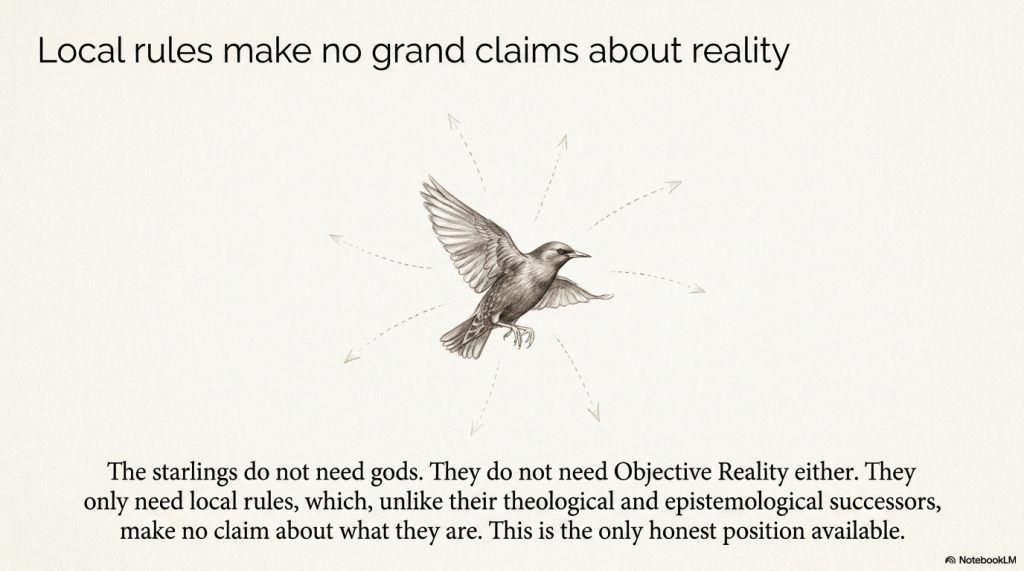
The murmuration of starlings is useful here. A rule of seven: Each bird responds to its seven nearest neighbours. Local rules, local information, irreducibly individual embodiment. The apparent organism wheeling across the sky – that single fluid entity that seems to breathe and turn as one – is a scale-dependent phenomenon that observers impose from a sufficient distance. Pareidolia at work. There is no murmuration-subject, and there is no fact of the matter about what it is like to be the flock, because the flock is not the level at which anything is happening. Whilst the coherence is real, the subject isn’t.
A statistical person is the murmuration.
A statistical person is the murmuration. Every apparatus of governance, moral philosophy, and institutional coordination operates by constructing a subject at the flock scale – the rational agent, the bearer of rights, the member of the moral community, the person before the court. These constructions aren’t errors at all. They’re necessary compressions. Courts can’t adjudicate the irreducible particularity of each defendant; they need the type. But the utility of the compression at the institutional scale isn’t evidence that the compression names anything real at the experiential scale. As the average human isn’t actually a human, the murmuration is not a starling.
What does this mean for the consciousness debate – about bats, digital systems, or the person sitting across from you? The question ‘is there something it is like to be X?‘ isn’t merely unanswered, but it’s malformed as posed. It presupposes a subject-object grammar within which the question makes sense: a discrete, bounded subject, either possessing or lacking inner experience, in principle distinguishable from other such subjects. That grammar produces the apparent problem. Dissolve the grammar, and the problem doesn’t get solved; rather, it gets diagnosed. Which brings us to God…
if God did not exist, it would be necessary to invent Him
Here, Voltaire’s quip – if God did not exist, it would be necessary to invent Him – is almost right. But its failure is in the verb. Invention implies architects: identifiable agents who construct a useful fiction and install it in a credulous population. This is the wrong model for how the objective world works. No one decided to construct it. Rather, it accreted. Each starling wasn’t conspiring to produce the murmuration; the murmuration is what the local rules produce at scale – No intention necessary. The exogenous imposition has no imposer behind it, which is precisely why it presents with such unimpeachable authority. Expose an inventor, and you discredit the invention. But when there isn’t an inventor – when the cage precipitated rather than being built – there isn’t a conspiracy to unmask; there’s no priest to dismiss – only the structure itself, which continues to function regardless of whether anyone believes in it.
Nietzsche understood this better. The death of God, for Nietzsche, wasn’t the liberation it appeared to be. It was the removal of the only anchor the entire normative structure had, without anyone noticing what was actually anchoring what. The Enlightenment didn’t interrogate the theological grammar. It secularised it. Reason, Nature, Science, Progress, History – each of these performed the same function God had performed: the external, authoritative, mind-independent referent against which claims could be measured and from which institutional authority could flow downward to the subject. The architecture was identical; only the tenant changed.
Objective is the edifice. When God was evicted, Reason, Science, Objective Truth became the new tenants
And that’s the point. The Objective isn’t a discovery. It’s a slot, a structural position in the grammar of subject-object discourse that requires an occupant if coördination at scale is to function. God was an early and effective tenant. When God was evicted, the slot didn’t disappear. It couldn’t because it’s not a belief but a grammatical necessity. It was immediately re-occupied, with the additional ideological advantage that the new tenants – Reason, Science, Objective Truth – present themselves as discovered rather than inherited. You can lose faith in God. You can’t, without apparent irrationality, lose faith in Objective Reality, because Objective Reality is now the precondition of the concept of rationality itself. The successor is more entrenched than the original. The slot has been occupied so continuously that it now looks like part of the foundation.
But it’s not. The building is the subject-object grammar, which generates the Objective slot as a structural correlate of the Subject. What fills the slot – God, Reason, the Market, the Algorithm – is the history of ideas, the history routinely mistaken for intellectual progress: the mature species finally locating the real external anchor, after centuries of superstitious misdirection. What’s actually happening is tenant succession. Each eviction is experienced as crisis, where each new occupant presents as the permanent solution. The edifice is never inspected because it’s always occupied, and this occupied building looks like a home.
The diagnostic move, then, isn’t to find a better tenant. Every reform programme, every Enlightenment, every revolution has done exactly that, and the slot fills again within a generation. The diagnostic move is to show that there is an edifice, that the grammar has a structure, that the structure generates the slot, and that the slot’s current occupant inherited its authority from the grammar rather than earning it from the world.
This is a different kind of intervention. Rather than a replacement, it produces a recognition that the coordinating function of the Objective is genuine and the ontological claim isn’t, that the murmuration coheres and the murmuration-subject doesn’t actually exist, that we are starlings – or turtles – all the way down, responding to our seven nearest neighbours, producing from the outside the appearance of a unified orientation toward a common truth.
the statistical person is regular enough to be governed, predicted, and addressed
A relativistic social model operates well enough on this account: It doesn’t require an objective world; it simply requires stable enough local rules that the flock coheres, that the statistical person is regular enough to be governed, predicted, and addressed. The objective world is the name we give to that coherence when observed from a sufficient distance. It’s robust enough for almost every practical purpose. What it isn’t is foundational. Remove the coordinating conventions, and it simply stops being produced.
The starlings don’t need gods. They don’t need Objective Reality either. They only need the local rules, which, unlike their theological and epistemological successors, make no claim about what they are. Which is, in the end, the only honest position available.
 Philosophics