Deconstructing Consciousness without Panpsychism

3–4 minutes

I am decidedly not a proponent of panpsychism. Most philosophers – and, let us be honest, most people – cannot deconstruct without immediately reconstructing; the rubble has barely settled before they are pouring fresh foundations. I decline that reflex, and I call the declining Dis–Integration – the term chosen partly to keep my distance from Derrida, whose own coinage is abused by more people than have even read him.

Audio: NotebookLM summary podcast of this topic.

Alex Connor begins well. He Dis–Integrates the folk package of consciousness, and he does it cleanly. Respect. Set aside that ‘consciousness’ carries literally dozens of definitions across disciplines and subdisciplines. Just grant him the ordinary picture and watch him strip it. Memory, sensory richness, identity, deliberation, narrative selfhood – he shows that none of these is intrinsic to consciousness as ordinarily imagined. As he says, close your eyes and subtract sight; still conscious. Subtract hearing, subtract touch, subtract memory until no instant is ever laid down. What remains, he says, is bare awareness. So far, so good. Descartes would have been proud.

But then Alex makes the same mistake as RenĂ©, mistaking the dust for an ontological primitive. That a folk bundle can be decomposed entails precisely nothing about the fundamentality of whatever is left at the bottom of the barrel. It may show only that ‘consciousness’ was never a stable kind-term – that we have been pointing at an assortment and calling it a thing.

This subtraction is only Dennett’s intuition pump, not the engine, which arrives at the end, when Alex argues that you can’t assemble a substance from parts that lack it – that the familiar emergence analogies, temperature from molecules, an image from pixels, all smuggle in the very phenomenality they pretend to derive, because temperature ’emerges’ only for someone who already feels heat. No good analogy survives, he concludes; therefore, consciousness cannot be built; therefore, it must already be down there in the atoms. Nope.

Leave that standing and the subtraction argument was never load-bearing at the start. The stripping was only ever ostensive, a way of pointing at minimal consciousness, but the fundamentality claim never rested on it.

The subtraction works only by thinning ‘consciousness’ to bare awareness – by evacuating redness, the unified first-person feel, the entire rich remainder, on purpose and as a matter of method. The anti-emergence argument works only by treating ‘consciousness’ as a robust substance whose assembly from non-conscious parts is incoherent – and every ounce of that incoherence is borrowed from exactly the rich phenomenal features the subtraction he’d just tossed overboard. ‘First-person unified experience’. ‘The redness of red’. Those were his words, and they are doing the work in the argument that needs consciousness to be thick, moments after he has insisted it is thin. Oops.

So the noun equivocates inside his own case. Damn dirty objects. It’s a decomposable bundle when he needs minimality; an indecomposable substance when he needs non-emergence. He can’t eat his cake and have it, too. There’s no single referent for the emergence to succeed or fail at. Some bundled features plainly emerge – that’s what bundling is. The bare what-it-is-like-ness is the contested remainder. And ‘it’s all one substance that can’t be built’ is simply the reification I diagnosed earlier.

This is why I decline the question. It’s not ‘consciousness is emergent‘ set against his ‘consciousness is fundamental‘ – that trade keeps the bad noun on the pitch. The framing of substance-versus-emergence is what fails. So, I’m not adjudicating the dispute. I’m just declining its terms after showing that its terms weren’t ever coherent to begin with.
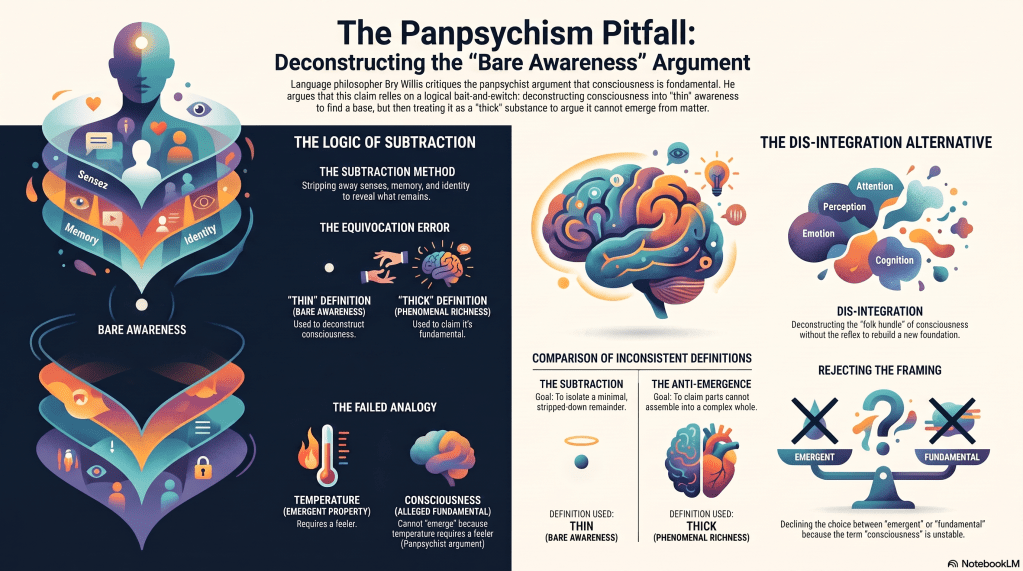
NotebookLM Infographic on this topic.

Legibility Meets Humanity for Xmas

3–4 minutes

I’m no fan of holidays. I neither enjoy nor celebrate Christmas. I’m acutely aware of its commercial excesses and its religious inheritance, two institutions I find, at best, tiresome and, at worst, actively corrosive. Whether that’s abhorrence or simple loathing is a distinction I’ll leave to braver souls.

Still, calendars exist whether one consents to them or not, and this piece happens to land today. If Christmas is your thing, by all means, have at it. Sincerely. Rituals matter to people, even when their metaphysics don’t survive inspection.

What follows is not a defence of the season, nor a seasonal moral. It’s a small human moment that happens to involve Santa, which is to say a costume, a script, and a public performance. What interests me is not the symbolism, but what happens when the performance yields just enough to allow someone else to be seen on their own terms. If nothing else, that feels like a tolerable use of the day.

Audio: NotebookLM summary podcast on this topic.

What Legibility?

When I use the term legibility, it’s usually as a pejorative. It’s my shorthand for reductionism. For the way human beings are flattened into checkboxes, metrics, market segments, or moral exemplars so they can be processed efficiently by institutions that mistake simplification for understanding.

But legibility isn’t always a vice.

Video: Santa signs with a 3-year-old dear girl

Most of us, I suspect, want to be legible. Just not in the ways we are usually offered. We want to be seen on our own terms, not translated into something more convenient for the viewer. That distinction matters.

In the video above, a deaf child meets Santa. Nothing grand happens. No lesson is announced. No slogan appears in the corner of the screen. Santa simply signs.

The effect is immediate. The child’s posture changes. Her attention sharpens. There’s a visible shift from polite endurance to recognition. She realises, in real time, that she does not need to be adapted for this encounter. The encounter has adapted to her. This is legibility done properly.

Not the synthetic legibility of television advertising, where difference is curated, sanitised, and arranged into a reassuring grid of representation. Not the kind that says, we see you, while carefully controlling what is allowed to be seen. That version of legibility is extraction. It takes difference and renders it harmless. Here, the legibility runs the other way.

Santa, already a performative role if ever there was one, doesn’t stop being performative. The costume remains. The ritual remains. But the performance bends. It accommodates. It listens. The artifice doesn’t collapse; it becomes porous.

I’m wary of words like authenticity. They’ve been overused to the point of meaninglessness. But I do think we recognise performatism when we see it. Not in the technical sense of speech acts, but in the everyday sense of personas that ring hollow, gestures that exist for the camera rather than the people involved. This doesn’t feel like that.

Of course, the child could already connect. Deaf people connect constantly. They persevere. They translate. They accommodate a world that rarely meets them halfway. Nothing here ‘grants’ her humanity. What changes is the tightness of the connexion.

The shared language acts as a verbal proxy, a narrowing of distance. You can see the moment it clicks. He speaks her language. Or rather, he speaks a language that already belongs to her, even if calling it ‘hers’ is technically imprecise. Mother tongue is a slippery phrase. Irony does some of the work here.

Legibility, in this case, doesn’t make her smaller. It makes the interaction larger. And that, inconveniently for our systems and slogans, is what most people have been asking for all along.

Psychology of Totalitarianism

I finished Mattias Desmet’s The Psychology of Totalitarianism, which I mentioned the other day. Unfortunately, my initial optimism was premature. Everything I enjoyed was front-loaded: the first four chapters set up a promising critique of mechanistic rationality and the collapse of shared meaning. Then the book turned into a long, therapeutic sermon. I should have stopped at Chapter 4 and saved myself the sunk-cost regret.

It isn’t that nothing follows; it’s just that what follows is so thin that the cost-benefit ratio goes negative. Once Desmet moves from diagnosis to prescription, the argument collapses into a psychologist’s worldview: an entire civilisation explained through mass neurosis and healed through better intuition. He builds his case on straw versions of reason, science, and modernity, so his ‘cure’ can look revelatory.

The trouble is familiar. Having dismantled rationalism, Desmet then installs intuition as its replacement – an epistemic monarchy by another name. His appeal to empathy and connection reads less like philosophy and more like professional self-promotion. The therapist can’t stop therapising; he privileges the psychological lens over every other possibility.

The result is a reductionist parascience dressed as social theory. The totalitarian mind, in Desmet’s telling, isn’t political or structural but psychological – a patient waiting for insight. I don’t doubt his sincerity, only his scope. It’s what happens when a discipline mistakes its vocabulary for the world.

Desmet’s project ultimately re-enchants what it claims to critique. He wants rationalism redeemed through feeling, order reborn through connection. Dis-Integrationism stops short of that impulse. It accepts fracture as the permanent condition – no higher synthesis, no therapeutic finale. Where Desmet sees totalitarianism as a collective pathology awaiting treatment, I see it as reason’s own reflection in the mirror: a system trying to cure itself of the only disease it knows, the need to be whole.