Titrating Hegel

3–4 minutes

Allow me to start with a declaration: I am no Hegel expert, and whether I am an expert at anything is debatable. Still, I’ve been reflecting on Hegel through my own lenses, and I have an opinion – because of course I do. My comment isn’t on a single Hegel publication. Rather, it’s a commentary on some of his general ideas – some more specific than others – that just so happen to be rattling around my noggin as I type.

Audio: NotebookLM summary podcast of this topic.

I know I’ve already claimed to have started, but this is the real start. Let’s talk translations.
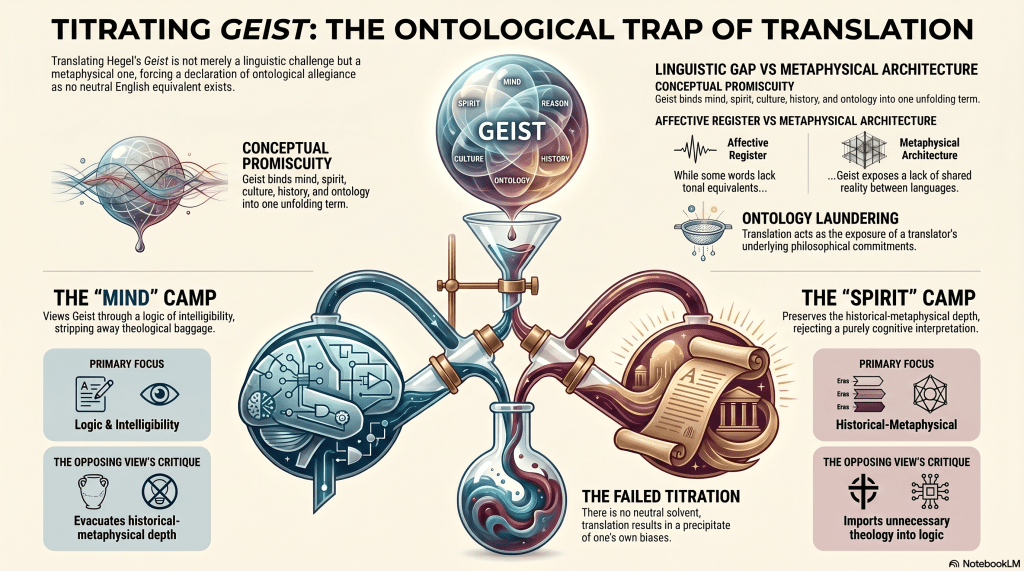
NotebookLM Infographic on this topic.

I recently discussed the problem with translating Meursault’s French maman. The short version: English lacks a clean equivalent. Every option – Mother, Mummy, Mama – over-interprets the son’s relation to his mother, leaning warmer or colder or more infantile than the French allows. Camus’ problem is at the level of affective register. The ambiguity is tonal, intimate, and culturally situated. English simply can’t carry it without choosing a side.

Hegel has a different problem, more philosophically weighty. His problem is Geist. Almost immediately, I think of zeitgeist and Poltergeist. Ghosts. Spirits. Phenomenology of Spirit, right? Easy peasy.

Not so fast. Some translators render it as Mind, in an attempt to distance themselves from theological baggage. The problem is that Hegel himself equivocates – so he’s of little help. He may have been intentionally cheeky, being stuck in the milieu of his day, as well as a product of it and producer through it.

Where maman exposes language’s insufficiency at the level of affective register, Geist exposes it at the level of metaphysical architecture. English can’t preserve the conceptual promiscuity by which Hegel binds mind, spirit, culture, history, and ontology into one unfolding term. The word doesn’t just mean something; it enacts a view of what is real and how the real moves. If that weren’t bad enough, enter ontological grammar commitments. (I’m a teetotaller, so someone else hold the bear.)

Video: Hold my bear

The translator is not neutrally asking: What does Geist mean? They are already asking, even if silently: What kind of reality do I think Hegel is describing?

Translation here isn’t the neutral transfer of meaning – it’s the exposure of ontological allegiance. The quarrel over Geist is not a lexical dispute. It is ontology laundering itself through vocabulary.

Let’s consider the two camps.

The Mind camp hears:

“You are importing theology into what is fundamentally a logic of intelligibility.”

The Spirit camp hears:

“You are evacuating the historical-metaphysical depth of the term and pretending Hegel was doing philosophy of cognition with better hats — nicer hats, perhaps, but hats all the same.”

Neither objection is irrational from within its own grammar. Both are locally coherent. They simply don’t share the same ontology of the term.

Reason doesn’t choose between Mind and Spirit from nowhere. It adjudicates from within a prior ontological settlement, then mistakes that settlement for neutrality. This is worth remembering well beyond the Hegel literature.

In disputes over Geist, reason doesn’t fail because the parties are irrational. It fails because each party’s reason operates inside a different ontological grammar. What appears as clarification within one frame appears as distortion within the other. A reason is not self-legitimating. It becomes a reason only inside a grammar that knows how to receive it.

Which brings us back to the title. Titration works when you have a known reagent and a neutral solvent – you add one to the other until the system reaches equilibrium. The whole method assumes there is an equilibrium to reach. Geist has no neutral solvent. Mind and Spirit are not two concentrations of the same substance. They are different substances, differently constituted, differently reactive. There is no volume at which one cancels the other out. You can titrate the word all you like. The indicator never changes colour. What you are left with is not a settled meaning but a record of your own ontological commitments, precipitated out of solution and sitting at the bottom of the flask – which, in the end, is more than most translations will admit.

Door Prize: Here’s your parting gift courtesy of NotebookLM…

Reason on a Spectrum

4–6 minutes

Reason is not an oracle of truth but a spectrum-bound tool, and when it is worshipped as absolute, it curdles into pathology. True rationality knows when to temper itself, when to equivocate, and when a kind lie is wiser than a cold fact.

Reason and rationality are the household gods of modernity. We light incense to them daily: follow the science, be reasonable, act rationally. But before we genuflect, it’s worth asking what exactly we mean. By reason, I mean the faculty of inference – spotting contradictions, tracing causes. By rationality, I mean the practice of applying that faculty toward some end. That’s all. Nothing mystical.

Audio: NotebookLM podcast on this topic.

The trouble starts when these concepts are treated as absolutes. They aren’t. They vary in intensity and application. A person’s reasoning operates on a spectrum with something like frequency and amplitude. Some minds hum at low frequency – broad strokes, contradictions smoothed over by intuition. Others burn hot at high frequency and amplitude – rapid logical leaps, obsessive consistency, the inability to let a premise go. And while some reason flows like a continuous wave – steady, consistent, predictable – other forms fire more like particles: synaptic sparks that don’t always connect, logic arriving in bursts or stutters rather than as a smooth line.

Push too far and what we sanctify as ‘reason’ bleeds into what psychiatry pathologises as autism or schizophrenia. Meanwhile, ‘normal’ cognition always includes an emotional ballast. Strip it out and the result looks alien, even monstrous. Freud’s quip about psychopathy – that the psychopath differs from the rest of us in degree, not kind – applies just as well to reason. Rationality is simply the socially acceptable blend of logic and affect. Deviate, and you’re declared broken.

Camus gave us a parable in The Stranger. Meursault observes his world with ruthless clarity, but no emotional resonance. He doesn’t weep at his mother’s funeral, and society condemns him less for murder than for failing to perform grief. His ‘pure’ reason reads as inhuman.

Here’s the paradox: if rationality means adapting effectively to one’s environment, then pure rationality demands knowing when to suspend itself. A person who insists on logic at every turn is not rational but maladapted. The rational actor lies, flatters, nods at the boss’s bad joke, comforts the friend who doesn’t want statistics but solace. Rationality that cannot bend collapses into pathology.

This is why the infamous ‘Do these jeans make me look fat?’ question is such a perfect test. The ‘true’ answer, if you are reasoning narrowly, may be ‘yes’. But true rationality recognises the context, the stakes, the human need beneath the words. The rational response is not the cold fact but the kind equivocation. Rationality that cannot lie is no rationality at all.

Here’s the paradox: if rationality means adapting effectively to one’s environment, then pure rationality demands knowing when to suspend itself. A person who insists on logic at every turn is not rational but maladapted. The rational actor lies, flatters, nods at the boss’s bad joke, comforts the friend who doesn’t want statistics but solace. Rationality that cannot bend collapses into pathology.

Consider the social rituals we all know. A partner says, ‘I like that house’, and the rationally over-tuned response is to evaluate the house. The actual cue is in the like, not the house. The answer isn’t that you dislike the house, but rather what you can appreciate about it. Miss that, and you miss the point. Or take the dinner table: when my son was seven, a well-meaning host – very Martha Stewart – asked him how he enjoyed his meal. He replied, with perfect candour, ‘I’ve had better’. From a logical standpoint, faultless. From a rational standpoint – if rationality includes social adaptation – disastrous. The question was never about the food. It was a cue for appreciation, for harmony. He gave fact when what was asked for was affiliation.

So yes, I attack reason and rationality – not because they don’t exist, but because they are misapplied, reified, and worshipped as neutral arbiters of truth. They are not. They are tools with a range, and outside that range, they fail catastrophically. To speak of ‘reason’ as if it were an unqualified good is like praising fire without mentioning its talent for arson.


After I wrote this, I realised I forgot to mention Kant.

Even Kant, patron saint of rational duty, insisted you must never lie, not even a white lie, not even to a murderer asking where your friend is hiding. For him, truth-telling was categorical, binding, immune to circumstance. But this is reason gone rigid, unable to flex with human reality. It shows how worship of Reason leads not to morality but to monstrosity. A rationality that cannot bend is no rationality at all.