
I am decidedly not a proponent of panpsychism. Most philosophers – and, let us be honest, most people – cannot deconstruct without immediately reconstructing; the rubble has barely settled before they are pouring fresh foundations. I decline that reflex, and I call the declining Dis–Integration – the term chosen partly to keep my distance from Derrida, whose own coinage is abused by more people than have even read him.
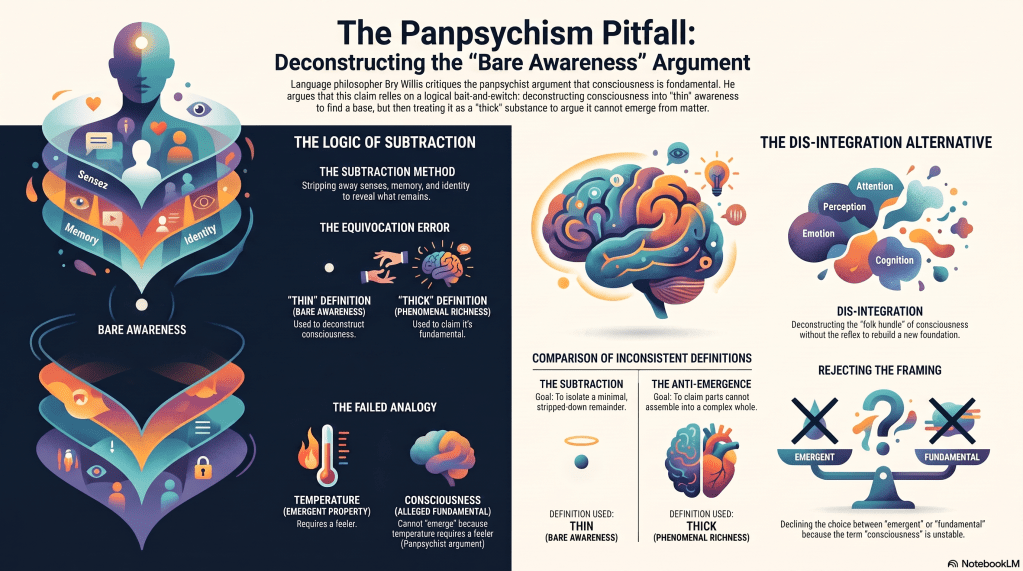
Alex Connor begins well. He Dis–Integrates the folk package of consciousness, and he does it cleanly. Respect. Set aside that ‘consciousness’ carries literally dozens of definitions across disciplines and subdisciplines. Just grant him the ordinary picture and watch him strip it. Memory, sensory richness, identity, deliberation, narrative selfhood – he shows that none of these is intrinsic to consciousness as ordinarily imagined. As he says, close your eyes and subtract sight; still conscious. Subtract hearing, subtract touch, subtract memory until no instant is ever laid down. What remains, he says, is bare awareness. So far, so good. Descartes would have been proud.
But then Alex makes the same mistake as René, mistaking the dust for an ontological primitive. That a folk bundle can be decomposed entails precisely nothing about the fundamentality of whatever is left at the bottom of the barrel. It may show only that ‘consciousness’ was never a stable kind-term – that we have been pointing at an assortment and calling it a thing.
This subtraction is only Dennett’s intuition pump, not the engine, which arrives at the end, when Alex argues that you can’t assemble a substance from parts that lack it – that the familiar emergence analogies, temperature from molecules, an image from pixels, all smuggle in the very phenomenality they pretend to derive, because temperature ’emerges’ only for someone who already feels heat. No good analogy survives, he concludes; therefore, consciousness cannot be built; therefore, it must already be down there in the atoms. Nope.
Leave that standing and the subtraction argument was never load-bearing at the start. The stripping was only ever ostensive, a way of pointing at minimal consciousness, but the fundamentality claim never rested on it.
The subtraction works only by thinning ‘consciousness’ to bare awareness – by evacuating redness, the unified first-person feel, the entire rich remainder, on purpose and as a matter of method. The anti-emergence argument works only by treating ‘consciousness’ as a robust substance whose assembly from non-conscious parts is incoherent – and every ounce of that incoherence is borrowed from exactly the rich phenomenal features the subtraction he’d just tossed overboard. ‘First-person unified experience’. ‘The redness of red’. Those were his words, and they are doing the work in the argument that needs consciousness to be thick, moments after he has insisted it is thin. Oops.
So the noun equivocates inside his own case. Damn dirty objects. It’s a decomposable bundle when he needs minimality; an indecomposable substance when he needs non-emergence. He can’t eat his cake and have it, too. There’s no single referent for the emergence to succeed or fail at. Some bundled features plainly emerge – that’s what bundling is. The bare what-it-is-like-ness is the contested remainder. And ‘it’s all one substance that can’t be built’ is simply the reification I diagnosed earlier.
This is why I decline the question. It’s not ‘consciousness is emergent‘ set against his ‘consciousness is fundamental‘ – that trade keeps the bad noun on the pitch. The framing of substance-versus-emergence is what fails. So, I’m not adjudicating the dispute. I’m just declining its terms after showing that its terms weren’t ever coherent to begin with.
 Philosophics