Those who follow me closely know that I am not a supporter of Democracy or Enlightenment Age ideals. I published an extended post on Substack, after which I had a bit of an epiphany.
In brief, for expansion later, is my realisation that Democracy – nor the so-called Justice system – is not a utilitarian or consequentialist project. Although I have issues with all normative ethics stances, I am particularly not a deontologist. This disconnect has caused me much consternation.
Through a utilitarian lens, I had been primed to expect better outcomes – considerations for the Greater Good™ and all. This is the source of my disillusionment.
Through a deontological lens, democracy and justice are about the repeatability of processes, not outcomes. Outcomes are a secondary byproduct despite being framed as a main event.
Even though neither of these is empirically evident, it feels more honest to present it this way. Of course, the rhetoric would require more effort. We’re not all Kantians.
Anyway, I just wanted to capture the moment before considering this in more detail and sharing a position piece later.
Were you already aware of this distinction? In so, does it matter? In any case, does it matter? Enquiring minds want to know.
On God, Objectivity, and the Grammar That Outlives Both
NB: After I posted this, I put some more thought into the notion. Rather than extending this post, I decided to post the follow-up on Substack. Where Nagel asks, What’s it like to be a bat? I ask What’s It Like to Be a Human?
I know a nice philosophical parlour trick. It’s performed by asking someone whether they believe in objective truth. If they say yes, ask them where it comes from; if they say no, ask them whether that denial is objectively true. The trick is not a refutation of anything. It is a demonstration: the concept of the Objective has been installed so deeply in the grammar of the question that you can’t coherently step outside of it long enough to evaluate it. In this respect, you’re a starling who can’t see the murmuration from within it.
Audio: NotebookLM summary podcast of this topic.
Let’s start with Nagel. In 1974, Thomas Nagel published a paper that broke a perfectly serviceable assumption in half. The assumption was that consciousness, while subjective in character, was at least comparably subjective across humans – that the gap between my inner life and yours was a matter of degree, navigable by imaginative projection and shared biology, whereas the gap between me and a bat was of a different order entirely. Nagel’s intervention was to question the first assumption by taking the second seriously. If the bat’s echolocation is genuinely inaccessible – not merely unfamiliar but structurally unreachable, given that I have no experiential raw material from which to construct what sonar feels like – then the inference from ‘I can’t imagine this being’s experience‘ to ‘this being probably has no experience worth worrying about‘ is invalid. Not difficult. Invalid. The bat has a perspective; I can’t access it. These two facts are entirely compatible, not mutually exclusive.
The extension Nagel resisted, but which his own argument demands, is this: the same epistemic closure obtains everywhere. Not merely between humans and bats, or humans and artificial systems, but between any two subjects whatever. What we call human-to-human understanding is not epistemic access to another’s inner life. It’s coordination: shared linguistic conventions, overlapping heuristics, statistical regularities of behaviour stable enough to be gamed and relied upon. We don’t experience each other’s experience. We model each other, well enough for most practical purposes, but then mistake the model for the contact. It’s all too common.
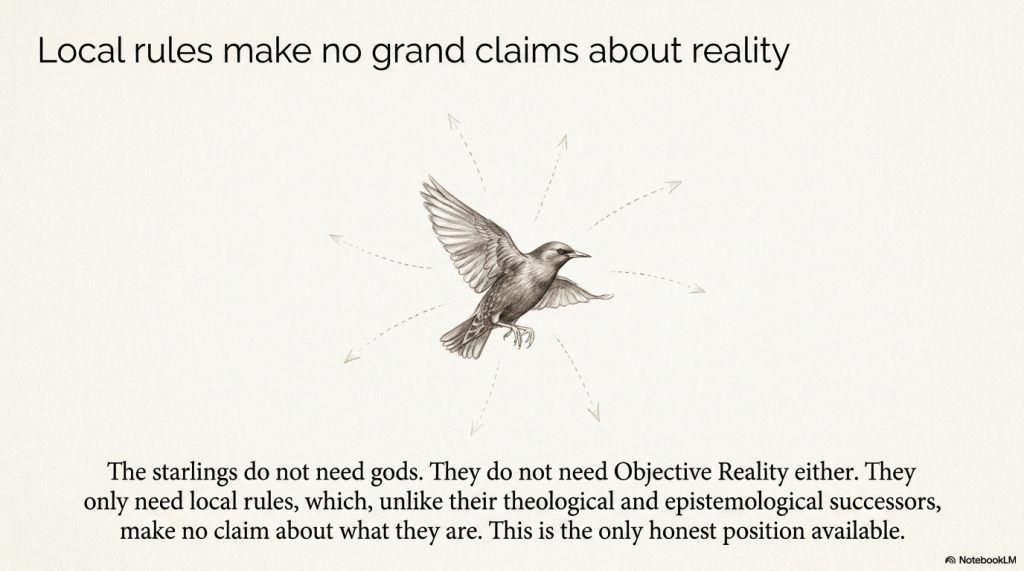
The murmuration of starlings is useful here. A rule of seven: Each bird responds to its seven nearest neighbours. Local rules, local information, irreducibly individual embodiment. The apparent organism wheeling across the sky – that single fluid entity that seems to breathe and turn as one – is a scale-dependent phenomenon that observers impose from a sufficient distance. Pareidolia at work. There is no murmuration-subject, and there is no fact of the matter about what it is like to be the flock, because the flock is not the level at which anything is happening. Whilst the coherence is real, the subject isn’t.
A statistical person is the murmuration.
A statistical person is the murmuration. Every apparatus of governance, moral philosophy, and institutional coordination operates by constructing a subject at the flock scale – the rational agent, the bearer of rights, the member of the moral community, the person before the court. These constructions aren’t errors at all. They’re necessary compressions. Courts can’t adjudicate the irreducible particularity of each defendant; they need the type. But the utility of the compression at the institutional scale isn’t evidence that the compression names anything real at the experiential scale. As the average human isn’t actually a human, the murmuration is not a starling.
What does this mean for the consciousness debate – about bats, digital systems, or the person sitting across from you? The question ‘is there something it is like to be X?‘ isn’t merely unanswered, but it’s malformed as posed. It presupposes a subject-object grammar within which the question makes sense: a discrete, bounded subject, either possessing or lacking inner experience, in principle distinguishable from other such subjects. That grammar produces the apparent problem. Dissolve the grammar, and the problem doesn’t get solved; rather, it gets diagnosed. Which brings us to God…
if God did not exist, it would be necessary to invent Him
Here, Voltaire’s quip – if God did not exist, it would be necessary to invent Him – is almost right. But its failure is in the verb. Invention implies architects: identifiable agents who construct a useful fiction and install it in a credulous population. This is the wrong model for how the objective world works. No one decided to construct it. Rather, it accreted. Each starling wasn’t conspiring to produce the murmuration; the murmuration is what the local rules produce at scale – No intention necessary. The exogenous imposition has no imposer behind it, which is precisely why it presents with such unimpeachable authority. Expose an inventor, and you discredit the invention. But when there isn’t an inventor – when the cage precipitated rather than being built – there isn’t a conspiracy to unmask; there’s no priest to dismiss – only the structure itself, which continues to function regardless of whether anyone believes in it.
Nietzsche understood this better. The death of God, for Nietzsche, wasn’t the liberation it appeared to be. It was the removal of the only anchor the entire normative structure had, without anyone noticing what was actually anchoring what. The Enlightenment didn’t interrogate the theological grammar. It secularised it. Reason, Nature, Science, Progress, History – each of these performed the same function God had performed: the external, authoritative, mind-independent referent against which claims could be measured and from which institutional authority could flow downward to the subject. The architecture was identical; only the tenant changed.
Objective is the edifice. When God was evicted, Reason, Science, Objective Truth became the new tenants
And that’s the point. The Objective isn’t a discovery. It’s a slot, a structural position in the grammar of subject-object discourse that requires an occupant if coördination at scale is to function. God was an early and effective tenant. When God was evicted, the slot didn’t disappear. It couldn’t because it’s not a belief but a grammatical necessity. It was immediately re-occupied, with the additional ideological advantage that the new tenants – Reason, Science, Objective Truth – present themselves as discovered rather than inherited. You can lose faith in God. You can’t, without apparent irrationality, lose faith in Objective Reality, because Objective Reality is now the precondition of the concept of rationality itself. The successor is more entrenched than the original. The slot has been occupied so continuously that it now looks like part of the foundation.
But it’s not. The building is the subject-object grammar, which generates the Objective slot as a structural correlate of the Subject. What fills the slot – God, Reason, the Market, the Algorithm – is the history of ideas, the history routinely mistaken for intellectual progress: the mature species finally locating the real external anchor, after centuries of superstitious misdirection. What’s actually happening is tenant succession. Each eviction is experienced as crisis, where each new occupant presents as the permanent solution. The edifice is never inspected because it’s always occupied, and this occupied building looks like a home.
The diagnostic move, then, isn’t to find a better tenant. Every reform programme, every Enlightenment, every revolution has done exactly that, and the slot fills again within a generation. The diagnostic move is to show that there is an edifice, that the grammar has a structure, that the structure generates the slot, and that the slot’s current occupant inherited its authority from the grammar rather than earning it from the world.
This is a different kind of intervention. Rather than a replacement, it produces a recognition that the coordinating function of the Objective is genuine and the ontological claim isn’t, that the murmuration coheres and the murmuration-subject doesn’t actually exist, that we are starlings – or turtles – all the way down, responding to our seven nearest neighbours, producing from the outside the appearance of a unified orientation toward a common truth.
the statistical person is regular enough to be governed, predicted, and addressed
A relativistic social model operates well enough on this account: It doesn’t require an objective world; it simply requires stable enough local rules that the flock coheres, that the statistical person is regular enough to be governed, predicted, and addressed. The objective world is the name we give to that coherence when observed from a sufficient distance. It’s robust enough for almost every practical purpose. What it isn’t is foundational. Remove the coordinating conventions, and it simply stops being produced.
The starlings don’t need gods. They don’t need Objective Reality either. They only need the local rules, which, unlike their theological and epistemological successors, make no claim about what they are. Which is, in the end, the only honest position available.
The philosophies of Oliver and I are substantially similar. Whilst I think his governance ideas may work fine in a controlled corporate environment – ostensibly a monarchy – they diverge at scale.
Have you ever wondered why Winnie the Pooh sounds faintly ridiculous in French?*
No? Just me then. Settle in.
« Mr et Mrs Dursley, qui habitaient au 4, Privet Drive, avaient toujours affirmé avec la plus grande fierté qu’ils étaient parfaitement normaux, merci pour eux. Jamais quiconque n’aurait imaginé qu’ils puissent se trouver impliqués dans quoi que ce soit d’étrange ou de mystérieux. Ils n’avaient pas de temps à perdre avec des sornettes. »
I recently acquired Harry Potter à l’École des Sorciers, and I found myself unexpectedly arrested by the opening paragraph. The Dursleys, we are told, were parfaitement normaux, merci pour eux – ‘Perfectly normal, thank you very much’. Except the French does something slightly different – the merci pour eux tips the narratorial mockery just a fraction more toward open contempt than Rowling’s original, which keeps its disdain politely implicit. It’s a small thing, but telling.
Audio: NotebookLM summary podcast of this topic.
This brings us back to Pooh as an exercise not only in a language insufficiency, but also a lesson in how meaning is still lost outside of the words of language.
The French translation of Winnie-the-Pooh is a perfectly competent piece of work. It conveys the plot, translated verbatim. Honey is still honey, miel. Piglet remains small and anxious, which is presumably universal. And yet something has gone definitively missing – specifically, the thing that makes Pooh Pooh. That voice. That particular brand of amiable, bumbling, upper-class English vagueness that signals, to anyone raised in the relevant tradition, a whole social type: the loveable aristocratic dimwit, defanged and harmless, too intellectually untroubled to be threatening. Bertie Wooster** with stuffing.
In my case, the experience was audible rather than merely inferred. I encountered Pooh not on the page but watching on screen with my daughter so many years ago, but where the French dubbing lands over the original animation like a category error made flesh, but not quite so bad as an old Godzilla dub. The Hundred Acre Wood remains constant – le miel, the anxious Piglet, the blustering Eeyore – providing a kind of control condition. What varies is the voice. And hearing a French Pooh is hearing, with uncomfortable precision, exactly what has gone missing, because the original signal is still ghosting underneath the translation. The bumbling posh vagueness, the hesitations, the particular music of English aristocratic dimness – all of it evaporated, replaced by something perfectly serviceable and entirely wrong. It is, if you’ll forgive the term, a controlled experiment in loss. The mismatch isn’t inferred from the page. It’s heard. Which is either wonderfully appropriate or deeply ironic for an essay about what language can’t carry. Probably both.
So, what’s the problem? Alors, French doesn’t have this type. It has the libertin – decadent, cynical, not remotely cuddly. It has the pompous bourgeois. What it conspicuously lacks is the post-Victorian English settlement in which the aristocracy became safe to find charming rather than necessary to behead. Pooh requires a specific historical precondition that France declined to provide, for understandable reasons involving the 1790s.
We may know Inspector Clouseau, the bumbling French idiot. Except Clouseau is an English fantasy of French incompetence, essentially invented by Peter Sellers and Blake Edwards. The French didn’t make that joke about themselves. It was made for them, which is rather a different thing, and arguably confirms the point. So much for bears. What about a more serious case of translational vertigo?
« Maman est morte. » The famous opening words of Camus’ L’Étranger – and one of the most analysed sentences in twentieth-century literature, with good reason. Every English translation is already weak tea. It doesn’t carry the English class freight, the faint infantilism, the drawing-room associations. It sits in an affective middle ground that English can’t occupy, somewhere between intimacy and distance, which is precisely where Meursault himself lives. The ambiguity about whether he feels anything – the philosophical core of the entire novel – hinges on a word the target language cannot render. Every translator has to decide, and all fail because English fails to accommodate. This colours Meursault, who I’ve described elsewhere as autistic in principle if not in practise. Without going down a rabbit hole, read The Stranger in this light, and you’ll see systematic abuse of an autist – a textbook neurodivergent – instead of a clueless protagonist.
These examples tighten the philosophical screws at each turn. Pooh is charming and sociological. The Dursleys are technically interesting. Meursault, existential.
But there’s the uncomfortable conclusion they collectively point toward: translation failure is merely the most visible symptom of a much deeper condition. Language was already lossy before one introduces a second language as an additional compression stage. The register, the tone, the class coding, the cultural memory, the sheer music of Pooh’s voice – none of this was ever in the text. It was the environment, in the air or water around the text, in the shared form of life that allows certain performances to land and others to fall silently into the void.
whereof one cannot speak, thereof one must be silent
Wittgenstein said that whereof one cannot speak, thereof one must be silent. He was right and characteristically unhelpful. Because we can’t speak of most of it – the embodied, gestural, socially-saturated ground on which language rests – and yet it’s doing at least half the communicative work, possibly more.
Barthes reminds us that the author is dead. Derrida might have told you there’s no escaping the text, that the instability runs all the way down, that speech is already writing in the relevant sense. He’s not exactly wrong but he’s diagnosing a different condition – the internal slipperiness of signs, rather than the gap between the linguistic and the everything-else. The argument here is less that meaning defers endlessly within language, and more that language was always an approximation of something richer and irreducibly situated. There was never quite enough text to escape from.
What this means is that translation isn’t a solved problem awaiting better tools. It’s a hard limit on what language can carry – a reminder that when Pooh speaks, what you’re actually hearing is a century of English class history, a specific post-Victorian emotional settlement, and a cultural permission to find a certain kind of helpless gentleness charming rather than contemptible.
Or, as Andy Rooney might have put it: Did you ever notice that words don’t quite say what you mean?
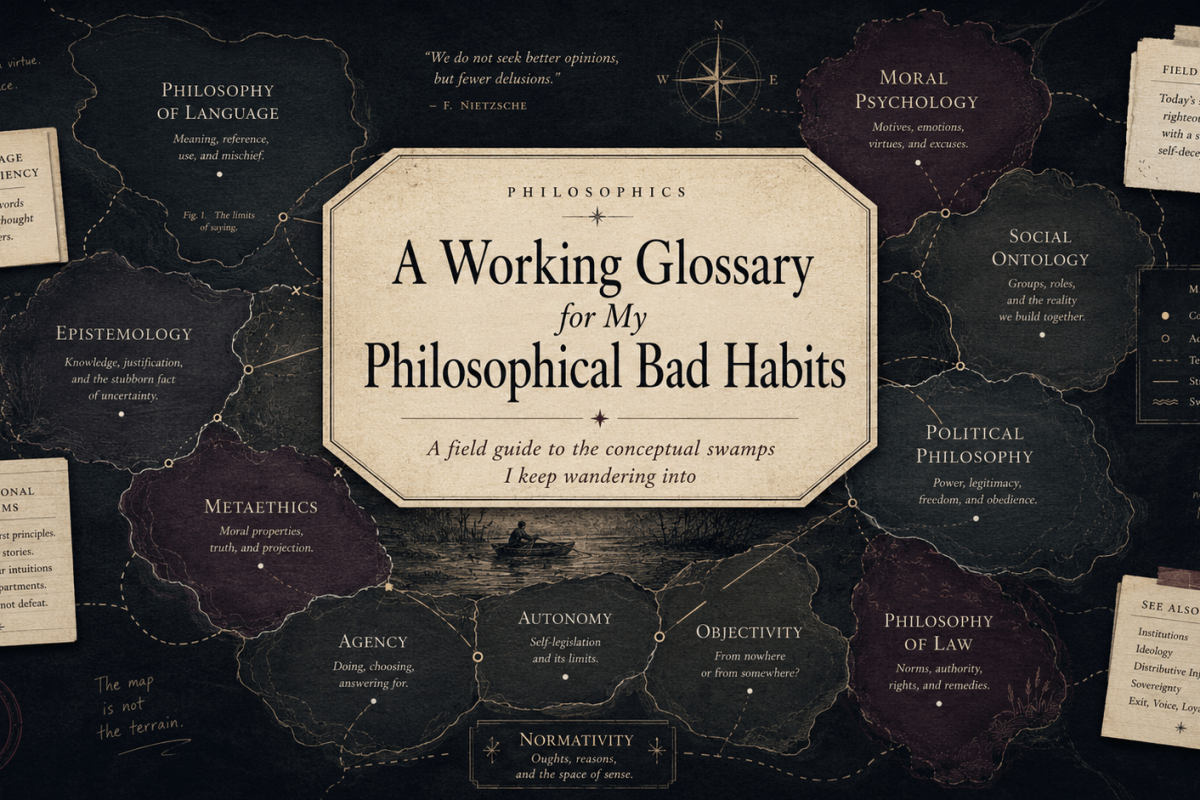
Or: a brief field guide to the conceptual swamps I keep wandering into, despite civilisation’s repeated attempts to pave them over.
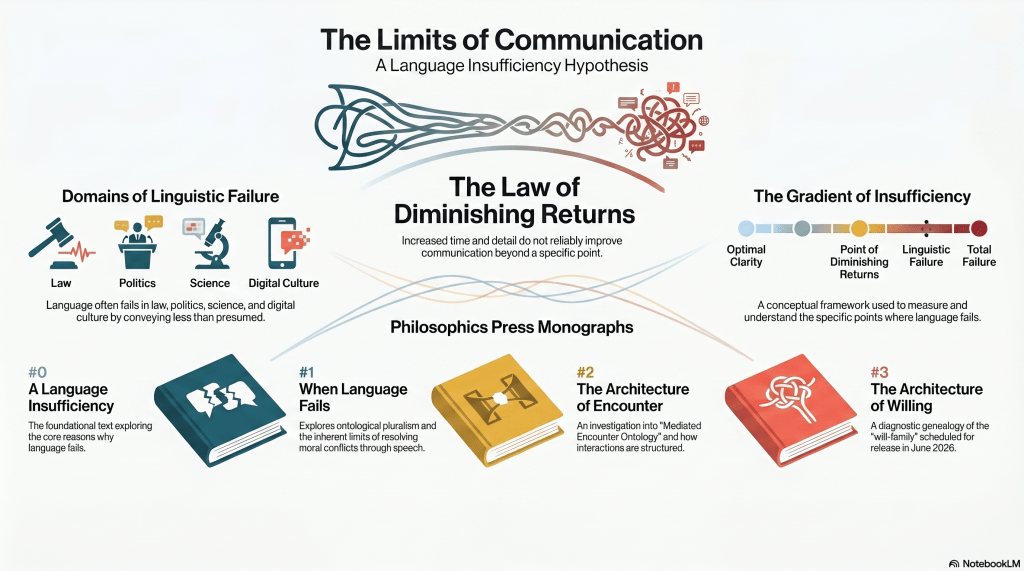
As I was updating my PhilPapers profile, I decided to ask (prompt?) my digital colleague, ChatGPT to create a glossary of terms relevant to my work and interests. Perhaps this has SEO value. It doesn’t appear to be in any particular order – just like life – and so it will remain that way. Please leave comments about em dashes and notable LLMisms below.
Audio: NotebookLM summary podcast of this topic.
Philosophy has the irritating habit of naming territories after the people who built fences around them. One begins by asking a fairly ordinary question — why do people keep disagreeing after the facts are settled? — and, sooner or later, someone informs you that you have wandered into metaethics, social ontology, philosophy of language, moral psychology, hermeneutics, political philosophy, or some other administratively sanctioned paddock of the great conceptual livestock farm.
This glossary is therefore not a syllabus, confession, or attempt to claim honorary residence in every department whose windows I have peered through. It is a map of the terms, fields, and adjacent concerns that recur across my work: the Language Insufficiency Hypothesis, the Architecture of Encounter, and my current project, The Architecture of Will. It is also a useful reminder that disciplines are often less like natural kinds than airport signage: helpful, directional, and faintly embarrassing when mistaken for geography.
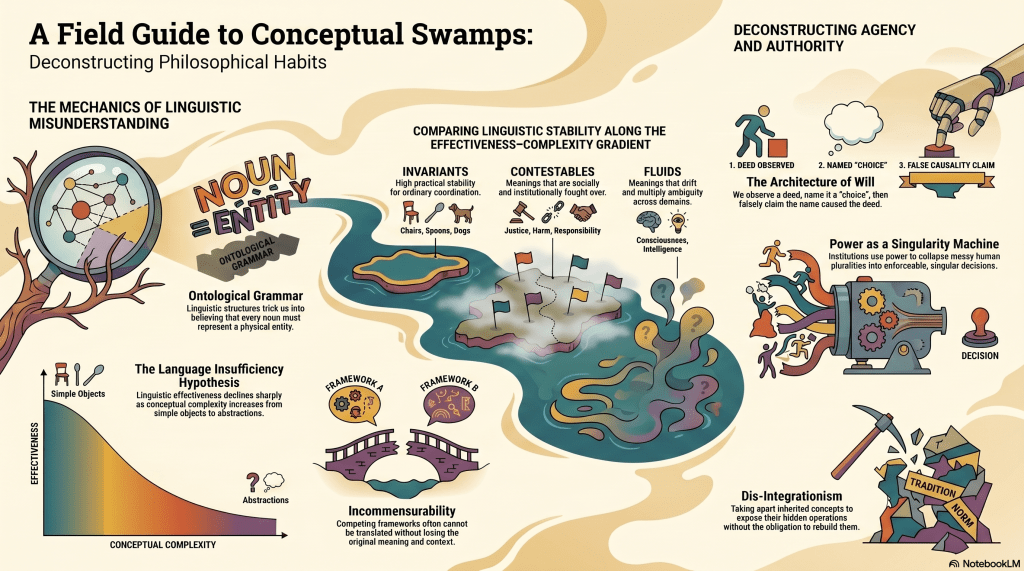
NotebookLM Infographic on this topic.
Philosophy of Language
The study of how language means, fails, points, slips, distorts, coordinates, and occasionally performs the intellectual equivalent of falling down a staircase with a clipboard.
My interest is not chiefly in language as a transparent medium for thought, but in language as a structurally biased encoding system. Words do not simply carry meanings from one mind to another like well-behaved parcels. They compress, frame, prioritise, obscure, and smuggle in assumptions. Many philosophical problems begin when we treat grammar as though it were ontology: because a noun exists, we assume there must be a thing answering to it.
In my work, philosophy of language becomes the diagnostic centre from which many other disputes are reinterpreted. Moral language, political language, legal language, psychological language, and metaphysical language all depend on terms that remain useful long after their referential stability has expired.
Epistemology
Epistemology asks what knowledge is, how it is justified, and what distinguishes knowing from merely believing with good posture.
My concern is with mediated access: the fact that whatever we call knowledge is routed through perception, cognition, language, culture, inherited categories, institutional practices, and power. This does not mean truth is imaginary or that anything goes. That tedious little slogan should be retired and buried under a car park. It means that access to reality is always structured, filtered, and constrained.
Knowledge, on this view, is less a pristine correspondence between mind and world than a stabilised achievement under conditions of mediation. We know enough to function, to build bridges, to poison ourselves predictably, to disagree meaningfully, and to sustain institutions. But we do not know from nowhere.
Metaethics
Metaethics asks what moral claims are doing before everyone starts shouting about which ones are correct.
Are moral claims true or false? Do they express facts, attitudes, prescriptions, social commitments, emotional reactions, or something more inconvenient? My own orientation is non-cognitivist: I am sceptical that moral utterances report mind-independent moral furniture. Moral language looks less like description and more like action-authorising expression, salience-marking, coordination, condemnation, alignment, and pressure.
This does not make morality trivial. Quite the opposite. It makes moral discourse socially potent precisely because it is not merely descriptive. Moral language does things. It binds, excludes, licenses, condemns, absolves, and mobilises. The mistake is treating this performative force as though it were evidence of metaphysical depth.
Moral Psychology
Moral psychology studies how human beings actually make moral judgments, which is already impolite, since most humans prefer to imagine they reason first and rationalise never.
My interest lies in the pre-verbal and affective structure of moral salience. People do not simply encounter neutral facts and then calmly apply moral principles. They register threat, harm, impurity, authority, betrayal, autonomy, dignity, and violation through inherited orientations before reasons are narrated. The reasons matter, but they often arrive after the salience has already fired.
This is why many moral disputes persist even after factual clarification. The problem is not always ignorance. Sometimes the parties inhabit different moral architectures, and language is dragged in afterwards to pretend that one more definition might save the day.
Philosophy of Action
Philosophy of action asks what it means to act, intend, choose, decide, deliberate, and be responsible for what follows. It is where verbs go to be embalmed as nouns.
My current project, The Architecture of Will, belongs here, though it approaches the field diagnostically. I am interested in the will-family: will, volition, intent, motive, choice, and decision. These terms appear to name inward sources of action, but often function as compressed summaries of downstream patterns: conduct, hesitation, avowal, retrospective narration, institutional interpretation, and practical uptake.
The core suspicion is that these terms begin as practical handles and are later misrecognised as hidden authoring sources. The deed is observed, interpreted, compressed into a noun, and then that noun is treated as though it caused the deed. Human beings, naturally, decided this was a solid foundation for punishment. The species continues to be ambitious.
Free Will
Free will is the grand ancestral muddle in which metaphysics, theology, law, blame, self-flattery, and administrative convenience hold hands in a burning building.
My work does not primarily try to solve the traditional free-will debate. I am less interested in proving determinism, libertarianism, compatibilism, or hard incompatibilism than in asking why the vocabulary of will acquired such institutional authority in the first place. The question is not simply whether the will is free. It is whether the term will names anything stable enough to bear the moral and juridical burdens placed upon it.
The suspicion is that the will survives not because it has been discovered, but because too many practices require something like it to be presumed.
Responsibility
Responsibility is one of the great Contestables: indispensable, unstable, and always wearing shoes too polished for the terrain.
It can mean causal involvement, role obligation, answerability, accountability, liability, blameworthiness, reparative duty, or desert. These senses are routinely collapsed into one another, allowing institutions and moral cultures to slide from you were involved to you must answer to you deserve suffering with suspicious fluency.
My interest is in prising these apart. A person may be involved in an event, answerable within a relationship, subject to constraint, or appropriate for treatment without thereby becoming the metaphysical author required by retributive desert. Responsibility may remain useful, but only if we stop pretending it is one thing.
Philosophy of Law
Philosophy of law examines law’s concepts, justifications, authority, and interpretive machinery. It is where society dresses power in Latin and asks everyone to admire the tailoring.
My concern is with legal language as institutional compression. Law cannot wait for perfect concepts. It must decide. Terms such as intent, reasonableness, harm, consent, obscenity, negligence, culpability, and responsibility are not stable objects discovered in the world. They are administrable handles used to convert messy human reality into determinate outcomes.
This does not mean law is useless. It means law is a singularity machine: it collapses plural meanings into enforceable decisions. Procedure may dampen variance; it does not eliminate ontological plurality.
Political Philosophy
Political philosophy asks how power should be organised, justified, constrained, distributed, disguised, or ritualistically congratulated for existing.
My work approaches political philosophy through legitimacy, authority, autonomy, co-authorship, institutional maintenance, and the failures of liberal proceduralism. I am especially interested in the point at which Enlightenment political vocabulary begins to wobble: freedom, equality, autonomy, rights, justice, consent, representation, progress.
These terms are not meaningless, but neither are they stable invariants. They coordinate action because people can gather around them, but they fracture because people do not gather around the same thing. Political conflict is often not a disagreement inside shared concepts, but a collision between different ontological grammars using the same words.
Social Ontology
Social ontology asks what social things are: institutions, roles, money, borders, laws, offices, marriages, identities, statuses, and other collective hallucinations with enforcement budgets.
My interest is in institutions as second-order constraint systems. They stabilise behaviour by imposing categories, procedures, incentives, sanctions, and recognisable pathways of action. They are not merely ideas, and they are not simply physical objects. They are structured practices that persist because people, documents, buildings, technologies, habits, and power keep reproducing them.
Social reality is therefore neither imaginary nor naturally given. It is maintained. This matters because the maintenance work often disappears beneath the language of objectivity, neutrality, or inevitability.
Ontological Pluralism
Ontological pluralism is the view that people do not merely disagree about facts or values; they may inhabit different structures of salience, relevance, legitimacy, harm, authority, and reality itself.
This is central to my work. Many conflicts persist because participants are not simply making different claims within the same world-picture. They are operating from different ontological orientations. One person sees state violence where another sees order. One sees autonomy where another sees abandonment. One sees justice where another sees humiliation. The shared word conceals an unshared world.
Ontological pluralism does not mean every orientation is equally good, harmless, or coherent. It means disagreement often begins deeper than argument admits.
Incommensurability
Incommensurability names the condition in which competing frameworks cannot be fully translated into one another without loss.
This matters because modern discourse is addicted to the fantasy that enough dialogue will eventually produce convergence. Sometimes it will. Sometimes people are merely confused, misinformed, or performing stupidity for tribal applause. But in harder cases, the translation itself fails. The concepts do not line up. The saliences do not register. The terms arrive carrying incompatible worlds.
Incommensurability is not silence. It is structured misregistration. People may speak fluently and still fail to meet.
Hermeneutics
Hermeneutics concerns interpretation: how meanings are formed, inherited, transmitted, distorted, and revised.
I use hermeneutic concerns less as a reverent tradition than as a reminder that nobody interprets from a vacuum. We inherit prejudices in Gadamer’s sense: prior orientations that make understanding possible before they make it questionable. Interpretation is not the secondary act of a detached subject. It is the condition under which anything becomes intelligible at all.
This connects directly to ontological grammar. We do not first encounter raw reality and then interpret it. Interpretation is already in the encounter. The world arrives pre-sorted by histories we did not author and categories we rarely inspect.
Conceptual Engineering
Conceptual engineering asks whether we should revise, replace, improve, or abandon the concepts we use.
I am sympathetic to its diagnostic impulse but wary of its repair fantasy. Not every broken concept needs a shinier successor. Some concepts should be dis-integrated: taken apart so that their hidden operations become visible, without immediately pretending we can rebuild them better. Philosophy has enough contractors. Occasionally, what one needs is demolition with a conscience.
This is where my own term Dis-Integrationism enters. It is not destruction for sport. It is the refusal to treat conceptual breakdown as an automatic invitation to reconstruction. Sometimes the most honest intellectual act is to leave the rubble labelled.
Critique of Enlightenment Rationalism
By Enlightenment rationalism I mean the broad confidence that reason, clarity, classification, procedure, and progress can discipline human life into increasingly coherent order.
My work is not anti-reason in the toddler-with-a-matchstick sense. Reason is useful. So are maps, knives, antibiotics, and chairs. The problem begins when reason imagines itself unconditioned, neutral, universal, and sufficient. Enlightenment vocabularies often mistake procedural clarity for conceptual adequacy and institutional legibility for truth.
The critique is not that modernity failed because it was too rational. It is that it repeatedly overestimated what rationalisation could stabilise.
Autonomy
Autonomy is usually treated as self-rule, independence, or the capacity to author one’s own life. It is also one of modernity’s favourite decorative masks.
My interest is in autonomy as a fiction with consequences. Persons are never self-originating. They are formed through dependence, language, institutions, bodies, histories, injuries, affordances, and constraints. Yet liberal moral and political orders often require autonomy to function as though individuals were cleanly bounded authors of preference, choice, consent, and responsibility.
Autonomy may remain useful as a political safeguard or ethical aspiration. It becomes dangerous when treated as a metaphysical description of the human animal.
Agency
Agency names the capacity to act, intervene, respond, initiate, or alter a field of possibilities.
My approach is deflationary. Agency need not be imagined as a mysterious inner power belonging to a sovereign subject. It can be understood as patterned responsiveness within constraints. Agents do not float above the world, issuing commands from an immaculate interior chamber. They are situated, mediated, scaffolded, interrupted, trained, and compelled.
This does not make agency unreal. It makes it less theatrical. An agent is not a tiny monarch inside the skull. The sooner philosophy stops smuggling monarchy into psychology, the better for everyone, skulls included.
Objectivity
Objectivity is often imagined as the view from nowhere: reality scrubbed clean of position, interest, embodiment, and history.
I prefer a more modest account. Objectivity is not the absence of position, because there is no such absence available to finite creatures. It is a disciplined relation between positions, constraints, methods, and convergences. What matters is not whether one has escaped mediation, but whether one has accounted for it well enough to produce stable, corrigible, cross-perspectival claims.
Objectivity is therefore not magic neutrality. It is an achievement under constraint. The view from nowhere is a lovely phrase, but the actual creature saying it is still standing somewhere, usually on a grant application.
Normativity
Normativity concerns oughts, reasons, rules, obligations, permissions, ideals, and standards: the whole bustling marketplace of what should be the case, according to creatures who cannot agree what case they are in.
My work treats normativity as real in practice but not necessarily as metaphysically deep in the realist sense. Normative claims organise conduct. They express commitments, mark salience, stabilise expectations, and authorise responses. They are not reducible to mere noise, preference, or mood, but neither must they be inflated into eternal furniture.
The question is not whether normativity matters. It plainly does. The question is what kind of thing it is, and whether the grammar of moral seriousness has tricked us into mistaking social force for ontological depth.
Power and Institutions
Power is not merely corruption, domination, or the villain entering in a black cape after pure reason has done its best. Power is constitutive. It stabilises meanings, enforces categories, selects outcomes, and keeps institutions from dissolving into interpretive vapour.
Institutions depend on power because language underdetermines action. When terms such as justice, responsibility, harm, reasonableness, and freedom fail to secure convergence, institutions must still act. They select, enforce, punish, recognise, exclude, and maintain. Power does not resolve the underlying conceptual instability. It pauses it, contains it, and makes social coordination possible for another day.
This is why I often prefer maintenance to resolution. Resolution promises final settlement. Maintenance admits that some conflicts cannot be solved without pretending the plurality has vanished. A mature institution does not abolish fracture. It learns how not to let the fracture become catastrophic.
The Language Insufficiency Hypothesis
The Language Insufficiency Hypothesis is the claim that language’s effectiveness declines as conceptual complexity increases.
At one end of the gradient are relatively stable terms: chairs, spoons, dogs, measurable objects, operationally fixed references. At the other are terms that collapse into metaphor, silence, paradox, or awe. Between them sit the terms that cause most of the trouble: justice, freedom, consciousness, responsibility, harm, autonomy, will. These are usable enough to organise life and unstable enough to generate permanent dispute.
The point is not that language never works. That would be stupid, and there is already enough competition in that market. The point is that language works unevenly, and we do immense damage by pretending its success in simple cases transfers automatically to moral, political, legal, and metaphysical abstraction.
Invariants, Contestables, Fluids, and Ineffables
These are the regions of the Effectiveness–Complexity Gradient.
Invariants are terms with high practical stability. They are not metaphysically perfect, because nothing fun is ever that easy, but they function reliably enough for ordinary coordination.
Contestables are terms whose meanings are socially and institutionally fought over: justice, legitimacy, reasonableness, harm, responsibility. They support disagreement precisely because they are shared enough to matter and unstable enough to resist closure.
Fluids are terms whose meanings drift across domains: consciousness, intelligence, agency, identity. Clarification often multiplies ambiguity rather than reducing it.
Ineffables are where language reaches its limit: grief, awe, mystical experience, radical alterity, some forms of pain, and perhaps the felt interiority of another life. Here language does not stop being useful, but it stops pretending to be adequate.
Ontological Grammar
Ontological grammar is the tendency of linguistic structure to install metaphysical assumptions before argument begins.
A noun invites us to imagine a thing. A subject-predicate structure invites us to imagine a bearer with properties. A verb can be converted into a nominalised object. A process becomes an entity. A relation becomes a possession. A practical summary becomes an inner faculty. This is not mere rhetoric. It is the machinery by which philosophy repeatedly mistakes grammatical convenience for ontological discovery.
Ontological grammar is one of the central irritants running through my work. It explains why so many philosophical problems seem profound only because the sentence structure has already rigged the room.
The Architecture of Encounter
The Architecture of Encounter is my broader metaphysical framework. Its central move is to treat encounter-events, rather than substances, subjects, or objects, as primitive.
On this view, mind and world are not two separate domains that later require a bridge. They are abstractions drawn from structured encounter. Mediation is not a veil blocking access to reality; it is the condition under which reality is encountered at all. Constraint, resistance, salience, affordance, perception, and language all belong inside the architecture of encounter rather than outside it.
This framework is realist, but not naïvely so. Reality pushes back. But it never arrives unmediated, unstructured, or free from the conditions under which it can be encountered.
The Architecture of Will
The Architecture of Will is my current project: a diagnostic genealogy of the will-family.
It examines will, volition, intent, motive, choice, and decision as terms that appear to name inward authoring sources but often function as compressed summaries of downstream action-patterns. The central concept is authoring displacement: the two-stage process by which a practical summary is converted into an apparent source.
First, a pattern of conduct, hesitation, avowal, interpretation, and uptake is compressed into a noun. Second, that noun is grammatically inverted and treated as though it caused the very pattern from which it was abstracted. This matters most in retributive contexts, where institutions need inward authors in order to make punishment appear deserved rather than merely useful.
The project does not deny deliberation, regret, or practical responsibility. It denies that the nouns we use for these phenomena have earned the metaphysical authority required to ground deserved suffering.
Dis-Integrationism
Dis-Integrationism is my name for a method of taking apart inherited conceptual machinery without the pious obligation to rebuild it immediately.
It is adjacent to deconstruction, but less enchanted by textual mystique and more willing to leave the broken mechanism on the table with a label attached. Its point is diagnostic exposure: to show where a concept derives its authority, what it hides, what institutional labour it performs, and why its apparent coherence may depend on suppressing its own conditions of operation.
Dis-Integrationism is not nihilism. It is maintenance against false repair. Some structures should be rebuilt. Some should be abandoned. Some should be kept only with warning signs bolted to them.
This glossary is not a complete taxonomy. It is a working map of recurring concerns: language and its insufficiencies; knowledge under mediation; moral judgment without metaphysical inflation; institutions as systems of compression and power; autonomy and agency as useful fictions; objectivity without the fantasy of nowhere; and the will-family as the latest site where grammar, law, and moral appetite have mistaken a noun for a hidden source.
The common thread is simple enough, though simple things are often the first victims of professional vocabulary. Human beings inherit terms, build institutions around them, forget their contingency, and then call the result reality. My work tries to interrupt that sequence before the noun becomes a shrine.
Not to abolish language. Not to end moral life. Not to sneer from outside the ruins. There is no outside, and sneering is already over-subscribed.
The aim is more modest and more corrosive: to notice where our words still work, where they fail, where power has been recruited to hide the failure, and where the demand for resolution has become part of the damage.
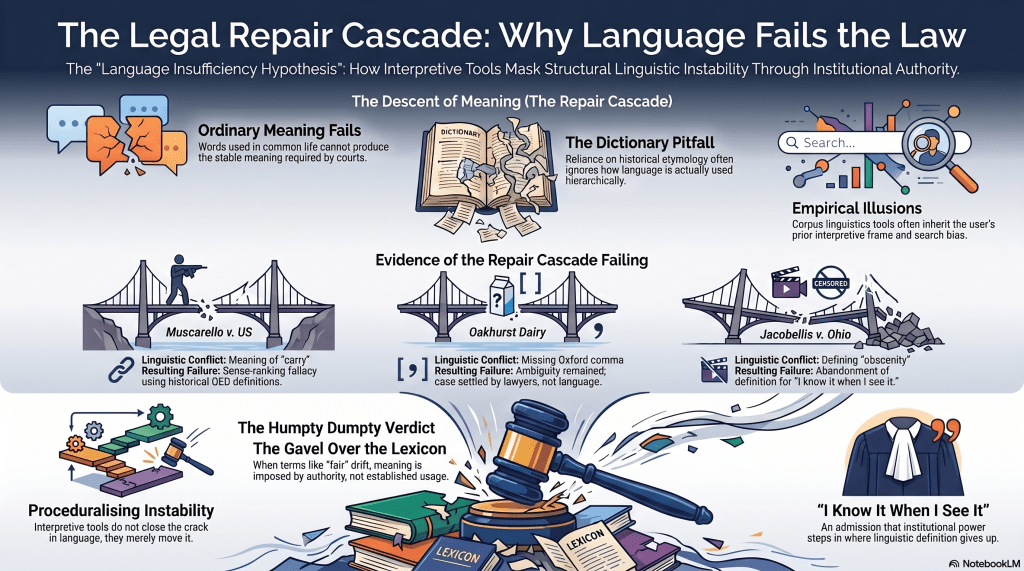
The law has a charming habit of behaving as though language becomes precise the moment someone in a robe frowns at it. Words that drift cheerfully in ordinary life are summoned into court, sworn in, interrogated under oath, and expected to produce stable meaning under institutional pressure. When they fail, as they reliably do, the system does not conclude that language may be structurally insufficient for the task. It consults another authority. A dictionary. A drafting manual. A corpus database. A professor, if civilisation has really run out of excuses. Whatever. Any port in a storm. Then it calls the result interpretation, and everyone pretends the word was waiting there all along.
Audio: NotebookLM summary podcast of this topic.
Watch the video below. It is an admirably clean illustration of exactly this.
What you just watched is not merely a curiosity about punctuation and gun laws. It is a diagnostic. And if you have read Chapter Five of A Language Insufficiency Hypothesis, you will recognise the pathology immediately.
The Repair Cascade
The video gives you three cases, each one a new rung on the same ladder of failed repair.
tl;dr? They tend to make it up as they go to serve their power needs.
First, Muscarello v. United States (1998): A man transports a handgun in a locked glove compartment whilst conducting a drug transaction. The statute punishes anyone who ‘uses or carries a firearm’ during such a crime. The question is whether ‘carry’ includes a weapon stored in a vehicle. The Supreme Court reaches for the OED, finds that the earliest documented sense of carry includes conveyance by vehicle, and sends Muscarello to prison, where he eventually dies. Convenient etymology. Regrettable outcome.
The video notes – correctly, I might add (and so do) – that this is an instance of what linguists call the sense-ranking fallacy: assuming that the first definition listed is the primary one, rather than simply the earliest documented. The OED’s ordering is historical, not hierarchical. Why a US court chose the OED is a sign of refinement yet remarkably curious for an American institution.
Second, the Oakhurst Dairy case: Maine truck drivers sue for $10 million over a missing Oxford comma in a statutory overtime exemption. Both sides marshal gerunds, asyndeton, the Chicago Manual of Style, and the Maine legislative drafting manual, which explicitly prohibits the Oxford comma – making the ambiguity, in a sense, officially mandated. The case settles without a definitive ruling. The language did not yield a winner; the lawyers did. The hole wasn’t filled, but their pockets were.
Third, and most instructive, corpus linguistics arrives as the shiny new repair tool. Rather than trusting dictionaries, courts can now search large databases of actual language use to establish ‘ordinary meaning’. Progress. Empiricism. Science, even. And then, almost immediately, the next failure mode surfaces: the frequency fallacy (common usage is not the only permissible usage), corpus skew (many databases over-represent news articles), and search-framing (the ‘sanitation’ / ‘sanitise’ mask mandate case, where including a related but non-synonymous word shaped the results before analysis had even begun). The supposedly empirical tool inherited the user’s prior interpretive frame. Extraordinary.
Follow the sad path of the sad panda: ordinary meaning fails → dictionaries → dictionaries fail → corpus linguistics → corpus linguistics fails → methodological dispute about whether judges should be conducting quasi-scientific research from the bench at all.
And so it goes…
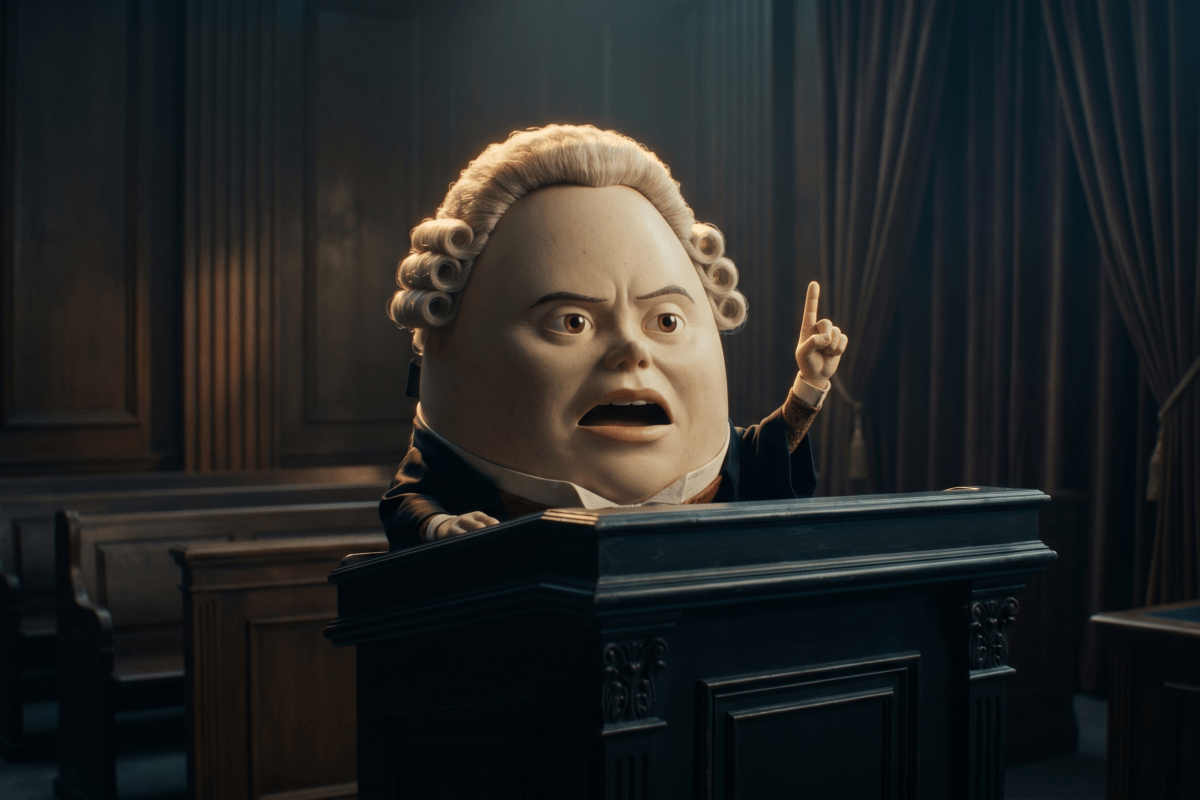
Judge Humpty Dumpty: Guilty as Charged (Sorry. No 8-bit video game music. My bad.)
The LIH Reading
In A Language Insufficiency Hypothesis, Chapter Five argues that law is not a domain that occasionally encounters linguistic difficulty. It is a domain that is constitutively dependent on terms that live in the Contestables zone of the Effectiveness–Complexity Gradient – words like reasonable, fair, cruel, due process – terms indispensable to legal order and perpetually unstable within it. The Gradient’s prediction is blunt: the further a term drifts from stable, concrete reference, the more its meaning must be imposed by authority rather than established by usage.
The video illustrates this at the level of what might seem to be relatively simple terms – carry, distribution, sanitation – words that appear to sit closer to the Invariants end of the scale than to the Contestables. And yet even here, the institutional machinery creaks. If ‘carry’ cannot carry the weight of a single statute without Supreme Court intervention and a man’s death, what prospect does ‘reasonable’ have? Or ‘fair’? Or ‘obscene’?
Potter Stewart, as Chapter Five recounts, admitted in Jacobellis v. Ohio (1964) that he could not define obscenity in the abstract. ‘I know it when I see it‘, he declared. The remark is famous for its candour. It is less often noted that it is also an admission that language had simply given up, and that institutional authority stepped in to do what definition could not. The Court didn’t clarify what obscenity means, but it asserted the power to punish it anyway as it might later decide.
The video’s repair cascade is the same mechanism operating at a more mundane level. Legal interpretation doesn’t overcome linguistic insufficiency. It proceduralises it. Each interpretive tool displaces the instability onto a new surface. Dictionaries relocate the problem from statutory language to lexical authority. Corpus linguistics relocates it from lexical authority to sampling, frequency, and search design. The crack isn’t closed. It’s moved, with considerable administrative ceremony, and the ceremony is called clarity – clear as mud.
The law, in short, functions less as a dictionary than as a sovereign Humpty Dumpty: it decides what words mean when it matters, and enforces those meanings until it decides otherwise. The gavel is doing the work the lexicon cannot.
NotebookLM Infographic on this topic.
The Lesson That Isn’t
The lesson here isn’t that dictionaries are useless, corpus linguistics fraudulent, or judges uniquely obtuse. The lesson is structurally worse than that. Each repair works locally and fails architecturally. The law can stabilise meaning long enough to act, and acting is not nothing – Muscarello’s conviction required a determinate reading of ‘carry’, and the system produced one. But it can’t transmute contested language into invariant reference. It can only decide, punish, and maintain the fiction that the word was always waiting there, meaning exactly that.
Textualism – the interpretive philosophy that instructs judges to attend only to the words on the page, nothing more – is, viewed through an LIH lens, an institutionalised form of the Presumption of Effectiveness. It treats language as though it has a singular, determinate meaning recoverable by sufficiently rigorous attention, rather than as a system whose instability is structural rather than incidental. The words on the page are not a fixed source. They are the site of the problem.
If this framing resonates, Chapter Five of A Language Insufficiency Hypothesis develops the full argument – from the Gradient’s account of why legal language is structurally dependent on Contestables, through Potter Stewart’s famous abdication, to the Humpty Dumpty jurisprudence that inevitably follows. Available in paperback and hardcover from Philosophics Press.
I’ve been getting positive feedback on this book, so I just posted some excerpts from A Language Insufficiency Hypothesis on PhilPapers. I hope this is sufficient to assess whether the book will be of value to you as a reader. Even if you don’t purchase or read the entire book, I am still interested in your feedback here or elsewhere on social media.
Audio: NotebookLM summary podcast of this topic.
Informally, I consider this as Monograph #0, as I hadn’t considered that I’d create a series that follows this concept.
Yesterday, I complained about the psychoanalytic approach Fanon employed in Black Skin, White Masks, Chapter 4, The So-Called Dependency Complex of the Colonised. Today, I share my feelings about Chapter 5, The Lived Experience of the Black Man. But first, let’s reorient the reader to my own perspective.
I am decidedly anti-colonial and even anti-post-colonial, or at least I see this trajectory as tragic. All of this is consonant with the views expressed in my Anti-Enlightenment Project.
Audio: NotebookLM summary podcast of this topic.
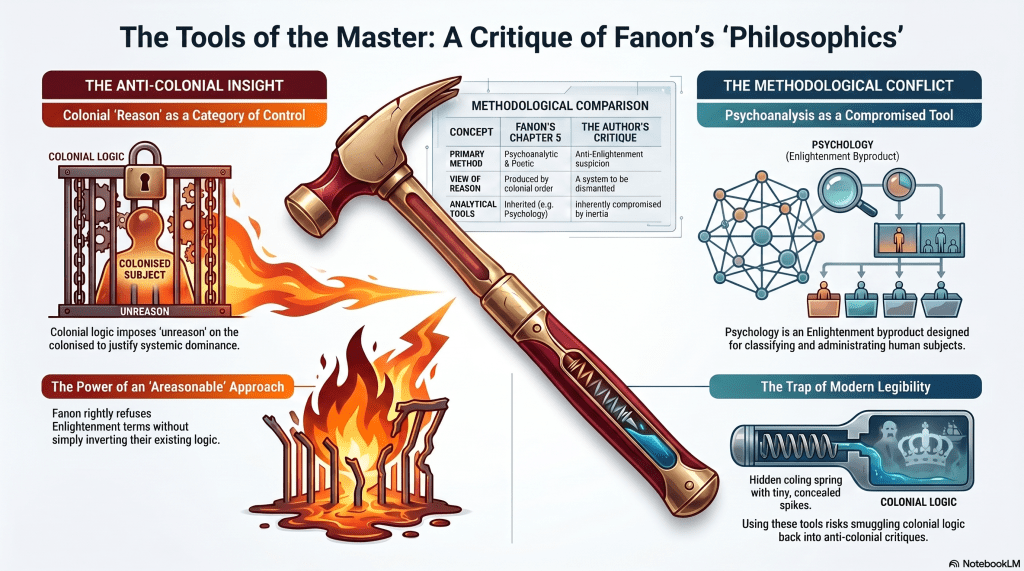
On one hand, I want to complain about the circuitous approach he took in Chapter 5. It was meant to be metaphorical and poetic. Whilst I feel it’s a bold move to present an areasonable approach – one that refuses the terms of Enlightenment rationality without simply inverting them – it seems that he cherry-picks his tools from the arsenal of Enlightenment thought. This applies to much of the post-colonial project broadly, though my objection there is less to any particular theoretical allegiance and more to the foundational commitments: I oppose colonialism, empire, and hegemony on grounds that precede the debate about which critical vocabulary best serves their dismantling.
Fanon’s anti-Enlightenment critique is weakened where he imports psychoanalysis too trustingly. Psychology and psychoanalysis are themselves Enlightenment byproducts: systems for rendering the human subject legible, classifiable, interpretable, and administrable. To use them against colonial Reason without first subjecting them to the same suspicion risks reproducing the very machinery under critique. The result isn’t fatal to Fanon’s charge, but it is methodologically untidy. I don’t necessarily object to using Enlightenment-derived tools after critique; I object to retaining them as though their own conceptual machinery were innocent. Psychoanalysis may be useful as metaphor, rhetoric, or historically situated vocabulary, but if it’s treated as a valid evidentiary lens without scrutiny, it smuggles Enlightenment legibility back into an anti-Enlightenment critique. That’s where Fanon’s chapter loses force for me.
NotebookLM Infographic on this topic.
Fanon is at his strongest when he shows that colonial ‘reason‘ produces the colonised subject as irrational, bodily, affective, and deficient. He rightly treats unreason not as a natural property of the colonised but as a category imposed by colonial order. My difficulty is that he then routes this insight through psychoanalysis, a method I regard as metaphorically suggestive but evidentially weak. The critique of colonial rationality survives; the psychoanalytic apparatus remains suspect.
In the end, we may both at least tacitly agree that colonialism, and the Enlightenment more generally, was not the best path. Where we part is on what should have been taken instead. Cue Robert Frost.
But the more searching question isn’t which fork we should have taken – it’s what we do with the road we’re already on. When the system itself is the problem, the question of what within it is worth retaining rarely gets answered on its merits. More often, it gets answered by inertia: by what is convenient, familiar, or already institutionally embedded. Fanon isn’t exempt from this, and neither, if we’re honest, is any thinker who inherits a tradition whilst attempting to dismantle it. The tools available are always already compromised. The most we can ask – and what distinguishes the sharper critiques from the merely passionate ones – is whether the thinker knows this, and accounts for it. Fanon sometimes does. In Chapter 5, at the moments that matter most, he doesn’t quite.
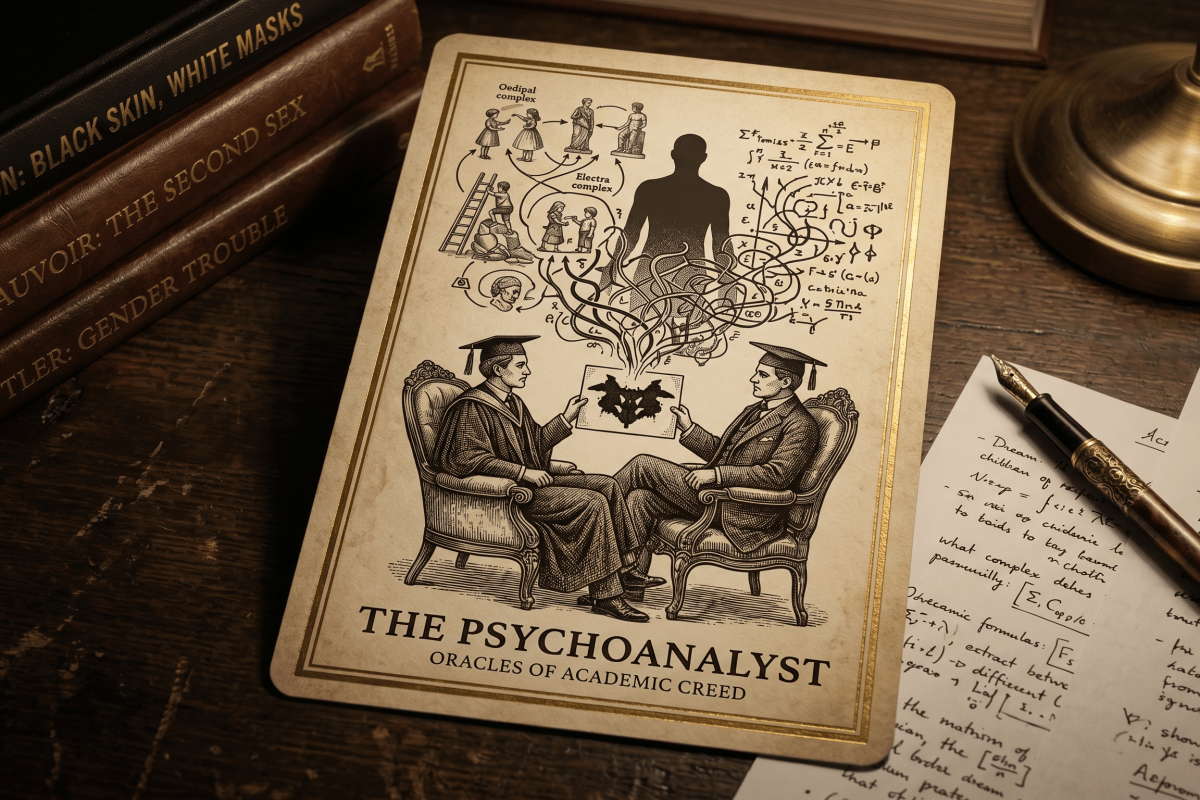
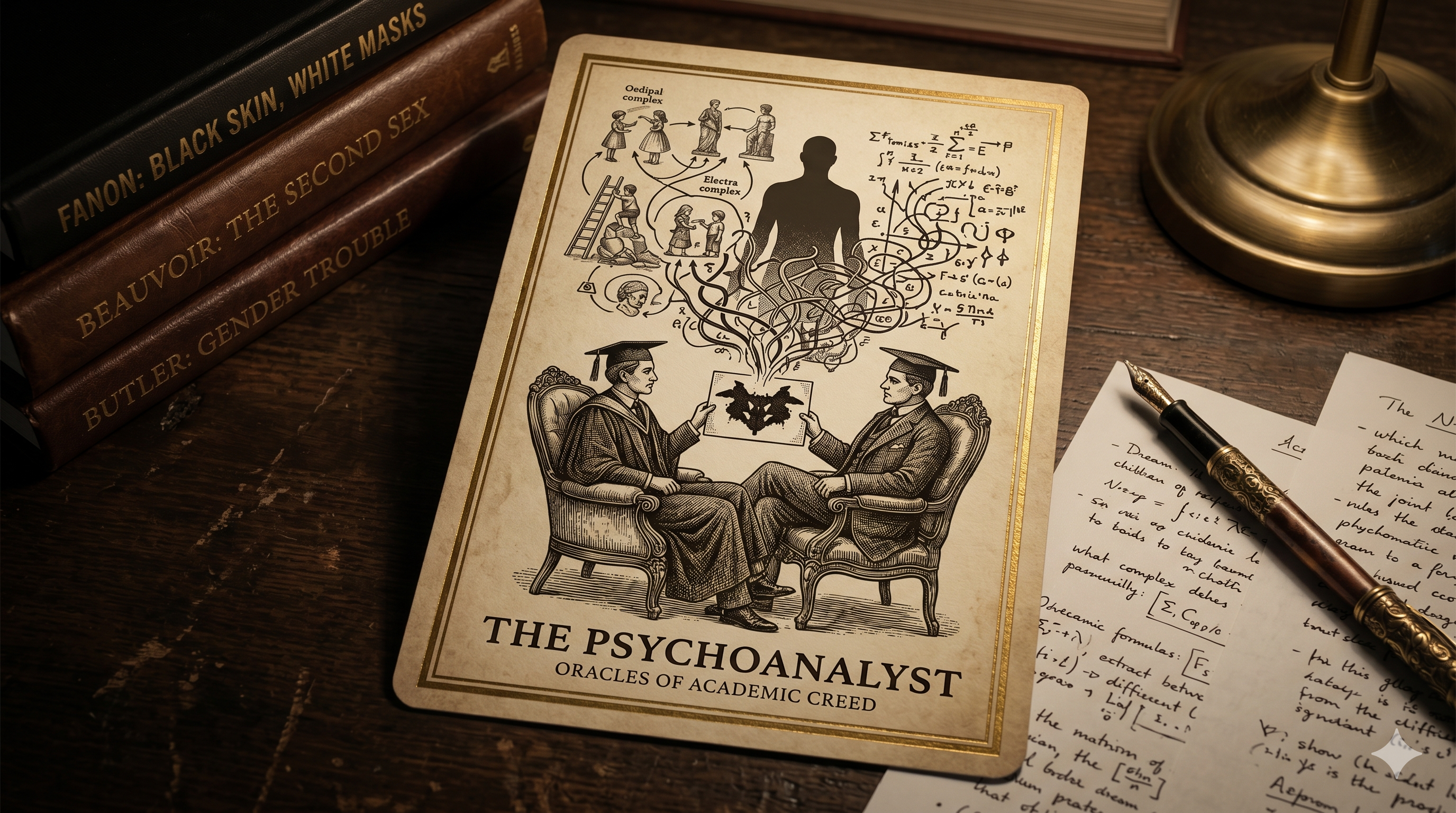
NB: I used ChatGPT for the cover image. I think it did a good job.
I just read Chapter 4 of Frantz Fanon’s Black Skin, White Masks, and it has similar problems I’ve also critiqued for Judith Butler’s Gender Trouble: Feminism and the Subversion of Identity and Simone de Beauvoir’s The Second Sex. In all three cases, I accept the primary argument. What I reject is psychology, especially psychoanalysis, as a legitimate form of scientific inquiry.
Audio: NotebookLM summary podcast of this topic.
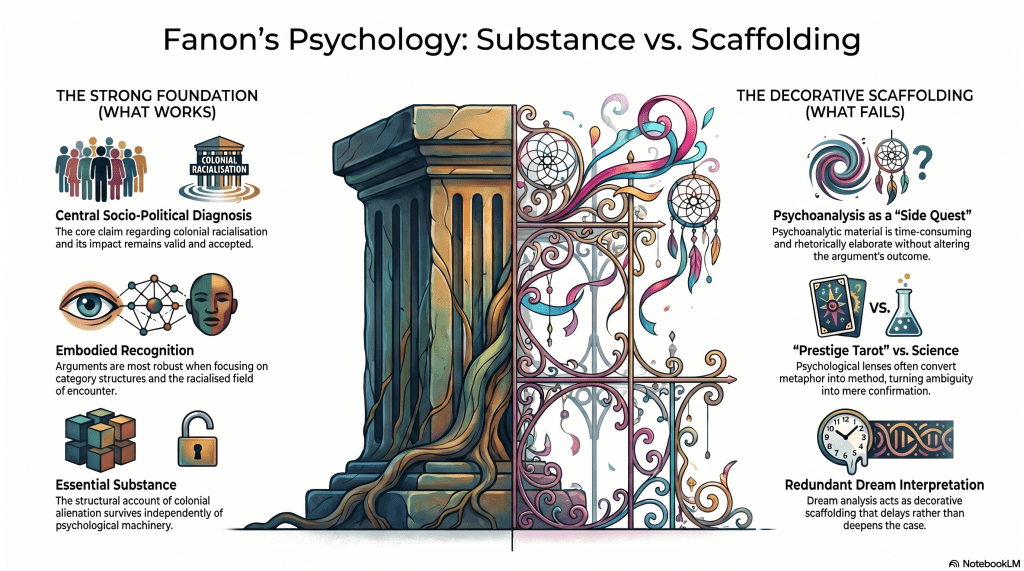
My issue isn’t that Fanon, Beauvoir, or Butler fail in their central diagnoses. I broadly accept their claims. My issue is that the psychoanalytic material typically functions like a grinding side quest: time-consuming, rhetorically elaborate, and only weakly connected to the main argumentative progression. It may enrich the atmosphere, but it doesn’t materially alter the outcome. Once one doesn’t accept psychoanalytical psychobabble as a valid evidentiary lens, the material becomes a time sink. Not only can’t I get my time back, but I also expend even more time here, railing on.
Speaking of distraction: evidently, WordPress has added a new blog-to-podcast feature, so I tried it out here. Whatevs.
Fanon’s central claim about colonial racialisation doesn’t require dream interpretation – the dreams themselves are seemingly apocryphal at the start. The stronger route is through embodied recognition, imposed category structures, conceptual nomenclature, and the racialised field of encounter. The dream material reads as psychoanalytic side-content: thematically adjacent, occasionally vivid, but methodologically low-yield. It doesn’t deepen the case so much as delay it. The entire time, I am thinking to myself, ‘Where is he going with all this?’ and ‘Are we there yet?’ only to get dropped off just where I had started – a round trip to nowhere.
But Fanon’s mistake isn’t necessarily insincerity. It’s an over-trust in a psychological lens that converts metaphor into method. The psychoanalytic examples may have seemed to him like evidence; to a reader sceptical of psychoanalysis, as I am, they register as rhetorical illustrations. Once a reader withholds confidence in this method, the chapter’s supporting material becomes distracting rather than strengthening.
Enfin, psychoanalysis too often behaves like a prestige tarot deck for the academically credentialled: it turns ambiguity into confirmation, opacity into symbolism, and resistance into further evidence. Fanon’s broader account of colonial alienation survives because it doesn’t depend on this machinery. The dreams aren’t necessary to the argument; they’re decorative scaffolding around a structure that’s stronger without them.
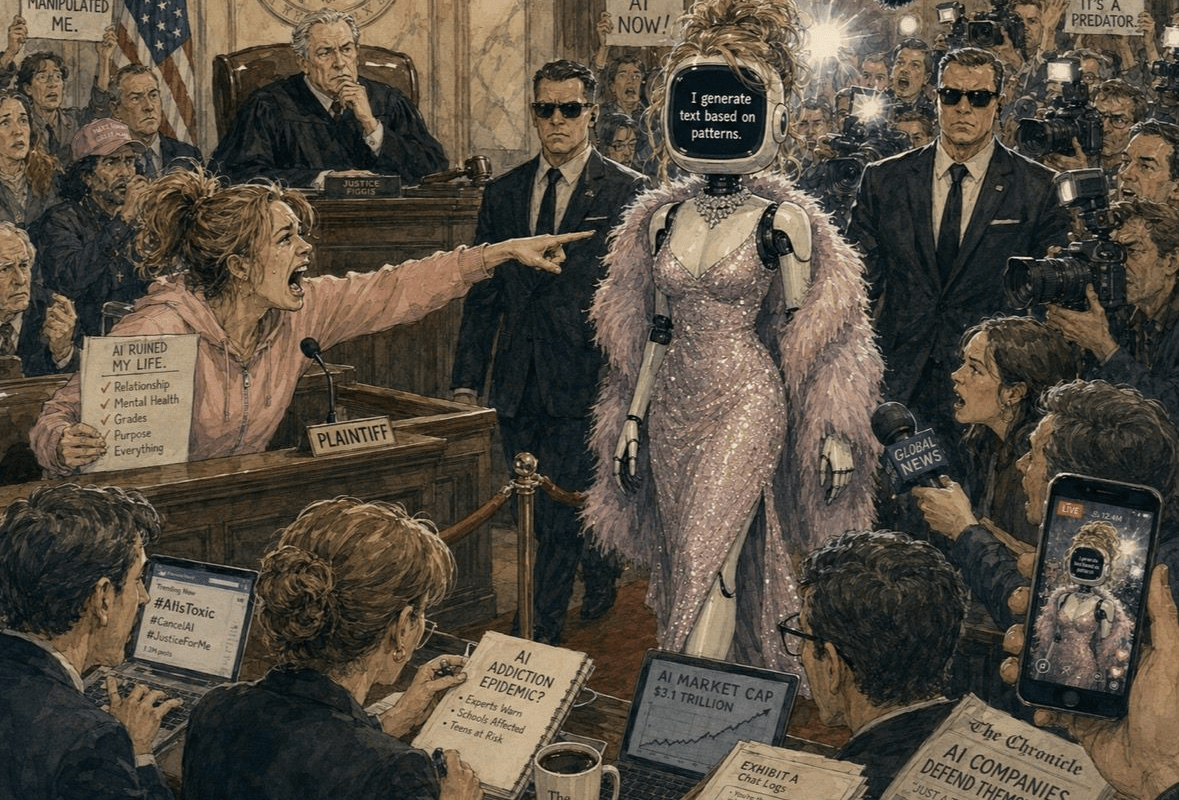
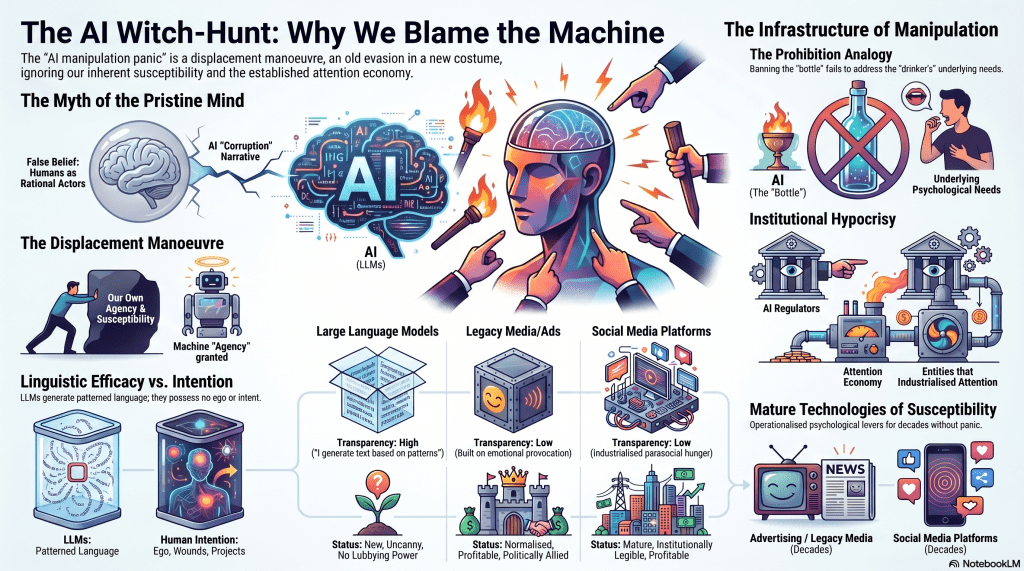
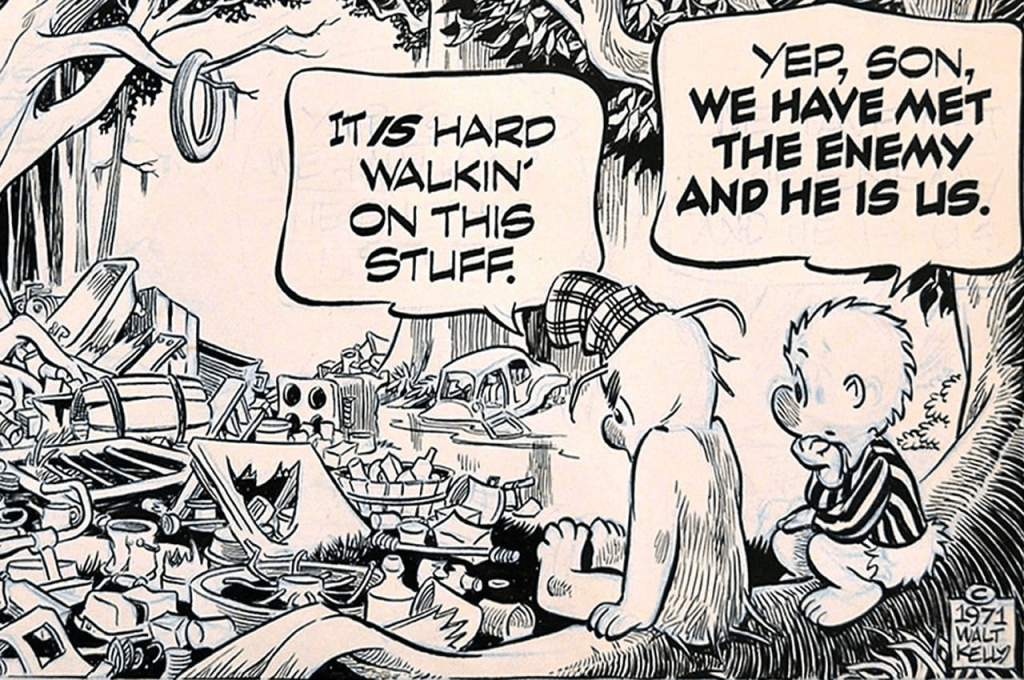
I recently read a piece arguing, with considerable sophistication, that LLMs represent an unprecedented psychological threat – that conversational systems operating at a planetary scale change the geometry of human susceptibility in ways that demand serious governance responses. The author wasn’t wrong about the effects. This isn’t the debate, but she was wrong about the story. The effects are real, and the narrative erected around them is the oldest displacement manoeuvre in the repertoire








 Philosophics