1–2 minutes
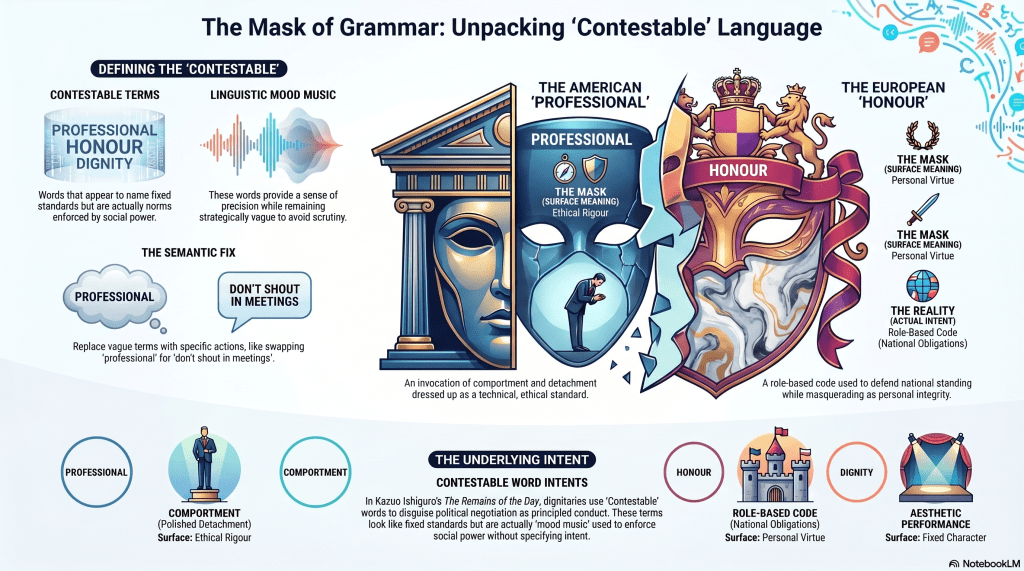
I had planned to write a blog post on The Remains of the Day, but I posted it on Substack instead because I changed the scope. I also created this podcast on NotebookLM.
Socio-political philosophical musings
I had planned to write a blog post on The Remains of the Day, but I posted it on Substack instead because I changed the scope. I also created this podcast on NotebookLM.

As I was preparing another essay – an essay on the rhetoric of evil – I had a thought about the relative intersubjectivity of subjectivity.
If one takes subjectivity seriously – not the Hollywood version with self-made heroes, but the real creature stitched together from language, history, and whatever emotional debris it stepped in on the way to adulthood – then one ends up somewhere awkward: the relative intersubjectivity of subjectivity.
Which is to say, we’re all standing on conceptual scaffolding built by other people, insisting it’s solid marble. A charming fiction, until we apply it to anything with moral voltage. ‘Evil’, for instance, collapses the moment you remove the demonological life-support and notice it’s little more than a child’s intensifier strapped to a cultural power tool.
More on that later. For now, just sit with the discomfort that the ‘self’ making moral judgments is already a negotiated artefact – relational, compromised, and never as autonomous as it pretends.


Apologies in advance for the didactic nature of this post.
Every so often, the universe gives you a gift. Not the good kind, like an unexpected bottle of Shiraz, but the other kind – the ‘teachable moment’ wrapped in a small tragedy. In this case, a perfectly innocent run of MEOW GPT (my Mediated Encounter Ontology engine) was fed into NotebookLM to generate a pseudo-podcast. And NotebookLM, bless its little algorithmic heart, proceeded to demonstrate every classic mistake people make when confronting a relational ontology.
It’s perfect. I couldn’t have scripted a better example of How Not To Read MEOW GPT if I’d hired a team of Enlightenment rationalists on retainer.
So consider this your public service announcement – and a guide for anyone experimenting with MEOW GPT at home, preferably while sitting down and not holding onto any cherished metaphysical delusions.
NotebookLM began, earnestly, by trying to uncover the ‘inner architecture of honour’, as if it were a cathedral with blueprints lying around.
This is the central error:
Honour is not a thing. There is no inner architecture.
There are only patterns – drifting, contested, historically mangled patterns – that happen to share a word. If you start with ‘What is honour?’, you’ve already fallen down the stairs.
MEOW GPT gives you biological (T0), cognitive (T1), linguistic (T2), and institutional/technical (T3) mediation because that’s how constraints emerge. NotebookLM, meanwhile, reconstructed these as ‘layers’ of the same virtue – like honour was a three-storey moral townhouse with a loft conversion.
No. The tiers are co-emergent constraints, not components of a moral particle.
If your conclusion looks like a metaphysical onion, you’ve misread the recipe.
NotebookLM kept returning to:
At this point we might as well carve Aristotle’s name into the hull.
MEOW’s stance is simple: the self is not a marble statue – it’s an ongoing social, cognitive, and technical scandal. Treating honour as a personality trait is just the old moral ontology with a new hairstyle.
NotebookLM acknowledged the differing uses of ‘honour’, but always with the implication that beneath the variations lies one pure moral essence. This is backwards. The ambiguity is the point. The polysemy isn’t messy data; it’s the signature of conceptual drift.
If you treat ambiguity as a problem to be ironed out, you’ve missed half the LIH and all of the MEOW.
The podcast tried to wrap things up by contrasting honour’s “deep internal permanence” with the ephemerality of digital rating systems.
It’s cute, but it’s still modernist comfort-food. MEOW does not mourn for the ‘permanent self’. It doesn’t recognise such a creature. And digital honour doesn’t ‘replace’ the old patterns; it aggressively rewrites the honour-economy into algorithmic form. If your conclusion sounds like ‘ancient virtue meets modern technology’, that’s TED, not MEOW.
A short cheat-sheet for anyone experimenting at home:
Warning:
If you believe thick moral concepts have single, universal meanings, MEOW GPT may cause temporary metaphysical discomfort.
Consult your ontological physician if symptoms persist.
 Philosophics