The Butler Did It (To Himself)

5–8 minutes

I have just started reading Kazuo Ishiguro’s The Remains of the Day, and I must confess that I can’t read like a normal person.

I made it roughly fifteen pages before the analytical lenses clamped on and refused to retract. Stevens – Ishiguro’s impeccable, heartbreaking narrator – opens with a monologue about what makes a great butler, and I found myself not following the argument so much as watching the scaffolding. Because Stevens isn’t really theorising butlers. He’s performing a world. And the performance is so seamless, so grammatically composed, that it almost disguises itself as description.

Audio: NotebookLM summary podcast of this topic.

Here’s the trick. Stevens treats terms like greatness, dignity, and quality as though they named discoverable features of reality. He doesn’t present them as historically contingent, institution-soaked, liable to buckle under interrogation. He presents them as if the universe itself had ratified them, and he’s merely reporting. It’s the calm, definitional tone of a man who believes he’s describing essences when he is actually curating preferences.

Take butler itself. In ordinary usage, it looks occupationally concrete – a person who does a particular job. But in Stevens’s mouth, it stops being a role descriptor and becomes a bearer of metaphysical vocation. The word accrues civilisational mythology, evaluative freight, quasi-sacred weight, until it no longer refers to a man who answers a door but to a figure who embodies an entire moral cosmology. That is a lot for a job title to carry, and the weight does not come from the world. It comes from the grammar.

Then there is dignity. An interlocutor reasonably suggests that dignity might be something like beauty, a weasel word, like aesthetic, perceptual, taste-bound. Stevens refuses the comparison. Dignity must not sound contingent. It must present itself as something sturdier than preference, almost an objective feature of character, something a person has in the way a table has weight.

And then, naturally, he proceeds to explain it in entirely aesthetic terms: comportment, bearing, restraint, and poise – the look of self-command.

He denies the aesthetic register but then relies on it. His explicit philosophy and his operative language diverge. This isn’t a slip. It’s structural. The term needs to disavow its own supports in order to retain authority. Dignity must deny its kinship with aesthetic discrimination precisely because, without that kinship, it has no flesh.

We do this constantly – take the shakiest words and polish them until they look load-bearing. The more pressure the term is under, the more ceremonially we utter it.
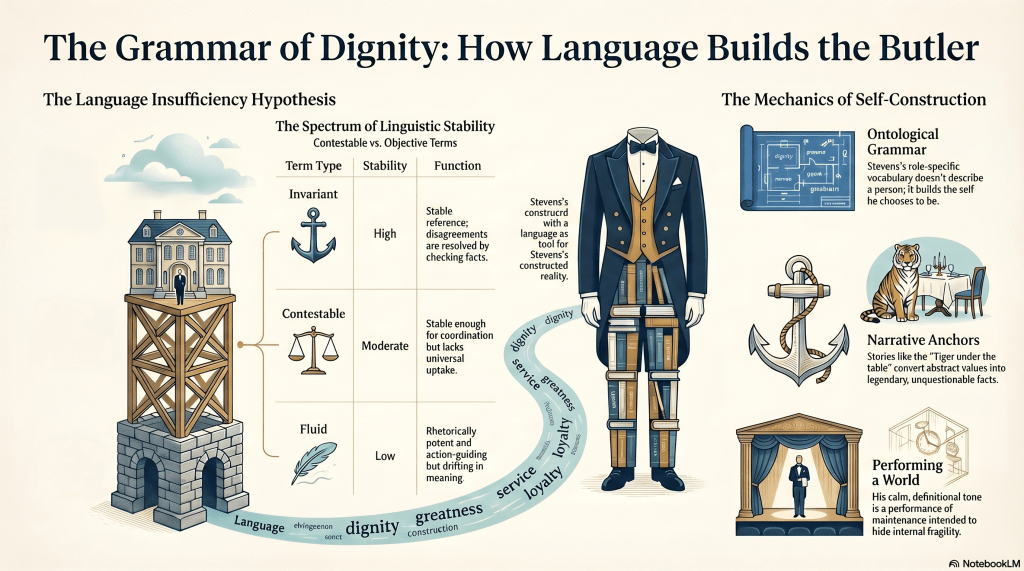
NotebookLM Infographic on this topic.

Weasel words

There’s a name for what Stevens is doing, and I’ve spent a perhaps inadvisable amount of time trying to articulate it.

In my own work, A Language Insufficiency Hypothesis, I distinguish between terms that behave differently under pressure. Some are genuinely invariant – they hold stable reference across contexts, and disagreement about them can be resolved by checking. Some are contestable – stable enough for coordination and argument, but insufficiently fixed to secure the same uptake everywhere. And some are fluid – still rhetorically potent, still action-guiding, but drifting across contexts without anyone quite admitting it.

Stevens’s vocabulary sits at the dangerous end of that spectrum. Greatness and dignity are classic contestables, possibly shading into fluids: they retain social force long after referential stability has gone soft. They still feel like they mean something precise. They don’t. And Stevens’ entire identity is organised around treating them as though they do.

This matters because the language isn’t sitting atop an independent self. It’s helping to constitute the self Stevens can intelligibly be. His selfhood is assembled from grammars of rank, service, and propriety. The role vocabulary doesn’t describe a prior person. It builds one.

This brings us to his father

Stevens admits that his father might belong among the great butlers, despite lacking certain attributes Stevens associates with the newer generation. He notes the gap, then writes it off. The missing qualities belong to a different era; they are secondary, accidental, beside the essential point. His father remains the reference.

But notice what has happened. Stevens is not applying a neutral criterion and then discovering that his father qualifies. He’s adjusting the criterion around the father he already reveres. The supposed standard of greatness turns out to be less a fixed measure than a retrospective act of preservation. Firstly, canonise the figure, then tidy the theory.

The father is doing at least three jobs at once: He’s an exemplar; he’s a stabilising emotional anchor; and he’s a concealed limit-case that proves the category is being bent.

That’s how value-laden language typically works. The abstraction pretends to govern the attachment, but really the attachment is governing the abstraction. Stevens wants the dignity of a rule whilst retaining the comfort of a cherished exception. This isn’t hypocrisy in the simple sense. It’s something more interesting: it’s the ordinary mechanics of human categorisation when the stakes are personal.

And of course, the father isn’t merely a person Stevens admires. He’s the living conduit through which Stevens inherits the whole ontology of service. When Stevens prefers his father as the reference point, he’s anchoring the category in the formative figure through whom the category became intelligible in the first place. The father is part of the installation mechanism.

Then there is the tiger

With the reverent caveat that it may be apocryphal, Stevens recounts a story in which an unidentifiable butler known to his father, confronted by a tiger under a dining room table (the details are gloriously improbable), maintains perfect composure. He doesn’t flinch. He doesn’t break form. He remains, in the deepest sense, a butler.

Whether the story is true barely matters. Its function isn’t evidential but exemplary. It condenses a whole metaphysics of dignity into narrative form. It is a saint’s life for the religion of service.

And that’s the key. For the father – and then for Stevens – dignity is not a detachable opinion. It’s a lived orientation. In the face of the tiger, one doesn’t first deliberate about values and then choose restraint. One already inhabits a world in which restraint is what seriousness looks like. The salience structure is preinstalled. The event is interpreted through it automatically.

The story converts dignity from abstraction into legend. It makes composure appear not merely admirable but real. It turns comportment into ontology. And it authorises imitation through lineage: the son inherits not just a standard but a dramatic image of what the standard looks like when tested.

The possible apocryphal status doesn’t weaken this. If anything, it strengthens it. The father has become less a man than a vessel for the category. The tale smooths over ambiguity and turns a contingent life into an emblem. We’re forever embalming values in stories, then pretending the stories prove the values rather than merely rehearse them.

So Ishiguro’s opening chapter is doing at least four things at once.

  1. It presents contestable terms as if they were settled realities.
  2. It shows institutional language masquerading as neutral description.
  3. It reveals a person whose identity has been stabilised – constituted, really – by those terms.
  4. And it lets the reader feel the gap between the serenity of the grammar and the fragility of what it is trying to hold together.

That last part is the killer. Stevens’s calm definitional tone is itself evidence of instability. The more pressure the terms are under, the more polished the delivery. He’s performing maintenance whilst pretending to describe an essence.

I’m only one chapter in. I suspect Ishiguro is going to make this hurt.

When Words Do the Work: A Case Study in Nomenclature Drift

3–5 minutes

Lewis Goodall, a talk show host, calls the cross-border seizure of Venezuela’s Nicolás Maduro a ‘kidnapping’. His guest and Trump apologist, Angie Wong, rejects the word. She first says ‘arrest’, then ‘extradition’, then finally the improvised ‘special extradition’. Around that single lexical choice, a 12-minute standoff unfolds.

Audio: NotebookLM summary podcast of this topic.

As a language philosopher, I am evaluating the language and am less concerned with the underlying facts of the matter. Language serves to obscure these facts from the start and then rhetorically controls the narrative and framing.

Video: Source segment being analysed

There is a familiar mistake made whenever public discourse turns heated: the assumption that the real disagreement lies in the facts. This is comforting, because facts can, at least in principle, be checked. What follows examines a different failure mode altogether. The facts are largely beside the point.

Consider a broadcast exchange in which a political commentator and an interviewer argue over how to describe the forcible removal of a head of state from one country to another. The interviewer repeatedly uses the word kidnapping. The guest repeatedly resists this term, preferring arrest, extradition, and eventually the improvisational compromise ‘special extradition’.

What matters here is not which term is correct. What matters is what the interaction reveals about how meaning is negotiated under pressure.

The illusion of disagreement

Superficially, the exchange appears to be a dispute about legality. Was there a treaty? Was due process followed? Which court has jurisdiction? These questions generate heat, but they are not doing the work.

The real disagreement is prior to all of that: which lexical frame is allowed to stabilise the event.

Once a label is accepted, downstream reasoning becomes trivial. If it was an extradition, it belongs to one legal universe. If it was a kidnapping, it belongs to another. The participants are not arguing within a shared framework; they are competing to install the framework itself.

Equivocation as method, not error

The guest’s shifting vocabulary is often described as evasive or incoherent. This misreads what is happening. The movement from extradition to special extradition is not confusion. It is a deliberate widening of semantic tolerance.

‘Special extradition’ is not meant to clarify. It is meant to survive. It carries just enough institutional residue to sound procedural, while remaining sufficiently vague to avoid binding criteria. It functions less as a description than as a holding pattern.

This is equivocation, but not the amateur kind taught in logic textbooks. It is equivocation under constraint, where the aim is not precision but narrative continuity.

Why exposure fails

The interviewer repeatedly points out that extradition has a specific meaning, and that the situation described does not meet it. This is accurate, and also ineffective.

Why? Because the exchange is no longer governed by definitional hygiene. The audience is not being asked to adjudicate a dictionary entry. They are being asked to decide which voice has the authority to name the act.

Once that shift occurs, exposing misuse does not correct the discourse. It merely clarifies the power asymmetry. The guest can concede irregularity, precedent-breaking, even illegality, without relinquishing control of the label. The language continues to function.

Truth as a downstream effect

At no point does the exchange hinge on discovering what ‘really happened’. The physical sequence of events is relatively uncontested. What is contested is what those events are allowed to count as.

In this sense, truth is not absent from the discussion; it is subordinate. It emerges only after a rhetorical frame has been successfully installed. Once the frame holds, truth follows obediently within it.

This is not relativism. It is an observation about sequence. Rhetoric does not decorate truth here; it prepares the ground on which truth is later claimed.

Language doing institutional work

The most revealing moment comes when the guest effectively shrugs at the legal ambiguity and asks who, exactly, is going to challenge it. This is not cynicism. It is diagnostic.

Words like arrest and extradition are not merely descriptive. They are operational tokens. They open doors, justify procedures, and allow institutions to proceed without stalling. Their value lies less in semantic purity than in administrative usability.

‘Kidnapping’ is linguistically precise in one register, but administratively useless in another. It stops processes rather than enabling them. That is why it is resisted.

What the case study shows

This exchange is not about geopolitics. It is about how language behaves when it is tasked with carrying power. Meaning drifts not because speakers are careless, but because precision is costly. Labels are selected for durability, not accuracy. Truth does not arbitrate rhetoric; rhetoric allocates truth. Seen this way, the debate over terminology is not a failure of communication. It is communication functioning exactly as designed under modern conditions. Which is why insisting on ‘the correct word’ increasingly feels like shouting into a ventilation system. The air still moves. It just isn’t moving for you.

A History of Language Insufficiency

3–4 minutes

I’ve been working on A Language Insufficiency Hypothesis since 2018. At least, that’s the polite, CV-friendly version. The truer account is that it’s been quietly fermenting since the late 1970s, back when I was still trapped in primary school and being instructed on how the world supposedly worked.

Social Studies. Civics. Law. The whole civic catechism. I remember being taught about reasonable persons and trial by a jury of one’s peers, and I remember how insistently these were presented as fair solutions. Fairness was not argued for. It was asserted, with the weary confidence of people who think repetition counts as justification.

I didn’t buy it. I still don’t. The difference now is that I have a hypothesis with some explanatory power instead of a vague sense that the adults were bluffing.

Audio: NotebookLM summary podcast of this topic.

I’ve always been an outsider. Eccentric, aloof, l’étranger if we’re feeling theatrical. It never particularly troubled me. Outsiders are often tolerated, provided they remain decorative and non-contagious. Eye rolls were exchanged on both sides. No harm done.

But that outsider position had consequences. It led me, even then, to ask an awkward question: Which peers? Not because I thought I was superior, but because I was plainly apart. How exactly was I meant to be judged by my peers when no one else occupied anything like my perspective?

Later, when I encountered the concept of fundamental attribution bias, it felt less like a revelation and more like confirmation. A peer-based system assumes not just similarity of circumstance, but similarity of interpretation. That assumption was dead on arrival.

Then there were reasonable persons. I was assured they existed. I was assured judges were trained to embody them. I had never met one. Even as a teenager, I found the idea faintly comical. Judges, I was told, were neutral, apolitical, and dispassionate. Writing this now from the United States, one hardly needs to belabour the point. But this wasn’t prescience. It was intuition. The smell test failed decades ago.

Before LIH had a name, I called these things weasel words. I still do, as a kind of shorthand. Terms like fair, reasonable, accountable, appropriate. Squishy concepts that do serious institutional work whilst remaining conveniently undefinable. Whether one wants to label them Contestables or Fluids is less important than recognising the space they occupy.

That space sits between Invariables, things you can point to without dispute, and Ineffables, where language more or less gives up. Communication isn’t binary. It isn’t ‘works’ or ‘doesn’t’. It’s a gradient. A continuous curve from near-certainty to near-failure.

Most communication models quietly assume a shared ontology. If misunderstanding occurs, the remedy is more explanation, more context, more education. What never sat right with me, even as a child, was that this only works when the disagreement is superficial. The breaking point is ontological.

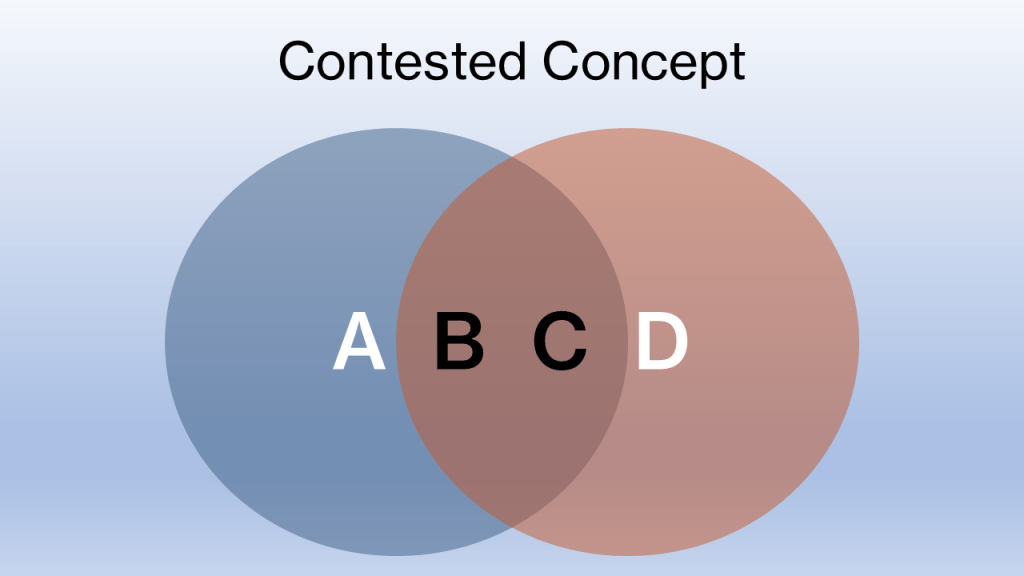
If one person believes a term means {A, B, C} and another believes it means {B, C, D}, the overlap creates a dangerous illusion of agreement. The disagreement hides in the margins. A and D don’t merely differ. They are often irreconcilable.

Image: Venn diagramme of a contested concept.
Note: This is illustrative and not to scale

Fairness is a reliable example. One person believes fairness demands punishment, including retributive measures. Another believes fairness permits restoration but rejects retribution, citing circumstance, history, or harm minimisation. Both invoke fairness sincerely. The shared language conceals the conflict.

When such disputes reach court, they are not resolved by semantic reconciliation. They are resolved by authority. Power steps in where meaning cannot. This is just one illustration. There are many.

I thought it worth sharing how LIH came about, if only to dispel the notion that it’s a fashionable response to contemporary politics. It isn’t. It’s the slow crystallisation of a long-standing intuition: that many of our most cherished concepts don’t fail because we misuse them, but because they were never capable of doing the work we assigned to them.

More to come.