
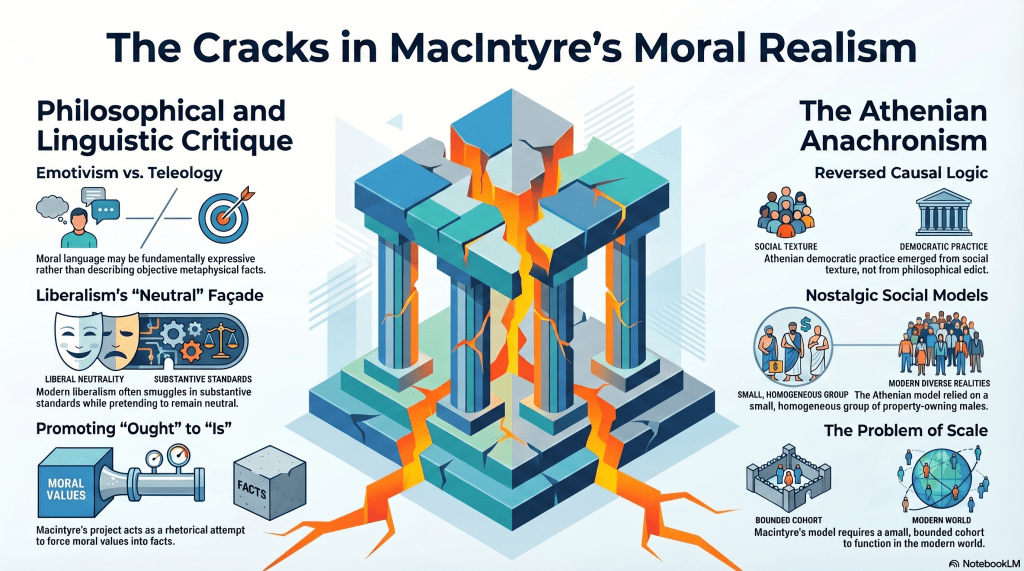
Alasdair MacIntyre is persuasive when he argues that moral discourse is never neutral, and that modern liberalism smuggles in substantive standards while pretending not to. But he dismisses emotivism too quickly as a cultural disaster rather than considering whether it might describe moral language more accurately than his own teleological alternative. If moral utterance is fundamentally prescriptive or expressive rather than descriptive, then the collapse of ‘view from nowhere’ morality doesn’t send us scurrying back to Aristotle. It simply shows that moral language was never doing the metaphysical work MacIntyre wants from it.
The Aristotelian remedy also depends on a nostalgic and anachronistic social model. The Athens he implicitly romanticises was a small polis whose demos consisted of citizens, meaning property-owning males, already bound by shared norms, proximity, and cultural inheritance. In other words, the sort of thick local world that made a certain kind of practical ethical life possible in the first place. MacIntyre’s causal arrow points the wrong way. In Athens, democratic practice emerged from that prior social texture. You do not reproduce the same conditions by philosophical edict.
To put it more bluntly: I don’t think moral realism is tenable, and I am not convinced MacIntyre really thinks so either. His project reads less like a discovery of moral facts than an attempt to promote an ought into an is by force of inheritance and rhetorical confidence. If he carved out a bounded cohort and imposed the right shared practices, perhaps something like his model could function. He may need to annex a reasonably sized car park for the purpose.
 Philosophics