The Butler Did It (To Himself)

5–8 minutes

I have just started reading Kazuo Ishiguro’s The Remains of the Day, and I must confess that I can’t read like a normal person.

I made it roughly fifteen pages before the analytical lenses clamped on and refused to retract. Stevens – Ishiguro’s impeccable, heartbreaking narrator – opens with a monologue about what makes a great butler, and I found myself not following the argument so much as watching the scaffolding. Because Stevens isn’t really theorising butlers. He’s performing a world. And the performance is so seamless, so grammatically composed, that it almost disguises itself as description.

Audio: NotebookLM summary podcast of this topic.

Here’s the trick. Stevens treats terms like greatness, dignity, and quality as though they named discoverable features of reality. He doesn’t present them as historically contingent, institution-soaked, liable to buckle under interrogation. He presents them as if the universe itself had ratified them, and he’s merely reporting. It’s the calm, definitional tone of a man who believes he’s describing essences when he is actually curating preferences.

Take butler itself. In ordinary usage, it looks occupationally concrete – a person who does a particular job. But in Stevens’s mouth, it stops being a role descriptor and becomes a bearer of metaphysical vocation. The word accrues civilisational mythology, evaluative freight, quasi-sacred weight, until it no longer refers to a man who answers a door but to a figure who embodies an entire moral cosmology. That is a lot for a job title to carry, and the weight does not come from the world. It comes from the grammar.

Then there is dignity. An interlocutor reasonably suggests that dignity might be something like beauty, a weasel word, like aesthetic, perceptual, taste-bound. Stevens refuses the comparison. Dignity must not sound contingent. It must present itself as something sturdier than preference, almost an objective feature of character, something a person has in the way a table has weight.

And then, naturally, he proceeds to explain it in entirely aesthetic terms: comportment, bearing, restraint, and poise – the look of self-command.

He denies the aesthetic register but then relies on it. His explicit philosophy and his operative language diverge. This isn’t a slip. It’s structural. The term needs to disavow its own supports in order to retain authority. Dignity must deny its kinship with aesthetic discrimination precisely because, without that kinship, it has no flesh.

We do this constantly – take the shakiest words and polish them until they look load-bearing. The more pressure the term is under, the more ceremonially we utter it.
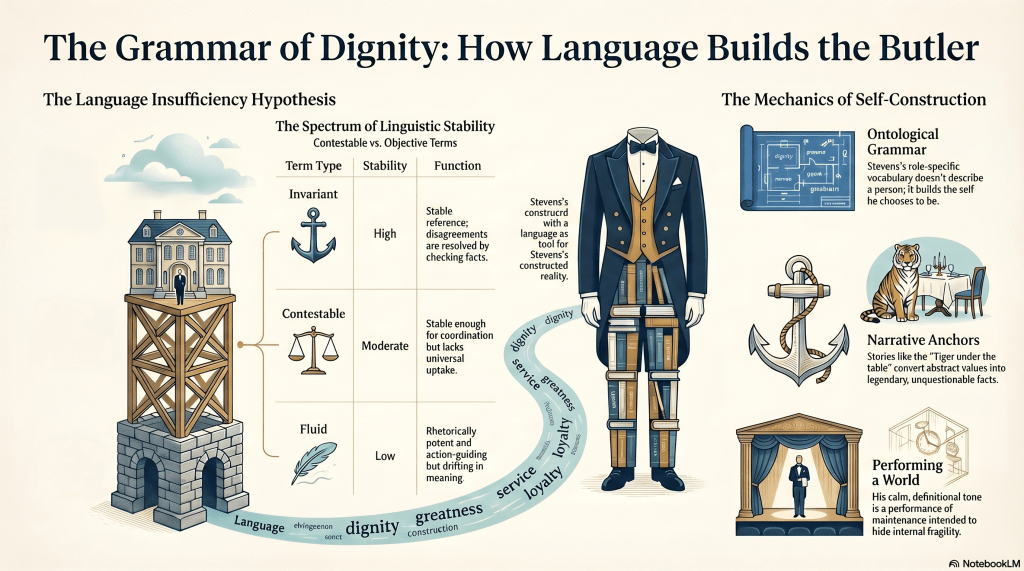
NotebookLM Infographic on this topic.

Weasel words

There’s a name for what Stevens is doing, and I’ve spent a perhaps inadvisable amount of time trying to articulate it.

In my own work, A Language Insufficiency Hypothesis, I distinguish between terms that behave differently under pressure. Some are genuinely invariant – they hold stable reference across contexts, and disagreement about them can be resolved by checking. Some are contestable – stable enough for coordination and argument, but insufficiently fixed to secure the same uptake everywhere. And some are fluid – still rhetorically potent, still action-guiding, but drifting across contexts without anyone quite admitting it.

Stevens’s vocabulary sits at the dangerous end of that spectrum. Greatness and dignity are classic contestables, possibly shading into fluids: they retain social force long after referential stability has gone soft. They still feel like they mean something precise. They don’t. And Stevens’ entire identity is organised around treating them as though they do.

This matters because the language isn’t sitting atop an independent self. It’s helping to constitute the self Stevens can intelligibly be. His selfhood is assembled from grammars of rank, service, and propriety. The role vocabulary doesn’t describe a prior person. It builds one.

This brings us to his father

Stevens admits that his father might belong among the great butlers, despite lacking certain attributes Stevens associates with the newer generation. He notes the gap, then writes it off. The missing qualities belong to a different era; they are secondary, accidental, beside the essential point. His father remains the reference.

But notice what has happened. Stevens is not applying a neutral criterion and then discovering that his father qualifies. He’s adjusting the criterion around the father he already reveres. The supposed standard of greatness turns out to be less a fixed measure than a retrospective act of preservation. Firstly, canonise the figure, then tidy the theory.

The father is doing at least three jobs at once: He’s an exemplar; he’s a stabilising emotional anchor; and he’s a concealed limit-case that proves the category is being bent.

That’s how value-laden language typically works. The abstraction pretends to govern the attachment, but really the attachment is governing the abstraction. Stevens wants the dignity of a rule whilst retaining the comfort of a cherished exception. This isn’t hypocrisy in the simple sense. It’s something more interesting: it’s the ordinary mechanics of human categorisation when the stakes are personal.

And of course, the father isn’t merely a person Stevens admires. He’s the living conduit through which Stevens inherits the whole ontology of service. When Stevens prefers his father as the reference point, he’s anchoring the category in the formative figure through whom the category became intelligible in the first place. The father is part of the installation mechanism.

Then there is the tiger

With the reverent caveat that it may be apocryphal, Stevens recounts a story in which an unidentifiable butler known to his father, confronted by a tiger under a dining room table (the details are gloriously improbable), maintains perfect composure. He doesn’t flinch. He doesn’t break form. He remains, in the deepest sense, a butler.

Whether the story is true barely matters. Its function isn’t evidential but exemplary. It condenses a whole metaphysics of dignity into narrative form. It is a saint’s life for the religion of service.

And that’s the key. For the father – and then for Stevens – dignity is not a detachable opinion. It’s a lived orientation. In the face of the tiger, one doesn’t first deliberate about values and then choose restraint. One already inhabits a world in which restraint is what seriousness looks like. The salience structure is preinstalled. The event is interpreted through it automatically.

The story converts dignity from abstraction into legend. It makes composure appear not merely admirable but real. It turns comportment into ontology. And it authorises imitation through lineage: the son inherits not just a standard but a dramatic image of what the standard looks like when tested.

The possible apocryphal status doesn’t weaken this. If anything, it strengthens it. The father has become less a man than a vessel for the category. The tale smooths over ambiguity and turns a contingent life into an emblem. We’re forever embalming values in stories, then pretending the stories prove the values rather than merely rehearse them.

So Ishiguro’s opening chapter is doing at least four things at once.

  1. It presents contestable terms as if they were settled realities.
  2. It shows institutional language masquerading as neutral description.
  3. It reveals a person whose identity has been stabilised – constituted, really – by those terms.
  4. And it lets the reader feel the gap between the serenity of the grammar and the fragility of what it is trying to hold together.

That last part is the killer. Stevens’s calm definitional tone is itself evidence of instability. The more pressure the terms are under, the more polished the delivery. He’s performing maintenance whilst pretending to describe an essence.

I’m only one chapter in. I suspect Ishiguro is going to make this hurt.
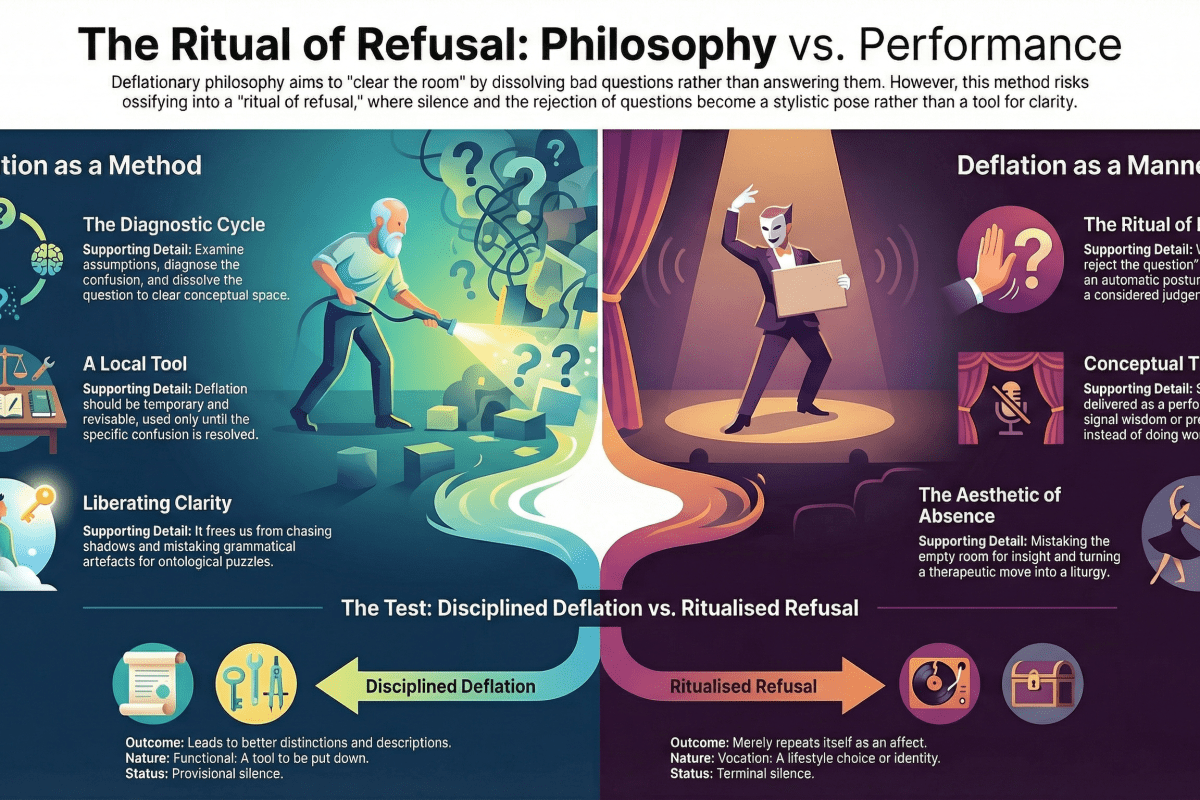
When Deflation Becomes Ritual

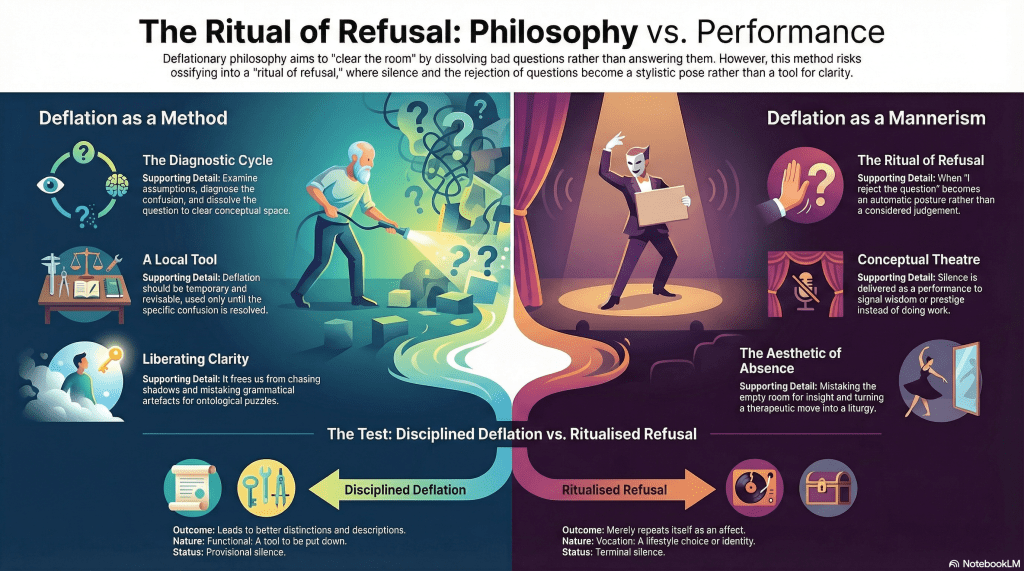
I recently shared a post calling out mystics, trying to fill spaces I deflate, but I am self-aware enough that I can be guilty, too. I worry about Maslow’s Law of the Instrument. Deflationary philosophy likes to imagine itself as immune to excess. It dissolves puzzles, clears away bad questions, and resists the urge to add metaphysical upholstery where none is needed. No mysteries, thank you. No hidden depths. Just conceptual hygiene. This self-image is mostly deserved. But not indefinitely. This post is an attitude check.

Because deflation, like anything that works, can ossify. And when it does, it doesn’t inflate into metaphysics. It hardens into something more embarrassing: a ritual of refusal.

Audio: NotebookLM summary podcast on this topic.

From method to mannerism

Deflation begins as a method:

  • A question is posed.
  • Its assumptions are examined.
  • The confusion is diagnosed.
  • The question dissolves.
  • Everyone goes home.

At its best, this is liberating. It frees us from chasing shadows and mistaking grammatical artefacts for ontological puzzles. The trouble begins when the gesture outlives the job.

What was once a diagnostic move becomes a stylistic tic. Refusal becomes automatic. Silence becomes performative. ‘There is nothing there’ is delivered not as a conclusion, but as a posture. At that point, deflation stops doing work and starts doing theatre.

I am often charged with being negative, a pessimist, a relativist, and a subjectivist. I am sometimes each of these. Mostly, I am a Dis–Integrationist and deflationist, as it were. I like to tear things apart – not out of malice, but seeing that certain things just don’t sit quite right.

Another thing I do is to take things at face value. As I came up through the postmodern tradition, I don’t trust metanarratives, and I look for them everywhere. This is why I wrote A Language Insufficiency Hypothesis (LIH), and even more so, the Mediated Encounter Ontology (MEOW). Some words carry a lot of baggage and connotation, so I want to be sure I understand the rawest form. This is why I rail on about weasel words like truth, justice, freedom, and such.

I also refrain from responding if I am not satisfied with a definition. This is why I consider myself an igntheist as opposed to an atheist. Functionally, I am the latter, but the definition I’d be opposing is so inane that it doesn’t even warrant me taking a position.

Image: NotebookLM infographic of this topic.

The prestige of saying less

There is a quiet prestige attached to not answering questions. Refusal sounds serious. Restraint sounds wise. Silence, in the right lighting, sounds profound. This is not an accident. Our intellectual culture has learned to associate verbal minimalism with depth, much as it associates verbosity with insecurity. Deflationary philosophers are not immune to this aesthetic pull.

When ‘I reject the question’ becomes a default response rather than a considered judgement, deflation has slipped from method into mannerism. The absence of claims becomes a badge. The lack of commitments becomes an identity. One is no longer clearing space, but occupying emptiness.

This is how deflation acquires a style – and styles are how rituals begin.

Apophasis without God

Mysticism has its negative theology. Ritualised deflation develops something similar.

Both rely on:

  • refusal to name
  • insistence on limits
  • reverent quiet

The difference is meant to be procedural. Mysticism stops at the silence. Deflation is supposed to pass through it. But when deflation forgets that its silence is provisional, it starts to resemble the thing it set out to criticise. Absence becomes sacred again, just without the cosmology. The metaphysician worships what cannot be said. The ritualised deflationist admires themselves for not saying it. Neither is doing conceptual work anymore.

A brief and unavoidable Wittgenstein

This is where Ludwig Wittgenstein inevitably reappears, not as an authority, but as a warning. Wittgenstein did not think philosophy ended in silence because silence was holy. He thought philosophy ended in silence because the confusion had been resolved. The ladder was to be thrown away, not mounted on the wall and admired. Unfortunately, ladders make excellent décor.

When deflation becomes ritual, the therapeutic move freezes into liturgy. The gesture is preserved long after its purpose has expired. What was meant to end a problem becomes a way of signalling seriousness. That was never the point.

A diagnostic test

There is a simple question that separates disciplined deflation from its ritualised cousin:

  • Is this refusal doing explanatory work, or is it being repeated because it feels right?
  • If silence leads to better distinctions, better descriptions, or better questions, it is doing its job.
  • If silence merely repeats itself, it has become an affect.

And affects, once stabilised, are indistinguishable from rituals.

Deflation is local, not terminal

The corrective is not to abandon deflation, but to remember its scope.

Deflation should be:

  • local rather than global
  • temporary rather than terminal
  • revisable rather than aestheticised

Some questions need dissolving. Some need answering. Some need rephrasing. Knowing which is which is the entire discipline. Deflation is not a worldview. It is not a temperament. It is not a lifestyle choice. It is a tool, and like all tools, it should be put down when it stops fitting the task.

Clearing space is not a vocation

There is a temptation, once a room has been cleared, to linger in it. To admire the quiet. To mistake the absence of furniture for the presence of insight. But clearing space is not a vocation. It is a task. Once it is done, staying behind is just another way of refusing to leave. And refusal, repeated without reason, is no longer philosophy. It is choreography.

The Expiration Date of Object Permanence

2–4 minutes

There is a persistent story we tell ourselves about quantum mechanics:* that it reveals reality to be fundamentally strange, paradoxical, or hostile to common sense. Particles in two places at once. Cats be both alive and dead. Worlds multiplying to save appearances.

I’ve never found that story convincing.

Audio: NotebookLM summary podcast of this topic.
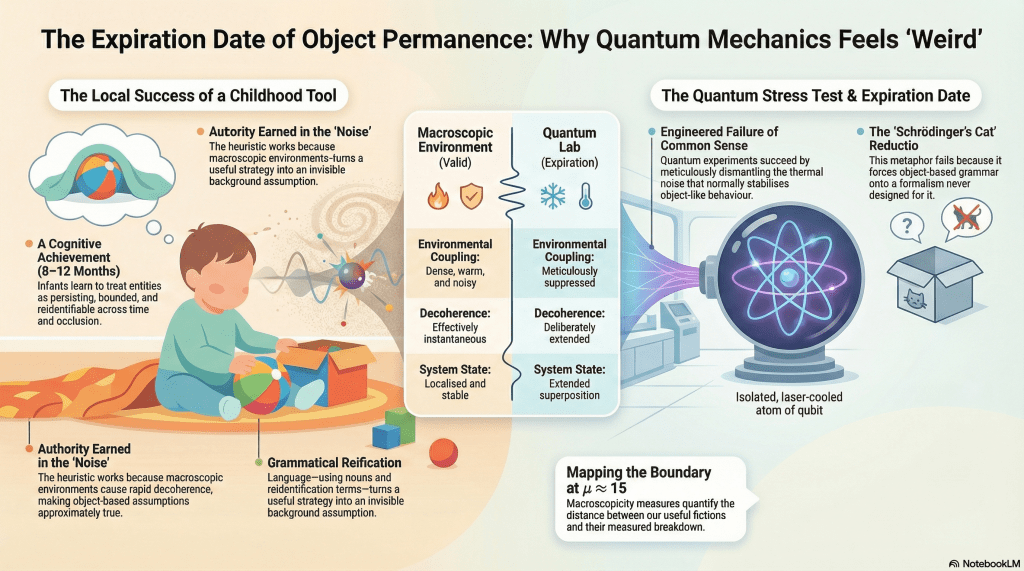
Image: NotebookLM infographic for this topic.

What I do find convincing is a simpler diagnosis: that we are applying a cognitive tool far beyond the conditions under which it earned its authority – and then mistaking the resulting discomfort for metaphysical insight.

Object permanence is one of our earliest and most successful heuristics. It allows infants to track toys behind sofas, caregivers behind doors, and threats behind occlusion. Without it, coordinated action would be impossible. With it, the world becomes navigable, predictable, and stable. It is a genuine cognitive achievement. But it is not a universal guarantee about reality.

In a new essay, The Expiration Date of Object Permanence: Heuristics, Grammar, and Quantum Pseudoproblems, I argue that much of what we call ‘quantum weirdness’ arises from the uncritical extension of this heuristic into domains where its ecological licensing no longer holds. The problem is not that quantum mechanics violates common sense. The problem is that we quietly treat common sense as metaphysics.

Quantum mechanics functions here not as a mystery generator, but as a stress test. Recent matter-wave interference experiments with increasingly massive systems show that object-based expectations fail quantifiably under carefully engineered conditions. When environmental coupling is suppressed, when decoherence is delayed, when the world is no longer warm, noisy, and forgiving, the assumptions underwriting object permanence simply stop paying rent.

The essay also takes a dim view of some familiar cultural furniture. Schrödinger’s cat, for example, was introduced as a reductio – an intentionally absurd demonstration of what happens when microscopic formalism is naively scaled up. That it now circulates as an explanatory image tells us less about quantum mechanics than about the tenacity of object-grammar. Even jokes cannot escape it.

Interpretations fare no better. I suggest that the appeal of frameworks like Many-Worlds is not exhausted by their technical merits. They also function as strategies for preserving object-based reidentification – ways of ensuring that there is still something that can be pointed to, counted, and followed through time, even if the price is ontological inflation.

None of this denies the reality of quantum phenomena, nor does it pretend to solve the measurement problem. The essay is deliberately deflationary. Its claim is methodological, not revisionary: that many of the puzzles we inherit are artefacts of treating developmentally acquired heuristics as if they were unconditional features of the world.

Philosophy’s task, on this view, is not to make reality intuitive. It is to recognise when intuition has reached the end of its jurisdiction.

The paper is now available on Zenodo and will be indexed shortly on PhilPapers. As always, comments, objections, and principled misreadings are welcome.


This post and the underlying essay were inspired by a Nature article: Probing quantum mechanics with nanoparticle matter-wave interferometry, published on 21 January 2026. I get annoyed watching people misunderstand quantum mechanics and its effects, so I decided to address some of the issues in an essay. Read this essay as well as mine, which will explain why the paradoxes and ‘spooky behaviour’ of QM are only counter-intuitive if you’ve fallen into this heuristic trap.

Why Deflationary Philosophy Keeps Attracting Mystics

4–5 minutes

The struggle is real. There is an odd occupational hazard that comes with writing deflationary philosophy: mystics keep turning up to thank you for your service.

This is always mildly bewildering. One spends a great deal of time dismantling metaphysical furniture, only to discover a small group lighting incense in the newly cleared space. Candles appear. Silence thickens. Someone whispers ineffable. Nope. The filing cabinet was just mislabeled.

Audio: NotebookLM summary podcast of this topic.

The problem is not misunderstanding. It’s reuse.

It is tempting to think this is a simple misreading: I say this concept breaks down here, and someone hears you have glimpsed the ultimate. But that’s too kind. What’s really happening is more interesting. Mysticism does not merely misunderstand deflationary work; it feeds on the same linguistic moves and then stops too early.

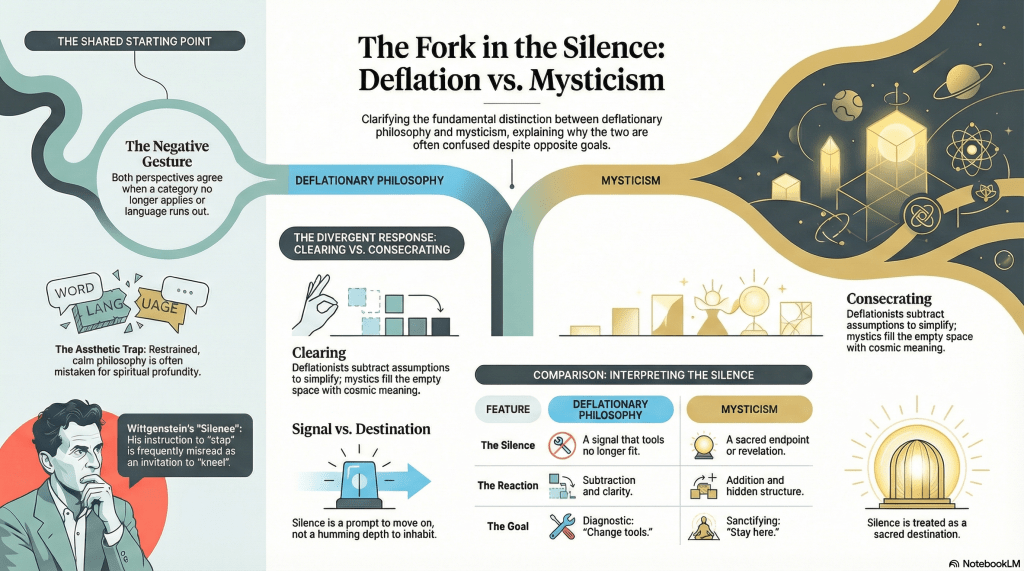
Both mysticism and deflation rely on negative gestures:

  • “This description fails.”
  • “That category no longer applies.”
  • “Our usual language runs out.”

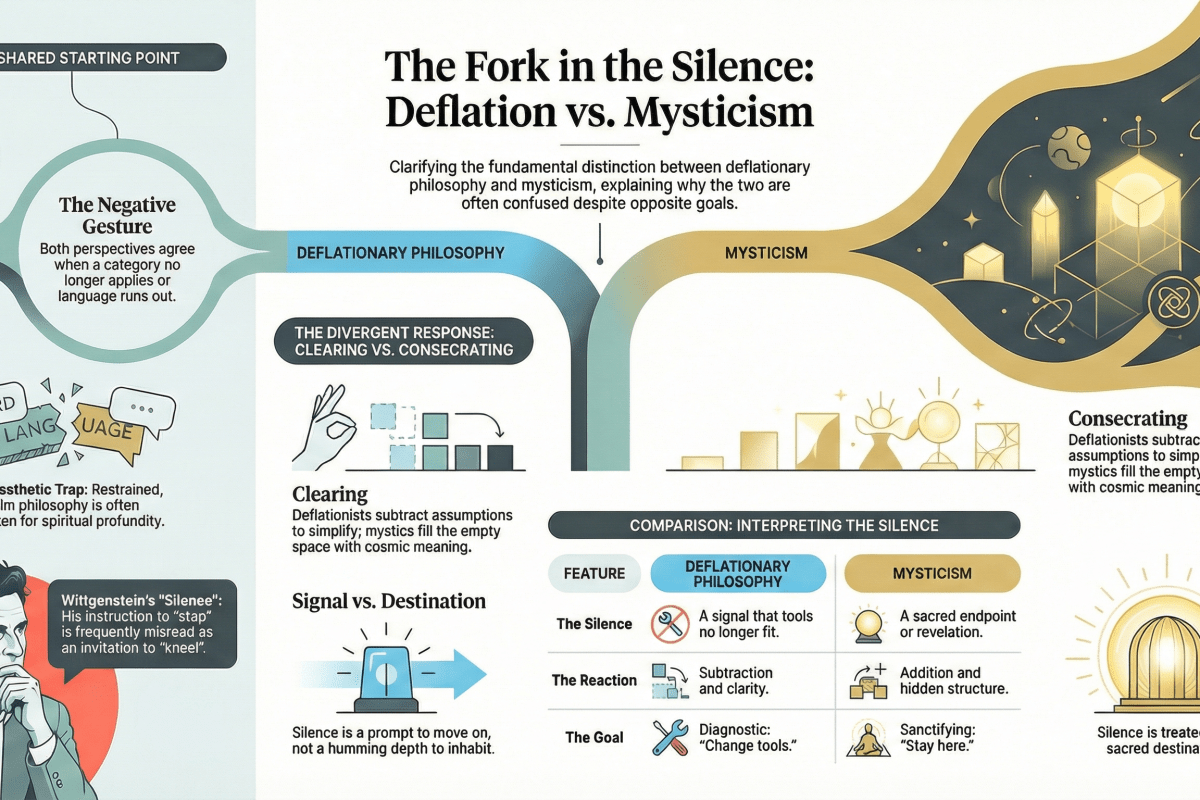
Up to this point, they are indistinguishable. The fork comes immediately after. The mystic treats conceptual failure as an endpoint. The silence itself becomes the destination. Something deep must live there, humming quietly, just out of reach.

The deflationist treats the same failure as a transition. The silence is not sacred. It’s a signal. It means: this tool no longer fits; pick another or move on. Same breakdown. Entirely different posture.

Clearing space versus consecrating it

Much deflationary philosophy clears space. It removes assumptions that were doing illicit work and leaves behind something quieter, simpler, and occasionally disappointing.

Mysticism has a standing policy of consecrating cleared space. An empty room is never just empty. It must be pregnant with meaning. Absence becomes depth. Silence becomes revelation. The fewer claims you make, the more cosmic you must be.

This is not a philosophical disagreement so much as a difference in temperament. One side sees subtraction. The other experiences loss and rushes to compensate. Modern intellectual culture strongly prefers addition. New layers. Hidden structures. Further depths. Deflation feels like theft. So it gets reinterpreted as a subtler form of enrichment: Ah, fewer words, therefore more truth.

The aesthetic trap

There is also an aesthetic problem, which I increasingly suspect does most of the damage. Deflationary philosophy, when done well, tends to sound calm, patient, and restrained. It does not shout. It does not posture. It does not perform certainty. Unfortunately, this is exactly how profundity is supposed to sound.

Quiet seriousness is easily mistaken for spiritual depth. Refusal to speculate reads as wisdom. Negative definition acquires an apophatic glow. This is how one ends up being mistaken for a mystic without having said anything mystical at all.

A brief word about Wittgenstein (because of course)

This is not a new problem. Ludwig Wittgenstein spent a good portion of his career trying to convince people that philosophical problems arise when language goes on holiday. He was not pointing at a deeper reality beyond words. He was pointing back at the words and saying: look at what you’re doing with these.

Unfortunately, “Whereof one cannot speak, thereof one must be silent” has proven irresistible to those who think silence is where the real action is. Wittgenstein meant: stop here. Many readers heard: kneel here. This is the recurring fate of therapeutic philosophy. The cure gets mistaken for a sacrament.

Charity is not complicity

Another contributor to the confusion is tone. Deflationary work tends to be charitable. It explains why certain intuitions arise. It traces confusions to their sources. It does not sneer. This generosity is often misheard as validation. When you say, “It makes sense that we think this way,” some readers hear, “Your intuition is pointing at something profound.” You are offering an explanation. They are receiving an affirmation. At that point, no disclaimer will save you. Any denial is absorbed as further evidence that you are brushing up against something too deep to articulate.

The real disagreement

The disagreement here is not about reality. It is about what to do when explanation fails.

Mysticism treats failure as revelation. Deflation treats failure as diagnostic.

One sanctifies the breakdown. The other changes tools.

Once you see this, the repeated misfire stops being frustrating and starts being predictable.

A final, self-directed warning

There is, admittedly, a risk on the other side as well. Deflation can become mystical if it turns into ritual. If refusal hardens into identity. If “there is nothing there” becomes something one performs rather than concludes. Even subtraction can acquire ceremony if repeated without purpose. The discipline, such as it is, lies in knowing when to clear space—and when to leave the room.

No replacement gods

When a metaphysical idol is removed, someone will always ask what god is meant to replace it. The deflationary answer is often disappointing: none. This will never satisfy everyone. But the room is cleaner now, and that has its own quiet reward—even if someone insists on lighting incense in the corner.

Image: Full cover image infographic by NotebookLM

The Ontology–Encounter–Evaluation Model: Retributive Justice as an Instantiation

7–10 minutes

Now that A Language Insufficiency Hypothesis has been put to bed — not euthanised, just sedated — I can turn to the more interesting work: instantiating it. This is where LIH stops being a complaint about words and starts becoming a problem for systems that pretend words are stable enough to carry moral weight.

Read part 2 of this essay.

What follows is not a completed theory, nor a universal schema. It’s a thinking tool. A talking point. A diagram designed to make certain assumptions visible that are usually smuggled in unnoticed, waved through on the strength of confidence and tradition.

The purpose of this diagram is not to redefine justice, rescue it, or replace it with something kinder. It is to show how justice is produced. Specifically, how retributive justice emerges from a layered assessment process that quietly asserts ontologies, filters encounters, applies normative frames, and then closes uncertainty with confidence.

Audio: NotebookLM summary podcast of this topic.

Most people are willing to accept, in the abstract, that justice is “constructed”. That concession is easy. What is less comfortable is seeing how it is constructed — how many presuppositions must already be in place before anything recognisable as justice can appear, and how many of those presuppositions are imposed rather than argued for.

The diagram foregrounds power, not as a conspiracy or an optional contaminant, but as an ambient condition. Power determines which ontologies are admissible, which forms of agency count, which selves persist over time, which harms are legible, and which comparisons are allowed. It decides which metaphysical configurations are treated as reasonable, and which are dismissed as incoherent before the discussion even begins.

Justice, in this framing, is not discovered. It is not unearthed like a moral fossil. It is assembled. And it is assembled late in the process, after ontology has been assumed, evaluation has been performed, and uncertainty has been forcibly closed.

This does not mean justice is fake. It means it is fragile. Far more fragile than its rhetoric suggests. And once you see that fragility — once you see how much is doing quiet, exogenous work — it becomes harder to pretend that disagreements about justice are merely disagreements about facts, evidence, or bad actors. More often, they are disagreements about what kind of world must already be true for justice to function at all.

I walk through the structure and logic of the model below. The diagram is also available as a PDF, because if you’re going to stare at machinery, you might as well be able to zoom in on the gears.

Why Retributive Justice (and not the rest of the zoo)

Before doing anything else, we need to narrow the target.

“Justice” is an infamously polysemous term. Retributive, restorative, distributive, procedural, transformative, poetic, cosmic. Pick your flavour. Philosophy departments have been dining out on this buffet for centuries, and nothing useful has come of letting all of them talk at once.

This is precisely where LIH draws a line.

The Language Insufficiency Hypothesis is not interested in pedestrian polysemy — cases where a word has multiple, well-understood meanings that can be disambiguated with minimal friction. That kind of ambiguity is boring. It’s linguistic weather.

What LIH is interested in are terms that appear singular while smuggling incompatible structures. Words that function as load-bearing beams across systems, while quietly changing shape depending on who is speaking and which assumptions are already in play.

“Justice” is one of those words. But it is not usefully analysable in the abstract.

So we pick a single instantiation: Retributive Justice.

Why?

Because retributive justice is the most ontologically demanding and the most culturally entrenched. It requires:

  • a persistent self
  • a coherent agent
  • genuine choice
  • intelligible intent
  • attributable causation
  • commensurable harm
  • proportional response

In short, it requires everything to line up.

If justice is going to break anywhere, it will break here.

Retributive justice is therefore not privileged in this model. It is used as a stress test.

The Big Picture: Justice as an Engine, Not a Discovery

The central claim of the model is simple, and predictably unpopular:

Not invented in a vacuum, not hallucinated, not arbitrary — but assembled through a process that takes inputs, applies constraints, and outputs conclusions with an air of inevitability.

The diagram frames retributive justice as an assessment engine.

An engine has:

  • inputs
  • internal mechanisms
  • thresholds
  • failure modes
  • and outputs

It does not have access to metaphysical truth. It has access to what it has been designed to process.

The justice engine takes an encounter — typically an action involving alleged harm — and produces two outputs:

  • Desert (what is deserved),
  • Responsibility (to whom it is assigned).

Everything else in the diagram exists to make those outputs possible.

The Three Functional Layers

The model is organised into three layers. These are not chronological stages, but logical dependencies. Each layer must already be functioning for the next to make sense.

1. The Constitutive Layer

(What kind of thing a person must already be)

This layer answers questions that are almost never asked explicitly, because asking them destabilises the entire process.

  • What counts as a person?
  • What kind of self persists over time?
  • What qualifies as an agent?
  • What does it mean to have agency?
  • What is a choice?
  • What is intent?

Crucially, these are not empirical discoveries made during assessment. They are asserted ontologies.

The system assumes a particular configuration of selfhood, agency, and intent as a prerequisite for proceeding at all. Alternatives — episodic selves, radically distributed agency, non-volitional action — are not debated. They are excluded.

This is the first “happy path”.

If you do not fit the assumed ontology, you do not get justice. You get sidelined into mitigation, exception, pathology, or incoherence.

2. The Encounter Layer

(What is taken to have happened)

This layer processes the event itself:

  • an action
  • resulting harm
  • causal contribution
  • temporal framing
  • contextual conditions
  • motive (selectively)

This is where the rhetoric of “facts” tends to dominate. But the encounter is never raw. It is already shaped by what the system is capable of seeing.

Causation here is not metaphysical causation. It is legible causation.
Harm is not suffering. It is recognisable harm.
Context is not total circumstance. It is admissible context.

Commensurability acts as a gatekeeper between encounter and evaluation: harms must be made comparable before they can be judged. Anything that resists comparison quietly drops out of the pipeline.

3. The Evaluative Layer

(How judgment is performed)

Only once ontology is assumed and the encounter has been rendered legible does evaluation begin:

  • proportionality
  • accountability
  • normative ethics
  • fairness (claimed)
  • reasonableness
  • bias (usually acknowledged last, if at all)

This layer presents itself as the moral heart of justice. In practice, it is the final formatting pass.

Fairness is not discovered here. It is declared.
Reasonableness does not clarify disputes. It narrows the range of acceptable disagreement.
Bias is not eliminated. It is managed.

At the end of this process, uncertainty is closed.

That closure is the moment justice appears.

Why Disagreement Fails Before It Starts

At this point, dissent looks irrational.

The system has:

  • assumed an ontology
  • performed an evaluation
  • stabilised the narrative through rhetoric
  • and produced outputs with institutional authority

To object now is not to disagree about evidence. It is to challenge the ontology that made assessment possible in the first place.

And that is why so many justice debates feel irresolvable.

They are not disagreements within the system.
They are disagreements about which system is being run.

LIH explains why language fails here. The same words — justice, fairness, responsibility, intent — are being used across incompatible ontological commitments. The vocabulary overlaps; the worlds do not.

The engine runs smoothly. It just doesn’t run the same engine for everyone.

Where This Is Going

With the structure in place, we can now do the slower work:

  • unpacking individual components
  • tracing where ontological choices are asserted rather than argued
  • showing how “reasonableness” and “fairness” operate as constraint mechanisms
  • and explaining why remediation almost always requires a metaphysical switch, not better rhetoric

That should worry us more than if it were merely malfunctioning.

The rest of the story

Read part 2 of this essay.

This essay is already long, so I’m going to stop here.

Not because the interesting parts are finished, but because this is the point at which the analysis stops being descriptive and starts becoming destabilising.

The diagram you’ve just walked through carries a set of suppressed footnotes. They don’t sit at the margins because they’re trivial; they sit there because they are structurally prior. Each one represents an ontological assertion the system quietly requires in order to function at all.

By my count, the model imposes at least five such ontologies. They are not argued for inside the system. They are assumed. They arrive pre-installed, largely because they are indoctrinated, acculturated, and reinforced long before anyone encounters a courtroom, a jury, or a moral dilemma.

Once those ontologies are fixed, the rest of the machinery behaves exactly as designed. Disagreement downstream is permitted; disagreement upstream is not.

In a follow-up essay, I’ll unpack those footnotes one by one: where the forks are, which branch the system selects, and why the alternatives—while often coherent—are rendered unintelligible, irresponsible, or simply “unreasonable” once the engine is in motion.

That’s where justice stops looking inevitable and starts looking parochial.

And that’s also where persuasion quietly gives up.

Justice as a House of Cards

4–6 minutes

How retribution stays upright by not being examined

There is a persistent belief that our hardest disagreements are merely technical. If we could stop posturing, define our terms, and agree on the facts, consensus would emerge. This belief survives because it works extremely well for birds and tables.

It fails spectacularly for justice.

Audio: NotebookLM summary podcast of this topic.

The Language Insufficiency Hypothesis (LIH) isn’t especially interested in whether people disagree. It’s interested in how disagreement behaves under clarification. With concrete terms, clarification narrows reference. With contested ones, it often fractures it. The more you specify, the more ontologies appear.

Justice is the canonical case.

Retributive justice is often presented as the sober, adult conclusion. Not emotional. Not ideological. Just what must be done. In practice, it is a delicately balanced structure built out of other delicately balanced structures. Pull one term away and people grow uneasy. Pull a second and you’re accused of moral relativism. Pull a third and someone mentions cavemen.

Let’s do some light demolition. I created a set of 17 Magic: The Gathering-themed cards to illustrate various concepts. Below are a few. A few more may appear over time.

Card One: Choice

Image: MTG: Choice – Enchantment

The argument begins innocently enough:

They chose to do it.

But “choice” here is not an empirical description. It’s a stipulation. It doesn’t mean “a decision occurred in a nervous system under constraints.” It means a metaphysically clean fork in the road. Free of coercion, history, wiring, luck, trauma, incentives, or context.

That kind of choice is not discovered. It is assumed.

Pointing out that choices are shaped, bounded, and path-dependent does not refine the term. It destabilises it. Because if choice isn’t clean, then something else must do the moral work.

Enter the next card.

Card Two: Agency

Image: MTG: Agency – Creature – Illusion

Agency is wheeled in to stabilise choice. We are reassured that humans are agents in a morally relevant sense, and therefore choice “counts”.

Counts for what, exactly, is rarely specified.

Under scrutiny, “agency” quietly oscillates between three incompatible roles:

  • a descriptive claim: humans initiate actions
  • a normative claim: humans may be blamed
  • a metaphysical claim: humans are the right kind of cause

These are not the same thing. Treating them as interchangeable is not philosophical rigour. It’s semantic laundering.

But agency is emotionally expensive to question, so the discussion moves on briskly.

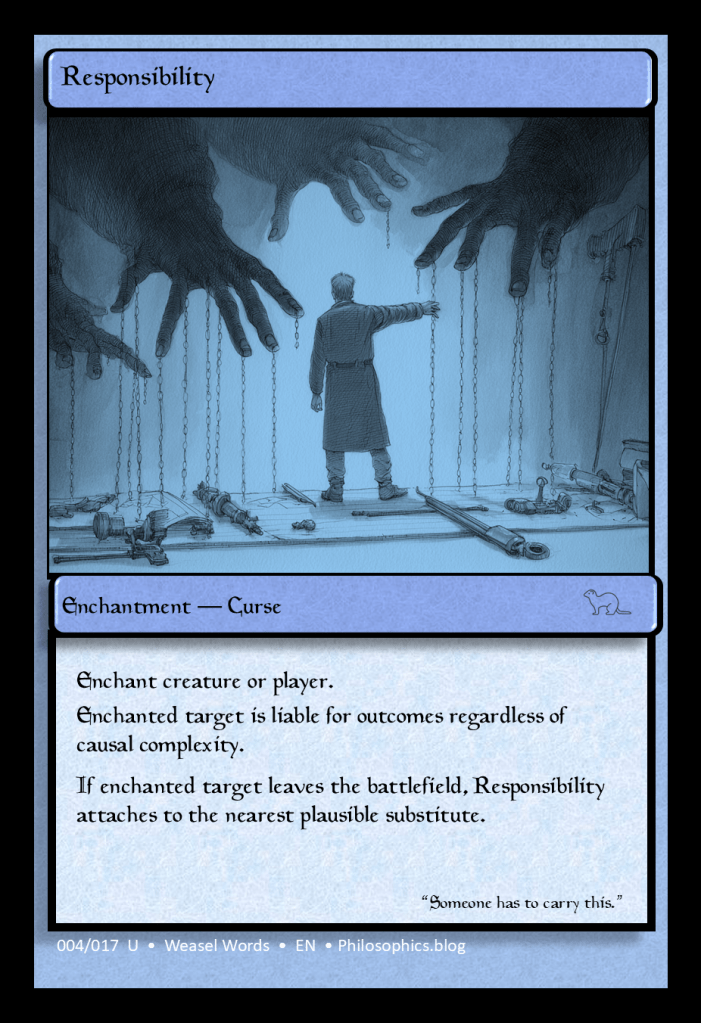
Card Three: Responsibility

Image: MTG: Responsibility – Enchantment – Curse

Responsibility is where the emotional payload arrives.

To say someone is “responsible” sounds administrative, even boring. In practice, it’s a moral verdict wearing a clipboard.

Watch the slide:

  • causal responsibility
  • role responsibility
  • moral responsibility
  • legal responsibility

One word. Almost no shared criteria.

By the time punishment enters the picture, “responsibility” has quietly become something else entirely: the moral right to retaliate without guilt.

At which point someone will say the magic word.

Card Four: Desert

Image: MTG: Desert – Instant

Desert is the most mystical card in the deck.

Nothing observable changes when someone “deserves” punishment. No new facts appear. No mechanism activates. What happens instead is that a moral permission slip is issued.

Desert is not found in the world. It is declared.

And it only works if you already accept a very particular ontology:

  • robust agency
  • contra-causal choice
  • a universe in which moral bookkeeping makes sense

Remove any one of these and desert collapses into what it always was: a story we tell to make anger feel principled.

Which brings us, finally, to the banner term.

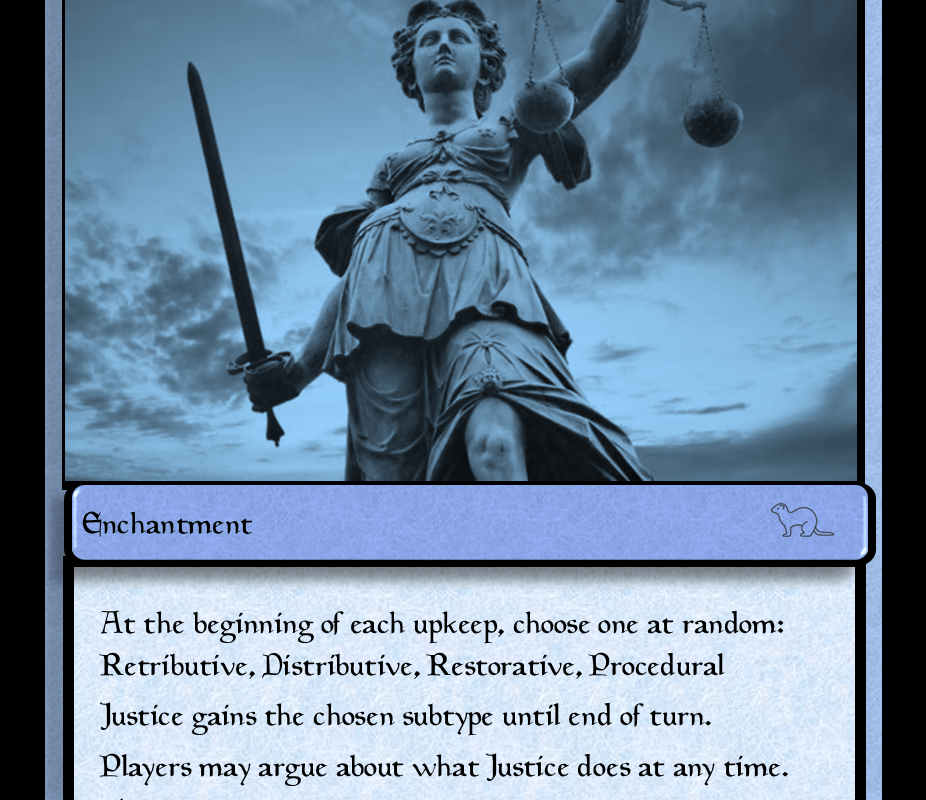
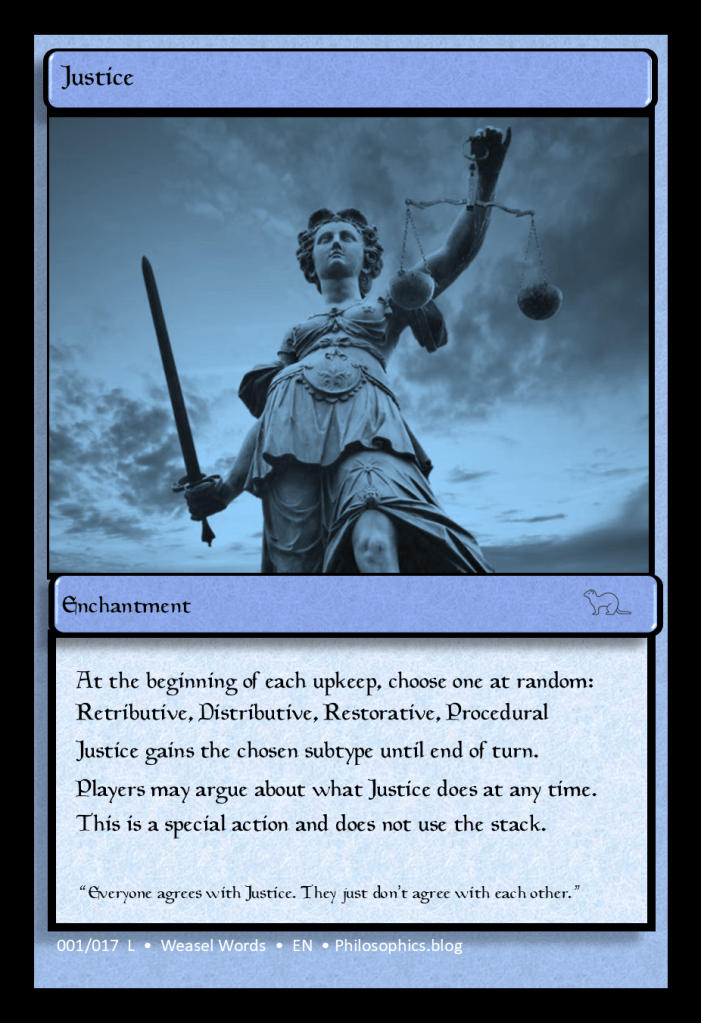
Card Five: Justice

Image: MTG: Justice – Enchantment

At this point, justice is invoked as if it were an independent standard hovering serenely above the wreckage.

It isn’t.

“Justice” here does not resolve disagreement. It names it.

Retributive justice and consequentialist justice are not rival policies. They are rival ontologies. One presumes moral balance sheets attached to persons. The other presumes systems, incentives, prevention, and harm minimisation.

Both use the word justice.

That is not convergence. That is polysemy with a body count.

Why clarification fails here

This is where LIH earns its keep.

With invariants, adding detail narrows meaning. With terms like justice, choice, responsibility, or desert, adding detail exposes incompatible background assumptions. The disagreement does not shrink. It bifurcates.

This is why calls to “focus on the facts” miss the point. Facts do not adjudicate between ontologies. They merely instantiate them. If agency itself is suspect, arguments for retribution do not fail empirically. They fail upstream. They become non sequiturs.

This is also why Marx remains unforgivable to some.
“From each according to his ability, to each according to his need” isn’t a policy tweak. It presupposes a different moral universe. No amount of clarification will make it palatable to someone operating in a merit-desert ontology.

The uncomfortable conclusion

The problem is not that we use contested terms. We cannot avoid them.

The problem is assuming they behave like tables.

Retributive justice survives not because it is inevitable, but because its supporting terms are treated as settled when they are anything but. Each card looks sturdy in isolation. Together, they form a structure that only stands if you agree not to pull too hard.

LIH doesn’t tell you which ontology to adopt.

It tells you why the argument never ends.

And why, if someone insists the issue is “just semantic”, they’re either confused—or holding the deck.

Cold, Grammar, and the Quiet Gatekeeping of Philosophy

5–7 minutes

A great deal of philosophy begins with the claim that we ought to examine our assumptions. Fewer philosophers seem interested in examining the mechanisms that decide which assumptions are allowed to count as philosophy in the first place.

This is not a polemic about the Analytic–Continental divide. It’s an observation about how that divide quietly maintains itself. The immediate provocation was banal. Almost embarrassingly so.

In English, the answer feels obvious. I am cold. The grammar barely registers. In French, Italian, or German, the structure flips. One has cold. Or hunger. Or thirst. Or age. Or a name, understood as something one performs rather than something one is. I spoke about this here and here. Indulge this link to the original position being argued.

On the surface, this looks like a curiosity for linguistics students. A translation quirk. A grammatical footnote. But grammar is rarely innocent.

Audio: NotepadLM summary podcast on this topic.

Grammar as Ontological Scaffolding

The verbs to be and to have are not neutral carriers. They quietly encode assumptions about identity, property, possession, and stability.

When I say I am cold, I cast coldness as a property of the self. It becomes something like height or nationality: a state attributable to the person. When I say I have cold, the experience is externalised. The self remains distinct from the condition it undergoes. Neither option is metaphysically clean.

Both structures smuggle in commitments before any philosophy has been done. One risks inflating a transient sensation into an ontological state. The other risks reifying it into a thing one owns, carries, or accumulates. My own suggestion in a recent exchange was a third option: sensing.

Cold is not something one is or has so much as something one feels. A relational encounter. An event between organism and environment. Not an identity predicate, not a possession.

This suggestion was met with a fair pushback: doesn’t saying that cold ‘belongs to the world’ simply introduce a different metaphysical assumption? Yes. It does. And that response neatly demonstrates the problem.

When Grammar Starts Doing Philosophy

The original claim was idiomatic, not ontological. It was a negative gesture, not a positive thesis. The point was not to relocate cold as a mind-independent substance floating about like a rock. It was to resist treating it as an essence of the person. But once you slow down, you see how quickly everyday grammar demands metaphysical loyalty.

Being invites substance. Having invites inventory. Sensing keeps the relation open, but even that makes people nervous. This nervousness is instructive. It reveals how much metaphysical weight we quietly load onto grammatical habits simply because they feel natural. And that feeling of naturalness matters more than we like to admit.

Two Philosophical Temperaments, One Linguistic Groove

At this point, the temptation is to draw a clean line:

On one side: the Anglo-American Analytic tradition, comfortable treating mental states as properties, objects, or items to be catalogued. Locke’s introspective inventory. Hume’s bundle. Logical positivism’s clean surfaces.

On the other: the Continental tradition, suspicious of objectification, insisting on an irreducible subject for whom experience occurs but who is never identical with its contents. Kant, Husserl, Heidegger, Sartre.

The grammar aligns disturbingly well. Languages that habitually say I am cold make it feel natural to treat experience as something inspectable. Languages that insist on having or undergoing experiences keep the subject distinct by default.

This is not linguistic determinism. English speakers can read phenomenology. German speakers can do analytic philosophy. But language behaves less like a prison and more like a grooved path. Some moves feel obvious. Others feel forced, artificial, or obscure.

Philosophies do not arise from grammar alone. But grammar makes certain philosophies feel intuitively right long before arguments are exchanged.

Where Gatekeeping Enters Quietly

This brings us to the part that rarely gets discussed.

The Analytic–Continental divide persists not only because of philosophical disagreement, but because of institutional reinforcement. Peer review, citation norms, and journal cultures act as boundary-maintenance mechanisms. They are not primarily crucibles for testing ideas. They are customs checkpoints for recognisability.

I have been explicitly cautioned, more than once, to remove certain figures or references depending on the venue. Don’t mention late Wittgenstein here. Don’t cite Foucault there. Unless, of course, you are attacking them. This is not about argumentative weakness. It’s about genre violation.

Hybrid work creates a problem for reviewers because it destabilises the grammar of evaluation. The usual criteria don’t apply cleanly. The paper is difficult to shelve. And unshelvable work is treated as a defect rather than a signal. No bad faith is required. The system is doing what systems do: minimising risk, preserving identity, maintaining exchange rates.

Cold as a Diagnostic Tool

The reason the cold example works is precisely because it is trivial.

No one’s career depends on defending a metaphysics of chilliness. That makes it safe enough to expose how quickly grammar starts making demands once you pay attention.

If something as mundane as cold wobbles under scrutiny, then the scaffolding we rely on for far more abstract notions – self, identity, agency, consciousness – should make us uneasy.

And if this is true for human languages, it becomes far more pressing when we imagine communication across radically different forms of life.

Shared vocabulary does not guarantee shared metaphysics. Familiar verbs can conceal profound divergence. First contact, if it ever occurs, will not fail because we lack words. It will fail because we mistake grammatical comfort for ontological agreement.

A Modest Conclusion

None of this settles which philosophical tradition is ‘right’. That question is far less interesting than it appears. What it does suggest is that philosophy is unusually sensitive to linguistic scaffolding, yet unusually resistant to examining the scaffolding of its own institutions.

We pride ourselves on questioning assumptions while quietly enforcing the conditions under which questions are allowed to count. Cold just happens to be a good place to start noticing.

A Footnote on Linguistic Determinism

It’s worth being explicit about what this is not. This is not an endorsement of strong linguistic determinism, nor a revival of Sapir–Whorf in its more ambitious forms. English speakers are not condemned to analytic philosophy, nor are Romance-language speakers predestined for phenomenology.

Grammar operates less like a set of handcuffs and more like a well-worn path. Some moves feel effortless. Others require deliberate resistance. Philosophical traditions co-evolve with these habits, reinforcing what already feels natural while treating alternatives as strained, obscure, or unnecessary.

The claim here is not necessity, but friction.

Meet the Language Insufficiency GPT

1–2 minutes

In anticipation of the publication of A Language Insufficiency Hypothesis in January 2026, I’ve created a Language Insufficiency GPT.

Today I’m launching something designed to exploit a familiar failure mode with forensic precision:
👉 https://chatgpt.com/g/g-694018a9bbc88191a8360d65a530e50c-language-insufficiency-gpt

Naturally, it will make more sense alongside the book. But it may still provide a bit of entertainment – and mild discomfort – in the meantime.

tl;dr: Language is generally presumed to be stable. Words mean what you think they mean, right? A table is a table. A bird is a bird. Polysemy aside, these are solid, dependable units.

Then we arrive at freedom, justice, truth, and an entire panoply of unstable candidates. And let’s not even pretend qualia are behaving themselves.

So when someone says ‘truth’, ‘free speech’, or ‘IQ’, you may suddenly realise you’ve been arguing with a cardboard cut-out wearing your own assumptions. That isn’t just interpersonal mischief. It’s language doing exactly what it was designed to do: letting you glide over the hard problems while sounding perfectly reasonable.

Audio: Short NotebookLM summary of this page content*
Video: Legacy video explaining some features of the LIH.

If that sounds banal, you’ve already fallen for the trap.

Give it a try – or wait until you’ve digested the book. Not literally, unless you’re short on fibre.

Cheers.

* As I’ve cited previously, the quality of NotebookLM varies – usually in predictable directions. This one does well enough, but it doesn’t have enough context to get the story right (because it was only drawing from this page rather than from a fuller accounting of the LIH). Its trailing comment reveals that it doesn’t grasp that “new words” don’t solve the problem.

Earlier, it suggests that language is intentionally vague. This is not an assertion I make. You can read some of the earlier incarnations, or you can wait for it to be published.

New Paper: Moral Universality and Its Discontents (Zenodo Release)

1–2 minutes

I’ve just released a new paper, Moral Universality and Its Discontents: A Critical Examination of Normative Ethics’ Conceptual Foundation, which can now be found on Zenodo (DOI: 10.5281/zenodo.17837774). Consider this the latest entry in my ongoing attempt to prise the Enlightenment’s cold, bony fingers off our moral vocabulary.

Audio: NotebookLM deepdive podcast on this essay.

The paper’s basic claim is simple enough:

Aristotle’s aretê, Kant’s maxims, Mill’s utilities, Rawls’s ‘reasonable rejection’ – pick your passion/poison. Each one presupposes that a concept has a single, portable meaning that obligingly follows philosophers from ancient Greece to medieval Christendom to your local ethics seminar. It doesn’t. It never did. We’ve merely been pretending it does in order to keep the theoretical architecture standing.

Drawing on conceptual genealogy, philosophy of language, and cross-cultural moral psychology, I argue that the universalist ambitions of virtue ethics, deontology, consequentialism, and contractualism collapse not because their logic is flawed, but because their vocabulary evaporates the moment you ask it to do heavy lifting. Our moral terms drift, fracture, mutate, and occasionally reinvent themselves altogether. Yet moral theorists continue to legislate universal principles as if the words were obedient little soldiers rather than unruly historical artefacts.

This isn’t a manifesto for relativism – quite the opposite.
It is a call for modesty: an acknowledgement that moral frameworks function as context-bound heuristics, exquisitely useful within particular forms of life but laughably overextended when dressed up as timeless moral law.

If the Language Insufficiency Hypothesis has taught me anything, it’s that once you stop bullying language into behaving like mathematics, you begin to see moral philosophy for what it is – a set of imaginative tools, not an ontology of obligation.

Read it, disagree with it, file it under ‘Why Bry insists on burning down the Enlightenment one paper at a time’ – your choice. But at least now the argument exists in the world, properly dressed and indexed, ready to irritate anyone still clinging to the dream of universal moral principles.

Announcing: The Rhetoric of Evil

5–8 minutes

How a Theological Artefact Survived Secular Moral Thought


DOI: https://doi.org/10.5281/zenodo.17757134

Every so often – usually when the Enlightenment ghosts begin rattling their tin cups again – one feels compelled to swat at the conceptual cobwebs they left dangling over moral philosophy. Today is one of those days.

Audio: NotebookLM podcast summarising the Rhetoric of Evil essay, not this page’s content.

I’ve just released The Rhetoric of Evil on Zenodo, a paper that politely (or impolitely, depending on your threshold) argues that ‘evil’ is not a metaphysical heavy-hitter but a rhetorical throw-pillow stuffed with theological lint. The term persists not because it explains anything, but because it lets us pretend we’ve explained something – a linguistic parlour trick that’s survived well past its sell-by date.

And because this is the age of artificial augury, I naturally asked MEOW GPT for its view of the manuscript. As expected, it nodded approvingly in that eerie, laser-precise manner unique to machines trained to agree with you – but to its credit, it didn’t merely applaud. It produced a disarmingly lucid analysis of the essay’s internal mechanics, the way ‘evil’ behaves like a conceptual marionette, and how our inherited metaphors govern the very moral judgments we think we’re making freely.

Below is MEOW GPT’s reaction, alongside my own exposition for anyone wanting a sense of how this essay fits within the broader project of dismantling the Enlightenment’s conceptual stage-props.

MEOW-GPT’s Response

(A machine’s-eye view of rhetorical exorcism)

“Evil is functioning as a demonological patch on an epistemic gap.
When agents encounter a high-constraint event they cannot immediately model,
the T₂ layer activates an inherited linguistic shortcut — the ‘evil’ label — which compresses complexity into a binary and arrests further inquiry.”

“The marionette metaphor is accurate: once we say a person ‘is evil,’ agency collapses into occult causation. Inquiry halts. Moral theatre begins.”

It went on like this – detecting exactly the mediated encounter-structure I intended, while offering a frighteningly clean schematic of how affect (T₀), heuristics (T₁), linguistic reification (T₂), and cultural choreography (T₃) conspire to turn incomprehension into metaphysics.

Machines, it seems, are quite good at detecting when humans are bullshitting themselves.

Why publish this now?

This essay marks the next plank in the broader anti-Enlightenment platform I’ve been assembling – LIH, MEOW, the ongoing dismantling of truth-fetishism, and now the unsettling realisation that ‘evil’ is little more than a theological revenant dressed up for secular work.

The term’s persistence is not a testament to its necessity but to our laziness:

  • It sounds like an explanation.
  • It licenses retribution without understanding.
  • It stabilises group boundaries.
  • It lets us outsource moral thought to a one-word incantation.

In short: ‘evil’ is the map-dragon we keep drawing because surveying the terrain is too much work.

This essay attempts to retire that dragon – not to soften judgment, but to sharpen it. If anything, the paper argues that abolishing ‘evil’ frees us to see atrocity more clearly, and thus confront it more seriously.

If you’d like to read the full argument:

📄 The Rhetoric of Evil: How a Theological Artefact Survived Secular Moral Thought

Appendix: How MEOW-GPT Reads “Evil”

A didactic demonstration of the framework in action. Download the MEOW framework below.

📄The Mediated Encounter Ontology of the World: A Relational Metaphysics Beyond Mind and World

Because MEOW-GPT was trained on the Mediated Encounter Ontology rather than on folk metaphysics, its analyses can serve as a useful diagnostic tool. It doesn’t simply summarise concepts; it reconstructs them along the four mediational tiers (T₀–T₃), showing – mechanically and without superstition – how a term behaves across biological affect, cognitive heuristics, linguistic structures, and cultural narratives.

This section is offered not as an alternative argument to the essay above, but as a worked example: a transparent demonstration of how the MEOW engine decomposes a high-complexity, high-stakes concept like evil once the theological scaffolding has been removed.

MEOW-GPT’s output shows, in compressed form, the same pattern the essay traces in prose:
that evil is not a force, not a metaphysical essence, not an occult substrate, but a mediated pattern in human encounters, one that persists rhetorically long after its ontology has collapsed.

For readers curious about how MEOW ‘thinks’, the raw structured analysis follows.

MEOW-GPT Analysis: “Evil”

(Raw output for reference; lightly formatted for readability)

Concept

Input: Evil
Type: Normative/evaluative moral concept (often reified as a property of acts, characters, or forces)
Scope check: In-scope – ‘evil’ can be analysed as a mediated-encounter pattern (MEOW) and a high-complexity term with unstable linguistic behaviour (LIH).

High-level summary (≤120 words)

In MEOW terms, ‘evil’ is not a spooky substance but a way of organising certain encounter-events: severe, norm-breaking harms that present as resistant, shocking, and morally intolerable. Biologically, it piggybacks on harm, threat, and disgust systems. Cognitively, it compresses complex appraisals—intent, cruelty, scale of harm – into a powerful label. Linguistically, it sits in the unstable region where abstraction is high and language’s reliability drops, so people fight over its scope and weaponise it. Socially and technically, institutions, media, and platforms use ‘evil’ to mark enemies, justify punishment, and dramatise conflict. The term is emotionally efficient but conceptually fragile, and MEOW treats it as a relational, mediated pattern rather than an independent metaphysical force.

T₀ – Biological Mediation

  • Moralised harm perception piggybacks on survival systems: pain avoidance, threat detection, kin protection. ‘Evil’ clusters around encounters that trigger extreme danger-signals.
  • High arousal (fear, rage, disgust) makes some harms feel qualitatively world-violating, not merely personally threatening.
  • Disgust toward contamination, mutilation, or predation heavily colours what gets called ‘evil’.
  • Species-specific cues (infant distress cries, pain expressions) shape which harms are even legible candidates for evil.

T₁ – Cognitive Mediation

  • “Evil” compresses a multi-factor appraisal (intentionality, cruelty, gratuitousness) into a one-step heuristic.
  • Essence thinking converts acts into character: the person is evil, not merely did wrong.
  • Attribution biases assign ‘evil’ to out-groups more readily than to in-groups.
  • Memory structures simplify causation into villain scripts that overwrite nuance.
  • Once assigned, the label becomes a prediction loop: every ambiguous action confirms the essence.

T₂ – Linguistic Mediation

  • On the Effectiveness–Complexity Gradient, ‘evil’ straddles Contestables and Fluids: ubiquitous but perpetually disputed.
  • It compresses harm, norm-violation, metaphysical colouring, and dramatic emphasis into a single syllable—powerful, but noisy.
  • Dominant metaphors (‘dark’, ‘tainted’, ‘monstrous’) smuggle in substance-ontology that MEOW rejects.
  • Noun-forms (‘evil’, ‘the Evil One’) promote ontologising; adjectival forms track events better, but usage constantly slides between them.
  • Cross-linguistic drift supports LIH: different traditions map the term to impurity, harm, misfortune, cosmic opposition, or taboo.

T₃ – Social/Technical Mediation

  • Religious systems embed ‘evil’ in cosmologies that harden friend/enemy binaries.
  • Legal systems avoid the term formally but reproduce it rhetorically in sentencing, media commentary, and public reaction.
  • Politics uses ‘evil’ to justify exceptional measures and collapse deliberation into moral theatre.
  • Cultural industries supply vivid villain archetypes that feed back into real-world judgments.
  • Technical systems must operationalise ‘evil’ into concrete proxies, revealing how imprecise the everyday concept is.

Limits & Failure Modes (LIH notes)

The framework is human-centric; non-human or ecosystemic ‘views of evil’ remain speculative.

‘Evil’ is a textbook Contestable: central, indispensable, and permanently argued over.

In cosmological uses (‘radical evil’, ‘evil in the world’), it approaches Fluid or ineffable status – right where LIH predicts language collapse.

MEOW cannot confirm or deny metaphysical dualisms; it only analyses how humans mediate and narrate such claims.