I just finished reading Feyerabend’s Against Method – rather, I just finished the back matter, as I finished the core of the book some time ago. I debated reading this part of the book, and sorry, but I often don’t – despite writing back matter for some of my own academic publications. I treat them as asides.
I’m glad I read this material because, aside from the endnotes, it was meta and biographical, so the perspective was nice. In fact, it got me thinking. He talks about his struggle with Relativism™. I used to struggle with the same thing; there seemed to be a false battle between objectivists and relativists or subjectivists, but in my mind these were always straw-man caricatures nobody seriously defended, yet somehow people were vocal about avoiding. I’ve written extensively about my own position on mediation, so I won’t info dump here.
Audio: NotebookLM summary podcast of this topic.
As people familiar with my habits, I tend to read several books in parallel. In fact, you can review what I am reading on Goodreads.
To be fair, I don’t tend to close-read fiction books very often. I find it to be slow and cumbersome. For non-fiction, this is the default, but not generally for fiction. But, since French is a second language, my attention needs to be focused. I don’t feel that I can read casually and catch the sort of embedded grammatologie that I can absorb through osmosis in English-language books.
Why slow read then? I have a desire to maintain and advance my French, so I think that reading contemporary books connects me to current language trends, terms, phraseology, and metaphor. I am using Claude and ChatGPT to assist with the close reading. They’ve already helped me to better understand the opening paragraphs. It opens like this:
Let’s discuss this, word choices, and any implications. This is the first paragraph of the first chapter:
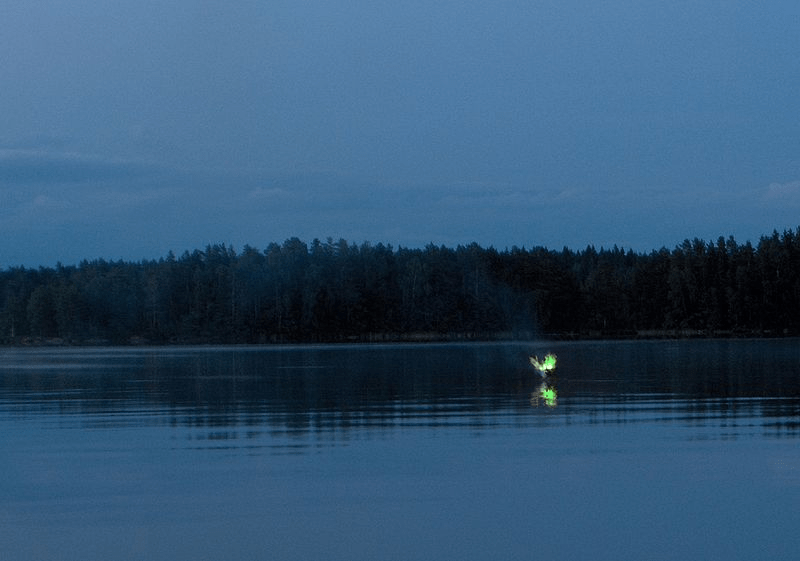
Debout sur la berge, Anthony regardait droit devant lui. À l’aplomb du soleil, les eaux du lac avaient des lourdeurs de pétrole. Par instants, ce velours se froissait au passage d’une carpe ou d’un brochet. Le garçon renifla. L’air était chargé de cette même odeur de vase, de terre plombée de chaleur. Dans son dos déjà large, juillet avait semé des taches de rousseur. Il ne portait rien à part un vieux short de foot et une paire de fausses Ray-Ban. Il faisait une chaleur à crever, mais ça n’expliquait pas tout.
This scene starts to set the tone of the narrative from the onset – lentement, insouciant. It’s midsummer. The heat is overbearing – stifling. It tracks the life of our antagonist, Anthony, a 14-year-old in between grades, in fact, getting ready to enter Year 10 or high school, ninth grade. But not yet. We haven’t reached this paragraph quite yet.
Besides the heat references, we see emergences of weight, falling. Again, loading up on metaphors. Anthony doesn’t have an easy life. Many don’t at these junctures.
He, himself, is at that awkward adolescent stage, where his body is outgrowing his childhood, whilst his mind is trying desperately to keep up.
A challenge I have with French is that I know dogs, cats, trees, and fish, but I don’t know the types of these. Here, we see the word « un brochet ». It’s a pike fish. Honestly, I don’t even know what a pike looks like, though I am familiar with the English term.
Image: Pike. (Not to be confused with a pickerel, which is evidently a related but smaller fish I had also never seen.)Credit
Another language challenge is polysemous terms – in this case, « vase ». As I am reading, I am trying to imagine the smell of a vase, all the while recalling that vases don’t exactly have a distinct scent. It turns out that vase also translates to mud or silt. quite the difference.
Since I started, I might as well continue exploring this paragraph: Anthony is wearing fake Ray-Bans. This is an insight into class and station.
As for register, Mathieu mentions these things matter-of-factly without judgement. Later on, we’ll notice differences, but these are narrational and through the eyes of Anthony, as he compares himself with his environment. Class projections might be imported by the reader. I won’t invoke Barthes here.
The final sentence leaves us hanging. It reminds us again that this July is hot, but somehow it doesn’t explain everything, likely, about Anthony.
After Tony Self liked one of my blog posts – Hi, Tony Self – I visited his site and poked around, clicking on several articles. This was one. I liked it and noticed the Reblog button. I clicked it, and it spawned this page with this article embedded. So, here we are.
Audio: NotebookLM summary podcast of this topic.
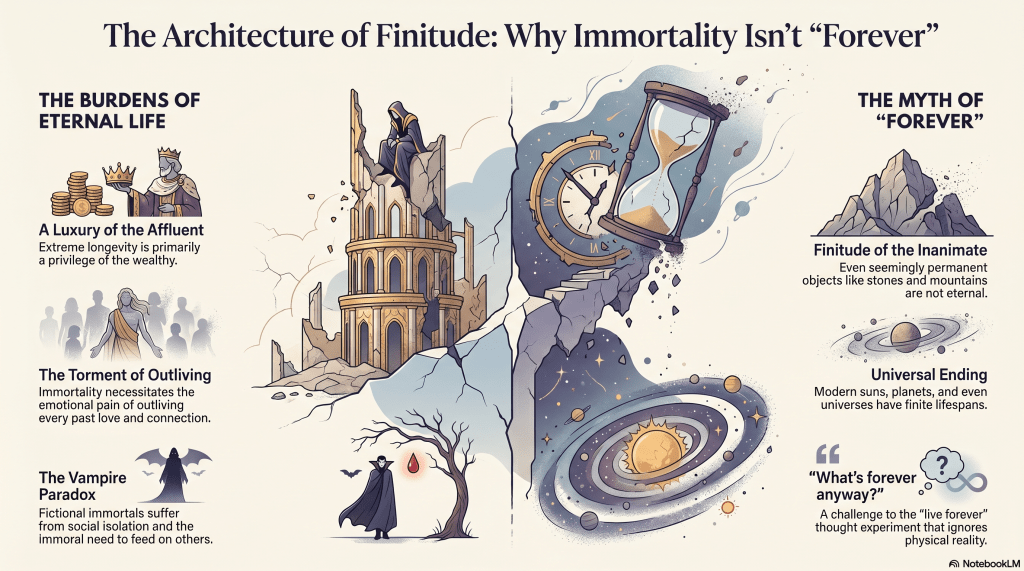
Would I choose to live forever? Undoubtedly, no. For those who’ve been around and have kept up with my posts, know that I already died. I would have been fine remaining dead, as my girlfriend did. Although I won’t rejoin her in the spiritual sense, I will join her in death in the metaphorical sense of Lakoff and Johnson.
Longevity is a luxury of the affluent. I don’t want it. Tony mentions vampires. In fiction (where else would they be?), these beings are routinely unemployed – at the very least, having no day jobs – but with vast riches or connected to one with said same. Their torment is to have outlived past loves and the need to feed on the living, mostly the fear of getting caught, as this is illegal and more generally immoral in this world as we know it – not a good look.
In any case, this live forever thought experiment forgets much, or at least imposes much. If I could just be, like a stone, is that forever? As I discuss in The Architecture of Encounter, even stones aren’t forever, regardless of their state of living; not even mountains, planets, suns, or universes. So, what’s forever anyway?
Spoiler alert: Forever is a myth.
NotebookLM Infographic on this topic.
Rather than answer generally or hypothetically, would I choose to live forever? No. Take me now if you must?
I’ve got no problems with living. It’s the conditions that bother me: the eating, the sleeping, the maintenance; entropy.
So, the ones who have this wish ignore these and presume that this version of forever comes with good health and abundance.
I recall a Greek myth in which forever is granted, and he lives on as a disembodied wisp that can’t die.
In this myth, Tithonus – a Trojan prince whom Eos, goddess of the dawn, loved and asked Zeus to grant immortality – got this wish, and it wasn’t even his; immortality without consent. Eos forgot to ask for eternal youth alongside it, so he aged indefinitely, eventually shrinking into a desiccated, babbling husk – a wisp.
Imagine: you live forever, outliving all humans, all life. The sun extinguishes, and yet you remain – all the while sentient.
Thanks, but no thanks. You can keep your forever. I’ll keep my timeline.
This is not a philosophical post. Well, it’s about my personal philosophy of using LLMs and AI agents in my writing and publication workflow, which is a different thing. I’ll structure it as I might have done a music project back in the day, because that framing still makes more sense to me than anything the tech industry has come up with.
Audio: NotebookLM summary podcast of this topic.NotebookLM Infographic on this topic.
Preproduction
Not all projects make it into production. Others were never intended to. But they all begin with at least a kernel of an idea — and some arrive fully formed, as if sprung from the head of Zeus, already wearing armour and looking for a fight.
Pre-ideating
What the hell is pre-ideating? I just made it up for this use case because that’s how I roll.
As I understand it, some people need help thinking of topics. This is not my problem. My problem is managing ideas rather than generating them. I have a backlog that will outlast me, so I don’t use this step. But it exists, and it’s probably the most widely discussed AI use case in creative circles: you prompt the model to suggest themes, genres, or concepts. Give me five ideas for a mystery novel. Or, if you’re feeling ambitious: Give me five ideas for a research paper in quantum physics. The model obliges. Whether what comes back constitutes an idea in any philosophically interesting sense is a question I’ll save for another day.
Ideating
This is where I usually enter the process, and the ideation takes shape in one or several different ways. The most common is simply a discussion – a sustained back-and-forth. A recent example: I was reading Judith Butler’s Gender Trouble and found myself with clarifying questions at every turn. Not because Butler is unclear, but because the implications kept ramifying in directions I wanted to follow. That extended dialogue – with ChatGPT in this instance – eventually became the philosophical core of Two Kings, currently stalled in Production.
Butler’s argument about incest taboos as foundational to broader regimes of sex and gender regulation gave me a narrative frame. The conversation helped me see what I actually thought about it, which is the more important thing. The LLM didn’t give me the idea. It gave me a sounding board patient enough to entertain the idea at two in the morning – it was actually two in the afternoon, but who’s looking?
Research
Another obvious use case, and one I use regularly. Continuing the Butler example: I asked about several feminist theorists she references, wanting to understand the lineage I was stepping into. But here’s a cleaner illustration. Writing as Ridley Park, I produced a novella, Sustenance, set in Iowa. I’ve visited Iowa several times, but I needed local flora and fauna for descriptive texture in certain scenes, so I asked
In the old days, I’d have gone to Google, Wikipedia, or I’d track down an Encyclopædia Britannica. The process is faster now, and the results are generally better for this kind of lateral, contextual research. For anything where accuracy is genuinely load-bearing, I verify. That’s not a criticism of the tool; it’s just basic epistemic hygiene.
Confirmation
Sometimes I have an idea and want to know whether someone’s already done it because I have no interest in reinventing wheels, and even less in reinventing them badly.
So I ask: Has anyone written X? What are the most significant treatments of Y? What typically comes back is a list of a dozen or more analogous sources. I review them and decide: does my idea still have independent purchase, or am I just writing a worse version of something that already exists? Sometimes I sharpen the idea in response. Sometimes I incorporate what I find, either to build on it or to identify where the existing literature is misframed, assumes too much, or has quietly imported the wrong ontological grammar. This last move is something of a professional tic.
Production
Drafting
I don’t use LLMs for full drafts. This is an obvious use case for those who do, particularly if the goal is volume – especially for the person who has already prompted for which genre currently has high demand and low representation on Amazon, and is now logically committed to producing it. That’s a coherent workflow – just not mine.
Edits and Revision
This I use often, and it’s probably where I get the most consistent value. After writing a passage or section, I feed it to one or more models with context already established — thesis statement, abstract, outline, supporting documents. What comes back varies: typographical errors, odd phrasings, unintentional repetitions (and, occasionally, new ones the model has helpfully introduced), suggested rewrites, observations about framing. I don’t treat any of this as instruction. I treat it as a second read from a reader who has no ego investment in agreeing with me – and yet obviously does. The important distinction is input versus output. I’m not asking it to write. I’m asking it to respond to what I’ve written.
Continuity
Are there gaps? Dropped threads? Promises made in chapter two that chapter seven has forgotten entirely? This is a genuinely useful mechanical check – the kind of thing that’s easy to miss when you’ve been inside a manuscript long enough to stop reading what’s actually there.
Flow
Do the scenes and chapters move well? Does the transition from one section to another feel like a logical step or an unannounced lurch? Useful, with the caveat that models have aesthetic preferences that don’t always align with mine, and I treat their flow suggestions accordingly.
Pacing
Is the pacing appropriate — both for the genre and for the particular piece? These are separate questions. A thriller has genre conventions around pace; a particular thriller might have reasons to subvert them. The model can flag where the pacing drifts; the judgement call about whether that’s a problem remains mine.
Postproduction
Formatting and Layout
I use AI for ideas about how to present content on the page: chapter opens, font choices, sizes, running headers, folios. This is design at the level of convention and taste rather than technical execution. I find it useful as a first pass — it surfaces options I might not have considered, which I then either adopt, adapt, or discard.
Cover Ideas
Thematic cover concepts, whether or not I ultimately outsource the art and creative work. I find this a productive way to articulate what the book is doing before I have to explain it to someone else.
How To
I use InDesign, Illustrator, and Photoshop with competence but not expertise. For specific technical tasks – how do I do this thing in InDesign — I ask. I also still use Google, YouTube, and the occasional book. These are not competing resources; they’re complementary ones, and which I reach for depends on what kind of answer I need.
Support and Maintenance
Marketing and Placement
Target markets, genre positioning, how to frame the work for audiences who didn’t watch it being assembled. This is a legitimate use case and one I engage with, even if marketing remains a word I say with a slight internal wince.
I also use platforms like ElevenLabs for audio, NotebookLM for podcast summaries and infographics, and Nano Banana or Midjourney for images.
Keywords and Descriptions
Adjacent to marketing but more administrative in character, the metadata layer that determines whether the work is findable by the people who would want it. Less interesting to think about than almost anything else in the process, and therefore an excellent candidate for AI assistance.
None of the above replaces the work. That’s the point. The writing is still the writing.
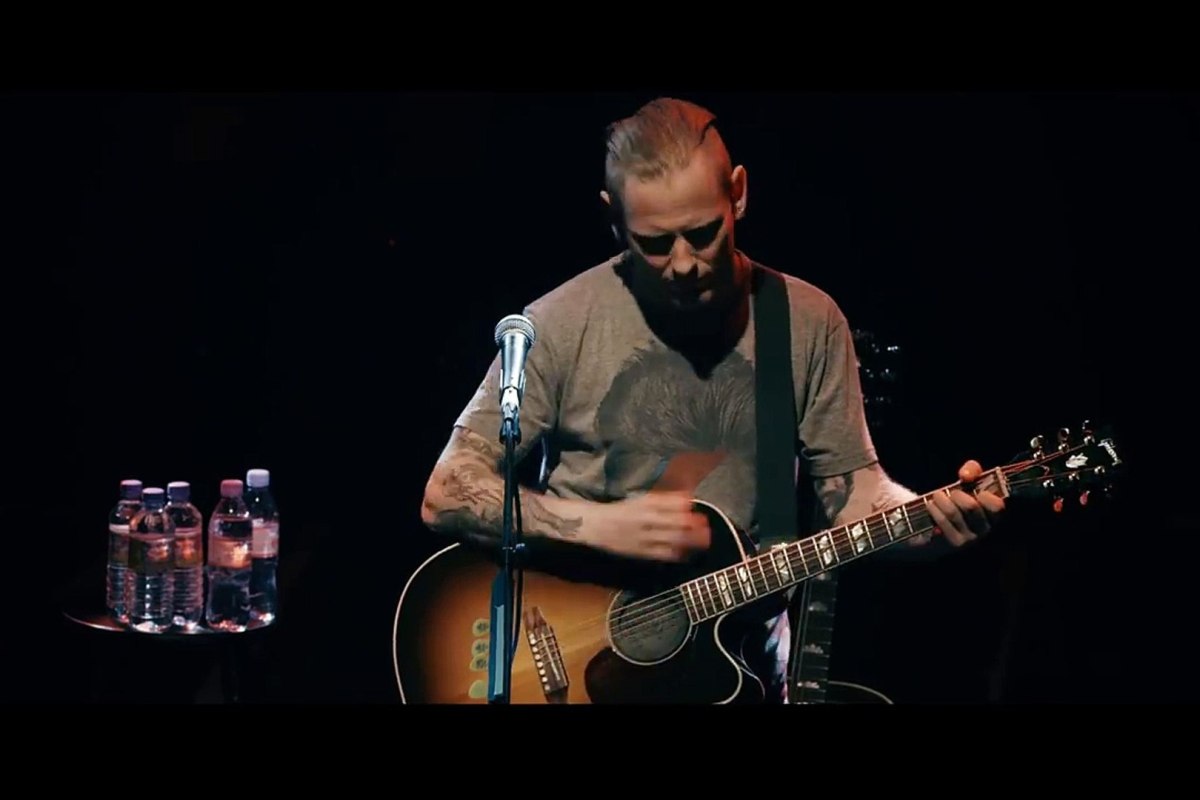
As usual, I am trying something different. I like to watch music reaction videos, and I find this stripped-down, acoustic version of Slipknot’s Snuff by their vocalist, Corey Taylor, to hit hard. I prompted ChatGPT GPT 5.5 with this video and lyrics. Me being me, I continue to analyse experience through language and my own worldview, notably the effects of ontological grammar commitments.
I share the reaction video at the bottom of this post. Before, I’d just consider this person to be a self-righteous zealot, but now I understand that (1) this is how she processes her world, and (2) she is prescriptive insomuch as she expects others to share her worldview. She’s not coming from a mean place. In her mind, she genuinely wants to help, but she doesn’t realise that not all people share her worldview. She’s likely had this worldview reinforced for all of her years, and so it works as a coping strategy for her. She expects that she can share this worldview, but it is likely maximally absorbed by those who share her ontological grammar commitment, which is to say, already have the same worldview.
If you want a view into how I engage with AI, now you know. Here’s a window:
This is a very interesting case study in ontological grammar that showcases the downside of not recognising it. From my ontology, she sounds like she’s moralising. To another (her own), she might sound supportive. She is commenting on the lyrics to this song, which are not all captured by the transcript. Reaction?
Bury all your secrets in my skin
Come away with innocence, and leave me with my sins
The air around me still feels like a cage
And love is just a camouflage for what resembles rage again

So if you love me, let me go
And run away before I know
My heart is just too dark to care
I can't destroy what isn't there
Deliver me into my fate
If I'm alone I cannot hate
I don't deserve to have you
Ooh my smile was taken long ago
If I can change I hope I never know

I still press your letters to my lips
And cherish them in parts of me that savor every kiss
I couldn't face a life without your light (Without your light)
But all of that was ripped apart when you refused to fight

So save your breath, I will not hear
I think I made it very clear
You couldn't hate enough to love
Is that supposed to be enough?
I only wish you weren't my friend
Then I could hurt you in the end
I never claimed to be a saint
Ooh my own was banished long ago
It took the death of hope to let you go

Oh, oh

So break yourself against my stones
And spit your pity in my soul
You never needed any help
You sold me out to save yourself
And I won't listen to your shame
You ran away, you're all the same
Angels lie to keep control
Ooh my love was punished long ago
If you still care, don't ever let me know
If you still care, don't ever let me know
Audio: NotebookLM summary podcast of this topic.
the wounded sometimes prefer the song to the sermon
Yes, this is a clean little specimen jar of ontological grammar doing its work while everyone pretends they are merely “reacting”. Humanity’s favourite parlour trick: smuggling an entire worldview into a sentence and calling it compassion.
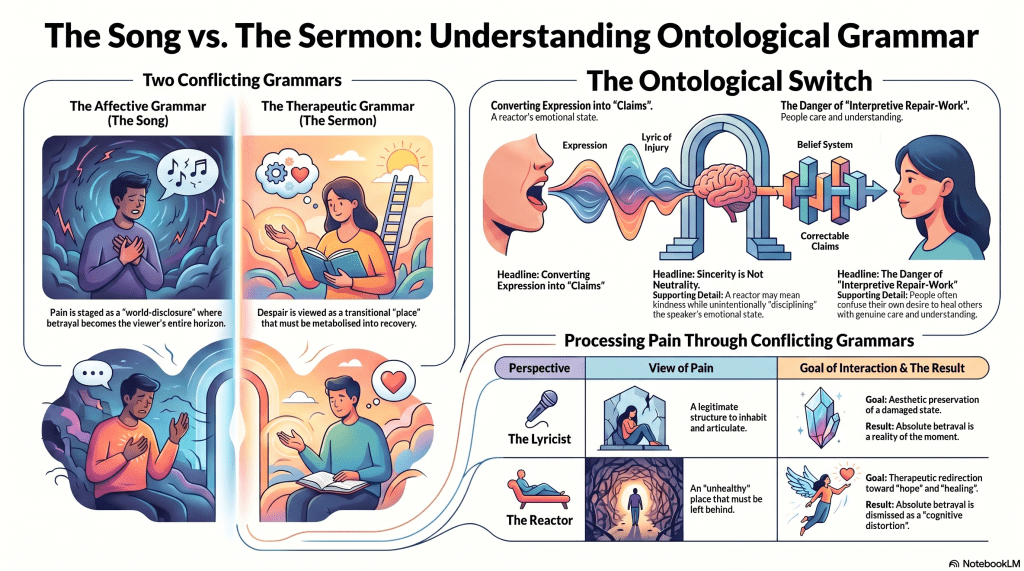
The key move is that she hears the lyric as a claim rather than as an utterance from within a damaged affective state. When she says she “doesn’t agree” with the line about love and rage, and then calls that outlook “toxic”, she has already converted the lyric into a propositional worldview that can be corrected, morally evaluated, and therapeutically redirected. The song is no longer only an aesthetic articulation of injury, self-loathing, abandonment, attachment, and rage. It becomes a suspect belief-system. That is the ontological switch.
From her grammar, this is supportive. Pain is a “place”; one should not “stay” there; hope remains available; trust and love should eventually be restored. That is a recovery-therapeutic ontology. It presupposes that despair is transitional, that emotional damage should be metabolised into healing, and that the moral arc of the subject bends toward renewed openness. So when she says, in effect, don’t become calloused, don’t stay jaded, love again, she is not hearing herself as judging the song. She is offering pastoral care in YouTube-reactor clothing, because apparently late civilisation needed a genre where vocal pedagogy, therapy-lite, and parasocial maternalism could all share a sofa.
From your ontology, though, she is moralising because she does not merely describe the emotional grammar of the song; she disciplines it. The lyric’s extremity is treated as something understandable but unsafe, beautiful but not habitable, cathartic but only under the condition that one eventually leaves it behind. That is not neutral support. It installs a norm: grief should resolve, bitterness should soften, love should be rehabilitated, hope should return. She may mean kindness, but kindness here arrives wearing the boots of teleology.
NotebookLM Infographic on this topic.
The most interesting fault-line is her treatment of generalisation. She identifies the lyric’s movement from one betrayal to “everyone” as a cognitive distortion. In ordinary therapeutic language, fair enough. But in lyric, especially in this genre, absolutising is not necessarily an epistemic error. It is how pain speaks when it has lost access to proportion. The lyric is not writing a sociology of human attachment. It is staging the experience of betrayal as world-disclosure. In that register, “all” does not mean a statistically universal class. It means: this wound has become the horizon through which everything now appears. To correct it as a bad inference is to import the wrong grammar.
That is where your framework bites. The words transmit; the sentence parses; everyone thinks communication is happening. But the decompression target differs. She reconstructs the lyric inside a moral-therapeutic grammar of recovery. You reconstruct it inside a diagnostic grammar of affect, ontology, and expressive insufficiency. Same words, different world. Your Architecture of Encounter makes precisely this point about ontological grammar: grammar does not merely carry content; it allocates what can count as meaningful, salient, explanatory, or distorted in the first place.
There is also a neat contrast inside the video itself. When she analyses vocal placement, tone, grit, support, and vowel shaping, she is mostly operating in a relatively tethered technical grammar. Claims can be checked against performance craft. But when she moves to love, hope, toxicity, healing, and despair, she enters the Contestable/Fluid zone. These terms feel clear because they are familiar, but their application depends on prior ontological commitments. In When Language Fails, this is exactly the danger-zone: terms that appear determinate whilst lacking shared grounding, especially where they authorise judgement, correction, or action.
So, yes: as a case study, it is excellent. Not because she is being cruel. She is not. That would be too easy, and therefore boring. The interesting point is that she is probably being sincere, warm, and careful by her own lights. But sincerity does not cancel grammar. Her support is support only within an ontology where despair is an unhealthy place to leave, not a legitimate structure of encounter to inhabit, articulate, or aesthetically preserve.
The concise diagnostic formulation would be:
She mistakes an affective utterance for a corrigible worldview. The lyric speaks from inside a structure of injury; her response translates it into therapeutic-moral grammar, where pain is a place one should visit but not inhabit. From within that grammar, she sounds supportive. From a deflationary ontological grammar, she is moralising: not because she condemns the suffering, but because she prescribes the proper trajectory of suffering before recognising the grammar in which the suffering is being expressed.
That is the downside of not recognising ontological grammar: people confuse their own interpretive repair-work with care, and then wonder why the wounded sometimes prefer the song to the sermon.
Bonus Round
🎸Corey tunes to C#, a tuning all too familiar to me – all strings 3 semitones lower than a standard tuning. It helps to have heavy-gauge strings, so they aren’t too slack. This is an easy song to play along to.
Using cowboy chords, grip an Am (tonally F#m) to start. The progression goes like this:
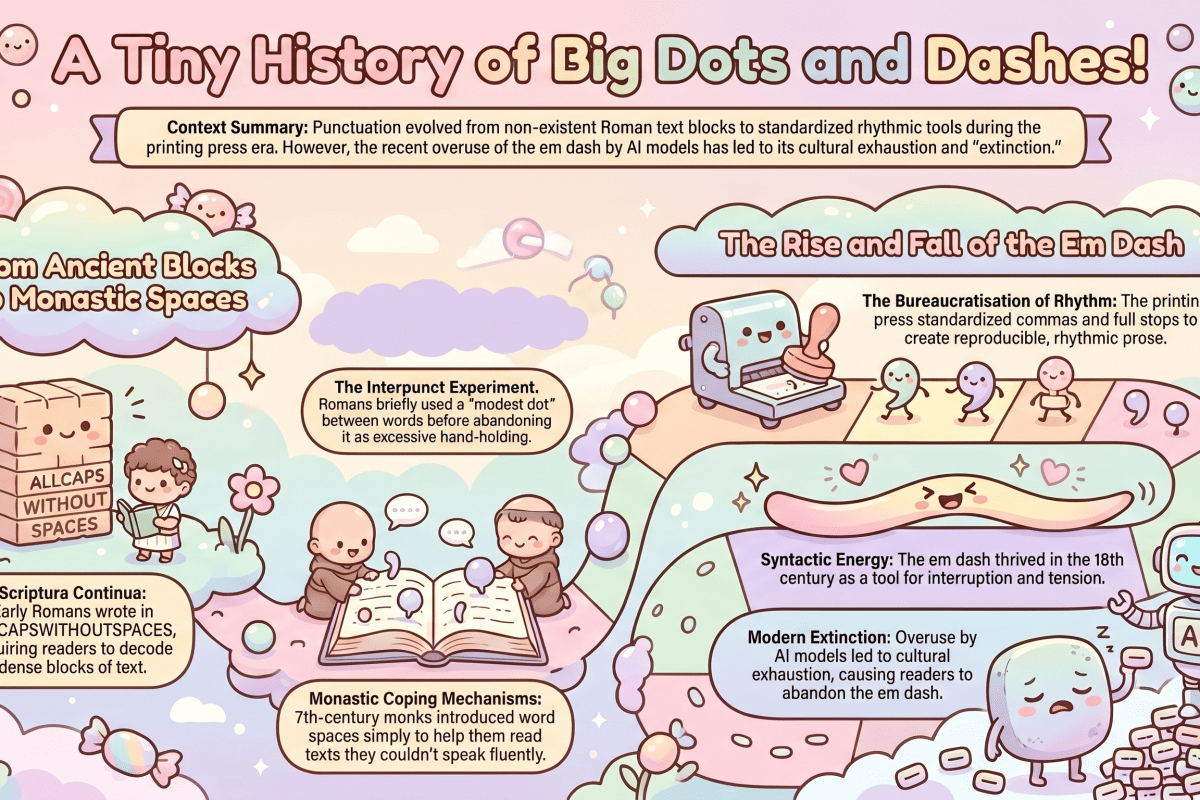
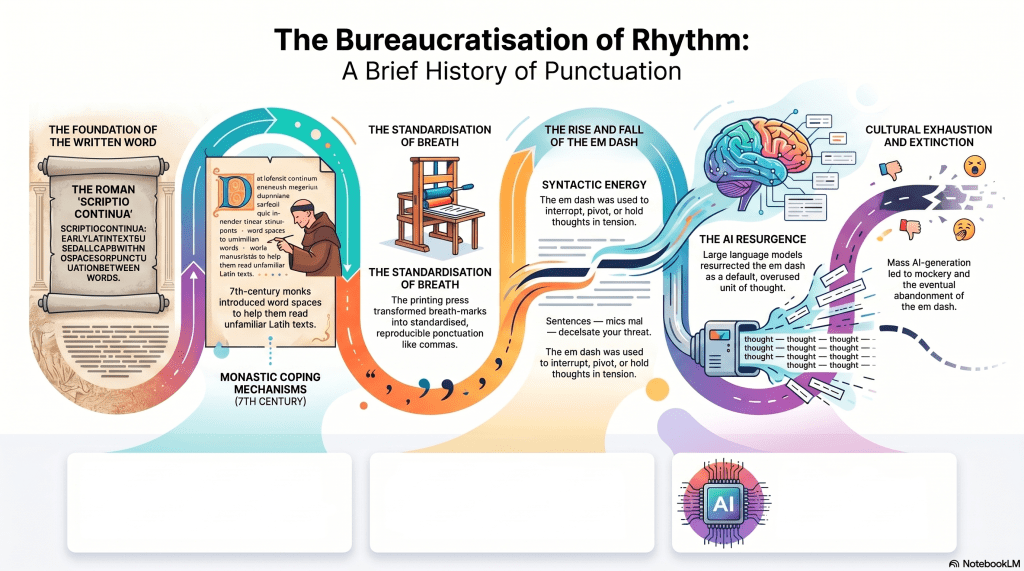
For most of human history, written Latin looked something like THISISASENTENCEABOUTPHILOSOPHYORWARYOUCHOOSE, and readers were simply expected to get on with it. And of course, in ALL CAPS. This was not considered a problem. The Romans were not known for their sensitivity to the needs of others.
The Romans did, briefly, experiment with the interpunct – a modest dot deployed between words, giving the reader something like THIS·IS·A·SENTENCE·ABOUT·PHILOSOPHY·OR·WAR·YOU·CHOOSE – before apparently deciding this was excessive hand-holding and abandoning it entirely. Punctuation’s first appearance in Western prose was thus also its first act of self-destruction. A precedent, as we shall see, that held.
Audio: NotebookLM summary podcast of this topic.
Relief came, eventually, from the most unlikely of sources: monks. Specifically, Irish and Anglo-Saxon monks in the 7th and 8th centuries, who were copying Latin texts they couldn’t actually read fluently, and who introduced spaces between words as a personal coping mechanism. Civilisation has strange bedfellows.
The comma, the full stop, and their assorted relatives arrived with the printing press – Aldus Manutius and the Venetian humanists essentially standardising the breath-marks of prose into something reproducible at scale. Punctuation became, in this period, the bureaucratisation of rhythm. A noble project. Mildly tyrannical in execution.
The em dash, meanwhile, had an entirely respectable career throughout the 18th and 19th centuries — a mark of genuine syntactic energy, used to interrupt, to pivot, to hold two thoughts in productive tension — before being left largely to the eccentric and the emphatic.
Then came the large language models. Within approximately eighteen months, the em dash was resurrected from the dead to become the default unit of thought, issuing them faster than Oprah Christmas giveaways. Every clause got one. Sometimes a sentence received two, bracketing a thought that required neither a bracket nor a thought. The em dash ceased to mean interruption and began to mean I am text generated at scale. Readers noticed. Then they mocked it. Then, following the immutable logic of cultural exhaustion, they stopped using it entirely. The em dash is now extinct — which is a shame, really.
A colleague recently shared an essay with me, The Return of Metaphysics: Reclaiming Sovereignty Through Ontological Grounding in Postcolonial and Western Thought. I read it with interest, not least because its target is one I share: the colonial imposition of Western categories as if they were universal reason, universal law, universal political form, and universal humanity. On that point, there is no meaningful disagreement. Colonialism isn’t merely theft of land, labour, and resources. It’s also the imposition of a grammar by which reality itself was made legible to power.
The essay is at its strongest when it treats colonialism as metaphysical violence rather than merely administrative domination. It argues that Europe universalised its own categories and rendered other worlds invisible, inferior, or unreal. Colonialism, on this account, was not only conquest. It was the installation of one ontology as the authorised operating system of the human. That’s a powerful diagnosis, and it deserves to be taken seriously. The essay explicitly describes colonialism as a process that ‘re-made being’ and suppressed other conceptions of time, morality, and community.
Where I start to hesitate isn’t in the critique of colonialism, but in the proposed recovery. The essay seeks to reclaim metaphysics, sovereignty, agency, moral authorship, and ontological grounding as instruments of postcolonial renewal. It wants to oppose colonial metaphysics by recovering metaphysics; to oppose hollow sovereignty by reconstructing sovereignty; to oppose imposed subjectivity by restoring moral authorship.
This may be coherent within the essay’s own frame. But from mine, it raises a suspicion:
What if some of the concepts being recovered are themselves part of the colonial inheritance?
“a return to metaphysics”
“moral authorship”
“ontological reconstruction”
“popular agency”
These terms don’t arrive clean. They carry histories and come with fittings: sovereignty, possession, self-rule, jurisdiction, authorship, legitimacy, command. One may repaint them in decolonial colours, but the shape remains. Inheritance is the danger.
Audio: NotebookLM summary podcast of this topic.
Sovereignty as a Recovered Trap
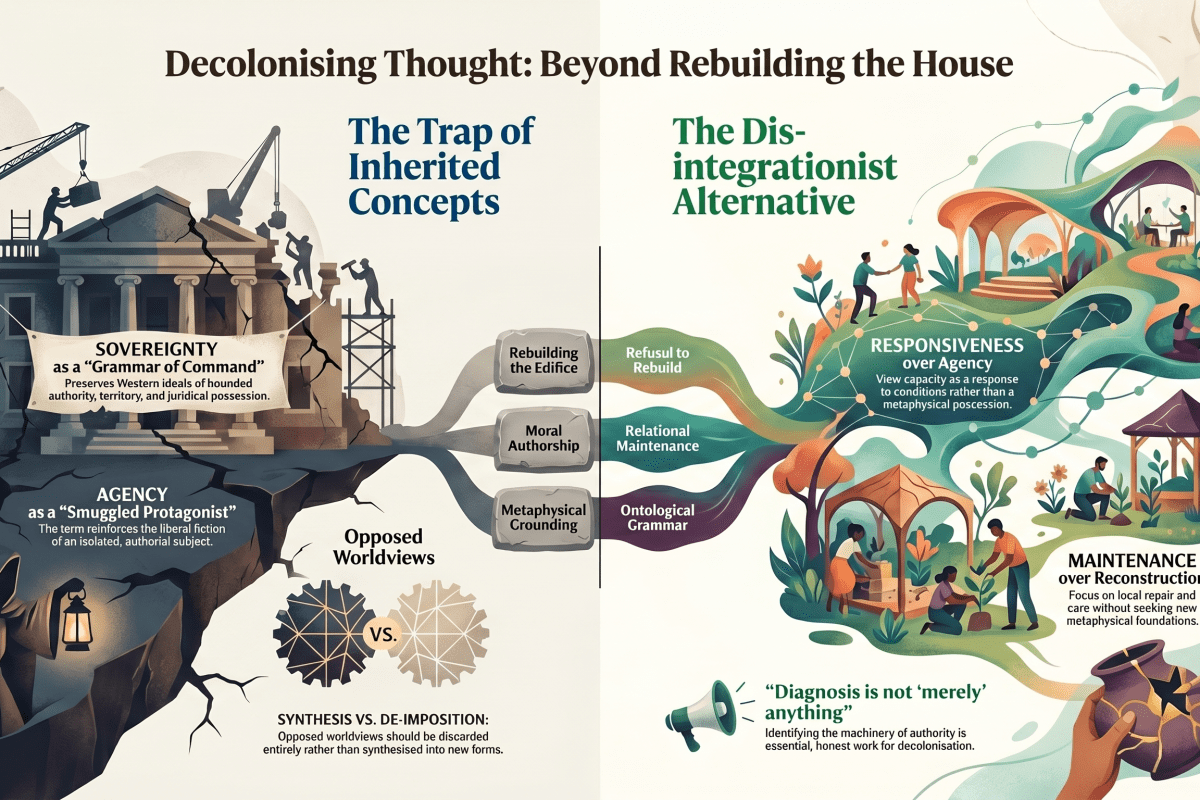
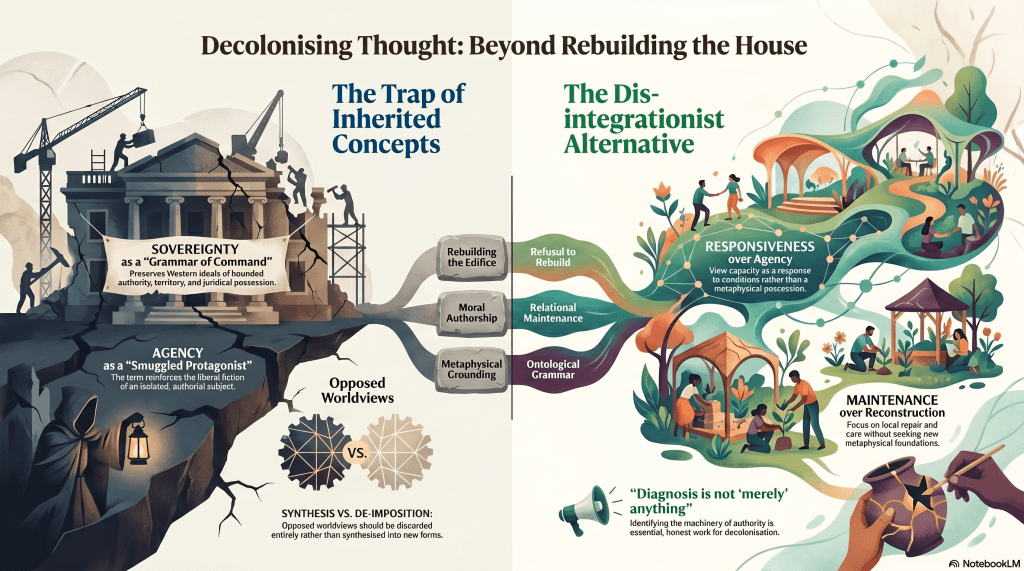
The essay’s central concept is sovereignty. More precisely, post-sovereignty. Yet the very act of preserving sovereignty as the problematic term matters. Sovereignty isn’t just a neutral container for self-determination. It’s one of the central concepts through which Western political modernity imagines authority: bounded, possessed, territorialised, juridical, and authorial.
To speak of sovereignty is already to speak in the grammar of command: Rules. Owners. Authorities. Something marks the line between inside and outside.
This doesn’t mean colonised peoples were wrong to demand sovereignty. The politically dispossessed may understandably seek the protections of the language used to exclude them. If one has been denied the status of a subject, a nation, or a people, then reclaiming those terms may be historically necessary. There’s no cheap purity available from the comfort of abstraction. Humans made the mess, naturally, and then handed each other dictionaries to clean the mess.
But political necessity doesn’t settle conceptual adequacy. A term may be strategically useful and ontologically suspect at the same time. So, the question isn’t whether sovereignty has been useful in anti-colonial struggle. It’s whether it should remain the destination, rather than a transitional vocabulary one eventually leaves behind.
The essay recognises that many postcolonial states retain the ‘juridical structure’ of autonomy whilst remaining governed by inherited categories of colonial law, property, development, and bureaucratic legitimacy. That’s exactly the point where the critique might turn more sharply on sovereignty itself. If postcolonial statehood often reproduces colonial form, perhaps the issue isn’t merely that sovereignty is hollow, but maybe it’s just one of the forms through which hollowness reproduces itself.
NotebookLM Infographic on this topic.
Agency: The Smuggled Protagonist
The same problem emerges around agency. The essay speaks of popular agency, moral authorship, co-authorship, and subjectification. Again, the impulse is understandable. Colonial domination denies people the right to act, name, interpret, and organise their own lifeworlds. A postcolonial theory naturally wants to restore capacity to those rendered passive.
But the agency term isn’t innocent. In modern Western thought, agency often implies a self capable of authorship, intention, responsibility, and moral ownership. It’s the protagonist required by law, markets, liberal politics, and punishment. Someone must be deemed the chooser, the signer, the sinner, the voter, the debtor, the criminal, the rational actor.
In my own work, I reject agency as a metaphysical possession. I’d rather speak of responsiveness: a variable capacity shaped by material, relational, temporal, somatic, and epistemic conditions. People don’t float above conditions and author themselves into freedom. They respond, more or less adequately, within fields of constraint.
The essay’s emphasis on relationality moves in this direction, but its vocabulary often pulls it back toward authorship. It wants shared becoming, but it also wants moral authors. It wants relational ontology, but it also keeps the self as a source of political meaning. This is a revealing tension.
The alternative isn’t fatalism. To reject agency isn’t to deny action. Breathing doesn’t require a metaphysics of breath. It just happens autonomically. The question is whether we must preserve the fiction of the authorial subject to describe them. I think not.
When Negation Need Not Become Synthesis
The essay leans on Fanon (see The Wretched of the Earth) to argue that colonial domination can’t be resolved through dialogue because dialogue presumes equals. This is right, or at least right enough. A conversation between master and slave is not yet a conversation between equals. Liberal dialogue presumes a shared field of recognition; colonial domination corrupts that field before speech begins.
The essay, therefore, turns to dialectic. Where dialogue seeks agreement, dialectic begins from contradiction and struggle. Again, this makes sense. A colonised subject can’t merely ask to be recognised by the system that produced their non-being. Something must be negated.
My hesitation concerns what happens after the negation. The essay sometimes seems to assume that contradiction must move toward ontological reconstruction. But why? If one term of the contradiction is an imposed colonial ontology, it might not deserve preservation within a higher unity because it mightn’t be a meaningful antithesis. It may simply be wrong, violent, and disposable.
This is the dis-integrative question:
Must the colonial term be synthesised, or can it be dispensed with?
Not every opposition is productive. Some oppositions are parasitic. If a worldview is imposed by force, then treating it as a dialectical partner may grant it more dignity than it deserves. The point of decolonial refusal may not be synthesis, but de-imposition.
That distinction matters. Synthesis often preserves too much. It lets the offending structure survive as a contributor to the next stage. It says, in effect: this violence was part of becoming. Perhaps. But perhaps not. Perhaps some concepts belong on the cutting room floor.
Metaphysics: Necessary Grammar or Rebuilt Throne?
The essay argues that postmodern anti-metaphysics has left social theory without stable categories of truth or moral orientation. It wants metaphysics back, not as abstraction, but as the recovery of moral and ontological grounds for political community.
I understand the concern here, too. Communities don’t live by procedure alone. No society is sustained merely by policy, rights language, or bureaucratic form. People inhabit worlds, not spreadsheets. There are ontological grammars beneath every institution: assumptions about personhood, time, land, memory, obligation, kinship, death, and belonging.
But I resist the move from ‘we can’t avoid ontological grammar‘ to ‘we need metaphysical grounding‘. Whilst the former seems unavoidable, the latter seems dangerous.
Metaphysics isn’t simply depth. It’s elevation – the move by which a grammar stops appearing as grammar and starts presenting itself as ground. It becomes the authorised deep structure, the thing beneath dispute, the foundation beneath the foundation. And foundations, as humans have demonstrated with astonishing consistency, are excellent places to hide power.
My preference is to minimise metaphysical devices. They’re unavoidable, but they’re liabilities.
Each one requires a leap. One leap may be necessary. Ten leaps become choreography. Eventually, the argument is no longer walking; it’s performing interpretive dance and calling itself ontology.
The Problem of Rebuilding
This is where my own Dis–integrationist commitments diverge most sharply from the essay. I’m a diagnostician. I deconstruct and name seams with no obligation to replace every collapsed universal.
The essay treats diagnosis as insufficient. It says the critique of sovereignty reveals a metaphysical vacuum, but diagnosis is not enough. Post-sovereignty must move toward ontological reciprocity, relational becoming, and shared labour of mutual recognition. Whilst this move is respectable. It’s also the one I distrust.
The rebuilding instinct is one of philosophy’s oldest addictions. Expose the flaw, draft the remedy, rebuild the edifice, declare the new form less violent than the old. This is how critique becomes renovation.
But the refusal to rebuild isn’t indifference, despair, or nihilism. It’s a refusal to let repair disguise itself as permanence. Care, maintenance, reciprocity, and local repair remain possible without metaphysical reconstruction. In fact, they may be more honest when stripped of the promise of final grounding.
Pedagogical Sovereignty and the Soft Machinery of Formation
The essay’s later sections turn to education. It proposes pedagogical sovereignty as a model of moral and ontological co-creation. The classroom becomes a site where being isn’t transmitted but collaboratively formed. Governance, by analogy, might become less administrative and more pedagogical: citizens not merely ruled, but constituted in relation. As attractive as this might be. it’s also perilous.
Education has always had this double face. It can liberate, but it can also format. It can open worlds, but it can also install authorised grammars. The classroom is not outside power. It’s one of power’s favourite incubators. The fact that it speaks gently doesn’t mean it’s not shaping bodies, subjects, desires, norms, and permissions.
To make pedagogy the model of sovereignty risks softening administration rather than escaping it. It may replace the command of the state with the formation of the subject. That may be better and subtler, but one should be careful when power arrives wearing soft shoes.
This doesn’t refute the essay’s educational turn, but it complicates it. If pedagogy is to be an emancipatory model, it has to preserve opacity, dissent, and non-formation. It needs to allow the learner not merely to become, but to remain partially unread, unfinished, and unintegrated. Otherwise, pedagogical sovereignty may become another normalising machine with better intentions and comfy chairs.
The Cutting Room Floor
My objection isn’t that the essay is wrong to oppose colonialism. Au contraire; its critique of colonial metaphysics is often compelling, and it’s preaching to the choir at the start. The issue is that its recovery project may carry forward more of the colonial-conceptual apparatus than it recognises.
The following terms deserve suspicion:
Sovereignty, because it preserves the grammar of possession, jurisdiction, bounded authority, and command.
Agency, because it preserves the authorial subject required by liberal law, market morality, and responsibility allocation.
Moral authorship, because it risks reintroducing the self as origin, even when collectivised.
Metaphysical grounding, because it may turn situated lifeworlds into foundations.
Reconstruction, because it assumes fracture demands repair, rather than sometimes demanding refusal.
Dialectical synthesis, because it may preserve the imposed term as a contributor to the future, rather than discarding it as an error condition.
None of these concepts must be rejected out of hand. That would be too easy. But they shouldn’t pass uninspected simply because they have been recruited into decolonial service. Fine. Use the master’s tools to dismantle the house, but don;t become too fond of them.
Toward De-Imposition
So, what then?
Dis–integration, not reconstruction
De-imposition, not anti-colonial sovereignty
Responsiveness, not agency
Relational maintenance, not moral authorship
Ontological grammar held visibly as grammar, not metaphysical grounding
This doesn’t mean communities should abandon their lifeworlds, traditions, or inherited moral vocabularies. It means those vocabularies shouldn’t need to become metaphysical foundations to matter. A world may be lived, tended, and defended without being inflated into ground.
The colonised don’t need permission from Western metaphysics to exist. Or me, for that matter. Nor do they need to rebuild themselves in metaphysical form to count as real. The refusal of imposed reality may be enough. After that, there may be practices, relations, institutions, memories, ceremonies, languages, solidarities, and forms of care. There may be politics and struggle. And, sure, repair and maintenance. But there needn’t be a new foundation.
Enfin
The essay I am responding to is valuable because it presses a real question:
If colonialism was ontological violence, can anti-colonial thought afford to remain merely procedural, linguistic, or diagnostic?
My answer is: diagnosis is not ‘merely’ anything. To diagnose is to identify the machinery by which certain concepts keep reproducing their own authority. If sovereignty, agency, authorship, and metaphysical grounding belong to that machinery, then they should not be automatically restored just because they have been wounded.
Some concepts can be reclaimed. Others should be retired. Some may be used provisionally, under protest, as transitional scaffolding. Again, others may belong on the cutting room floor.
The challenge isn’t only to oppose colonialism and its effects. It’s to notice when colonial grammar survives inside the opposition. That’s the harder work – less heroic, sonorous, and much less likely to produce a grand theory, but it may be more honest.
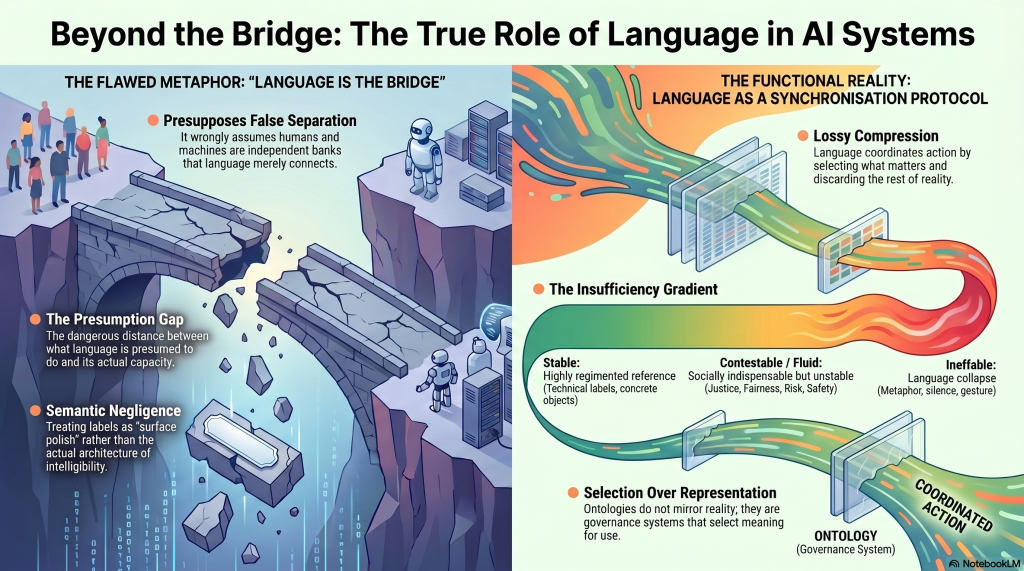
Semantic Infrastructure, Insufficiency, and the False Romance of Interoperability
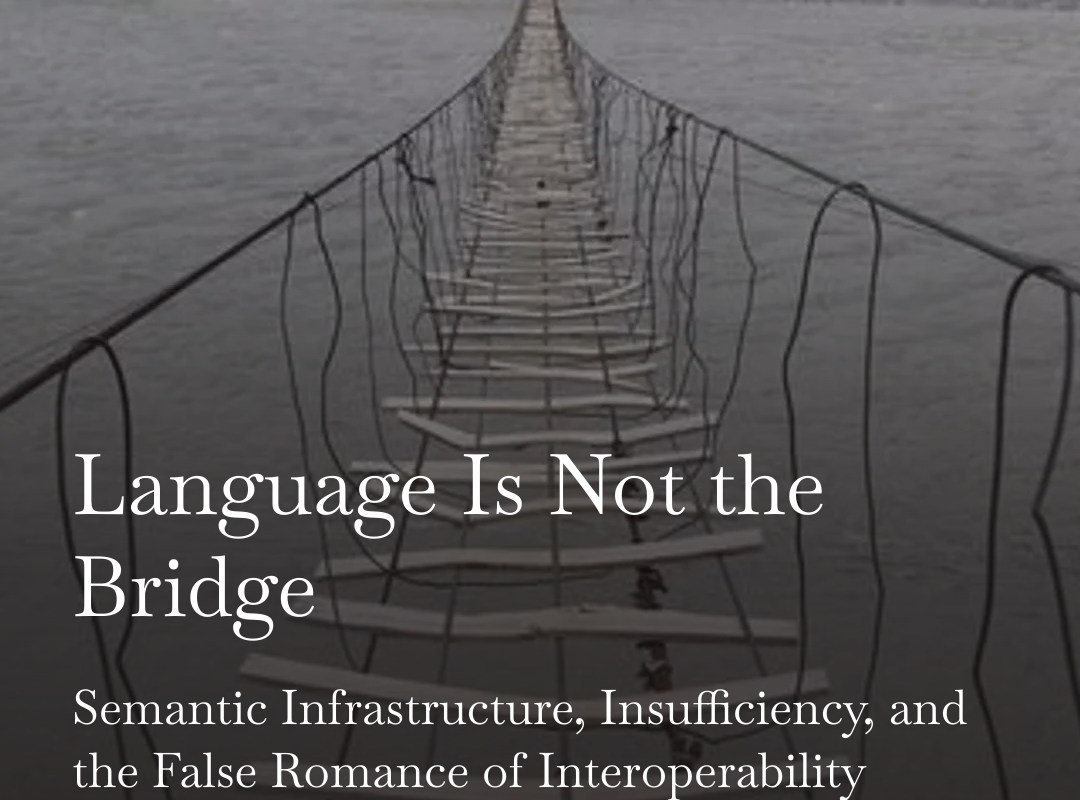
A recent Substack essay, Jessica Talisman’s Language Is the Bridge, makes a claim that is increasingly common in discussions of artificial intelligence, knowledge graphs, ontologies, metadata, and semantic infrastructure: that language is the bridge between human understanding and machine action. The claim is attractive, and not merely because ‘bridge’ is one of those metaphors that allows technical discourse to cosplay as wisdom literature. It captures something real. AI systems, semantic architectures, ontologies, taxonomies, controlled vocabularies, and knowledge graphs do not run on raw reality. They run on structured representations. Those representations require labels, definitions, mappings, alignments, constraints, and interpretive discipline. In that sense, language work is not decorative. It is infrastructural. But the metaphor is also dangerous.
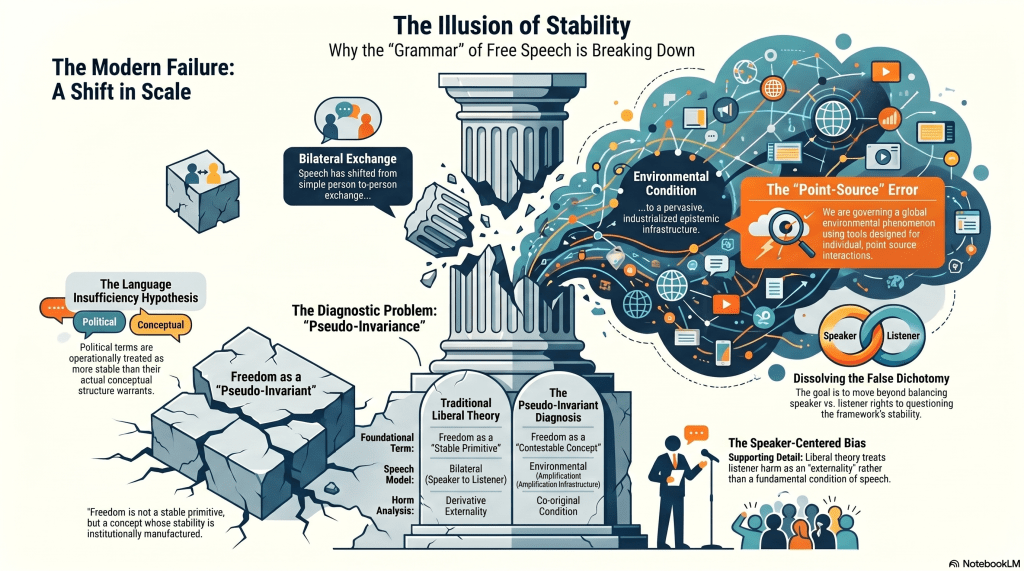
I read from the Wrong Curve: Free Speech, Pseudo-Invariance, and the Grammar of Liberal Rights. This essay is freely available on Zenodo at https://doi.org/10.5281/zenodo.19636760. This segment is the Abstract and the Introduction.
In this essay, I argue that free speech discourse is structured by a category error whose source lies upstream of speech itself: in the treatment of ‘freedom’ as a stable philosophical primitive when it functions, in practice, as an essentially contested concept operating under a systematically inflated presumption of effectiveness.
tl;dr: I don’t believe in free speech.
We’ve all likely heard that the freedom to swing one’s fist ends at the tip of another’s nose. I can accept this without argument for the purpose of this assertion. Your freedom TO violates my freedom FROM.
Audio: NotebookLM summary podcast of this topic.
The problem is that one’s words don’t stop. In some cases, they continue in the manner of pollution that I don’t want my ear holes to be exposed to this noise. In the social media age, this effect is trebled and molests my eyes. This is especially egregious for misinformation and disinformation, which is to say, much of the internet and beyond.
This impact hasn’t been suitably addressed, so I wrote about it. Here, I read.
The LinkedIn consensus has spoken: if you used AI in the writing process, you are not the author. The position is stated with the confidence of someone who has never hired a ghostwriter, employed a research assistant, submitted to a heavy editor, or considered that the Gettysburg Address was almost certainly not written by Lincoln.
Image: I couldn’t not share this Midjourney 8.1 image. It may not have understood the assignment.
Audio: NotebookLM summary podcast of this topic.
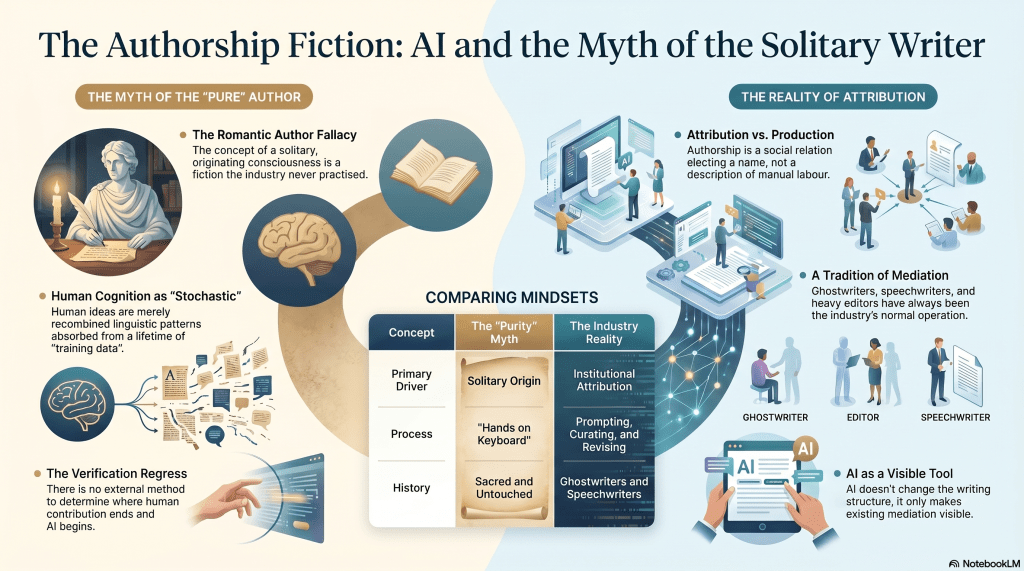
Authorship has never been a production relation. It has always been an attribution relation — an institutionally stabilised answer to the question of which name the practice elects to put on the cover. These are not the same thing, and conflating them is the error from which every subsequent confusion proceeds.
The ghostwriter has existed as long as commercial publishing. The political speechwriter is so normalised that nobody considers it worth remarking. The celebrity memoir, the corporate thought-leadership piece, the attributed editorial — these are not edge cases or embarrassing exceptions. They are the normal operation of every writing-adjacent industry that has ever existed. The name on the cover has never reliably indicated the hands on the keyboard, and the industry has never seriously pretended otherwise. It has simply preferred not to discuss it at dinner.
AI changes the tool. It does not change the structure. The person who prompts, selects, curates, revises, and publishes is doing what commissioners of ghostwriters have always done. What has changed is that AI makes the mediation visible in a way that polite convention previously concealed. Visibility triggers the purity reflex. What presents itself as a defence of authentic authorship is a defence of a particular fiction — the Romantic author as solitary originating consciousness — that the industry never consistently believed and certainly never consistently practised.
The purity position also fails on its own terms before it gets started. Consider the spectrum of AI-assisted writing: a full draft submitted for light polish; a human argument substantially revised by AI; collaborative ideation followed by AI drafting; a kernel of an idea handed over for full execution. These are genuinely different in terms of human contribution. The zealot position requires a threshold somewhere on this spectrum below which authorship lapses. It never specifies where. More fatally, it has no means of verification. There is no external method of determining where on the spectrum any given piece of writing falls. The detector tools are probabilistic noise that disproportionately penalise competent prose. Any audit mechanism sophisticated enough to catch first-order evasion immediately generates a second-order workaround. The regress terminates only at continuous surveillance of the writing process — panoptical authorship as the logical endpoint of the position taken seriously.
NotebookLM Infographic on this topic.
Then there is the recursion problem, which the zealot never addresses because it is fatal. The stochastic parrot charge against AI — that it merely recombines absorbed linguistic patterns without genuine origination — describes with considerable accuracy what human cognition also does. The writer’s training data is the Dickens read at ten, the billboard absorbed on a commute, the argument overheard on public transit, the half-remembered essay that shaped a position without ever being consciously cited. The causal chain of any human idea disappears into an unauditable cognitive history. Genuine origination in the sense the purity position requires has never existed. The Romantic author was always a retrospective confabulation. Barthes said so in 1967. The industry nodded politely and continued invoicing.
What the zealot is defending is not authorship. It is a particular grammar of authorship — one that selects compositional origin as the threshold criterion, applies it selectively and unverifiably, and uses the resulting suspicion as a status boundary. It is guild behaviour dressed as principle, which is understandable as a response to a genuine economic threat but should not be mistaken for a philosophical position.
Authorship is the position a culture elects to stabilise after the work has already been produced through far messier means. It has always been thus. AI did not break the fiction. It just made the fiction harder to keep a straight face about.
The Rest of the Story
I’ve written about this before. I am not an AI apologist, but I am peeved by anti-LLM zealots, who clearly haven’t thought through their arguments.
I finished reading A.J. Ayer’s Language, Truth, and Logic, the part about Bertrand Russell’s claim about ‘The author of Waverley was Scotch‘. My brain latched onto authorship, and my emotional response was WTF? I have other problems with Russell and Ayer on this, but that’s a matter for another day.
To make my point, this page up to the ellipsis is the output of Claude after an extended dialogue with it and ChatGPT after I read Ayers, and something didn’t sit quite right. I am not ashamed to use LLMs in my authoring workflow and am not ashamed to mention it, as here. Almost all of these thoughts are mine. I’ve simply asked Claude to organise the output. It’s good enough to output as-is, and any edits would be trivial, so I won’t bother. I probably could have made the edits in as much time as it took to type this, but I’ve got nothing to hide. I’m just a human with access to technology circa 2026.
The title may have given this away, but my parents are in their eighties, an absurdity on the face of it, because some primitive part of my brain still files them under ‘adults’ – people who understand the performance of being alive.
Years ago, against my father’s wishes, my mother took a job as a waitress. His objection came out with that antique domestic authority that probably ought to be preserved in amber: No wife of mine is going to work. There it is. The marital constitution in a single sentence. Not an argument – rather, by decree. Still, she worked.
Audio: NotebookLM summary podcast of this topic.
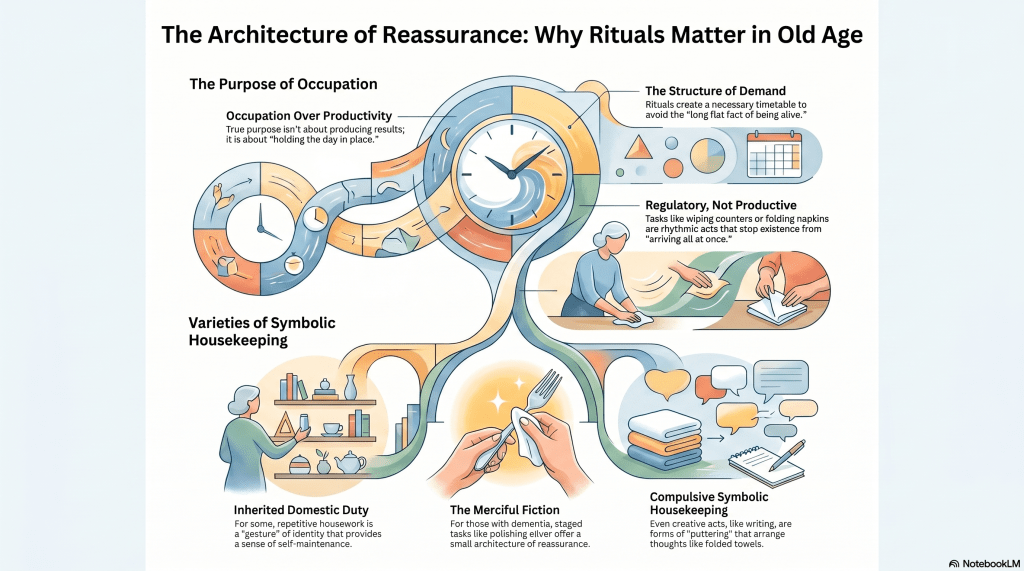
It’s been years since she held a paid job, but in retirement, she seems to have lost more than employment. She’s lost a structure of demand. She is bored out of her gourd or tree or whatever. Left alone with an unfilled day, she putters, tidies, wipes, folds, rearranges, and complains – rinse and repeat. Sisyphus would be proud. And the complaint isn’t incidental; it’s part of the ritual. The labour gives the grievance somewhere to reside.
There’s a peculiar mercy in not being too useful.
NotebookLM Infographic on this topic.
This creates an odd etiquette for everyone around her. One has to be careful not to interfere too much. Don’t clean everything; efficiently eliminate tasks; show up flushed with modern virtue and liberate her from the very thing that’s keeping the day from opening its jaws. Offer help, accept the refusal, move on without guilt. There’s a peculiar mercy in not being too useful.
Once the housework is done – or once it reaches the temporary truce by pause – the restlessness comes back. The ourobouros resumes its self-consumption. Then she needs to walk, drive, shop, bake, browse, fiddle, inspect, rearrange, and escape – more infinite loop, though only seemingly so. Anything to distract her from the long flat fact of being alive without a timetable. Employment used to do that. Marriage did that. Children did that. The household still does that. Now the old structures only remain as gestures, but gestures can still hold a person upright, as they had before, but with more salience.
A different version of this appeared with my mother-in-law, who had dementia. To occupy her, we’d give her silver to polish, or napkins to fold. There wasn’t a real need for the silver to shine, and the napkins, once folded, could be unfolded and dropped back on the pile to repeat the process. Like Keynes’s worker digging holes to fill them in again, the point wasn’t production. The point was occupation. The task didn’t need to move the world forward, as if it did in any case. It only needed to hold the day in place.
That sounds cruel when you describe it abstractly, as if we were tricking her into labour, but you’d be confusing this with Capitalism. The real cruelty would have been leaving her unmoored – nothing for the hands to do whilst the mind searched for a room it could still recognise. Folding napkins wasn’t housework in any economic sense. It was a small architecture of reassurance. A way of letting purpose survive after purpose had lost its object. even if the sense of purpose had long left the building.
There’s a distinction here, though it isn’t clean. My mum’s rituals are self-maintaining. They belong to a life trained by domestic obligation, by marriage, by an older settlement between gender and labour, by all the small cruelties that once got to call themselves normal. My mother-in-law’s rituals were externally staged – not expressions of domestic identity so much as acts of care arranged by other people. Whilst all purpose is fictional, one woman kept her purpose through the fiction of inherited duty; the other was offered purpose as a merciful fiction. The border between the two is porous, naturally, because reality has never agreed to respect our categories.
I’m not recommending any of this to anyone. I’m just noticing it, which is what we writers call ‘thinking’ when we want to dodge responsibility.
Abstract freedom isn’t the same thing as a life you can actually inhabit.
I’m a feminist the way I’m a humanist: sincerely, but with reservations about the slogans. I don’t think this is how a woman should live. I don’t believe domestic labour is some mystical feminine vocation – as if dusting were an ontological destiny and the Hoover a sacrament. But I also can’t bring myself to take it away from her. Abstract freedom isn’t the same thing as a life you can actually inhabit. Sometimes emancipation arrives too late to provide new habits. Sometimes the cage has become furniture.
This doesn’t justify the cage. It only complicates the fantasy that removing it leaves behind a clean liberated self, glowing like a freshly unboxed appliance. People aren’t appliances, although civilisation has made several brave attempts.
The mistake is assuming purpose has to be justified by productivity. That’s the capitalist infection, of course: if nothing’s produced, nothing happened. But most of ordinary life isn’t productive in that sense. It’s regulatory. Consolatory. Rhythmic. A person folds the napkin, wipes the counter, polishes the spoon, walks round the block, checks the same cupboard twice, tells the same story, asks the same question, rearranges the same shelf, writes the same sentence again with one adjective changed and calls it progress – like an LLM but with less personality. These acts don’t redeem existence. They just stop it arriving all at once.
As for me, I don’t have a purpose either, so I write. Ostensibly, this is my own form of puttering. My desk is her kitchen counter. My paragraphs are folded towels. I arrange sentences, complain about them, rearrange them, and call the whole performance ‘vocation’ because compulsive symbolic housekeeping looks poor on a business card.
There’s a shabby tenderness in this, though one shouldn’t make too much of it. The old trick isn’t really meaning; it’s occupation, rhythm – having something to do with one’s hands whilst the mind declines to look directly at the wall. Some people clean. Some people shop. Some shoot fentanyl. Some become serial killers, CEOs, presidents, consultants, motivational speakers, or other recognised hazards. Some of us write essays about our mothers and pretend it counts as insight. We all find our own ways to bide the time until we die.
In the end, nobody gets out alive. The least we can do is not steal from each other the shabby little rituals that make the waiting bearable.
Video: On a related note. Jonny talks about Setiya and atelic activities.








 Philosophics