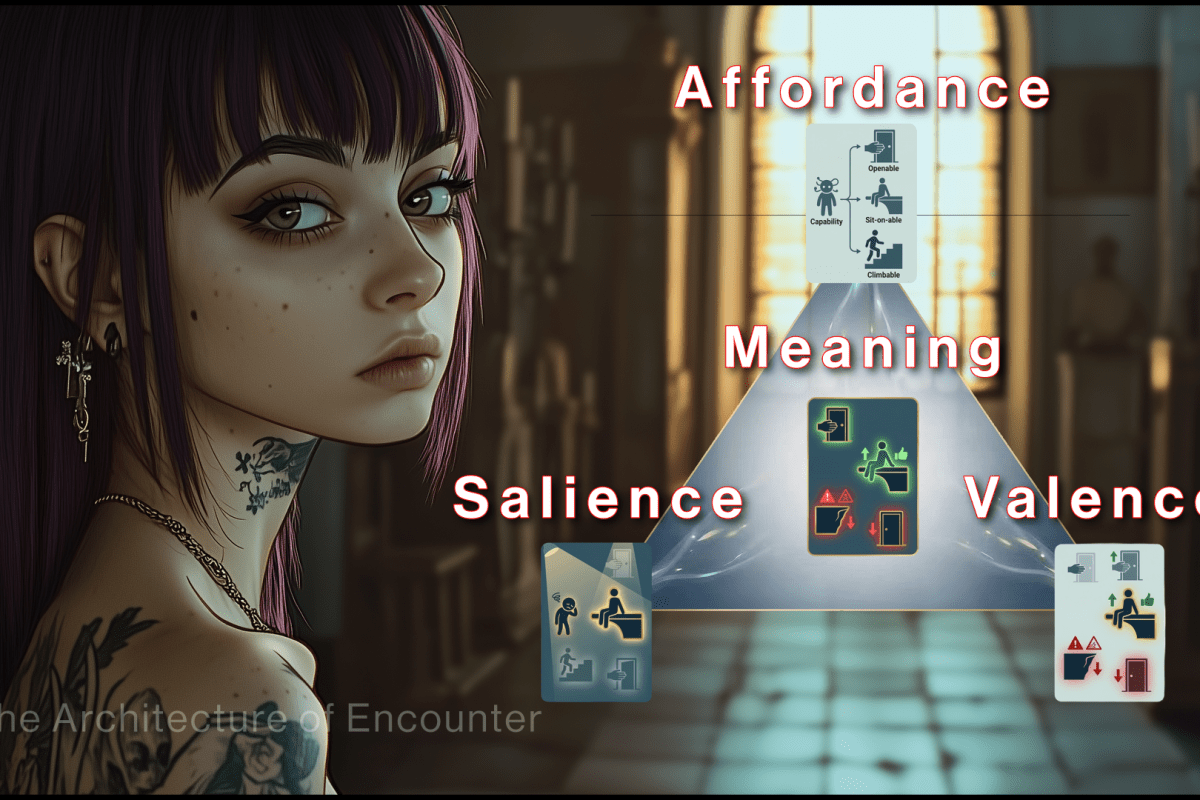
I had already decided there were limitations to this notion, but I feel it’s still useful. The way I see it, affordance instantiates with an encounter. Stairs don’t have affordances as attributes absent interaction. Generalised, affordance is a function where one needs something like this
A = {subject:object:index:context}
where the subject is the sentient or animate entity, let’s say the chimps in this image; the object is the encountered item, say the bench; the index is the affordance, say sitting or standing, and the context is a salience (or valence or attention) modifier.
In the case of sitting, I may not be tired or particularly interested in sitting. The bench still affords sitting, but I don’t instantiate the act.
Taking stairs as a more common example, if I am a typically abled human adult, stairs afford climbing (ascending and descending), but if I am relegated to a wheelchair, no such affordance relationship exists. This helps to explain why affordance isn’t an attribute of the stairs, but rather of the encounter.
Water to a non-swimmer doesn’t afford swimming any more than a tree affords climbing for a fish – and yet does for a chimp.
Salience, attention, valence and the construction of disposition
Today I live about 90 minutes out of Boston by car on a good day – and 2 hours on a return trip because I live in Cape Cod, a tourist area, so I tend to have to compete with traffic. Today, it took over 2 and a half hours, a Friday afternoon, trapped among boat and beach seekers. I don’t drive, so I require chauffeurs to get me here and there. Today I driving with a bloke for whom traffic possesses unusual psychological gravity. He seems to have traffic and weather on the brain – and don’t get me started on crime, national security, and petrol prices.
Audio: NotebookLM summary podcast of this topic.
I’ll spare the reader the trip up, which was fairly easy, despite traffic-related side comments whenever inappropriate. On the way back and at the first patch of congestion, he harrumphed and announced that we would certainly be stuck in traffic for the entire journey. I checked the Google Maps. Traffic was intermittent, and I told him so.
Soon afterwards, the road cleared. We travelled freely for miles – no traffic to report – but when we later encountered another queue, however, he declared that his prediction had been vindicated. On arrival, he told others that we had been stuck in traffic ‘the whole way’.
Two people; the same reality; different experiences. I got me thinking – and chatting with ChatGPT because the driver was focused on driving – and of course the misery of traffic.
Here’s the rest of the story: The traffic didn’t occupy the whole journey. To him, it occupied the portions of the journey that counted. The clear road was perceptually available but apparently lacked evidential weight. It was experienced without being recruited into the eventual account.
Noticing the divergence between out perceptions, I tried to reconcile. First, I considered filing this under selective attention and confirmation bias, that great psychological lost-property office into which every untidy inference is now deposited, but this doesn’t feel quite right; it doesn’t seem to capture the essence.
Before a belief can be confirmed by evidence, something must first become evidence, right? So, the more interesting question isn’t merely why this geezer interpreted the journey pessimistically, but why congestion became salient whilst free movement receded into the background. What determines which parts of experience become psychologically substantial?
Here’s how I see it:
I tried to view this through lenses of salience, attention and valence. First, a quick refresher:
Salience concerns what stands out, demands processing or acquires significance.
Attention concerns the allocation and maintenance of cognitive resources.
Valence concerns the positive or negative affective character assigned to something.
Traffic may be salient because it frustrates an aim. Its negative valence may help capture attention. Sustained attention may then produce richer encoding, making the traffic easier to recall. Later recollection may strengthen the prior belief that journeys are usually obstructed, which may increase vigilance for traffic during the next journey. No single element need rule the others.
The relation is recursive:
disposition shapes salience
salience directs attention
attention affects encoding
valence influences interpretation
memory reconstructs the event
reconstruction reinforces disposition
And even this is too linear, but here we are. Attention can alter valence. Bodily arousal can alter salience. Memory can modify present interpretation. Expectations can affect what is noticed before conscious appraisal has properly begun. The arrows run in both directions, and probably sideways as well.
The result isn’t simply a biased opinion about a neutral world. It’s a patterned encounter wherein some features arrive already amplified and others scarcely become legible.
Pessimism: Disposition as an epistemic filter
This got my pondering mental health issue. I’m not a psychologist, and I discount the discipline quite heavily, but I wanted to consider the notion of disposition. How can two people quite literally in the same vehicle on the same journey view the world so differently. Of course, we are all carved by our experiences, but this is a reciprocating function: the more we experience the world positively or negatively, the more the world will reveal itself as such. Confirmation bias drives the nails into the coffin.
Let’s look at the down side: pessimism. I don’t mean some clinical depression, but instead of seeing the world with no glasses, and rose-coloured spectacle, the world is view with dark glasses – I’m envisioning a welder’s visor. One could stare at the sun and proclaim it’s overcast. Eyeore on steroids.
A pessimistic disposition might usually described as a tendency to expect bad outcomes. And whilst this may be true, it’s incomplete. Pessimism may also affect what is noticed, how long attention remains with it, how it is interpreted, and what survives into later recall. This is my thesis – or at least my point. The unpleasant becomes an event. The satisfactory becomes the absence of an event.
Congestion is noticed; free movement is merely used. An insult is retained; an ordinary kindness passes as social administration. A failure requires explanation; success is dismissed as luck, temporary relief or an exception that proves nothing.
This asymmetry can make a disposition appear empirically vindicated. The pessimist remembers abundant evidence for pessimism because pessimistically congruent events were more likely to become salient, receive attention and survive reconstruction. The conclusion is then presented as realism:
I don’t expect things to go badly because I am pessimistic.
I am pessimistic because experience shows that things go badly.
Yet ‘experience‘ here isn’t an untouched archive. It’s already been selected, weighted and narrated.
Research on depression is compatible with this more interactive account. Depression and vulnerability to depression have been associated not only with increased processing of negative material but also with diminished positive biases across attention, interpretation, memory and self-referential thought. The pattern is therefore not merely an excess of negativity. It may also involve a failure of positive information to acquire or retain ordinary psychological weight.
A negatively valenced event may dominate because it attracts unusually strong attention. But an apparently negative world might also arise because positive events are weakly encoded, rapidly discounted or treated as anomalous. The same remembered landscape could therefore emerge through different cognitive routes.
Before I continue, a disclaimer: I am not trying to claim that my perception is correct and his isn’t. I’m merely asking how we end up with distinct narratives. It reminds me of the beginning of Woody Allen’s Annie Hall, where a couple are speaking to counsellors. A therapist asks about their love life:
Alvy Singer (him) and Annie Hall (her) are seeing their therapists at the same time on a split screen
Alvy’s Therapist: How often do you sleep together?
Annie’s Therapist: Do you have sex often?
Alvy: [lamenting] Hardly ever. Maybe three times a week.
Annie: [annoyed] Constantly. I’d say three times a week.
The interesting think here, is that both are disappointed for the same event one because sex is over-indexed and the other because it is under-indexed.
Moving on…
Anxiety and the world as warning
Anxiety offers a related configuration. Threatening material tends to capture attention more strongly in anxious populations, although effect sizes, experimental measures and the direction of attention over time are not perfectly uniform. Some people may orient rapidly towards threat; others may struggle to disengage; still others may shift from vigilance to avoidance. The bureaucracy of diagnosis naturally prefers a single box, whilst cognition persists in behaving like a process.
Interpretation and memory may then participate in the same system. An ambiguous expression becomes disapproval. A delayed reply becomes rejection. A bodily sensation becomes evidence of illness. Each interpretation increases anxiety; increased anxiety makes threat more salient; heightened salience provides further material for threatening interpretation.
Research on anxiety increasingly examines these as interacting biases rather than sealed mechanisms. Attention, interpretation and memory can be associated with one another, though the evidence does not support a single simple causal sequence in every case.
The important point is not that the danger is imaginary. Sometimes the road really is congested. Sometimes the delayed reply does indicate trouble. Sometimes the body is ill. The question is how individual events acquire representative force and how readily contrary events are permitted to revise the emerging model.
When significance itself becomes unstable
In some accounts of psychosis, salience plays a still more direct role. The aberrant-salience hypothesis proposes that neutral or incidental stimuli may acquire excessive significance, leaving the person to explain why ordinary events feel unusually charged. A glance, coincidence, headline or passing remark may become loaded with personal meaning.
This is not a complete theory of psychosis, nor should it be paraded as one. Predictive-processing accounts differ over whether particular symptoms arise from weakened prior expectations, excessively rigid priors, altered prediction-error signalling, or different disturbances at different levels of processing. Hallucinations and delusions may not share one uniform mechanism merely because diagnostic manuals house them in neighbouring rooms.
Still, the idea illustrates the broader point. Salience does not merely determine which established facts receive attention. It participates in determining what feels fact-like, connected or worthy of explanation.
Once significance has been assigned, interpretation begins its work. Once interpreted, the event may be more readily remembered. Once remembered, it joins the accumulating case for the interpretation that helped produce it.
Not merely ‘in the head’
None of this means that dispositions are autonomous cognitive errors floating above the world, and I reiterate that I am not a medical professional. Hell, I’m barely a professional. Salience is affected by history. Someone who has repeatedly encountered danger may reasonably become more attentive to possible danger. Poverty, discrimination, violence, illness and insecurity do not merely supply ‘negative thoughts’; they alter the statistical environment in which attention and expectation develop. What appears clinically as excessive vigilance may have been learned under conditions in which vigilance was adaptive.
Nor is salience purely conceptual. Sleep, stress, hormones, medication, pain and physiological arousal may all affect what attracts attention and what is retained. Experimental research indicates that arousal and valence can make distinct contributions to emotional memory, another reason not to compress the process into the nursery vocabulary of ‘positive’ and ‘negative thinking’. The world acts upon the disposition, and the disposition acts upon the encountered world. Neither term stands outside the relation.
This also guards against the moral obscenity of telling distressed people that they have simply chosen the wrong interpretation. A recursive process may be self-maintaining without being voluntary. One doesn’t escape it merely by deciding to notice flowers, practise gratitude and purchase a notebook with an inspirational slogan embossed upon it. Sorry, pop psychology and psychological self help industry
From bias to rigidity
Everyone relies upon selective attention. Everyone remembers unevenly. Everyone encounters a world already organised by concern, expectation and affect. Complete neutrality would not be enlightenment; it would be cognitive paralysis.
The relevant distinction may therefore not be between biased and unbiased minds. It may be between systems that remain revisable and systems that become rigidly self-confirming.
A disposition becomes pathological, perhaps, not merely when it selects, but when selection becomes pervasive; not merely when it assigns valence, but when valence governs what can count as evidence; not merely when memory reconstructs, but when reconstruction repeatedly erases whatever might disturb the governing account.
Even then, ‘pathology’ isn’t a property of one mechanism. It may emerge from the interaction of degree, duration, distress, social conditions, bodily states, functional consequences and the available means of correction. The traffic anecdote isn’t a diagnosis. It’s an anecdote, a small model of how a world can be cognitively weighted.
The bloke didn’t invent the congestion. He encountered real traffic. But the congestion became representative, whilst the open road became incidental. Later, memory converted this inequality of weight into an equality of duration: traffic here and there became traffic everywhere.
Perhaps certain dispositions operate similarly. They do not simply add a judgement to experience after the fact. They influence which experiences become prominent, which are sustained by attention, which acquire positive or negative force, and which are later recruited into the story of what the world is like. The question is therefore not merely whether a person sees reality accurately. It is which parts of reality become visible enough to count.
A final word
My ex-wife used to complain how we never did anything – and like the Annie Hall story, I’d say we did too much – so every week or two she’d want to do something, and her refrain was always, ‘Let’s do it. We never do anything.’ One can imagine, that this was not a sustainable model – perhaps as evidenced by the ex prefix. And so not to and this as a therapy session, I’ll leave it here.
Anyone familiar enough with my writing knows that I don’t support objectification – nounification – except as a scale-dependent heuristic shortcut. Victoria pulls memory out of the object of the brain and relocates it to time or, more specifically, to Bergson’s durée. But this move doesn’t make sense either. Plus, it adds an unnecessary or at least unearned metaphysical inflation. Whilst time may be containerised, durée can’t be by its very phenomenal nature.
In any case, after an extended chat with a GPT, I asked for a rendition to share. I’ll amend this in various ways, but for now, I wanted to capture the essence for review. I’ll describe the relata in more detail presently.
Image: ChatGPT render of memory process
Phenomenal Presentation Whatever is presently given in experience before it becomes a later recollection. This is not necessarily an unmediated encounter with reality, merely the phenomenal field available to apprehension.
Dynamically Weighted Relata Presentation, attention, salience, bodily condition, prior experience, habitus and ontological grammar operate relationally rather than as isolated faculties. Their relative influence shifts according to context, purpose and inherited orientation.
Selective Apprehension Only part of the phenomenal field is attended to or registered. Attention and salience are especially entangled here: what appears salient attracts attention, whilst attention may itself produce or intensify salience.
Lossy Collection / Compression What is apprehended is not preserved as a complete experiential copy. Some features are omitted, abstracted, merged or weighted more heavily than others, leaving a compressed consequence of the encounter rather than the encounter itself.
Retention as Altered System-State The event has ceased, but the apprehending system remains differently configured because it occurred. ‘Retention’, therefore, names a persisting alteration or inherited constraint, not an object stored intact within a container.
Cue-Dependent Recollection A later cue, whether sensory, linguistic, affective or contextual, recruits the retained alteration. Recollection is not simple retrieval but a present operation conditioned by both the earlier event and the system’s current state.
Reconstructed Re-Presentation The result is a new phenomenal presentation related to, but not identical with, the earlier one. Its vividness does not guarantee fidelity, since missing material may be supplied through expectation, narrative, habitus and present context.
The feedback loop indicates that recollection may itself revise the system. Each re-presentation can alter subsequent weighting, interpretation and recollection, so memory is not a static archive but a recursively reconstructive process.
I borrow some of this nomenclature from Iain McGilchrist, which I’ll also explain in future.
I want to clarify my recent The Trouble with Facts post. I realise that I was speaking to one non-trivial form of facts, but there is more than one class of facts. We argue about facts as if the word named a single, stable thing. It doesn’t. It names a family of very different things, quietly grouped together by habit, convenience, and institutional need. Most disputes about facts go nowhere, not because one side is irrational, but because the word itself is doing covert work. We slide between meanings without noticing, then act surprised when disagreement follows. This piece is an attempt to slow that slide.
Audio: NotebookLM summary podcast of this topic.
Polysemy We Notice, Polysemy We Don’t
We are comfortable with ambiguity when it is obvious. A bank can be a financial institution or the edge of a river. A bat can be an animal or a piece of sports equipment. Context resolves these instantly. No one feels existentially threatened by the ambiguity.
Fact is different. The word is polysemous in a way that is both subtle and consequential. Its meanings sit close enough to bleed into one another, allowing certainty from one sense to be smuggled into another without detection. Calling something a fact does not merely describe it. It confers authority. It signals that questioning should stop. That is why this ambiguity matters.
Different Kinds of Facts
Before critiquing facts, we need to sort them.
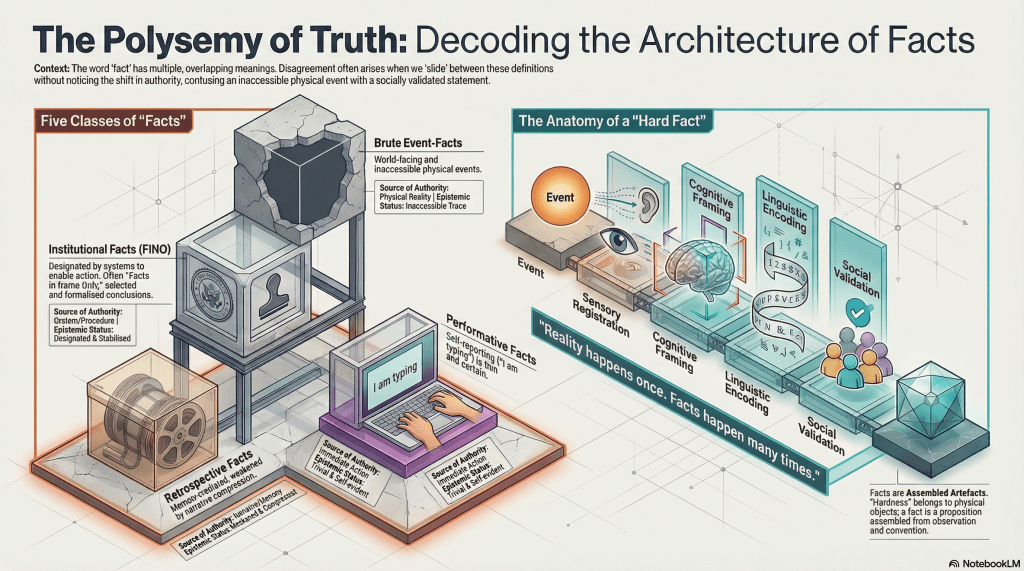
1. Event-facts (brute, world-facing) As mentioned previously, these concern what happens in the world, independent of observation.
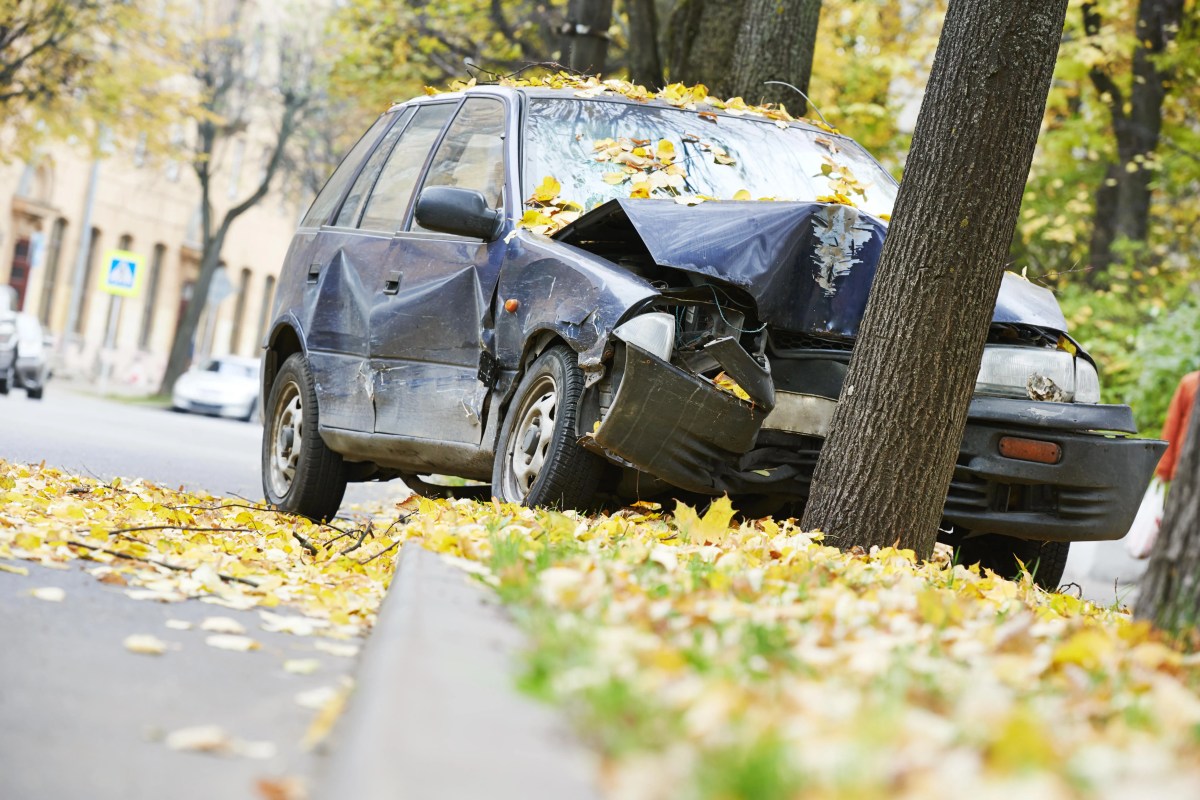
A car collides with a tree.
Momentum changes.
Metal deforms.
These events occur whether or not anyone notices them. They are ontologically robust and epistemically inaccessible. No one ever encounters them directly. We only ever encounter traces.
2. Indexical or performative facts (trivial, self-reporting) “I am typing.”
I am doing this now – those now may not be relevant when you read this. This is a fact, but a very thin one. Its authority comes from the coincidence of saying and doing. It requires no reconstruction, no inference, no institutional validation. These facts are easy because they do almost no work.
3. Retrospective personal facts (memory-mediated) “I was typing.”
This may be relevant now, at least relative to the typing of this particular post. Still a fact, but weaker. Memory enters. Narrative compression enters. Selectivity enters. The same activity now carries a different epistemic status purely because time has passed.
4. Prospective statements (modal, not yet facts) “I will be typing.”
This is not yet a fact. It may never come to be one. It is an intention or prediction that may or may not be realised. Future-tense claims are often treated as incipient facts, but this is a category error with real consequences.
5. Institutional facts (designated, procedural) “The court finds…” “The report concludes…”
These are facts by designation. They are not discovered so much as selected, formalised, and stabilised so that systems can act. They are unlikely to rise to the level of facts, so the legal system tends to generate facts in name only – FINO, if I am being cute.
All of these are called ‘facts’. They are not interchangeable. The trouble begins when certainty migrates illicitly from trivial or institutional facts into brute event-facts, and we pretend nothing happened in the transfer.
One Motor Vehicle
Reconsider the deliberately simple case: A motor vehicle collides with a tree. Trees are immobile, so we can rule out the tree colliding with the car.
Ontologically, something happened. Reality did not hesitate. But even here, no one has direct access to the event itself.
The driver does not enjoy privileged access. They experience shock, adrenaline, attentional narrowing, selective memory, post hoc rationalisation, perhaps a concussion. Already several layers intervene before language even arrives.
A rough schema looks like this:
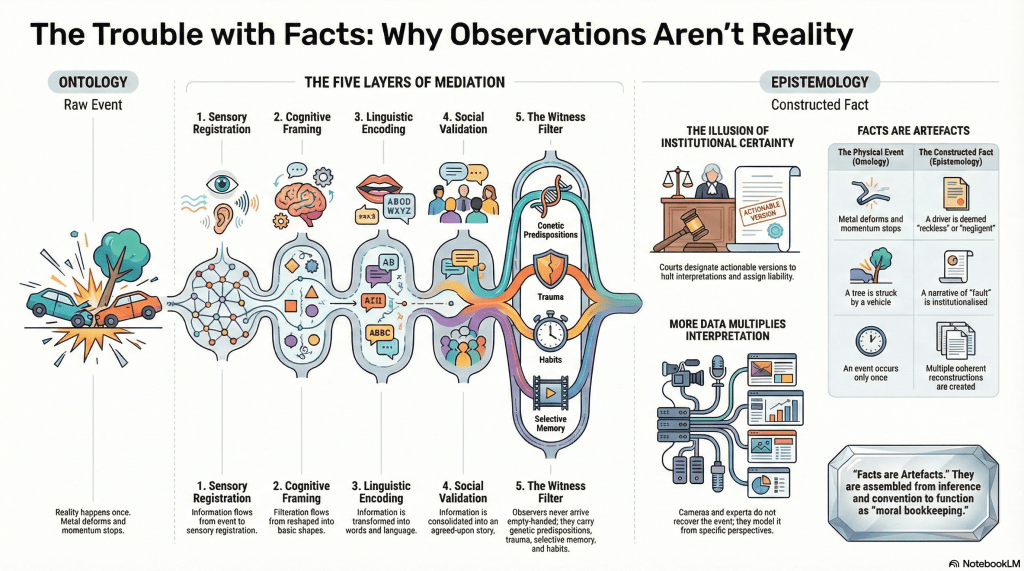
event → sensory registration → cognitive framing → linguistic encoding → social validation
Ontology concerns what happens. Epistemology concerns how anything becomes assertable.
Modern thinking collapses the second into the first and calls the result the facts.
People speak of “hard facts” as if hardness transfers from objects to propositions by proximity. It doesn’t. The tree is solid. The fact is an artefact assembled from observation, inference, convention, and agreement.
And so it goes…
Why the Confusion Persists
When someone responds, “But isn’t it a fact that I read this?”, the answer is yes. A different kind of fact.
The error lies not in affirming facts, but in failing to distinguish them. The word fact allows certainty to migrate across categories unnoticed, from trivial self-reports to brute world-events, and from institutional verdicts to metaphysical claims. That migration is doing the work.
Conclusion
Clarifying types of facts does not weaken truth. It prevents us from laundering certainty where it does not belong.
Facts exist. Events occur. But they do not arrive unmediated, innocent, or singular.
Reality happens once. Facts happen many times.
The mistake was never that facts are unreal. It was believing they were all the same kind of thing.
What we call facts are not discoveries of an unfiltered world. They are the end-products of mediation.
Let’s walk through an example.
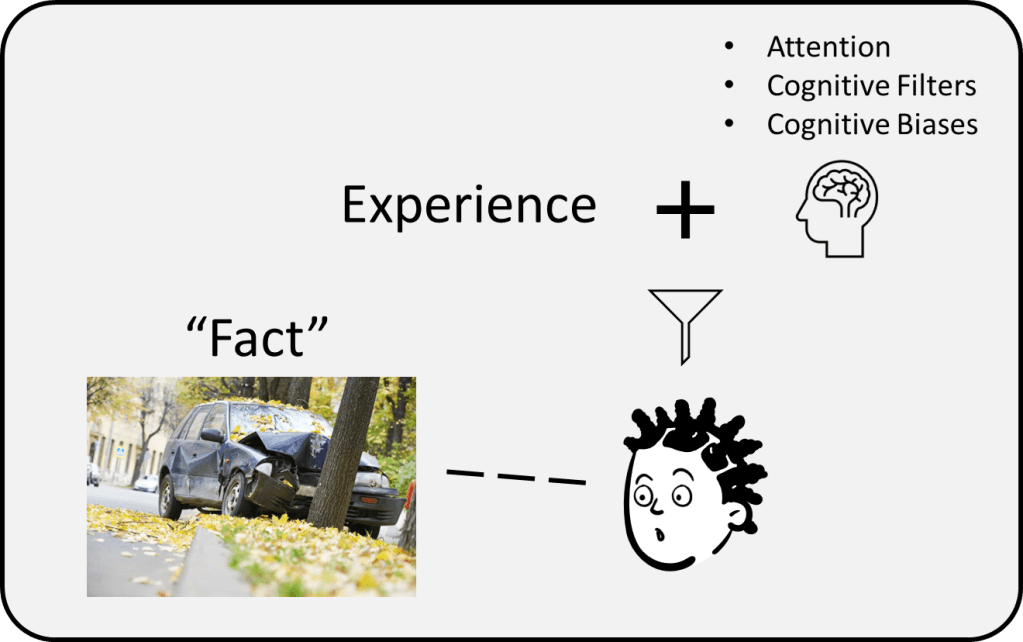
Image: Autosmash example. An observer arrives with experience – from genetic predisposition to childhood trauma to winning the lottery. Whatever it might be. Of course, they have many cognitive deficits, biases and filters. Then, there’s the immediate problem of attention. When did they notice the event? Did they turn to look after hearing the noise, or were they meditating on the tree in that moment?
Apparently, a motor vehicle has collided with a tree. Trees are immobile objects, so we can safely rule out the tree colliding with the car.*
So what, exactly, are the facts?
Audio: NotebookLM summary podcast of this topic.
Ontology (the boring bit)
Ontologically, something happened.
A car struck a tree. Metal deformed. Momentum stopped.
Reality did not hesitate. It did not consult witnesses. It did not await interpretation.
This is the part Modernity likes to gesture at reverently before immediately leaving it behind.
Image: Requisite NotebookLM infographic on this content.
The Witness
Even the driver does not enjoy privileged access to “what really happened”.
They get:
proprioceptive shock
adrenaline distortion
attentional narrowing
selective memory
post hoc rationalisation
possibly a concussion
Which is already several layers deep before language even arrives to finish the job.
We can generalise the structure:
event → sensory registration → cognitive framing → linguistic encoding → social validation
Ontology: events occur. States of affairs obtain. Something happens whether or not we notice.
Epistemology: observation is always filtered through instruments, concepts, language, habits, and incentives.
Modern sleight of hand: collapse the second into the first and call the result the facts.
People love the phrase “hard facts”, as if hardness transfers from objects to propositions by osmosis. It doesn’t. The tree is solid. The fact is not.
Facts are artefacts. They are assembled from observation, inference, convention, and agreement. They function. They do not reveal essence.
Reality happens once. Facts happen many times, differently, depending on who needs them and why.
Filtration
An event occurred. A car struck a tree.
Then an observer arrives. But observers never arrive empty-handed.
They arrive with history: genetics, upbringing, trauma, habits, expectations, incentives. They arrive already filtered.
Were they already looking, or did the noise interrupt something else entirely?
Reality happens once. Facts happen many times, differently, depending on who needs them and why.
Here Comes the Law
This is where the legal system enters, not because truth has been found, but because closure is required.
Courts do not discover facts. They designate versions of events that are good enough to carry consequences. They halt the cascade of interpretations by institutional force and call the result justice.
At every epistemic level, what we assert are interpretations of fact, never access to ontological essence.
Intent, negligence, recklessness. These are not observations. They are attributions. They are stopping rules that allow systems to function despite uncertainty.
The law does not ask what really happened. It asks which story is actionable.
Two Motor Vehicles
Now add a second moving object.
Another car enters the frame, and with it an entire moral universe.
Suddenly, the event is no longer merely physical. It becomes relational. Agency proliferates. Narratives metastasise.
Who was speeding? Who had the right of way? Who saw whom first? Who should have anticipated whom?
Intent and motive rush in to fill the explanatory vacuum, despite remaining just as unobservable as before.
Nothing about the ontology improved. Everything about the storytelling did.
Where the tree refused intention, the second vehicle invites it. We begin inferring states of mind from trajectories, attributing beliefs from brake lights, extracting motives from milliseconds of motion.
But none of this is observed.
What we observe are:
vehicle positions after the fact,
damage patterns,
skid marks,
witness statements already filtered through shock and expectation.
From these traces, we construct mental interiors.
The driver “intended” to turn. The other driver “failed” to anticipate. Someone was “reckless”. Someone else was merely “unlucky”.
These are not facts. They are interpretive assignments, layered atop already mediated observations, selected because they allow responsibility to be distributed in socially recognisable ways.
This is why explanation now fractures.
One cascade of whys produces a story about distraction or poor judgment. Another produces a story about road design or visibility. Another about timing, traffic flow, or urban planning.
Each narrative is plausible. Each is evidence-constrained. None is ontologically privileged.
Yet one will be chosen.
Not because it is truer, but because it is actionable.
The presence of a second vehicle does not clarify causation. It merely increases the number of places we are willing to stop asking questions.
Modernity mistakes this proliferation of narrative for epistemic progress. In reality, it is moral bookkeeping.
The crash still occurred. Metal still deformed. Momentum still stopped.
What changed was not access to truth, but the urgency to assign fault.
With one vehicle and a tree, facts already fail to arrive unmediated. With two vehicles, mediation becomes the point.
And still, we insist on calling the result the facts.
But nothing fundamental has changed. We have not escaped mediation. We have merely scaled it up and professionalised it.
Cameras do not record reality. They record:
a frame,
from a position,
at a sampling rate,
with compression,
under lighting conditions,
interpreted later by someone with a mandate.
Video feels decisive because it is vivid, not because it is ontologically transparent. It freezes perspective and mistakes that freeze for truth. Slow motion, zoom, annotation. Each step adds clarity and distance at the same time.
Experts do not access essence either. They perform disciplined abduction.
From angles, debris fields, timing estimates, and damage profiles, they infer plausible sequences. They do not recover the event. They model it. Their authority lies not in proximity to reality, but in institutional trust and methodological constraint.
More data does not collapse interpretation. It multiplies it.
With enough footage, we don’t get the story. We get competing reconstructions, each internally coherent, each technically defensible, each aligned to a different question:
Who is legally liable?
Who is financially responsible?
Who violated policy?
Who can be blamed without destabilising the system?
At some point, someone declares the evidence “clear”.
What they mean is: we have enough material to stop arguing.
This is the final Modern illusion: that accumulation converges on essence. In reality, accumulation converges on closure.
The event remains what it always was: inaccessible except through traces. The facts become thicker, more confident, more footnoted. Their metaphysical status does not improve.
Reality happened once. It left debris. We organised the debris into narratives that could survive institutions.
Cameras didn’t reveal the truth. Experts didn’t extract it. They helped us agree on which interpretation would count.
And agreement, however necessary, has never been the same thing as access to what is.
* I was once driving in a storm, and a telephone pole fell about a metre in front of my vehicle. My car drove over the pole, and although I was able to drive the remainder of the way home, my suspension and undercarriage were worse for the wear and tear.
Written by Bry Willis and ChatGPT 5.2 after an extended chat about the image as a talking point about the inaccessibility of facts.
A recent parody video making the rounds on social media shows a man at a kitchen table, his girlfriend, and their cat. In a desperate attempt to gain his girlfriend’s attention, he knocks a cup off the table. The moment it hits the floor, she turns on him, scolding him for his clumsiness. Quick to deflect, he blames the cat, and suddenly her anger dissipates. She shifts from reprimanding him to lavishing affection on the supposedly guilty feline. The tension lifts—until he sheepishly confesses that it was, in fact, his doing all along. Her response? An incredulous, “Are you kidding me?”
What’s fascinating about this skit isn’t the comedy of the man’s mischief or even the cat’s unknowing role in the charade. It’s the girlfriend’s starkly different reactions to the same act, depending on who she believes committed it. The cat, in her eyes, can do no wrong; the boyfriend, however, is immediately culpable. It’s easy to laugh at the scenario’s absurdity, but the dynamic it portrays is familiar and, dare I say, quite telling about human behaviour.
The Double Standard of Blame
Why is it that we’re quick to exonerate some and just as quick to indict others? The phenomenon is more than a quirk of personality; it reveals our deeper, often unconscious, biases. While it’s understandable that the girlfriend might think the cat incapable of intentional mischief, her reaction also suggests a predisposition to forgive certain actors—whether due to perceived innocence, attachment, or simply habit.
This dynamic isn’t limited to pets and partners. In families, workplaces, and social groups, we often see a similar pattern. One person becomes the perennial scapegoat, bearing the brunt of blame for any and all misdeeds, while another enjoys a seemingly unshakeable immunity. Think of the “golden child” and the “black sheep” within a family. One can rarely put a foot wrong, while the other’s every move is scrutinised, questioned, or condemned.
Beyond the Blame: Motivations and Consequences
The reasons behind these imbalances can be complex. Sometimes, they stem from past behaviour: if someone has repeatedly erred, we may be primed to expect the worst from them, even if they’ve reformed. Other times, they arise from emotional bonds or biases: we excuse those we love or admire because acknowledging their faults would cause us discomfort or cognitive dissonance.
This phenomenon isn’t just about playing favourites; it can have significant psychological consequences. For the person perpetually cast as the villain, the burden of unwarranted blame can lead to feelings of resentment, anxiety, or self-doubt. Meanwhile, those consistently exonerated may internalise a skewed perception of their own infallibility, which can be equally damaging.
A Broader Reflection on Accountability
Returning to the video’s context, the girlfriend’s swift switch from reproach to indulgence once she believed the cat was at fault, and her subsequent anger when the truth was revealed, invites us to question our own responses to perceived transgressions. Are we, too, guilty of selectively assigning blame based on who we think is responsible? How often do we let our preconceptions shape our judgments, favouring one actor over another without truly weighing the evidence?
The parody is amusing, no doubt, but it also serves as a subtle reminder: our reactions often reveal more about our biases and expectations than about the actions themselves. The next time we find ourselves quick to blame or forgive, it’s worth pausing to ask: are we reacting to the act, or to the actor?
In a world increasingly marked by polarised opinions and knee-jerk reactions, cultivating this kind of self-awareness is crucial. We need to be vigilant not only about how we judge others but also about why we do so. For, in the end, it’s not just about who knocked the cup off the table—it’s about who we believe deserves to be scolded for it.
Chapter two is titled Attention. It’s about how what we attend to tends to shape our sense of reality. This is a story of the functional speciality of the hemispheres and their mediating components. Each hemisphere has its own protocols and modus operandi, each with distinct task specialisation. Important to note coming in is that about thirty per cent of all neuronal activity is inhibitory in nature. In fact, the frontal lobe is what inhibits the reflexive animal-reptilian responses allowing for some—I mean, let’s be honest here—human civil capacity. These mediating elements are designed—idiomatically, not literally—to orchestrate hemispheric activities so that each side can do what it’s best suited for.
Content
Both hemispheres attend to their environments, but they have different foci. One way to distinguish which hemisphere is focused on what, McGilchrist regards research oriented toward people with damage to one or the other part, whether by a stroke or accident. In some cases, this separation is accomplished clinically. There is a difference between right- and left-handedness, but I am not going to elaborate here.
Persons with left hemisphere damage noted difficulty writing and spelling whilst right hemisphere damaged people experienced a loss of empathy as well as a range of cognitive and emotional impairments.
Selective Attention: Invisible Gorilla Test
In general, the right hemisphere attends to the broader environment with a trade-off on specificity whilst the left hemisphere is laser-focused at the expense of the wider perspective and ability to maintain attention. Evidently, and I quote, “the left hemisphere has a tendency to ‘space out’ for seconds (sometimes 15 or more) at a time”. McGilchrist cites the invisible gorilla study where viewers are asked to watch a video clip of two teams of basketball players dribbling and passing a ball to count the number of times one team passes the ball. As this is happening, a person dressed in a gorilla costume walks into frame and makes gestures to bring attention to itself and then walks out of frame.
Focusing on the ball passing is a left-brain function that predominates right-brain activity. As it is laser-focused on the task at hand, it is oblivious to the gorilla in the midst. When re-viewing the clip without the focus activity, the gorilla is quite obviously present. He cites another substitution study that again illustrates what happens when the right brain does not have an audience.
Again, whilst “the right hemisphere is sensitive to the whole picture in space and time, background and periphery, the left hemisphere is focussed on what is central in the field of vision and lies in the foreground.” This becomes evident with hemispheric damage. When the left hemisphere is damaged, people can still perceive the full view-frame because the right hemisphere remains intact, but when the right hemisphere is damaged, less than half of the world remains. In the book, some examples follow.
The left hemisphere suffers from a stickiness problem. Without a participating right hemisphere, a person can have their attention fixated on some objects in the environment. And he points out that this is not a problem with visual perception, because tests demonstrate that subjects can be made to fixate on imaginary objects in a dark room. In schizophrenics, this fixation always occurred on the right side of the field of vision. This fixation ties into staring, which he describes as “a special kind of vision, in itself predatory: left hemisphere attention gets locked onto its target.” I’ll guess that many of us have been fixated on some activity and an unexpected interloper startles us when they become apparent. He mentions the discredited Sapir-Whorf hypothesis in passing. I won’t bother.
McGilchrist foreshadows chapter four a bit by informing the reader that the left hemisphere is grasping and apprehending whilst the right hemisphere excels at comprehending. More on this in future segments.
Another feature of the left hemisphere is that it not only ignores the majority of the environment it finds itself in, but it is also a master of denial.
Another feature of the left hemisphere is that it not only ignores the majority of the environment it finds itself in, but it is also a master of denial. For example, a person with right-hemispheric damage was paralysed on the left side of his body, yet he was not only unaware of the paralysis. He denied that he was paralysed.
In a second case, another person with right-hemisphere damage and left-side paralysis, when asked to perform tasks would comply with the requests directed toward the right side of the body but ignore or claim not to understand the directions when directed toward the left side.
What this represents is that the left hemisphere had established a map of the body that was unable to be updated because of the damage to the right hemisphere that would have provided an update. One might consider this in the manner of an old SAT-NAV when map updates needed to be manually applied. If you happen to be travelling in a new development on an obsolete map, the map will not correspond to the terrain.
As mentioned previously, the right hemisphere can be thought to present whilst the left hemisphere can be thought to re-present, having codified and archived the contents for later retrieval. The book has more types of examples including people experiencing reality through a set of freeze-frames and time elapses, but the takeaway is that the hemispheres also differ in how they interpret space, time, and motion. In fact, the right hemisphere is instrumental in perceiving three-dimensional space.
I won’t exhaust the many remaining examples in the book, though I may reference some in summary when I share my reaction and perspective. The final topic I’ll mention is that human infants are right-hemisphere dominant. They are practically all about gathering inputs without being concerned with how they map the terrain for later retrieval. They simply experience the world without the analysis and judgment the left brain later brings to bear.
Perspective
At the end of the chapter, McGilchrist provides a summary. The right hemisphere is always vigilant to what might be out there. For the left hemisphere, if it hasn’t been brought to attention, it doesn’t exist. Consider the invisible gorilla. The left hemisphere’s attention is sharply restricted in space and time. It favours precision over accuracy and at the expense of depth. It is not concerned with the “expansive, always moving, always changing, endlessly interconnected nature of reality.” The left is all about atomisation and stasis.
Unfortunately, despite all these limitations, the left still thinks it’s right. Revisiting the SAT-NAV scenario, the left brain is akin to a person staring at the screen that declares the destination has been reached. The right brain looks out the window and informs that they are decidedly not in the right place. Does one trust the instrumentation or the environment?
One undercurrent I feel is that McGilchrist wants to play the left and right hemispheres against each other to assess which is more veridical. This is where I think we differ, but the jury is still out. In his case, he wants to compare the way that each hemisphere maps to our experience of the real world. In his view, and I don’t think I am putting words into his mouth, our experience is the world because we experience it as it appears to us. In my view, experiences are simply a representative map as limited by our sense-perceptions and cognitive abilities. So, when he assesses the right hemisphere as a better reflection of reality, I say it just better captures the map.
For him, it’s either left or right. But for me, it’s right, left, or none of the above. I believe our disagreement is that I subscribe to a fitness before truth paradigm whilst McGilchrist doesn’t. I feel that fitness is the evolutionary litmus, and evolution doesn’t care about truth. In fact, assessing truth comes at the expense of energy and attention, the subject of this topic. The reason the case studies cited in this chapter are interesting is not that they illustrate some truth deficit that would render them easy prey in a Darwinian world, it’s because their perception leaves them with a fitness penalty. There is no reason to invoke some spectre of truth.
This was an interesting chapter with over a dozen clinical anecdotes. It does well to articulate the differences in hemisphere function and lends credence to left and right brain asymmetry. I feel it’s worth cracking on to the next chapter, Perception.
Before I bring this commentary to a close, I want to make an orthogonal comment. McGilchrist mentioned case studies where people reported freeze-framing. It is understood that certain birds have a faster frame rate than humans, so if they were viewing a movie running at 60 frames per second, they would not see the same continuous motion picture as a typical person; rather, they would perceive it as how we might perceive a slide show or a slow flip book. Of course, this is unrelated to the brain conversation, but the topic reminded me of the difference. For anyone who feels they need to educate me about the fact that the ocular systems don’t operate in frames per second, allow me instead to direct you to the domain of metaphor and analogy.
What are your thoughts on the split function of brain hemispheres? If you’ve read the book or at least this chapter, what was your favourite story? Did I omit your favourite? Leave comments below or on the blog.








 Philosophics