
Gibson’s Affordances

I was inspired to write about affordances on Substack this afternoon.

I had already decided there were limitations to this notion, but I feel it’s still useful. The way I see it, affordance instantiates with an encounter. Stairs don’t have affordances as attributes absent interaction. Generalised, affordance is a function where one needs something like this

A = {subject:object:index:context}

where the subject is the sentient or animate entity, let’s say the chimps in this image; the object is the encountered item, say the bench; the index is the affordance, say sitting or standing, and the context is a salience (or valence or attention) modifier.
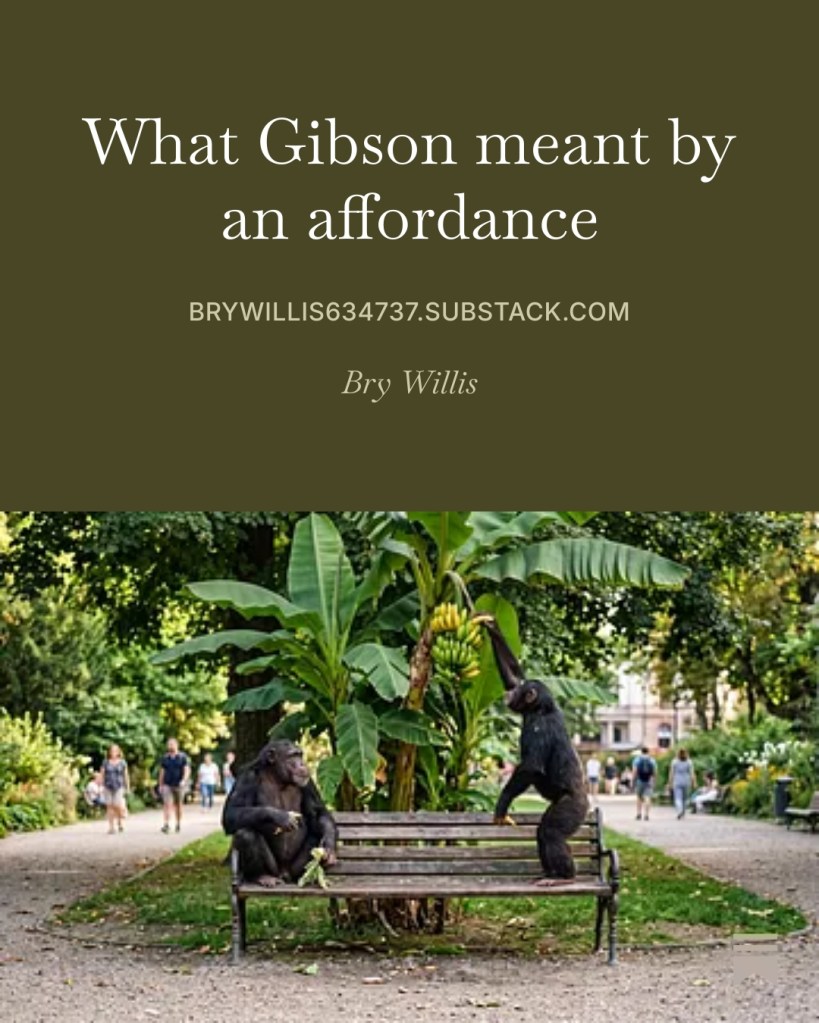
In the case of sitting, I may not be tired or particularly interested in sitting. The bench still affords sitting, but I don’t instantiate the act.

Taking stairs as a more common example, if I am a typically abled human adult, stairs afford climbing (ascending and descending), but if I am relegated to a wheelchair, no such affordance relationship exists. This helps to explain why affordance isn’t an attribute of the stairs, but rather of the encounter.

Water to a non-swimmer doesn’t afford swimming any more than a tree affords climbing for a fish – and yet does for a chimp.
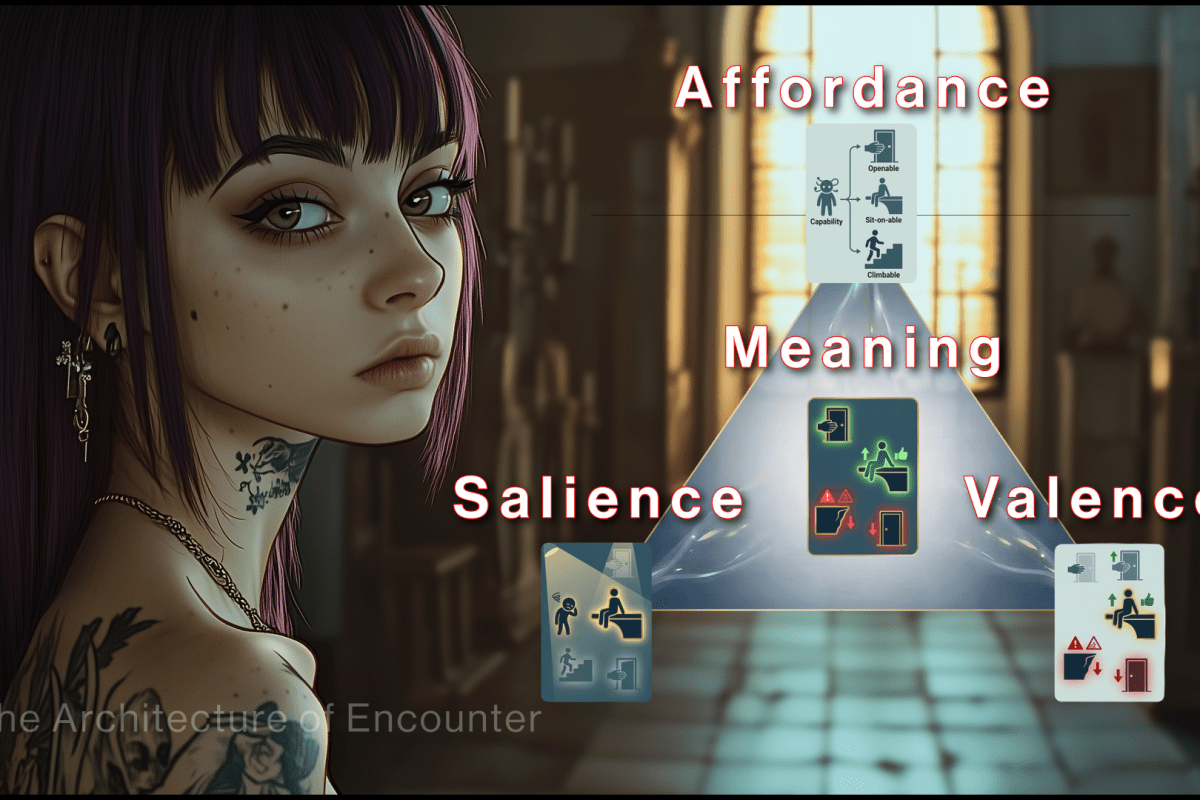
Architecture of Encounter: Attention, Affordance, Salience, and Valence

What do attention, affordance, salience, and valence have to do with meaning, and what is the architecture of encounter?

I’m still trying to figure out how to simplify these concepts. How am I doing?

  • 0:00 Introduction and Encounter
  • 0:52 Attention
  • 1:53 What is Affordance?
  • 3:13 What is Salience?
  • 4:12 Example: Salience Connexion and Context (My ex-wife)
  • 4:44 What is Valence?
  • 5:38 What is Meaning?
  • 6:23 Example: Southern Hospitality (Salience and Meaning)

Short and sweet.

New Architecture of Encounter Video Content: Glossary Terms

I’ve commenced a new series in support of my new book. First, I’m building a glossary.

Video: Bry – Architecture of Encounter

On the docket in this segment are affordance, salience, and valence as they relate to the book. I selected these terms from the glossary in the appendix.

Over the next few weeks, I plan to produce videos on other terms and additional videos explaining key concepts. This one is straightforward and academic. Others will be less formal, hoping to accommodate different learning styles.

Does anyone subscribe to Kindle Unlimited? I may take time to create Kindle and eBook versions.

My fiction books had some formatting issues with Kindle, but these titles are more standard – no fancy layouts or fonts, and not too many images.