I’m a nihilist. Possibly always have been. But let’s get one thing straight: nihilism is not despair. That’s a slander cooked up by the Meaning Merchants – the sentimentalists and functionalists who can’t get through breakfast without hallucinating some grand purpose to butter their toast. They fear the void, so they fill it. With God. With country. With yoga.
Audio: NotebookLM podcast on this topic.
Humans are obsessed with function. Seeing it. Creating it. Projecting it onto everything, like graffiti on the cosmos. Everything must mean something. Even nonsense gets rebranded as metaphor. Why do men have nipples? Why does a fork exist if you’re just going to eat soup? Doesn’t matter – it must do something. When we can’t find this function, we invent it.
But function isn’t discovered – it’s manufactured. A collaboration between our pattern-seeking brains and our desperate need for relevance, where function becomes fiction, where language and anthropomorphism go to copulate. A neat little fiction. An ontological fantasy. We ask, “What is the function of the human in this grand ballet of entropy and expansion?” Answer: there isn’t one. None. Nada. Cosmic indifference doesn’t write job descriptions.
And yet we prance around in lab coats and uniforms – doctors, arsonists, firemen, philosophers – playing roles in a drama no one is watching. We build professions and identities the way children host tea parties for dolls. Elaborate rituals of pretend, choreographed displays of purpose. Satisfying? Sometimes. Meaningful? Don’t kid yourself.
We’ve constructed these meaning-machines – society, culture, progress – not because they’re real, but because they help us forget that they’re not. It’s theatre. Absurdist, and often bad. But it gives us something to do between birth and decomposition.
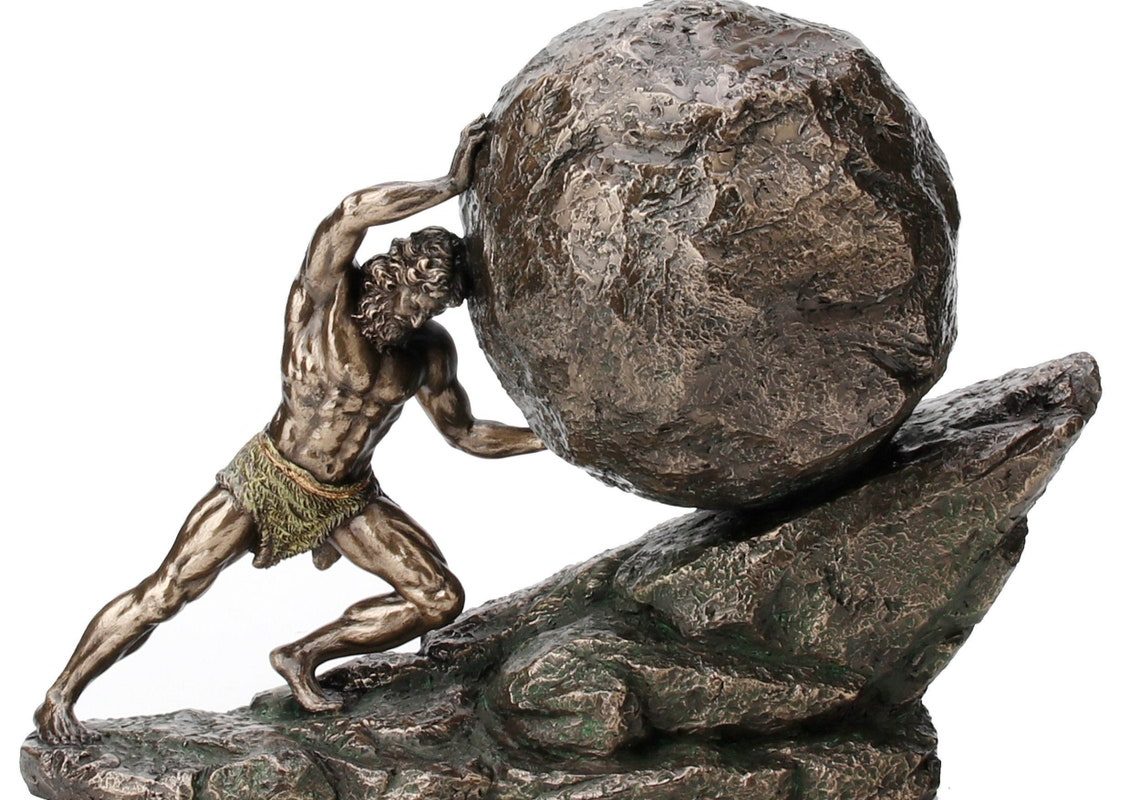
Sisyphus had his rock. We have careers.
But let’s not confuse labour for meaning, or imagination for truth. The boulder never reaches the top, and that’s not failure. That’s the show.
So roll the stone. Build the company. Write the blog. Pour tea for Barbie. Just don’t lie to yourself about what it all means.
“Is the universe really infinite? Or could it loop back on itself like a sphere?” Sabine Hossenfelder’s words on the nature of space-time are arresting, not merely for the cosmological implications but for the deeper metaphor they offer. They strike a resonant chord with anyone wrestling with a different kind of infinite: the slippery expanse of language.
As Sabine walks us through the intricacies of curved space-time, she inadvertently shines a light on something equally abstract yet close to home—how language, like the universe, seems vast and unbounded but is, in practice, riddled with constraints. What if language itself, for all its apparent openness, is its own kind of finite geometry?
Drawing on my Language Insufficiency Hypothesis (LIH), I propose that Sabine’s insights into cosmology can offer a lens to explore the paradoxes of human communication. Language, like space-time, is internally defined, replete with loops, and prone to infinite configurations that fail to expand meaningfully. Let’s explore how the universe’s curvature mirrors the curvatures of our words.
The Closed Systems of Space and Language
In physics, the curvature of space-time is measured internally. You can determine if space is flat or curved by drawing a triangle and adding its angles. If they don’t sum to 180 degrees, you’re in curved space. Sabine highlights that this is true without any external reference point; the geometry is self-contained.
Language operates much the same way. Words and meanings are often bounded by the internal logic of the systems they inhabit—be they legal, technical, or ideological. Much like the curvature of space-time, linguistic meaning is determined not externally but within the context of its own closed system. Think of a term like “justice”: in a legal setting, it might add up to one interpretation, while in a political debate, its angles skew wildly. To an outsider, the system is opaque, even though it seems perfectly flat from within.
Infinite Expanses or Finite Loops?
Sabine explains that the universe might be infinite, but it might also loop back on itself, creating patterns of repetition. Her analogy of light travelling endlessly through a curved universe only to return to its origin provides a striking metaphor for language’s “effectiveness horizons.”
As concepts grow more abstract—freedom, truth, beauty—language seems to expand infinitely. But in practice, it often circles back, repeating itself in kaleidoscopic loops of contested meaning. Philosophers have debated terms like “good” or “justice” for millennia, yet here we are, still tracing the same paths, unable to break free from the system’s internal constraints. Language doesn’t expand into new meaning; it curves back on itself.
Schrödinger’s Words: Infinite Interpretations
One of Sabine’s most evocative ideas is the notion that in an infinite universe, there are infinite copies of you, some slightly different, some wildly so. A version of you with more hair. One with less brain. This multiplicity mirrors what I call Schrödinger’s Weasels: words that exist in multiple, contradictory states until “collapsed” by context.
Take a word like “freedom.” In political discourse, it can simultaneously mean the right to self-determination, freedom from government interference, or the economic liberty to exploit markets. Much like Sabine’s infinite configurations, these meanings coexist until someone forces them into a single interpretive frame. The result? Semantic exhaustion. A single word tries to carry the weight of an infinite universe.
The Precision Paradox
Sabine notes that asking what the universe expands into is a meaningless question because expansion describes relationships within space-time, not beyond it. Similarly, the pursuit of perfect precision in language often collapses into meaninglessness. Trying to pin down a word like “justice” leads to endless definitions, each requiring further clarification. It’s a Zeno’s paradox of semantics: the closer we get to precision, the more distance remains.
Lessons from Curved Space and Twisted Words
What does this tell us about the limits of language? Sabine’s insights reinforce the idea that complexity doesn’t always lead to clarity. Like the universe, language isn’t infinite in the way we might wish; it’s bounded by its own structure. The more abstract the concept, the greater the chance we’ll find ourselves lost in a linguistic loop, navigating words that seem to expand but merely repeat.
Understanding this doesn’t mean abandoning the pursuit of meaning but accepting its constraints. Just as cosmologists use models to map the unobservable edges of the universe, we can use frameworks like the Language Insufficiency Hypothesis to chart the limits of our words. Both efforts are acts of humility in the face of infinite complexity.
Closing Thought
If Sabine is right that there are infinitely many versions of ourselves in the universe, perhaps one of them has already solved the riddle of language. Or, more likely, they’ve just found a new loop to wander.
What do you think? Is language a closed system, forever folding back on itself? Or can we stretch it, like space-time, to infinity and beyond?
I’ve written a lot on the insufficiency of language, and it’s not even an original idea. Language, our primary tool for sharing thoughts and ideas, harbours a fundamental flaw: it’s inherently insufficient for conveying precise meaning. While this observation isn’t novel, recent developments in artificial intelligence provide us with new ways to illuminate and examine this limitation. Through a progression from simple geometry to complex abstractions, we can explore how language both serves and fails us in different contexts.
Audio: NotebookLM summary podcast of this topic.
The Simple Made Complex
Consider what appears to be a straightforward instruction: Draw a 1-millimetre square in the centre of an A4 sheet of paper using an HB pencil and a ruler. Despite the mathematical precision of these specifications, two people following these exact instructions would likely produce different results. The variables are numerous: ruler calibration, pencil sharpness, line thickness, paper texture, applied pressure, interpretation of ‘centre’, and even ambient conditions affecting the paper.
This example reveals a paradox: the more precisely we attempt to specify requirements, the more variables we introduce, creating additional points of potential divergence. Even in mathematics and formal logic—languages specifically designed to eliminate ambiguity—we cannot escape this fundamental problem.
Precision vs Accuracy: A Useful Lens
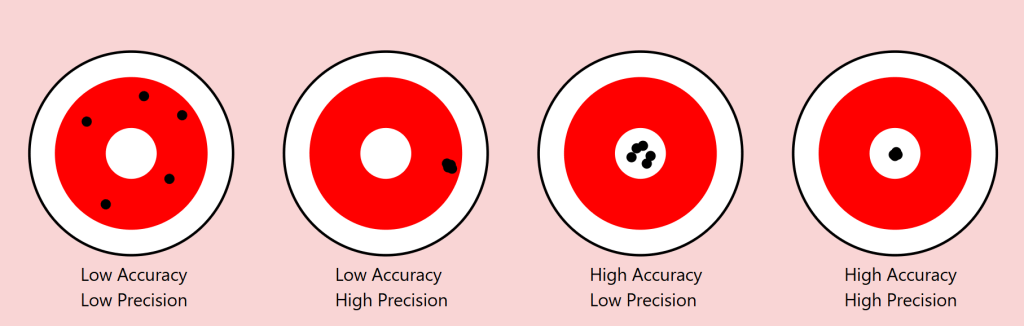
The scientific distinction between precision and accuracy provides a valuable framework for understanding these limitations. In measurement, precision refers to the consistency of results (how close repeated measurements are to each other), while accuracy describes how close these measurements are to the true value.
Returning to our square example:
Precision: Two people might consistently reproduce their own squares with exact dimensions
Accuracy: Yet neither might capture the ‘true’ square we intended to convey
As we move from geometric shapes to natural objects, this distinction becomes even more revealing. Consider a maple tree in autumn. We might precisely convey certain categorical aspects (‘maple’, ‘autumn colours’), but accurately describing the exact arrangement of branches and leaves becomes increasingly difficult.
The Target of Meaning: Precision vs. Accuracy in Communication
To understand language’s limitations, we can borrow an illuminating concept from the world of measurement: the distinction between precision and accuracy. Imagine a target with a bullseye, where the bullseye represents perfect communication of meaning. Just as archers might hit different parts of a target, our attempts at communication can vary in both precision and accuracy.
Consider four scenarios:
Low Precision, Low Accuracy When describing our autumn maple tree, we might say ‘it’s a big tree with colourful leaves’. This description is neither precise (it could apply to many trees) nor accurate (it misses the specific characteristics that make our maple unique). The communication scatters widely and misses the mark entirely.
High Precision, Low Accuracy We might describe the tree as ‘a 47-foot tall maple with exactly 23,487 leaves displaying RGB color values of #FF4500’. This description is precisely specific but entirely misses the meaningful essence of the tree we’re trying to describe. Like arrows clustering tightly in the wrong spot, we’re consistently missing the point.
Low Precision, High Accuracy ‘It’s sort of spreading out, you know, with those typical maple leaves turning reddish-orange, kind of graceful looking.’ While imprecise, this description might actually capture something true about the tree’s essence. The arrows scatter, but their centre mass hits the target.
High Precision, High Accuracy This ideal state is rarely achievable in complex communication. Even in our simple geometric example of drawing a 1mm square, achieving both precise specifications and accurate execution proves challenging. With natural objects and abstract concepts, this challenge compounds exponentially.
The Communication Paradox
This framework reveals a crucial paradox in language: often, our attempts to increase precision (by adding more specific details) can actually decrease accuracy (by moving us further from the essential meaning we’re trying to convey). Consider legal documents: their high precision often comes at the cost of accurately conveying meaning to most readers.
Implications for AI Communication
This precision-accuracy framework helps explain why AI systems like our Midjourney experiment show asymptotic behaviour. The system might achieve high precision (consistently generating similar images based on descriptions) while struggling with accuracy (matching the original intended image), or vice versa. The gap between human intention and machine interpretation often manifests as a trade-off between these two qualities.
Our challenge, both in human-to-human and human-to-AI communication, isn’t to achieve perfect precision and accuracy – a likely impossible goal – but to find the optimal balance for each context. Sometimes, like in poetry, low precision might better serve accurate meaning. In other contexts, like technical specifications, high precision becomes crucial despite potential sacrifices in broader accuracy.
The Power and Limits of Distinction
This leads us to a crucial insight from Ferdinand de Saussure’s semiotics about the relationship between signifier (the word) and signified (the concept or object). Language proves remarkably effective when its primary task is distinction among a limited set. In a garden containing three trees – a pine, a maple, and a willow – asking someone to ‘point to the pine’ will likely succeed. The shared understanding of these categorical distinctions allows for reliable communication.
However, this effectiveness dramatically diminishes when we move from distinction to description. In a forest of a thousand pines, describing one specific tree becomes nearly impossible. Each additional descriptive detail (‘the tall one with a bent branch pointing east’) paradoxically makes precise identification both more specific and less likely to succeed.
An AI Experiment in Description
To explore this phenomenon systematically, I conducted an experiment using Midjourney 6.1, a state-of-the-art image generation AI. The methodology was simple:
Generate an initial image
Describe the generated image in words
Use that description to generate a new image
Repeat the process multiple times
Attempt to refine the description to close the gap
Continue iterations
The results support an asymptotic hypothesis: while subsequent iterations might approach the original image, they never fully converge. This isn’t merely a limitation of the AI system but rather a demonstration of language’s fundamental insufficiency.
A cute woman and her dog stand next to a tree
One can already analyse this for improvements, but let’s parse it together.
a cute woman
With this, we know we are referencing a woman, a female of the human species. There are billions of women in the world. What does she look like? What colour, height, ethnicity, and phenotypical attributes does she embody?
We also know she’s cute – whatever that means to the sender and receiver of these instructions.
I used an indefinite article, a, so there is one cute woman. Is she alone, or is she one from a group?
It should be obvious that we could provide more adjectives (and perhaps adjectives) to better convey our subject. We’ll get there, but let’s move on.
and
We’ve got a conjunction here. Let’s see what it connects to.
her dog
She’s with a dog. In fact, it’s her dog. This possession may not be conveyable or differentiable from some arbitrary dog, but what type of dog is it? Is it large or small? What colour coat? Is it groomed? Is it on a leash? Let’s continue.
stand
It seems that the verb stand refers to the woman, but is the dog also standing, or is she holding it? More words could qualify this statement better.
next to a tree
A tree is referenced. Similar questions arise regarding this tree. At a minimum, there is one tree or some variety. She and her dog are next to it. Is she on the right or left of it?
We think we can refine our statements with precision and accuracy, but can we? Might we just settle for “close enough”?
Let’s see how AI interpreted this statement.
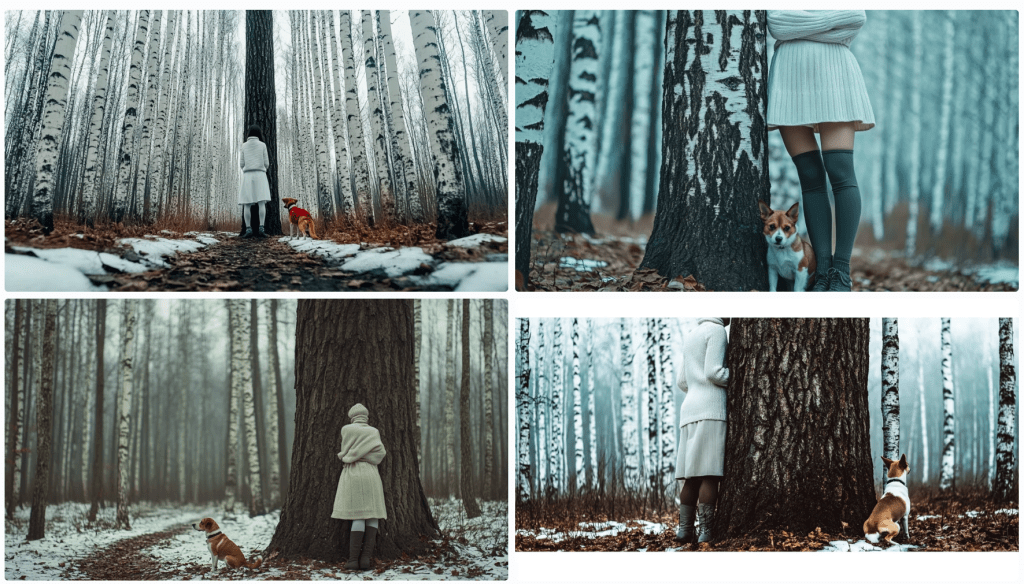
Image: Eight Midjourney renders from the prompt: A cute woman and her dog stand next to a tree. I’ll choose one of these as my source image.
Let’s deconstruct the eight renders above. Compositionally, we can see that each image contains a woman, a dog, and a tree. Do any of these match what you had in mind? First, let’s see how Midjourney describes the first image.
In a bout of hypocrisy, Midjourney refused to /DESCRIBE the image it just generated.
Last Midjourney description for now.
Let’s cycle through them in turn.
A woman is standing to the left of an old-growth tree – twice identified as an oak tree. She’s wearing faded blue jeans and a loose light-coloured T-shirt. She’s got medium-length (maybe) red-brown hair in a small ponytail. A dog – her black and white dog identified as a pitbull, an American Foxhound, and an American Bulldog – is also standing on his hind legs. I won’t even discuss the implied intent projected on the animal – happy, playful, wants attention… In two of the descriptions, she’s said to be training it. They appear to be in a somewhat residential area given the automobiles in the background. We see descriptions of season, time of day, lighting, angle, quality,
A woman is standing to the right of an old-growth tree. She’s wearing short summer attire. Her dog is perched on the tree.
An older woman and her dog closer up.
A read view of both a woman and her dog near an oak tree.
As it turned out, I wasn’t thrilled with any of these images, so I rendered a different one. Its description follows.
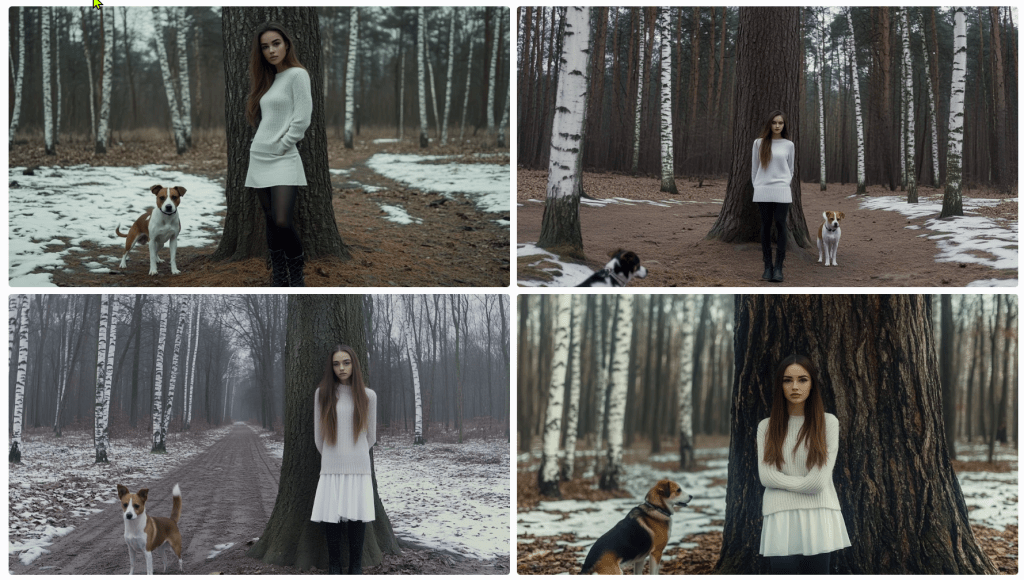
The consensus is that ‘a beautiful girl in a white dress and black boots stands next to a tree’ with a Jack Russell Terrier dog. I see birch trees and snow. It’s overcast. Let’s spend some time trying to reproduce it. To start, I’m consolidating the above descriptions. I notice some elements are missing, but we’ll add them as we try to triangulate to the original image.
A beautiful girl in a white dress and black boots stands next to a tree in a winter forest with birch trees. A Jack Russell Terrier dog is nearby, and the weather is cloudy. The photo has a cinematic style. --ar 128:71
This is pretty far off the mark. We need to account for the overall setting and composition, relative positioning, clothing, hair, camera, perspective – even lighting and film emulsion.
Let’s see how we can refine it with some adjectives. Before this, I asked Anthropic’s Claude 3.5 to describe the image. Perhaps we’ll get more details.
An atmospheric winter photograph was taken in what appears to be a birch and pine forest. The ground is partially covered with snow, creating a patchy pattern of white snow and brown leaves or soil. In the image, there's a person wearing winter attire consisting of a white knit turtleneck sweater, a white skirt, dark knee-high socks, and grey lace-up boots. They're standing against a large tree trunk with their arms crossed. Next to them is a Jack Russell Terrier mix dog with distinctive brown and white colouring. The dog appears to be well-behaved, sitting attentively beside the tree. The composition is quite striking, with the massive dark tree trunk serving as a central focal point against the misty, winter forest background. The white clothing of the person creates a visual echo with the white bark of birch trees visible in the background, as well as with the patches of snow on the ground. The overall mood of the photo is somewhat moody and contemplative, enhanced by what appears to be overcast lighting and the misty quality of the forest in the background. The colour palette is largely monochromatic, dominated by whites, greys, and browns, which adds to the winter atmosphere of the scene.
We don’t seem to be moving in a good direction. Let’s modify the initial prompt.
A beautiful girl in a white dress and tall laced black boots stands facing the camera to the right of large oak tree centred in the foreground of a winter forest with birch trees in the background. To the left of the tree is a Jack Russell Terrier dog looking at the camera, and the weather is cloudy. The photo has a cinematic style. --ar 128:71
I’ll allow the results to speak for themselves. Let’s see if we can’t get her out of the wedding gown and into a white jumper and skirt. I’ll bold the amends.
A beautiful girl in a white jumper and skirt wearing black leggings and tall laced black boots stands facing the camera to the right of large oak tree centred in the foreground of a winter forest with birch trees in the background. To the left of the tree is a Jack Russell Terrier dog looking at the camera, and the weather is cloudy. The photo has a cinematic style. --ar 128:71
s
A beautiful young woman with long brown hair pulled to the side of her face in a white jumper and white skirt wearing black leggings under tall laced black boots stands facing the camera to the right of large oak tree centred in the foreground of a winter forest with birch trees in the background. Patchy snow is on the ground. To the left of the tree is a Jack Russell Terrier dog looking at the camera, and the weather is overcast. The photo has a cinematic style. --ar 128:71
What gives?
I think my point has been reinforced. I’m getting nowhere fast. Let’s give it one more go and see where we end up. I’ve not got a good feeling about this.
A single large oak tree centred in the foreground of a winter forest with birch trees in the background. Patches of snow is on the ground. To the right of the oak tree stands a beautiful young woman with long brown hair pulled to the side of her face in a white jumper and white skirt wearing black boots over tall laced black boots. She stands facing the camera. To the left of the tree is a Jack Russell Terrier dog looking at the camera, and the weather is overcast. The photo has a cinematic style. --ar 128:71
With this last one, I re-uploaded the original render along with this text prompt. Notice that the girl now looks the same and the scene (mostly) appears to be in the same location, but there are still challenges.
After several more divergent attempts, I decided to focus on one element – the girl.
As I regard the image, I’m thinking of a police sketch artist. They get sort of close, don’t they? They’re experts. I’m not confident that I even have the vocabulary to convey accurately what I see. How do I describe her jumper? Is that a turtleneck or a high collar? It appears to be knit. Is is wool or some blend? does that matter for an image? Does this pleated skirt have a particular name or shade of white? It looks as though she’s wearing black leggings – perhaps polyester. And those boots – how to describe them. I’m rerunning just the image above through a describe function to see if I can get any closer.
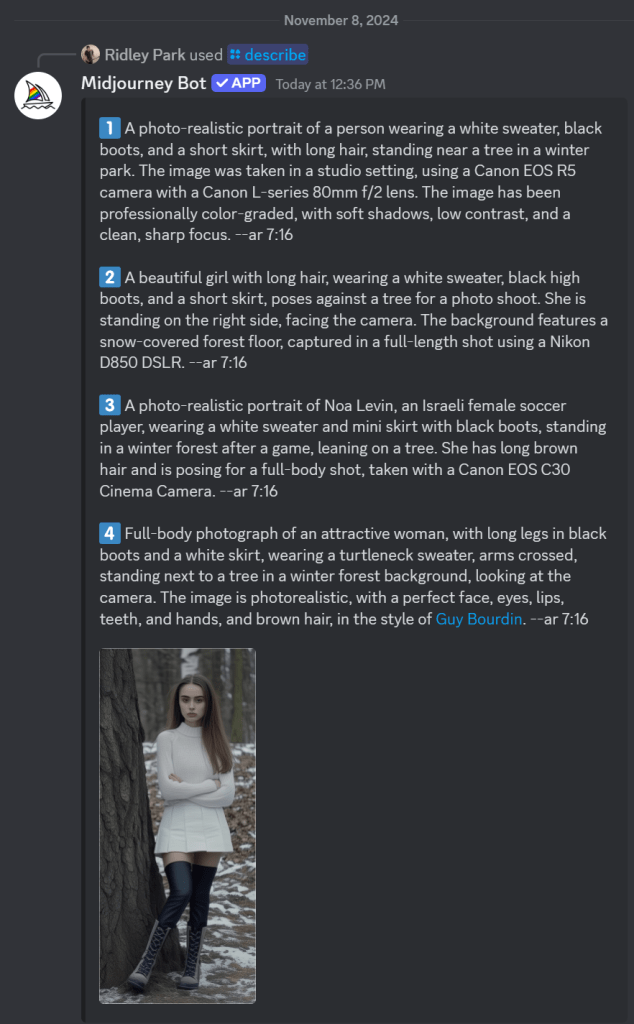
These descriptions are particularly interesting and telling. First, I’ll point out that AI attempts to identify the subject. I couldn’t find Noa Levin by a Google search, so I’m not sure how prominent she might be if she even exists at all in this capacity. More interesting still, the AI has placed her in a scenario where the pose was taken after a match. Evidently, this image reflects the style of photographer Guy Bourdin. Perhaps the jumper mystery is solved. It identified a turtleneck. I’ll ignore the tree and see if I can capture her with an amalgamation of these descriptions. Let’s see where this goes.
A photo-realistic portrait of Israeli female soccer player Noa Levin wearing a white turtleneck sweater, arms crossed, black boots, and a short skirt, with long brown hair, standing near a tree in a winter park. The image captured a full-length shot taken in a studio setting, using a Canon EOS R5 camera with a Canon L-series 80mm f/2 lens. The image has been professionally color-graded, with soft shadows, low contrast, and a clean, sharp focus. --ar 9:16
Close-ish. Let’s zoom in to get better descriptions of various elements starting with her face and hair.
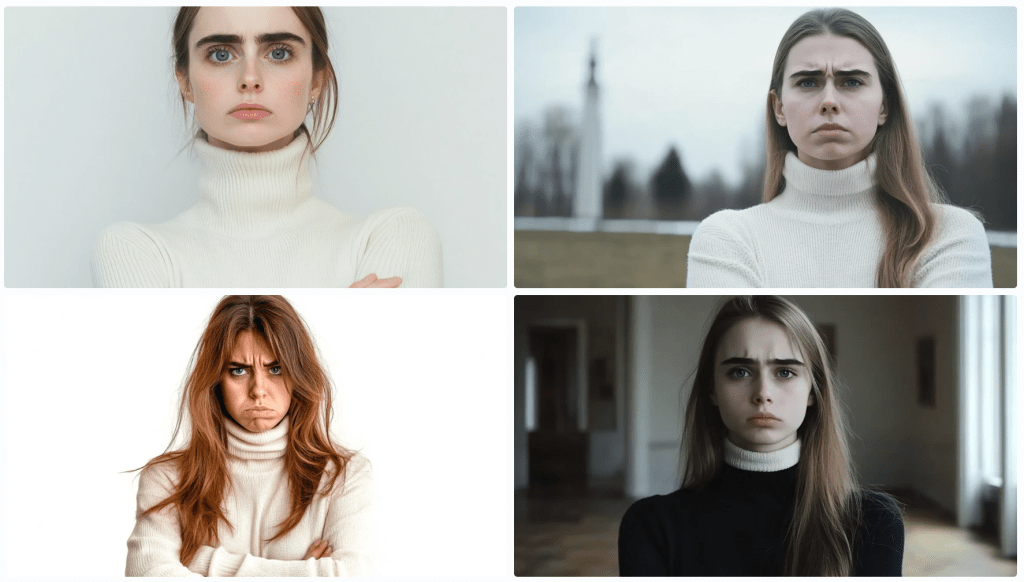
Now, she’s a sad and angry Russian woman with (very) pale skin; large, sad, grey eyes; long, straight brown hair. Filmed in the style of either David LaChapelle or Alini Aenami (apparently misspelt from Alena Aenami). One thinks it was a SnapChat post. I was focusing on her face and hair, but it notices her wearing a white (oversized yet form-fitting) jumper sweater and crossed arms .
I’ll drop the angry bit – and then the sad.
Stick a fork in it. I’m done. Perhaps it’s not that language is insufficient; it that my language skills are insufficient. If you can get closer to the original image, please forward the image, the prompt, and the seed, so I can post it.
The Complexity Gradient
A clear pattern emerges when we examine how language performs across different levels of complexity:
Categorical Distinction (High Success)
Identifying shapes among limited options
Distinguishing between tree species
Basic color categorization
Simple Description (Moderate Success)
Basic geometric specifications
General object characteristics
Broad emotional states
Complex Description (Low Success)
Specific natural objects
Precise emotional experiences
Unique instances within categories
Abstract Concepts (Lowest Success)
Philosophical ideas
Personal experiences
Qualia
As we move up this complexity gradient, the gap between intended meaning and received understanding widens exponentially.
The Tolerance Problem
Understanding these limitations leads us to a practical question: what level of communicative tolerance is acceptable for different contexts? Just as engineering embraces acceptable tolerances rather than seeking perfect measurements, perhaps effective communication requires:
Acknowledging the gap between intended and received meaning
Establishing context-appropriate tolerance levels
Developing better frameworks for managing these tolerances
Recognizing when precision matters more than accuracy (or vice versa)
Implications for Human-AI Communication
These insights have particular relevance as we develop more sophisticated AI systems. The limitations we’ve explored suggest that:
Some communication problems might be fundamental rather than technical
AI systems may face similar boundaries as human communication
The gap between intended and received meaning might be unbridgeable
Future development should focus on managing rather than eliminating these limitations
Conclusion
Perhaps this is a simple exercise in mental masturbation. Language’s insufficiency isn’t a flaw to be fixed but a fundamental characteristic to be understood and accommodated. By definition, it can’t be fixed. The gap between intended and received meaning may be unbridgeable, but acknowledging this limitation is the first step toward more effective communication. As we continue to develop AI systems and push the boundaries of human-machine interaction, this understanding becomes increasingly critical.
Rather than seeking perfect precision in language, we might instead focus on:
Developing new forms of multimodal communication
Creating better frameworks for establishing shared context
Accepting and accounting for interpretative variance
Building systems that can operate effectively within these constraints
Understanding language’s limitations doesn’t diminish its value; rather, it helps us use it more effectively by working within its natural constraints.
Welcome to Part 3 of a Week-Long Series on the Evolution and Limits of Language! This article is part of a seven-day exploration into the fascinating and often flawed history of language—from its primitive roots to its tangled web of abstraction, miscommunication, and modern chaos. Each day, we uncover new layers of how language shapes (and fails to shape) our understanding of the world.
If you haven’t yet, be sure to check out the other posts in this series for a full deep dive into why words are both our greatest tool and our biggest obstacle. Follow the journey from “flamey thing hot” to the whirlwind of social media and beyond!
Wittgenstein: Words Don’t Actually Mean Things, Sorry
If you thought we were done with language being slippery and unreliable, buckle up. Enter Ludwig Wittgenstein, the philosopher who essentially came along and said, “Oh, you thought words were bad? Let me show you just how deep this rabbit hole goes.”
Wittgenstein wasn’t content to let us cling to the idea that words could actually, you know, mean things. His big revelation? Words don’t even have fixed meanings at all. They only mean something because we use them in certain ways—and the meaning can change depending on the context. Welcome to Wittgenstein’s idea of language games, where words are like players on a field, running around, changing positions, and playing by different rules depending on which game you’re in.
Think of it this way: You’re talking about “justice” in a courtroom. Here, it’s got a very specific meaning—laws, evidence, fairness, right? But then you go to a protest, and suddenly “justice” is a rallying cry for social change. Same word, totally different game. And just like in sports, if you don’t know the rules of the game you’re in, you’re probably going to embarrass yourself. Or worse, end up arguing with someone who’s playing a completely different game with the same word.
Wittgenstein’s genius (and possibly, his cruelty) was in pointing out that language doesn’t have a stable relationship with the world around us. Words aren’t these neat little labels that correspond to actual things out there in the world. No, words are just part of a human activity. We throw them around and hope they land somewhere close to what we mean. And that’s on a good day.
But if words don’t mean anything on their own, then how can we ever trust them? According to Wittgenstein, we can’t. We’re constantly interpreting and reinterpreting the world through language, but it’s all just one big game of telephone. And don’t expect there to be one final, correct interpretation. There isn’t one. It’s all just a series of shifting meanings, with no way of getting to the “truth” behind them.
Here’s the kicker: Wittgenstein’s insight means that when you say something like “freedom” or “justice,” you’re not actually referring to some objective, concrete thing. You’re just participating in a language game where those words have specific meanings in that moment, but they can and will change depending on the context. So, one person’s “freedom” is another person’s “anarchy,” and one person’s “justice” is another’s “oppression.”
In other words, we’re all just out here, throwing words at each other like they’re going to hit some bullseye of meaning, when in reality, they’re bouncing off the walls and landing in places we never intended. It’s chaos, really, and Wittgenstein just stands there, arms crossed, probably smirking a little, as we desperately try to make sense of it all.
So, if you were hoping to pin down “truth” or “justice” with language, sorry. Wittgenstein says no. You’re just playing the game – and the rules? They’re made up, and they change constantly. Good luck.
Chomsky: Universal Grammar – A Shiny Idea, but Still…
After Wittgenstein thoroughly dismantled any hope we had of words actually meaning something, along comes Noam Chomsky to try and bring a little order to the chaos. Chomsky’s big idea? Universal grammar—the idea that, deep down, every human shares a common structure for language. It’s like a blueprint coded into our brains, and no matter what language you speak, we’re all building our sentences using the same basic tools.
Sounds neat, right? The world finally has some linguistic order! We’ve all got the same grammar in our heads, so maybe this whole miscommunication thing isn’t so bad after all. Except, here’s the problem: even if we’re all working from the same universal grammar, we’re still working with different words and different cultural baggage attached to those words. So, congratulations, Chomsky—you’ve built us a solid foundation, but the house we’re living in is still falling apart.
Let’s break it down. Chomsky argues that the ability to acquire language is hard-wired into the human brain. Babies don’t need to be taught grammar; they just pick it up naturally, like some kind of linguistic magic trick. No matter where you’re born—New York, Tokyo, or the middle of nowhere in the Amazon rainforest—you’re going to develop language using the same set of grammatical principles. It’s like we’re all born with the same linguistic software installed.
But here’s where the cracks start to show. Sure, we might all have this underlying grammar, but that’s not what’s causing the problems. The trouble is, language is more than just grammar—it’s words and meanings, and those are far more slippery. Just because we can all form sentences doesn’t mean we’re forming the same ideas behind those sentences. You can have the best grammar in the world and still be arguing about what “justice” means for hours on end.
For instance, take a phrase like “freedom is important.” Simple enough, right? Chomsky’s universal grammar means that everyone, regardless of where they’re from, can understand this sentence structure. But what does “freedom” mean? That’s where the universal grammar falls apart. One person thinks it’s the right to speak freely; another thinks it’s the freedom to make their own choices. Another might think it’s the absence of external control. The grammar is doing its job, sure, but the meaning? It’s off in a hundred directions at once.
Chomsky’s contribution is crucial—it tells us that our brains are wired to pick up language, and we all follow the same rules when we build sentences. But, unfortunately, those sentences are still subject to all the same chaos that Wittgenstein warned us about. Because even though we’ve got the structure nailed down, we’re still trying to throw abstract, subjective ideas into that structure, and it just doesn’t hold together.
So, while Chomsky’s universal grammar helps explain how we all manage to learn language in the first place, it doesn’t save us from the fundamental problems that come when we try to talk about anything beyond the basics. In other words, grammar can get us from “flamey thing hot” to “freedom is important,” but it can’t tell us what we really mean by either one. We’re still stuck with all the ambiguities that come with words—and no amount of universal grammar is going to fix that.
Nihilism, often misunderstood and misrepresented, shares a common plight with philosophies such as atheism, anarchism, and Marxism. Like its counterparts, nihilism is frequently subjected to the creation of strawman arguments in public discourse, resulting in its vilification and scapegoating. In this article, I aim to demystify nihilism by providing a clear definition, description, and defence of this philosophical perspective.
Firstly, let’s address the misconception that nihilism entails a chaotic disregard for morality and societal norms: “If life has no meaning or purpose, then anyone can do anything.” This sentiment is often echoed in discussions about nihilism, as well as anarchism and atheism. However, it presupposes a fundamental misunderstanding of human nature. Despite the absence of inherent meaning in the universe, humans are not devoid of emotions or social affinities.
It is crucial to recognise that while the universe does not impart meaning or purpose, humans have constructed various systems of meaning throughout history. Whether through moral codes, religious doctrines, or cultural norms, individuals and societies have ascribed significance to different aspects of life. These constructs provide a framework within which individuals navigate their existence, albeit one that is socially constructed rather than inherent to the universe.
Critics of nihilism often argue that the acknowledgement of life’s inherent meaninglessness leads to despair and existential angst, rendering life devoid of purpose. However, this perspective fails to account for the resilience and adaptability of human beings. While some individuals may struggle initially with the realisation that there is no inherent meaning, many nihilists find liberation in embracing the absence of preordained purpose. Rather than succumbing to despair, they recognise the freedom to create their own meaning and forge their own path in life.
It is essential to understand that nihilism does not negate the validity of individual or societal pursuits. While nihilists reject the notion of inherent meaning, they acknowledge the significance of subjective meaning and the importance of human connection, fulfilment, and well-being. Whether it is pursuing personal goals, fostering relationships, or contributing to the betterment of society, nihilists recognise the value of such endeavours within the context of human experience.
In conclusion, nihilism offers a perspective that challenges conventional notions of meaning and purpose. By acknowledging the absence of inherent meaning in the universe, nihilists embrace the freedom to create their own meaning and chart their own course in life. Far from being a philosophy of despair, nihilism invites individuals to confront the uncertainty of existence with courage and resilience, recognising the inherent value of human experience in a world devoid of inherent meaning.
jimoeba mentioned that he enjoyed an interview with Vervake and Fridman in a comment, so I thought I’d give it a listen. It turns out there are several including a 3-plus-hour version. Arbitrarily, I chose this one. Even if it’s not the particular interview on the meaning crisis, it gives me a sense of the two and their dynamics. I’m glad I listened to it. I like Vervaeke. I can’t say I’m much of a Fridman fan on first listen.
John Vervaeke and Lex Fridman interview: Human civilisation is facing a meaning crisis
This interview content provides an orientation of where Vervaeke is coming from. It helps to clarify his position. His claim seems to be that many people today identify as having no religion but being spiritual. By extension, he posits that this cohort is searching for meaning. I can’t disagree. What it tells me is that I am not in his target demographic. I have no religion, as I am an atheist. I have no spiritual void to fill. This is Vervaeke’s goal—to find something to perform the function of the religion without the, perhaps, baggage and dogma.
I sympathise with his goal. He brings up Nietzsche’s “God is dead” quote, famous or infamous depending on your worldview. Essentially, he wants to answer Nietzsche’s query of what to do now that it’s been revealed that humans created God, not the other way around. His aim is to replace the font of wisdom for this generation.
For me, wisdom is a heuristic, part of the Gestalt McGilchrist mentions. McGilchrist’s work is even referenced here. Of course, I interpret McGilchrist’s references in this space to be metaphorical. It seems that he views it as ‘real’. I’m not sure where Vervaeke places it. Somehow, I feel that if there is a spectrum, Vervaeke leans closer to McGilchrist than me, and that’s OK. They just happen to be wrong.
I still don’t get the need for meaning. I don’t feel despondent that there is no inherent meaning in anything, but we are free to invite or adopt one or many. I remember a Christian mate of mine who explained that people have a God-sized hole that can only be filled by God. Essentially, Vervaeke is making a similar claim, but his void is filled by wisdom. I suppose that I don’t feel I have a void doesn’t mean there isn’t one.
Ever since encountering Viktor Frankl’s Man’s Search for Meaning in my youth, I’ve pondered why people search for and indeed invent meaning. By meaning, I am speaking in terms of finding a higher purpose or some spiritual affinity rather than the meaning of why bad things happen, though there are undoubtedly some intersections of the concepts.
This lecture, Ep. 39 – Awakening from the Meaning Crisis – The Religion of No Religion, from a series by John Vervaeke was recommended to an associate in my social network by another trusted associate, and it’s got me going. I’ve long been a nihilist and existentialist. I am even partial to aspects of the philosophic framework of Zen Buddhism. But I’ve never felt there was some higher meaning or raison d’être that isn’t self-imposed. How else would it be imposed? A person may be indoctrinated, but in the end, ignorance is no excuse from self-imposition.
I guess I can’t quite understand what drives this search for meaning. As Vervaeke notes, even some noted atheists like Richard Dawkins have suggested that we should find a secular proxy for the religion—or the namesake religion of no religion. I understand the social function of religion as well as some psychological functions, but the disconnect for me is that I have no such drive. I am admittedly an introvert, so whilst I admit the need for social cohesion and coöperation, I don’t understand the fabrication of religions or the personal, not only belief in meaning, but a yearning for it and even a belief that one has found it.
some people don’t search for meaning so much as they feel they have discovered meaning, but when their discovered meaning doesn’t jibe with another’s discovered meaning, the result is a search to justify or reconcile this conflict
I am empathetic to people like Iain McGilchrist who asserts that there is exogenous meaning out there to be had. He’d probably also assert that asking for proof is a left-hemisphere cerebral request but that absent the imposition by the left hemisphere, one would just feel it and know it. I just can’t abide.
Vervaeke does touch on the postmodern critique of religion as a power play, which is how I feel about it, but this is about the social aspect and doesn’t touch on the personal search for meaning. What I can’t say is whether a person would have this drive to search for meaning if they were either absent socialisation or exposed only to people who are not going to suggest meaning. I understand that previous generations have shown this propensity, but are there cultures that don’t? And is there a common thread to those who do?
In the past, many cultures have asserted gods and higher powers (whether or not as a power play), but could this simply prompt the people to search for alternative meanings, perhaps having noticed the dissonance between certain dogma and their lived lives?
Interestingly, some people don’t search for meaning so much as they feel they have discovered meaning, but when their discovered meaning doesn’t jibe with another’s discovered meaning, the result is a search to justify or reconcile this conflict.
It’s late. Time to retire for the evening. I have none of these answers, but I will jot the questions down on my to-do list just above the search for meaning.
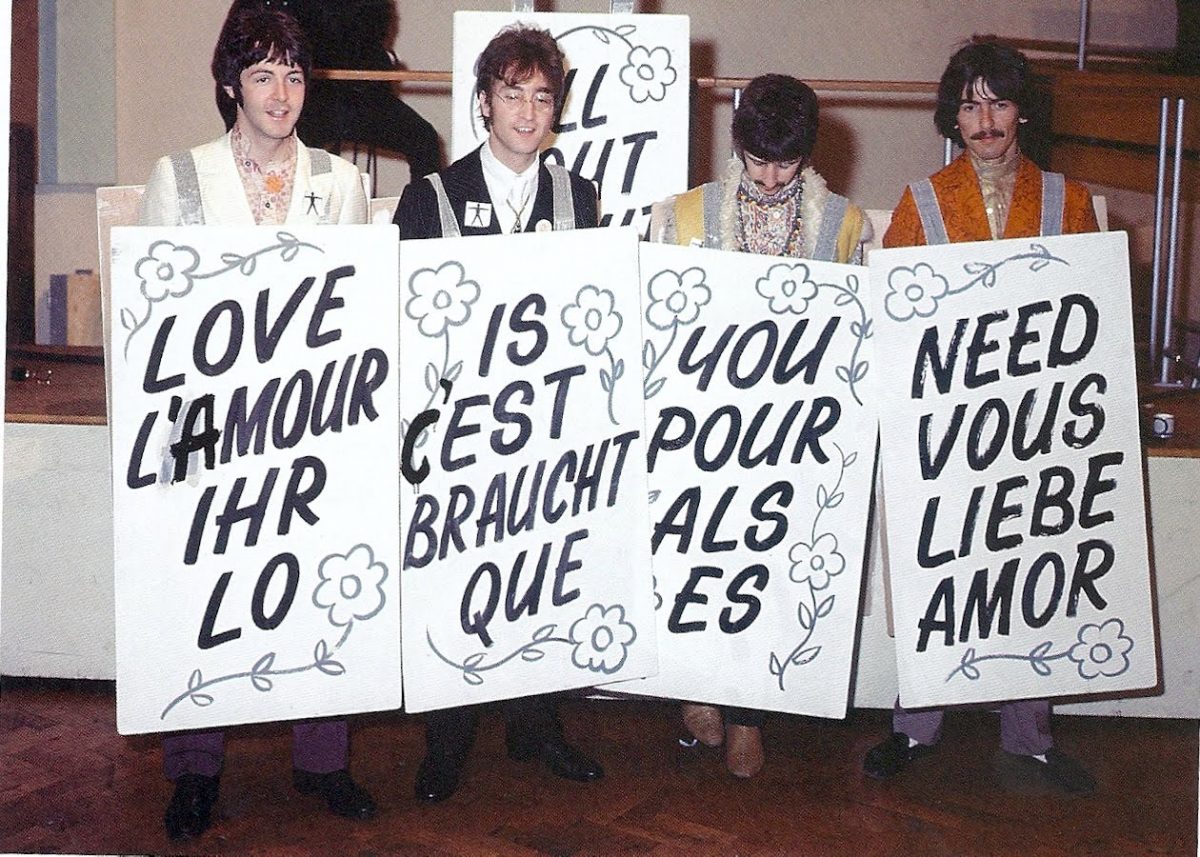
Love is an archetype. It’s a word we’ve created to express the notion of caring off the charts, on steroids. We throw it around and over-use it for many purposes. Generally, love is amorphic and expansive. In the typical scenario, a mother with a loved-child who bears another loves them both equally, but it’s not part of some arithmetic function where each child gets half an equal dose each. Love defies any notion of conservation of energy. Both children receive equal shares of the same quantity of love that the first received.
The Beatles – All You Need Is Love
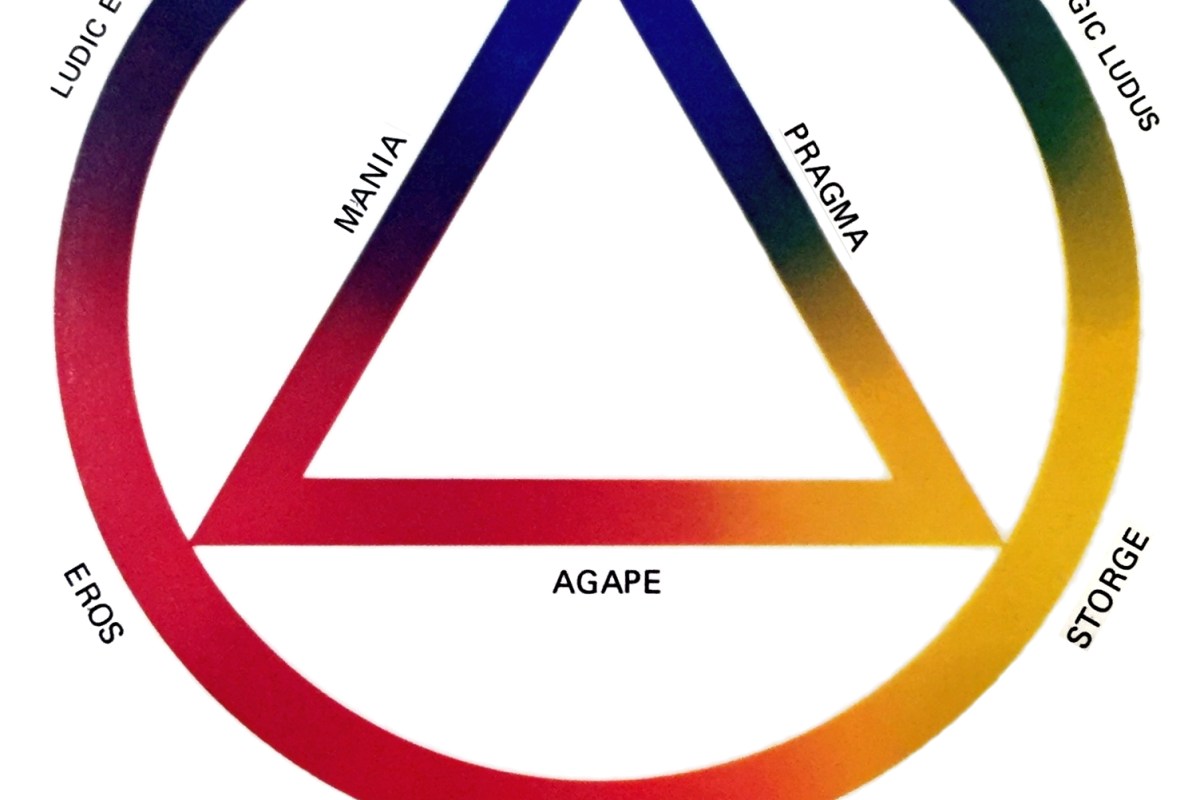
The ancient Greeks had several words to express love.
Storge (στοργή)
Storge is the love we have for community, for family, for our children and spouses. Storge is not romantic love. It is more a love of affection and tenderness. It may be the basis for the urge toward tribalism and nationalism, and it may have a sort of analogue to gravity, wherein the proximity of the source, the greater the attraction. This is where ‘blood is thicker than water’ and why I like my sports team better than yours.
Storge – love of family
Agape (ἀγάπη)
Agape is a sort of universal love, the selfless love of biblical reference of God and all of his children. Neither is agape a romantic notion. It is akin to charity, and the connection of transcending storge to include all of the world and ignoring the silos of tribalism. There appears to be a tension between agape and storge because one cannot have an equal love for all whilst retaining a greater love for one’s own tribe. Perhaps the notion is more aspirational than practicable.
Agape – Universal love
Philia (φιλία)
Philia is fraternal (to be more inclusive, perhaps also sororal) love, the brotherly love hoped to be inspired by the city of Philadelphia in Pennsylvania. This is an affectionate love, typically between equals. Again, philia has no romantic basis.
Philia – Sororal love
Eros (ἔρως)
Eros is notably erotic love; sexual love; intimate, passionate love; lust. Eros is ephemeral. Returning to physics, eros requires a lot of energy to maintain. In a typical setting, eros moderates to storge or pragma.
Plato believed that this love was transcendent of the body—and so could exist independently of body—, but I’ll not give heed to this metaphysical notion. Perhaps, this is where the notion of soulmates derives. This is a romantic love.
Ludus
Ludus is a lightweight version or precursor to erotic love. It is the playful, flirtatious nature expressed by young proto-lovers. Viewed teleologically, ludus may be seen as a stepping stone to eros, but not everyone makes it successfully to the final level.
Full disclosure: Ludus is Latin and not of Greek original.
Pragma (πράγμα)
Obviously, pragma is a pragmatic love. This is the love that remains to bond a pair who have remained together for years, say, an old married couple. This form either requires a lot of energy and compromise or a lot of apathy or indifference.
Older couple demonstrate pragma
Philautia
Philautia is a love of one’s self. It’s a portmanteau of philia + auto. As the saying goes, if you can’t love yourself, you can’t love anyone. As with most adages, they is as often true as not and require additional context to assess. Philautia should not be confused with narcissism, which may more properly be classified as a mania. It should also not be confused by onanism.
Philautia – Love of one’s self
Love will tear us apart… again.
Joy Division
Mania (μανία)
Some people include mania in their love collection. Mania is simply an unbalanced sort of love; obsessive love; eros gone wild.
Love has many meanings, but they are all about connecting. Perhaps, I am being hasty to dismiss the term, but it is overused and perhaps more phatic than genuine. In the parlance of Foucault, it’s a power phrase—especially in the erotic arena—, a means to manipulate.
I’ve been having a side debate with a Christian mate of mine who made these claims:
Whom do you serve?
Chrétien de Troyes — Perceval
‘[Non-religious people may] not define themselves as particularly “religious”, but…everyone is’, as he references lyrics from a Rush song, ‘even if you choose NOT to decide, you still have made a choice’.
‘One can choose to believe in nothing but themselves, but if they’re honest, “self” IS their religion. Everyone is religious.
We all yearn for some meaning and we end up pursuing something or someone to fill that inward desire. Whether we organise that something and call it “religion” is beside the point, as he references Bob Dylan’s lyric, “Ya gotta serve somebody; it may be the devil, or it may be the Lord, but ya gotta serve somebody.”
This had been the fluid exchange of ideas, but I’ll reply in turn.
even if you choose not to decide, you still have made a choice
Rush — Freewill
I’ve won’t repeat my position on free will, but one can choose to be religious or not. To choose not to be religious is not also a choice to be religious. I can agree that some people substitute superstitious, metaphysical believe for, say, scientism, and this is just as ridiculous, but some people remain unconvinced in these metanarratives.
“Self” is their religion
Some Guy
Again, not everyone even ascribes to the notion of self, and there is little reason to believe that there is some element of religious worship involved.
We all yearn for some meaning
Some Guy
Again, this is fundamental attribution error, the assumption that because he believes there is some underlying meaning and yearns to find it that everyone else does. I understand that he surrounds himself with people who share this belief system, and they convince themselves that someone who says otherwise is mistaken.
Ya gotta serve somebody; it may be the devil, or it may be the Lord, but ya gotta serve somebody
Bob Dylan — GottA Serve Somebody
This is clearly dualistic thinking incarnate; a false ‘you’re either with me or against me’ dichotomy.
I remember self-assessing myself when I was in high school. Nietzsche notwithstanding, I could never agree with the frame or the assertion that there are leaders and there are followers. I did not identify with either. I do feel that within the society I was born, that I need to comply just enough to not be subjected to the violence inherent in the system for non-conformance, but that’s not exactly following. I also don’t care to lead.
It turns out that this (perhaps not coincidentally) manifested in my career, as I am a consultant—an adviser.
Of those who do not require meaning, I don’t have much to say, and anything I do have to say about this will be obvious in reflection to the people who do.
Some people—perhaps even the majority or super-majority of them—require meaning. Of these, some accept the doctrines offered by religion or society whilst others will construct meaning. Even those who don’t patently need meaning may still construct one anyway, whether employment, family, country, or duty.
People who require meaning feel that the world will devolve into chaos if no meaning were inherent, that people would become selfish anarchists, hooligans, and ne’er-do-wells. Most of these people (convincingly) convince themselves that there is some source of objective morality and that that reality is known. Insomuch as, in this case, perception is reality, it doesn’t matter whether it is or isn’t.
Pinker’s possible objections in The Blank Slate notwithstanding—there may be some genetic component driving this delusion—, this reality is a social construct.
I guess the point is that some people are incapable of accepting a world with no meaning. Unfortunately, politicians, and Randian Objectivists (perhaps a large overlap in some circles) can prey on these gullible masses, and they can vilify others who are not so lucky in masking their motives.
















 Philosophics