I had already decided there were limitations to this notion, but I feel it’s still useful. The way I see it, affordance instantiates with an encounter. Stairs don’t have affordances as attributes absent interaction. Generalised, affordance is a function where one needs something like this
A = {subject:object:index:context}
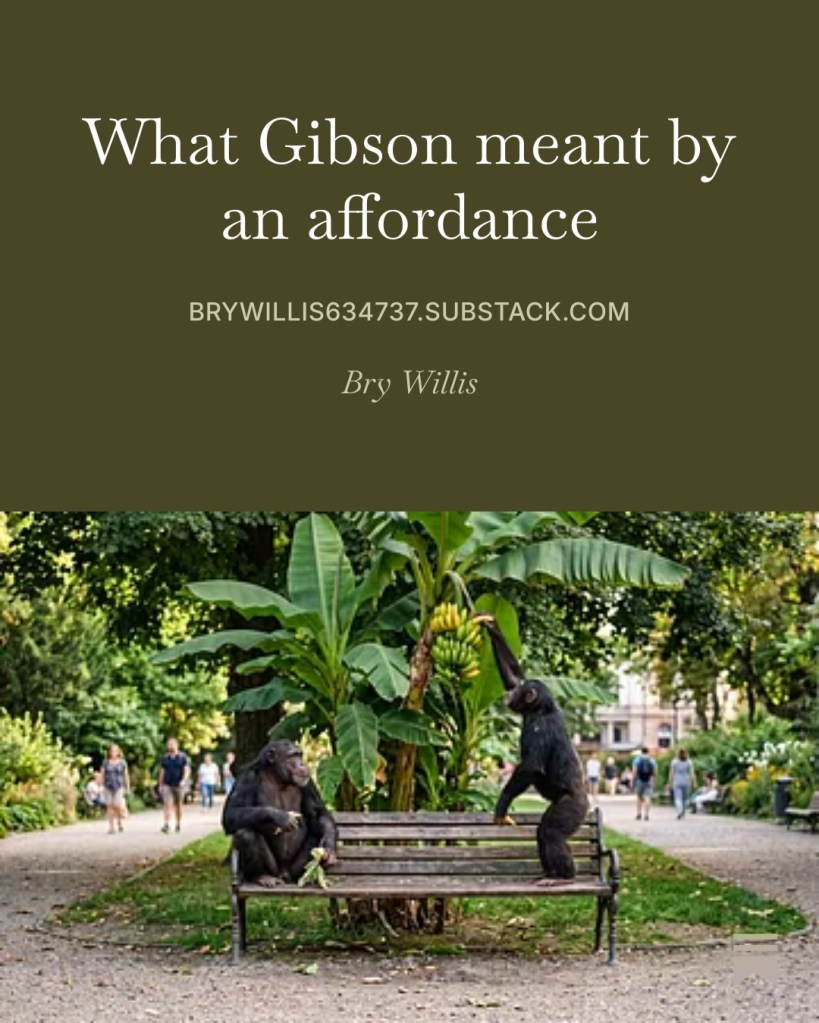
where the subject is the sentient or animate entity, let’s say the chimps in this image; the object is the encountered item, say the bench; the index is the affordance, say sitting or standing, and the context is a salience (or valence or attention) modifier.
In the case of sitting, I may not be tired or particularly interested in sitting. The bench still affords sitting, but I don’t instantiate the act.
Taking stairs as a more common example, if I am a typically abled human adult, stairs afford climbing (ascending and descending), but if I am relegated to a wheelchair, no such affordance relationship exists. This helps to explain why affordance isn’t an attribute of the stairs, but rather of the encounter.
Water to a non-swimmer doesn’t afford swimming any more than a tree affords climbing for a fish – and yet does for a chimp.
Salience, attention, valence and the construction of disposition
Today I live about 90 minutes out of Boston by car on a good day – and 2 hours on a return trip because I live in Cape Cod, a tourist area, so I tend to have to compete with traffic. Today, it took over 2 and a half hours, a Friday afternoon, trapped among boat and beach seekers. I don’t drive, so I require chauffeurs to get me here and there. Today I driving with a bloke for whom traffic possesses unusual psychological gravity. He seems to have traffic and weather on the brain – and don’t get me started on crime, national security, and petrol prices.
Audio: NotebookLM summary podcast of this topic.
I’ll spare the reader the trip up, which was fairly easy, despite traffic-related side comments whenever inappropriate. On the way back and at the first patch of congestion, he harrumphed and announced that we would certainly be stuck in traffic for the entire journey. I checked the Google Maps. Traffic was intermittent, and I told him so.
Soon afterwards, the road cleared. We travelled freely for miles – no traffic to report – but when we later encountered another queue, however, he declared that his prediction had been vindicated. On arrival, he told others that we had been stuck in traffic ‘the whole way’.
Two people; the same reality; different experiences. I got me thinking – and chatting with ChatGPT because the driver was focused on driving – and of course the misery of traffic.
Here’s the rest of the story: The traffic didn’t occupy the whole journey. To him, it occupied the portions of the journey that counted. The clear road was perceptually available but apparently lacked evidential weight. It was experienced without being recruited into the eventual account.
Noticing the divergence between out perceptions, I tried to reconcile. First, I considered filing this under selective attention and confirmation bias, that great psychological lost-property office into which every untidy inference is now deposited, but this doesn’t feel quite right; it doesn’t seem to capture the essence.
Before a belief can be confirmed by evidence, something must first become evidence, right? So, the more interesting question isn’t merely why this geezer interpreted the journey pessimistically, but why congestion became salient whilst free movement receded into the background. What determines which parts of experience become psychologically substantial?
Here’s how I see it:
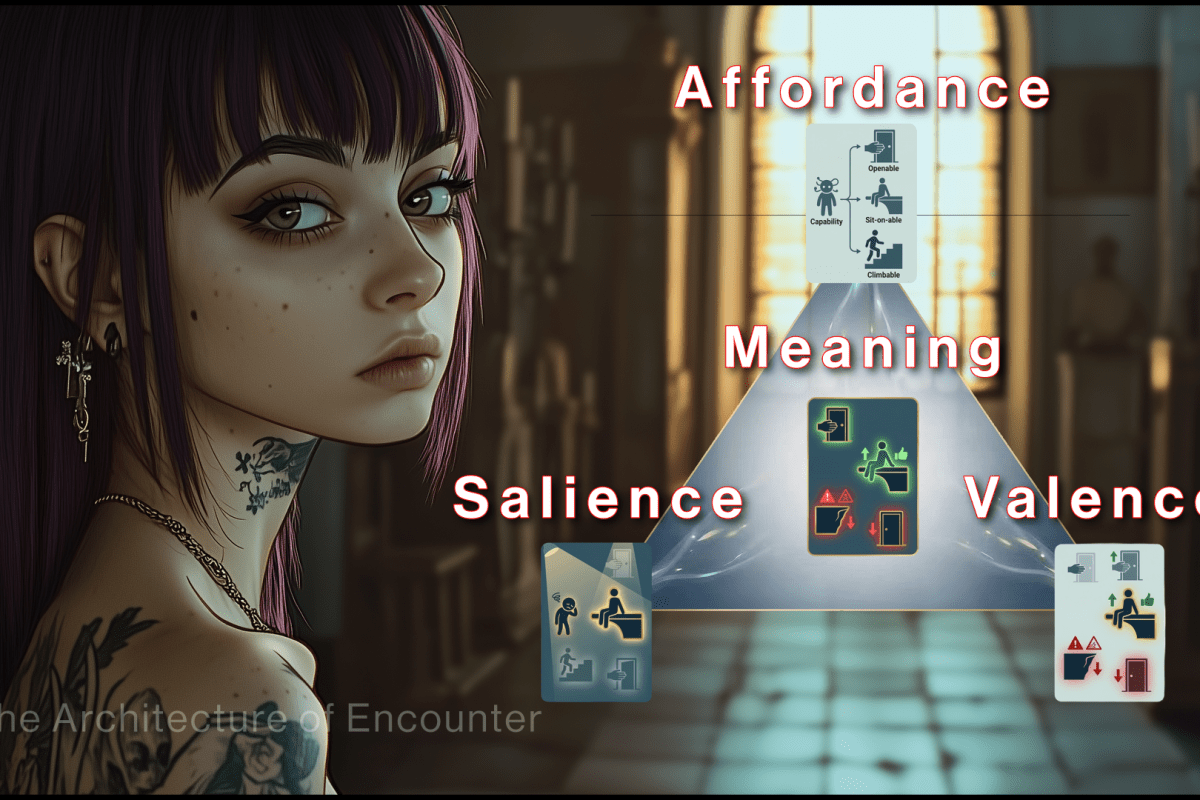
I tried to view this through lenses of salience, attention and valence. First, a quick refresher:
Salience concerns what stands out, demands processing or acquires significance.
Attention concerns the allocation and maintenance of cognitive resources.
Valence concerns the positive or negative affective character assigned to something.
Traffic may be salient because it frustrates an aim. Its negative valence may help capture attention. Sustained attention may then produce richer encoding, making the traffic easier to recall. Later recollection may strengthen the prior belief that journeys are usually obstructed, which may increase vigilance for traffic during the next journey. No single element need rule the others.
The relation is recursive:
disposition shapes salience
salience directs attention
attention affects encoding
valence influences interpretation
memory reconstructs the event
reconstruction reinforces disposition
And even this is too linear, but here we are. Attention can alter valence. Bodily arousal can alter salience. Memory can modify present interpretation. Expectations can affect what is noticed before conscious appraisal has properly begun. The arrows run in both directions, and probably sideways as well.
The result isn’t simply a biased opinion about a neutral world. It’s a patterned encounter wherein some features arrive already amplified and others scarcely become legible.
Pessimism: Disposition as an epistemic filter
This got my pondering mental health issue. I’m not a psychologist, and I discount the discipline quite heavily, but I wanted to consider the notion of disposition. How can two people quite literally in the same vehicle on the same journey view the world so differently. Of course, we are all carved by our experiences, but this is a reciprocating function: the more we experience the world positively or negatively, the more the world will reveal itself as such. Confirmation bias drives the nails into the coffin.
Let’s look at the down side: pessimism. I don’t mean some clinical depression, but instead of seeing the world with no glasses, and rose-coloured spectacle, the world is view with dark glasses – I’m envisioning a welder’s visor. One could stare at the sun and proclaim it’s overcast. Eyeore on steroids.
A pessimistic disposition might usually described as a tendency to expect bad outcomes. And whilst this may be true, it’s incomplete. Pessimism may also affect what is noticed, how long attention remains with it, how it is interpreted, and what survives into later recall. This is my thesis – or at least my point. The unpleasant becomes an event. The satisfactory becomes the absence of an event.
Congestion is noticed; free movement is merely used. An insult is retained; an ordinary kindness passes as social administration. A failure requires explanation; success is dismissed as luck, temporary relief or an exception that proves nothing.
This asymmetry can make a disposition appear empirically vindicated. The pessimist remembers abundant evidence for pessimism because pessimistically congruent events were more likely to become salient, receive attention and survive reconstruction. The conclusion is then presented as realism:
I don’t expect things to go badly because I am pessimistic.
I am pessimistic because experience shows that things go badly.
Yet ‘experience‘ here isn’t an untouched archive. It’s already been selected, weighted and narrated.
Research on depression is compatible with this more interactive account. Depression and vulnerability to depression have been associated not only with increased processing of negative material but also with diminished positive biases across attention, interpretation, memory and self-referential thought. The pattern is therefore not merely an excess of negativity. It may also involve a failure of positive information to acquire or retain ordinary psychological weight.
A negatively valenced event may dominate because it attracts unusually strong attention. But an apparently negative world might also arise because positive events are weakly encoded, rapidly discounted or treated as anomalous. The same remembered landscape could therefore emerge through different cognitive routes.
Before I continue, a disclaimer: I am not trying to claim that my perception is correct and his isn’t. I’m merely asking how we end up with distinct narratives. It reminds me of the beginning of Woody Allen’s Annie Hall, where a couple are speaking to counsellors. A therapist asks about their love life:
Alvy Singer (him) and Annie Hall (her) are seeing their therapists at the same time on a split screen
Alvy’s Therapist: How often do you sleep together?
Annie’s Therapist: Do you have sex often?
Alvy: [lamenting] Hardly ever. Maybe three times a week.
Annie: [annoyed] Constantly. I’d say three times a week.
The interesting think here, is that both are disappointed for the same event one because sex is over-indexed and the other because it is under-indexed.
Moving on…
Anxiety and the world as warning
Anxiety offers a related configuration. Threatening material tends to capture attention more strongly in anxious populations, although effect sizes, experimental measures and the direction of attention over time are not perfectly uniform. Some people may orient rapidly towards threat; others may struggle to disengage; still others may shift from vigilance to avoidance. The bureaucracy of diagnosis naturally prefers a single box, whilst cognition persists in behaving like a process.
Interpretation and memory may then participate in the same system. An ambiguous expression becomes disapproval. A delayed reply becomes rejection. A bodily sensation becomes evidence of illness. Each interpretation increases anxiety; increased anxiety makes threat more salient; heightened salience provides further material for threatening interpretation.
Research on anxiety increasingly examines these as interacting biases rather than sealed mechanisms. Attention, interpretation and memory can be associated with one another, though the evidence does not support a single simple causal sequence in every case.
The important point is not that the danger is imaginary. Sometimes the road really is congested. Sometimes the delayed reply does indicate trouble. Sometimes the body is ill. The question is how individual events acquire representative force and how readily contrary events are permitted to revise the emerging model.
When significance itself becomes unstable
In some accounts of psychosis, salience plays a still more direct role. The aberrant-salience hypothesis proposes that neutral or incidental stimuli may acquire excessive significance, leaving the person to explain why ordinary events feel unusually charged. A glance, coincidence, headline or passing remark may become loaded with personal meaning.
This is not a complete theory of psychosis, nor should it be paraded as one. Predictive-processing accounts differ over whether particular symptoms arise from weakened prior expectations, excessively rigid priors, altered prediction-error signalling, or different disturbances at different levels of processing. Hallucinations and delusions may not share one uniform mechanism merely because diagnostic manuals house them in neighbouring rooms.
Still, the idea illustrates the broader point. Salience does not merely determine which established facts receive attention. It participates in determining what feels fact-like, connected or worthy of explanation.
Once significance has been assigned, interpretation begins its work. Once interpreted, the event may be more readily remembered. Once remembered, it joins the accumulating case for the interpretation that helped produce it.
Not merely ‘in the head’
None of this means that dispositions are autonomous cognitive errors floating above the world, and I reiterate that I am not a medical professional. Hell, I’m barely a professional. Salience is affected by history. Someone who has repeatedly encountered danger may reasonably become more attentive to possible danger. Poverty, discrimination, violence, illness and insecurity do not merely supply ‘negative thoughts’; they alter the statistical environment in which attention and expectation develop. What appears clinically as excessive vigilance may have been learned under conditions in which vigilance was adaptive.
Nor is salience purely conceptual. Sleep, stress, hormones, medication, pain and physiological arousal may all affect what attracts attention and what is retained. Experimental research indicates that arousal and valence can make distinct contributions to emotional memory, another reason not to compress the process into the nursery vocabulary of ‘positive’ and ‘negative thinking’. The world acts upon the disposition, and the disposition acts upon the encountered world. Neither term stands outside the relation.
This also guards against the moral obscenity of telling distressed people that they have simply chosen the wrong interpretation. A recursive process may be self-maintaining without being voluntary. One doesn’t escape it merely by deciding to notice flowers, practise gratitude and purchase a notebook with an inspirational slogan embossed upon it. Sorry, pop psychology and psychological self help industry
From bias to rigidity
Everyone relies upon selective attention. Everyone remembers unevenly. Everyone encounters a world already organised by concern, expectation and affect. Complete neutrality would not be enlightenment; it would be cognitive paralysis.
The relevant distinction may therefore not be between biased and unbiased minds. It may be between systems that remain revisable and systems that become rigidly self-confirming.
A disposition becomes pathological, perhaps, not merely when it selects, but when selection becomes pervasive; not merely when it assigns valence, but when valence governs what can count as evidence; not merely when memory reconstructs, but when reconstruction repeatedly erases whatever might disturb the governing account.
Even then, ‘pathology’ isn’t a property of one mechanism. It may emerge from the interaction of degree, duration, distress, social conditions, bodily states, functional consequences and the available means of correction. The traffic anecdote isn’t a diagnosis. It’s an anecdote, a small model of how a world can be cognitively weighted.
The bloke didn’t invent the congestion. He encountered real traffic. But the congestion became representative, whilst the open road became incidental. Later, memory converted this inequality of weight into an equality of duration: traffic here and there became traffic everywhere.
Perhaps certain dispositions operate similarly. They do not simply add a judgement to experience after the fact. They influence which experiences become prominent, which are sustained by attention, which acquire positive or negative force, and which are later recruited into the story of what the world is like. The question is therefore not merely whether a person sees reality accurately. It is which parts of reality become visible enough to count.
A final word
My ex-wife used to complain how we never did anything – and like the Annie Hall story, I’d say we did too much – so every week or two she’d want to do something, and her refrain was always, ‘Let’s do it. We never do anything.’ One can imagine, that this was not a sustainable model – perhaps as evidenced by the ex prefix. And so not to and this as a therapy session, I’ll leave it here.
Anyone familiar enough with my writing knows that I don’t support objectification – nounification – except as a scale-dependent heuristic shortcut. Victoria pulls memory out of the object of the brain and relocates it to time or, more specifically, to Bergson’s durée. But this move doesn’t make sense either. Plus, it adds an unnecessary or at least unearned metaphysical inflation. Whilst time may be containerised, durée can’t be by its very phenomenal nature.
In any case, after an extended chat with a GPT, I asked for a rendition to share. I’ll amend this in various ways, but for now, I wanted to capture the essence for review. I’ll describe the relata in more detail presently.
Image: ChatGPT render of memory process
Phenomenal Presentation Whatever is presently given in experience before it becomes a later recollection. This is not necessarily an unmediated encounter with reality, merely the phenomenal field available to apprehension.
Dynamically Weighted Relata Presentation, attention, salience, bodily condition, prior experience, habitus and ontological grammar operate relationally rather than as isolated faculties. Their relative influence shifts according to context, purpose and inherited orientation.
Selective Apprehension Only part of the phenomenal field is attended to or registered. Attention and salience are especially entangled here: what appears salient attracts attention, whilst attention may itself produce or intensify salience.
Lossy Collection / Compression What is apprehended is not preserved as a complete experiential copy. Some features are omitted, abstracted, merged or weighted more heavily than others, leaving a compressed consequence of the encounter rather than the encounter itself.
Retention as Altered System-State The event has ceased, but the apprehending system remains differently configured because it occurred. ‘Retention’, therefore, names a persisting alteration or inherited constraint, not an object stored intact within a container.
Cue-Dependent Recollection A later cue, whether sensory, linguistic, affective or contextual, recruits the retained alteration. Recollection is not simple retrieval but a present operation conditioned by both the earlier event and the system’s current state.
Reconstructed Re-Presentation The result is a new phenomenal presentation related to, but not identical with, the earlier one. Its vividness does not guarantee fidelity, since missing material may be supplied through expectation, narrative, habitus and present context.
The feedback loop indicates that recollection may itself revise the system. Each re-presentation can alter subsequent weighting, interpretation and recollection, so memory is not a static archive but a recursively reconstructive process.
I borrow some of this nomenclature from Iain McGilchrist, which I’ll also explain in future.
I’ve commenced a new series in support of my new book. First, I’m building a glossary.
Video: Bry – Architecture of Encounter
On the docket in this segment are affordance, salience, and valence as they relate to the book. I selected these terms from the glossary in the appendix.
Over the next few weeks, I plan to produce videos on other terms and additional videos explaining key concepts. This one is straightforward and academic. Others will be less formal, hoping to accommodate different learning styles.
Does anyone subscribe to Kindle Unlimited? I may take time to create Kindle and eBook versions.
My fiction books had some formatting issues with Kindle, but these titles are more standard – no fancy layouts or fonts, and not too many images.
With the MEOW thesis now roaming freely across the intellectual savannah, knocking over conceptual furniture and frightening the rationalists, it’s time to walk through a simple example. We’ll stay safely within the realm of conscious perception for now. That way, no one panics, and everyone can pretend they’re on familiar ground.
Our case study: colour.
Or rather, the quite embarrassing misunderstanding of colour that Western philosophy has been peddling for roughly three centuries.
Audio: NotebookLM podcast summary of this topic, Colour, Perception, and Mediated Ontology.
The Realist’s Apple: A Comedy of Certainty
Picture an apple on a table: plump, unashamedly spherical, wearing its redness like a badge of honour. The traditional Realist swears it’s red in itself, quite independent of anyone wandering in to admire it. The apple has redness the way it has mass, curvature, and that little bruise from the careless shop assistant. When you enter the room, you ‘see’ the red it’s been proudly radiating all along.
Image 0: Subject viewing red apple.
By school age, most of us are told that apples don’t ‘have’ colour; they merely reflect certain wavelengths. A minor complication. A mechanical detail. Nothing to disturb the fundamental metaphysical fantasy: that redness is still ‘out there’, waiting patiently for your eyes to come collect it.
It’s all very straightforward. Very tidy. And very wrong.
Idealists to the Rescue (Unfortunately)
Ask an Idealist about the apple and the entertainment begins.
The Berkeley devotee insists the apple exists only so long as it’s perceived – esse est percipi – which raises awkward questions about what happens when you step out for a cuppa. God, apparently, keeps the universe running as a kind of 24-hour perceptual babysitter. You may find this profound or you may find it disturbingly clingy.
The Kantian, inevitably wearing a waistcoat, insists the apple-in-itself is forever inaccessible behind the Phenomenal Veil of Mystery. What you experience is the apple-for-you, sculpted by space, time, causality, and a toolkit of categories you never asked for. This explains a lot about post-Kantian philosophy, not least the fixation on walls no one can climb.
Contemporary idealists get creative: proto-experience in everything, cosmic consciousness as universal substrate, matter as a sleepy epiphenomenon of Mind. It’s quite dazzling if you ignore the categories they’re smashing together.
What unites these camps is the conviction that mind is doing the heavy lifting and the world is an afterthought – inconvenient, unruly, and best kept in the margins.
The Shared Mistake: An Architectural Catastrophe
Both Realist and Idealist inherit the same faulty blueprint: mind here, world there – two self-contained realms entering into an epistemic handshake.
Realists cling to unmediated access (a fantasy incompatible with biology). Idealists cling to sovereign mentality (a fantasy incompatible with objectivity).
Both take ‘experience’ to be a relation between two pre-existing domains rather than a single structured encounter.
This is the mistake. Not Realism’s claims about mind-independence. Not Idealism’s claims about mental primacy. The mistake is the architecture – the assumption of two separately-existing somethings that subsequently relate.
MEOW – yes, we’re calling it that – puts it bluntly:
The problem isn’t where colour is. The problem is assuming it has to be in something – mind or world – rather than in the event.
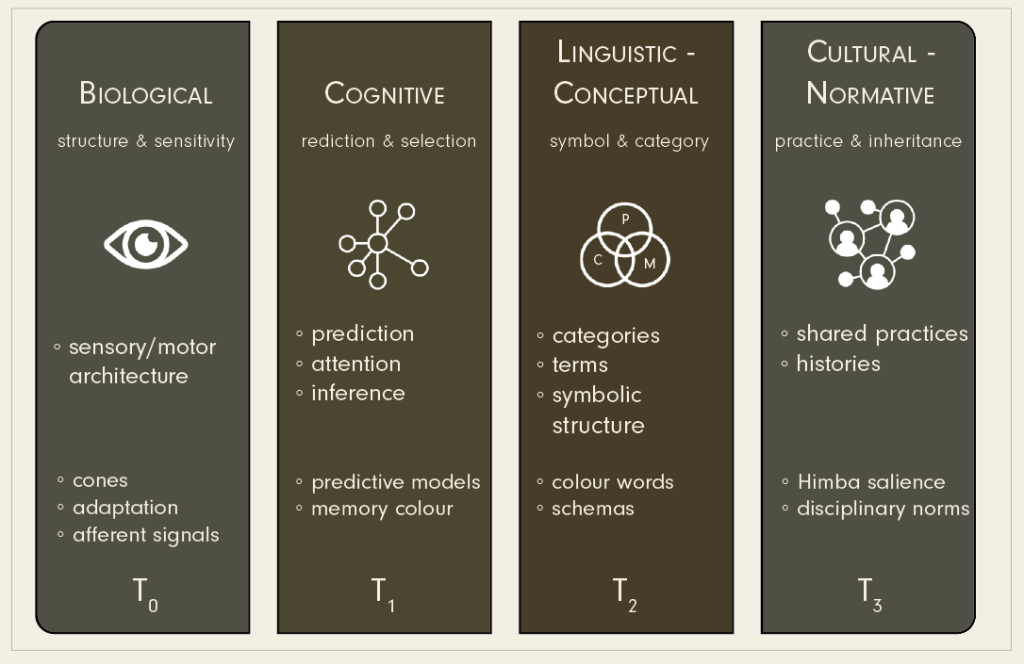
Redness isn’t inside your head or inside the apple. It’s co-constituted by biological, cognitive, linguistic, and cultural mediation interacting with persistent constraint patterns.
Time to peel this onion… er, apple.
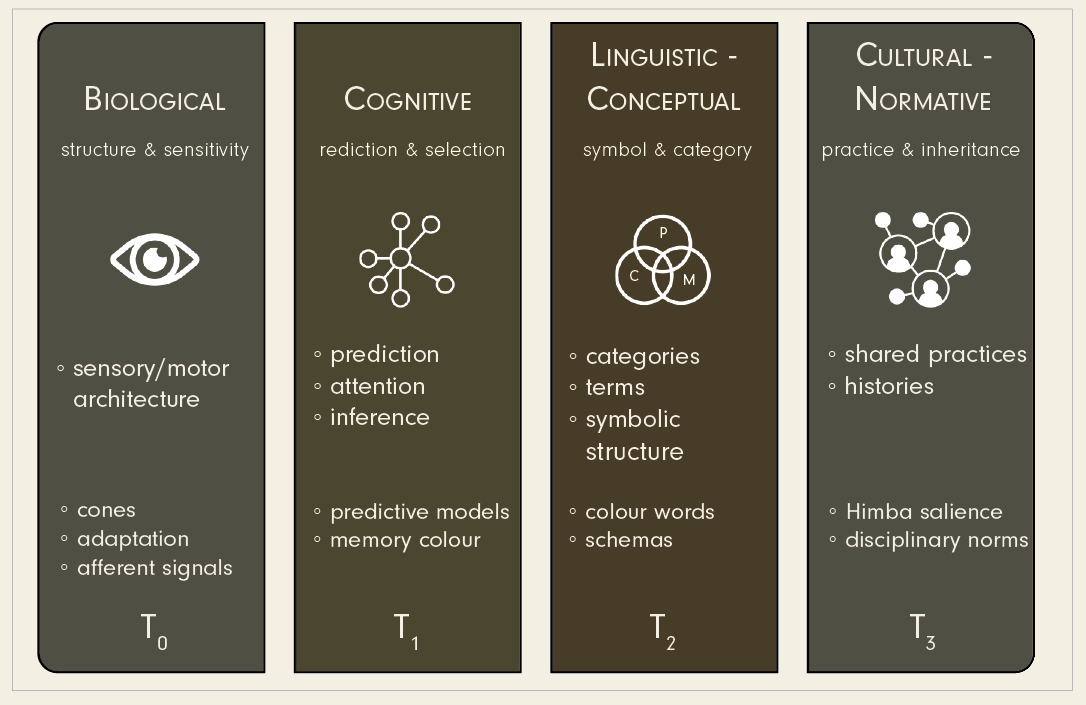
The Four Layers of Mediation (T₀–T₃)
A Ridiculously Oversimplified Cheat-Sheet That Still Outperforms Most Metaphysics Syllabi
Structure and Sensitivity: the Architecture You Never Asked For
This is where the Enlightenment’s fantasy of ‘raw perception’ goes to die.
Your visual system transforms, filters, enhances, suppresses, and reconstructs before ‘red’ even reaches consciousness. Cone responses, opponent processes, retinal adaptation, spatial filtering – all of it happening before the poor cortex even gets a look-in.
You never perceive ‘wavelengths’. You perceive the output of a heavily processed biological pipeline.
The biology isn’t the barrier.The biology is the view.
Image 2: Chromatic processing pathway (T₀→T₁): the layered biological transformations that make “red” possible long before consciousness gets involved.
T₁ – Cognitive Mediation
Prediction and Inference: You See What You Expect (Until Constraint Smacks You)
Your cognitive system doesn’t ‘receive’ colour information – it predicts it and updates the guess when necessary.
Memory colour biases perception toward canonical instances. Attentional gating determines what gets processed intensively and what gets summary treatment. Top-down modulation shapes what counts as signal versus noise.
There is no percept without mediation. There is no ‘raw data’ waiting underneath.
The Enlightenment liked to imagine perception as a passive window. Cognition turns that window into a heavily editorialised newsfeed.
Image 3: Expectation and input co-determine the percept: “red” emerges from the encounter, not from either source alone.
T₂ – Linguistic–Conceptual Mediation
Categories and Symbols: How Words Carve the Spectrum
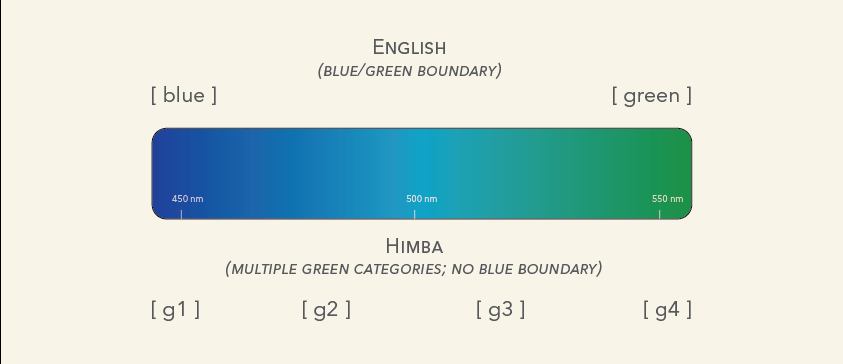
Enter the famous Whorf skirmishes. Do words change perception? Do they merely label pre-existing distinctions? Do Russians really ‘see’ blue differently?
Berlin & Kay gave us focal colour universals – constraint patterns stable across cultures. Roberson et al. gave us the Himba data – linguistic categories reshaping discrimination and salience.
The correct answer is neither universalism nor relativism. It’s MEOW’s favourite refrain:
Mediation varies; constraint persists.
Words don’t invent colours. But they do reorganise the perceptual field, changing what pops and what hides.
Image 4: Different languages carve the same physical continuum differently: English imposes a blue/green split; Himba divides the region into several greens with no blue boundary at all.
T₃ – Cultural–Normative Mediation
Shared Practices: The Social Life of Perception
Your discipline, training, historical context, and shared norms tell you:
which distinctions matter
which differences ‘count’
which patterns get ignored
A Himba herder, a Renaissance painter, and a radiologist do not inhabit the same perceptual world – even when staring at the same patch of light.
Cultural mediation doesn’t rewrite biology; it reorganises priorities, salience, and interpretive readiness.
Image 5: Three observers confronting the same stimulus yet extracting different distinctions: the scientist tracks wavelength, the artist tracks hue and value, and the Himba pastoralist tracks ecologically salient greens. Same object, different salience hierarchies. Not arbitrary – just mediated.
What Seeing Red Actually Involves (Step By Exhausting Step)
You walk into a room. Apple on table. Looks red. What just happened?
T₀ – Biological: Long wavelength light hits L-cones harder than M- and S-cones. Opponent channels compute (L−M). Adaptation shifts baseline. Edge detection fires. You don’t have ‘red’ yet – you have transformed photoreceptor output.
T₁ – Cognitive: Your brain predicts ‘apple, probably red’ based on shape and context. Memory colour pulls toward canonical apple-red. Attention allocates processing resources. Prediction matches input (roughly). System settles: ‘yes, red apple’.
T₂ – Linguistic–Conceptual: The continuous gradient gets binned: ‘red’, not ‘crimson’ or ‘scarlet’ unless you’re a designer. The category provides stability, ties this instance to others, makes it reportable.
T₃ – Cultural–Normative: Does the exact shade matter? Depends whether you’re buying it, photographing it, or painting it. Your practical context determines which distinctions you bother tracking.
And through all of this: Constraint. Metameric matches stay stable. Focal colours persist cross-culturally. Wavelength sensitivities don’t budge. The encounter isn’t arbitrary – but it’s not unmediated either.
What happened wasn’t: Mind Met World. What happened was: an encounter-event unfolded, organised through four mediational layers, exhibiting stable constraint patterns that made it this and not that.
Where This Leaves Us
Colour is not ‘out there’. Colour is not ‘in here’.
Colour is the structured relational event of encounter.
Four mediation layers shape what appears. Constraint patterns stabilise the encounter so we aren’t hallucinating wildly divergent rainbows.
There is no ‘apple as it really is’ waiting behind the encounter. Nor is there a sovereign mind constructing its own private theatre.
There is only the event – where biological structure, cognitive dynamics, conceptual categories, and cultural histories co-emerge with the stable patterns of constraint we lazily call ‘the world’.
The apple was never red ‘in itself’. You were never seeing it ‘as it really is’. And the Enlightenment can finally take off its colour-blind uncle glasses and admit it’s been squinting at the wrong question for three hundred years.
Next time: Why visual illusions aren’t perception failing, but perception revealing itself.
Until then: stop asking where colour ‘really’ lives.
It lives in the event. And the event is mediated, constrained, and real enough.









 Philosophics