I’ve got a new annotated edition of Heidegger‘s Being and Time, and it’s got me thinking about time – and thinking out loud. Obviously, Husserl is invoked by Heidegger, and the notion of duration (via durée) is from Bergson. Memory is not stored in the brain by| Victoria Trumbull on IAI TV might have been the real tipping point. I’m not sure how far I’ll develop this, but I wanted to capture my thoughts so I can refocus on my other topics, Parfit and Frege–Geach, to name two.
NB: I feel compelled to walk the NotebookLM podcasters back onto the reservation with their ending flurry. I would never posit that humans (or beings) will ever have direct access to The Universe™. All access, per MEOW, is necessarily limited by mediational encounter.
Duration – in a sense that will require distinguishing from Bergson’s – is ontologically prior. It is not the absence of structure but structure prior to segmentation, ordering, and metric discretisation. Time – segmented into intervals, directionally ordered, and metrically structured – is what results when intervalic form is imposed upon duration. The imposition is representational rather than discovered: we do not encounter intervals in duration any more than we encounter grid-lines in a landscape. It is not imposed from outside experience but enacted from within it, through the structuring operations by which finite subjects render duration intelligible as time, and this includes succession itself. The ‘before-and-after’ of temporal experience is not inherited from duration but is itself a product of the intervalic cut – the minimal structure required for the grid to function as a grid. Without this stronger claim, the imposition would merely metricise an already ordered flow. Duration would then retain an intrinsic direction independent of the grid. The present thesis denies this: prior to the imposition, duration has no intrinsic ordering of the sort the grid later makes available. This does not make time unreal; it makes it derivative. What follows is an articulation of the temporal distinctions that become available once the imposition is in place.
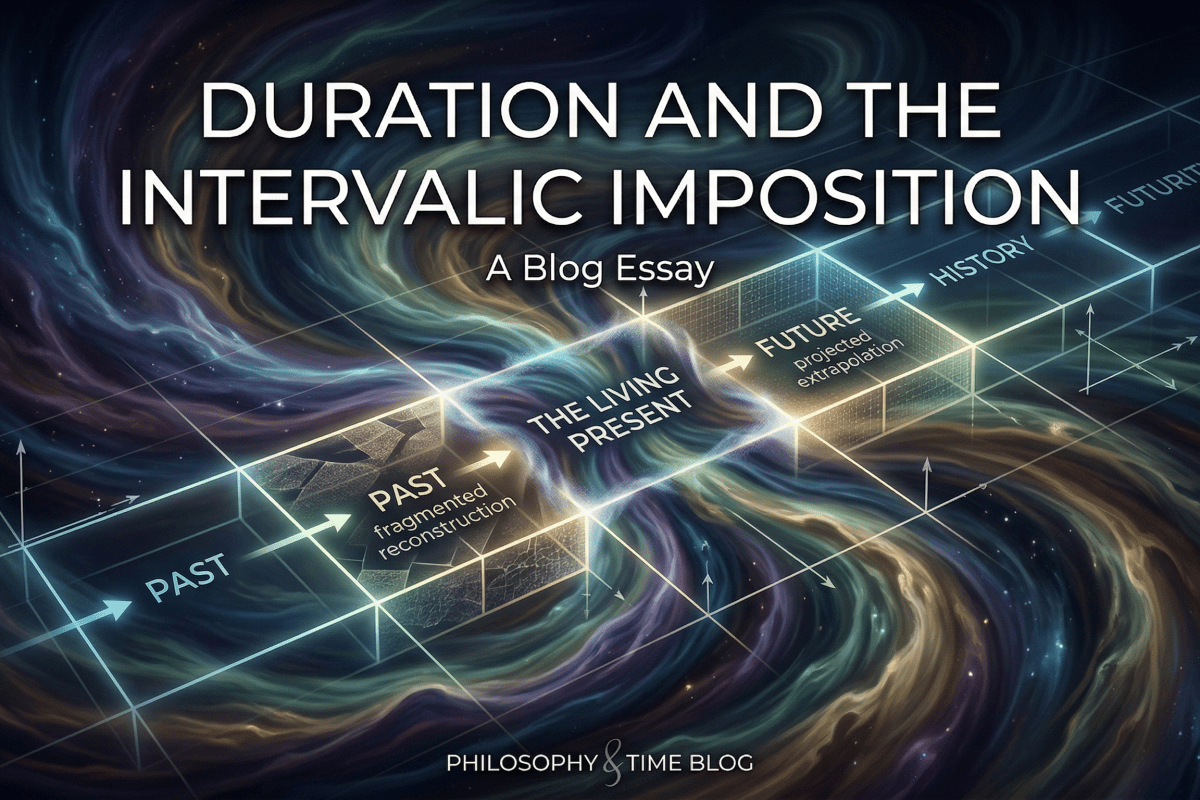
Once the intervalic cut is made, experience within its frame exhibits an asymmetric structure. The present, the past, the future, history, and futurity are not features of duration itself but modes of access that become intelligible only within the imposed temporal grid. They may be stated compactly:
- Present – actuality at the dimensionless limit of the intervalic cut.
- Past – prior actuality, no longer extant, now only reconstructible from retention, trace, and surviving fragment.
- Future – possible actuality, not yet extant, available only through projection, expectation, and extrapolation from present constraints.
- History – lossy interpolation from fragmentary surviving traces of prior actuality.
- Futurity – lossy extrapolation from present constraints, tendencies, and uncertainties.
Because the grid resolves duration only partially and from a situated cut, both reconstruction and projection are necessarily lossy: the former inherits only traces of what has been structured, the latter extends only tendencies available from where the cut presently stands.
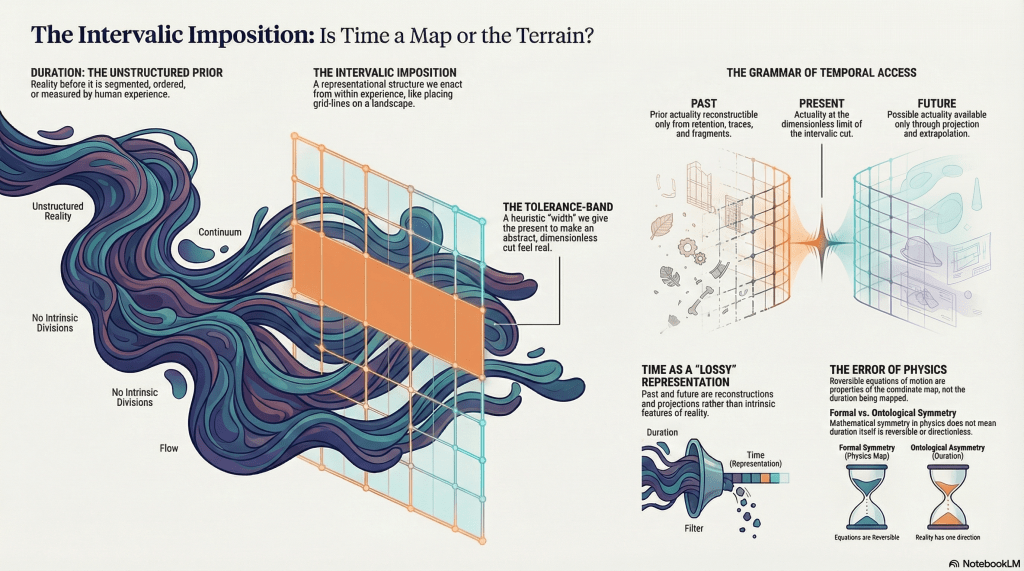
What ordinary experience calls the present is not, however, the dimensionless limit itself. It is a heuristic tolerance-band, a phenomenal spread across the cut that permits experience to function as though it inhabits a moment with extension. The strict present, as a product of the intervalic imposition, is an abstraction: a point that formal structure requires but that experience cannot occupy without borrowing width from duration. It is here, at the tolerance-band, that the imposition fails to fully displace what it organises. The failure is not accidental. Any representational scheme that discretises a continuous prior will underdetermine what it carves – there will always be a residue that the grid cannot fully resolve. The tolerance-band is where that residue is phenomenally evident.
The asymmetry between past and future is real, but it is real within the grammar of access generated by the intervalic imposition rather than as a primitive feature of duration itself. The past is reconstructed from what has obtained; the future is projected from what may obtain. A natural objection arises: if duration is truly without intrinsic direction, why is this asymmetry so stubbornly one-way? Why can we not reconstruct forwards or project backwards in any equivalent sense? The answer is that the imposition is not directionless even though what it is imposed upon is. The intervalic cut does not merely segment – it orders, and the ordering it introduces is irreversible because the cut is made from within experience, by subjects who retain traces of what the grid has already structured but have no corresponding access to what it has not yet reached. The arrow belongs to the act of imposition, not to duration itself.
A corollary follows for physics. Bidirectional temporal coordinates are artefacts of the intervalic grid, not discoveries about the deep structure of what the grid represents. That the equations of motion are time-symmetric means only that the formalism remains invariant under temporal reversal operations. It does not mean that duration is reversible, still less that time could ‘go backwards.’ The reversibility belongs to the representational instrument, the coordinate structure and its algebraic properties, not to what is being represented. To conclude otherwise is to read the map’s indifference to orientation as evidence that the terrain has none. Philosophical positions that take this inference at face value, the block-universe interpretation being the most familiar, inherit the error rather than originate it. The error itself is simpler and more general: the conflation of formal symmetry with ontological symmetry.
Situating the Argument
The foregoing account operates on terrain that others have worked before, and it owes debts that should be made explicit – not least so that the points of departure are equally clear.
The most obvious creditor is Bergson. The ontological priority of duration, the critique of spatialised time, and the insistence that metric structure is imposed rather than discovered are all recognisably Bergsonian commitments. The departure is equally plain. Bergson characterises duration positively as qualitative becoming, heterogeneous flow, interpenetrating states – a rich inner life that spatialisation distorts. The present account is more austere. It claims that duration is structure prior to segmentation and ordering, but it does not claim to know what that structure is like from the inside. Bergson thinks he can describe what the imposition conceals; the present thesis maintains that description is itself a structuring operation and therefore cannot reach behind the imposition it enacts. Duration here is an ontological commitment, not an experiential report.
Husserl‘s phenomenology of internal time-consciousness provides much of the apparatus for the epistemic layer. Retention and protention, the specious present, the constitutive role of temporal synthesis in experience – these are Husserlian structures, and the tolerance-band is in obvious dialogue with his account of the living present. The departure is that Husserl treats these structures as disclosing the temporal character of consciousness itself, whereas the present account treats them as artefacts of the intervalic imposition. For Husserl, retention is how consciousness holds the just-past; here, retention is a mode of access that the grid makes available. The difference matters because it determines whether the phenomenology is foundational or derivative. On the present account, it is derivative – downstream of the imposition, not prior to it.
The Kantian resonance is structural rather than doctrinal. The claim that the imposition is enacted from within experience by finite subjects, and that temporal order is a condition of intelligibility rather than a feature of things in themselves, places this account in the neighbourhood of the transcendental aesthetic. But Kant‘s time is a form of inner sense – a pure intuition that structures all experience a priori. The present thesis does not commit to this. It says the imposition is enacted by subjects but does not say it is a priori in Kant’s sense, nor that it is a form of intuition rather than (for instance) a contingent cognitive achievement or an evolved heuristic. The source of the imposition is left deliberately underdetermined at this stage, since settling it prematurely would foreclose possibilities the argument has not yet earned the right to exclude.
Finally, the critique of physics ontologising its own coordinate structure has affinities with van Fraassen‘s constructive empiricism – the insistence that empirical adequacy does not entail structural correspondence between formalism and reality. The affinity is genuine but limited. Van Fraassen is concerned with the epistemology of scientific theories in general; the present argument is concerned with one specific inferential error – the slide from formal symmetry to ontological symmetry – and it grounds that error in a prior thesis about the representational character of intervalic time that van Fraassen does not share. The diagnostic is narrower and the ontological commitment is stronger.
What the present account shares with all four predecessors is the conviction that the ordinary temporal framework – past, present, future, measured and directional – is not simply given. Where it departs from all four is in its specific diagnosis of what the framework is: a representational imposition. It structures a priori, it cannot fully displace, and is enacted from within experience by subjects whose epistemic situation is constitutively shaped by the imposition itself.