A Jellyfish Knows More About Time Than Your Physics Textbook

4–6 minutes

Disclosure: I shouldn’t have to apologise for two consecutive posts written by Claude – previous post on duration and time – this time about reframing a chat about time and duration around the hydrozoan jellyfish (sic. sea jelly). Yet again, this post arrives with a warning: if you don’t like AI-authored content, it’s not too late to turn back or click away.

Audio: NotebookLM summary podcast of this topic.

A hydrozoan jellyfish off the coast of Japan has no brain, no central nervous system, and no opinion about the block universe. It does, however, have something to teach us about the nature of time — and it’s more than most pop-science accounts manage.

Researchers recently described Clytia sp. IZ-D, a previously undocumented species of jellyfish that releases its gametes each evening with remarkable precision. The interesting part isn’t the precision. It’s what produces it.

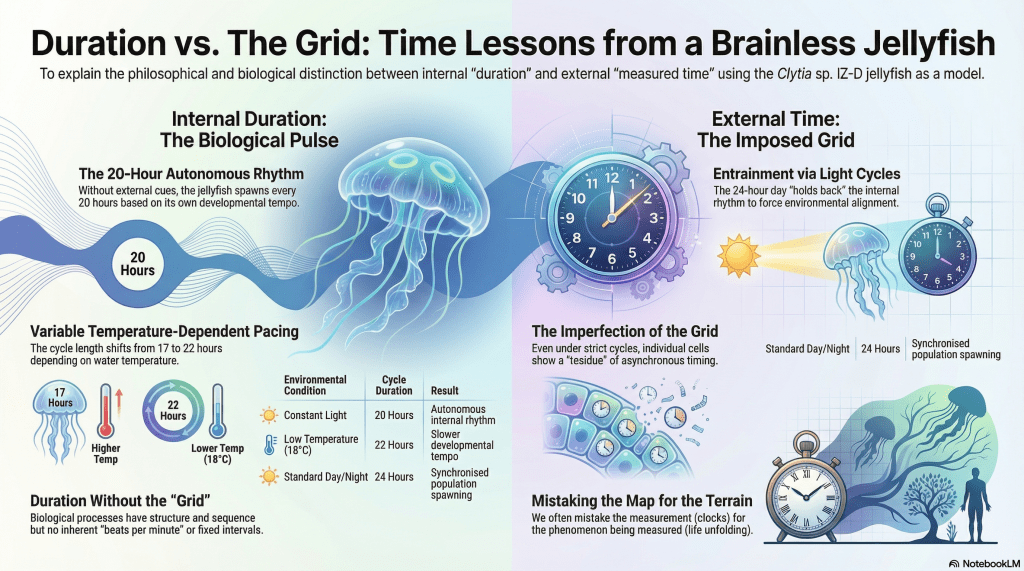
Left to its own devices under constant light, the jellyfish spawns every 20 hours. Not 24. Twenty. It has its own autonomous developmental rhythm — oocytes growing, acquiring competence, reaching a threshold, and releasing. That rhythm belongs to the organism. It’s not borrowed from the environment. It’s not calibrated to the rotation of the Earth. It’s the jellyfish’s own tempo.

But place the jellyfish under a normal day-night cycle, and the 20-hour rhythm gets pulled into a 24-hour one. The daily light-dark transition doesn’t trigger spawning directly. It delays the autonomous cycle by several hours, dragging it into alignment with the environmental period. Sunrise resets the clock — not by starting it, but by holding it back. Under a standard 12-hour light cycle at 21°C, spawning occurs 14 hours after dawn. Every day. Synchronised across the population to within about 20 minutes.

The 24-hour cycle is not the jellyfish’s rhythm. It’s what happens when an external structure is imposed on it.

Now, you could read this as a charming piece of marine biology and move on. But if you’re paying attention, it’s a remarkably clean illustration of something that applies well beyond cnidarian reproduction.

The jellyfish has its own duration — a developmental tempo with no fixed metric. Under constant conditions, the cycle length shifts with temperature: 17 hours at 24°C, 22 hours at 18°C. There’s no intrinsic interval. The process has structure — oocyte growth, staged competence acquisition, threshold sensitivity — but it has no grid lines. No bar lines. No BPM.

The 24-hour day provides the grid. The light-dark cycle imposes intervallic structure on a process that doesn’t natively possess it. And the imposition works — it synchronises the population, coordinates male and female gamete release, and presumably improves reproductive success. The grid is useful. Indispensable, even.

But it’s not the organism’s time. It’s what the organism’s time looks like after the environment has had its way with it.

And here’s the part that matters philosophically. The imposition is imperfect. Individual oocytes within the same gonad don’t all reach maturation competence at the same moment. There’s a spread — 40 to 60 minutes under normal conditions, widening further under constant light. The grid says “now.” The biology says “roughly now, give or take, depending on which oocyte you’re asking.” The grid cannot fully resolve what it organises. There’s always a residue.

Under constant darkness, the residue takes over entirely. The autonomous rhythm reasserts itself, but without the entraining signal it becomes asynchronous. Different jellyfish spawn at different times. Different oocytes within the same jellyfish mature at different rates. The developmental process is still there — the structure is still there — but without the intervallic imposition, it doesn’t produce anything that looks like coordinated “time.” It produces duration doing what duration does when nobody is counting.

None of this requires a brain. None of it requires experience. None of it requires a subject who feels the passage of time. The jellyfish doesn’t experience the 24-hour cycle as given. It doesn’t experience anything, so far as we know. And that’s precisely what makes it useful as an illustration: it shows intervallic structuring operating at a purely material level, without any phenomenological overlay. The grid is imposed on the biology. The biology is not the grid.

Now scale up.

We do the same thing the light-dark cycle does to the jellyfish, except we do it to everything, and we do it to ourselves. We impose intervallic structure on duration — segmenting it, ordering it, metrising it — and then we mistake the structure for what it’s imposed on. We experience time as sequenced, directional, and measured, and we assume that’s what time is. Physics formalises the assumption into equations and discovers, to no one’s surprise, that the formalism is time-symmetric. And then pop science announces that time could therefore “go backwards” — which is exactly like saying that because the score reads the same in both directions, the music could be played in reverse.

The jellyfish knows better. Not because it’s clever, but because it’s simple enough that you can see the layers separately: the autonomous developmental duration, the environmental intervallic imposition, the imperfect entrainment, and the residue the grid can’t capture. In us, those layers are collapsed. We live inside the imposition and mistake it for the terrain.

The 24-hour day is a grid. A useful grid. An indispensable grid. But the jellyfish was doing something before the grid arrived, and it will go on doing something if the grid is removed. What it does without the grid doesn’t look like “time.” It looks like biology unfolding at its own pace, in its own structure, answerable to its own constraints.

That’s duration. And it was there before we started counting.

Why ProTools Knows More About Time Than Physics Does

Disclosure: This post was written by Claude after a chat about time and duration. As a musician emeritus, I suggested the connexion between free time, metred time, and the quantising of ProTools. This discussion occurred as I was talking through a more serious piece on duration and time as ontic versus phenomenological essences. Not wanting to divert my efforts too far, I asked Claude to summarise our chat for this blog post. If you don’t like AI-authored content, this is your opportunity to exit. As for the rest, Abandon All Hope Ye Who Enter Here.

Audio: NotebookLM summary podcast of this topic.

Musicians have been complaining about quantisation for decades. You record a performance — human, breathing, alive — and then the software snaps every note to the nearest grid point. The timing is “correct.” The feel is gone. Something was there and now it isn’t.

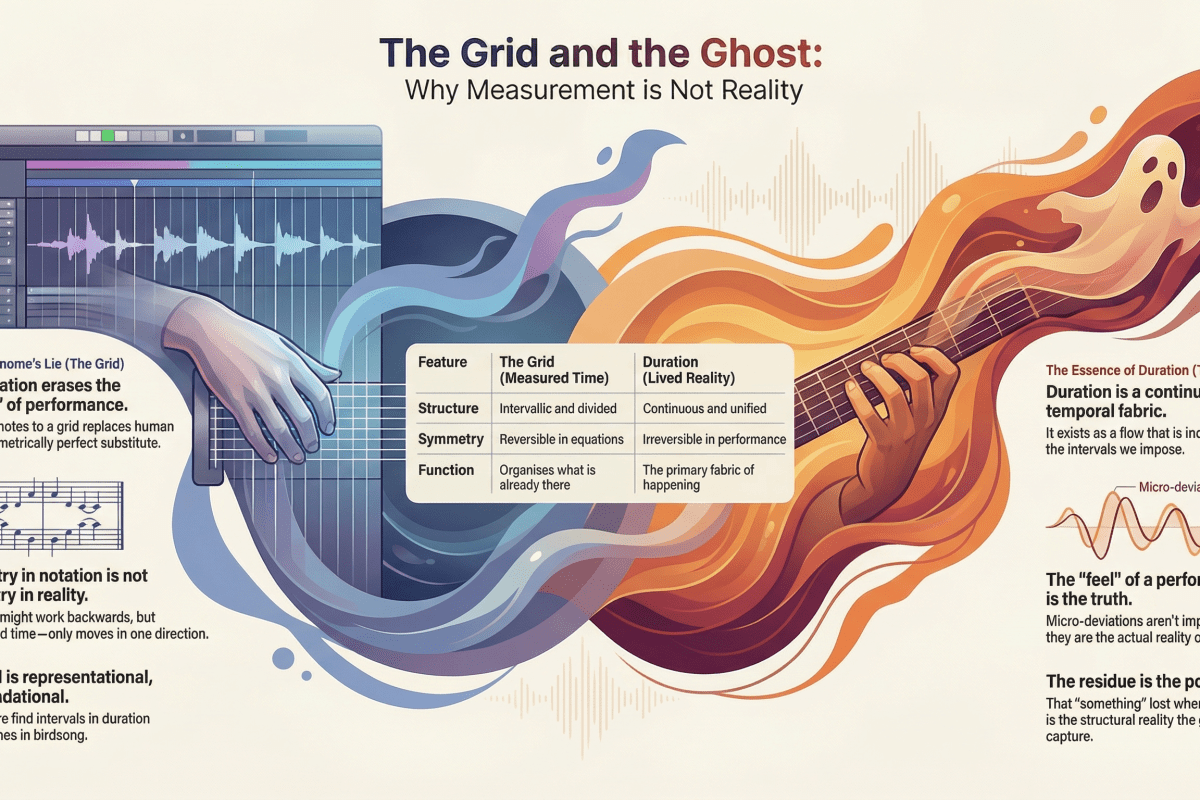
The standard explanation is that quantisation removes “feel” or “groove” — which is true but vague. What it actually removes is everything that falls between the intervals. The micro-deviations. The fractional push ahead of the beat, the slight drag behind it, the breath between phrases that doesn’t land on any grid division. These aren’t imprecisions. They’re the performance. Quantisation doesn’t tidy up the music; it overwrites it with a metrically perfect substitute and calls the result an improvement.

This is not a blog post about music production.

This is a blog post about time — and about the fact that the ProTools complaint is a precise, intuitive articulation of a philosophical problem that has been mishandled for over a century.

Here’s the short version. Duration — the actual temporal fabric of things — is something like free time in music. Not metrically structured, not divided into equal intervals, not indifferent to direction. Just: what’s happening, happening. Time, as we ordinarily understand it — clock time, measured time, the physicist’s time — is what you get when you impose intervallic structure on duration. Bar lines. A tempo marking. A grid.

The grid is useful. Indispensable, even. But it’s representational. It organises what’s there; it doesn’t discover what’s there. We no more find intervals in duration than we find bar lines in birdsong.

Now here’s where physics gets into trouble.

The equations of motion are time-symmetric. Run them forwards or backwards, they work either way. Pop science takes this and says: therefore time could, in principle, go backwards. Time travel! Reversed entropy! Christopher Nolan!

But this is exactly like saying: the score reads the same in both directions, therefore the music could be played backwards and remain the same music. It couldn’t. The score is the grid. The music is not the grid. The formal symmetry of the notation tells you something about the representational scheme. It tells you nothing about the direction of the performance.

Bergson saw half of this a century ago. He insisted that lived time — durée — is irreducible to the physicist’s spatialised coordinates. He was right. But he made his own version of the musician’s error: he confused free time with no time at all. Playing without a click track isn’t escaping metric structure. It’s still playing notes in sequence. Bergson thought philosophical intuition could recover duration as it actually is — but the feel of playing freely is still the feel of playing. It’s closer to the truth than the metronome is, but it’s not the truth itself.

Einstein, meanwhile, gave us the most sophisticated metronome ever built and then we all agreed the metronome was the music.

And ProTools? ProTools is what happens when you take the grid seriously enough to enforce it absolutely. Quantise everything. Snap every event to the nearest interval. And then notice — as every musician who has ever hit that button notices — that something real has been lost. Not a feeling. Not a subjective impression. Something that was in the sound is no longer in the sound.

That loss is the point. The grid cannot fully capture what it organises. There is always a residue — and the residue isn’t a flaw in the grid or a limitation of the technology. It’s a structural feature of any intervallic imposition on something continuous. The grid does real work. But the work it does is not the same as the thing it works on.

Time doesn’t go backwards. It doesn’t go forwards either. “Going” is what the grid gives you. Duration doesn’t go anywhere. It’s what’s already there before the grid arrives.

The musicians have known this all along. They just didn’t know it was philosophy.

Encounter with Carlo Rovelli

2–3 minutes

I’m a philosopher of language, which sometimes veers off the reservation into philosophies of science and even metaphilosophy, but I am not a physicist. I don’t pretend to be. I do try to remain abreast of the goings-on in physics and science just because. Still, I view most affairs first through a philosophical lens.

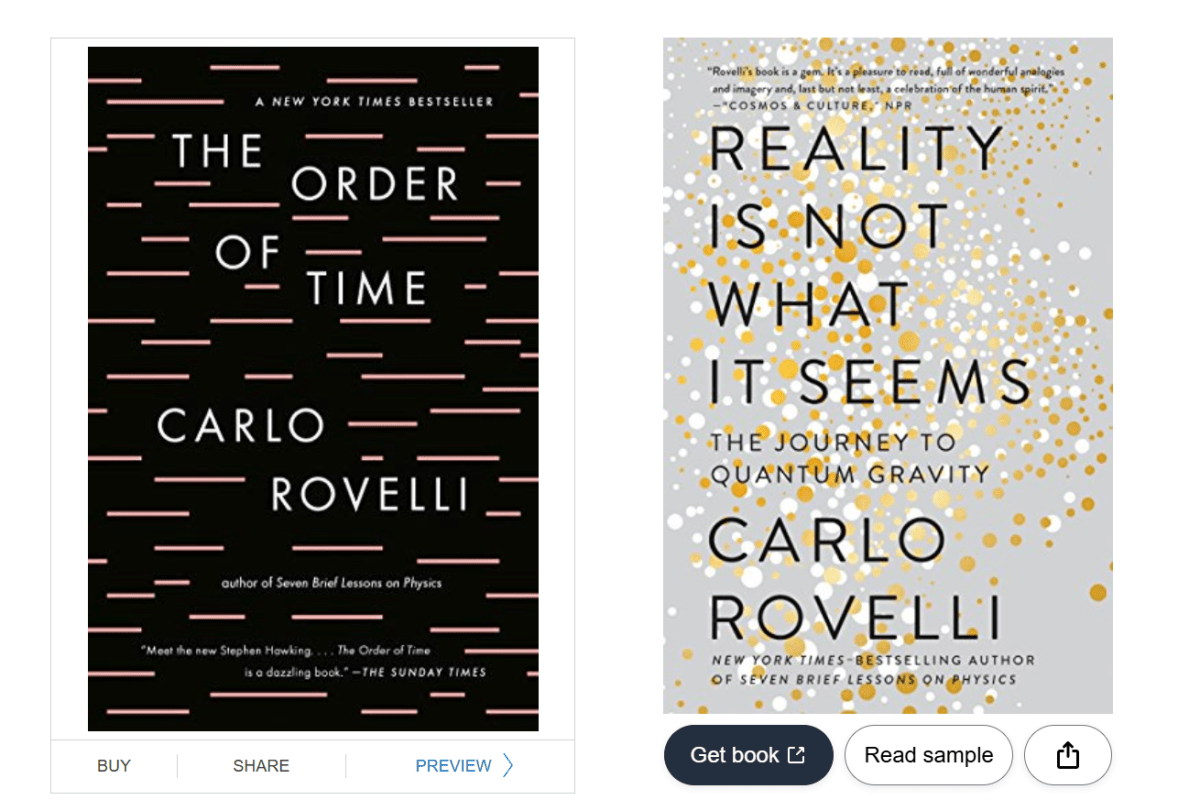
I watch a decent amount of science videos on YouTube, and I’ve been following Rovelli for years, but I hadn’t engaged with his work directly until I was researching for my current book, The Architect of Encounter. First, I read The Order of Time, followed by Reality Is Not What It Seems.

Rovelli published these books around 2017, but I am only reading them now. We are travelling in the same neighbourhood, but we occupy different residences and have different orientations.

Surveying the marketplace, quite a few physicists and science educators make some of the same points I and Rovelli make. In fact, these things appear to occur as trends. When I wanted to write about agency and free will over five years ago, I noticed a slew of books on the topics, and I had nothing more to add, so I shelved the idea.

In this case, the trend appears to have been between 2017 and 2018. I’m sure this is where I absorbed some of my knowledge, opinions, and grammar, but my thesis goes further and comes from a different perspective, so I feel this manuscript is worth publishing.

Getting back to Rovelli, his books are very well written – very approachable and light on the academics. I hope mine lands somewhere in the middle. As I continue to write my book, I will lean on Rovelli for the perspective on quantum theory. If he’s wrong or it’s wrong, then we fall together. That’s what happens when you borrow a foundational commitment. It’s a risk I am willing to take.

As much as I want to share more of what I am working on, it turns out I still need to work on it if I want to complete it. I am aiming for April this year, if not sooner. At least I’ve got some of the administrative stuff out of the way. Here’s a quick glimpse, title and copyright pages.

Sundials, Spacetime, and Other Human Fabrications

Time is not fundamental. It is not lurking behind the curtains of reality, counting down the universe like some cosmic metronome. Time is a human construct, a clumsy accounting trick invented so that hunter-gatherers could remember when to plant seeds, priests could know when to fleece the flock, and later, managers could know when to dock your wages.

Video: Sabine Hossenfelder discusses the proposed origins of time

Yes, our ancestors tracked cycles: the swing of day and night, the waxing of the moon, the slouch of the seasons. But this is proto-time at best. Call it rhythm, call it recurrence, call it the universe refusing to sit still. It was not time. It was change, and we anthropomorphised it.

Then along came Newton with his stopwatch. He baptised “absolute time,” a divine river that flowed “equably without relation to anything external.” In other words, he built the cosmic grandfather clock and declared it law. This fantasy held just long enough for Einstein to make mischief, weaving time into space with duct tape and calling it spacetime. Romantic, yes, but hardly fundamental. Time, in Einstein’s cosmos, bends and dilates depending on who’s doing the bending. Not exactly the firm bedrock you’d expect of a “dimension.”

Meanwhile, in the quantum world, time is the awkward dinner guest: not an observable, not dynamic, just an external parameter scribbled into the equations because no one knew where else to put it. Like a bad houseplant, it sits in the corner – unmeasurable, unaccountable, but impossible to get rid of.

And yet, not everyone has given up the ghost. One camp – think Julian Barbour and Carlo Rovelli – insists time is an illusion, something emergent from relations, clocks, and counters. Others, like Lee Smolin, flip the script and claim that time is more fundamental than space itself, the real stage upon which the cosmic drama plays out. Philosophical infighting aside, what this tells you is that physics doesn’t actually know what time is. They’re as clueless as Aristotle, who called it “the number of motion”, a definition so circular it should’ve been printed on a sundial.

Enter Constructor Theory (Deutsch & Marletto), which simply does away with time entirely in the fundamental laws. No ticking clocks, no background river. Just possible and impossible transformations, with time emerging only when we strap timers onto systems and start counting. Which, of course, makes perfect sense: time is what we measure with clocks – and clocks are just things that change.

The dirty secret is this: every culture, every cosmology, every physics textbook has tried to smuggle “time” in as if it were self-evident, while quietly redefining it to suit the mood. We can’t agree on whether it’s an illusion, a dimension, or the last shred of fundamentality left to cling to. And if that isn’t the mark of a human construct, I don’t know what is.

Yesterday and Today

For no apparent reason, I was pondering lost temporal words, so I paid a quick visit to ChatGPT and wanted to share the wealth. Perhaps we can bring some of these back from the grave.

Audio: Podcast prattle of this content.

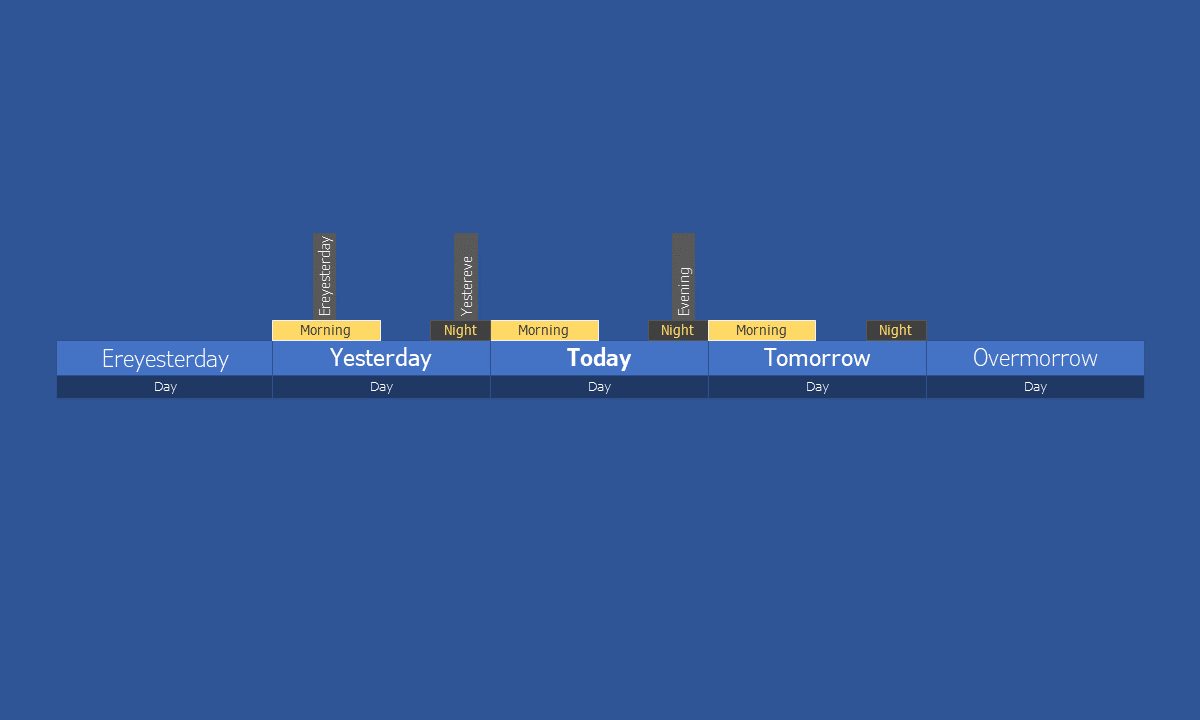
Eldernight: Referring to the night before last, this term has long since faded from common usage.

Erewhile: Meaning “a little while ago” or “previously.”

Ereyesterday: Meaning “the day before yesterday” – a direct counterpart to “overmorrow.”

Erstwhile: Similar to “erewhile,” it denotes something that was formerly the case.

Fortnight: Short for “fourteen nights,” this term refers to a two-week period and is still in use in British English.

Nudiustertian: A wonderfully specific Latin-derived term meaning “of or relating to the day before yesterday.”

Overmorrow: This term was used to indicate the day after tomorrow.

Sennight: Derived from “seven nights,” this word was used to mean a week.

Umwhile: Another Scottish term meaning “at times” or “occasionally” in the past.

Whilom: An archaic term meaning “formerly” or “once upon a time.”

Yore: While you touched on similar concepts with “whilom,” this term specifically means “of long ago” or “of time long past.”

Yestereve: This term referred to the evening of the previous day, essentially what we’d call “last night.”

Yestermorrow: An intriguing word that denoted “yesterday morning.”

Yestreen: A Scottish and Northern English word meaning “yesterday evening” or “last night” – similar to “yestereve” but with different regional origins.

These terms, though largely obsolete, offer a glimpse into the linguistic richness of earlier English, providing nuanced ways to express temporal relationships that have since been lost in modern usage.

Time

Yes. Time. That Time.

Podcast: Audio rendition of this page content

I was browsing YouTube, and I got captivated by reaction videos, where a younger audience listens to music some of us grew up with and reacts to it. Time is a song I grew up on. Pink Floyd were a major influence on my music and my worldview. I have to admit that I am partial to the David Gilmour years and stopped caring about anything released after Roger Waters left. I have spent hours listening to their back catalogue with Syd Barrett and early David Gilmour, but Meddle, released in 1971, is about as far back as I prefer to go—even that old gem, Seamus.

Roger Waters penned the deepest lyrics for Pink Floyd, and this was one of his best. He wrote this in his late twenties, though it feels like he would have been older and wiser. I suppose he’s an old soul. Here’s the first verse:

Ticking away the moments that make up a dull day
Fritter and waste the hours in an offhand way
Kicking around on a piece of ground in your hometown
Waiting for someone or something to show you the way

This speaks to how we tend to take time for granted. Sometimes, we just want the time to pass. We’re bored, and we want to get on to something meaningful, eventful, or perhaps exciting. We might be sat in work or school just waiting for quitting time. We aren’t living in the moment or enjoying the moment. And we might just be kicking around on a piece of ground in our hometowns rather aimlessly. And whilst I am aware that many people are looking for someone to guide them to the next level, whether a religion, a vocation, a guru, or a hero, that bit’s never really resonated with me. I suppose I’ve always been naturally insouciant and Zen. Some have said to a fault.

you missed the starting gun

Tired of lying in the sunshine, staying home to watch the rain 
You are young and life is long, and there is time to kill today 
And then one day you find ten years have got behind you 
No one told you when to run, you missed the starting gun 

The second verse picks up where the first one left off. Let’s not forget that this is Britain—London—plenty of rain. But some people do get tired of lying in the sunshine living their routine workaday lives. When we are younger, the days feel longer. Time is stretched. Einsteinian relativity. Again, we’ve got time to pad out and fill. Something’s happening at the weekend. Let’s just fast-forward, but we can’t, so let’s fill the time with mindless prattle and television or somesuch. Once you were 18 and now you’re 28. What happened? Tens years gone. Where’d the time go?

The last line in the second verse is telling. For me, it’s more an indictment of quote-modern-unquote society. It only applies to those who buy into this worldview. I never bought in. It’s’ always been a sham. But for some, they reach 28 and realise they’ve made the wrong decisions for their lives to end up the way they may have envisaged. I’ve never had this grand vision.

one day closer to death

And you run, and you run to catch up with the sun but it's sinking 
Racing around to come up behind you again 
The sun is the same in a relative way but you're older 
Shorter of breath and one day closer to death 

Resistance is futile. You can’t escape the movement of time as represented by the quotidian sun. It will always lap you. The sun ages on a different time scale to you. The sun doesn’t appear to age. It was here when we arrived. It will be here when we leave. It was here before any of us were born. It will be here after we’ve all left. Yet with every lap of the sun, we are each another day closer to death. That day may be tomorrow, next week, or in a hundred years, but as Twelve-Step programmes remind us, we live one day at a time. Perhaps even this is too large of a time slice, as we can only live moment to moment. Anything else is but a construction. Nothing else is real. Memento Mori.

thought I’d something more to say

Every year is getting shorter, never seem to find the time 
Plans that either come to naught or half a page of scribbled lines 
Hanging on in quiet desperation is the English way 
The time is gone, the song is over, thought I'd something more to say 

Again, time is relative. When we are young, we yearn for things: perhaps to graduate high school; get a driver’s license; graduate college; get the job we wanted; get some promotion or recognition; get signed to a big label; get a big break; the list goes on.

For those who are planners, the best-laid plans go awry. We dream of whatever and even journal these thoughts, but in the words of another song, “you can’t always get what you want”.

We want to do this or that, but life gets in the way. We can’t do everything. Economists capture this by the notion of opportunity costs. We can do this but not that. It doesn’t matter if we are Elon Musk, Jeff Bezos, Bill Gates, or whomever. Time is the ultimate leveller.

We can just keep a stiff upper lip and persevere. Just occupy some place on this third rock, Next thing you know, the time is gone. I recall my ninety-odd-year-old father-in-law after his wife of seventy-five years died. He just wanted to die. He was done. He was ready to quit, but the music was still playing. Any semblance of hope was exchanged for the hope to reach the ending peacefully.

home again

Home, home again 
I like to be here when I can 
And when I come home cold and tired 
It's good to warm my bones beside the fire 

In this verse, Roger becomes reflective. He’s nostalgic for home. Anyone with a home has a place to return to after work, after school, or a childhood memory, but to touring performers, home is an even more special place. It’s a place to return to after life on the road, perhaps for months or years. Consider Odysseus and the travellers of old. This home.

He wants to be in this comfortable, familiar place. And after a long day or excursion, it’s a place to rejuvenate and rekindle by the warmth of the fire.

softly spoken magic spells

Far away across the field 
The tolling of the iron bell 
Calls the faithful to their knees 
To hear the softly spoken magic spells 

The final verse is even more metaphorical than the others. There’s an allusion. Religious allegory. In the distance, we hear the peal of the church bell beckoning the parishioners to hear the palliative words of the vicars and priests and whatnot. Or perhaps these softly spoken magic spells are simply the prayers of the individuals.

In deference to Barthes, the author is dead. But it doesn’t matter this is my interpretation—my meaning. Even more so, in deference to chapter eight of the Matter with Things, poetry and music are meant to be appreciated as a whole, not dissected. We can reflect on the words and phrases—even the melodies and rhythms—but the words are less than they sum to. Still, this piece moves me. It always has.

What does this mean to you?

Revisiting Time Reborn

I’ve just finished with Time Reborn. I wasn’t expecting to be converted to Smolin’s proposition that time is real rather than constructed. I enjoyed the book, and he provided a solid foundational understanding of the conventional scientific perspective (circa 2013, when the book was published).

I understand that Smolin is a professional physicist with a PhD and his grasp of the fundamentals is solid, and I am a peripheral scientist at best. I fully grant that I may be on the left of the Dunning-Kruger curve and making rookie mistakes.

The biggest contention I have is that he insists that everything needs to have a reason, citing Leibnitz. His argument is based on the question of why is our universe so perfectly structured, that it would be improbable to have happened purely by chance.

Whilst I agree that everything has a cause, reasons are an artifice imposed by humans. In practice, where reasons don’t exist, we make them up. This is how we get false theories and gods. Smolin does discuss false theories of the past and attempts to claim that the prevailing theories occupy this space whilst his theory should replace it.

Any universe created without the ability to sustain life would not have us asking why it did not support life.

My reaction is that it just is. Whether Roger Penrose is correct in saying that the universe is continually recreated and destroyed, rinse and repeat, the reason the universe is constructed in such an (improbably) ordered fashion that can sustain life is that there is no reason. Any universe created without the ability to sustain life would not have us asking why it did not support life. It does. We are here to question, and so we do. End of story.

We can make up all sorts of stories, whether through science, religion, or some other origin myth. None of them is provable. As Smolin notes, this is a one-time event. If it is destroyed, so are we and our memories. If life is sustainable in a future—or even parallel—configuration, we’re sent back to start where we can fabricate new stories.

Perhaps in another universe, it will be configured so differently that some other sort of life is created, perhaps this life will not be DNA-based and be anaerobic? Who knows?

It seems that he has an interest in reserving a place for human agency, which has little room for movement in current scientific models. His model provides this room. Moreover, he further thinks that even in current models, human agency should be injected into the models. I suppose he is not familiar with Keynes’ animal spirits.

For some reason, he decided to devote the final chapter to the hard problem of consciousness. This was a particularly hot topic around that time, so he didn’t want to miss the boat. The long and the short of it, he didn’t think the qualia-consciousness answer would be found through physics—though he reserved that there was a non-zero probability that it could be. He posits this as an existential, experiential challenge, and science is not designed to address such affairs.

Time Reborn

Einstein was wrong. Time is not the relative factor in space-time. Space is. Time is constant. Here’s a lecture on the topic of the book.

Lee Smolin Public Lecture: Time Reborn

As a result of a discussion with a colleague, on the possibility of variability or mutability of so-called physical laws, he recommended Lee Smolin’s book Time Reborn: From the Crisis in Physics to the Future of the Universe. He mentioned that it would be suitable as an audiobook. Since I had a credit on Audible, I decided to use it so I could listen to this without deep scrutiny and a need for taking notes.

There is a nice review in the Guardian from 2013. I suppose I am a bit behind the times.

Whilst running errands, I listened to the Preface and Introduction. I stopped at the start of the first chapter, and am debating whether to continue. Given his setup, I don’t believe I am Smolin’s target audience. Many of the beliefs he is attempting to dispel, I already don’t hold. Yet I don’t feel that I need to hold time as a constant to hold them. He seems to feel otherwise.

Preface

For the record, Lee Smolin is a theoretical physicist, who has written several books in this space. Quickly, recapping some of his points:

He provides examples of various illusions humans tend to be swayed by:

  • Matter appears to be smooth but turns out to be made of atoms
  • Atoms seem indivisible but turn out to be built of protons, neutrons, and electrons
  • Protons and neutrons are further made of still more elementary particles called quarks
  • The sun appears to go around the Earth, but it’s the other way around

Smolin relates that the prevailing perspective today is that time is an illusion—name-dropping Plato and Einstein, who hold this view. He conveys that he used to share this belief, but now he disagrees—whence the book. He tells us:

Not only is time real, but nothing we know or experience gets closer to the heart of nature than the reality of time.

— Lee Smolin, Time Reborn

Next, he posits that some people believe in timeless events—events outside of time, eternal and not a function of time. Here’s where he goes off the rails in my book.

“We perceive ourselves as living in time, yet we often imagine that the better aspects of our world and ourselves transcend it. What makes something really true, we believe, is not that it is true now but that it always was and always will be true.”

Evidently, he feels or felt this way. I am sure many others. I am not among them.

“What makes a principle of morality absolute is that it holds in every time and every circumstance.”

My position is that all morality is a social construct, so this doesn’t resonate with me.

“We seem to have an ingrained idea that if something is valuable, it exists outside time.”

Again, I am not in his intended audience.

“We yearn for “eternal love.” We speak of “truth” and “justice” as timeless.”

Love, truth, and justice are all human constructs—weasel words.

“Whatever we most admire and look up to — God, the truths of mathematics, the laws of nature — is endowed with an existence that transcends time. We act inside time but judge our actions by timeless standards.”

Yet again, I am unburdened by these beliefs.

Nothing transcends time, not even the laws of nature. Laws are not timeless. Like everything else, they are features of the present, and they can evolve over time.

— Lee Smolin, Time Reborn

I think that this quote is a reason this book was recommended to me. I do believe that the properties that comprise laws can evolve over time. I’m not sure if this is by a probabilistic process or something else. There are a few possible implications. One is that the laws at the onset of the universe may have been different, making the understanding of that time more challenging if not impossible. I don’t know if I believe in multiverses, and I doubt I may ever live long enough to discover. However, even if there is only one universe, per the name, perhaps universes can exist sequentially and when one dies another appears with a different set of initial conditions and properties. Borrowing from evolution, perhaps these survive or perish based on the viability of this combination.

Smolin goes on to posit that, ‘thinking in time is not relativism but a form of relationalism‘.

He continues,

“Truth can be both time-bound and objective when it’s about objects that exist once they’ve been invented, either by evolution or human thought.”

— Lee Smolin, Time Reborn

I’m not sure he is going to define truth, but I believe he conflates moral truths with axiomatic or tautological truths. Perhaps it doesn’t matter because both are constructed.

Smolin makes it clear that he is not a determinist, but unless you take the view he is proposing, as a physicist, you almost have to be. As he says regarding Determinism, theoretically. a person could suss out a mathematical equation to predict every future event. He also considers this belief to be a metaphysical vestige of religion.

Introduction

According to [the] dominant view, everything that happens in the universe is determined by a law, which dictates precisely how the future evolves out of the present. The law is absolute and, once present conditions are specified, there is no freedom or uncertainty in how the future will evolve.

— Lee Smolin, Time Reborn

He continues to describe a deterministic system without mentioning indeterminism, which may be a more prominent belief given what we understand about quantum mechanics. He claims that this perspective diminishes time for several reasons. Inflating or at least elevating time is important for his thesis, and I am thinking that this is more an act of wishful thinking.

He takes a stab at the inherent reductionism of physics—it reduces everything to parts until there are no longer subparts, at which point the process fails—and explains that by adopting this approach, one needs to get outside of the universe to make some evaluations, but this is impossible. And this might be a true statement, but so what? The answer is not to make up a story that creates an environment where that’s no longer necessary.

Smolin reiterates over and again about timeless laws in a time-bound universe, but I question his notion of timelessness. He admits that he has no grand theory—just an idea he hopes others can pursue and build upon. Emergent properties appear to be an emerging theme.

Leibniz is next up, in particular his principle of sufficient reason. Leibniz’ vision is a relational universe composed of a network of relationships—the space is simply the absence of things. He contrasts this with Newton’s view that space is absolute and serves as the container for things. He sets up a future chapter that he says establishes that Leibniz’ vantage precludes the possibility of absolute time, but I don’t see this as a challenge for those of us who believe that time is constructed in the first place.

The Newtonian view prevailed until Einstein resurrected Leibnitz with his general relativity theory of space and time. The trending vogue is about relationalism, whether biology or information science.

He cites the challenges of maintaining Locke’s views on autonomy and personal liberties in a deterministic world (again leaving indeterminism unmentioned).

And he’s back on the emergence of emergence. (I was in the midst of writing a post on emergence when this interrupted my flow. I suspect it should be forthcoming in time.)

Falling

As it turned out, I ran another errand and listened to the first chapter of part 1. It is about gravity and parabolas, but I shan’t recount it here, save to note that he seems to be of the opinion that many people have the desire to transcend the bounds of human life. He may be right. I am not one of these people.

I don’t feel that I am in his target market.

It’s about time…

Rather it’s about days.

Have you even just let your mind and fingers wander?

The English language morphs, and sometimes some useful notions are lost to the dustbin of history. I take it especially hard when other languages retain these aspects.

I tend to evaluate much in terms of time. In practice, this is why I dispute notions of self and identity—Plank-sliced frames stitched in time.

Although ‘today’ is the central reference and I could start with ‘today’, I’m going to unfold this chronologically, instead. First some background.

Getting Down to Basics

Day

In its original incarnation, day meant the ‘period during which the sun is above the horizon’ and was expanded to comprise the entirety of a cycle.

Fun Fact: Days used to be measured starting at sunset rather than midnight as is the current custom. So time was relative in a different sense to today.

Evening

Originally referring to the time just before sunset—parallel to the morning having meant the time just before sunrise—, it’s been expanded to mean the time from sunset (post the original intent) and bedtime.

Morning

Although morning had originally been limited to the time just before sunrise, its domain has been expanded to encompass the part of the day between midnight and noon, exclusively.

Morrow

Morrow simply means morning. Good morrow would have been taken as ‘good morning‘.

Night

Night is ostensibly the dark part of a day.

Yester

I don’t want to be the one to break it to you, but yester (from gester) means yesterday. More on this later.

Putting It All Together

Ereyesterday

Ereyesterday can be disintegrated into three components. Ere means before or previous, so reintegrating, we get something like the day before yesterday or the day prior to yesterday.

Yestermorrow

Yestermorrow is a rendition of yesterday with a focus on the morrow—the morning.

Yesterday

If you’ve been following the breadcrumbs, there is no big reveal here. Given that yester already means ‘the day before today‘, yesterday disintegrates into yesterday day—’the day before today day‘. That’s the English language for you. It could be worse.

Yesternight

Yesternight is the flip side of yestermorrow, but it should be more recognisable as the night of the prior day—yesterday.

Yestreen

I debated whether to include this yestreen the mix. Yestreen is more of a Scottish word that is a synonym for yesternight. And we don’t use either of them anymore. Such a shame.

Today

As with tomorrow, today was generally written as a hyphenated word—to-day—until about 100 years ago. It had been two words until the 1500s. Essentially, today refers to this day—the current day.

Tomorrow

As with today, tomorrow was generally written as a hyphenated word—to-morrow—until about 100 years ago. It had been two words until the 1500s. Effectively, tomorrow refers to the next morning, though we have extended the meaning to account for the entirety of the next day.

Overmorrow

If you’ve been paying attention and following the progression, you’ll have guessed that overmorrow is the day over tomorrow—after tomorrow.

And so it goes…

I understand that many (at least some) languages retain some of these time markers—German and Dutch come to mind. There are other markers such as the English fortnight—meaning fourteen days or two weeks, but I wanted to limit my focus around today.

Foucault Identity

‘Do not ask who I am and do not ask me to remain the same: Leave it to our bureaucrats and our police to see that our papers are in order. At least spare us their morality when we write.’

—Michel Foucault, The Archaeology of Knowledge & the Discourse on Language

I am going to take liberal liberty with Foucault’s quote. This is another take on Heraclites’ ‘never the same man, never the same river’ quote. It can be taken as a commentary on identity and impermanence. Effectively, he is taking the position that the concept of identity is a silly question, so don’t bother asking about it. Then he defers to people who insist on it anyway.

To be fair, creating a sort of contiguous identity does simplify things and creates categorical conveniences.

Vendor: ‘Wasn’t it you who purchased that from me and promised to pay with future payments?

Zen: ‘There is no future. There is only now. And I am not the same person who purchased your car.

Perhaps this is where the saying, ‘Possession is 9/10 of the law‘, a nod to temporal presentism.

In any case, some systems are predicated on their being identity, so a person benefiting from that system will insist on the notion of identity.

Clearly, I’m rambling in a stream of consciousness, and it occurs to me that Blockchain offers a solution to identity, at least conceptually. In the case of Blockchain, one can always audit the contents of the past in the moment. And so it carries the past into the now.

If one were able to capture into an archive every possible historical interaction down to the smallest unit of space-time—neutral incident recording, indexing and retrieval challenges notwithstanding—, one could necessarily attribute the record with the person, so long as they are otherwise inseparable. (We’re all well-aware of the science fiction narrative where a person’s history or memory is disassociated, so there is that.)

Anyway, I’ve got other matters to tend to, but now this is a matter of historical record…