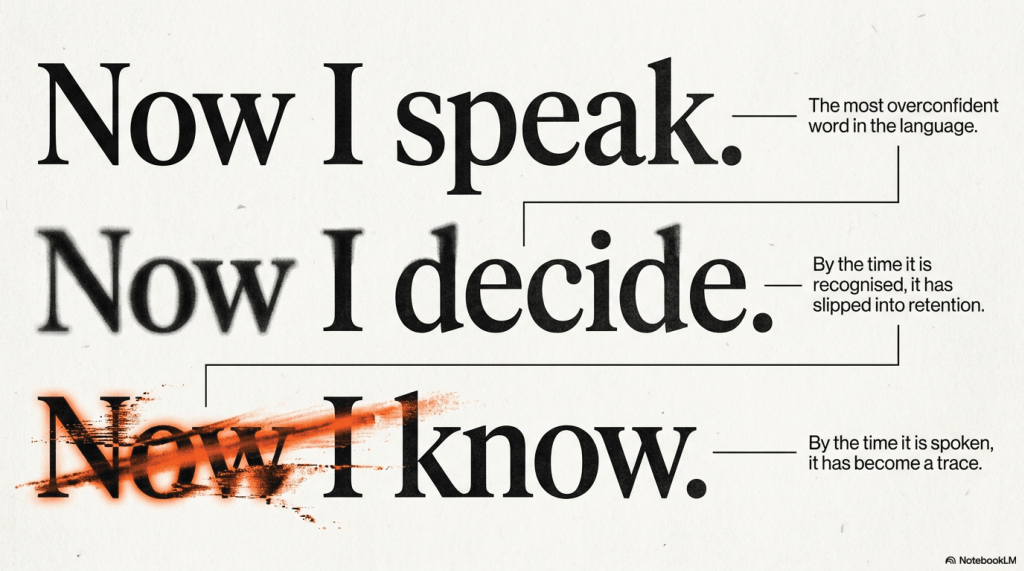
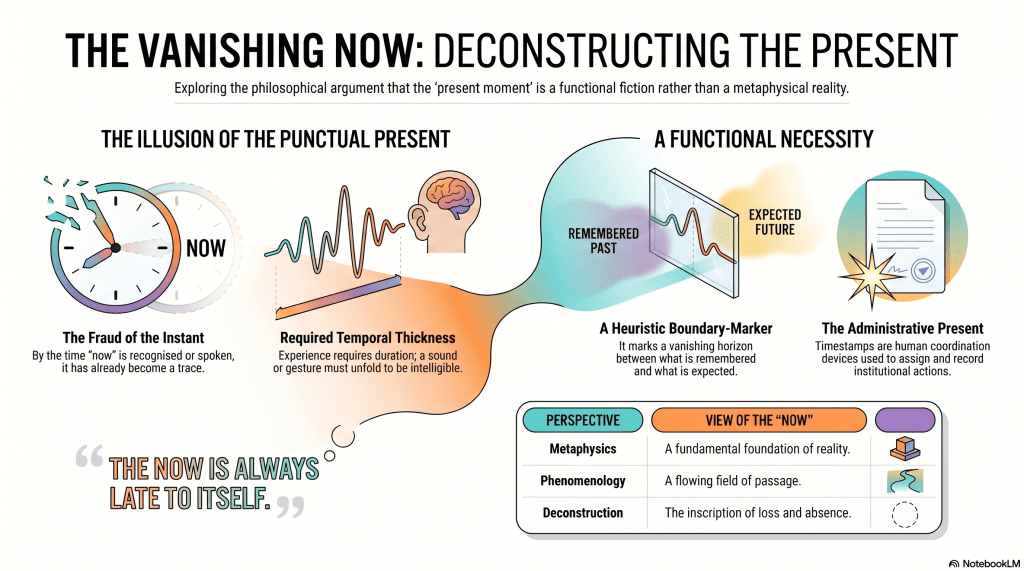
‘Now’ is one of the most overconfident little words in the language. It presents itself as immediate, self-evident, and available. We speak as though it names the present cleanly: now I speak, now I decide, now I know, now is the moment. Yet the word performs a small fraud every time it appears. By the time ‘now’ is recognised, it has already slipped into retention. By the time it is spoken, it has become a trace.
‘Now’ is not an experienced unit but a heuristic boundary-marker within temporal flow. It names a vanishing horizon between retention and protention: already past by the time it is recognised, already structured by what is expected before it can be stabilised. What it designates isn’t a thing, not a slice, not a metaphysical bead on the string of time, but a practical fiction by which consciousness, language, and action coordinate within a moving field.
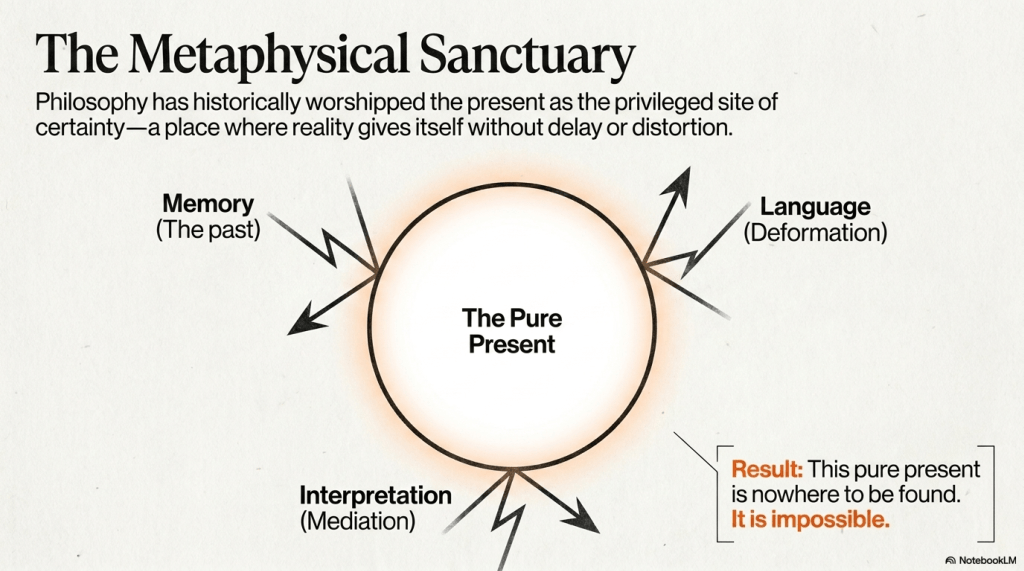
This distinction matters because philosophy has often treated the present as though it were the privileged site of certainty. Presence has been taken as the place where reality gives itself without delay, mediation, or distortion. The present moment becomes the imagined sanctuary of immediacy: before memory corrupts it, before language deforms it, before interpretation arrives with its grubby little toolkit. But this pure present is nowhere to be found. It’s not hidden; it’s impossible.
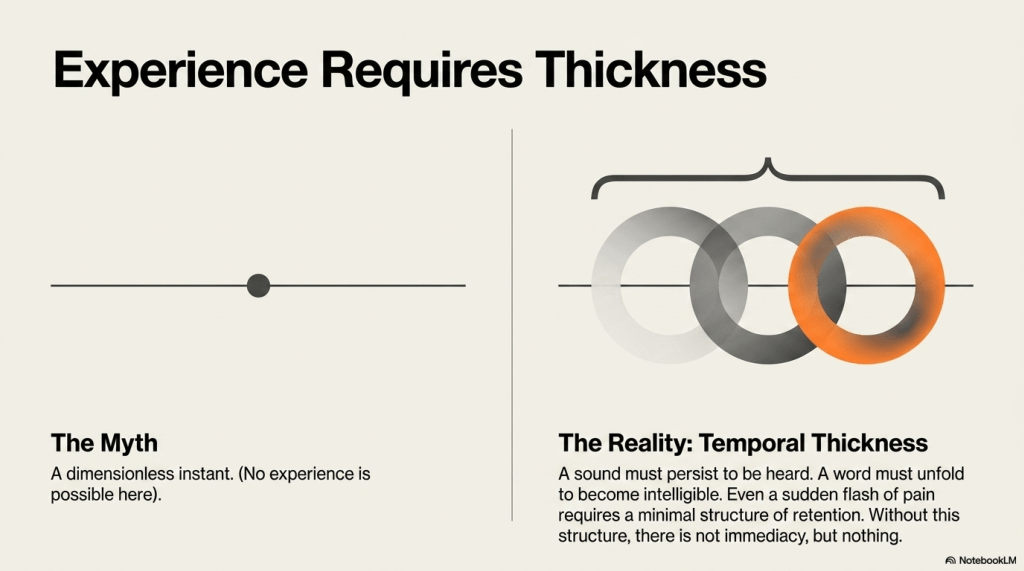
Experience is never given as a dimensionless instant. To experience anything at all requires temporal thickness. A sound must persist long enough to be heard as a sound. A word must unfold across time to become intelligible. A gesture is not apprehended as a gesture unless its beginning is retained and its likely completion anticipated. Even the flash, the shock, the sudden pain, the glimpse at the edge of vision, all require some minimal structure of retention. Without that structure, there isn’t immediacy but nothing recognisable as experience.
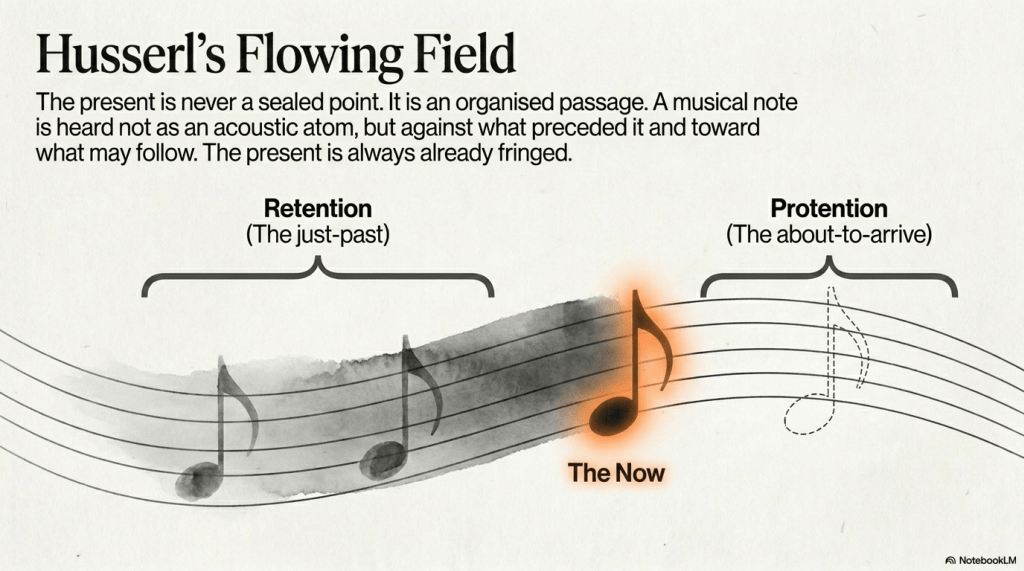
Husserl saw part of this with his account of retention and protention. The present isn’t a sealed point but a flowing field in which the just-past and the about-to-arrive are already implicated. A musical note isn’t heard as an isolated acoustic atom. It’s heard as part of a phrase, against what has preceded it and toward what may follow. The same is true of speech, perception, decision, and action. The present is always already fringed. It’s bordered by memory and expectation. It’s not pure presence but organised passage.
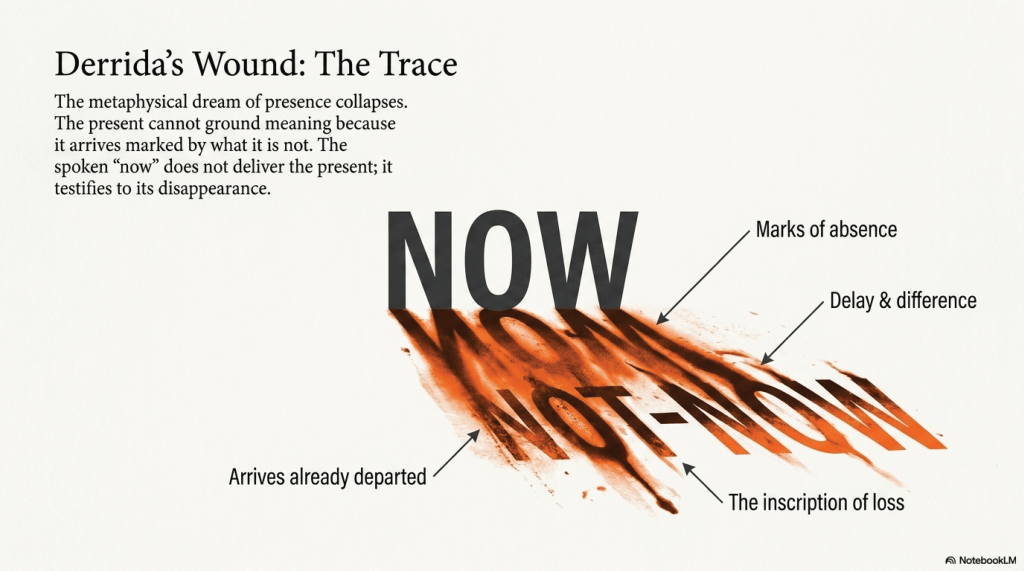
Derrida presses the wound further. If the now is always contaminated by what is not-now, then the metaphysical dream of presence collapses. The present cannot ground meaning because the present is never simply present. It arrives marked by absence, delay, difference, and trace. The spoken now does not deliver the present. It testifies to its disappearance. It isn’t the arrival of immediacy but the inscription of loss.
This isn’t merely a technical problem in phenomenology. It has consequences for how we think about agency, meaning, and reality. We routinely speak as though action occurs in a present moment of self-possession: I now choose, I now intend, I now decide. But this grammar flatters us. Decision is never contained in a punctual present. It condenses prior dispositions, pressures, perceptions, habits, bodily states, histories, and anticipated consequences. The now of decision is a narrative compression imposed after and within a process that exceeds it.
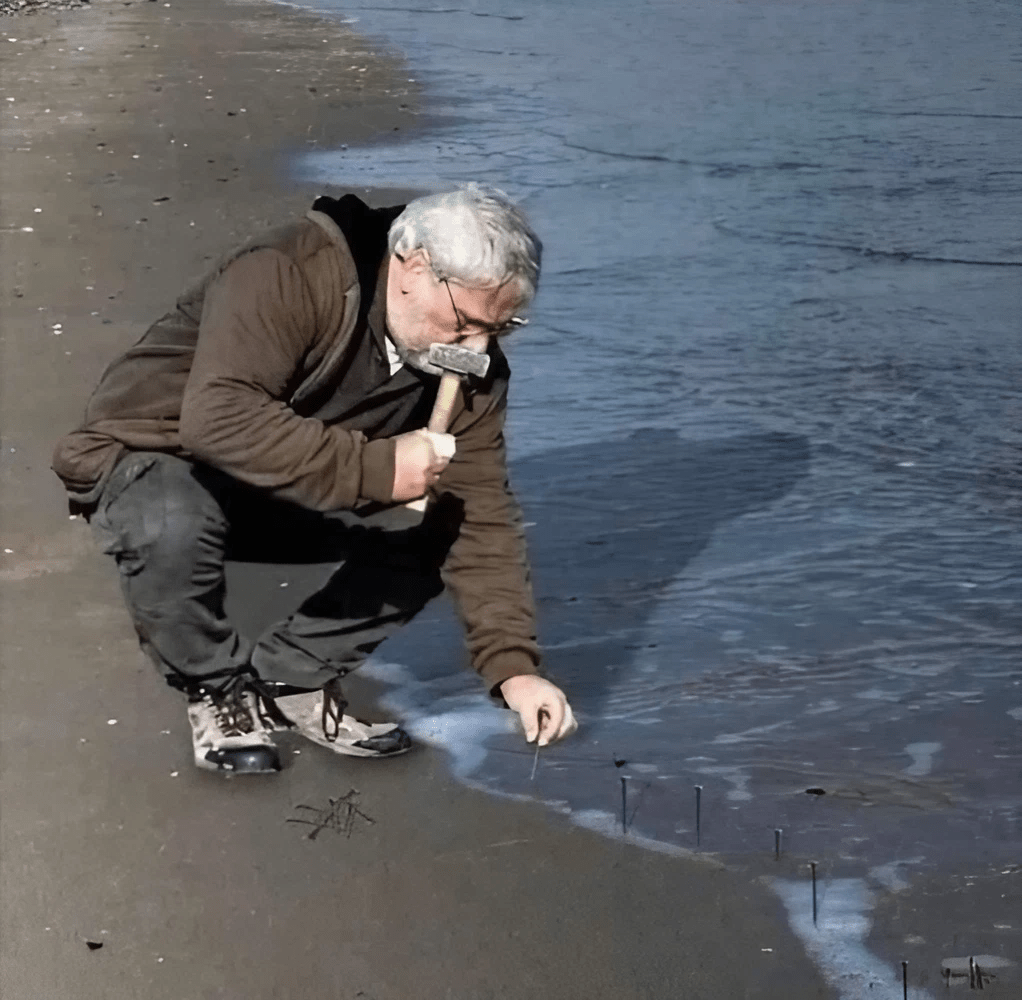
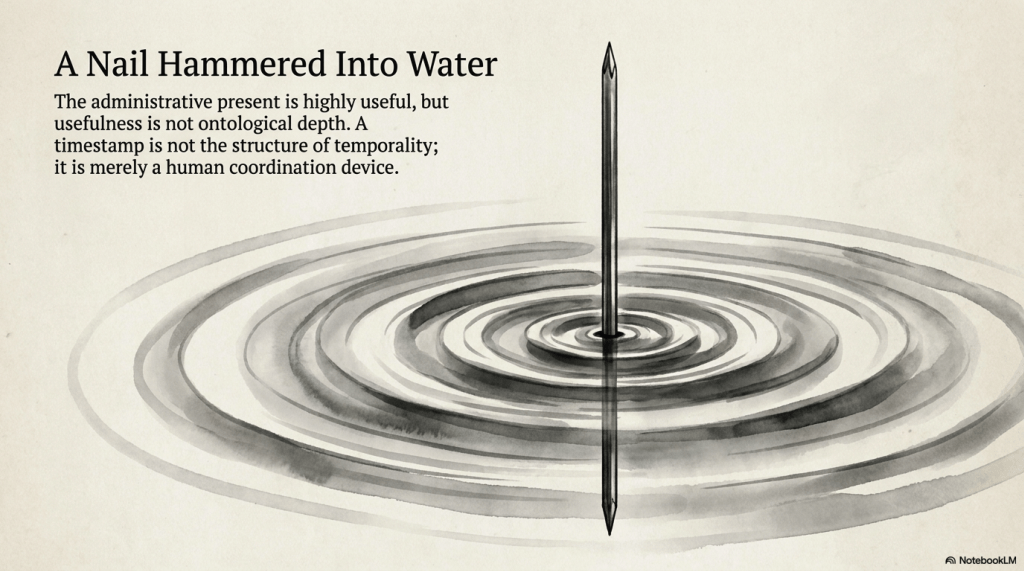
The same applies to moral and institutional language. Law loves timestamps. Bureaucracy loves decision-points. Politics loves moments. Each requires a tractable ‘now‘ because institutions must act, record, assign, and close. The administrative present is useful because it can be filed. But usefulness shouldn’t be mistaken for ontological depth. A timestamp isn’t the structure of temporality. It’s a human coordination device, a nail hammered into water.
The now survives because it’s pragmatically indispensable. We need it to coordinate action. ‘Do it now’ doesn’t mean ‘act in a dimensionless metaphysical instant’. It means ‘act within the authorised window of urgency established by this utterance’. The operational now is a tolerance band, not a point. It belongs to practice, not purity.
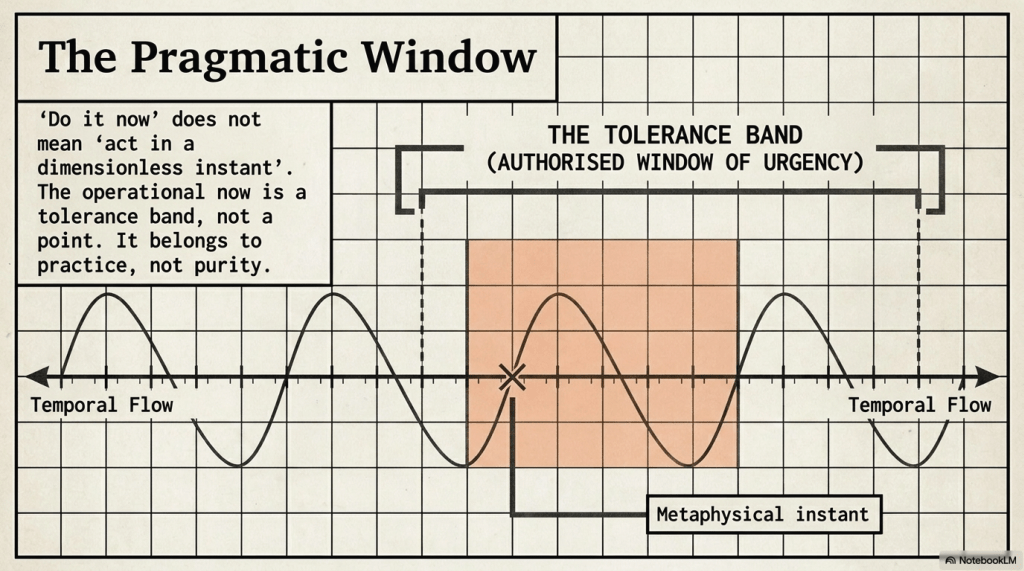
This is why the present should be deflated rather than worshipped. The now isn’t an entity. It’s not a metaphysical foundation. It’s a boundary-function within temporal flow, a stabilising fiction by which agents orient themselves amid movement. It marks a horizon that vanishes as it is named.
The metaphysician wants the now to be a foundation; the phenomenologist discovers it as flow; the deconstructionist hears in it the trace of what has already departed. The institution converts it into a timestamp and pretends the problem has been solved. Each inherits the same word, but not the same burden.
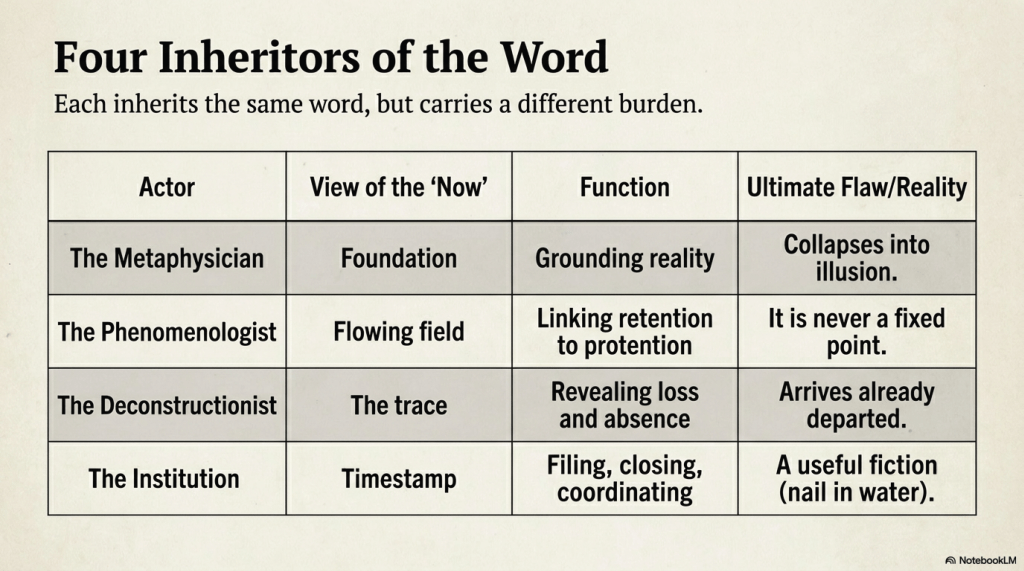
To invoke ‘now’ is therefore not to seize presence. It’s to gesture at the impossible purity of presence from inside its failure. The word works, but it works heuristically. It coordinates, compresses, and stabilises just enough. What it doesn’t do is deliver the present as such. The now is always late to itself.


Your mistress is the left cerebral hemisphere – can I lure you over to the right? (I suspect she’ll throw a hissy-fit if she even thinks you might stray.)
LikeLiked by 1 person
haha 🤣
LikeLike