I keep an eye on the metrics of my various social media outlets, but I don’t always click in. Today, I did, and I noticed a female-dominant listenership.
This is surprising for two reasons.
Most interactions I get are from males – at least people with traditionally male names.
Until now, the split has been reversed.
I am not going to make any assumptions based on these data, but I was, as I said, surprised.
Add to this the age chart, and it shows that the majority of these listeners were between 35 and 44, a majority of whom were female. This is the outlier spike. Other than this, listeners skew toward older males, especially between 45 and 59. This makes intuitive sense to me, given my age, content and interests.
This was an unplanned post. I just wanted to share my surprise. More on unicorns and perspectival realism to follow presently. Please stand by.
NB: Don’t blame me for the cover image. This is Midjourney’s idea of a male and female engaging in a tug-of-war. Are those outfits standard fare? I’m not so sure about the rope physics either. 🧐
I wrote about this content in 2019, but I wanted to revisit it for a video as well as create a podcast audio version.
Video: YouTube version of this page content
Podcast: Audio rendition of this page content
In today’s segment, I am going to share my perspectives on the truth about truth. To start, I’ll let the audience know that I do not believe in the notion of truth. I feel the term is ill-defined especially in the realm of metaphysics and morality. I feel that when most people employ the word ‘truth’, what they mean to say is ‘fact.’ That a fire engine is red, for example, may be a fact, if indeed the fire engine happens to be red, but it is not true. This is a misapplication of the term. If you employ truth as a direct synonym for fact, then this is not what’s being discussed here, and perhaps your time might be better spent watching some content by the Critical Drinker.
My argument is that truth is not objective. Rather it is subjective and perspectival. I concede that there may be some objective truth out there somewhere, but it is not and will not ever be accessible to us because of limitations in our sense-perception faculties and cognitive limitations. Per Aristotle, we only have five senses with which we can connect to the world, and these senses are limited. If there is anything out there that would require another sense receptor—a sense receptor not available to us—, we would never be able to sense it, to even know of its existence. Perhaps the universe emits 100 sense signals, but we are only capable of receiving and translating five. We’d be oblivious to 95 per cent of reality.
I am not making any claims that this is the case, but human cognition is so limited, that we can’t even conceive of what another sense might be. If you can, please leave a comment.
To be clear, I am not talking about senses we know other species possess. Bats may have echolocation, and sharks may have electroreception. Some animals may have greater sensory acuity—superior vision and auditory senses, olfactory and gustatory, tactile, or whatever. Some can see into infrared or ultraviolet light spectra. Technology that includes biomimicry provides humans with microscopes for the microworld and telescopes for the macroworld. We have x-rays and sonar and radar, radios and televisions that extend our senses, but these provide no new sensory receptors.
Like the story of the blind people and the elephant, we are left grasping at parts. But even if we are able to step back to view the whole elephant, to hear the elephant, to touch and smell or even taste the elephant, if there is more to the elephant, we cannot know it. The same goes for ourselves.
I know that some people might inject gods or psychic or paranormal energy into this void, and sure, feel free, but I am looking beyond these pedestrian concepts. What else might there be?
But let’s depart this train and head in a different direction. I want us to focus on the senses we do have. For the typical human, sight is our primary arbiter of reality, at least as defined idiomatically. We tend to believe what we see, and what we see, we assume as real—even if we are later mistaken. I guess that wasn’t a unicorn or a pink elephant. I must have been hallucinating or dreaming. I could have sworn that was Auntie Em.
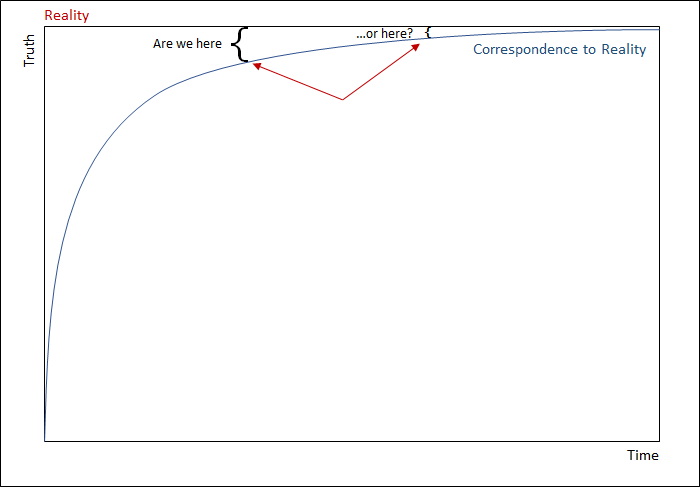
There are several competing theories around truth, but I’ll focus on the Correspondence theory, which is simply put, the notion that, proxying reality for truth, human perception corresponds with the real world. And a pragmatist might argue that’s close enough for the government.
Keep in mind that historically humans have contorted themselves into making calculations. Remember how long people had been tying themselves into knots to show planetary motion in a geocentric system creating epicycles and retrograde motion to map understanding to a perceived reality.
One might even argue that we’ve progressed. It wasn’t true or accurate then, but now it is. And perhaps it is. Let’s look at some illustrations.
NB: Due to an editorial mishap, this paragraph was dropped in the podcast, hence dropped from the video, which shared the podcast audio source. As such, this image was also not used in the video. This is unfortunate, as it was meant to introduce those with limited maths knowledge to the asymptotic curve, as described. Apologies, and I hope this serves to orient any travellers who may have lost their way at this point.
In this first illustration, we see Truth (or relative truthiness) on the Y-axis and Time on the X-Axis. On the top, we see a threshold representing Reality. In the plane, I’ve rendered an asymptotic curve, where over time, we get closer and closer to the Truth. But we never quite get there. More on this later.
The next illustration will help to demonstrate what’s happening.
Notice there is a gap between the curve and the Reality cap. For one thing, we don’t really know where we are relative to Reality. In the case of the geocentric system, we might have been at the leftmost space. Once we determined that the system is actually solar-centric, we might have moved right on the curve to close the gap. We might be tempted to defend that we’ve finally reached the truth, but we’d have been equally willing to make the same defence from the geocentric position, so we need to be mindful of the past.
Perhaps, this last example was too obvious. We feel comfortable staking a truth claim—or at least a claim of fact. So let’s look at another example.
Let’s re-use the same axes—Truth and Time—, but rather than an asymptotic curve, let’s presume something more polynomial in nature—or not particularly cyclic. Rather than retrograde motion in planets, let’s visit the supposed progress of Newtonian over Einsteinian physics.
This takes a bit more setup but bear with me. In this case, I have taken liberties and illustrated the Einsteinian physics gap to capture an inferior vantage on reality over Newtonian physics. Granted, I need to rely on a bit of suspension of disbelief, but in the bigger picture, I am trying to convey a scenario where some new paradigm puts the prior knowledge in perspective.
In this instance, both Newtonian and Einsteinian flavours of physics are based on a materialistic, particles-based model, which is where the modern physics consensus resides. But, let’s say that consensus changes in such a way that it is determined that something else underlies reality, say consciousness per Analytic Idealism as proposed by Bernardo Kastrup or per Integrated Information Theory (IIT) as advanced by Donald Hoffman and others. As with retrograde motion, we might end up finding that we were barking up the wrong tree. This might be a bit different because the particles are a directly perceived manifestation of the underlying consciousness, but I wanted to create a scenario where knowledge thought to have advanced actually regressed, but this wasn’t revealed until a new perspective was available.
Yet again, an important aspect of note is that we don’t actually know the distance between our perceptions and real Reality.
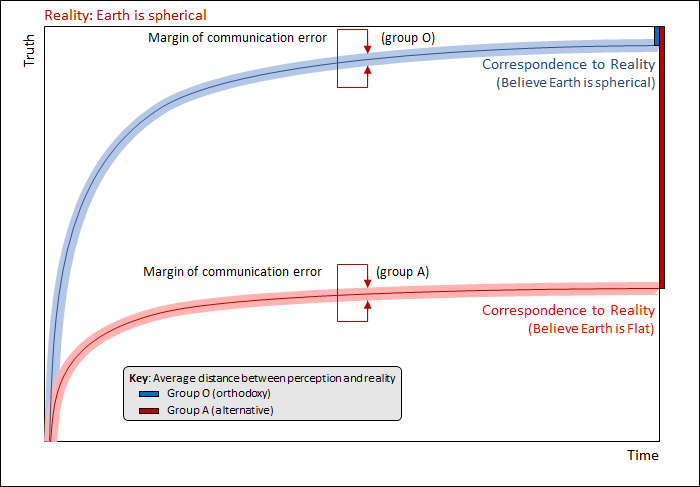
This last illustration builds upon the first asymptotic chart but has an in-built error margin meant to reflect language insufficiencies. There is some concept that people feel they grasp, but the consensus is not as unified as the group thinks.
I’ll share two examples, the first being the concept of justice. To me, Justice is what I deem a weasel word. It’s a word we commonly use, but it means different things to different people. To me, it’s a euphemism for vengeance by proxy, but for others, it transcends that and mirrors some impartial dispensation of just desert—some good old-fashioned law and order.
[Justice is] a euphemism for vengeance by proxy
Without getting stuck down some rabbit hole, my point is that if we aggregate these beliefs, the asymptotic curve represents an average consensus vantage rather than something as obvious as 2 plus 2 equals 4. On this note, allow me to clear the air.
Some viewers might be clamouring to say, “but 2 plus 2 equals four is true.” But this is tautologically true, which is to say that it’s true by definition. It’s a similar tautology to saying that it’s true that snow is white, or coal is black. We’ve already defined snow, white, coal, and black, so these may be facts, but they are true by definition.
Revisiting the chart, notice that there are two curves in the space. In this case, I illustrate competing truth claims from the perspective of an omniscient narrator. The case is whether the earth is an oblate spheroid or is flat. I am going to go out on a limb and assert the earth is spherical, as represented by the top blue curve—and we have some margin of error as to what that might mean. The bottom red curve depicts the perceived truth of the flat earthers, who also have some room for semantic error.
Given that I am presuming that I am in the right adopting the majority position—please be right—, the blue curve is closer to Reality than the red curve. Of course, in the event that the earth is really flat, then it proves my point that we don’t know where we are relative to truth, so we assume that the state of knowledge at any given time is what’s real.
Again, forgive my fanciful examples. Please don’t tell me that this spheroid versus planer earth is tautological too because you’d be correct, but I am already aware. They are just nonsensical illustrations. Nonetheless, I hope they’ve served to express a point.
I could have as well created curves that depicted two cohorts’ beliefs on the efficacy of tarot or astrology in predicting the future. I am sure that it might render somewhat like the last chart, but I’d also presume that both curves would have very low truth values as seen from an objective observer. Secretly, I hope tarot wins the truth battle.
Before I end our time together, I’d like to convey that for an Analytic Idealist, these charts might be more acceptable at face value. For a Realist, Naïve or otherwise, they may argue that this curve is not asymptotic and may in fact reach some tangency. I don’t happen to believe this is the case or I wouldn’t have spent my time assembling and presenting this. Time will tell. Or will it?
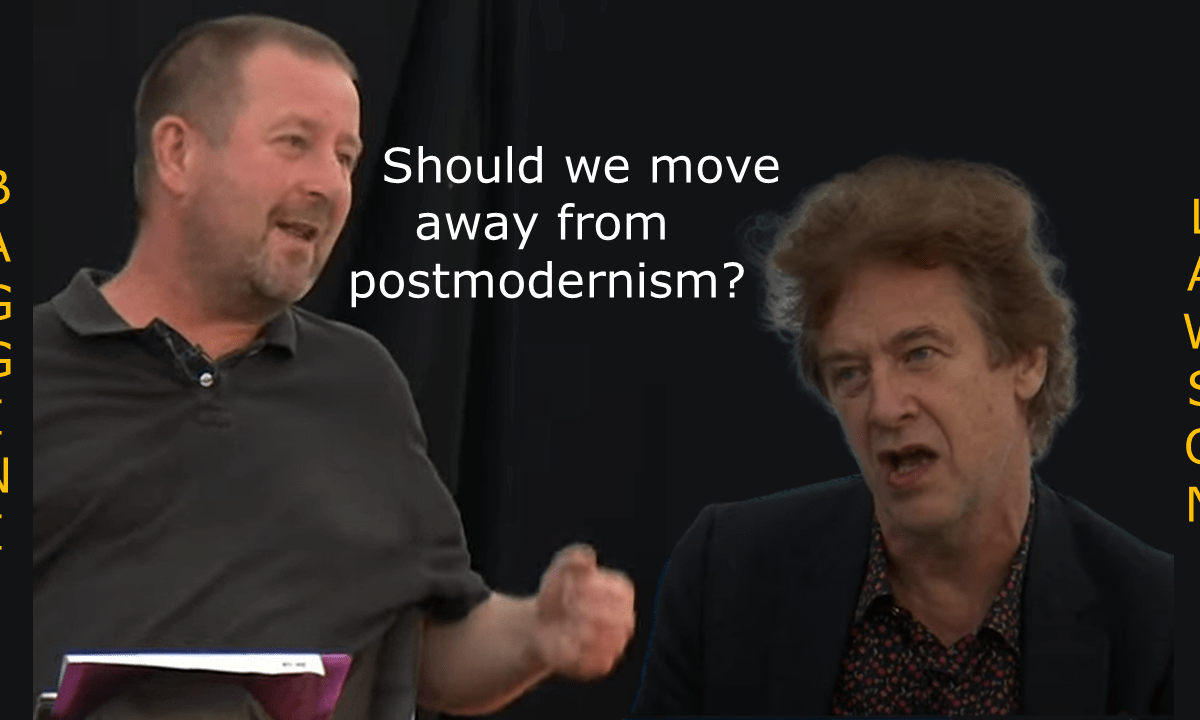
The theme of this Institute of Art and Ideas video is ‘Should we move away from postmodernism?‘
Podcast: Audio rendition of this page content
EDIT: Find my version of this content on YouTube:
Video: Postmodern Defence
At the start, I feel as usual, that the definition of postmodernism is nebulous, and the fora agree, methinks. Toward the end, Hilary Lawson concedes that key actors tied to the early postmodern movement denied being postmoderns, singling out Foucault and Derrida. More on this. Keep reading.
Julian Baggini, the bloke sat on the left and whose positions I am only getting familiar with, starts off the clip. He makes some points, some of which I agree with and others not so much.
He makes a play at claiming that there is some objective truth to be attained, following on with the statement that without this notion, it’s anything goes. I disagree with both of these assertions. Then he cites Thomas Nagel’s The View from Nowhere, wherein he posits that subjectivity and objectivity are extrema on a spectrum and that experience is somewhere in between. This conforms to my beliefs, but there are two provisos. First, the extremum of objective truth is unattainable, objectively speaking. Moreover, as I’ve written before, we have no way of adjudicating whether a given observation is truer than another. It seems that he leaves it that we don’t need to know the absolute truth to know “true enough”, but I think this is both a copout and wrong—but not too wrong for pragmatism to operate.
For example—not mentioned in the clip—, I can imagine that physicists feel that Einsteinian motion physics is truer than Newtonian physics, especially as we need to take measurements nearer to the speed of light. In my thinking, this might provide a better approximation of our notion of the world, but I can also conceive of an Ideal, non-materialistic perspective where both of these are rubbish from the perspective of truth. I feel that people tend to conflate truth with utility.
Julian makes an interesting point about semantics with the claim that “some people” define certain things in such a way as to not possibly be attainable and then claim victory. But what are his three examples? Free will, the self, and objectivity. If you’ve been following me, you’ll know that I might be in his crosshairs because I tend to be in the camp that sees these concepts as sketchy. And to be fair, his claim of defining something in a manner to keep a concept out of bounds is the other side of the same coin as defining something in such a way as to get it into bounds.
The self is different to free will insomuch as it’s a construction. As with any construction, it can exist, but it’s a fiction.
I’ve spoken at length about my position on free will, but I am fairly agnostic and don’t particularly care either way. I feel that the causa sui argument as it applies to human agency is more important in the end. The self is different to free will insomuch as it’s a construction. As with any construction, it can exist, but it’s a fiction. Without interacting with Julian or reading his published works on the self, if there are any, I don’t know how he defines it. And here we are discussing objectivity.
Given Nagel’s objective-subjective polarity, it seems they want to paint postmodernism as claiming that everything is subjective and that science (and religion) hold claims to objectivity. Hilary Lawson, the geezer on the right takes a position between extremes, but he denounces Julian’s claim about objective truth, noting that many people (especially of religious persuasions) make claims on Truth that are diametrically opposed, ostensibly labelling the same object simultaneously black and white. And the object for all intents and purposes is red.
I’ve gotten out of order, but Julie Bindel makes some good points on Feminism and suggests that the philosophical feminists—may I call them pheminists? No? OK then—such as Judith Butler have set women’s rights back by claiming that the category of ‘woman’ is invalid. Minni Salami defended Judith by noting that Butler has helped constructively in some ways and, citing Simone de Beauvoir, that woman is a category established by men to create The Other Sex. Still, Julie—not incorrectly—states that without a category, women (or whatever collective term one decides is representative) cannot be afforded legal protections—because law, as facile as it is, is all about categories and classes.
Hilary reenters the fray and states that it is not acceptable for one person to claim that their lived experience is all that is needed just because that is their truth. To be fair, this feels like a bit of a strawman argument. Perhaps I need to get out more, but I am not familiar with anyone credible making this claim.
I enjoyed watching this clip and processing the information. I hope you do as well. If you have any comments, I’d love to read them.
This is my take on the fifth chapter of The Matter with Things. I suggest reviewing the previous chapters before you delve into this one, but I won’t stop you from jumping queue.
Podcast: Audio rendition of this page content
Intro
Chapter five of The Matter with Things is titled Apprehension, following the previous chapters, Attention, Perception, and Judgment. From the start, let’s clarify that apprehension is not meant in the manner of being nervous or apprehensive. It’s meant to pair with comprehension. More on this presently.
Whilst the previous chapters have been heavily focused on the importance of the right hemisphere, this chapter is focused on the left, which may be given the chance to redeem itself. Not surprisingly perhaps, given the relative function of the right hemisphere versus the left, this chapter is much shorter than prior chapters.
Content
This chapter opens by asking what happens to a person who experiences left hemisphere damage. But let’s return to the chapter title. Apprehension is retaken etymologically and means to hold onto or to grasp. This is the function of the left hemisphere. The right hemisphere is about comprehension. The root ‘prehension’ is Latin for hold; the added ap prefix suggests holding on, whilst the com prefix suggests holding together.
Whilst conceptualising and abstract language is a right hemisphere function, spoken words are a left-brain function. It turns out that so is pointing and other gesticulation, reminding me of some ethnic stereotypes of people who speak with their hands. We need to keep in mind that the right hemisphere controls the left part of the body whilst the left hemisphere controls the right. What this means is that the right hand, being guided by the left hemisphere is marching to a different drummer.
Also, keep in mind from the previous chapters that the right hemisphere is holistic whilst the left is atomistic. Where right hemisphere damage is evident, a person has difficulty viewing the parts of a whole, whilst if the damage is on the left, a person has difficulty constructing a whole from its constituent parts. Namely, it may recognise that a body is constructed from an inventory of pieces—head and shoulders, knees, and toes—, but it can’t seem to grasp the cohesive orchestrated picture.
Apart from body continuity, when the left hemisphere is damaged, it might know all of the steps of a given process—McGilchrist shares the example of a person trying to light a smoking pipe—, but there may be difficulty in some of the instrumentation along the way. He cites an example by Czech neurologist, Arnold Pick, which I share here intact:
The patient is given a pipe and brings it correctly to his mouth, then expertly reaches for the tobacco pouch and takes a match from the box but when asked to light it, sticks the head of the match into the mouthpiece and puts the other end in his mouth as if to smoke it. Then he takes it out of his mouth, draws it out of the mouthpiece and sticks the other end of the match in the mouthpiece of the pipe, pulls it out again, holds it for a while in his hand apparently thinking, and then puts it away.
a person when encountering a pencil would feel compelled to grab it and start writing nothing in particular
To underscore the apprehension, where there is damage evident in the right hemisphere, the right hand (under control of the left hemisphere) may just grasp at things for no reason, perhaps reaching arbitrarily out to doorknobs. In one case, a person when encountering a pencil would feel compelled to grab it and start writing nothing in particular. In each case, the right hemisphere was not available to contextualise the experience. This right hemisphere is opening and exploratory whilst the left is closing and instrumental. It seems one might tend to meander without the left to provide a certain will and direction.
McGilchrist makes some correlations between humans and other great apes, but I’ll just mention this in passing.
I am going to pause to editorialise on McGilchrist’s next claim. He argues that Saussure’s claim that language signs are arbitrary is false and gives some examples—sun, bread, and spaghetti—but I am not ready to accept this stance. For now, I am remaining in the camp with Saussure and Wittgenstein that language is both arbitrary and self-referential. Getting down off my soapbox.
Recall again that whilst the right hemisphere takes the world as presented, the left hemisphere can only re-present. This is why language symbols are handled by the left hemisphere. Coming back to Saussure, the right-brain experiences a ‘cat’ whilst the left-brain names that object a ‘cat’ and classifies it as a mammal, feline, quadruped, and whatever else.
The right hemisphere is about metaphor, prosody, and pragmatics whilst the left hemisphere, though not exclusively, is about syntax and semantics.
The right hemisphere is about metaphor, prosody, and pragmatics whilst the left hemisphere, though not exclusively, is about syntax and semantics. The left hemisphere is about symbols. As such, lipreading and interpreting sign language are both left-brain activities.
An interesting conveyance is a case study of a person with left hemisphere damage reading a book who recites the elephant in place of the written word India, so making an association by not recognising the word itself. And there may be a naming problem, so if there was a problem related to an ankle, they would point to an ankle but substitute the name of the part.
Finally, to reiterate the holistic versus atomistic divide, some people with left hemisphere damage can articulate the parts of the body or a bicycle, but when queried can’t relate that the mouth is beneath the nose or some such.
Perspective
To summarise, McGilchrist leaves with a comment, “The fabric of reality typically goes for the most part unaltered when the left hemisphere is suppressed.”
As I’ve been editorialising a bit throughout, I don’t have much to add at this point. Aside from my Saussure nit, I am still very interested in the concept that the right hemisphere constructs reality. I feel that I interpret this construction differently to Iain.
I believe that we agree that there is a world out there, and we interpret this world by interacting with it. Where I feel we differ is that he feels there is a world of objects that we interact with and perceive whilst I believe that we construct this world of objects by means of constructing the underlying material, from particles to fields. I think he’ll discuss this more in later chapters and I could be off base. Time will tell.
Having put Apprehension to bed, next up is a chapter on Emotional Support and Intelligence. I hope you’ll join me.
What are your thoughts? What did you think of this chapter? Were there any surprises? Anything of particular interest?
In this segment, I continue the journey through Iain McGilchrist’s masterwork, The Matter with Things by summarising chapter three, Perception, a followup to the previous chapters, respectively titled Some Preliminaries and Attention. I strongly recommend that you listen to these in turn, but feel free to play the rebel and cut queue. No one will even notice but you, and if you don’t tell, neither shall I. Come join me.
Podcast: Audio rendition of this page content
Intro
Chapter two of The Matter with Things is titled Perception. Following the previous chapter, Attention, it’s about how we perceive what we attend to. Without attention, there is no perception, but perception is not always correspondent with the so-called reality “out there”.
Content
From the start, McGilchrist wants to assess which hemisphere is more veridical. Spoiler Alert: It’s the right half. But you already knew that because you’ve been keeping pace. And you also know that I feel he is leaving an option on the table, that neither is veridical to the actual terrain; rather, one just better maps the map. But the question essentially resolves to the same place, not as much verity as trust.
Sensory perception occurs in both hemispheres, but it is better in the right hemisphere than the left, as the left has been somewhat relegated to re-presentation over time—the same hemisphere that is better suited for codifying and mapping using symbolic language—something reserved for the brains of primates—which gives us a virtually inexhaustible way of mapping the world.
Perception is holistic, something better handled by the right hemisphere, being as the left hemisphere is more about focus and specificity. On balance, the right hemisphere is the arbiter of performance delegation, whether to perform a task or delegate it to the left hemisphere. About three-quarters of perception functions are right hemisphere processes.
McGilchrist is partial to the position advanced by Merleau-Ponty, that is “perception as a reciprocal encounter.” Perception is not a passive act. It is an interactive intercourse with the environment. What and how we perceive is affected by our experience and the situation.
Visual Perception
Perception involves all the available senses—and by definition none of those otherwise unavailable. He starts with vision. The right hemisphere does a lot of heavy lifting here. It handles size, shape and pattern recognition, contour, shadows, distance and depth, for example, three-dimensional space, and motion and time as well as the ability to recognise objects from unusual angles or from incomplete information, which I tend to think of as playing some Gestalt role. The right also handles colour perception, though the left maintains the colour name mapping.
The left hemisphere is slightly faster at detection, but if what is detected has any signal degradation, the right hemisphere tends to be more accurate. And since the left hemisphere is, what I’ll call lazy, it may tire quickly and space out, so the right hemisphere may have to intervene, if even a bit more slowly. Paradoxically, if the left hemisphere is given more time, its recognition error rate increases. Incidentally, one reason the right hemisphere may respond more slowly is that it is deliberating to attempt to deliver the correct response whilst the left tosses out its first best guess and declares victory. Nailed it!
Nailed It!
Recall from the last chapter that the left hemisphere is also a master of denial, so it is unapologetic when it guesses wrong. I imagine it signalling ‘that’s not a bus’ just as it hits you and then insists that it never was a bus; that injury must have been caused by something else. Perhaps it was an untoward wrecking ball.
Without delving into details here, McGilchrist points out that much early research might be invalid because it employed cathode ray tubes—CRTs—whose mechanisms present biased information to the visual field, thereby invalidating conclusions.
the left hemisphere is better at recognising tools—hammers and spanners—, but not musical instruments, which it perceives more as living entities
An interesting area for me is that the left hemisphere is better at recognising tools—hammers and spanners—, but not musical instruments, which it perceives more as living entities. And this is an apt segue to auditory perception.
Auditory Perception.
Whereas the left hemisphere is better at symbolic language processing and “the processing of meaningless noises, such as clicks”, the right hemisphere pretty much handles the rest, from pitch, inflexion, tone, phrasing, metre and complex rhythm, and melody. The left keeps tabs on basic rhythmic patterns. It is assumed that rhyming relies on both hemispheres working in concert.
For most people, music processing is a right hemisphere event, but this is not true for professional musicians, who utilise both hemispheres, likely owing to the musical language translation processing unnecessary for the casual listener.
Olfactory Perception
Interestingly, the acuity of the nose is orders of magnitude superior to that of the eyes and ears. Olfactory recognition and discrimination have a right hemisphere preference, but emotional reactions to scent may be stronger in the left hemisphere.
Gustatory Perception
“Apart from five very basic tastes – salt, sweet, sour, bitter and umami – which come from the tongue, all flavours come from the olfactory sense.” In general, gustatory perception is a right hemisphere function. However, there is an exception for professional wine tasters, who like professional musicians need to map experiences to words associated to rating and naming.
Tactile Perception
Remembering that the right hemisphere controls the left half of the body, whilst the left hemisphere controls the right, the sense of touch is superior in the left hand. Feelings of warmth, and temperature discriminations in general, are associated with right hemisphere activation. Interoception, the ability to perceive the internal workings of the body, is another right hemisphere process.
Local versus Global Perception
Recall that the right hemisphere captures the world holistically whilst the left hemisphere has a laser focus. This equates respectively to global and local perception. As it happens, the right can do both, but the left is limited to local. This means that if the left hemisphere is damaged, the right can pick up the slack, but if the right hemisphere is damaged, the left cannot compensate for the lost holistic perspective. In practice, the right runs the show and delegates to the left when it deems it to be appropriate for the circumstance. For some reason, normal adolescents have a bias toward local perception over global.
Pathologies of Perception
This leads us to abnormalities, such as Alzheimer’s disease. Deterioration of right hemisphere function leads to a sense of disorganisation and loss of sensation. This hemisphere is also responsible for constructing a sense of self and self-awareness. McGilchrist calls out that the term self has multiple meanings. Much of the notion of self is associated with the medial prefrontal cortex in both hemispheres, but the objectified self and the self as an expression of will (in the respect Schopenhauer spoke of) are left brain aspects.
Perception of a contiguous self over time is a right hemisphere function, the loss of which is not uncommon in cases of schizophrenia.
In discussing visual hallucinations and distortions, almost ninety per cent of these have been attributable to right hemisphere anomalies. McGilchrist shares examples over several pages, but I’ll summarise by description alone of what can be categorised under the umbrella term of metamorphopsia. These might lead to object impermanence, or viewing things as too large or too small, too close or too distant, skewed, or the wrong shape altogether. In some cases, only half of an object, including self-perception, was outsized. This might occur on a macro level or a micro level, which is to say that it may be entire objects or bodies or just faces, or just familiar faces or just eyes or just one eye. This might occur on a macro level or a micro level, which is to say that it may be entire objects or bodies or just faces, or just familiar faces or just eyes or just one eye.
Some of these cases involved motion, for example, the sense that some object is receding away from the observer as the observer draws nearer to it.
After a journey through Charles Dodgson, AKA Lewis Carroll, and Alice in Wonderland, provides a plethora of examples in prose of some of these visual effects.
From visual hallucinations, we wonder through hallucinations of the other senses, though the data points on these are much sparser, but the left hemisphere does seem to be the culprit of most auditory hallucinations.
Perspective
To summarise, I am again left to feel that the left hemisphere is a deadbeat hanger-on. It’s there in a pinch, but it’s an unreliable narrator and worker that falls asleep at the wheel. Psychology does have a position on what a normal person should see and hear and taste and touch, but normal doesn’t mean real.
I was hoping to see some information and perspective on synaesthesia, a condition where people perceive experiences through sense-perception organs different to normal. These people see music and hear smells or taste colours and so on. We consider this to be anomalous, but does it provide a fitness benefit, and are these people ahead of “normal” people or are they carrying excess baggage that creates a burden, even if the condition is otherwise benign.
Now that we’ve covered attention and perception, we’ll be covering judgment in the next chapter. I hope you’ll join me.
What are your thoughts? What did you think of this chapter? Have you experienced or know of anyone who has experienced any of these so-called anomalies. Are you familiar with any of the effects mentioned in Alice in Wonderland? Leave comments below.
Chapter two is titled Attention. It’s about how what we attend to tends to shape our sense of reality. This is a story of the functional speciality of the hemispheres and their mediating components. Each hemisphere has its own protocols and modus operandi, each with distinct task specialisation. Important to note coming in is that about thirty per cent of all neuronal activity is inhibitory in nature. In fact, the frontal lobe is what inhibits the reflexive animal-reptilian responses allowing for some—I mean, let’s be honest here—human civil capacity. These mediating elements are designed—idiomatically, not literally—to orchestrate hemispheric activities so that each side can do what it’s best suited for.
Content
Both hemispheres attend to their environments, but they have different foci. One way to distinguish which hemisphere is focused on what, McGilchrist regards research oriented toward people with damage to one or the other part, whether by a stroke or accident. In some cases, this separation is accomplished clinically. There is a difference between right- and left-handedness, but I am not going to elaborate here.
Persons with left hemisphere damage noted difficulty writing and spelling whilst right hemisphere damaged people experienced a loss of empathy as well as a range of cognitive and emotional impairments.
Selective Attention: Invisible Gorilla Test
In general, the right hemisphere attends to the broader environment with a trade-off on specificity whilst the left hemisphere is laser-focused at the expense of the wider perspective and ability to maintain attention. Evidently, and I quote, “the left hemisphere has a tendency to ‘space out’ for seconds (sometimes 15 or more) at a time”. McGilchrist cites the invisible gorilla study where viewers are asked to watch a video clip of two teams of basketball players dribbling and passing a ball to count the number of times one team passes the ball. As this is happening, a person dressed in a gorilla costume walks into frame and makes gestures to bring attention to itself and then walks out of frame.
Focusing on the ball passing is a left-brain function that predominates right-brain activity. As it is laser-focused on the task at hand, it is oblivious to the gorilla in the midst. When re-viewing the clip without the focus activity, the gorilla is quite obviously present. He cites another substitution study that again illustrates what happens when the right brain does not have an audience.
Again, whilst “the right hemisphere is sensitive to the whole picture in space and time, background and periphery, the left hemisphere is focussed on what is central in the field of vision and lies in the foreground.” This becomes evident with hemispheric damage. When the left hemisphere is damaged, people can still perceive the full view-frame because the right hemisphere remains intact, but when the right hemisphere is damaged, less than half of the world remains. In the book, some examples follow.
The left hemisphere suffers from a stickiness problem. Without a participating right hemisphere, a person can have their attention fixated on some objects in the environment. And he points out that this is not a problem with visual perception, because tests demonstrate that subjects can be made to fixate on imaginary objects in a dark room. In schizophrenics, this fixation always occurred on the right side of the field of vision. This fixation ties into staring, which he describes as “a special kind of vision, in itself predatory: left hemisphere attention gets locked onto its target.” I’ll guess that many of us have been fixated on some activity and an unexpected interloper startles us when they become apparent. He mentions the discredited Sapir-Whorf hypothesis in passing. I won’t bother.
McGilchrist foreshadows chapter four a bit by informing the reader that the left hemisphere is grasping and apprehending whilst the right hemisphere excels at comprehending. More on this in future segments.
Another feature of the left hemisphere is that it not only ignores the majority of the environment it finds itself in, but it is also a master of denial.
Another feature of the left hemisphere is that it not only ignores the majority of the environment it finds itself in, but it is also a master of denial. For example, a person with right-hemispheric damage was paralysed on the left side of his body, yet he was not only unaware of the paralysis. He denied that he was paralysed.
In a second case, another person with right-hemisphere damage and left-side paralysis, when asked to perform tasks would comply with the requests directed toward the right side of the body but ignore or claim not to understand the directions when directed toward the left side.
What this represents is that the left hemisphere had established a map of the body that was unable to be updated because of the damage to the right hemisphere that would have provided an update. One might consider this in the manner of an old SAT-NAV when map updates needed to be manually applied. If you happen to be travelling in a new development on an obsolete map, the map will not correspond to the terrain.
As mentioned previously, the right hemisphere can be thought to present whilst the left hemisphere can be thought to re-present, having codified and archived the contents for later retrieval. The book has more types of examples including people experiencing reality through a set of freeze-frames and time elapses, but the takeaway is that the hemispheres also differ in how they interpret space, time, and motion. In fact, the right hemisphere is instrumental in perceiving three-dimensional space.
I won’t exhaust the many remaining examples in the book, though I may reference some in summary when I share my reaction and perspective. The final topic I’ll mention is that human infants are right-hemisphere dominant. They are practically all about gathering inputs without being concerned with how they map the terrain for later retrieval. They simply experience the world without the analysis and judgment the left brain later brings to bear.
Perspective
At the end of the chapter, McGilchrist provides a summary. The right hemisphere is always vigilant to what might be out there. For the left hemisphere, if it hasn’t been brought to attention, it doesn’t exist. Consider the invisible gorilla. The left hemisphere’s attention is sharply restricted in space and time. It favours precision over accuracy and at the expense of depth. It is not concerned with the “expansive, always moving, always changing, endlessly interconnected nature of reality.” The left is all about atomisation and stasis.
Unfortunately, despite all these limitations, the left still thinks it’s right. Revisiting the SAT-NAV scenario, the left brain is akin to a person staring at the screen that declares the destination has been reached. The right brain looks out the window and informs that they are decidedly not in the right place. Does one trust the instrumentation or the environment?
One undercurrent I feel is that McGilchrist wants to play the left and right hemispheres against each other to assess which is more veridical. This is where I think we differ, but the jury is still out. In his case, he wants to compare the way that each hemisphere maps to our experience of the real world. In his view, and I don’t think I am putting words into his mouth, our experience is the world because we experience it as it appears to us. In my view, experiences are simply a representative map as limited by our sense-perceptions and cognitive abilities. So, when he assesses the right hemisphere as a better reflection of reality, I say it just better captures the map.
For him, it’s either left or right. But for me, it’s right, left, or none of the above. I believe our disagreement is that I subscribe to a fitness before truth paradigm whilst McGilchrist doesn’t. I feel that fitness is the evolutionary litmus, and evolution doesn’t care about truth. In fact, assessing truth comes at the expense of energy and attention, the subject of this topic. The reason the case studies cited in this chapter are interesting is not that they illustrate some truth deficit that would render them easy prey in a Darwinian world, it’s because their perception leaves them with a fitness penalty. There is no reason to invoke some spectre of truth.
This was an interesting chapter with over a dozen clinical anecdotes. It does well to articulate the differences in hemisphere function and lends credence to left and right brain asymmetry. I feel it’s worth cracking on to the next chapter, Perception.
Before I bring this commentary to a close, I want to make an orthogonal comment. McGilchrist mentioned case studies where people reported freeze-framing. It is understood that certain birds have a faster frame rate than humans, so if they were viewing a movie running at 60 frames per second, they would not see the same continuous motion picture as a typical person; rather, they would perceive it as how we might perceive a slide show or a slow flip book. Of course, this is unrelated to the brain conversation, but the topic reminded me of the difference. For anyone who feels they need to educate me about the fact that the ocular systems don’t operate in frames per second, allow me instead to direct you to the domain of metaphor and analogy.
What are your thoughts on the split function of brain hemispheres? If you’ve read the book or at least this chapter, what was your favourite story? Did I omit your favourite? Leave comments below or on the blog.
I’ve decided after all to share my thoughts as I journey through Iain McGilchrist’s The Matter with Things. Come join me.
Podcast: Audio rendition of this page content (6:41)
Intro and Biographical
I’ve decided, perhaps against my better judgement, to have a run at Iain McGilchrist’s The Matter with Things. At almost 3,000 pages this seems a bit daunting at the start. I debate whether I wish to pursue this course because it slows my pace significantly—perhaps allowing me to progress at a rate 15 to 20 per cent of what I might have otherwise been able to maintain. However, creating content affords me at least two offsetting benefits. Firstly, I get to share my experience with a wider audience and do so in the moment. Secondly, it allows me to better absorb and comprehend the material. As a former professor of economics myself, I internalised the aphorism “to teach is to learn twice.” Of course, this is not teaching so much as regurgitating and providing my own reactions and perspectives in places. It may be akin to learning some one-point-some-odd times. Let’s round up to two.
Biographically, McGilchrist was a lecturer of Literature at Oxford before refocusing on Medicine and then Psychiatry with an interest in Neuroscience. Interestingly, he was particularly interested in hemisphere differences in the brain and was advised strongly not to pursue this academically, as it was a certain career-killer. Besides the domain was already over-studied and summarily disproven. Iain persisted.
As it happens, the older notions of hemispheric differences were facile nonsense, but there was evidence of brain asymmetry—which will become readily apparent in the opening chapters—, and this has been his passion project ever since.
Structure
The Matter with Things is a two-volume set presented in three parts, the first two contained in the first volume. Neuropsychology—both neurological and neuropsychological—is the theme of the first part, which is comprised of nine chapters. The second part consists of 10 chapters with a focus on epistemology. The second volume, being the third part, is about metaphysics.
Content
The first chapter is aptly named, Some Preliminaries and How We Got Here. Per the author, this is the most technical chapter with the added encouragement: “If you survive this, you’re good to go.”
This chapter provides some basic history of the evolution of the brain. He establishes that the “raison d’être [of the right hemisphere] is to enable us to be on the lookout for potential predators, to form bonds with mates, and to understand, and interpret the living world around us” whilst the left hemisphere’s purpose “is to enable us to be effective predators.”
This is a gross oversimplification, but details will follow. Essentially, the right hemisphere experiences the external world rather holistically as presented whilst the left hemisphere interprets, codifies, and maps this world for later access. He doesn’t mention it in this chapter, but since I’ve read a bit ahead already—so we’ll return to it presently—the left hemisphere does not, loosely speaking, interact with the external world. It creates map based on what the right hemisphere conveys of the terrain, as I like to call it, and refers only to the map from then on. This sets us up for some peculiar behaviours, but we’ll get to that in upcoming chapters.
Perspective
I don’t have much to say about this first chapter as it is pretty much scientific facts, and I don’t have any unique perspective to offer. As I expect to reserve the tail of these segments for perspective, I’ll use this allotted space for some general thoughts going in.
I am not sure where McGilchrist falls on the Realism versus Idealism front. As I understand from other sources, he believes there is an out there out there, and without our brains, perception couldn’t happen. I also understand that he’s a Panpsychist, which is to say that he believes that everything has consciousness, so it will be interesting how that all comes together. Unfortunately, I feel this is second-volume fare.
As I am an Analytic Idealist, I believe that there is an out there out there as well. But I don’t believe we have any access to its veridical nature. What we experience is a Bayesian approximation, the best guess necessary for us to survive and evolve. I mention this as I believe it is a difference of opinion I have up front, so I am offering full disclosure of a potential bias. Also, I get the feeling that he conflates this paradigm with those espousing views that we live in a Matrix-style simulation, or everything is a hologram or holograph, and one day I’ll understand the difference between the two.
If you know the difference between a hologram and a holograph, let me know in the comments or on the blog.
Have you read this book already? Are you interested in reading it? If so, stick around and perhaps you’ll gather enough information here to catch your attention.
Several of my esteemed colleagues prompted me to become familiar with Iain McGilchrist. I had viewed hours upon hours of his lectures before I decided to commit to his latest book and likely magnum opus, though I don’t want to sell him short. The Matter with Things is an approximately 3,000-page, two-volume tome. To be fair, it’s about 1,600 pages of narrative content with the remainder being appendices, a bibliography, an index, and other such back matter.
Podcast: Audio rendition of the content on this page.
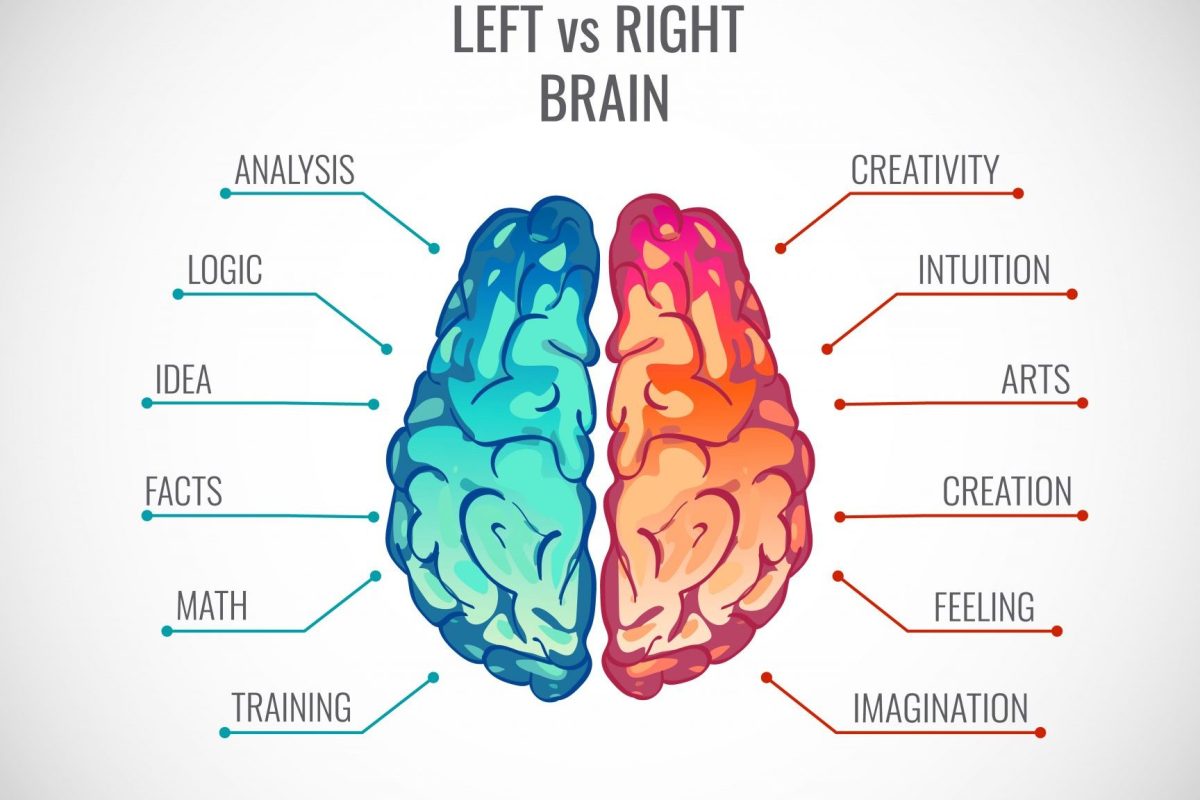
I’ve mentioned much of this before, but I am writing this post with a particular LinkedIn audience in mind, whom I don’t expect to be familiar with my prior commentary, though they are invited to explore more. McGilchrist’s thesis is that the human brain operates with asymmetrical hemispherical differences. These differences are not the facile “left-brain analytical, right-brain creative” distinction of yore, rather the differences are more nuanced. If you are interested in the minutiae of this, stick around and read past and future posts when they arrive, as I’ll be documenting my journey through these volumes presently.
So, what’s the matter with project managers? And why bring up project managers? In my workaday life, I’ve often been asked to perform project management functions, something decidedly not my forte. I could be reading into and am guilty of reductionism, but in reading The Matter with Things, I may have stumbled onto something with explanatory power. So let’s pause for a quick reflection.
Pistachio in hand
In a very small nutshell. I’m talking, perhaps, pistachio-sized here. The right brain hemisphere is the part that experiences the world as it is. The right brain is not about making judgments and categorising. Rather, it’s about just absorbing without interpreting, per se. On the other hand, the left brain hemisphere interprets, codifies, and maps this world for later access. Again, forgive the over-simplification, but this is the information pertinent to the matter at hand—a very left-hemisphere control function, I might add.
It turns out that the left brain is not so much concerned with the outside world at large. Once it has its map, it is rather content to reference it from there on in unless the right brain nudges it to pass along more information. Whereas the right hemisphere opens possibilities, the left hemisphere shuts them down. If you’ve read Daniel Kahneman’s work, Thinking Fast and Slow, you may notice certain parallels. I’d be interested to know if McGilchrist comments on this. Perhaps a later topic.
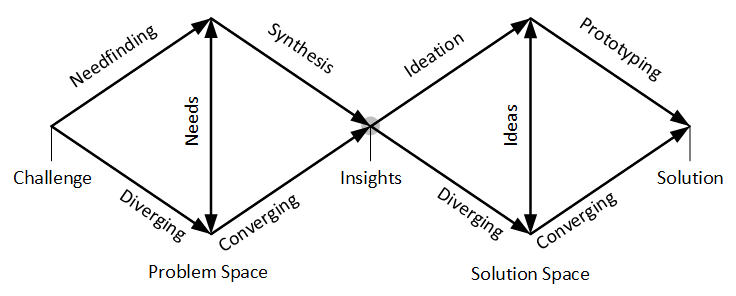
Borrowing from some aspects of Design Thinking, there is a double diamond design process model. I purloined one from the internet that will work for my purposes.
Double Diamond Design Process Model
I feel that I can simplify and assume that the diverging activity represents a right hemisphere strength whilst the converging is more apt to be a left hemisphere activity.
The right brain is not only always open to seeing options and opportunities, it actively seeks them. The left brain just wants to close any discussion and settle on a decision or an answer.
From an evolutionary perspective, the “raison d’être [of the right hemisphere] is to enable us to be on the lookout for potential predators, to form bonds with mates, and to understand, and interpret the living world around us” whilst the left hemisphere’s purpose “is to enable us to be effective predators.”
A right-hemisphere dominant person will likely continue to play what-if until the cows come home. A left-brain dominant person will take the first semi-viable solution and want to run on it. No need for deliberation. In a balanced scenario, the left and right hemispheres will battle for dominance, but they will arrive at a good-enough solution.
And this is where project managers enter the picture, and where I exit. I am decidedly over-indexed on the right brain. Among other things, I see options and possibilities. And, sure, I have enough balance to resolve to take action, but I don’t lose track of the possibilities and I am always ready to change course at a moment’s notice—what we call pivot in the business—or perish as the case might be.
The project manager, on the other hand, sees the map. This represents practically inviolable marching orders.
Disney Sorceror’s Apprentice Brooms-Flood Scene
One aspect of a good project manager is the ability to filter out the noise. Rather, this is what a right-brain person would surmise. Instead, the left-brain person doesn’t even register the noise. Where a right-brain person has to expend energy continually filtering out options and possibilities, the left-brain person never registers these options from the start. So, where I as a right-brain person may find it exhausting to actively and continuously limit this noise, this threshold is never triggered for the left-brainer.
In closing, I want to remind you again and again and again, that this is a gross oversimplification and rather metaphorical in nature. Nonetheless, I feel the that it is germane and offers insights into why some people are more apt at certain tasks than others.
I want to emphasise that one side is not better than the other. A right-dominant person is not superior to e left-dominant person, and vice versa. As with the brain itself, these can be complementary. Some people are very capable of tasking whichever hemisphere is necessary, but this is rarer than one might at first assume. McGilchrist provides many examples, so you can read them for yourself firsthand, or you can follow along as I call out key highlights in The Matter with Things.
If you have any comments or suggestions, feel free to leave them in the space provided.
I’ve only read the first four chapters of Iain McGilchrist’s The Matter with Things. My intent is to build up to how his ideas intersect with my workaday life in a future segment, but for now, I’ll summarise some main themes.
Podcast: Audio rendition of this page content (< 5 minutes)
The chapters I’ve read are
Some preliminaries: How we got here
Attention
Perception
Judgment
The next chapter is Apprehension.
Philosophically, or rather I have an interest in McGilchrist’s ontological model, but that appears not to arrive until the second volume, perhaps in chapters 24 or 25, respectively Space and Matter and Matter and Consciousness. Being that this underlaid my reluctance to engage with this book, I did take liberties and skimmed these chapters quickly in an attempt to discern whether he is a Realist or an Idealist.
Until recently, I’ve been a Realist with reservations, but now I consider myself instead to be an Idealist with reservations—though I may have fewer reservations, so perhaps I am moving in the right direction.
As a Realist with reservations, I felt that there was some underlying reality, but sense-perception and cognitive limitations limited access to it, so correspondence to it was necessarily limited.
As an Idealist with reservations, I feel that there is some underlying reality, and sense-perception and cognitive limitations limit access to it, so correspondence to it is still necessarily limited, so we generate an approximation.
I agree with Donald Hoffman’s assertion of Fitness Before Truth, in summary, that it is faster and more efficient to assess environmental fitness and take penalties where the assessment may have been a false positive. If one recoils in error from a coiled garden hose initially perceiving it to be a snake, the penalty is low. If a delay is incurred to assess some ‘snakeness’ truth value, we may have already been bitten. If we see something charging at us, better to avert and assess than to take time to discern. It’s of little consolation to consider, “Ah. I’m being mauled by a cheetah.” Better to have ducked and covered.
My chapter skimming was not enough to ascertain McGilchrist’s position. I’ll wait until I arrive there in due time. No need to spoil the ending. Given the book’s title, I am leaning toward Idealist, but I may be mistaken.
Moving on, these chapters build on each other. Not so much with narrative content as to represent the necessary chain of perceptual events: attention, perception, and judgment—in this order.
We cannot judge what we can’t perceive, and we can’t perceive what doesn’t come into the sense-perception space. McGilchrist reminds the reader that just because something is in a space where it can be perceived does not mean it can or will be perceived. He cites the example of the invisible gorilla in a basketball game study, which I’ll link to separately.
What we attend to is a matter of the situation and experience. Once we bring our attention to it, we can attempt to perceive it. Is it a snake or just a garden hose? Finally, we can make a judgment—it was just a garden hose. Silly old bear. Or, I sure am thankful my reflexes are lightning quick.
Winnie the Pooh: Silly Old Bear
McGilchrist provides a plethora of examples, though most are tied to split-brain scenarios, which brings me to my last point. One of his theses is that left-right brain hemisphere differences are real and significant. Some had argued that the left-right representation is false, and he wants to take it back and regain that space by asserting arguments to the contrary.
I expect to discuss this more in an upcoming segment and apply my preliminary thoughts to my comprehension.










 Philosophics