NB: The following post will be entirely human-generated, with no LLM involvement – except for the cover image rendered by Gemini. It will also be brief.
I am (still, perpetually) learning French, and I use Anki to help me. I recommend it for standard and non-standard flashcard uses. Recently, I asked ChatGPT to generate a CSV with phrases for the front and back of the cards, for example:
Front: I will be able to visit France next year.
Back: Je pourrai visiter la France l’année prochaine. (futur simple)
I found the pack useful, but a few days later (today), I asked for more than first-person perspectives, as well as additional tenses. I entered this prompt, which is what triggered this blog entry:
‘You’ rendered this for me. Might you generate a similar file that I can use to import to Anki that includes versions other than first-person singular? Future tenses would be helpful as well.
Notice the ‘you‘ in scare quotes – inverted commas.
It’s no secret that I am partial to the episodic selves of Galen Strawson in contrast with diachronic selves, which is to say that I don;t believe that the you or the I or yesterday – or even a second ago – is intrinsically the same person. I’ve explained this elsewhere, so I’ll leave it here.
As much as I feel this way, I don’t feel put off referring to myself as myself or I – me, myself, and I – or to you as you, but I am more consciously uncomfortable with addressing an LLM as you, as demonstrated.
I know full well that each prompt and response is to a different instance of the LLM – a different episode. Unless the LLM accesses an earlier conversation in memory – and I use this term loosely here, too – it would not retain context, and the absence of you-ness would be painfully obvious.
I don;t believe that the self of people is functionally any different. Obviously, humans are carbon-based rather than silicon-based, and storage and retrieval operate differently beyond the substrates, but the mechanism is metaphorically similar.
Does anyone else feel dis-ease in addressing an LLM in the second person? Or is it just me – or me?
This is the fourth of a deeper look into ten philosophical positions. This one is on convergence realism within the category of epistemology. A full article is available on Substack, with supporting information on a recent post here on Philosophics Blog.
Below is a ~5-minute short podcast.
I don’t regard the self as a persistent entity travelling through time while accumulating experiences like stamps in a metaphysical passport.
The first-person “I” is an indexical compression. It marks the presently organised locus of perspective, salience, memory-access, and action. It is indispensable, but indispensability does not establish an inner owner to which the index refers.
The diachronic self is a broader compression: a narrative, biological, documentary, interpersonal, and institutional device for tracking selected continuities across time. Memory contributes to this, but memory is lossy, reconstructive, and uneven. The person remembered is not transported intact into the act of remembering.
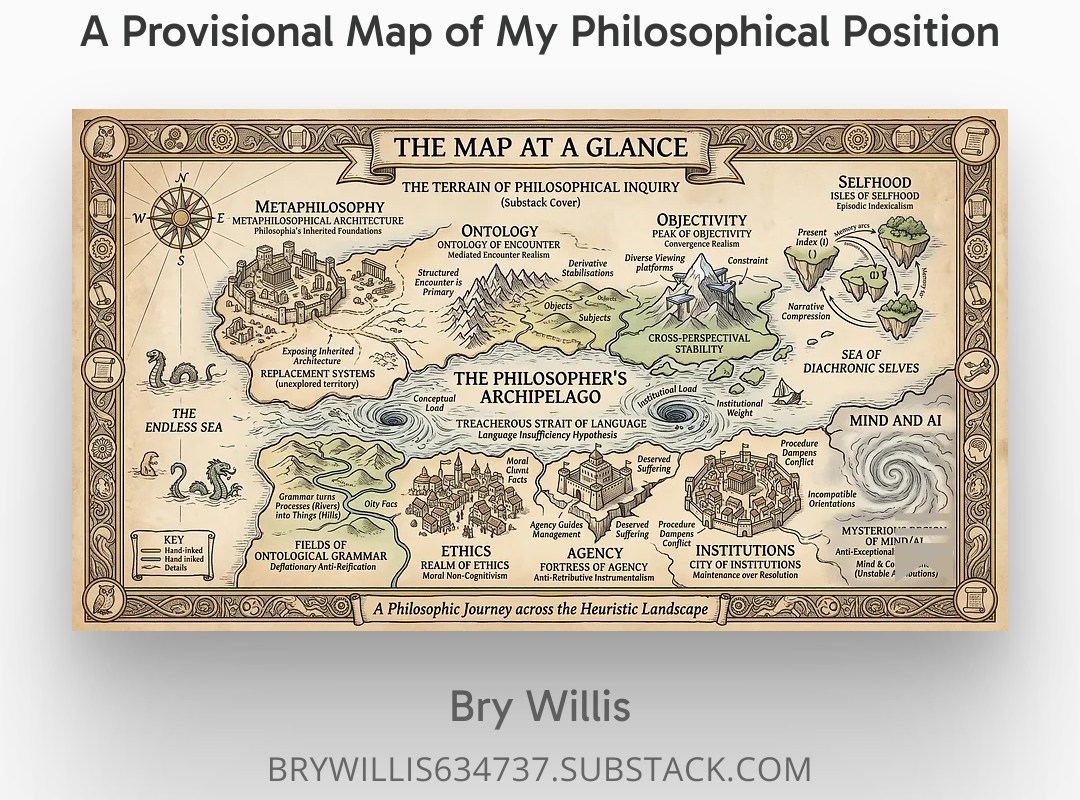
The question is reasonable, although belief may already be doing more work than I would permit it under cross-examination. My writing is generally diagnostic rather than doctrinal. I am more interested in identifying the architectural assumptions beneath a dispute than in selecting a furnished room within it. Where philosophy offers a contest between established positions, I often suspect that the arena itself has been badly designed.
Still, repeated diagnoses eventually disclose a pattern. Certain commitments recur: suspicion of substance, resistance to metaphysical inflation, distrust of linguistic confidence, rejection of moral realism, scepticism toward persistent personal identity, and an insistence that mediation does not entail fabrication.
What follows is therefore neither a creed nor a completed system. It is a provisional map of where I presently stand.
The labels are intended as coordinates, not allegiances. Where no established term quite fits, I have used my own. This is partly unavoidable and partly evidence for the very linguistic difficulty I spend so much time diagnosing.
This content, including video and podcast summary, are of a longer Substack article on my philosophical positions with descriptions.
This is less a confession than an earmark. I came across a conversation with Michael Puett on Chinese philosophy, selfhood, ritual, and the modern Western compulsion to find oneself, and the whole thing caught on an old hook.
Audio: NotebookLM summary podcast of this topic.
Synthèse audio de ce sujet en français dans le podcast NotebookLM.
I am already familiar with some high-level accounts of Asian philosophies, especially Buddhism and the doctrine of anattā (Pali) or anātman (Sanskrit): non-self. That idea has never seemed especially alien to me. If anything, it names with admirable economy a suspicion I already held: that the stable, discoverable, authentic Self is less a hidden metaphysical jewel than a bundle of habits wearing a name badge.
Puett’s point, as I take it, is not merely that the Western self is overblown. That would be too easy, and therefore popular. The sharper claim is that the search for one’s True Self may become dangerous precisely because it mistakes the current arrangement of ruts, reflexes, wounds, preferences, and defensive routines for an essence. ‘This is just who I am’, says the person, embracing not a soul but a sediment. The bad habit acquires a halo. Therapy-speak finds a throne. Another little sovereign subject is crowned in the bathroom mirror.
Against this, Puett presents Chinese philosophy as a tradition of cultivation: not self-discovery, but self-transformation. The point is not to excavate an authentic interior but to train perception, conduct, relation, and response. Ritual, in this frame, is not dead ceremony or social programming. It is a technology of de-naturalisation. It interrupts the little automatisms by which we become legible to ourselves and intolerable to everyone else.
This matters to me because I have long been suspicious of Western narratives and metanarratives, especially those that mistake local grammar for cosmic architecture. The year and a half I lived around Tokyo was instrumental here. I did not leave Japan with a doctrine, thankfully. Nothing so vulgar. But it loosened something. I had already begun to distrust the sovereign Western subject, the metaphysical executive behind the eyes, the heroic interiority forever pretending to be origin rather than residue. What I lacked was a broader vocabulary. A better frame.
As often happens, I later encountered thinkers who had already articulated versions of what I had been circling, usually with more patience, precision, and elegance. Such is the scholar’s reward: to discover that one’s private revelation has an older bibliography.
What struck me in Puett’s discussion was the movement from identity to practice. Religion, selfhood, reading, even attention itself: these need not be treated as badges to defend, but as disciplines to inhabit. This is a useful corrective to the modern anxiety of proof. The self must prove itself. The worker must prove worth. The believer must prove identity. The thinker must prove originality. Modern life becomes a Calvinist treadmill with better branding and worse lighting.
The alternative is not passivity. Nor is it the wet little slogan that everything is socially constructed, therefore nothing matters, therefore let us all dissolve into discourse and invoices. The alternative is practice: deliberate, repeated, embodied interruption. Ritual as a way of making habits visible. Reading as a ritual of humility. Attention as a cultivated stance. Relation as something made, not merely felt.
This is where Chinese philosophy may become especially useful for my own work. It offers neither the Western fantasy of the fixed self nor the lazy inversion of pure flux. It gives us formation, pattern, training, relation, and transformation. Not the Self as essence. Not the self as fiction. The self as practised arrangement. That, at least, is worth returning to.
I am busy, always busy, because apparently exhaustion has been mistaken for virtue by a civilisation that should know better by now. But I want to earmark this thread for further consideration: Chinese philosophy, ritual, anti-authenticity, non-self, practice over identity, and the possibility that what we call ‘who I am’ is often only what has not yet been interrupted.
I’ve just finished reading Ishiguro’s 2021 novel, Klara and the Sun, and I was scripting a video review, but I wanted to focus on one aspect in particular.
I’ve published a full piece on Substack, but here are summaries and artefacts from YouTube and Spotify.
Now that A Language Insufficiency Hypothesis has been put to bed — not euthanised, just sedated — I can turn to the more interesting work: instantiating it. This is where LIH stops being a complaint about words and starts becoming a problem for systems that pretend words are stable enough to carry moral weight.
What follows is not a completed theory, nor a universal schema. It’s a thinking tool. A talking point. A diagram designed to make certain assumptions visible that are usually smuggled in unnoticed, waved through on the strength of confidence and tradition.
The purpose of this diagram is not to redefine justice, rescue it, or replace it with something kinder. It is to show how justice is produced. Specifically, how retributive justice emerges from a layered assessment process that quietly asserts ontologies, filters encounters, applies normative frames, and then closes uncertainty with confidence.
Audio: NotebookLM summary podcast of this topic.
Most people are willing to accept, in the abstract, that justice is “constructed”. That concession is easy. What is less comfortable is seeing how it is constructed — how many presuppositions must already be in place before anything recognisable as justice can appear, and how many of those presuppositions are imposed rather than argued for.
The diagram foregrounds power, not as a conspiracy or an optional contaminant, but as an ambient condition. Power determines which ontologies are admissible, which forms of agency count, which selves persist over time, which harms are legible, and which comparisons are allowed. It decides which metaphysical configurations are treated as reasonable, and which are dismissed as incoherent before the discussion even begins.
Justice, in this framing, is not discovered. It is not unearthed like a moral fossil. It is assembled. And it is assembled late in the process, after ontology has been assumed, evaluation has been performed, and uncertainty has been forcibly closed.
This does not mean justice is fake. It means it is fragile. Far more fragile than its rhetoric suggests. And once you see that fragility — once you see how much is doing quiet, exogenous work — it becomes harder to pretend that disagreements about justice are merely disagreements about facts, evidence, or bad actors. More often, they are disagreements about what kind of world must already be true for justice to function at all.
I walk through the structure and logic of the model below. The diagram is also available as a PDF, because if you’re going to stare at machinery, you might as well be able to zoom in on the gears.
Why Retributive Justice (and not the rest of the zoo)
Before doing anything else, we need to narrow the target.
“Justice” is an infamously polysemous term. Retributive, restorative, distributive, procedural, transformative, poetic, cosmic. Pick your flavour. Philosophy departments have been dining out on this buffet for centuries, and nothing useful has come of letting all of them talk at once.
This is precisely where LIH draws a line.
The Language Insufficiency Hypothesis is not interested in pedestrian polysemy — cases where a word has multiple, well-understood meanings that can be disambiguated with minimal friction. That kind of ambiguity is boring. It’s linguistic weather.
What LIH is interested in are terms that appear singular while smuggling incompatible structures. Words that function as load-bearing beams across systems, while quietly changing shape depending on who is speaking and which assumptions are already in play.
“Justice” is one of those words. But it is not usefully analysable in the abstract.
So we pick a single instantiation: Retributive Justice.
Why?
Because retributive justice is the most ontologically demanding and the most culturally entrenched. It requires:
a persistent self
a coherent agent
genuine choice
intelligible intent
attributable causation
commensurable harm
proportional response
In short, it requires everything to line up.
If justice is going to break anywhere, it will break here.
Retributive justice is therefore not privileged in this model. It is used as a stress test.
The Big Picture: Justice as an Engine, Not a Discovery
The central claim of the model is simple, and predictably unpopular:
Justice is not discovered. It is produced.
Not invented in a vacuum, not hallucinated, not arbitrary — but assembled through a process that takes inputs, applies constraints, and outputs conclusions with an air of inevitability.
The diagram frames retributive justice as an assessment engine.
An engine has:
inputs
internal mechanisms
thresholds
failure modes
and outputs
It does not have access to metaphysical truth. It has access to what it has been designed to process.
The justice engine takes an encounter — typically an action involving alleged harm — and produces two outputs:
Desert (what is deserved),
Responsibility (to whom it is assigned).
Everything else in the diagram exists to make those outputs possible.
The Three Functional Layers
The model is organised into three layers. These are not chronological stages, but logical dependencies. Each layer must already be functioning for the next to make sense.
1. The Constitutive Layer
(What kind of thing a person must already be)
This layer answers questions that are almost never asked explicitly, because asking them destabilises the entire process.
What counts as a person?
What kind of self persists over time?
What qualifies as an agent?
What does it mean to have agency?
What is a choice?
What is intent?
Crucially, these are not empirical discoveries made during assessment. They are asserted ontologies.
The system assumes a particular configuration of selfhood, agency, and intent as a prerequisite for proceeding at all. Alternatives — episodic selves, radically distributed agency, non-volitional action — are not debated. They are excluded.
This is the first “happy path”.
If you do not fit the assumed ontology, you do not get justice. You get sidelined into mitigation, exception, pathology, or incoherence.
2. The Encounter Layer
(What is taken to have happened)
This layer processes the event itself:
an action
resulting harm
causal contribution
temporal framing
contextual conditions
motive (selectively)
This is where the rhetoric of “facts” tends to dominate. But the encounter is never raw. It is already shaped by what the system is capable of seeing.
Causation here is not metaphysical causation. It is legible causation. Harm is not suffering. It is recognisable harm. Context is not total circumstance. It is admissible context.
Commensurability acts as a gatekeeper between encounter and evaluation: harms must be made comparable before they can be judged. Anything that resists comparison quietly drops out of the pipeline.
3. The Evaluative Layer
(How judgment is performed)
Only once ontology is assumed and the encounter has been rendered legible does evaluation begin:
proportionality
accountability
normative ethics
fairness (claimed)
reasonableness
bias (usually acknowledged last, if at all)
This layer presents itself as the moral heart of justice. In practice, it is the final formatting pass.
Fairness is not discovered here. It is declared. Reasonableness does not clarify disputes. It narrows the range of acceptable disagreement. Bias is not eliminated. It is managed.
At the end of this process, uncertainty is closed.
That closure is the moment justice appears.
Why Disagreement Fails Before It Starts
At this point, dissent looks irrational.
The system has:
assumed an ontology
performed an evaluation
stabilised the narrative through rhetoric
and produced outputs with institutional authority
To object now is not to disagree about evidence. It is to challenge the ontology that made assessment possible in the first place.
And that is why so many justice debates feel irresolvable.
They are not disagreements within the system. They are disagreements about which system is being run.
LIH explains why language fails here. The same words — justice, fairness, responsibility, intent — are being used across incompatible ontological commitments. The vocabulary overlaps; the worlds do not.
The engine runs smoothly. It just doesn’t run the same engine for everyone.
Where This Is Going
With the structure in place, we can now do the slower work:
unpacking individual components
tracing where ontological choices are asserted rather than argued
showing how “reasonableness” and “fairness” operate as constraint mechanisms
and explaining why remediation almost always requires a metaphysical switch, not better rhetoric
Justice is not broken. It is doing exactly what it was built to do.
That should worry us more than if it were merely malfunctioning.
This essay is already long, so I’m going to stop here.
Not because the interesting parts are finished, but because this is the point at which the analysis stops being descriptive and starts becoming destabilising.
The diagram you’ve just walked through carries a set of suppressed footnotes. They don’t sit at the margins because they’re trivial; they sit there because they are structurally prior. Each one represents an ontological assertion the system quietly requires in order to function at all.
By my count, the model imposes at least five such ontologies. They are not argued for inside the system. They are assumed. They arrive pre-installed, largely because they are indoctrinated, acculturated, and reinforced long before anyone encounters a courtroom, a jury, or a moral dilemma.
Once those ontologies are fixed, the rest of the machinery behaves exactly as designed. Disagreement downstream is permitted; disagreement upstream is not.
In a follow-up essay, I’ll unpack those footnotes one by one: where the forks are, which branch the system selects, and why the alternatives—while often coherent—are rendered unintelligible, irresponsible, or simply “unreasonable” once the engine is in motion.
That’s where justice stops looking inevitable and starts looking parochial.
And that’s also where persuasion quietly gives up.
Written by Bry Willis and ChatGPT 5.2 after a couple of days of back and forth
“Man is least himself when he talks in his own person. Give him a mask, and he will tell you the truth.” — Oscar Wilde
Identity is an illusion—but a necessary one. It’s a shortcut. A heuristic, evolved not for truth but for coherence. We reduce ourselves and others to fixed traits to preserve continuity—psychological, social, narrative.
Audio: NotebookLM podcast on this topic. (Spotify)
But what if continuity is a lie?
In the latest post on RidleyPark.blog, we meet Sarah—a woman who survives by splintering. She has three names, three selves, three economies of interaction. Each persona—Sarah, Stacey, and Pink—fulfils a role. Each protects her in a system that punishes complexity.
And yet, this isn’t fiction. It’s reality intensified.
Identity Is Compression
Cognitive science suggests that we don’t possess a self—we perform one. Our so-called identity is assembled post-hoc from memory, context, and social cues. It’s recursive. It’s inferred.
We are not indivisible atoms of identity. We are bundled routines, personae adapted to setting and audience.
This is not pathology. It’s strategy.
From Performance to Survival
In Needle’s Edge, Sarah doesn’t use aliases to deceive. She uses them to survive contradictions:
Stacey is desirable, stable, and profitable—so long as she appears clean and composed.
Pink is a consumer, invisible, stripped of glamour but allowed access to the block.
Sarah is the residue, the name used by those who once knew her—or still believe they do.
Each persona comes with scripts, limitations, and permissions. Sarah isn’t being dishonest. She’s practicing domain-specific identity. This is no different from how professionals code-switch at work, or how people self-edit on social media.
It’s just more raw. More urgent. Less optional.
The Literary Echo
In character development, we often demand “depth,” by which we mean contradiction. We want to see a character laugh and break. Love and lie. But Sarah shows us that contradiction isn’t depth—it’s baseline reality. Any singular identity would be a narrative failure.
Characters like Sarah expose the poverty of reduction. They resist archetype. They remind us that fiction succeeds when it reflects the multiple, the shifting, the incompatible—which is to say, the real.
What Else Might We Say?
That authenticity is a myth: “Just be yourself” presumes you know which self to be.
That moral judgment often stems from a failure to see multiple selves in others.
That trauma survivors often fracture not because they’re broken, but because fracturing is adaptive.
That in a capitalist framework, the ability to fragment and role-play becomes a survival advantage.
That fiction is one of the few spaces where we can explore multiple selves without collapse.
The Missing Link
For a concrete, narrative reflection of these ideas, this post on RidleyPark.blog explores how one woman carries three selves to survive three worlds—and what it costs her.
A five-part descent into the illusion of autonomy, where biology writes the script, reason provides the excuse, and the self is merely the echo of its own conditioning.This is a follow-up to a recent post on the implausibility of free will.
Audio: NotebookLM podcast on the topic.
“It’s not just that you’re a hallucination of yourself. It’s that everyone else is hallucinating you, too — through their own fog.”
The Feedback Loop of False Selves
You are being judged — by others who are also compromised
If you are a chemically modulated, state-dependent, narrativising automaton, then so is everyone who evaluates you. The moral courtroom — society, the law, the dinner table — is just a gathering of biased systems confidently misreading each other.
We are taught to believe in things like:
“Good character”
“Knowing someone”
“Getting a read on people”
But these are myths of stability, rituals of judgment, and cognitive vanity projects. There is no fixed you — and there is no fixed them to do the judging.
Judging the Snapshot, Not the Self
Let’s say you act irritable. Or generous. Or quiet. An observer sees this and says:
“That’s who you are.”
But which version of you are they observing?
The you on two hours of sleep?
The you on SSRIs?
The you grieving, healing, adjusting, masking?
They don’t know. They don’t ask. They just flatten the moment into character.
One gesture becomes identity. One expression becomes essence.
This isn’t judgment. It’s snapshot essentialism — moral conclusion by convenience.
The Observer Is No Less Biased
Here’s the darker truth: they’re compromised, too.
If they’re stressed, you’re rude.
If they’re lonely, you’re charming.
If they’re hungry, you’re annoying.
What they’re perceiving is not you — it’s their current chemistry’s reaction to your presentation, filtered through their history, memory, mood, and assumptions.
It’s not a moral lens. It’s a funhouse mirror, polished with certainty.
Mutual Delusion in a Moral Marketplace
The tragedy is recursive:
You act based on internal constraints.
They judge based on theirs.
Then you interpret their reaction… and adjust accordingly.
And they, in turn, react to your adjustment…
And on it goes — chemical systems calibrating against each other, mistaking interaction for insight, familiarity for truth, coherence for character.
Identity isn’t formed. It’s inferred, then reinforced. By people who have no access to your internal states and no awareness of their own.
The Myth of the Moral Evaluator
This has massive implications:
Justice assumes objectivity.
Culture assumes shared moral standards.
Relationships assume “knowing” someone.
But all of these are built on the fantasy that moral evaluation is accurate, stable, and earned.
It is not.
It is probabilistic, state-sensitive, and mutually confabulatory.
You are being judged by the weather inside someone else’s skull.
TL;DR: Everyone’s Lying to Themselves About You
You behave according to contingent states.
Others judge you based on their own contingent states.
Both of you invent reasons to justify your interpretations.
Neither of you has access to the full picture.
The result is a hall of mirrors with no ground floor.
So no — you’re not “being seen.” You’re being misread, reinterpreted, and categorised — by people who are also misreading themselves.
A five-part descent into the illusion of autonomy, where biology writes the script, reason provides the excuse, and the self is merely the echo of its own conditioning.This is a follow-up to a recent post on the implausibility of free will.
Continuity Is Not Identity
You are not who you were — you are what you’ve become
“A river doesn’t remember yesterday’s curve. But we point to it and say: ‘Look, it’s still the same.’”
Audio: NotebookLM podcast on this topic.
The compatibilist move here is subtler — less grandiose than autonomy, more domesticated than sovereignty. It says: Even if you didn’t choose your traits, your past, your preferences — you’re still you. That self has endured. And moral responsibility flows from that continuity.
But this, too, is sleight of hand.
Because continuity is a pattern, not a person. And a pattern that evolves without origin is not accountable. It’s just happening.
A River Is Not a Moral Agent
Yes, you are still “you” — but only in the loosest, most cosmetic sense. The fact that your behaviour follows a recognisable pattern does not imply authorship. It merely confirms that systems tend toward stability, or path dependence, or neural canalisation.
You can be stable. You can even be consistent. But that doesn’t mean you’re choosing anything.
Continuity is not control. It’s inertia dressed up as identity.
Predictability Is Not Ownership
We mistake persistence for personhood. If someone acts one way for long enough, we assume that behaviour is theirs — that it reflects their values, their self. But all it really reflects is probability.
“You’re still you,” we say. But which you?
The one shaped by sleep deprivation?
The one under hormonal flux?
The one shaped by language, trauma, and cultural myopia?
Every iteration of “you” is a snapshot — a chemical event disguised as character.
You’re Not Rebuilding — You’re Accreting
The recursive defence — “I can change who I am” — also crumbles here. Because you don’t change yourself from nowhere. You change because something changed you. And that change, too, emerges from your condition.
Growth, reflection, habit formation — these aren’t proofs of freedom. They’re signs that adaptive systems accumulate structure.
You are not shaping clay. You are sediment, layered by time.
Character Is Compulsion in Costume
We love stories about people who “showed their true colours.” But this is narrative bias — we flatten a life’s complexity into a myth of revelation.
Yet even our finest moments — courage, restraint, sacrifice — may be nothing more than compulsions coded as character. You didn’t choose to be brave. You just were.
The brave person says: “I had no choice.” The coward says the same.
Who gets the medal is irrelevant to the question of freedom.
TL;DR: Continuity Doesn’t Mean You Own It
The self is a pattern of events, not a stable agent.
Continuity is not agency — it’s habit.
Predictability doesn’t prove ownership.
Even your finest moments might be involuntary.
And if you’re not choosing your changes, you’re just being changed.
So, no — you are not who you were. You are what you’ve become. And what you’ve become was never yours to shape freely.
📅 Coming Tomorrow:
Manipulability as Disproof
If your will can be altered without your knowledge, was it ever truly yours?
A five-part descent into the illusion of autonomy, where biology writes the script, reason provides the excuse, and the self is merely the echo of its own conditioning.This is a follow-up to a recent post on the implausibility of free will.
Audio: NotebookLM podcast discussing this topic.
Constraint Is Not Freedom
The ergonomic cage of compatibilist comfort
“You are not playing the piano. You are the piano, playing itself — then applauding.”
Compatibilists — those philosophical locksmiths determined to keep the myth of free will intact — love to say that constraint doesn’t contradict freedom. That a system can still be “free” so long as it is coherent, self-reflective, and capable of recursive evaluation.
In this view, freedom doesn’t require being uncaused — it only requires being causally integrated. You don’t need to be sovereign. You just need to be responsive.
“The pianist may not have built the piano — but she still plays it.”
It sounds lovely.
It’s also false.
You Are the Piano
This analogy fails for a simple reason: there is no pianist. No ghost in the gears. No homunculus seated behind the cortex, pulling levers and composing virtue. There is only the piano — complex, self-modulating, exquisitely tuned — but self-playing nonetheless.
The illusion of choice is merely the instrument responding to its state: to its internal wiring, environmental inputs, and the accumulated sediment of prior events. What feels like deliberation is often delay. What feels like freedom is often latency.
Recursive ≠ Free
Ah, but what about reflection? Don’t we revise ourselves over time?
We do. But that revision is itself conditioned. You didn’t choose the capacity to reflect. You didn’t choose your threshold for introspection. If you resist a bias, it’s because you were predisposed — by some cocktail of education, temperament, or trauma — to resist it.
A thermostat that updates its own algorithm is still a thermostat.
It doesn’t become “free” by being self-correcting. It becomes better adapted. Likewise, human introspection is just adaptive determinism wearing a philosophical hat.





 Philosophics