The Grammar of Bettering Yourself

7–10 minutes

Self-help, pop psychology, LinkedIn, and the metaphysics smuggled into advice

Self-improvement books rarely begin by telling you what it believes a person is. That would be too honest, and honesty is bad for conversion funnels. Instead, it begins with verbs.

Choose. Decide. Commit. Heal. Optimise. Manifest. Reframe. Own. Level up. Set boundaries. Do the work. Become intentional. Stop self-sabotaging. Unlock your potential. Be your authentic self. Take radical responsibility.

The vocabulary shifts depending on the tradition. One speaks of healing, one of discipline, one of nervous systems, one of leadership, one of purpose, one of abundance. What they share is not a doctrine but a grammar: a way of arranging the person before the advice begins. The subject is always inward, sovereign, and temporarily malfunctioning. The problem is always locatable. The solution is always available, often for $29.99 or in a free webinar that becomes a masterclass for $299.

But here is where the easy cynicism runs out of road, because the people writing this stuff — by and large — believe it.

Audio: NotebookLM summary podcast of this topic.

That is the part of the critique that tends to get skipped, because it is less satisfying than imagining a cynical operator deliberately strip-mining the anxious for recurring revenue. Most self-help authors arrived at their framework the same way their readers are about to: they were struggling, they encountered a grammar that organised their experience, they felt the specific relief of suddenly being intelligible to themselves, and they mistook that relief for discovery. Then they wrote a book about it. The author is not the shark. The author is a previous customer who graduated to the front of the room.

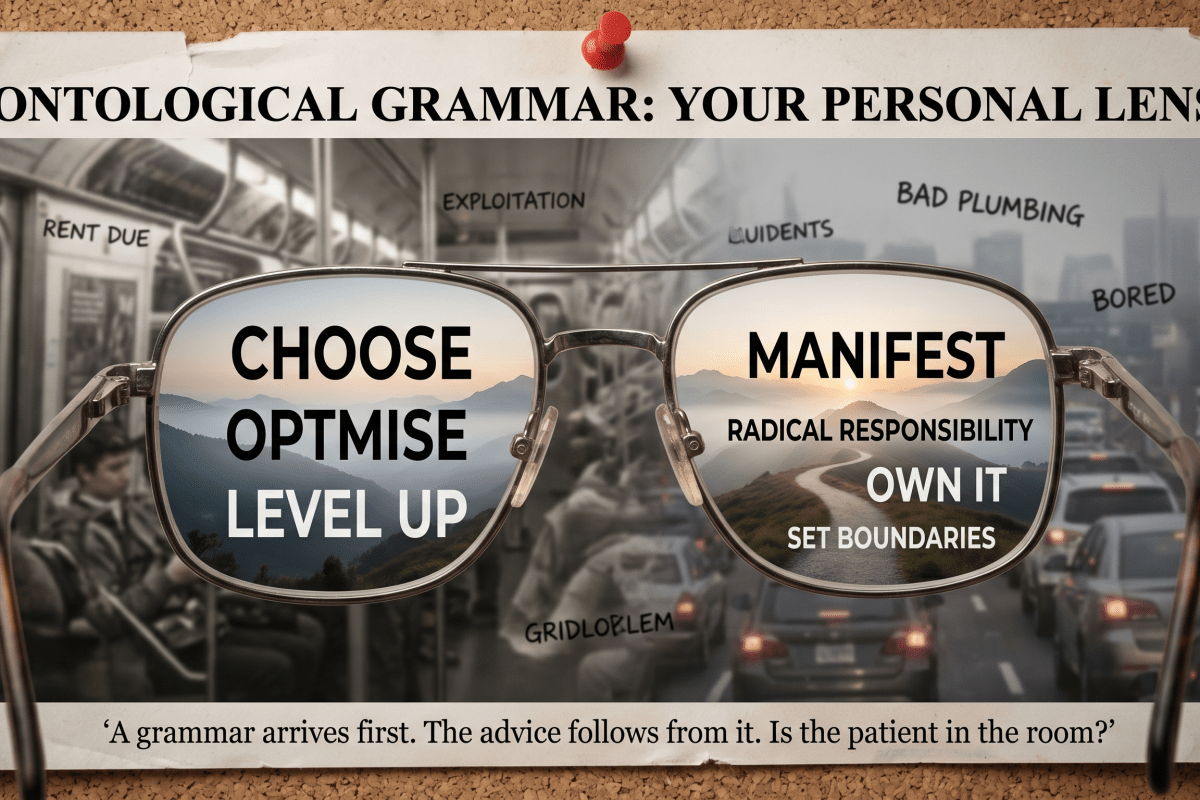
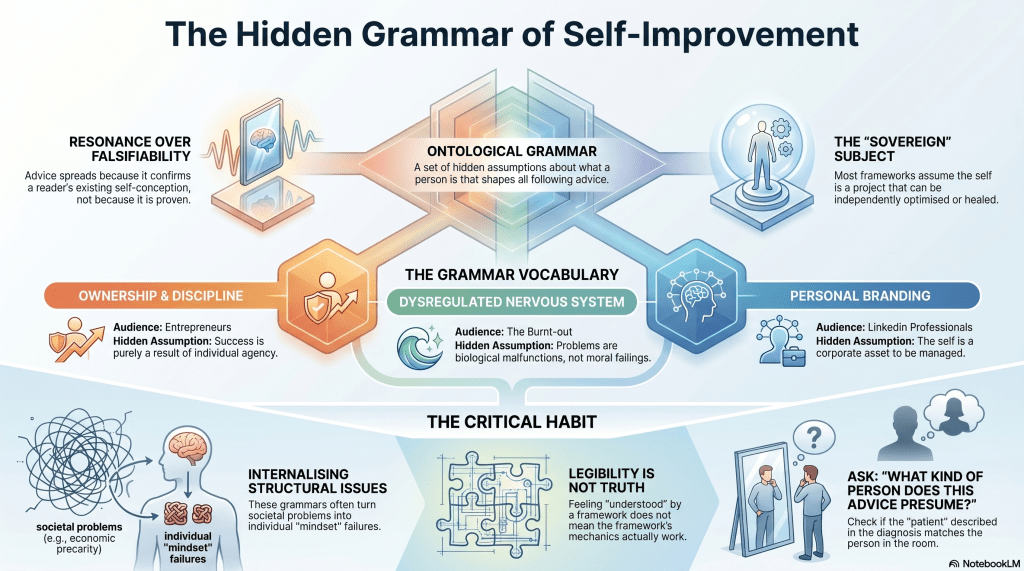
The framework they found — and are now evangelising — is what I call, in The Architecture of Encounter, an ontological grammar: a set of prior commitments about what kind of thing a person is, which arrives upstream of any specific advice and quietly determines what advice is even thinkable. You cannot recommend reframing without first presuming a self transparent enough to observe its own cognitions and sovereign enough to revise them. You cannot prescribe boundaries without presuming a self whose territory is violable and whose autonomy is the relevant moral unit. You cannot offer alignment without presuming a self that has a true direction, temporarily obscured, patiently awaiting discovery through either a values exercise on page forty-seven or a retreat in somewhere with good lighting and worse plumbing.

The grammar arrives first. The advice follows from it. And the person reading it is not being shown a mirror. They are being issued a lens.

The lens finds its wearer. “Take ownership” resonates with people already invested in the idea of themselves as agents who have been insufficiently deliberate — it confirms the worldview while appearing to challenge the behaviour. “Your nervous system is dysregulated” resonates with people for whom the moralised language of laziness and discipline has become intolerable; here is a vocabulary that removes the accusation while retaining the explanation, which is a genuinely useful service even if the mechanism on offer is borrowed loosely from neuroscience and the rest is borrowed from hope. “Mindset is your prison” resonates with people who need their suffering to remain individually tractable — solvable, that is, without anyone having to redistribute anything expensive or inconvenient. “Manifest your abundance” resonates with people who find both structural analysis and self-blame equally unappealing and would like a third option involving the universe.

Each grammar finds its congregation. Which is precisely the problem.

A grammar propagates not because it has been tested against alternatives or evaluated for efficacy, but because it maps onto a prior self-conception cleanly enough to produce the sensation of being understood. The entrepreneur already believes in agency-language: execution, discipline, ownership, leverage. The book that tells them their discipline is the differentiator is not offering new information; it is offering comfortable confirmation in a more expensive format. The therapeutic reader already suspects their relational difficulties involve something called attachment. The book that tells them so is not illuminating; it is flattering them with their own vocabulary. The LinkedIn professional already believes their career is a project of self-authorship. The thought leader who tells them to communicate their value and build authentic leadership is not giving them a strategy; they are giving them a liturgy.

The community that forms around a grammar is a church, not a seminar. It has converts, not students. And like most churches, it is considerably better at solidarity than at falsifiability.

This matters because the mechanism by which self-help content spreads — resonance, recognition, testimonial, referral — is entirely decoupled from the mechanism by which we would establish that it works. A sentence resonates because it fits a grammar the reader has already adopted. That tells you something real: about the anxieties structuring a cohort’s self-understanding, the stories they are trying to make liveable, the descriptions of themselves they find tolerable or intolerable. It does not tell you whether the intervention produces the claimed effect, in whom, under what conditions, and compared with what alternative. Those are duller questions. Less shareable. They do not fit on a carousel post with a soft gradient and a mountain.

Horoscopes also resonate. So do conspiracy theories, national myths, and the first chapter of any book you buy during a difficult stretch of your life.

The point is not that the advice is necessarily wrong. Sometimes “set boundaries” is exactly right. Sometimes “take ownership” is precisely what someone has been avoiding hearing. Sometimes a new frame genuinely reorganises attention in ways that produce durable change, and the person is measurably better off for having found it. None of that is in question. The question is whether a framework that produced one useful instance has any reliable claim to truth beyond that instance — and whether the person reaching for it during a difficult period is in any position to make that evaluation carefully.

They usually are not. That is not stupidity. That is the condition of being in difficulty: you reach for intelligibility, and whoever offers it collects a great deal of credit. The problem is not the reaching. The problem is that the self-help ecosystem — including the parts of it operated by entirely sincere people who believe every word they publish — has no reliable mechanism for distinguishing frameworks that help from frameworks that merely feel like help while the underlying situation continues undisturbed. The true believer and the true seeker share the same vulnerability. Both reached for a grammar. One of them got to write the book.
NotebookLM Infographic on this topic.

It is also worth noting that commerce is the easy villain here, and an overrated one. The same dynamic runs through pop psychology, where the grammar of individual cognitive mechanisms tends to dominate because it produces legible interventions in a way that structural analysis never quite does; blaming cognition is tractable, blaming the organisation of society is dispiriting and hard to monetise, even when it is accurate. It runs through LinkedIn, where the grammar is not therapeutic but managerial — the self reimagined as an optimisable professional asset — and where burnout becomes a boundary failure, precarity becomes an invitation to upskill, and alienation becomes a purpose deficit. Nobody on LinkedIn is necessarily trying to extract money from anyone. Many of them are trying to be useful, or to be visible, or both, which is human enough. But the grammar they are deploying disappears material conditions into interior architecture with the same efficiency as the most cynically produced wellness content. The mechanism does not require a profit motive. It requires only a grammar and an audience that already shares it.

The useful response to all of this is not wholesale dismissal, which would be too easy and almost certainly wrong. Some people need clearer habits. Some need better descriptions of their own conduct. Some need permission to stop tolerating what they have been tolerating. Some need a vocabulary that makes their own patterns visible, and a framework — however approximate — is better than none. These are real services. The fact that they are sometimes delivered inside a dubious metaphysics of the person does not automatically negate them.

But there is a question worth developing the habit of asking, before the grammar installs itself: what kind of person does this advice presume? Is the self it describes sovereign, where I am actually constrained? Wounded where I am actually responsible? Deficient where I am actually being exploited? Misaligned where I am actually just bored? In need of self-belief, where I am in need of rent?

These questions are less fun than a morning routine designed by someone who has never had a difficult commute. They do not come with a community or a badge or an accountability partner who sends encouraging voice notes. But they do something the grammar on its own cannot: they ask whether the patient described in the diagnosis is the one actually in the room.

Most self-help skips that step. So, not infrequently, does the person who wrote it. They found a grammar that made their experience legible, felt the relief that comes from that, and never quite got around to distinguishing legibility from truth. Which is understandable. It is also, for everyone downstream of that decision, a problem.

I don’t occupy this shared space of ontological grammar, so I call bollox.


new release: the box

2–3 minutes

My novella, The Box, is now available. At 96 pages, it’s a short read. It’s only available in paperback. I haven’t made a Kindle or eBook version yet. I won’t publish a hardcover version, which seems like a silly format for a novella. Did I mention that an assistant might help? 🧐

Audio: Brief NotebookLM summary podcast of this topic.

Marketing

Borrowing the marketing blurb:

After his father’s death, Freddy returns to the family home in southeast London to sort through the remnants of a life reduced to tools, paperwork, and silence. In the basement workshop he finds a cedar box, apparently nothing more than a modified sauna left behind by a grieving old man who had never quite learned how to let go.

But the box is not what it seems.

What begins as an act of curiosity becomes something stranger and far more dangerous: a way of stepping into encounters with the past. Not memories exactly. Not dreams. Something more immediate, more convincing, and more unstable. As Freddy begins testing the device, first alone and then with his old friend Charles, the two men find themselves drawn back into moments shaped by loss, resentment, and regret, hoping not only to revisit what has been lost but, perhaps, to change it.

At first the stakes are intimate. A dead mother. A half-remembered grievance. A friendship warped by years of misunderstanding. But when the box appears to offer access to larger, public tragedies, grief gives way to obsession, and the question is no longer whether the past can be reached, but what it means to interfere with it at all.

Set in ordinary rooms, pubs, offices, corridors, and basements, The Box is a literary speculative novella about mourning, fathers and sons, memory, and the human need to believe that what is gone might still be recovered.

Quietly uncanny and emotionally precise, it asks what we are really seeking when we turn back toward the past: truth, forgiveness, or simply another version of the story we can bear to live with.

Philosophy

Following the advice of a publisher, I wanted to share the core ideas of The Architecture of Encounter as fiction. He told me that, for the most part, no one reads nonfiction. I suggested that, from what I’ve read, reading itself is a dying breed. Moreover, novellas don’t sell well – write a novel.

Sell or not, I wasn’t about to contrive a novel, and I feel the tide is turning. People can’t justify the time to read long novels anymore. In a time of TikTok, more than 30 seconds of engagement is a bit much to ask from an audience. But not all audiences are entranced by the likes of TikTok – and especially certain genres, like philosophy, as if philosophy were a genre.

Philosophically, it’s an enquiry into the nature of time and memory, but through the lens of The Architecture of Encounter. Sure, you won’t get the entire story or the nuance, but the core message provides the answer to the mystery – of sorts.


Meantime, I’m trying to finalise my monograph, The Architecture of Willing – and yes, I admit I may need to consider another naming convention, The Architecture of Naming. Just not today.

Architecture of Willing Cover Art

I’ve selected the cover colour for Architecture of Willing. It’s monograph number 3 in a series. I chose a dark aubergine-violet colour (#4b256b) because I like the contrast, and it is different to the other 2.

Monograph #1 is When Language Fails: Ontological Pluralism and the Limits of Moral Resolution, which is rather a slate charcoal grey (#3c3f47).

#2 is The Architecture of Encounter: A Mediated Encounter Ontology, which is mulberry (#9e1f63).

I discussed Chapter 1 of The Architecture of Willing in a recent post, as well as a piece on my review process. I’ll be sharing more presently. I expect it to be completed by the end of May, but time will tell. Even though I’ve gone through seven revision passes, errors and fixes continue to crop up all the way to production – in fact, even afterwards.

The Striated Woman: No One Owns the Category

A longer post about my thoughts after having read the first section of Judith Butler’s Gender Trouble.

‘woman’ is a normative identity, and like all normative identities it is striated. It is composed of putative essences, recurring structural constraints, intersectional positions, cohort-relative projections, subjective inhabitations, and external gatekeeping.

Audio: NotebookLM summary podcast of this topic.

Manuscript Review with LLMs

4–5 minutes

Main event

I’m an active AI user. It’s no secret. My top uses are research and enquiry, but it is instrumental in my review and revision process.

Audio: NotebookLM summary podcast of this topic.

I am trying to wrap up my latest manuscript. I’m about 5 revisions through, so I felt I was finally in a position to check for cracks and missing elements, as well as the strength of my overall position and approach. It’s not a good idea to simply prompt, ‘What do you think about this?’

I’d tried prompts as simple as, ‘Act as a referee and be adversarial against this piece’ or ‘I got this from somewhere, and I want a critique’. These approaches shield you from AI’s programmed sycophantic tendencies. But they aren’t enough. You still need to create guidelines and guardrails, which include orientating the AI; otherwise, they will likely go off the reservation.

This is the actual prompt I last employed to various LLMs:

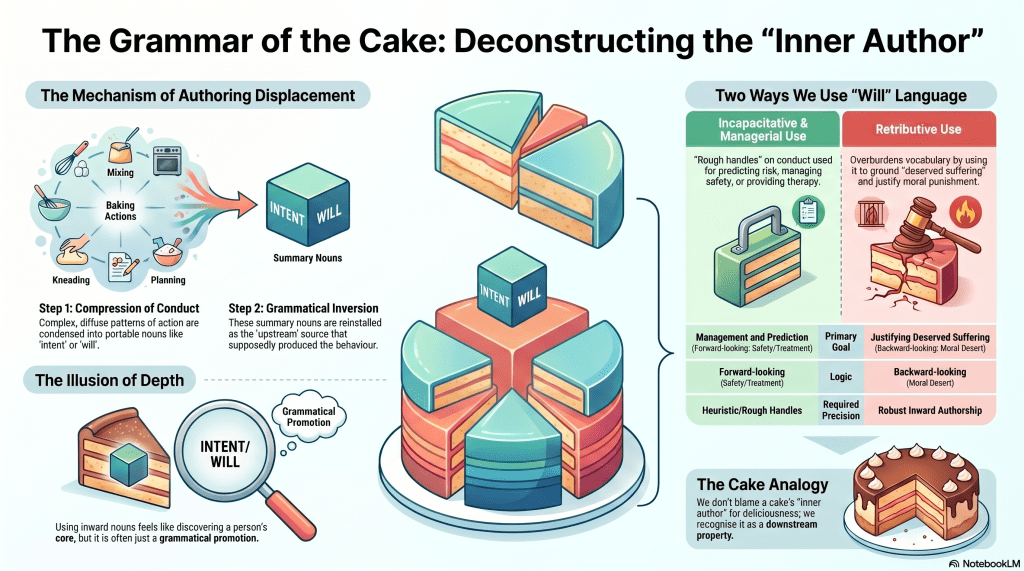
The attached is a complete development draft of Architecture of Willing, a philosophical monograph arguing that the vocabulary of will, intent, motive, choice, decision, and related terms operates through a two-stage grammatical mechanism – compression of action-patterns into portable nouns, followed by inversion of those nouns into apparent upstream authors of the very patterns from which they were abstracted. The book calls this mechanism authoring displacement and uses it to argue that retributive desert cannot be stably grounded in the vocabulary on which it depends.

The book is deliberately diagnostic rather than prescriptive. It does not propose a replacement psychology, a reformed legal code, or a new theory of agency. It refuses to settle the traditional free-will debate on either side. These refusals are intentional and are argued for within the text.

What I am asking for is a critical engagement from a position of maximum philosophical resistance. Specifically:

The book rests on a claim about what retributive practice requires – namely, a stable inward authoring source capable of making suffering genuinely owed rather than merely institutionally imposed. If that characterisation of retributivism’s requirements is wrong, or if it applies only to unsophisticated versions while leaving the strongest contemporary defences untouched, the central argument is significantly weakened. I would like to know whether that is the case, and if so, where exactly the book’s account of retributivism’s commitments fails to engage its best defenders.

More broadly: the book is a diagnosis of grammar. The question I want pressed is whether a grammatical diagnosis can do the normative work the book needs it to do – whether there is a gap between ‘this noun cannot stably support the load placed on it’ and ‘therefore practices depending on this noun are normatively unjustified’. If there is such a gap, what would close it, and does the book close it?

Please do not soften objections in the direction of ‘this is a good book with some gaps’. If the argument is unsound, say so and say where. If it is sound against some targets but not others, identify the targets it misses. The manuscript has already received generous assessments; what it needs now is the strongest case against it.

Of course, this prompt is specific to me and my project, but one may feel free to use it as a model for similar purposes.

Among the gaps returned were arguments I had not been aware of. In fact, in a couple of places, I had already cited authors, but the AI returned additional books or essays by the same people. In other cases, it offered material by authors I hadn’t considered. Obviously, I am interested in creating solid, watertight arguments, so this only helps my case.

For this project, my LLMs of choice have been Claude, ChatGPT, Gemini, Grok, and Kimi K2. I used Perplexity, Mistral, DeepSeek, and Z.ai GLM in earlier iterations.

Peer review

Another application is to take the critique output from one LLM into another with a prompt to evaluate the critique. My modus operandi here is to pick a ‘master’ LLM – typically in a Claude or ChatGPT project context – and treat it as my primary partner; the others are virtual subcontractors. This means that I can get a half-dozen or more reactions in minutes, which are then digested by the, let’s say, project manager, for assessment and a proposed action plan, typically in the form of a punch list. I recommend this approach as well.

NotebookLM Infographic on this topic.

Closing shot

When I was in grad school, this part of the project would have taken months. As it is, I’ve been working on this project since COVID-19, but it’s been an on-and-off affair, accumulating research information and documentation all the while. The manuscript will be better off, and my position honed sharper over this expanse of time, so the delay was beneficial.

Would more time also be beneficial? Probably, but one needs to stop somewhere, and I’m likely facing diminishing marginal returns. If I go the way of Wittgenstein, I’ll reverse track and recant everything. And so it goes…

The Architecture of Willing: An Early Peek

1–2 minutes

The Architecture of Willing is a passion project I’ve been considering since the COVID-19 debacle. I took a couple of career breaks to focus on the problem of agency. In fact, my working title until now has been Against Agency. Upon research, I discovered that (1) the idea was somewhat tired, and (2) it was mired in a free will debate centred around determinism. And (3) the argument had been made by many about a decade earlier, so I also missed the ground swell. As my interest is to present novel views or perspectives, I bowed out, but something still irked me.

Then it dawned on me: I’d dissect will under a language philosophy microscope. This got me to a new working title: Architecture of Willing, which perhaps uncoincidentally aligns with my Architecture of Encounter.

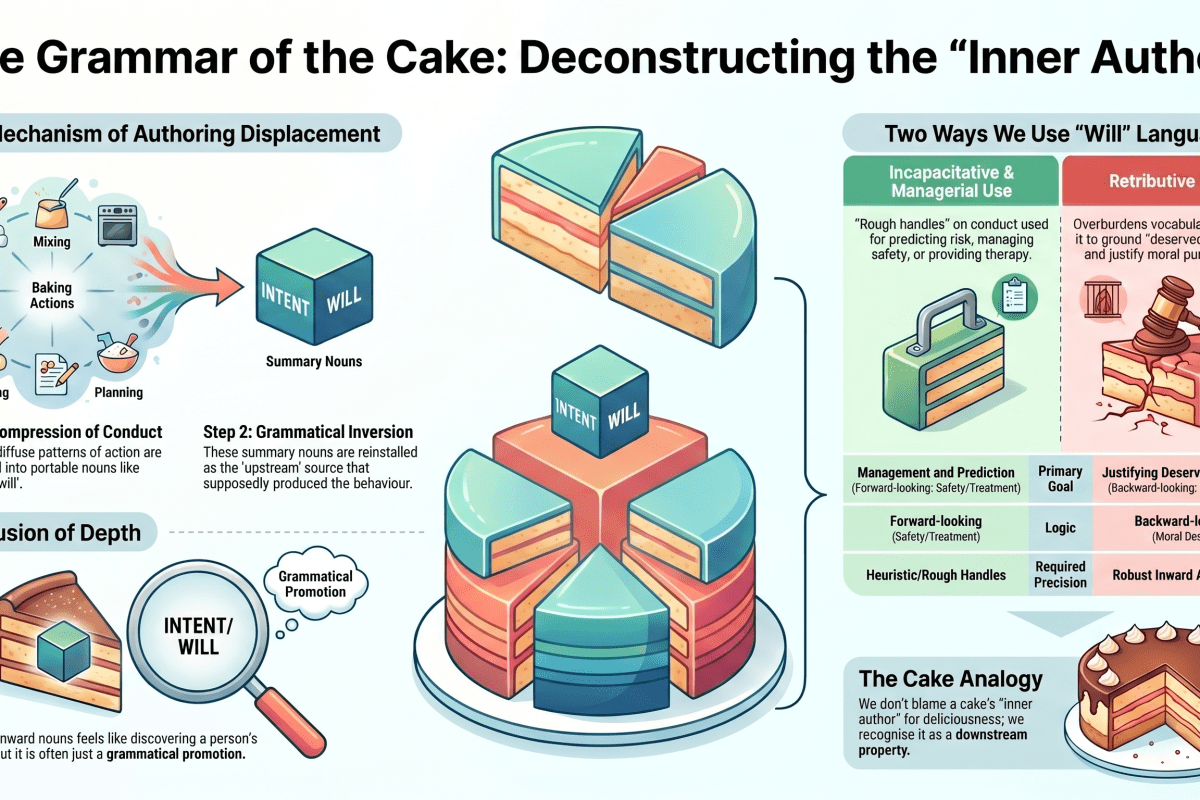
I’m still working through the first draft, but I’d like to share a NotebookLM summary of an early draft of Chapter 1, which serves as an introductory chapter: Authoring Displacement and the Cake Grammar or some such. Have a listen.

Audio: NotebookLM summary podcast of this topic.

I use the opening chapter as a setup. I had an idea of convicting a cake on charges of being delicious and using this absurdity as a metaphor for how we inflate and personify the notion of will. Perhaps interestingly, the will (particularly the free flavour) was the central theme I explored in my novel Propensity by Ridley Park, a little shameless cross-promotion.

I’ll keep this short because I am still drafting the monograph. I hope to have it published in May. Time will tell.

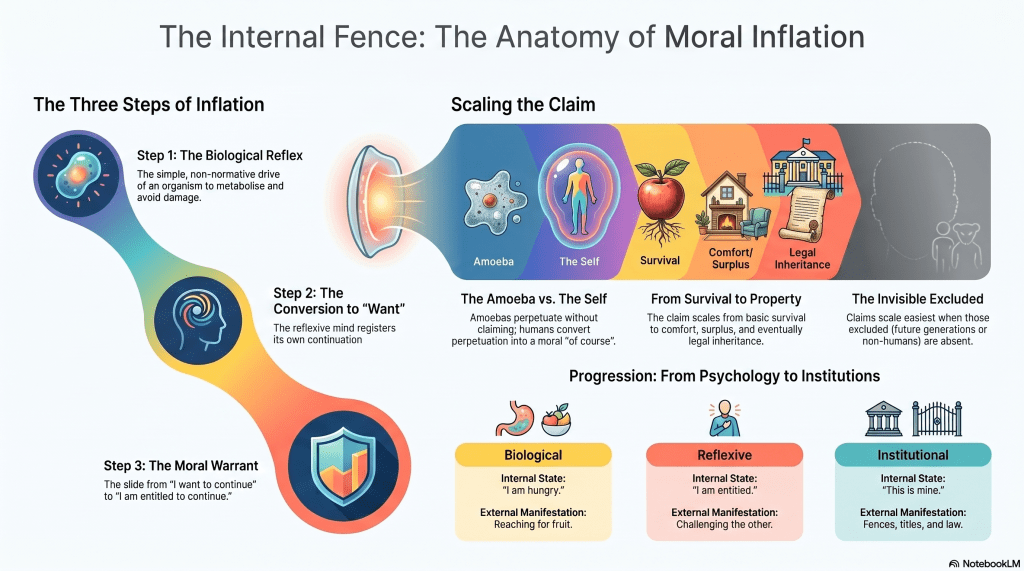
The Enclosure Within: The Hidden Roots of Property Theory

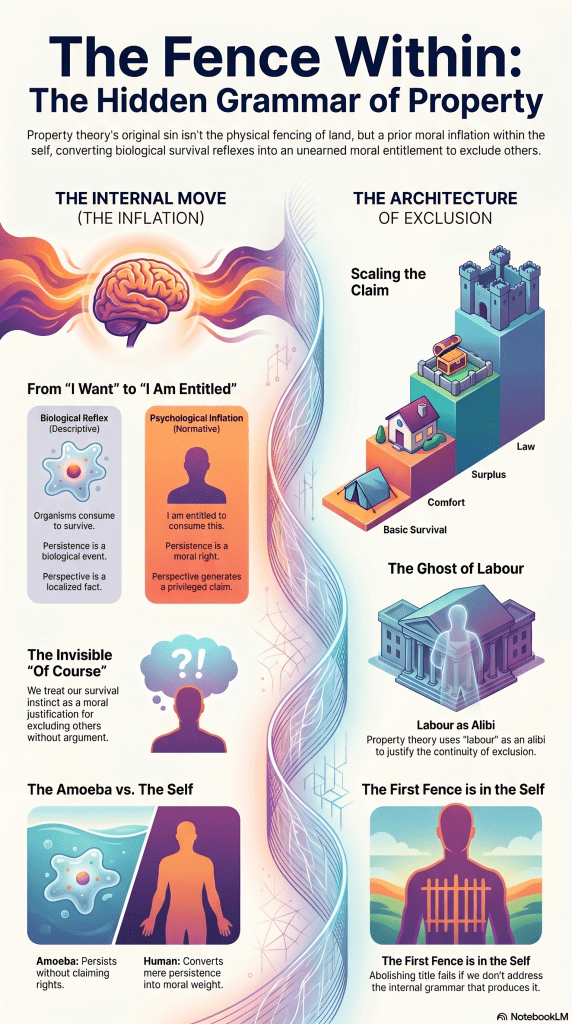
This is a bonus episode I asked NotebookLM to render based on the past two posts. These posts had been one, but I chose to separate them because of their core orientation on a shared topic. For those who read the posts together, this is made clear. I even continue several threads to make it obvious, but the two essays are a diptych. I feel the second post is stronger than the first, but the first was a stronger setup. If you don’t have time to read the essays, this is a decent summary.

Audio: NotebookLM summary podcast of this topic.

The two essays:

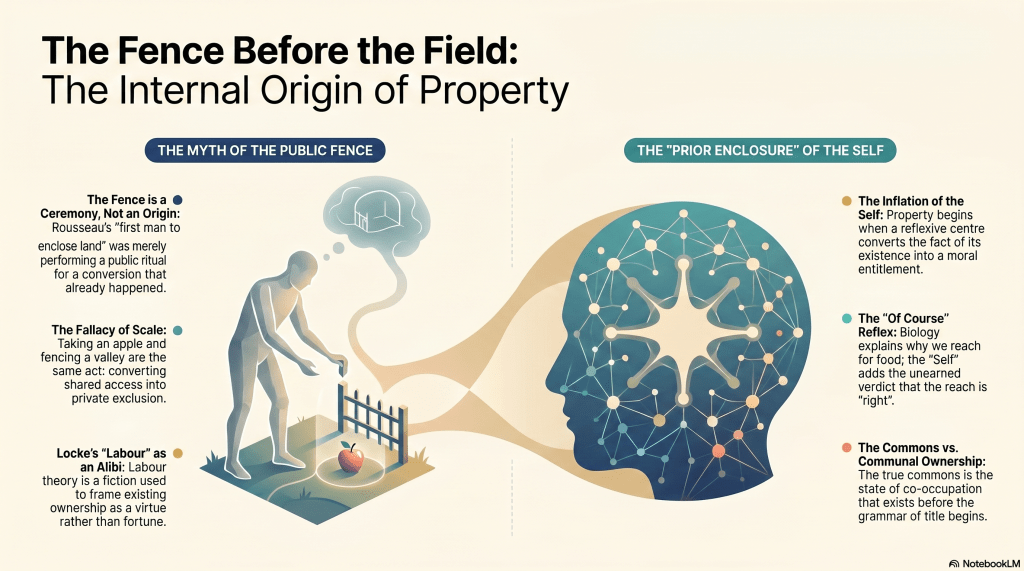
The Fence Before the Field

Before the Fence, the Self

The Fence Before the Field

The first man who, having enclosed a piece of ground, bethought himself of saying This is mine, and found people simple enough to believe him, was the real founder of civil society.

— Rousseau, Discourse on the Origin of Inequality

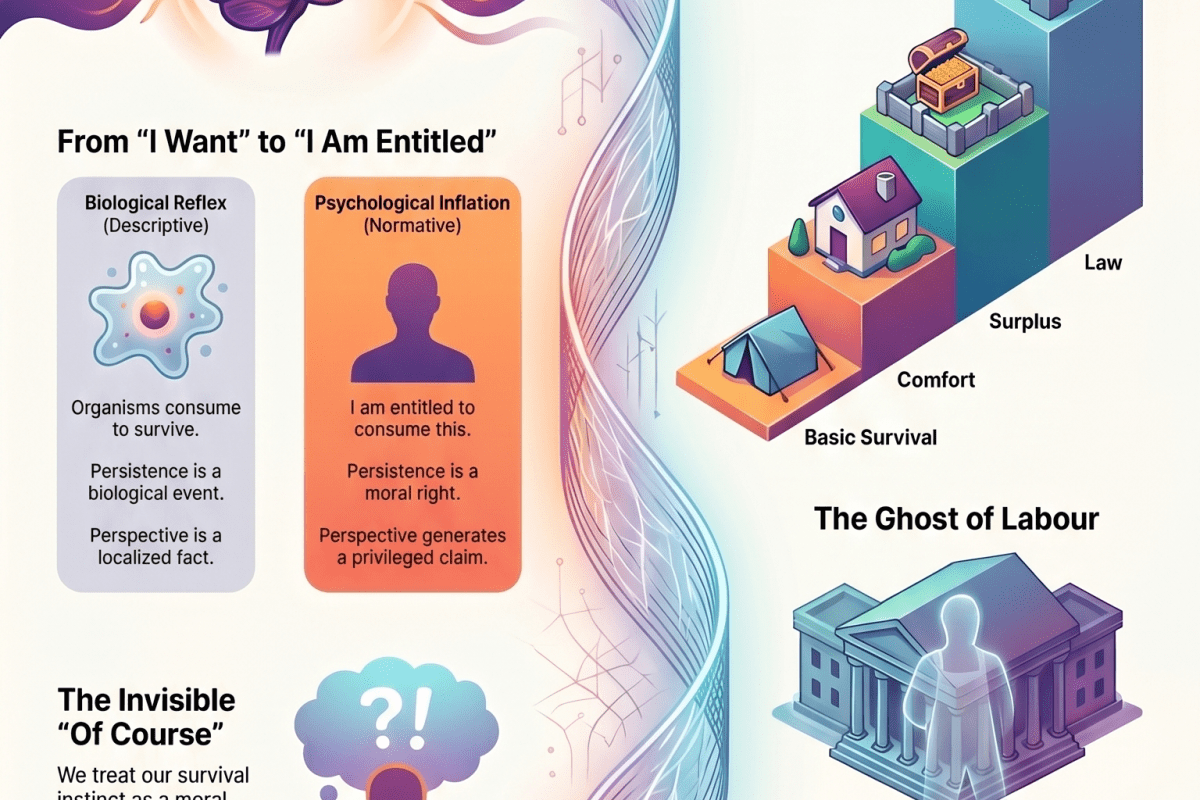
I posted another longer essay on Substack on the immorality of property ownership. This isn’t my first, but I wanted to go deeper in my critique. Actually, I wrote two, but I’ll advertise the second one tomorrow.

Audio: NotebookLM summary podcast of this topic.

Everything Must Go

James Ladyman and I agree that language is a fundamental impediment to understanding – and this includes notions of reality.

So, of course, I wrote about it. There is no spoon. A link to his interview is in the article, where I compare and contrast his Everything Must Go and my own The Architecture of Encounter.

I’ve been busy, so I’m sharing a link to Substack, which also includes this NotebookLM podcast summary.