The Architecture of Willing is a passion project I’ve been considering since the COVID-19 debacle. I took a couple of career breaks to focus on the problem of agency. In fact, my working title until now has been Against Agency. Upon research, I discovered that (1) the idea was somewhat tired, and (2) it was mired in a free will debate centred around determinism. And (3) the argument had been made by many about a decade earlier, so I also missed the ground swell. As my interest is to present novel views or perspectives, I bowed out, but something still irked me.
Then it dawned on me: I’d dissect will under a language philosophy microscope. This got me to a new working title: Architecture of Willing, which perhaps uncoincidentally aligns with my Architecture of Encounter.
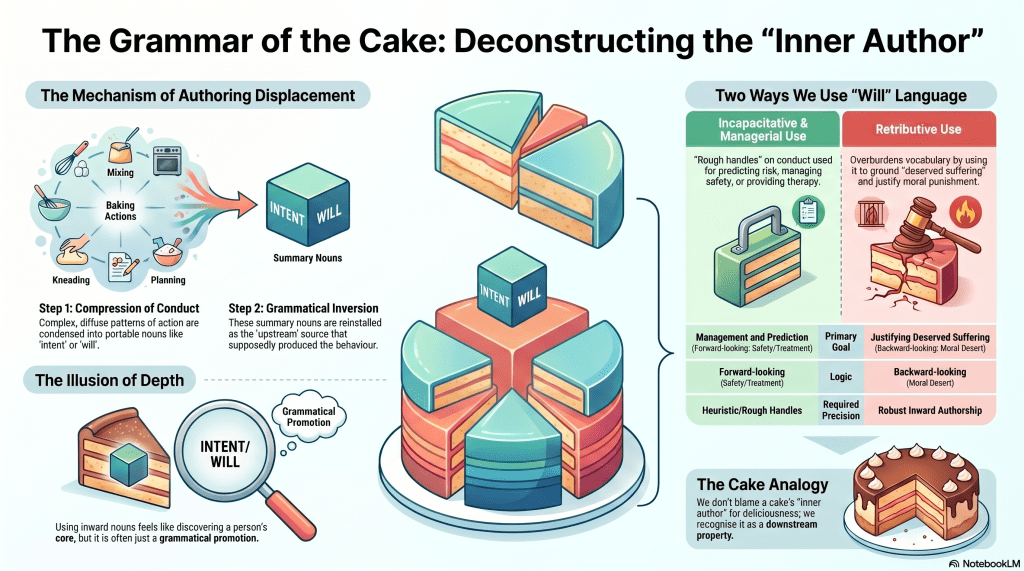
I’m still working through the first draft, but I’d like to share a NotebookLM summary of an early draft of Chapter 1, which serves as an introductory chapter: Authoring Displacement and the Cake Grammar or some such. Have a listen.
Audio: NotebookLM summary podcast of this topic.
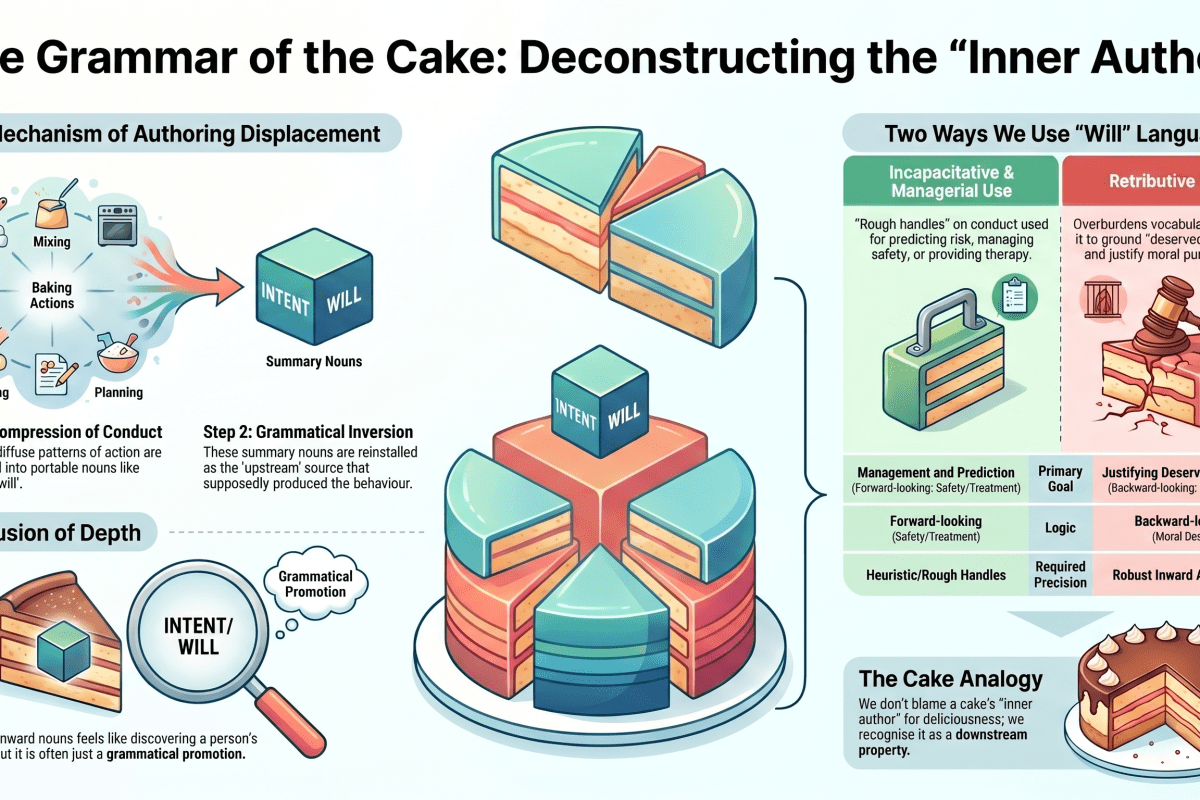
I use the opening chapter as a setup. I had an idea of convicting a cake on charges of being delicious and using this absurdity as a metaphor for how we inflate and personify the notion of will. Perhaps interestingly, the will (particularly the free flavour) was the central theme I explored in my novel Propensityby Ridley Park, a little shameless cross-promotion.
I’ll keep this short because I am still drafting the monograph. I hope to have it published in May. Time will tell.
I’ve read Part I of Hobbes’ Leviathan and wonder what it would have been like if he filtered his thoughts through Hume or Wittgenstein. Hobbes makes Dickens read like Pollyanna. It’s an interesting historical piece, worth reading on that basis alone. It reads as if the Christian Bible had to pass through a legal review before it had been published, sapped of vigour. As bad a rap as Schopenhauer seems to get, Hobbes is the consummate Ebenezer Scrooge. Bah, humbug – you nasty, brutish, filthy animals!*
Audio: NotebookLM podcast conversation on this topic.
In any case, it got me thinking of free will and, more to the point, of will itself.
A Brief History of Humanity’s Favourite Metaphysical Scapegoat
By the time Free Will turned up to the party, the real guest of honour—the Will—had already been drinking heavily, muttering incoherently in the corner, and starting fights with anyone who made eye contact. We like to pretend that the “will” is a noble concept: the engine of our autonomy, the core of our moral selves, the brave little metaphysical organ that lets us choose kale over crisps. But in truth, it’s a bloody mess—philosophy’s equivalent of a family heirloom that no one quite understands but refuses to throw away.
So, let’s rewind. Where did this thing come from? And why, after 2,500 years of name-dropping, finger-pointing, and metaphysical gymnastics, are we still not quite sure whether we have a will, are a will, or should be suing it for damages?
Plato: Soul, Reason, and That Poor Horse
In the beginning, there was Plato, who—as with most things—half-invented the question and then wandered off before giving a straight answer. For him, the soul was a tripartite circus act: reason, spirit, and appetite. Will, as a term, didn’t get top billing—it didn’t even get its name on the poster. But the idea was there, muddling along somewhere between the charioteer (reason) and the unruly horses (desire and spiritedness).
No explicit will, mind you. Just a vague sense that the rational soul ought to be in charge, even if it had to beat the rest of itself into submission.
Aristotle: Purpose Without Pathos
Aristotle, ever the tidy-minded taxonomist, introduced prohairesis—deliberate choice—as a sort of proto-will. But again, it was all about rational calculation toward an end. Ethics was teleological, goal-oriented. You chose what aligned with eudaimonia, that smug Greek term for flourishing. Will, if it existed at all, was just reason picking out dinner options based on your telos. No inner torment, no existential rebellion—just logos in a toga.
Augustine: Sin, Suffering, and That Eternal No
Fast-forward a few hundred years, and along comes Saint Augustine, traumatised by his libido and determined to make the rest of us suffer for it. Enter voluntas: the will as the seat of choice—and the scene of the crime. Augustine is the first to really make the will bleed. He discovers he can want two incompatible things at once and feels properly appalled about it.
From this comes the classic Christian cocktail: freedom plus failure equals guilt. The will is free, but broken. It’s responsible for sin, for disobedience, for not loving God enough on Wednesdays. Thanks to Augustine, we’re stuck with the idea that the will is both the instrument of salvation and the reason we’re going to Hell.
Cheers.
Medievals: God’s Will or Yours, Pick One
The Scholastics, never ones to let an ambiguity pass unanalysed, promptly split into camps. Aquinas, ever the reasonable Dominican, says the will is subordinate to the intellect. God is rational, and so are we, mostly. But Duns Scotus and William of Ockham, the original voluntarist hooligans, argue that the will is superior—even in God. God could have made murder a virtue, they claim, and you’d just have to live with it.
From this cheerful perspective, will becomes a force of arbitrary fiat, and humans, made in God’s image, inherit the same capacity for irrational choice. The will is now more than moral; it’s metaphysical. Less reason’s servant, more chaos goblin.
Hobbes: Appetite with Delusions of Grandeur
Then along comes Thomas Hobbes, who looks at the soul and sees a wheezing machine of appetites. Will, in his famously cheery view, is simply “the last appetite before action.” No higher calling, no spiritual struggle—just the twitch that wins. Man is not a rational animal, but a selfish algorithm on legs. For Hobbes, will is where desire stumbles into motion, and morality is a polite euphemism for not getting stabbed.
Kant: The Will Gets a Makeover
Enter Immanuel Kant: powdered wig, pursed lips, and the moral rectitude of a man who scheduled his bowel movements. Kant gives us the “good will”, which acts from duty, not desire. Suddenly, the will is autonomous, rational, and morally legislative—a one-man Parliament of inner law.
It’s all terribly noble, terribly German, and entirely exhausting. For Kant, free will is not the ability to do whatever you like—it’s the capacity to choose according to moral law, even when you’d rather be asleep. The will is finally heroic—but only if it agrees to hate itself a little.
Schopenhauer: Cosmic Will, Cosmic Joke
And then the mood turns. Schopenhauer, world’s grumpiest mystic, takes Kant’s sublime will and reveals it to be a blind, thrashing, cosmic force. Will, for him, isn’t reason—it’s suffering in motion. The entire universe is will-to-live: a desperate, pointless striving that dooms us to perpetual dissatisfaction.
There is no freedom, no morality, no point. The only escape is to negate the will, preferably through aesthetic contemplation or Buddhist-like renunciation. In Schopenhauer’s world, the will is not what makes us human—it’s what makes us miserable.
Nietzsche: Transvaluation and the Will to Shout Loudest
Cue Nietzsche, who takes Schopenhauer’s howling void and says: yes, but what if we made it fabulous? For him, the will is no longer to live, but to power—to assert, to create, to impose value. “Free will” is a theologian’s fantasy, a tool of priests and moral accountants. But will itself? That’s the fire in the forge. The Übermensch doesn’t renounce the will—he rides it like a stallion into the sunset of morality.
Nietzsche doesn’t want to deny the abyss. He wants to waltz with it.
Today: Free Will and the Neuroscientific Hangover
And now? Now we’re left with compatibilists, libertarians, determinists, and neuroscientists all shouting past each other, armed with fMRI machines and TED talks. Some claim free will is an illusion, a post hoc rationalisation made by brains doing what they were always going to do. Others insist that moral responsibility requires it, even if we can’t quite locate it between the neurons.
We talk about willpower, will-to-change, political will, and free will like they’re real things. But under the hood, we’re still wrestling with the same questions Augustine posed in a North African villa: Why do I do what I don’t want to do? And more importantly, who’s doing it?
Conclusion: Where There’s a Will, There’s a Mess
From Plato’s silent horses to Nietzsche’s Dionysian pyrotechnics, the will has shape-shifted more times than a politician in an election year. It has been a rational chooser, a moral failure, a divine spark, a mechanical twitch, a cosmic torment, and an existential triumph.
Despite centuries of philosophical handwringing, what it has never been is settled.
So where there’s a will, there’s a way. But the way? Twisting, contradictory, and littered with the corpses of half-baked metaphysical systems.
Welcome to the labyrinth. Bring snacks.
* The solitary, poor, nasty, brutish, and short quote is forthcoming. Filthy animals is a nod to Home Alone.
Whilst researching a chapter on the notion of blame among hominids, I was chasing down a rabbit hole and I ended up finding Schopenhauer’s oft-quoted,
Man can do what he wants, but he cannot will what he wants
And that’s where the trouble started. Memory is fallible. Although I feel deceived, I don’t feel bad because many people have misattributed this quote to Schopenhauer, but if the Wikipedia footnote is steering me right, this was actually Einstein’s misquote—the Einstein; Albert Einstein of E = MC2 fame.
According to the citation, Albert said this:
„Der Mensch kann wohl tun, was er will, aber er kann nicht wollen, was er will.”
— Albert Einstein, Mein Glaubensbekenntnis (August 1932)
It translates into the offending sentence.
‘Man can do what he wants, but he cannot will what he wants.’
The full translated quote reads,
‘I do not believe in free will. Schopenhauer’s words: ‘Man can do what he wants, but he cannot will what he wants’ accompany me in all situations throughout my life and reconcile me with the actions of others, even if they are rather painful to me. This awareness of the lack of free will keeps me from taking myself and my fellow men too seriously as acting and deciding individuals, and from losing my temper.’
Albert Einstein
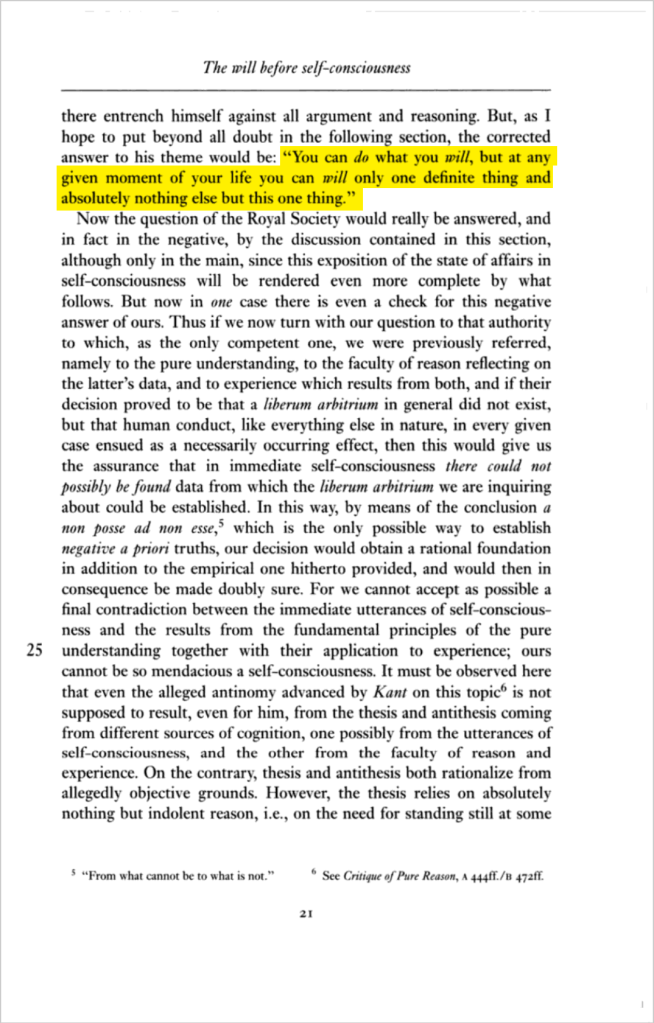
What Schopenhauer actually said not only doesn’t resonate quite so well, it doesn’t even convey the same notion. His actual words were:
‘You can do what you will, but in any given moment of your life you can will only one definite thing and absolutely nothing other than that one thing.’
Du kannst tun was du willst: aber du kannst in jedem gegebenen Augenblick deines Lebens nur ein Bestimmtes wollen und schlechterdings nichts anderes als dieses eine.
— Arthur Shopenhauer, Ueber die Freiheit des menschlichen Willens
Arnold Schopenhauer, On the Freedom of the Will
In the spirit of misattributed quotes, here are a few things Einstein never said but are attributed to I’m anyway.
“The definition of insanity is doing the same thing over and over again and expecting different results.”
“Everyone is a genius. But if you judge a fish by its ability to climb a tree, it will live its whole life believing that it is stupid.”
Not Albert Einstein
“I refuse to believe that God plays dice with the universe.”
Not Albert Einstein
Though to be fair, the last one at least directionally reflects something he did say,
“It seems hard to sneak a look at God’s cards. But that He plays dice and uses ‘telepathic’ methods… is something that I cannot believe for a single moment.”
Albert Einstein
Yet again, I am confused. I feel I’ve been living a lie.
Full Disclosure: I consider myself to be a determinist. I looked for something like Dawkins’ spectrum of theistic probability to evaluate where one might be oriented on a scale of free will to determinism to fatalism whilst also considering compatibilism.
Dawkins’ spectrum of theistic probability
Let’s lay some groundwork by establishing some definitions from most constrained to least:
Fatalism : a doctrine that events are fixed in advance so that human beings are powerless to change them
Compatibilism : a doctrine that maintains that determinism is compatible with free will
Determinism : a theory or doctrine that acts of the will, occurrences in nature, or social or psychological phenomena are causally determined by preceding events or natural laws
Freewill : freedom of humans to make choices that are not determined by prior causes or by divine intervention
It seems that freewill and fatalism are bookends with compatibilism attempting to moderate or synthesise freewill and deteminism. But it also seems that one’s selection may be contexual. Ultimately, this argument is fraught with semantic challenges insomuch as some underlying concepts are yet unresolved.
Crash Course Philosophy does provides a nice summary of the challenges in defending even compatibilist positions away from detemininism and even fatalism.
As this video notes, our choices may appear to be free, but it doesn’t take much effort to perform a 5-whys investigation to remove anything but homoeopathic amounts of agency.
Taking a short example, let’s look at the cases of the trial judges mentioned by Sapolsky (Behave) and Kahneman (Noise). Given all of the factors entering into sentences, prior offences, sex or gender of either the defendant or the judge, education, income, and so on, but far the largest factor in determining the length or severity of a sentence was the time between the sentencing and the judge’s last meal—effectively their blood glucose levels.
Some may argue that this is a short interval, but behaviourists would argue that a person now is a culmination of all of their experiences to date. That the decision of the so-called criminal to rob the liquor store (going for the stereotype here) was not the result of low blood sugar. This may be true, but there is still an unbroken chain of confluent events that brought them to that place.
From a culpabilty perspective, even absent true agency, the offender should still be incarcerated or whatever to prevent this behaviour from repeating. Of course, if you believe in rehabilitation, you are necessarily a behaviourist in soem shape or form: the idea is to effectively repattern experience impressions. The other problem is one of probability. That you did X once, are you lilkey to do it again? If not, then there is no further risk to society, as it were. Given the probability of recitivism—and some argue that mass incarceration increases the probability or attempting criminal actions post-release—, is this even an effective deterence? It’s time to get out of the rabbit hole.
From my position, it is impossible to reconcile experience and freewill. The best you can argue is that one is free in the moment—like some strange improv exercise, where you are shown a film that stops abrutly, and you are instructed to act out the remainder of the scene. Is this free, or is this extrapolating on your experience.
Skipping to fatalism, how probable is it that absolutely everything is determined. Reality is just a film we are both in and observing or experiencing, but all of it is already laid down. We are just unawares. Every strange plot twist and early exit was not only already scripted, but it’s already been captured. There is no room for improvisation or flubbed lines. There is no opportunity to go off-script. Even these words are predestined. Even unpublished thoughts were not meant to be published.
There is no way to test this sort of system from inside the system, and there is no way to get a vantage above it, so here we are.
The notion of determinism affords humans some modicum of agency, perhaps akin to one part in a trillion trillions. Practically, we are taking credit for a butterfly effect—and punishing for this degree of freedom. As Sapolsky has noted, most instances of perceived agency are trivial. We can ‘instruct’ finger movement with our brain. Ostensibly, we think: move finger; bend; point; stop. And even so, what was the cause of the thought to move the finger? Was there truly a non-causal event?
Cognotive dissonance ensures that we can’t allow ourselves to be NPCs or automotons. We have to omuch hubris for that. We must have some free will. Some religions say we not only have agency here in this life but that we chose the life to begin with. Even so, we’ve not seen the script in advance; we’ve merely chosen which lessons we want learnt.
So what about compatibilism? Sort of, who cares? Whilst I can define some interstitial state between free will and determinism, it seems that it would not be even tempered or would otherwise skew heavily toward determinism.
What keeps me from being a hard determinist is that I hold out hope for statistics, chaos, and stochasticism. One might argue in return, that these, too, are determined; we just don’t see the underlying connection. And that’s my cognitive cross to bear.
To be fair, it seems that the notion of free will or even compatibilism are secondary, let’s say, reactions to the need for culpability, for moral responsibility. Societies are built upon these notions, as are legal systems. Necessary ingredients to invent are:
‘Individual’
Agency and Volition
Choice, Motivation, and Intent
Responsibilty and Blame
None of these actually exist, so they need to be invented and constructed in order to associate self-control to actions. In fact, we have insanity escape clauses to recognise that there are cases where control is lost, whether temporarily or permanently, or never had in the first place for any number of ‘reasons’. At core, these attributes are necessary to exert power in a society. The next goal is to convince the actors or subjects that these things are ‘real enough’— as the saying goes, ‘good enough for the government’.
Even if we accept these things at face value, the interpretation and processing of these are different animals still. The notion of Will itself is likely speceous or another fabricated notion. Perhaps, I’ll address Will on another day. Probably not, as all of this is distracting me from my language insufficiency work.
When I think about free will, it is foisted on humanity in the same manner as gods and religion. With gods, we have been defending against theism for millennia. The gods fetish and free will are inextricably linked. As with the chicken and egg connundrum, the question is whach came first. Is God a reaction to fee will, or is it the other way around. Did we create free will to allow for responsibility and then fabricate Supreme busy bodies to act as ultimate judges? Or did we create the gods and build out the myth of free will to accommodate punishment of deviant behaviour. Or are these just parallel constructions? Enquiring minds want to know.




 Philosophics