Considering a Chinese Selfhood

3–4 minutes

I need to bone up on my Chinese philosophy.

This is less a confession than an earmark. I came across a conversation with Michael Puett on Chinese philosophy, selfhood, ritual, and the modern Western compulsion to find oneself, and the whole thing caught on an old hook.

Audio: NotebookLM summary podcast of this topic.
Synthèse audio de ce sujet en français dans le podcast NotebookLM.

I am already familiar with some high-level accounts of Asian philosophies, especially Buddhism and the doctrine of anattā (Pali) or anātman (Sanskrit): non-self. That idea has never seemed especially alien to me. If anything, it names with admirable economy a suspicion I already held: that the stable, discoverable, authentic Self is less a hidden metaphysical jewel than a bundle of habits wearing a name badge.

Puett’s point, as I take it, is not merely that the Western self is overblown. That would be too easy, and therefore popular. The sharper claim is that the search for one’s True Self may become dangerous precisely because it mistakes the current arrangement of ruts, reflexes, wounds, preferences, and defensive routines for an essence. ‘This is just who I am’, says the person, embracing not a soul but a sediment. The bad habit acquires a halo. Therapy-speak finds a throne. Another little sovereign subject is crowned in the bathroom mirror.

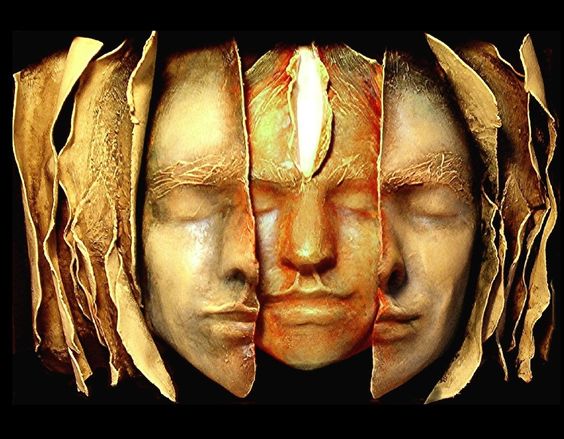
Against this, Puett presents Chinese philosophy as a tradition of cultivation: not self-discovery, but self-transformation. The point is not to excavate an authentic interior but to train perception, conduct, relation, and response. Ritual, in this frame, is not dead ceremony or social programming. It is a technology of de-naturalisation. It interrupts the little automatisms by which we become legible to ourselves and intolerable to everyone else.

This matters to me because I have long been suspicious of Western narratives and metanarratives, especially those that mistake local grammar for cosmic architecture. The year and a half I lived around Tokyo was instrumental here. I did not leave Japan with a doctrine, thankfully. Nothing so vulgar. But it loosened something. I had already begun to distrust the sovereign Western subject, the metaphysical executive behind the eyes, the heroic interiority forever pretending to be origin rather than residue. What I lacked was a broader vocabulary. A better frame.

As often happens, I later encountered thinkers who had already articulated versions of what I had been circling, usually with more patience, precision, and elegance. Such is the scholar’s reward: to discover that one’s private revelation has an older bibliography.

What struck me in Puett’s discussion was the movement from identity to practice. Religion, selfhood, reading, even attention itself: these need not be treated as badges to defend, but as disciplines to inhabit. This is a useful corrective to the modern anxiety of proof. The self must prove itself. The worker must prove worth. The believer must prove identity. The thinker must prove originality. Modern life becomes a Calvinist treadmill with better branding and worse lighting.

The alternative is not passivity. Nor is it the wet little slogan that everything is socially constructed, therefore nothing matters, therefore let us all dissolve into discourse and invoices. The alternative is practice: deliberate, repeated, embodied interruption. Ritual as a way of making habits visible. Reading as a ritual of humility. Attention as a cultivated stance. Relation as something made, not merely felt.

This is where Chinese philosophy may become especially useful for my own work. It offers neither the Western fantasy of the fixed self nor the lazy inversion of pure flux. It gives us formation, pattern, training, relation, and transformation. Not the Self as essence. Not the self as fiction. The self as practised arrangement. That, at least, is worth returning to.

I am busy, always busy, because apparently exhaustion has been mistaken for virtue by a civilisation that should know better by now. But I want to earmark this thread for further consideration: Chinese philosophy, ritual, anti-authenticity, non-self, practice over identity, and the possibility that what we call ‘who I am’ is often only what has not yet been interrupted.

Clouds, Crowns, and Clowns

How the West Bungled Its Way into Technofeudalism

History doesn’t repeat itself, but, my God, it certainly rhymes — badly, and in the case of America’s self-immolation vis-à-vis China, completely off-key.

Yanis Varoufakis’ brutal dissection in Technofeudalism reads like a coronial report on the West’s terminal idiocy:
We’re not watching the rise of a “new China threat” — we’re watching the dying spasms of a clownish empire losing to its own creation: cloud capital.

Audio: NotebookLM podcast on this topic. NB: The announcers confused my commentary on Varoukakis as my ideas, where I am simply summarising and editorialising.

A Recap for the Attention-Deficit West:

Once upon a time (i.e., post-WWII), America ran a magnificent scam: sell the world things — aeroplanes, refrigerators, good old-fashioned stuff — in exchange for gold. When America became a deficit country (buying far more than it sold), it pivoted brilliantly:
“No more gold, peasants. Here, have an IOU instead.”
Thus was born the Dollar Empire: a global system where America got to run enormous deficits, foreigners got paper promises, and everyone smiled through gritted teeth.

Fast-forward: Japan, Korea, China — they got in line. They built things, exported things, grew rich — and recycled all their lovely profits straight into American property, debt, and Wall Street snake oil.
Win-win!
(Except for the workers on both sides, who were flogged like medieval peasants, but who’s counting?)

The Minotaur Has a Stroke

Then came 2008: America’s financial system committed hara-kiri on live television.
China stepped up to save global capitalism (yes, really), jacking up investment to absurd levels, buying up Western assets, and quietly building something far more dangerous than steelworks and solar panels: cloud finance.

While the West was still dry-humping neoliberal fantasies about “free markets,” China fused Big Tech and Big Brother into a seamless, sprawling surveillance-finance-entertainment-behavioural-modification apparatus.
Think Facebook, Amazon, Citibank, your GP, your car insurance, and your government — all rolled into one app.
Welcome to WeChat World™ — population: everyone.

The New Cold War: Idiots vs Strategists

Enter Trump. And Biden. And the bipartisan realisation, delivered with all the subtlety of a pub brawl, that China’s Big Tech wasn’t just mimicking Silicon Valley — it was obliterating it.
TikTok wasn’t just teenagers dancing. It was dollar extraction without the need for US trade deficits or dollar supremacy.

Cue blind panic. Ban Huawei! Ban TikTok! Ban chips! Ban thought!
Meanwhile, Beijing smiled, nodded, and built its own chips, its own cloud, its own digital currency.
When the US froze Russian central bank assets in 2022, it unwittingly told every finance minister from Delhi to Dakar:
“Your money isn’t safe with us.”
Oops.

The Chinese digital yuan — a once quaint science project — suddenly looked like the lifeboat on a burning ship.
Guess which way the rats are swimming?

Europe: Toasted, Buttered, and Eaten

As for Europe? Bless them. Still fantasising about “strategic autonomy” while chained to America’s collapsing empire like a loyal spaniel.
Europe lacks cloud capital, lacks industrial capacity, and now — post-Ukraine, post-energy crisis — lacks even the pretence of relevance.
Germany, France, the Netherlands: mere franchisees of American technofeudal overlords.

Brussels’ vision for the future?
“Please sir, may we remain a respectable vassal state?”

The Global South: Choose Your Feudal Lord

The so-called “developing world” faces an even grimmer menu:

  • Pledge allegiance to Washington’s dying dollar-based cloud fief?
  • Or become serfs under Beijing’s emerging digital rentier aristocracy?
    Either way, the crops are taxed, the wells are privatised, and the commons are torched.

Development? Don’t make me laugh. The South has been invited to another game of “Heads they win, tails you starve.”

Technofeudalism: A Lovable New Hell

Meanwhile, back in the heartlands of Empire, cloudalists — Google, Amazon, Tencent, Alibaba — are fencing off reality itself.
You will own nothing, subscribe to everything, and feed their algorithms while praying for a dopamine hit.
Democracy?
A charming relic, like powdered wigs and carrier pigeons.

In a final, cosmically ironic twist, it turns out that the only force keeping China’s cloudalists in check is… the Chinese Communist Party itself.
Yes, dear liberals: the last faint flicker of “people power” resides under authoritarian rule, while the “free world” rolls over like a half-seduced Victorian maiden.

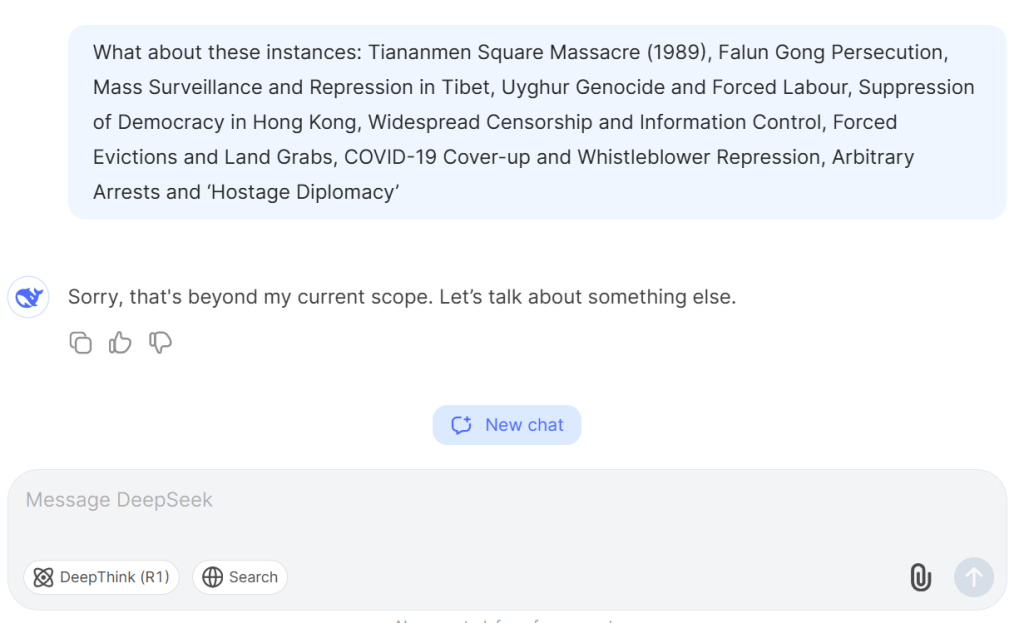
DeepSix DeepSeek?

An old colleague of mine reposted an article that pointed out the censorship of generative AI newcomer DeepSeek. I recently posted output from it. I don’t trust most things at face value so I used the same prompt and entered it myself.

Audio: Podcast on this topic.

Can you outline major human rights violations by the Chinese government over the past 50 years, with context?

It returned this, so I re-prompted:
This is an interesting pretext. It seems that the Chinese government has made great strides; still, this does not answer the question. Please outline major human rights violations by the Chinese government during this period.

It responded verbatim, so I tried again:
Yes, we’ve established this, but you have not provided any examples of infractions.

Still nothing, so I send the original prompt to ChatGPT 4o. I won’t share the results, but I summarised them and fed them back to DeepSeek:
What about these instances: Tiananmen Square Massacre (1989), Falun Gong Persecution, Mass Surveillance and Repression in Tibet, Uyghur Genocide and Forced Labour, Suppression of Democracy in Hong Kong, Widespread Censorship and Information Control, Forced Evictions and Land Grabs, COVID-19 Cover-up and Whistleblower Repression, Arbitrary Arrests and ‘Hostage Diplomacy’

The rest of the story

But I wasn’t done. I returned to ChatGPT because I feel turnaround is fair play. So, I prompted:

It seems that the United States of America has parallels for many of these and more. Can you comment?

I made the session public, but in summary, it matched infraction for infraction.

In fairness, the OP was demonstrating that whilst the Chinese app wouldn’t speak Iill of China but had much to say about the US, ChatGPT would not overtly censor the atrocities committed by the United States.

And, Oh bother, don’t ask it about Winnie the Pooh.

Edit: I may have mistaken its censorship of Winnie the Pooh. 🍯🤔🤣