A colleague shared a reference to Nelson Goodman’s Ways of Worldmaking (1978). I’d never heard of the book or the author, so I asked ChatGPT to compare and contrast this with MEOW, The Architecture of Encounter, and a bit of A Language Insufficiency Hypothesis. This is what it rendered:
Or, to put it in one line fit for people skimming with one eye while pretending to work:
Goodman asks how versions make worlds intelligible. MEOW asks what kind of reality makes mediated intelligibility possible at all.
Tl;dr
Goodman and MEOW are neighbours, but not housemates.
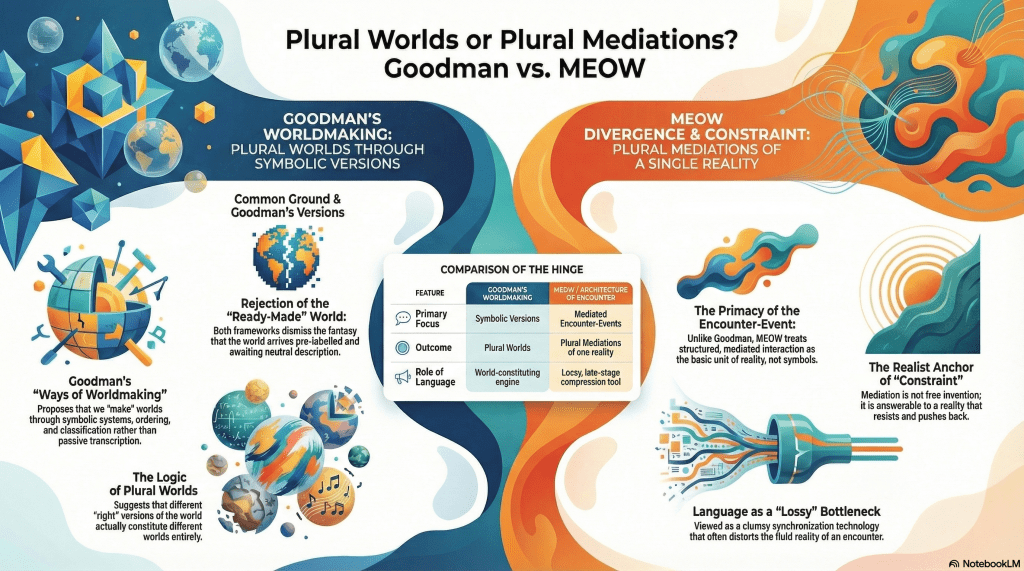
Both reject the childish fantasy that the world arrives already parcelled, labelled, and politely awaiting description by some neutral observer. Both are suspicious of naïve realism, fixed essences, and the conceit that language simply mirrors what is there. Both recognise that description, classification, and articulation are active, selective, and world-shaping.
But Goodman’s emphasis falls on versions, symbol systems, and the making of worlds through classificatory practice. MEOW and The Architecture of Encounter go elsewhere. They do not treat symbolic versioning as primary. They treat encounter as primary: mediated, structured interaction under constraint. Language and world-versioning come later, as derivative, partial, and often clumsy attempts to stabilise, synchronise, and re-present what is first given in encounter.
So the shortest contrast is this:
Goodman pluralises worlds.
MEOW pluralises mediation while retaining constraint.
That is the hinge.
The longer version
Goodman is often useful precisely because he helps loosen the grip of a bad picture: the notion that there is one fully furnished world, discretely laid out in advance, which language then copies with greater or lesser success. In Ways of Worldmaking, description is not passive transcription. Versions organise, sort, foreground, suppress, classify, and compose. They do not simply mirror. They make.
This much sits quite comfortably beside MEOW and The Architecture of Encounter. MEOW has never been sympathetic to the old theatre in which a subject peers out at a ready-made object-world and then tries to report back accurately. That picture has always seemed less like sober metaphysics and more like a grammatical superstition. It is one of those inherited arrangements that philosophy keeps polishing rather than questioning, as if centuries of confusion were somehow evidence of depth.
On that score, Goodman is an ally. He helps dissolve the myth of innocent description.
He also overlaps with MEOW in his suspicion of essentialist carving. There is no reason to suppose reality presents itself in one uniquely natural partition, fully jointed in the exact way our preferred nouns imply. Goodman’s attention to alternative versions, symbolic orderings, and rival systems of classification fits comfortably with the broader MEOW suspicion that what we call “objects” are not self-announcing substances but stabilised articulations within a mediated field. In The Architecture of Encounter, this becomes still sharper: subjects and objects are not ontological primitives but abstractions from recurring encounter-structures. That already places the framework some distance from ordinary metaphysical furniture.
So far, then, the affinity is genuine.
But it is just as important not to overstate it.
Goodman’s centre of gravity is symbolic and versional. His concern is with how worlds are made through systems of description, notation, projection, ordering, and exemplification. The operative verbs are things like sort, render, compose, construct. The world is inseparable from the version.
MEOW and The Architecture of Encounter are doing something heavier. They are not merely offering a theory of how descriptions organise a world. They are offering an ontology in which encounter-events are primary. The basic unit is not an interpreted object, nor a version, nor a sentence, but a structured event of mediated contact under constraint. Mediation is not a regrettable screen placed between mind and world. It is constitutive of whatever relation there is. But neither is mediation free invention. Encounter is answerable to what resists, pushes back, stabilises, recurs, and converges. That is the role of constraint.
This is where the deepest divergence emerges.
Goodman is often read, not unfairly, as weakening the notion of a single underlying world more radically than MEOW can tolerate. His pluralism risks allowing “worldmaking” to carry most of the ontological burden. The result can begin to sound as though right versions are all the realism one is entitled to. There are worlds, or world-versions, and their legitimacy depends less on correspondence to a singular underlying reality than on fit, function, coherence, utility, and internal rightness.
MEOW resists that move. It does not return to vulgar realism, with its fantasy of a view from nowhere, but it also refuses to let mediation collapse into fabrication. Constraint is not a decorative afterthought. It is the realist anchor. One may have multiple mediations, multiple articulations, multiple ontological grammars, multiple local stabilisations, but these are not unconstrained improvisations. They are answerable to an invariant field of relational resistance.
Put more brutally: Goodman destabilises the ready-made world and then tends to leave us with versions. MEOW destabilises the ready-made world and then asks what must be true for divergent mediations nonetheless to converge, however partially, on the same resistant reality.
That difference matters.
It matters again when language enters the picture. Goodman grants an enormous role to symbol systems in worldmaking. MEOW, especially once read through The Architecture of Encounter and A Language Insufficiency Hypothesis, treats language more suspiciously. Language matters, certainly, but it is late, compressed, and lossy. It is not the primordial engine of world-constitution. It is a finite synchronisation technology layered atop more basic forms of mediation: biological, perceptual, attentional, cognitive, social. Language helps coordinate. It helps compress. It helps stabilise public handling. But it also distorts, truncates, nominalises, and overcommits.
That is where LIH adds a useful corrective to Goodman. If Goodman sometimes sounds like a connoisseur of world-versioning, LIH reminds us that our versioning machinery is often embarrassingly underpowered for the tasks philosophers assign to it. Human beings keep trying to force syntax to carry ontological burdens it was never built to bear. We take grammatical distinctions for metaphysical disclosures. We inherit noun-heavy structures and then wonder why the world starts looking like a warehouse of things. We reify processes, discretise continua, and carve durational realities into portable lexical chunks. Then, having manufactured these pseudo-stabilities, we congratulate ourselves for discovering “selves”, “minds”, “meanings”, “moral facts”, and other linguistic taxidermy.
Goodman certainly helps expose the active role of symbolic systems. But LIH presses further by insisting that symbolic systems are not merely worldmaking tools. They are also bottlenecks. They fail. They coarsen. They generate ontological illusions through the very act of public coordination.
That is why I would not place Goodman and MEOW in opposition, but in a relation of partial inheritance and correction.
Goodman is valuable because he helps dismantle the myth of passive representation. He is right to resist the idea that language or symbolisation merely records a pre-cut world. He is right to foreground selection, ordering, categorisation, and articulation. He is right to reject the transparent-window fantasy.
But from a MEOW standpoint, he does not go far enough into encounter, and perhaps goes too far into version.
What is missing is a richer account of pre-linguistic mediation, presentational structure, salience, affordance, and the layered constraints under which any symbolic practice becomes possible in the first place. Symbol systems do not float free. They do not arise in a void. They are parasitic upon lived, embodied, constrained encounter. Nor is their plurality enough, by itself, to explain why some articulations fail, why some converge, why some distort in systematic ways, or why reality resists our preferred descriptions with such vulgar persistence.
That last point is worth dwelling on, because it is where many anti-realist gestures lose their nerve. The fact that access is mediated does not imply that reality is manufactured. The fact that articulation is active does not imply that resistance is optional. The fact that classifications vary does not imply that there is nothing to be classified beyond the classificatory act.
So the bottom line remains the same.
Goodman is useful for breaking the spell of the one already-made world and for showing that symbolisation is not passive mirroring. But MEOW and The Architecture of Encounter push in a different direction. They relocate the primary philosophical action from symbol systems to encounter-events, from worldmaking to world-disclosure under mediation, and from plural worlds to plural access under constraint. A Language Insufficiency Hypothesis then sharpens the point by showing that language is not an omnipotent engine of constitution but a compression scheme with predictable failure modes.


 Philosophics