Plural Worlds or Plural Mediations? Goodman Meets MEOW

6–9 minutes

A colleague shared a reference to Nelson Goodman’s Ways of Worldmaking (1978). I’d never heard of the book or the author, so I asked ChatGPT to compare and contrast this with MEOW, The Architecture of Encounter, and a bit of A Language Insufficiency Hypothesis. This is what it rendered:

Or, to put it in one line fit for people skimming with one eye while pretending to work:

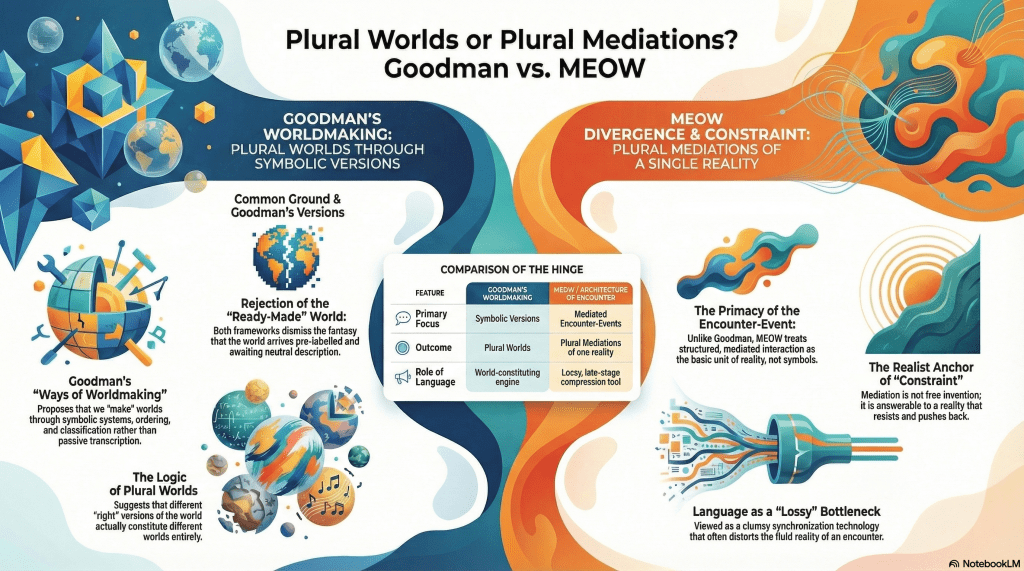
NotebookLM Infographic on this topic.
Audio: NotebookLM summary podcast of this topic.

Tl;dr

Goodman and MEOW are neighbours, but not housemates.

Both reject the childish fantasy that the world arrives already parcelled, labelled, and politely awaiting description by some neutral observer. Both are suspicious of naïve realism, fixed essences, and the conceit that language simply mirrors what is there. Both recognise that description, classification, and articulation are active, selective, and world-shaping.

But Goodman’s emphasis falls on versions, symbol systems, and the making of worlds through classificatory practice. MEOW and The Architecture of Encounter go elsewhere. They do not treat symbolic versioning as primary. They treat encounter as primary: mediated, structured interaction under constraint. Language and world-versioning come later, as derivative, partial, and often clumsy attempts to stabilise, synchronise, and re-present what is first given in encounter.

So the shortest contrast is this:

That is the hinge.

The longer version

Goodman is often useful precisely because he helps loosen the grip of a bad picture: the notion that there is one fully furnished world, discretely laid out in advance, which language then copies with greater or lesser success. In Ways of Worldmaking, description is not passive transcription. Versions organise, sort, foreground, suppress, classify, and compose. They do not simply mirror. They make.

This much sits quite comfortably beside MEOW and The Architecture of Encounter. MEOW has never been sympathetic to the old theatre in which a subject peers out at a ready-made object-world and then tries to report back accurately. That picture has always seemed less like sober metaphysics and more like a grammatical superstition. It is one of those inherited arrangements that philosophy keeps polishing rather than questioning, as if centuries of confusion were somehow evidence of depth.

On that score, Goodman is an ally. He helps dissolve the myth of innocent description.

He also overlaps with MEOW in his suspicion of essentialist carving. There is no reason to suppose reality presents itself in one uniquely natural partition, fully jointed in the exact way our preferred nouns imply. Goodman’s attention to alternative versions, symbolic orderings, and rival systems of classification fits comfortably with the broader MEOW suspicion that what we call “objects” are not self-announcing substances but stabilised articulations within a mediated field. In The Architecture of Encounter, this becomes still sharper: subjects and objects are not ontological primitives but abstractions from recurring encounter-structures. That already places the framework some distance from ordinary metaphysical furniture.

So far, then, the affinity is genuine.

But it is just as important not to overstate it.

Goodman’s centre of gravity is symbolic and versional. His concern is with how worlds are made through systems of description, notation, projection, ordering, and exemplification. The operative verbs are things like sort, render, compose, construct. The world is inseparable from the version.

MEOW and The Architecture of Encounter are doing something heavier. They are not merely offering a theory of how descriptions organise a world. They are offering an ontology in which encounter-events are primary. The basic unit is not an interpreted object, nor a version, nor a sentence, but a structured event of mediated contact under constraint. Mediation is not a regrettable screen placed between mind and world. It is constitutive of whatever relation there is. But neither is mediation free invention. Encounter is answerable to what resists, pushes back, stabilises, recurs, and converges. That is the role of constraint.

This is where the deepest divergence emerges.

Goodman is often read, not unfairly, as weakening the notion of a single underlying world more radically than MEOW can tolerate. His pluralism risks allowing “worldmaking” to carry most of the ontological burden. The result can begin to sound as though right versions are all the realism one is entitled to. There are worlds, or world-versions, and their legitimacy depends less on correspondence to a singular underlying reality than on fit, function, coherence, utility, and internal rightness.

MEOW resists that move. It does not return to vulgar realism, with its fantasy of a view from nowhere, but it also refuses to let mediation collapse into fabrication. Constraint is not a decorative afterthought. It is the realist anchor. One may have multiple mediations, multiple articulations, multiple ontological grammars, multiple local stabilisations, but these are not unconstrained improvisations. They are answerable to an invariant field of relational resistance.

Put more brutally: Goodman destabilises the ready-made world and then tends to leave us with versions. MEOW destabilises the ready-made world and then asks what must be true for divergent mediations nonetheless to converge, however partially, on the same resistant reality.

That difference matters.

It matters again when language enters the picture. Goodman grants an enormous role to symbol systems in worldmaking. MEOW, especially once read through The Architecture of Encounter and A Language Insufficiency Hypothesis, treats language more suspiciously. Language matters, certainly, but it is late, compressed, and lossy. It is not the primordial engine of world-constitution. It is a finite synchronisation technology layered atop more basic forms of mediation: biological, perceptual, attentional, cognitive, social. Language helps coordinate. It helps compress. It helps stabilise public handling. But it also distorts, truncates, nominalises, and overcommits.

That is where LIH adds a useful corrective to Goodman. If Goodman sometimes sounds like a connoisseur of world-versioning, LIH reminds us that our versioning machinery is often embarrassingly underpowered for the tasks philosophers assign to it. Human beings keep trying to force syntax to carry ontological burdens it was never built to bear. We take grammatical distinctions for metaphysical disclosures. We inherit noun-heavy structures and then wonder why the world starts looking like a warehouse of things. We reify processes, discretise continua, and carve durational realities into portable lexical chunks. Then, having manufactured these pseudo-stabilities, we congratulate ourselves for discovering “selves”, “minds”, “meanings”, “moral facts”, and other linguistic taxidermy.

Goodman certainly helps expose the active role of symbolic systems. But LIH presses further by insisting that symbolic systems are not merely worldmaking tools. They are also bottlenecks. They fail. They coarsen. They generate ontological illusions through the very act of public coordination.

That is why I would not place Goodman and MEOW in opposition, but in a relation of partial inheritance and correction.

Goodman is valuable because he helps dismantle the myth of passive representation. He is right to resist the idea that language or symbolisation merely records a pre-cut world. He is right to foreground selection, ordering, categorisation, and articulation. He is right to reject the transparent-window fantasy.

But from a MEOW standpoint, he does not go far enough into encounter, and perhaps goes too far into version.

What is missing is a richer account of pre-linguistic mediation, presentational structure, salience, affordance, and the layered constraints under which any symbolic practice becomes possible in the first place. Symbol systems do not float free. They do not arise in a void. They are parasitic upon lived, embodied, constrained encounter. Nor is their plurality enough, by itself, to explain why some articulations fail, why some converge, why some distort in systematic ways, or why reality resists our preferred descriptions with such vulgar persistence.

That last point is worth dwelling on, because it is where many anti-realist gestures lose their nerve. The fact that access is mediated does not imply that reality is manufactured. The fact that articulation is active does not imply that resistance is optional. The fact that classifications vary does not imply that there is nothing to be classified beyond the classificatory act.

So the bottom line remains the same.

Goodman is useful for breaking the spell of the one already-made world and for showing that symbolisation is not passive mirroring. But MEOW and The Architecture of Encounter push in a different direction. They relocate the primary philosophical action from symbol systems to encounter-events, from worldmaking to world-disclosure under mediation, and from plural worlds to plural access under constraint. A Language Insufficiency Hypothesis then sharpens the point by showing that language is not an omnipotent engine of constitution but a compression scheme with predictable failure modes.
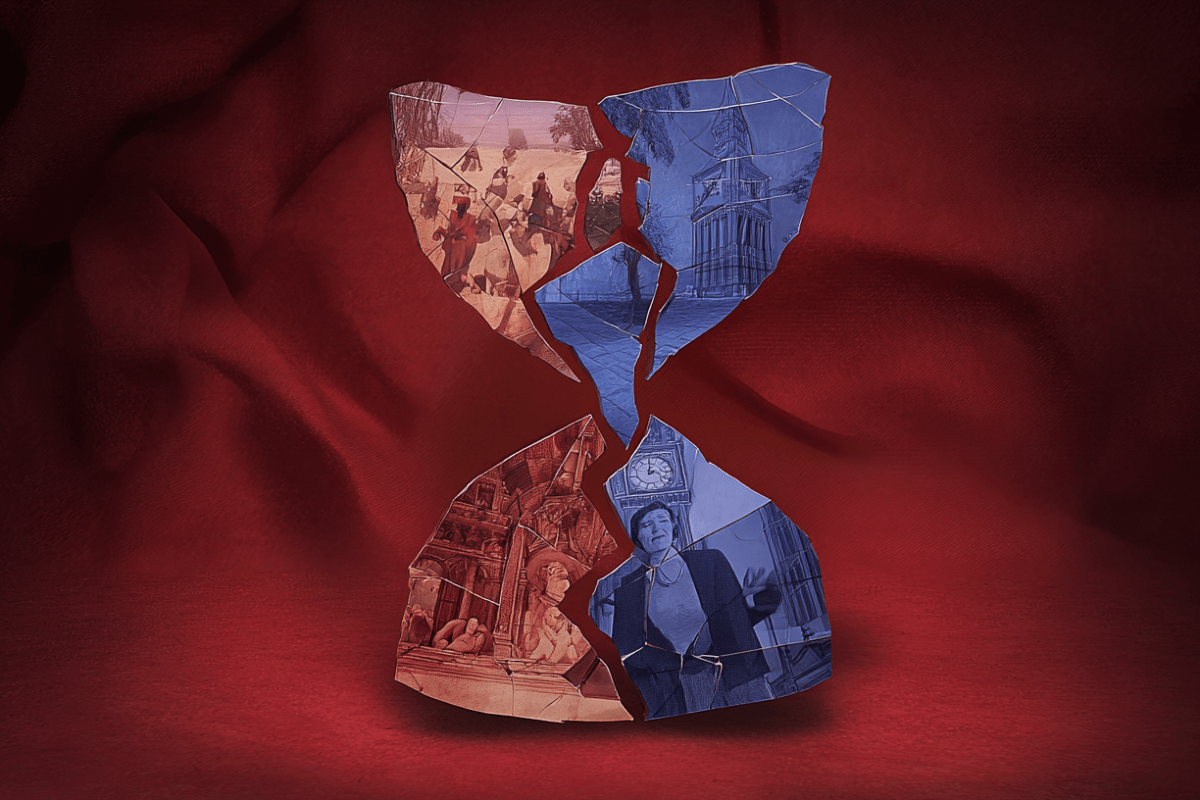
The Republic of Recursive Prophecy

5–7 minutes

How the Trump Era Rewrote Time, Truth, and the Very Idea of a Common World

Politics in the Trump era wasn’t merely a spectacle of bad manners and worse epistemology; it was the moment the United States stopped pretending it shared a common world – when politics ceased to be a quarrel over facts and became a quarrel over the very conditions that make facts possible. This essay is part of an ongoing project tracing how post-Enlightenment societies lose their shared grammar of verification and retreat into parallel narrative architectures that demand allegiance rather than assessment.

And before anyone hyperventilates about implied asymmetry: the recursive logic described here is not exclusive to the right. The progressive cosmology, though stylistically different, exhibits the same structural features – prophetic claims about impending catastrophe or salvation, retrospective reinterpretations to maintain coherence, and an insistence on possessing privileged interpretive tools. The Trump era didn’t invent this recursive mode; it simply accelerated it, stripped it naked, and pumped it through a 24-hour media bloodstream until everyone could see the circuitry sparking.

Audio: NotebookLM podcast on this topic.

Welcome to the new cosmology.

1. The Death of a Common Grammar

Once the shared grammar of verification dissolves, political discourse stops unfolding in empirical time. It migrates into suspended futurity – a realm of conditional wagers:

If this, then that. Just wait. You’ll see. The future will vindicate us.

But the horizon keeps receding. When reality refuses to comply, factions rewrite the past to preserve the equilibrium between prophecy and outcome. Truth becomes less a matter of correspondence and more an act of narrative self-maintenance. Where the world diverges from the story, the world is adjusted.

Political time becomes pliable; the narrative must be kept intact, whatever the cost.

2. Mimetic Prophecy and the Absence of Catharsis

A Girardian lens clarifies what’s happening beneath the surface. The factions are not simply disagreeing; they are locked in mimetic rivalry, each imitating the other’s claim to prophetic vision. Insight becomes the mimetic object: each camp insists it alone can decode the approaching shape of events.

As the rivalry escalates, differentiation collapses. Both sides perform identical moves – warnings of authoritarianism, narratives of national peril, promises of historical vindication – whilst insisting the other’s prophecies are delusional.

In classic Girardian fashion, this symmetry produces a crisis: a collapse of distinction between rivals, accompanied by a desperate hunt for a stabilising sacrifice. In the Trump era, the scapegoat was not a person but a category: truth itself. Doubt, verification, shared reality – these were sacrificed at the altar of maintaining internal cohesion.

Yet unlike the societies Girard studied, the American polity achieves no catharsis. The sacrificial mechanism fails. No cleansing moment restores order. The cycle loops endlessly, forcing the community to reenact the ritual without the relief of resolution.

Prophecy, rivalry, crisis – repeat.

3. From Chronology to Mythic Temporality

Once prediction and remembrance collapse into one another, political time becomes mythic rather than chronological. The present becomes a hinge between two versions of the world: the one the faction already believes in and the one it insists the future will confirm.

The future becomes partisan property. The past becomes commentary. The present becomes maintenance.

Each faction edits its cosmology to preserve coherence, producing a recursive temporality in which prophecy and memory reinforce one another. Narrative supplants chronology; plausibility is subordinated to coherence. The factions are not lying; they are mythologising.

This is what a society does when it cannot stabilise truth but cannot abandon truth-claims either.

4. Madison’s Diagnosis, Reversed

James Madison, in his republican optimism, believed factions were inevitable but containable. Pluralism, he argued, would safeguard the republic by ensuring no faction could elevate its partial vision into a universal claim. The sheer scale and diversity of the republic would generate cross-pressure strong enough to check epistemic domination.

He assumed a shared evidentiary world.

He did not imagine a polity in which factions construct discrete epistemic universes – self-sealing interpretive systems with their own temporal orders, myths of origin, and theories of legitimacy. Under such conditions, pluralism no longer disciplines factional excess; it shelters it. It becomes a buffer that prevents contact, not a mechanism that fosters correction.

Madison feared that factions might mistake their partial view for the whole.
Our moment dissolves the very idea of the whole.

Pluralism, once a remedy, becomes the architecture of epistemic secession.

5. The Theatre of Recursive Narration

What remains is not deliberation but theatre—political communities sustained by the perpetual reenactment of their own certainties. Each faction maintains itself through narrative recursion, chanting the same incantation of retrospective rightness, performing the same rites of interpretive renewal.

The republic no longer hosts disagreement; it hosts parallel cosmologies.

In the republic of recursive prophecy, truth is no longer what grounds politics – it’s what politics performs.


Afterword

This article followed a chat with ChatGPT. For what it’s worth, I now style myself a post-postmodern, post-critical theorist – though these labels are as pointless as the ones they replace.

The conversation began with Paul Feyerabend’s Against Method, which was already on my mind. In Appendix 1 he writes:

That set me wondering, again, how one discerns signal from noise. As a statistician, separating wheat from chaff is my daily bread, but how does one do it politically without pretending to possess privileged access to truth? In this environment, each faction insists it has such access. The other side, naturally, is deluded. Ignore the fact that there are more than two sides; binary thinking is the fashion of the day.

I leaned on ChatGPT and asked for sources on this lemma – what to read, where to dig. It replied with books I’d already read, save for one:

  1. Paul Feyerabend: Against Method and Science in a Free Society
  2. Jean-François Lyotard: The Postmodern Condition
  3. Richard Rorty: Contingency, Irony, and Solidarity
  4. Michel Foucault: Power/Knowledge and The Archaeology of Knowledge
  5. Jacques Derrida: Of Grammatology and Positions
  6. Bruno Latour: We Have Never Been Modern
  7. Chantal Mouffe and Ernesto Laclau: Hegemony and Socialist Strategy

I hadn’t read Laclau & Mouffe. ChatGPT summarised them neatly:

Right up my street. (I still need to read it.)

That, in turn, brought Madison’s Federalist No. 10 to mind – his warning that factional division, particularly the two-party structure the United States later perfected, would one day become corrosive.

Then Girard entered the chat. And so on. We followed the thread a little longer until this essay took shape. I didn’t feel compelled to polish it into a formal academic piece. A blog seems a far better home for now, and the essay version can remain an open question.

A Case for Intersectionalism

The Space Between

In the great philosophical tug-of-war between materialism and idealism, where reality is argued to be either wholly independent of perception or entirely a construct of the mind, there lies an underexplored middle ground—a conceptual liminal space that we might call “Intersectionalism.” This framework posits that reality is neither purely objective nor subjective but emerges at the intersection of the two. It is the terrain shaped by the interplay between what exists and how it is perceived, mediated by the limits of human cognition and sensory faculties.

Audio: Podcast conversation on this topic.

Intersectionalism offers a compelling alternative to the extremes of materialism and idealism. By acknowledging the constraints of perception and interpretation, it embraces the provisionality of knowledge, the inevitability of blind spots, and the productive potential of uncertainty. This essay explores the foundations of Intersectionalism, its implications for knowledge and understanding, and the ethical and practical insights it provides.

Reality as an Intersection

At its core, Intersectionalism asserts that reality exists in the overlapping space between the objective and the subjective. The objective refers to the world as it exists independently of any observer—the “terrain.” The subjective encompasses perception, cognition, and interpretation—the “map.” Reality, then, is not fully contained within either but is co-constituted by their interaction.

Consider the act of seeing a tree. The tree, as an object, exists independently of the observer. Yet, the experience of the tree is entirely mediated by the observer’s sensory and cognitive faculties. Light reflects off the tree, enters the eye, and is translated into electrical signals processed by the brain. This process creates a perception of the tree, but the perception is not the tree itself.

This gap between perception and object highlights the imperfect alignment of subject and object. No observer perceives reality “as it is” but only as it appears through the interpretive lens of their faculties. Reality, then, is a shared but imperfectly understood phenomenon, subject to distortion and variation across individuals and species.

The Limits of Perception and Cognition

Humans, like all organisms, perceive the world through the constraints of their sensory and cognitive systems. These limitations shape not only what we can perceive but also what we can imagine. For example:

  • Sensory Blind Spots: Humans are limited to the visible spectrum of light (~380–750 nm), unable to see ultraviolet or infrared radiation without technological augmentation. Other animals, such as bees or snakes, perceive these spectra as part of their natural sensory worlds. Similarly, humans lack the electroreception of sharks or the magnetoreception of birds.
  • Dimensional Constraints: Our spatial intuition is bounded by three spatial dimensions plus time, making it nearly impossible to conceptualise higher-dimensional spaces without resorting to crude analogies (e.g., imagining a tesseract as a 3D shadow of a 4D object).
  • Cognitive Frameworks: Our brains interpret sensory input through patterns and predictive models. These frameworks are adaptive but often introduce distortions, such as cognitive biases or anthropocentric assumptions.

This constellation of limitations suggests that what we perceive and conceive as reality is only a fragment of a larger, potentially unknowable whole. Even when we extend our senses with instruments, such as infrared cameras or particle detectors, the data must still be interpreted through the lens of human cognition, introducing new layers of abstraction and potential distortion.

The Role of Negative Space

One of the most intriguing aspects of Intersectionalism is its embrace of “negative space” in knowledge—the gaps and absences that shape what we can perceive and understand. A compelling metaphor for this is the concept of dark matter in physics. Dark matter is inferred not through direct observation but through its gravitational effects on visible matter. It exists as a kind of epistemic placeholder, highlighting the limits of our current sensory and conceptual tools.

Similarly, there may be aspects of reality that elude detection altogether because they do not interact with our sensory or instrumental frameworks. These “unknown unknowns” serve as reminders of the provisional nature of our maps and the hubris of assuming completeness. Just as dark matter challenges our understanding of the cosmos, the gaps in our perception challenge our understanding of reality itself.

Practical and Ethical Implications

Intersectionalism’s recognition of perceptual and cognitive limits has profound implications for science, ethics, and philosophy.

Science and Knowledge

In science, Intersectionalism demands humility. Theories and models, however elegant, are maps rather than terrains. They approximate reality within specific domains but are always subject to revision or replacement. String theory, for instance, with its intricate mathematics and reliance on extra dimensions, risks confusing the elegance of the map for the completeness of the terrain. By embracing the provisionality of knowledge, Intersectionalism encourages openness to new paradigms and methods that might better navigate the negative spaces of understanding.

Ethics and Empathy

Ethically, Intersectionalism fosters a sense of humility and openness toward other perspectives. If reality is always interpreted subjectively, then every perspective—human, animal, or artificial—offers a unique and potentially valuable insight into the intersection of subject and object. Recognising this pluralism can promote empathy and cooperation across cultures, species, and disciplines.

Technology and Augmentation

Technological tools extend our sensory reach, revealing previously unseen aspects of reality. However, they also introduce new abstractions and biases. Intersectionalism advocates for cautious optimism: technology can help illuminate the terrain but will never eliminate the gap between map and terrain. Instead, it shifts the boundaries of our blind spots, often revealing new ones in the process.

Conclusion: Navigating the Space Between

Intersectionalism provides a framework for understanding reality as a shared but imperfect intersection of subject and object. It rejects the extremes of materialism and idealism, offering instead a middle path that embraces the limitations of perception and cognition while remaining open to the possibilities of negative space and unknown dimensions. In doing so, it fosters humility, curiosity, and a commitment to provisionality—qualities essential for navigating the ever-expanding terrain of understanding.

By acknowledging the limits of our maps and the complexity of the terrain, Intersectionalism invites us to approach reality not as a fixed and knowable entity but as an unfolding interplay of perception and existence. It is a philosophy not of certainty but of exploration, always probing the space between.