The Merits of Meritocracy

4–5 minutes

I shared another Substack post, but I want to expand it a bit here. On the Substack version, I conspicuously didn’t name certain obvious names, but here, I shall. I also left out a reference to Plato’s Republic.

Meritocracy, and the men who would not deny it

The current American regime is built on meritocracy, and – this is the part everyone misses – it would not deny the charge. It rather likes the word. It uses the reinterpreted version, the laundered one my other essay was about, in which merit means precisely whatever the sovereign has decided it should mean this morning. Accuse them of meritocracy, and they will thank you for noticing.

Take the man at the centre of it. Whether Donald Trump is meritorious is not, in the end, a question about Donald Trump. It is a question about which ontological grammar you happen to be speaking, because the grammar constitutes the object before a single fact is admitted into evidence. This is the whole Language Insufficiency point in miniature: the frame quietly does the work the facts are later congratulated for.

To Cohort A, he is a charismatic and self-made businessman. The six bankruptcies are not failures but proof of a shrewd operator who knows how to play the game and walk away intact – power-mind, killer instinct, the art of the deal. That he has a decades-long habit of not paying his contractors, and an even longer one of not paying his tax, does not indict him; it endears him. It makes him the everyman who beat the system the rest of us merely resent. A working-class hero, if you can manage it, descending on a golden escalator.

To Cohort B – and I’ll confess my membership, since honesty is cheaper than the pretence of the view from nowhere – he is a less likeable Forrest Gump: a man forever arriving at the centre of history without ever quite grasping how he got there, weaponising a charisma that works only on the already-mesmerised, and rebuilding the world with himself at the origin. He has a certain gravity. It attracts sycophants and rewards them, which is the only merit test his court reliably administers.

Same man. Two grammars. The ‘merit’ resides in neither the man nor the record; it is assigned by the frame and then invoiced to the evidence. Which is exactly the thesis of the parent essay, now wearing a name tag.

The downward stroke, said plainly

The parent essay left the reverse operation as a coy ‘phrase in current circulation’. I’ll say it here without the euphemism: DEI hire. The move is to take career civil servants – people with decades of demonstrable domain competence, whatever their private politics – and broad-brush them as diversity appointments, which is to say, unqualified by definition, arrived by an unauthorised route. The vacancies then fill with those who have pledged fealty and displayed the one indispensable qualification: a flexible integrity. The competent are marked down for being the wrong sort; the pliant are marked up for being biddable. ‘Incompetent’ has been quietly reissued to mean not ours, and ‘qualified’ to mean loyal. Same machine, thrown into reverse – now with a name engraved on the lever.

The cream, and the dimension it rose along

Which brings me, as these things do, to Plato. The Substack piece used his ship of state – the crew who master the mutiny rather than the sea. Here I want the other half of the same complaint: the comfortable conviction that the meritorious rise to the top like cream.

They do rise. That was never in dispute. What the metaphor conceals is the dimension along which they rose. These people are genuinely competent – at working the system, at the acquisition and retention of position – which is a wholly different skill from governing, and precisely the one we so conveniently assume we were measuring. Cream rises; so does scum; the trope declines to specify which, and physics is no help at all.

This is the standing problem of republicanism – and no, before anyone lunges for the comment box, I do not mean the Republican Party, which has its own well-stocked catalogue of failures, as do the Democrats, who would be unwise to feel smug reading this. Nor is any of it uniquely American. If you are somewhere else entirely, enjoying the spectacle from a safe distance, do put the popcorn down. The mechanism by which a society mistakes competence-at-ascending for competence-at-ruling is not a national defect. It is a design flaw in selection itself, and your country installed it too.

I will not, on this occasion, start in on the failings of democracy as a system. Been there; done that. There are only so many sacred cows a man can tip before lunch.

The question, once more

‘Meritocracy’ survives all of this the way it survives everything – by never once being asked the only question that matters: merit at what, judged by whom, to whose benefit? Put it to the present court, and the answer is almost embarrassingly legible. Which is, of course, exactly why the question is never put.

Impostors, Competence, and the HR Hall of Mirrors

I was a professional musician in the 1980s. I played guitar, but this was always a sideline to my real work as a recording engineer and producer. Competence, not virtuosity, was the coin of the realm in the studio, and I was competent. Still, I spent much of my time surrounded by musicians who left me slack-jawed: people who could sight-read Bach at breakfast and bash out Van Halen riffs after lunch without missing a beat. Next to them, I was, charitably, merely competent.

That’s the thing about competence: it doesn’t make you the star, but it keeps the machine running. I knew I wasn’t the flash guitarist or the prodigy bassist, but I could play my parts cleanly and hold a band together. When later groups already had lead guitarists, I played bass. Was I a bassist? No. But I was competent enough to lock in with the drummer and serve the ensemble. Nobody mistook me for a virtuoso, least of all me. I wasn’t an impostor; I was a cog in the machine, good enough to keep the show on the road. That was my ego attachment: not “musician” as identity, but member of a band.

The Hallucination of “Impostor Syndrome”

Much ink is spilt on impostor syndrome, that anxious whisper that one is a fraud who doesn’t belong. The polite story is that it’s just nerves: you are competent, you do belong, you’re simply holding yourself against impossible standards. Nonsense. The truth is darker. Most people are impostors.

The nervous tension is not a malfunction of self-esteem; it’s a moment of clarity. A faint recognition that you’ve been miscast in a role you can’t quite play, but are forced to mime anyway. The Peter Principle doesn’t kick in at some distant managerial plateau; it’s the basic law of organisational gravity. People rise past their competence almost immediately, buoyed not by skill but by connections, bluff, and HR’s obsession with “fit.”

The Consultant’s View from the Cheap Seats

As a Management Consultant™, I met countless “leaders” whose only discernible talent was staying afloat whilst already over their heads. Organisations, too blind or too immature to notice, rewarded them with raises and promotions anyway. Somebody’s got to get them, after all. HR dutifully signed the paperwork, called it “talent management,” and congratulated itself on another triumph of culture-fit over competence.

In music, incompetence is self-correcting: audiences walk out, bands dissolve, the market punishes mediocrity. In corporate life, incompetence metastasises. Bluffers thrive. Mediocrity is embalmed, padded with stock options, and paraded on stage at leadership summits.

Good Enough vs. Bluff Enough

Competence, though, is underrated. You don’t need to be the best guitarist or the savviest CEO. You need to be good enough for the role you’re actually playing, and honest enough not to mistake the role for your identity. In bands, that worked fine. In business and politics, it’s subversive. The whole edifice depends on people pretending to be more than they are, rehearsing confidence in lieu of competence.

No wonder impostor syndrome is rampant. It’s not a pathology; it’s the ghost of truth in a system of lies.

The antidote isn’t TED-talk therapy or self-affirmation mantras. It’s honesty: admit the limits of your competence, stop mistaking ego for ability, and refuse to play HR’s charade. Competence is enough. The rest is noise.

HR’s Neoliberal Mirage: Human Resources Without the Humans

Let us disabuse ourselves of one of the workplace’s most cherished delusions: that Human Resources is there for the humans. HR is not your therapist, not your advocate, not your confessor. HR is an appendage of the organisation, and like all appendages, its nerve endings run straight back to the corporate brain. Its “concern” for your well-being is merely a prophylactic against lawsuits and productivity dips. The error is ours; we persist in mistaking the guard dog for a pet.

Audio: NotebookLM podcast on this topic.

Bal and Dóci’s 2018 paper in the European Journal of Work and Organizational Psychology (EJWOP) tears the mask off this charade. They demonstrate how neoliberal ideology has seeped, unseen, into both workplace practice and the very research that pretends to study it objectively. Through the lenses of political, social, and fantasmatic logics, they show that neoliberalism has convinced us of three dangerous fairy tales:

  • Instrumentality: people are not people but “resources,” as fungible as printer ink.
  • Individualism: you are not part of a collective but a lone entrepreneur of the self, shackled to your CV like a Victorian debtor.
  • Competition: you are locked in an endless cage fight with your colleagues, grinning through the blood as you “collaborate.”

These logics are then dressed up in fantasies to keep us compliant: the fantasy of freedom (“you’re free to negotiate your own zero-hours contract”), the fantasy of meritocracy (“you got that promotion because you’re brilliant, not because you went to the right school”), and the fantasy of progress (“growth is good, even if it kills you”).

Those of us with an interest in Behavioural Economics had naively hoped that the mythical homo economicus, that laughable caricature of a rational, utility-maximising automaton, would by now be filed under “anachronistic curiosities.” Yet in corporate domains, this zombie shuffles on, cosseted and cultivated by neoliberal ideology. Far from being discredited, homo economicus remains a protected species, as if the boardroom were some Jurassic Park of bad economics.

The brilliance and the horror is that even the academics meant to be studying work and organisations have been captured by the same ideology. Work and Organisational Psychology (WOP) too often frames employees as variables in a productivity equation, measuring “engagement” only in terms of its effect on shareholder value. The worker’s humanity is rendered invisible; the employee exists only insofar as they generate output.

So when HR offers you a mindfulness app or a “resilience workshop,” remember: these are not gifts but obligations. There are ways of making you responsible for surviving a system designed to grind you down. The neoliberal trick is to convince you that your suffering is your own fault, that if only you had been more proactive, more adaptable, more “employable,” you wouldn’t be so crushed beneath the wheel.

Bal and Dóci are right: the way forward is to re-politicise and re-humanise organisational studies, to see workers as humans rather than performance units. But until then, expect HR to keep smiling while sharpening its knives.

Technofeudalism: It’s a Wrap

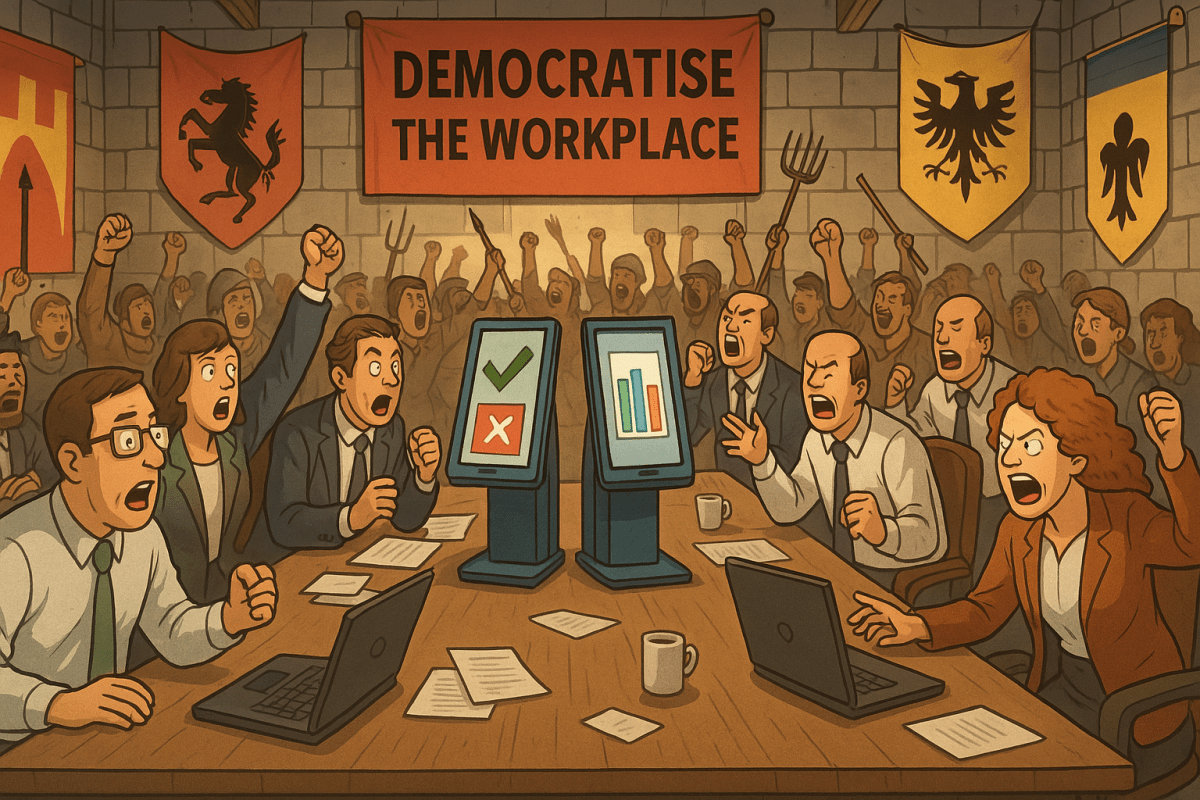
By the time we reach Chapter Seven of Technofeudalism: What Kills Capitalism, Yanis Varoufakis drops the ledger sheets and spreadsheets and starts sketching utopia in crayon. Entitled Escape from Technofeudalism, it proposes—brace yourself—a workplace democracy. It’s aspirational, yes. Compelling? Not particularly. Especially if, like me, you’ve long since stopped believing that democracy is anything more than a feel-good placebo for structural impotence.

Audio: NotebookLM podcast discussing this topic.

To be clear: the preceding chapters, particularly the first six, are sharp, incisive, and frankly, blistering in their indictment of today’s economic disfiguration. But Chapter Seven? It’s less an escape plan, more a group therapy session masquerading as an operational model.

So let’s take his proposal for Democratised Companies apart, one charming layer at a time.

Splendid. One person, one vote. Adorable.

Because there’s nothing more efficient than a hiring committee comprised of thirty engineers, two janitors, a receptionist, and Steve from Accounts, whose main contribution is passive-aggressive sighing.

Marvellous. We’ve now digitised the tyranny of the majority and can timestamp every idiotic decision for posterity.

A relief. Until it doesn’t.

Here, dear reader, is where the cake collapses. Why, precisely, should a randomly-assembled group of employees—with wildly varying financial literacy—be entrusted to divide post-tax revenue like it’s a birthday cake at a toddler’s party?

And how often are these slices recalibrated? Each fiscal year? Every time someone is hired or fired? Do we amend votes quarterly or wait until the economic ship has already struck an iceberg?

Varoufakis does suggest preference voting to tackle allocation disputes:

Fine. In theory, algorithmic voting procedures sound neat. But it presumes voters are rational, informed, and cooperative. If you’ve ever seen a corporate Slack thread devolve into emoji warfare, you’ll know that this is fiction on par with unicorns and meritocracy.

Ah yes, the ‘equality’ bit. Equal pay, unequal contribution. This isn’t egalitarianism—it’s enforced mediocrity. It might work in a monastery. Less so in a competitive tech firm where innovation requires both vision and differentiated incentive.

Now, on to bonuses, which are democratically determined by:

Welcome to Black Mirror: Workplace Edition. This is less economics, more playground politics. Who gets tokens? The charismatic chatterbox in the break room? The person who shared their lunch? The ghost employee who never shows up but emails back promptly?

And how, pray tell, does one evaluate the receptionist’s contribution relative to the lead engineer’s or the janitor’s? This isn’t peer review—it’s populism with a smiley face.

We’ve all seen “Teacher of the Year” competitions turn into contests of who had the cutest class poster or best cupcakes. Now imagine your livelihood depending on it.

In summary, democracy in the workplace may sound noble, but in practice, it’s the bureaucratic equivalent of herding caffeinated cats. It doesn’t even work in small groups, let alone an organisation of hundreds. Democracy—when applied to every function of an enterprise—is not liberation; it’s dilution. It’s design-by-committee, strategy-by-consensus, and ultimately, excellence-by-accident.

Escape from Technofeudalism? Perhaps. But not by replacing corporate lords with intranet polls and digital tokens. That’s not an exit strategy—it’s a cosplay of collectivism.