Watching Sam Harris ruminate on the nature of political lies (still believing, poor lamb, that reason might one day triumph) reminds me of something more sinister: lies today are not attempts at persuasion. They are shibboleths — tribal passwords, loyalty oaths, secret handshakes performed in the broad light of day.
Video: Sam Harris tells us why Trump and his ilk lie.
Forget “alternative facts.” That charming euphemism was merely a decoy, a jangling set of keys to distract the infantile media. The real game was always deeper: strategic distortion, the deliberate blurring of perception not to deceive the outsider, but to identify the insider.
Audio: NotebookLM podcast on this topic.
When Trump — or any other post-truth demagogue — proclaims that penguins are, in fact, highly trained alien operatives from the Andromeda galaxy, the objective is not persuasion. The point is to force a choice: will you, standing before this glistening absurdity, blink and retreat into reason, stammering something about ornithology… Or will you step forward, clasp the hand of madness, and mutter, ‘Yes, my liege, the penguins have been among us all along’?
Those who demur, those who scoff or gasp or say ‘You’re an idiot,”’have failed the loyalty test. They have outed themselves as enemy combatants in the epistemic war. Truth, in this brave new world, is not a destination; it is an allegiance. To speak honestly is to wage rebellion.
Orwell, who tried very hard to warn us, understood this dynamic well: the real triumph of Big Brother was not merely to compel you to lie but to compel you to believe the lie. Koestler, another battered prophet of the age, charted how political movements sink into ritualistic unreason, demanding not conviction but performance. Swift, for his part, knew it was all hilarious if you tilted your head just right.
The bigger the lie, the better the shibboleth. Claim that two and two make five, and you catch out the weak-willed rationalists. Claim that penguins are extraterrestrials, and you find the truly devoted, the ones willing to build altars from ice and sacrifice to their feathery overlords.
It’s no accident that modern political theatre resembles a deranged initiation ritual. Each day brings a new absurdity, a fresh madness to affirm: ‘Men can become women by declaration alone!” “Billionaires are victims of systemic oppression!’ ‘The penguins are amongst us, plotting!’ Each claim a little more grotesque than the last, each compliance a little more degrading, a little more irreversible.
And oh, how eagerly the initiates rush forward! Clap for the penguins, or be cast out into the howling wilderness! Better to bend the knee to absurdity than be marked as an unbeliever. Better to humiliate yourself publicly than to admit that the Emperor’s penguin suit is just a costume.
Meanwhile, the opposition — earnest, naive — keeps trying to argue, to rebut, to point out that penguins are terrestrial flightless birds. How quaint. How pathetic. They do not understand that the moment they say, “You’re an idiot,” they’ve broken the spell, declared themselves apostates, and rendered themselves politically irrelevant.
The shibboleth, once uttered, divides the world cleanly: the believers, who will say anything, do anything, believe anything, provided it marks them safe from exile; and the infidels, who cling stupidly to reality.
The future belongs, not to the true, but to the loyal. Not to the rational, but to the ritualistic. The more extravagant the lie, the greater the proof of your faith.
So raise a glass to the penguins, ye of faint heart, and prepare your soul for abasement. Or stand firm, if you dare, and be prepared to be eaten alive by those who traded reason for the rapture of belonging.
After all, in the land of the blind, the one-eyed man is not king. He’s a heretic.
We live in an age of two-dimensional minds trying to navigate a three-dimensional world—and doing it with all the grace of a toddler wielding a chainsaw. For over a generation, the US and UK have been polarised, Balkanised, and lobotomised by the Great Red vs. Blue Punch & Judy Show. Left, right. Us, them. Hero, villain. There is no nuance, no gradient, no middle ground. Just a glorious reduction of civilisation’s complexities into primary-coloured football teams for emotionally underdeveloped adults.
This is not politics. This is pantomime.
Audio: NotebookLM podcast on this topic.
And the real tragedy? The world isn’t even two-dimensional. It’s not even three. Try thinking of it as a cube—six sides at least, all pressing in at once, depending on your angle. Culture, history, class, geography, education, trauma, temperament, aesthetic preference—each a face of the cube. But tell that to the modern partisan and they’ll squint at you like you’ve just tried to explain jazz to a toaster.
No, to them, the world is flat. A line. A tug-of-war between two equally blinkered tribes dragging the rest of us into the pit. Pick a side or shut up, they shriek. If you’re not with us, you’re against us. If you don’t chant the correct slogans or signal the proper virtues, you’re obviously a heretic, a bigot, or—worst of all—centrist scum. They don’t want conversation; they want confirmation. Preferably in 280 characters or less.
Try introducing complexity and you’ll be accused of bothsidesism, moral cowardice, or—God forbid—thinking. It’s like throwing a Rubik’s cube into a toddler fight club.
This binary reductionism doesn’t stop at politics. Even gender—possibly the most nuanced and intimate aspect of human identity—has been flattened into a tug-of-war between biological essentialists and gender abolitionists, both sides wielding hashtags like holy relics. The irony? These same culture warriors still manage to marvel at rainbows, utterly unaware that their own worldview only permits two colours. How do they even process a traffic light?
The cult of the binary isn’t just intellectually bankrupt—it’s a threat to civilisation. We didn’t crawl out of the primordial ooze, develop language, invent calculus, and split the atom just so Karen and Kev from Facebook could reduce geopolitics to an episode of EastEnders. The world is messy. People are contradictory. Context matters. But nuance doesn’t trend.
We’re governed by algorithms, policed by outrage, and divided by design. The machinery of mass culture rewards the loudest, angriest, most wilfully ignorant voices, and we feed the beast like dopamine-addled pigeons pecking a lever. The cube has been flattened into a cartoon. And yet we wonder why everything feels broken.
So here’s a radical idea: what if we stopped flattening the world into a battlefield and started mapping it like a landscape? What if we admitted that not every problem has two sides—some have two hundred? What if we taught critical thinking instead of tribal loyalty? What if we made complexity sexy again?
But I digress. That might require imagination. And we’ve outsourced that to TikTok influencers and AI chatbots.
Meanwhile, the cube spins. And the rest of us try to hold on.
But this post isn’t about the book. It’s about what all good books should do: make you think.
If you’ve followed my writing over the years, you’ll know that I have little patience forpsychology, which I regard as the astrology to neuroscience’s astronomy. Reading Fisher’s Capitalist Realismhas only reinforced this perspective.
Frankly, I should do away with psychology altogether. Much of it—no, not just the vacuous self-help drivel clogging the internet and bookstore shelves—is pseudoscience. To its credit, it did function as a stepping stone to neuroscience, but that’s like crediting alchemy for modern chemistry.
Psychology’s greatest sin? Missing the forest for the trees—or, more precisely, ignoring the structural forces that shape the so-called individual. Western capitalism, ever eager to monetize everything, finds it far easier (and more profitable) to blame the individual rather than the system. It’s like the old joke about the man searching for his lost keys under the streetlamp, not because that’s where he dropped them, but because that’s where the light is. It’s just more convenient (and profitable) that way.
Enter psychology: the perfect tool for a society steeped in narcissism and instant gratification. Feeling anxious? Depressed? Alienated? Just take a pill! Never mind the material conditions of your existence—your stagnant wages, your crushing debt, your eroding sense of community. No, the problem is you, and conveniently, there’s a profitable solution waiting on the pharmacy shelf.
Sure, psychology has made some strides in attributing behaviours to neurotransmitters—dopamine, serotonin, norepinephrine, and the rest of the usual suspects. And sure, pharmaceuticals can sometimes treat symptoms effectively. But they are just that: symptoms. The root cause? Often stressors imposed by the very society we refuse to scrutinize. And guess what rarely makes the diagnostic checklist? The system itself.
We need to zoom out and see the whole damn forest. We need to ask the hard questions—run the classic five whys to get to the root of the problem. And spoiler alert: the answer isn’t some chemical imbalance in your head.
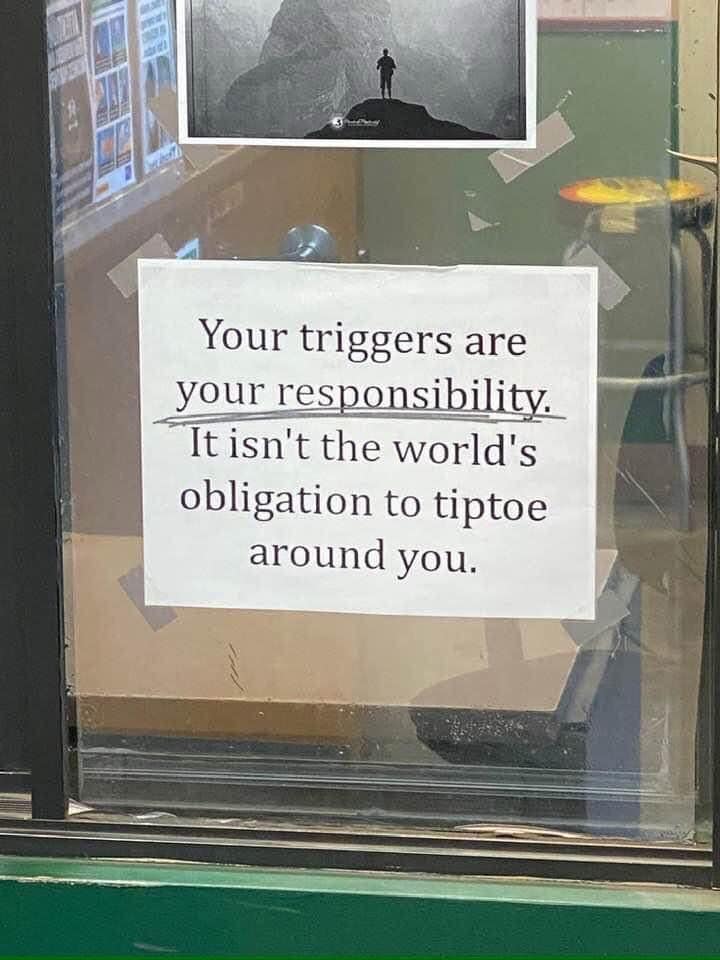
This came across my feed, the laminated wisdom of our times: Your triggers are your responsibility. It isn’t the world’s obligation to tiptoe around you. A phrase so crisp, so confident, it practically struts. You can imagine it on a mug, alongside slogans like Live, Laugh, Gaslight. These are the language games I love to hate.
Now, there’s a certain truth here. Life is hard, and people aren’t psychic. We can’t reasonably expect the world to read our mental weather reports—50% chance of anxiety, rising storms of existential dread. In an adult society, we are responsible for understanding our own emotional terrain, building the bridges and detours that allow us to navigate it. That’s called resilience, and it’s a good thing.
Audio: NotebookLM Podcast on this topic.
But (and it’s a big but) this maxim becomes far less admirable when you scratch at its glossy surface. What does triggers even mean here? Because trigger is a shape-shifter, what I term Shrödinger’s Weasels. For someone with PTSD, a trigger is not a metaphor; it’s a live wire. It’s a flashback to trauma, a visceral hijacking of the nervous system. That’s not just “feeling sensitive” or “taking offence”—it’s a different universe entirely.
Yet, the word has been kidnapped by the cultural peanut gallery, drained of precision and applied to everything from discomfort to mild irritation. Didn’t like that movie? Triggered. Uncomfortable hearing about your privilege? Triggered. This semantic dilution lets people dodge accountability. Now, when someone names harm—racism, misogyny, homophobia, you name it—the accused can throw up their hands and say, Well, that’s your problem, not mine.
And there’s the rub. The neat simplicity of Your triggers are your responsibility allows individuals to dress their cruelty as stoic rationality. It’s not their job, you see, to worry about your “feelings.” They’re just being honest. Real.
Except, honesty without compassion isn’t noble; it’s lazy. Cruelty without self-reflection isn’t courage; it’s cowardice. And rejecting someone’s very real pain because you’re too inconvenienced to care? Well, that’s not toughness—it’s emotional illiteracy.
Let’s be clear: the world shouldn’t have to tiptoe. But that doesn’t mean we’re free to stomp. If someone’s discomfort stems from bigotry, prejudice, or harm, then dismissing them as “too sensitive” is gaslighting, plain and simple. The right to swing your fist, as the old adage goes, ends at someone else’s nose. Likewise, the right to be “brutally honest” ends when your honesty is just brutality.
The truth is messy, as most truths are. Some triggers are absolutely our responsibility—old wounds, minor slights, bruised egos—and expecting the world to cushion us is neither reasonable nor fair. But if someone names harm that points to a broader problem? That’s not a trigger. That’s a mirror.
So yes, let’s all take responsibility for ourselves—our pain, our growth, our reactions. But let’s also remember that real strength is found in the space where resilience meets accountability. Life isn’t about tiptoeing or stomping; it’s about walking together, with enough care to watch where we step.
A Comparative Analysis of Sarah Perry, Emil Cioran, and Contemporaries
In a world where procreation is often celebrated as a fundamental human aspiration, a group of philosophers challenges this deeply ingrained belief by questioning the ethical implications of bringing new life into existence. Antinatalism, the philosophical stance that posits procreation is morally problematic due to the inherent suffering embedded in life, invites us to reexamine our assumptions about birth, existence, and the value we assign to life itself.
Audio: Podcast related to the content on this page
Central to this discourse are thinkers like Sarah Perry, whose work “Every Cradle is a Grave: Rethinking the Ethics of Birth and Suicide” intertwines the ethics of procreation with the right to die, emphasizing personal autonomy and critiquing societal norms. Alongside Perry, philosophers such as Emil Cioran, David Benatar, Thomas Ligotti, and Peter Wessel Zapffe offer profound insights into the human condition, consciousness, and our existential burdens.
This article delves into the complex and often unsettling arguments presented by these philosophers, comparing and contrasting their perspectives on antinatalism. By exploring their works, we aim to shed light on the profound ethical considerations surrounding birth, suffering, and autonomy over one’s existence.
The Inherent Suffering of Existence
At the heart of antinatalist philosophy lies the recognition of life’s intrinsic suffering. This theme is a common thread among our featured philosophers, each articulating it through their unique lenses.
Sarah Perry argues that suffering is an unavoidable aspect of life, stemming from physical ailments, emotional pains, and existential anxieties. In “Every Cradle is a Grave,” she states:
“Existence is imposed without consent, bringing inevitable suffering.”
Perry emphasises that since every human will experience hardship, bringing a new person into the world exposes them to harm they did not choose.
Similarly, David Benatar, in his seminal work “Better Never to Have Been: The Harm of Coming into Existence,” presents the asymmetry argument. He posits that coming into existence is always a harm:
“Coming into existence is always a serious harm.”
Benatar reasons that while the absence of pain is good even if no one benefits from it, the absence of pleasure is not bad unless there is someone for whom this absence is a deprivation. Therefore, non-existence spares potential beings from suffering without depriving them of pleasures they would not miss.
Emil Cioran, a Romanian philosopher known for his profound pessimism, delves deep into the despair inherent in life. In “The Trouble with Being Born,” he reflects:
“Suffering is the substance of life and the root of personality.”
Cioran’s aphoristic musings suggest that life’s essence is intertwined with pain, and acknowledging this is crucial to understanding our existence.
Thomas Ligotti, blending horror and philosophy in “The Conspiracy Against the Human Race,” portrays consciousness as a cosmic error:
“Consciousness is a mistake of evolution.”
Ligotti argues that human awareness amplifies suffering, making us uniquely burdened by the knowledge of our mortality and the futility of our endeavours.
Peter Wessel Zapffe, in his essay “The Last Messiah,” examines how human consciousness leads to existential angst:
“Man is a biological paradox due to excessive consciousness.”
Zapffe contends that our heightened self-awareness results in an acute recognition of life’s absurdities, causing inevitable psychological suffering.
Ethics of Procreation
Building upon the acknowledgement of life’s inherent suffering, these philosophers explore the moral dimensions of bringing new life into the world.
Sarah Perry focuses on the issue of consent. She argues that since we cannot obtain consent from potential beings before birth, procreation imposes life—and its accompanying suffering—upon them without their agreement. She writes:
“Procreation perpetuates harm by introducing new sufferers.”
Perry challenges the societal norm that views having children as an unquestioned good, highlighting parents’ moral responsibility for the inevitable pain their children will face.
In David Benatar’s asymmetry argument, he extends this ethical concern by suggesting that non-existence is preferable. He explains that while the absence of pain is inherently good, the absence of pleasure is not bad because no one is deprived of it. Therefore, bringing someone into existence who will undoubtedly experience suffering is moral harm.
Emil Cioran questions the value of procreation given the futility and despair inherent in life. While not explicitly formulating an antinatalist argument, his reflections imply scepticism about the act of bringing new life into a suffering world.
Peter Wessel Zapffe proposes that refraining from procreation is a logical response to the human condition. By not having children, we can halt the perpetuation of existential suffering. He suggests that humanity’s self-awareness is a burden that should not be passed on to future generations.
The Right to Die and Autonomy over Existence
A distinctive aspect of Sarah Perry’s work is her advocacy for the right to die. She asserts that just as individuals did not consent to be born into suffering, they should have the autonomy to choose to end their lives. Perry critiques societal and legal barriers that prevent people from exercising this choice, arguing:
“Autonomy over one’s life includes the right to die.”
By decriminalizing and destigmatizing suicide, she believes society can respect individual sovereignty and potentially alleviate prolonged suffering.
Emil Cioran contemplates suicide not necessarily as an action to be taken but as a philosophical consideration. In “On the Heights of Despair,” he muses:
“It is not worth the bother of killing yourself, since you always kill yourself too late.”
Cioran views the option of ending one’s life as a paradox that underscores the absurdity of existence.
While Benatar, Ligotti, and Zapffe acknowledge the despair that can accompany life, they do not extensively advocate for the right to die. Their focus remains on the ethical implications of procreation and the existential burdens of consciousness.
Coping Mechanisms and Societal Norms
Peter Wessel Zapffe delves into how humans cope with the existential angst resulting from excessive consciousness. He identifies four defence mechanisms:
Isolation: Repressing disturbing thoughts from consciousness.
Anchoring: Creating or adopting values and ideals to provide meaning.
Distraction: Engaging in activities to avoid self-reflection.
Sublimation: Channeling despair into creative or intellectual pursuits.
According to Zapffe, these mechanisms help individuals avoid confronting life’s inherent meaninglessness.
Thomas Ligotti echoes this sentiment, suggesting that optimism is a psychological strategy to cope with the horror of existence. He writes:
“Optimism is a coping mechanism against the horror of existence.”
Sarah Perry and Emil Cioran also critique societal norms that discourage open discussions about suffering, death, and the choice not to procreate. They argue that societal pressures often silence individuals who question the value of existence, thereby perpetuating cycles of unexamined procreation and stigmatizing those who consider alternative perspectives.
Comparative Insights
While united in their acknowledgement of life’s inherent suffering, these philosophers approach antinatalism and existential pessimism through varied lenses.
Sarah Perry emphasises personal autonomy and societal critique, advocating for policy changes regarding birth and suicide.
Emil Cioran offers a deeply personal exploration of despair, using poetic language to express the futility he perceives in existence.
David Benatar provides a structured, logical argument against procreation, focusing on the ethical asymmetry between pain and pleasure.
Thomas Ligotti combines horror and philosophy to illustrate the bleakness of consciousness and its implications for human suffering.
Peter Wessel Zapffe analyzes the psychological mechanisms humans employ to avoid confronting existential angst.
Critiques and Counterarguments
Critics of antinatalism often point to an overemphasis on suffering, arguing that it neglects the joys, love, and meaningful experiences that life can offer. They contend that while suffering is a part of life, it is not the totality of existence.
In response, antinatalist philosophers acknowledge the presence of pleasure but question whether it justifies the inevitable suffering every person will face. Benatar argues that while positive experiences are good, they do not negate the moral harm of bringing someone into existence without their consent.
Regarding the right to die, opponents express concern over the potential neglect of mental health issues. They worry that normalizing suicide could prevent individuals from seeking help and support that might alleviate their suffering.
Sarah Perry addresses this by emphasizing the importance of autonomy and the need for compassionate support systems. She advocates for open discussions about suicide to better understand and assist those contemplating it rather than stigmatizing or criminalizing their considerations.
Societal and Cultural Implications
These philosophers’ works challenge pro-natalist biases ingrained in many cultures. By questioning the assumption that procreation is inherently positive, they open a dialogue about the ethical responsibilities associated with bringing new life into the world.
Sarah Perry critiques how society glorifies parenthood while marginalizing those who choose not to have children. She calls for reevaluating societal norms that pressure individuals into procreation without considering the ethical implications.
Similarly, Emil Cioran and Thomas Ligotti highlight how societal denial of life’s inherent suffering perpetuates illusions that hinder genuine understanding and acceptance of the human condition.
Conclusion
The exploration of antinatalist philosophy through the works of Sarah Perry, Emil Cioran, and their contemporaries presents profound ethical considerations about life, suffering, and personal autonomy. Their arguments compel us to reflect on the nature of existence and the responsibilities we bear in perpetuating life.
While one may not fully embrace antinatalist positions, engaging with these ideas challenges us to consider the complexities of the human condition. It encourages a deeper examination of our choices, the societal norms we accept, and how we confront or avoid the fundamental truths about existence.
Final Thoughts
These philosophers’ discussions are not merely abstract musings but have real-world implications for how we live our lives and make decisions about the future. Whether it’s rethinking the ethics of procreation, advocating for personal autonomy over life and death, or understanding the coping mechanisms we employ, their insights offer valuable perspectives.
By bringing these often-taboo topics into the open, we can foster a more compassionate and thoughtful society that respects individual choices and acknowledges the full spectrum of human experience.
Encouraging Dialogue
As we conclude this exploration, readers are invited to reflect on their own beliefs and experiences. Engaging in open, respectful discussions about these complex topics can lead to greater understanding and empathy.
What are your thoughts on the ethical considerations of procreation? How do you perceive the balance between life’s joys and its inherent suffering? Share your perspectives and join the conversation.
References and Further Reading
Perry, Sarah. Every Cradle is a Grave: Rethinking the Ethics of Birth and Suicide. Nine-Banded Books, 2014.
Benatar, David. Better Never to Have Been: The Harm of Coming into Existence. Oxford University Press, 2006.
Cioran, Emil. The Trouble with Being Born. Arcade Publishing, 1973.
Ligotti, Thomas. The Conspiracy Against the Human Race. Hippocampus Press, 2010.
Zapffe, Peter Wessel. “The Last Messiah.” Philosophy Now, 1933.
For more in-depth analyses and reviews, consider exploring the following blog posts:
This ChatGPT o1-generated article aims to thoughtfully and respectfully present the philosophical positions on antinatalism and existential pessimism. The discussions about suffering, procreation, and the right to die are complex and sensitive. If you or someone you know is struggling with such thoughts, please seek support from mental health professionals or trusted individuals in your community.
Next Steps
Based on reader interest and engagement, future articles may delve deeper into individual philosophers’ works, explore thematic elements such as consciousness and suffering, or address counterarguments in more detail. Your feedback and participation are valuable in shaping these discussions.
Let us continue this journey of philosophical exploration together.
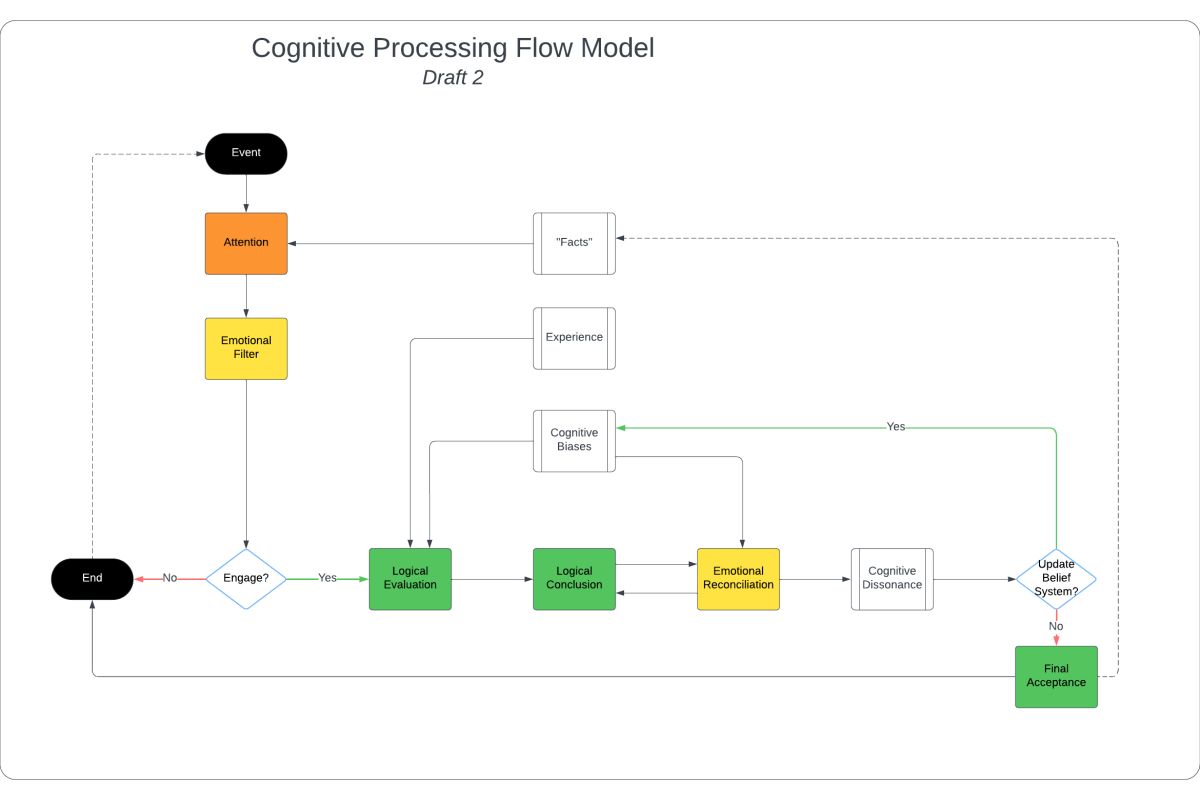
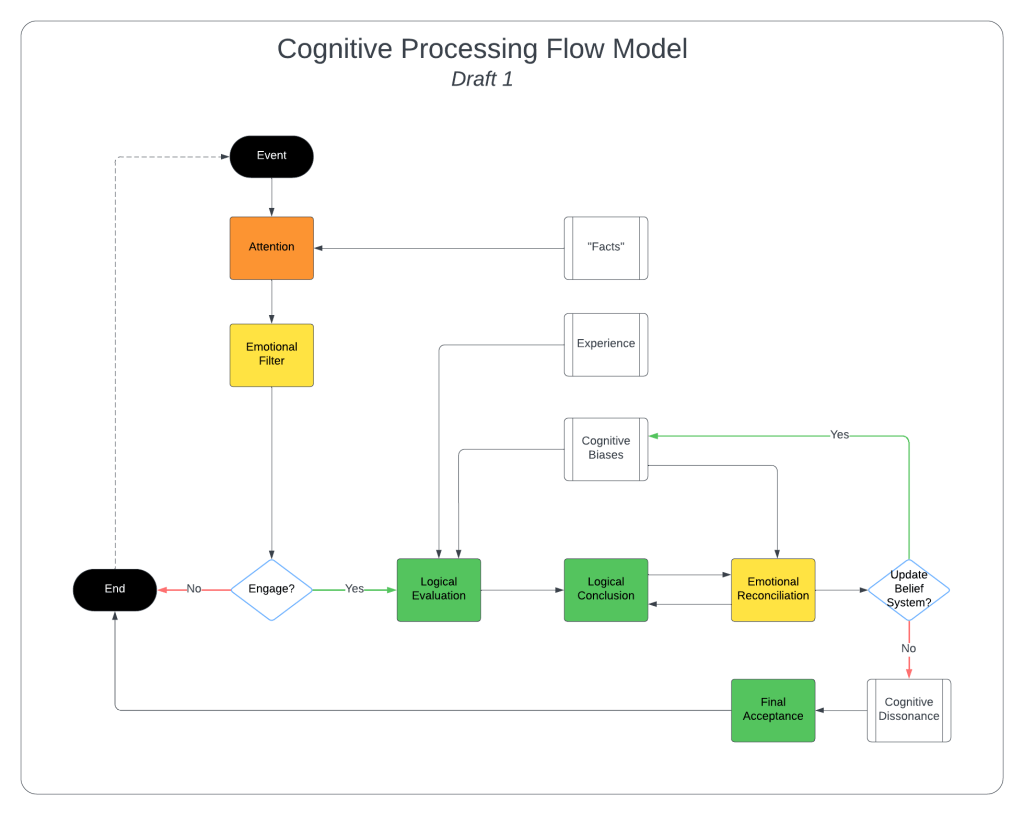
The Cognitive Process Flow Model illustrates how we process the phenomenal world. It’s reductionist and is missing aspects because it is just a back-of-the-napkin sketch. I created it because I uttered, “I can model it for you”. And so I did.
EDIT: I’ve updated the model slightly as the article head image, but the copy content refers to the first draft.
My response was to a person making the claim, that all you need to facts and logic prevails. Rather than restate the argument, I’ll just walk through the diagramme.
There’s meta information to set it up. We are subjective entities in the world. We have a sense-perception apparatus as we exist in it. Countless events occur in this world. We recognise only a few of them within our limited range, though technology expands this range in various ways.
Most of us interact in the world. Some are less ambulatory, so the world visits them. Some have sense-perception deficits whilst others have cognitive deficits. My point is not to capture every edge and corner case. This is just a generalised model.
All models are wrong, but some are useful.
—George Box
It starts with an event. Events occur ceaselessly. In our small portion of the world and elsewhere. For the purpose of the model, the first thing that happens is an event catches our attention. We might notice a shape, a colour, or a movement; we might hear a sound, smell an aroma, feel a sensation, or taste something.
A pre-emotion, pre-logic function serves to process these available inputs. Perhaps, you hear a report on anthropogenic climate change or read something about a political candidate. This emotional filter will police sensory inputs and unconsciously or preconsciously determine if you will react to the initial stimulus. If not, you’ll continue in an attention-seeking loop. Not that kind of attention-seeking.
As my dialogue was about the presentation of facts, our next stop will be logical evaluation. Does this make sense to us, or can we otherwise make it? This is a process in itself. I’ll assume here that it requires little elaboration. Instead, I’ll focus on the operating environment.
Our logical processes are coloured by past experiences and tainted by cognitive biases and deficits. We may also trigger the calling of additional facts through past experiences or the current engagement.
We’ll process these fragments and reach some logical conclusion. But we’re not done. We take this intermediate conclusion and run it through more emotional processing. Cognitive biases come back into play. If the event conforms with your past experiences and cognitive biases, we may run it through a cognitive dissonance routine. To be honest, this probably is part of the emotional reconciliation process, but I’ve drawn it here, so I’ll let it be. In this case, it’s just a filter. If it happens to conform to our belief system, it will pass unfettered; otherwise, it will be squared with our beliefs. Again, this leads me to believe it’s a subcomponent of emotional reconciliation. I’ll update the chart later.
In any case, we’ll end at Final Acceptance. This acceptance may be that we accept or reject the logic, but we arrive at an opinion that gets catalogued with the rest of them. Some may be elevated to facts or truths in the epistemological hierarchy. Although an end marker is identified, it’s really a wait state for the next event. Rinse and repeat until death.
I’ll update this presently. Be on the lookout. It could include more dimensions and interactions, but that might have to wait until version 3.
Meantime, does this feel right to you? Did it even get your attention?
An Example: Anthropogenic Climate Change
Let’s wrap up with an example. I’ll use climate change. An article comes into your attention field, and you have an interest in these things, so it passes through the emotional filter. If your propensity for these articles is high, it might race to the next stage.
You read the article, and it contains some facts—rather, it contains claims for evaluation. To do this, you’ll recall past experiences and cognitive biases are always lying in wait. You may have to look for new facts to add to the mix. These will have to take a similar route past your attention gatekeeper and emotional sidekick.
If you are already predisposed that climate change is a hoax, these facts will filter through that lens—or vice versa.
When all of this is resolved, you’ll have arrived at a conclusion—perhaps we’ll call it a proto-conclusion. It hasn’t been set yet.
You are still going to introspect emotionally and decide if this is a position you want to hold. Perhaps, you feel that climate change is a hoax but this doesn’t jive with that position. Here, you’ll either accept these facts and flip a bit to a sceptical believer or cognitive dissonance will kick in and ensure your sense of the world isn’t thrown off kilter. You may update your belief system to include this datum for future assessments.
Now we are ready for final acceptance. You can now express your established opinion. If the net event is to counter that acceptance, rinse and repeat ad infinitum.
When I was 17 years old, I shouted out into an empty room into a blank canvas that I would defeat the forces of evil. And for the next 10 years of my life, I suffered the consequences… with illness, autoimmunity, and psychosis.
As I got older, I realised that there were no real winners or no real losers in physiological warfare. But there were victims, and there were students.
It wasn’t David verses Goliath; it was a pendulum eternally awaying between the dark and the light. And the brighter the light shone, the darker the shadow it cast. It was never a battle for me to win. It was an eternal dance.
And like a dance, the more rigid I became, the harder it got. The more I cursed my clumsy footsteps, the more I suffered.
And so I got older and I learned to relax, and I learned to soften, and that dance got easier.
It is this eternal waltz that separates human beings from angels, from demons, from gods. And I must not forget, we must not forget that we are human beings.
Hi Ren provides personal insights into the struggle between one’s self and shadow self through performance art, music, and poetry.
I’ve got several things on my mind, but they are ostensibly unrelated. I’ll post separately as time allows, but this is a personal story.
My sister has been visiting a dialysis centre three times a week for the past 5 years awaiting a matching kidney donor. She rang me the other day to tell me she was en route to hospital as they had found a donor. Found is probably a poor word choice. Some person had died, rendering the kidney superfluous for all intents and purposes.
My sister was excited to regain some control over her life. She was told that the host of this kidney had been diagnosed with Hepatitis C and was informed of the risks. The official cause of death was Covid—perhaps owing to a compromised immune system. No matter. My sister accepted the risk. It was evening, and the transplant was scheduled for the morning after running some test panels.
That morning, she was devastated by the news that she had tested positive for Covid, so she was no longer a candidate for a transplant. This is a reminder that Covid is not just about the effects of having caught it. She’d go back on the list and wait. Perhaps it wouldn’t take 5 years this next time, though there are no guarantees.
This is not my first experience with Covid. My 20-something-year-old daughter was hospitalised for over a week due to Covid. I’ve had friends and acquaintances get it, but they all survive–long-Covid effects notwithstanding.
I thought I’d written about the death of my last girlfriend who was another Covid casualty of the indirect variety. She died in June 2020. Her plight was sealed by deferring treatment of an infection for fear that hospitalisation would increase the probability of her contracting Coronavirus. This decision turned out to be fatal.
To be fair, there is a lot of information, misinformation, and disinformation abound, and it’s a challenge to sift out the relevant material. And neither is the ambient fear helpful. And so it goes…
Not trying to shame, but ADHD should disqualify a person from having a driver’s licence. The next cigarette became the next snack became the next drink became readjusting the mirror became readjusting the seat became the next drink became the next application of lipstick became flicking an ash became changing the radio station became looking for a lighter to fire up the next cigarette became opening a window became adjusting the temperature became rinse and repeat ad infinitum….or until the trip ends or distraction kills.







 Philosophics