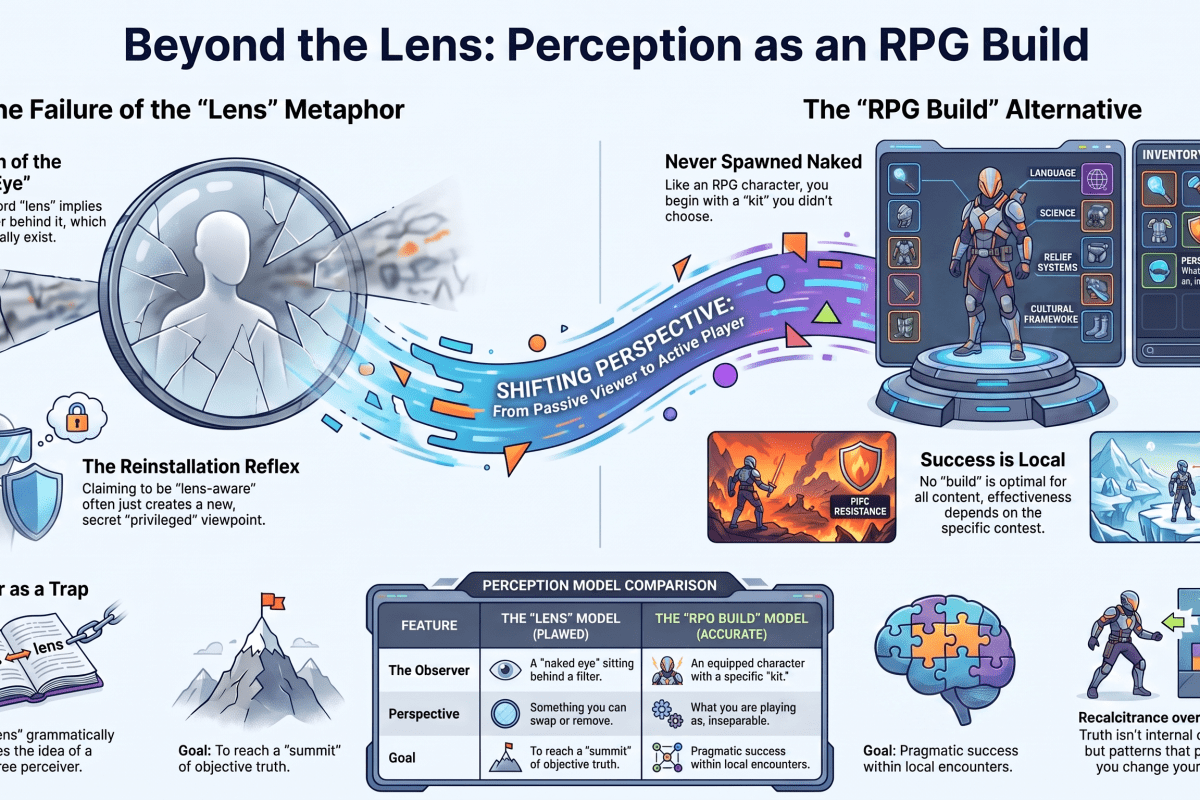
As an economist, I used to instruct my Econ 101 students to consider economics as another lens to add to their inventory, but as a philosopher my advice gets somewhat altered. I’ve discussed lenses before, though I can’t seem to find my econ story.
In any case, I’m interested in the philosophers account now. I don’t rescind my previous account which works well enough in a social context, but I want to discuss the ontological deficits in this advice.
NB: Now that I seem to be authoring more on Substack, I am trying to figure out what to do with this blog that I’ve been maintaining since 2017. I am considering using it as a holder of summaries and related digital assets, for example the PDF from Google Notebook. I expect to include a paragraph of two from the Substack article as a preview for readers to determine if it’s worth clicking. If you start at Substack, you may find this ancillary information to be useful.
Also, Substack doesn’t allow me to embed PDFs (through you can download them for viewing), and it doesn’t facilitate tables and such, so I’ve had to resort to alternate formats or screengrabs to share them as image files – not my preference.
IMPORTANT: Please not that my Substack is substantially free, so I am not pulling a bait and switch. If and when I place content behind a paywall, I’ll have a reason or at least an excuse. I believe that information should be free and freely shared with minimal constraints, which is the reason I don’t yet have anything protected.
Of course, I do sell books, but I also discuss the contents here and in other social media contexts. The books are more for a convenience of having everything in one place and supporting my endeavours, to provide additional incentives to produce similar content.
If you have any ideas or preferences, let me know.
I love language, and I study it. I also use LLMs. I am not anti-AI, but neither am I prescriptively pro-AI. I just happen to find them useful.
Audio: NotebookLM summary podcast of this topic.
I also, however, find them to have quirks. I won’t regurgitate the supposed over-representation of delve — or em dashes, or lists of three, and so on. These are each, at once, true and hardly egregious – especially given that we were all schooled on the same English that now sits in their training data.
What I want to focus on is the cadence. I watched this video, and the historical information is interesting – in fact, much of the material on the channel is. A few shorts were recommended to me, I discovered more, I subscribed, as one does. But listen to the talk track.
Video: The Most Mispronounced Words in English and the History Behind Them – Airlearn Language Show
Whilst I may be mistaken, it sounds like an LLM-produced script. Perhaps the joke is on me, and the presenter herself is an AI avatar. It also sounds as though a de-LLM process was applied afterwards to obfuscate the patterns – whether by a human or by another model running some humaniser GPT.
Of course, there are other explanations. Perhaps the writer simply happens to write this way, and the LLMs merely encroach on it. Without a writing history, one can’t know for certain. And – I know this is true of me – exposure, dare I say overexposure, shapes how one writes.
I run almost everything I write through AI and ask for suggestions – and you needn’t even ask; it volunteers anyway. When the output looks better, I adopt it: a word, a phrasing, a more concise rendering, a supporting sentence or a setup. After a while, my writing has been nudged in that direction. I already used delve; now I am merely conscious of it. I used to use em dashes – look at my pre–2020 posts – and switched to en dashes purely to avoid the witch-hunt. In each case, the LLM Age has done something to my style.
So, back to the video. If you are familiar with long-form LLM output, you will notice how she supports her ideas and how she builds her asides – with a very particular pattern. I am not judging: as I say, I use these tools extensively. I only want to point out an observation.
BONUS: I don’t pronounce Wednesday as /wenz.day/. I pronounce it closer to /wedñz-day/, the tilde is rather on the /d/ or the space the /d/ occupies, but I placed the mark on the /n/ instead because there is no tilde-d glyph, and I wanted to represent a nasality the more typical pronunciation doesn’t have – but that I add.
From here on, I asked Claude to analyse my post (above) along with the video script. Pay special attention to its own cadence, which comports with the video.
Here, then, is the observation.
Watch how a point is made to land. The move is nearly always the same: state the naïve reading, snatch it away, and hand back the corrected version as a tidy little binary. It’s not random. There’s a reason.It wasn’t design. It accumulated.English spelling isn’t bad design. It’s no design at all. The shape does the work an argument would otherwise have to do. Negate, reverse, reveal – and the reveal feels like insight precisely because something was first taken away. It is the cheapest available route to the sensation of having been told something.
Notice, too, the reassurance travelling alongside it. There’s a reason. There’s always a reason. The promise of an explanation, delivered before the explanation arrives, so that you settle in and stop wondering whether one is coming. And where genuine argument would be laborious, the list stands in for it: Old English, Norse, Norman, French, Latin, scholarship, Dutch typesetters, the great vowel shift. Abundance, read as authority. Say enough true things in a row and the row itself begins to feel like a proof.
Then the asides. Almost every one is the same manoeuvre – the proper noun that renames itself the instant it appears. Woden, the chief god of the Anglo-Saxon pantheon.Latin, the prestige language of learning.A Quechua word from the Andes.Frigg being Odin’s wife. Nothing is permitted to sit unglossed for even a clause. This is what maximal legibility looks like once it hardens into reflex: a horror of the unexplained referent, a compulsion to footnote in real time. The second variety is the personality wink – and English being English, it kept both – character applied topically, like a balm.
And, so that you are never left to feel anything unsupervised, your reactions are narrated back to you in advance: if that feels insane to you, good, because it is. The response, pre-issued, so you may be spared the labour of having it. The whole is held together by a governing metaphor with a landing – fossil, photograph, museum – reactivated at the close (every mispronounced word is a crime scene) and finished with a note of absolution: you haven’t been mispronouncing English because you’re careless. It is very nearly a form one could fill in.
None of which proves a human didn’t write it.
And that is the part worth sitting with. Suppose no model ever touched this script. Suppose the writer arrived at the cadence honestly, by the same route I did – by reading enough of the stuff that the rhythm simply seeped in. Then the pattern is no longer evidence of authorship at all. It is evidence of a house style, and the house is one we have all quietly moved into. The tell no longer tells you a machine was here. It tells you the machine’s prosody has become the water.
I find that rather more unsettling than a mere ghost-writer would be. A ghost-writer you can dismiss. A cadence you have caught, like an accent, off the sheer ambient volume of the thing – that you carry home. And the video is, with some poetry, about exactly this: silent letters as fossils, sounds that mouths stopped making but that spellings preserved, layer upon historical layer that nobody ever cleaned up. The irony is that the script is laying down a fresh one as it speaks. Somewhere in the prose of the next decade there will be a stratum you can date almost to the year – ah, yes, written just after the models arrived – and it will be made of precisely these moves.
I switched to en dashes to dodge the witch-hunt. But the dash was never the point. You can strip every em dash from a sentence and leave the skeleton wholly intact, because the skeleton was never punctuation. It was the not-this-but-that, the aside that footnotes itself, the pile that mistakes its own length for weight. A humaniser can launder the vocabulary. It cannot, so far, launder the architecture. Which is how one reads a script scrubbed clean of every obvious tell and still hears, quite distinctly, the thing it was scrubbed to hide.
I am not judging. I write this way too, now – rather more than I would like. I only wanted to point it out. While I can still tell that I’m doing it.
A LinkedIn colleague posts this. I didn’t want to rain on his parade there – we’ve got an interesting binary intellectual relationship – we either adamantly agree or vehemently disagree. This reflects the latter. The title is revelatory – the all-caps, his:
A good society requires more than virtuous individuals and fair institutions: it requires a mediating moral principle capable of binding persons, communities, and structures into a shared project of human flourishing.
Unfortunately, LinkedIn is a closed platform, so you’ll need an account to access the post. Anyway…
Audio: NotebookLM summary podcast of this topic.
I can remember when I emerged from this mindset – or at least consciously reflected on it and declined the invitation.
Video clip: Because I felt like it. (No Sound)
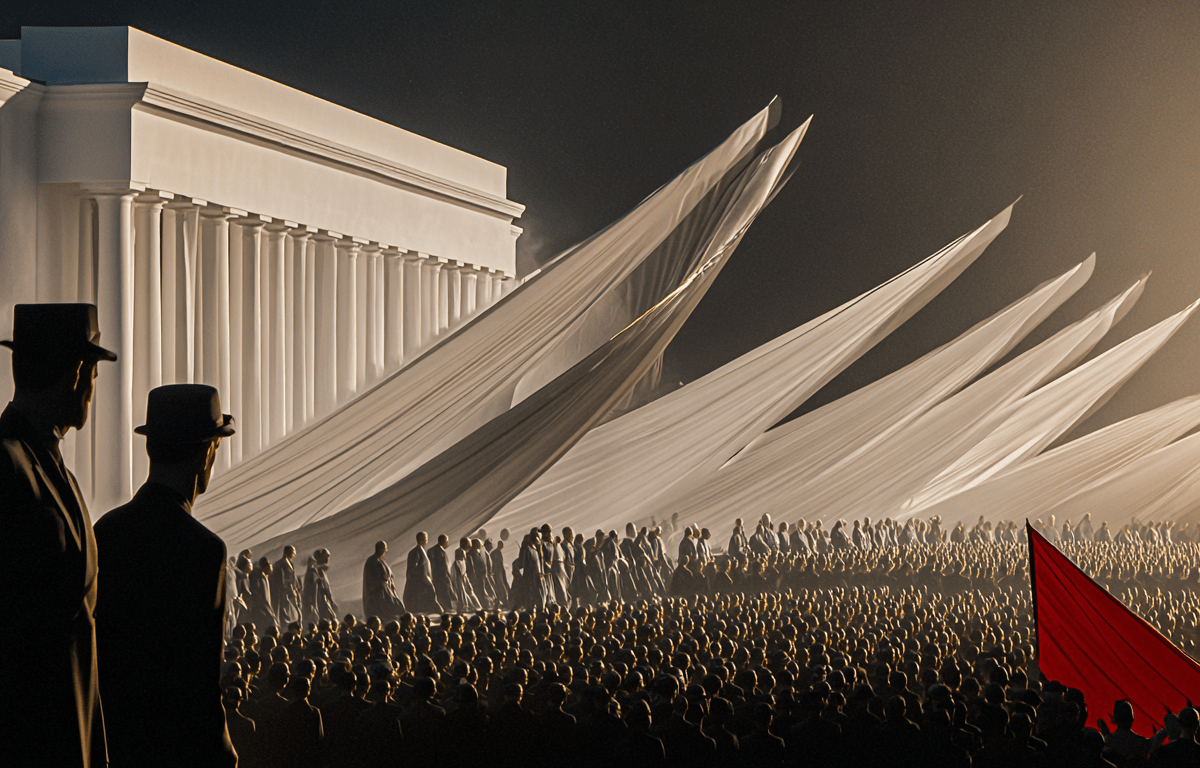
When I was 10 years old, I remember thinking about historical ‘National Socialism’ – wouldn’t it be nice if we were all on the same page in solidarity? Then I realised that I’d have to be on their page; they wouldn’t be on mine.
Then, I realised that ‘solidarity’ isn’t a warm circle of clasped hands under a rainbow; rather, it’s a demand to harmonise one’s interior life with someone else’s tuning fork. So-called unity is almost always a euphemism for ideological choreography, and one doesn’t get to pick the routine.
Children are sold the Sesame Street version of solidarity, where everyone shares crayons and sings about common purpose. Cue the Beach Boys: Wouldn’t It Be Nice?
Meanwhile, the historical version is rather more Wagnerian: impressive in scale, suspiciously uniform, and with all dissenters quietly removed from the choir.
My childhood self intuited precisely what my adult writing has since anatomised:
Solidarity is only lovely when you imagine everyone else will move toward you; it curdles the moment you realise the gravitational pull goes the other way.
‘We’re all on the same page’ always becomes ‘Get on the page we’ve selected for you’ – or elected against your vote. The fantasy of we dissolves into the machinery of they.
This isn’t a bug in the system; that is the system. Solidarity requires a centre, and once there’s a centre, someone else gets to define its radius. Even the gentle, ethical, cotton-wool versions still rely on boundary enforcement: who belongs in the shared project, who must adjust their cadence, who is politely removed for ‘disrupting the collective good’. I’m more often apt to be that person than not. History merely illustrates the principle at scale; the mechanism is universal.
Anyway, this is how my brain works, and how I think how I do, and write what I write. As much as I witter on about episodic selves, this remains a prevalent continuity.
WordPress has just informed me that my blog is having an anniversary. Technically true, though a little misleading: this blog has been around since 1 January 2017, but I’ve been loitering on the platform since 2006. Before that I dabbled in the great blog diaspora of the early internet—Google, Yahoo! 360, Blogger, and a few others that have long since evaporated into the ether.
Each space had its own flavour. One I recall from around 2010 was devoted to an experiment in World of Warcraft: levelling a pacifist character. The premise was simple—no violence allowed. My Human Priest, suitably named Passivefist, managed to crawl his way to level 7 before stalling out. The challenge was never to attack other NPCs, only to survive by gathering, healing, or sneaking through hostile terrain.
I am creating this account to track my progress as a pacifist in World of Warcraft. Others have done this before me and are, in fact, way ahead of me. Nonetheless, it is the challenge I am setting. I have created a Human Priest on Kael’thas named Passivefist.
Of course, in later expansions Blizzard eventually added pacifist-friendly content, making my small crusade somewhat redundant.
As for this blog, it’s taken a different path. I’ve recently crossed the 100,000-word milestone—101.4K, to be precise. Not that I’ve been counting obsessively, but it’s a nice marker, even if much of my writing also leaks into other projects: other blogs, manuscripts, and workaday scribbling.
As for this blog…
The intent here remains the same as when I started in 2017: to keep a space for philosophic musings, digressions, and the occasional provocation. I’ll continue publishing when I have something worth saying—or at least something worth testing out in public.



 Philosophics