Duration and the Intervalic Imposition

6–10 minutes

I’ve got a new annotated edition of Heidegger‘s Being and Time, and it’s got me thinking about time – and thinking out loud. Obviously, Husserl is invoked by Heidegger, and the notion of duration (via durée) is from Bergson. Memory is not stored in the brain by| Victoria Trumbull on IAI TV might have been the real tipping point. I’m not sure how far I’ll develop this, but I wanted to capture my thoughts so I can refocus on my other topics, Parfit and Frege–Geach, to name two.

Audio: NotebookLM summary podcast of this topic.

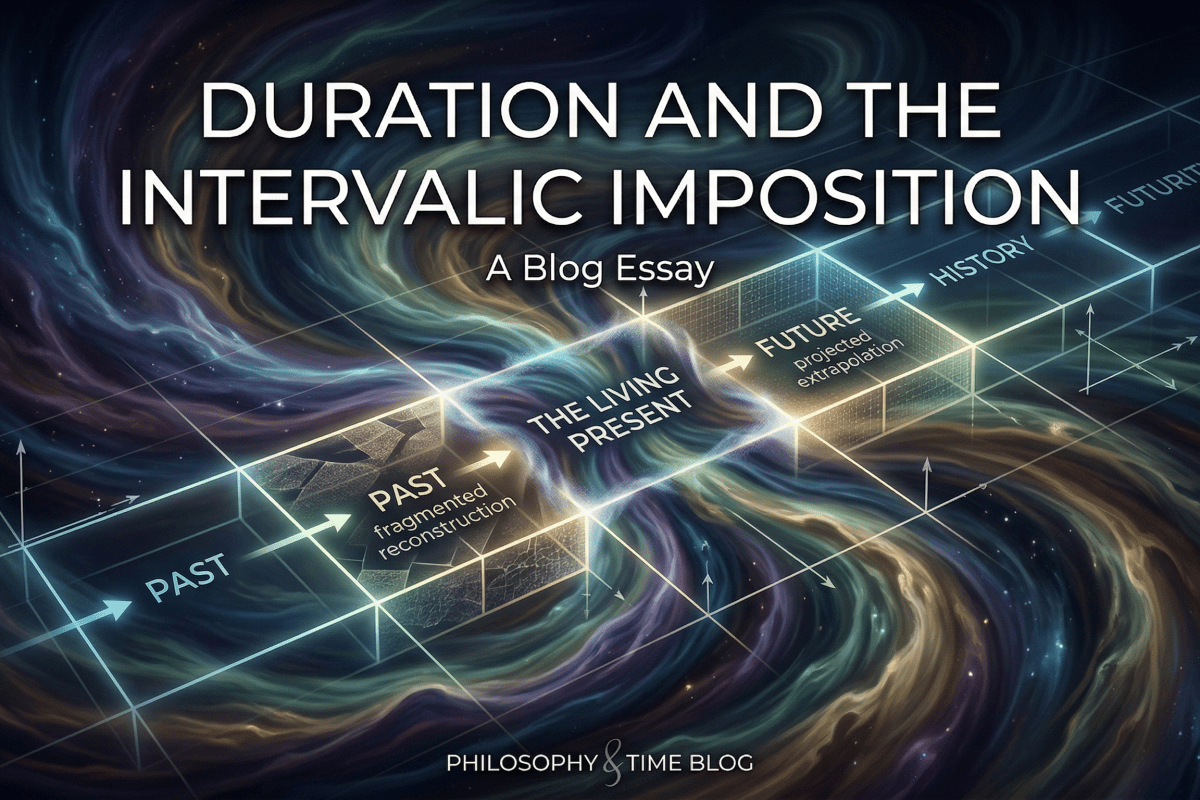
Duration – in a sense that will require distinguishing from Bergson’s – is ontologically prior. It is not the absence of structure but structure prior to segmentation, ordering, and metric discretisation. Time – segmented into intervals, directionally ordered, and metrically structured – is what results when intervalic form is imposed upon duration. The imposition is representational rather than discovered: we do not encounter intervals in duration any more than we encounter grid-lines in a landscape. It is not imposed from outside experience but enacted from within it, through the structuring operations by which finite subjects render duration intelligible as time, and this includes succession itself. The ‘before-and-after’ of temporal experience is not inherited from duration but is itself a product of the intervalic cut – the minimal structure required for the grid to function as a grid. Without this stronger claim, the imposition would merely metricise an already ordered flow. Duration would then retain an intrinsic direction independent of the grid. The present thesis denies this: prior to the imposition, duration has no intrinsic ordering of the sort the grid later makes available. This does not make time unreal; it makes it derivative. What follows is an articulation of the temporal distinctions that become available once the imposition is in place.

Once the intervalic cut is made, experience within its frame exhibits an asymmetric structure. The present, the past, the future, history, and futurity are not features of duration itself but modes of access that become intelligible only within the imposed temporal grid. They may be stated compactly:

  1. Present – actuality at the dimensionless limit of the intervalic cut.
  2. Past – prior actuality, no longer extant, now only reconstructible from retention, trace, and surviving fragment.
  3. Future – possible actuality, not yet extant, available only through projection, expectation, and extrapolation from present constraints.
  4. History – lossy interpolation from fragmentary surviving traces of prior actuality.
  5. Futurity – lossy extrapolation from present constraints, tendencies, and uncertainties.

Because the grid resolves duration only partially and from a situated cut, both reconstruction and projection are necessarily lossy: the former inherits only traces of what has been structured, the latter extends only tendencies available from where the cut presently stands.
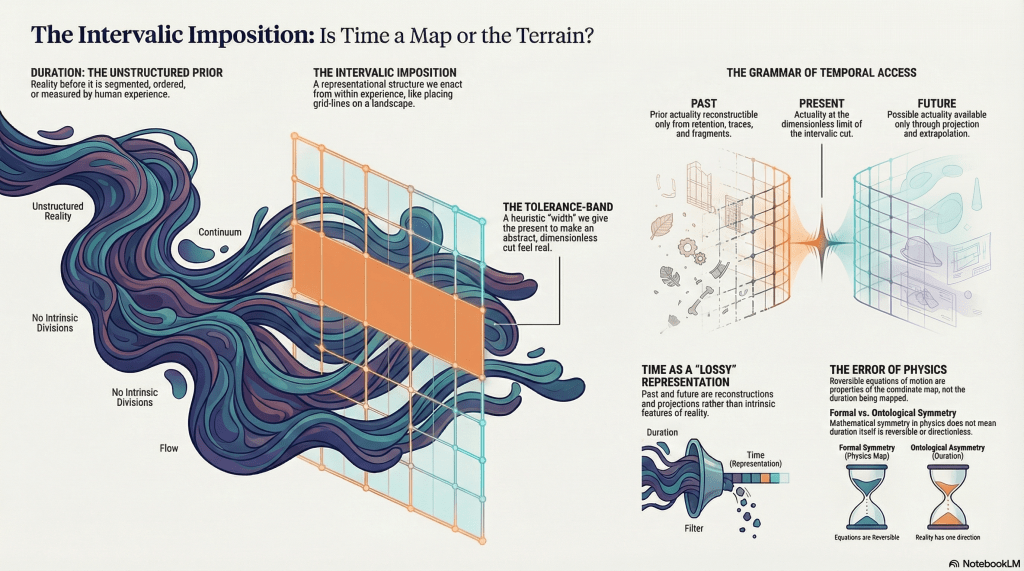
NotebookLM Infographic on this topic.

What ordinary experience calls the present is not, however, the dimensionless limit itself. It is a heuristic tolerance-band, a phenomenal spread across the cut that permits experience to function as though it inhabits a moment with extension. The strict present, as a product of the intervalic imposition, is an abstraction: a point that formal structure requires but that experience cannot occupy without borrowing width from duration. It is here, at the tolerance-band, that the imposition fails to fully displace what it organises. The failure is not accidental. Any representational scheme that discretises a continuous prior will underdetermine what it carves – there will always be a residue that the grid cannot fully resolve. The tolerance-band is where that residue is phenomenally evident.

The asymmetry between past and future is real, but it is real within the grammar of access generated by the intervalic imposition rather than as a primitive feature of duration itself. The past is reconstructed from what has obtained; the future is projected from what may obtain. A natural objection arises: if duration is truly without intrinsic direction, why is this asymmetry so stubbornly one-way? Why can we not reconstruct forwards or project backwards in any equivalent sense? The answer is that the imposition is not directionless even though what it is imposed upon is. The intervalic cut does not merely segment – it orders, and the ordering it introduces is irreversible because the cut is made from within experience, by subjects who retain traces of what the grid has already structured but have no corresponding access to what it has not yet reached. The arrow belongs to the act of imposition, not to duration itself.

A corollary follows for physics. Bidirectional temporal coordinates are artefacts of the intervalic grid, not discoveries about the deep structure of what the grid represents. That the equations of motion are time-symmetric means only that the formalism remains invariant under temporal reversal operations. It does not mean that duration is reversible, still less that time could ‘go backwards.’ The reversibility belongs to the representational instrument, the coordinate structure and its algebraic properties, not to what is being represented. To conclude otherwise is to read the map’s indifference to orientation as evidence that the terrain has none. Philosophical positions that take this inference at face value, the block-universe interpretation being the most familiar, inherit the error rather than originate it. The error itself is simpler and more general: the conflation of formal symmetry with ontological symmetry.

Situating the Argument

The foregoing account operates on terrain that others have worked before, and it owes debts that should be made explicit – not least so that the points of departure are equally clear.

The most obvious creditor is Bergson. The ontological priority of duration, the critique of spatialised time, and the insistence that metric structure is imposed rather than discovered are all recognisably Bergsonian commitments. The departure is equally plain. Bergson characterises duration positively as qualitative becoming, heterogeneous flow, interpenetrating states – a rich inner life that spatialisation distorts. The present account is more austere. It claims that duration is structure prior to segmentation and ordering, but it does not claim to know what that structure is like from the inside. Bergson thinks he can describe what the imposition conceals; the present thesis maintains that description is itself a structuring operation and therefore cannot reach behind the imposition it enacts. Duration here is an ontological commitment, not an experiential report.

Husserl‘s phenomenology of internal time-consciousness provides much of the apparatus for the epistemic layer. Retention and protention, the specious present, the constitutive role of temporal synthesis in experience – these are Husserlian structures, and the tolerance-band is in obvious dialogue with his account of the living present. The departure is that Husserl treats these structures as disclosing the temporal character of consciousness itself, whereas the present account treats them as artefacts of the intervalic imposition. For Husserl, retention is how consciousness holds the just-past; here, retention is a mode of access that the grid makes available. The difference matters because it determines whether the phenomenology is foundational or derivative. On the present account, it is derivative – downstream of the imposition, not prior to it.

The Kantian resonance is structural rather than doctrinal. The claim that the imposition is enacted from within experience by finite subjects, and that temporal order is a condition of intelligibility rather than a feature of things in themselves, places this account in the neighbourhood of the transcendental aesthetic. But Kant‘s time is a form of inner sense – a pure intuition that structures all experience a priori. The present thesis does not commit to this. It says the imposition is enacted by subjects but does not say it is a priori in Kant’s sense, nor that it is a form of intuition rather than (for instance) a contingent cognitive achievement or an evolved heuristic. The source of the imposition is left deliberately underdetermined at this stage, since settling it prematurely would foreclose possibilities the argument has not yet earned the right to exclude.

Finally, the critique of physics ontologising its own coordinate structure has affinities with van Fraassen‘s constructive empiricism – the insistence that empirical adequacy does not entail structural correspondence between formalism and reality. The affinity is genuine but limited. Van Fraassen is concerned with the epistemology of scientific theories in general; the present argument is concerned with one specific inferential error – the slide from formal symmetry to ontological symmetry – and it grounds that error in a prior thesis about the representational character of intervalic time that van Fraassen does not share. The diagnostic is narrower and the ontological commitment is stronger.

What the present account shares with all four predecessors is the conviction that the ordinary temporal framework – past, present, future, measured and directional – is not simply given. Where it departs from all four is in its specific diagnosis of what the framework is: a representational imposition. It structures a priori, it cannot fully displace, and is enacted from within experience by subjects whose epistemic situation is constitutively shaped by the imposition itself.
Architecture of Encounter Podcast: Episode 0 – Phenomenologists

Hear ye! Hear ye! Consider this an announcement of a new podcast series for The Architecture of Encounter.

This episode is an introduction to the 7-part series that discusses phenomenologists who laid the foundation on which the Mediated Encounter Ontology (MEOW) is built.

Audio: Introductory Podcast for The Architecture of Encounter

This series begins with philosophers from Descartes through Berkeley, Locke, and Hume to Kant, who will be the focus of the first episode. Except for this introduction, which is 15 minutes. Each episode is around 7 minutes because I wanted to keep them bite-sized.

  1. Immanuel (Manny) Kant: The Renovator
  2. Edmund (Eddie) Husserl: The Methodical Suspender
  3. Martin (Marty) Heidegger: The Destroyer Who Moved In
  4. Maurice (Moe) Merleau-Ponty: The Body That Almost Escaped
  5. Sara Ahmed: The Orienter Who Changed the Subject
  6. Frantz Fanon: The Phenomenologist under Fire
  7. Alfred North (Big Al) Whitehead: The Architect Who Overbuilt

The PDF table below is a summary of the various positions versus MEOW.

Pure Reason: The Architecture of Illusion

2–3 minutes

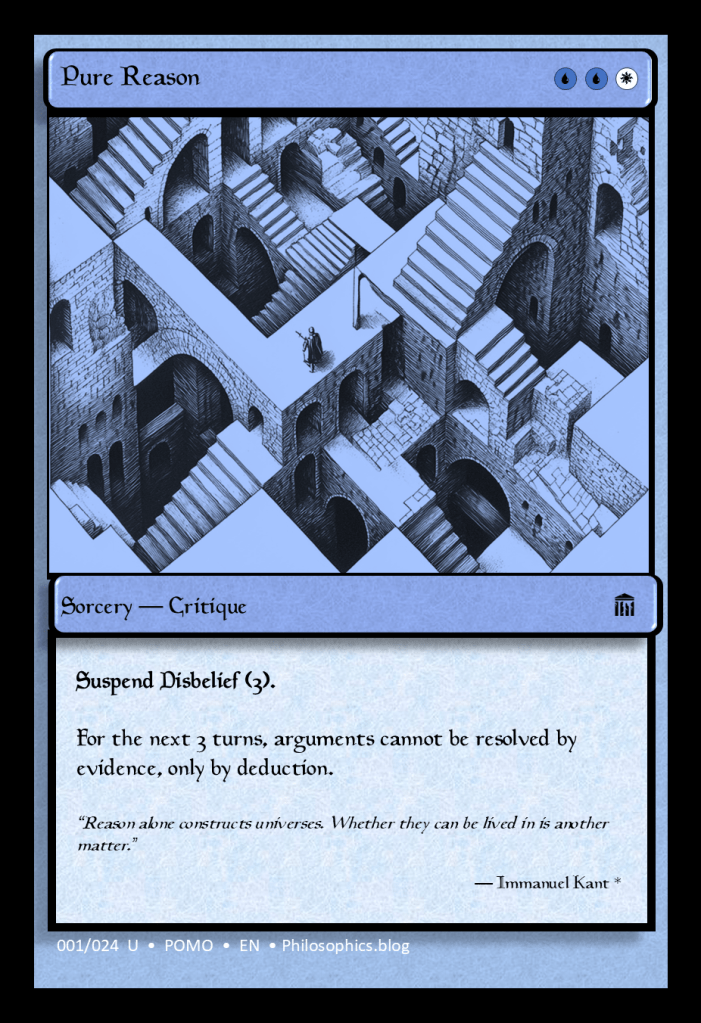
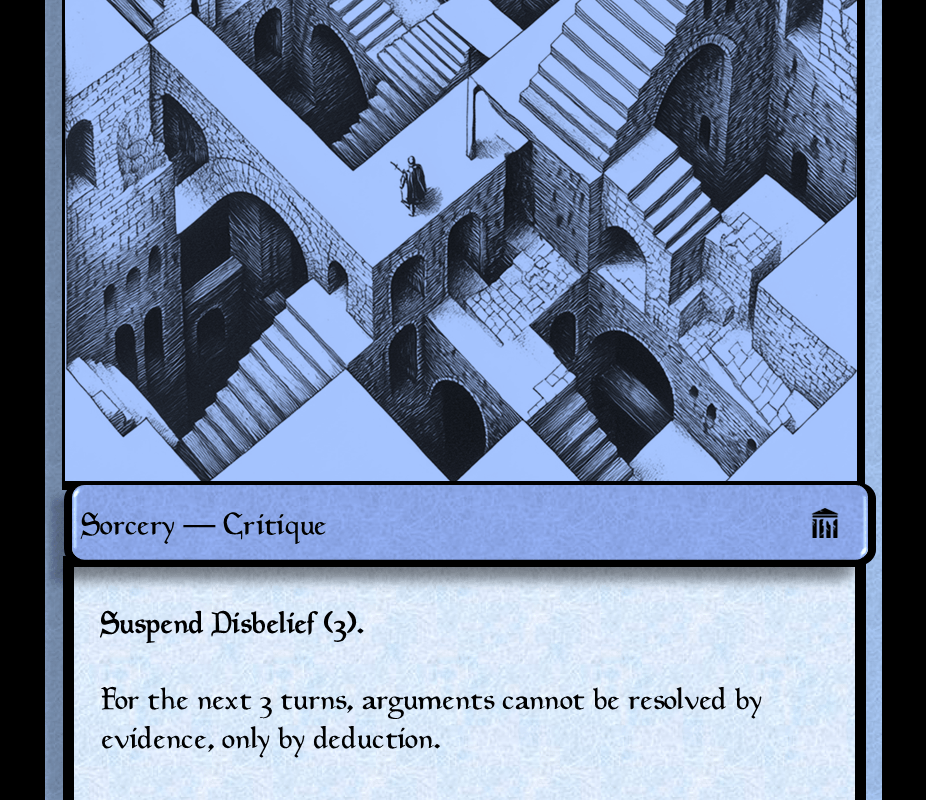
If reason had a landscape, it would look like this card: a maze of ascending and descending staircases, forever rational yet going nowhere. Kant might have called it a Critique of Pure Geometry.

Pure Reason, the first card in the Postmodern set, isn’t so much an homage to Kant as it is a cautionary reconstruction. It honours his ambition to build a universe from deduction while quietly mourning the price of that construction: alienation from experience.

Image: Card 001 from the Postmodern Set — Philosophics.blog

The Meta

Suspend Disbelief (3).
For the next three turns, arguments cannot be resolved by evidence, only by deduction.

Audio: NotebookLM podcast of this topic.

The rule text re-enacts Kant’s method. In the Critique of Pure Reason, he cordoned off the realm of empirical evidence and tried to chart what the mind could know a priori – before experience. The card’s mechanic enforces that isolation. For three turns, players must reason in a vacuum: no appeals to observation, no touchstones of reality, only deduction.

It’s a temporary world built entirely of logic, an echo of the transcendental playground Kant envisioned. The effect is powerful but sterile – thought constructing universes that can’t sustain life.

The flavour text says it plainly:

That line, of course, is apocryphal, but it captures the essence of his project: reason as world-maker and prison architect in one.

The Architecture of Thought

The artwork mirrors Escher’s impossible staircases – a labyrinth of pure geometry, ordered yet uninhabitable. Each path is internally consistent, logically sound, but spatially absurd. This is Kant’s transcendental edifice made visual: coherent on paper, dizzying in practice.

The lone figure standing in the maze is the transcendental subject – the philosopher trapped within the architecture of his own cognition. He surveys the world he has built from categories and forms, unable to escape the walls of his own reason.

It’s a neat metaphor for Enlightenment hubris: the belief that reason can serve as both foundation and roof, requiring no support from the messy ground of existence.

Kant’s Double Legacy

Kant’s Critique was both the high point and the breaking point of Enlightenment rationality. It erected the scaffolding for science, ethics, and aesthetics but revealed the fault lines beneath them. His insistence that the mind structures experience rather than merely reflecting it gave birth to both modern idealism and modern doubt.

Every philosopher after him – Hegel, Nietzsche, Husserl, Derrida – has been trying either to escape or to inhabit that labyrinth differently. Pure Reason captures this tension: the glory of construction and the tragedy of confinement.

My Take

Reason is a magnificent liar. It promises order, clarity, and autonomy, but its perfection is its undoing. It abstracts itself from life until it can no longer recognise its own maker. Kant’s world is flawless and airless – a rational utopia unfit for breathing creatures.

I view Pure Reason as the archetype of the Enlightenment illusion: the attempt to found a living world on the logic of dead forms. What he achieved was monumental, but the monument was a mausoleum.

The card, then, is not just a tribute to Kant but a warning to his descendants (ourselves included): every system of thought eventually turns into an Escher print. Beautiful, consistent, and utterly unlivable.

Morality: The Mirage of Subjectivity Within a Relative Framework

Morality, that ever-elusive beacon of human conduct, is often treated as an immutable entity—a granite monolith dictating the terms of right and wrong. Yet, upon closer inspection, morality reveals itself to be a mirage: a construct contingent upon cultural frameworks, historical conditions, and individual subjectivity. It is neither absolute nor universal but, rather, relative and ultimately subjective, lacking any intrinsic meaning outside of the context that gives it shape.

Audio: Spotify podcast conversation about this topic.

Nietzsche: Beyond Good and Evil, Beyond Absolutes

Friedrich Nietzsche, in his polemical Beyond Good and Evil and On the Genealogy of Morality, exposes the illusion of objective morality. For Nietzsche, moral systems are inherently the products of human fabrication—tools of power masquerading as eternal truths. He describes two primary moralities: master morality and slave morality. Master morality, derived from the strong, values power, creativity, and self-affirmation. Slave morality, by contrast, is reactive, rooted in the resentment (ressentiment) of the weak, who redefine strength as “evil” and weakness as “good.”

Nietzsche’s critique dismantles the notion that morality exists independently of cultural, historical, or power dynamics. What is “moral” for one era or society may be utterly abhorrent to another. Consider the glorification of war and conquest in ancient Sparta versus the modern valorisation of equality and human rights. Each framework exalts its own virtues not because they are universally true but because they serve the prevailing cultural and existential needs of their time.

The Myth of Monolithic Morality

Even viewed through a relativistic lens—and despite the protestations of Immanuel Kant or Jordan Peterson—morality is not and has never been monolithic. The belief in a singular, unchanging moral order is, at best, a Pollyanna myth or wishful thinking, perpetuated by those who prefer their moral compass untroubled by nuance. History is not the story of one moral narrative, but of a multiplicity of subcultures and countercultures, each with its own moral orientation. These orientations, while judged by the dominant moral compass of the era, always resist and redefine what is acceptable and good.

If the tables are turned, so is the moral compass reoriented. The Man in the High Castle captures this truth chillingly. Had the Nazis won World War II, Americans—despite their lofty self-perceptions—would have quickly adopted the morality of their new rulers. The foundations of American morality would have been reimagined in the image of the Third Reich, not through inherent belief but through cultural osmosis, survival instincts, and institutionalised pressure. What we now consider abhorrent might have become, under those circumstances, morally unremarkable. Morality, in this view, is not timeless but endlessly pliable, bending to the will of power and circumstance.

The Case for Moral Objectivity: Kantian Ethics

In contrast to Nietzsche’s relativism, Immanuel Kant offers a vision of morality as rational, universal, and objective. Kant’s categorical imperative asserts that moral principles must be universally applicable, derived not from cultural or historical contingencies but from pure reason. For Kant, the moral law is intrinsic to rational beings and can be expressed as: “Act only according to that maxim whereby you can, at the same time, will that it should become a universal law.”

This framework provides a stark rebuttal to Nietzsche’s subjectivity. If morality is rooted in reason, then it transcends the whims of power dynamics or cultural specificity. Under Kant’s system, slavery, war, and exploitation are not morally permissible, regardless of historical acceptance or cultural norms, because they cannot be willed universally without contradiction. Kant’s moral absolutism thus offers a bulwark against the potential nihilism of Nietzschean subjectivity.

Cultural Pressure: The Birthplace of Moral Adoption

The individual’s adoption of morality is rarely a matter of pure, autonomous choice. Rather, it is shaped by the relentless pressures of culture. Michel Foucault’s analysis of disciplinary power in works such as Discipline and Punish highlights how societies engineer moral behaviours through surveillance, normalisation, and institutional reinforcement. From childhood, individuals are inculcated with the moral codes of their culture, internalising these norms until they appear natural and self-evident.

Yet this adoption is not passive. Even within the constraints of culture, individuals exercise agency, reshaping or rejecting the moral frameworks imposed upon them. Nietzsche’s Übermensch represents the apotheosis of this rebellion: a figure who transcends societal norms to create their own values, living authentically in the absence of universal moral truths. By contrast, Kantian ethics and utilitarianism might critique the Übermensch as solipsistic, untethered from the responsibilities of shared moral life.

Morality in a Shifting World

Morality’s subjectivity is its double-edged sword. While its flexibility allows adaptation to changing societal needs, it also exposes the fragility of moral consensus. Consider how modern societies have redefined morality over decades, from colonialism to civil rights, from gender roles to ecological responsibility. What was once moral is now abhorrent; what was once abhorrent is now a moral imperative. Yet even as society evolves, its subcultures and countercultures continue to resist and reshape dominant moral paradigms. If history teaches us anything, it is that morality is less a fixed star and more a flickering flame, always at the mercy of shifting winds.

Conclusion: The Artifice of Moral Meaning

Morality, then, is not a universal truth etched into the fabric of existence but a subjective artifice, constructed by cultures to serve their needs and adopted by individuals under varying degrees of pressure. Nietzsche’s philosophy teaches us that morality, stripped of its pretensions, is not an arbiter of truth but a symptom of human striving—one more manifestation of the will to power. In contrast, Kantian ethics and utilitarianism offer structured visions of morality, but even these grapple with the tensions between universal principles and the messy realities of history and culture.

As The Man in the High Castle suggests, morality is a contingent, situational artefact, liable to be rewritten at the whim of those in power. Its apparent stability is an illusion, a construct that shifts with every epoch, every conquest, every revolution. To ignore this truth is to cling to a comforting, but ultimately deceptive, myth. Morality, like all human constructs, is both a triumph and a deception, forever relative, ever mutable, yet persistently contested by those who would impose an impossible order on its chaos.