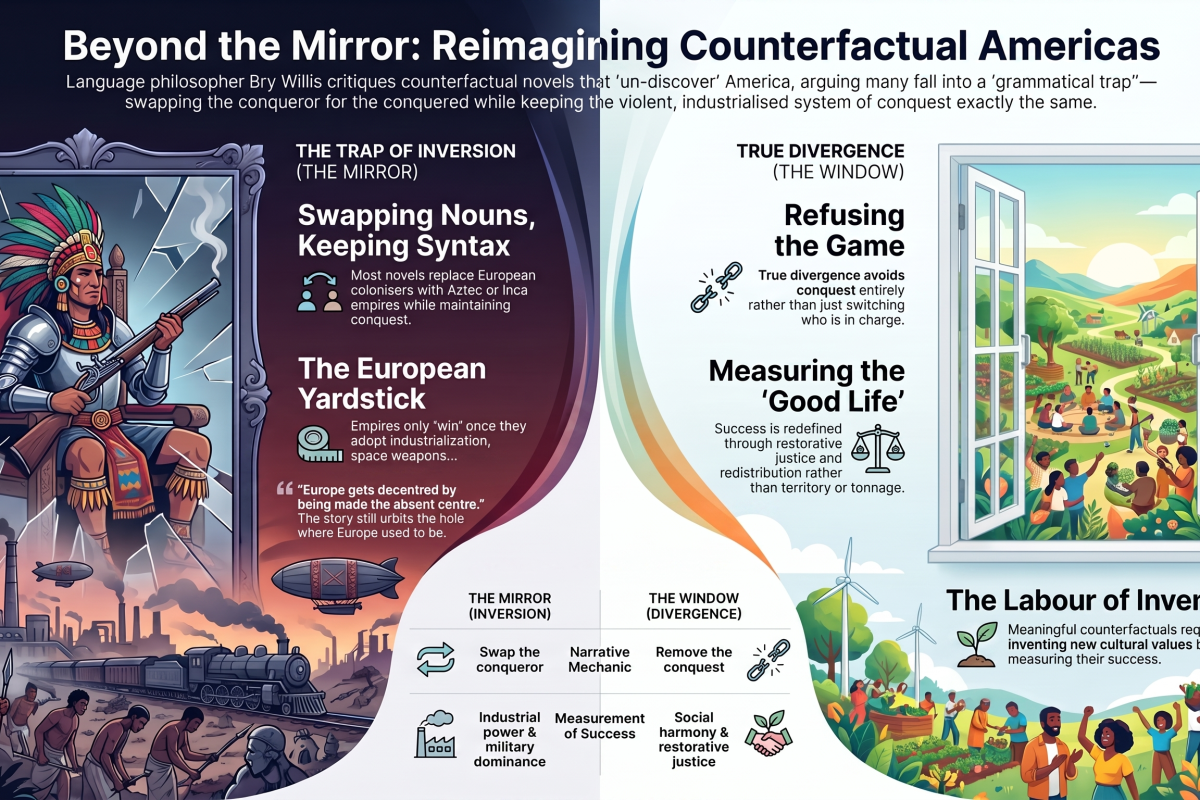
As Independence Day is upon the United States of America, I considered some counterfactuals. What if Europe fails to reach the Americas until a century or more late, and we watch the delay from the vantage of the peoples already here, going about the business of history without a Columbus to interrupt them? Then came the question everyone eventually asks about their own good ideas, in the tone of a man checking whether the milk has turned: has this been done before? Of course, it had been. Spoilers follow – sort of.
The inversions
The oldest respectable relative is Robert Silverberg’s The Gate of Worlds (1967). A nastier Black Death carries off three-quarters of Europe rather than a third; the continent never recovers, the Ottomans move in, London becomes New Istanbul, and by the twentieth century the great powers are the Aztecs, the Incas, the Russians and the Japanese. Our guide is a young Englishman named Dan Beauchamp, who sails to an industrial, motorcar-driving Mexico to seek his fortune. Note the pronoun. The world has been turned upside down, and we are shown it by a European looking up.
Christopher Evans’s Aztec Century (1993), which took that year’s BSFA Award, runs the same reversal with more brass. Cortés changes sides, a New World plague scythes through Europe instead of the reverse, and the Aztec Empire swells into a technological superpower that eventually occupies Britain. The narrator is Princess Catherine, daughter of a defeated British monarch, Princess Diana watching London burn from the losing side. Again, the conquered European tells us what the conquest was like.
Laurent Binet’s Civilizations (2019) is the cleverest of the lot, and the most decorated – it won the Grand Prix du roman de l’Académie française, and Sam Taylor’s English translation took the Sidewise Award for alternate history. A stray band of Vikings gifts the Americas iron, horses and, crucially, immunity; so when Columbus turns up in 1492, he is captured and demoted to court jester, and the Inca emperor Atahualpa later sails east to conquer a Europe conveniently fractured by Luther, the Inquisition and its own dynastic squabbles. Binet is far too intelligent not to know what he is doing. The whole thing is a Civilization-the-video-game daydream executed with Académie française tailoring, and it is genuinely delicious. It is also, structurally, another inversion: swap the conqueror, keep the conquest.
The remix and the intervention
Two cousins change the machinery rather than the direction. Kim Stanley Robinson’s The Years of Rice and Salt (2002) empties Europe almost entirely – the plague takes ninety-nine per cent – and then spends six hundred sprawling, reincarnation-threaded pages letting China, Islam, India and the Indigenous Americas run world history without the Europeans in the room at all. It is less a mirror than a vast tapestry, and its ambition is precisely that Europe should not be the pivot. Whether it manages that, or merely relocates the pivot, is a question the book is honest enough to leave open.
Orson Scott Card’s Pastwatch: The Redemption of Christopher Columbus (1996) cheats, and admits it: time-travellers reach back to soften the catastrophe of contact. It is a book about first contact, disease and conquest, but the engine is intervention from a guilty future, which makes it a novel about us editing them, the colonial gaze wearing a lab coat.
The one that isn’t a mirror
And then there is B. L. Blanchard’s The Peacekeeper (2022) – also, tellingly, a Sidewise Award winner – which does the rarer thing and quietly refuses the whole game. There is no inversion here, because there is no conquest to invert. North America was simply never colonised. The Great Lakes are an independent Anishinaabe nation; Chicago is Shikaakwa; there are no borders on the map because the book declines to draw any. It happens to be a murder mystery, and a slightly wobbly one – I called the culprit early, as apparently did everyone – but the mystery is scaffolding. The real work is a society organised around restorative justice, redistribution and something the glossary calls the Good Life, where crime is repaired rather than punished, and the question ‘what is success?’ gets a genuinely different answer. That difference is the whole point, and it is worth spelling out.
The tell
Watch what the inversion novels are obliged to do to their winners. Silverberg’s Aztecs drive coal-fired automobiles. Evans’s Aztecs somehow have flying warships and space weapons, to the audible irritation of every reviewer who has ever met a history book. In each case, the counter-empire only counts as having won once it has industrialised, once it has, in other words, become Europe in a headdress. The measuring stick never leaves the room. It just changes hands. Would not recommend. All of these are still viewed through Modernist lenses. They can’t seem to help themselves.
This is the trap, and it is a grammatical one: you can swap every noun in the sentence and leave the syntax of conquest perfectly intact. Who dominates whom is a variable. That domination is the axis of the story remains fixed – invisibly, load-bearingly fixed. So the shelf keeps producing books that promise to dethrone Europe and instead install a differently-costumed emperor on the same throne, using the same yardstick to prove he deserves it. Europe gets decentred by being made the absent centre. Everything still orbits the hole where it used to be.
Blanchard’s book is the one that escapes, and it escapes not by putting someone else on the throne but by asking whether the throne needed to exist. That is a far harder imaginative act, which is exactly why the shelf holds so many mirrors and so few windows. Inverting a hierarchy is a parlour trick – satisfying, symmetrical, teachable in an afternoon. Imagining a world whose values diverged, so that its people would not measure their flourishing in territory and tonnage at all, requires you to invent the ruler before you can invent the thing it measures. Most writers, sensibly, decline the extra labour.
Six books, then, and a warning label. Read Binet for the wit, Blanchard for the nerve, Silverberg for the ancestry, and the rest for the pleasure of watching very clever people not quite escape the room. Then, if you’re feeling brave, go and undiscover America properly, which means resisting the temptation to let it become us, wearing better feathers.

