I’ve been working for days on a new short story that investigates time. I’ve already published The Box in English, but this new piece looks at a different aspect of time, one I suspect may work better in French because the grammar gives me more useful pressure points than English.
The working title is Les Années Vécues, which translates literally as The Years Lived. For now, that’s only a working title. Oddly enough, the purpose of this post is not really to describe the story, though I may do some of that. It is more about the tools, the process, and the strange route by which the idea arrived.
The story began as a conversation between me, Claude, and ChatGPT about human innovation and creativity. A colleague had recommended How Language Began. I bought it and read the first few chapters. For the record, it’s interesting.
Early on, the author discusses genetics and evolution, citing human inventions along the way, particularly those associated with Homo erectus. Because I tend to question narratives of progress, and especially grand claims around Innovation and Creativity, I fell into some LLM-assisted chit-chat. From there, the conversation drifted into time travel in fiction. We discussed tropes from Back to the Future to Outlander. Somewhere in that mess, I noticed a missing perspective I felt I could capitalise on.
For the record, again, I have not been especially successful at writing short stories. They tend to grow beyond my intent, usually into novelettes or novellas. My first novel, written as Ridley Park, began as a short story. That story is now ostensibly chapter five of Hemo Sapiens. It can stand on its own, but it plays better in context. It is still my favourite chapter, if I had to choose one. So I’ll see where this new one goes, if anywhere. Nowhere is always an option. The blank page remains admirably non-committal.
After hours of brainstorming with the LLMs, arbitrarily switching from French to English and back again, I had a plot outline with beats and flavour, tropes and intentions, subversions and misdirects. I had captured dialogue exchanges, worked through worldbuilding constraints, and fleshed out several plot points. Then I asked ChatGPT to build me a tracking document to serve as a punch list.
I’ve done this a few times before, but with the advancement of the tools, the output was surprisingly robust, arguably overkill, which isn’t always a vice.
The spreadsheet contains 9 tabs:

- Lists
- Dashboard
- Punchlist
- Beat Map
- Continuity Rules
- Motifs & Plants
- Evidence Ledger
- Open Questions
- Sources
Lists
The Lists tab is mostly internal to the spreadsheet. It controls status values, priorities, categories, and related dropdowns. I would not have made it this elaborate manually, but I’m not offended by competence when it arrives uninvited.
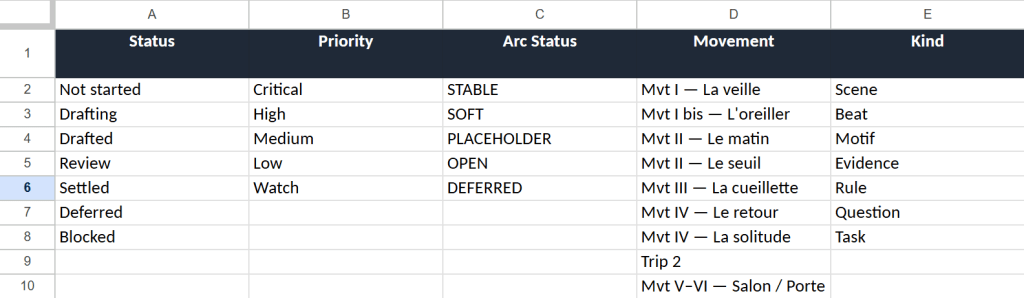
I wouldn’t have been so elaborate, but it’s nice nonetheless.
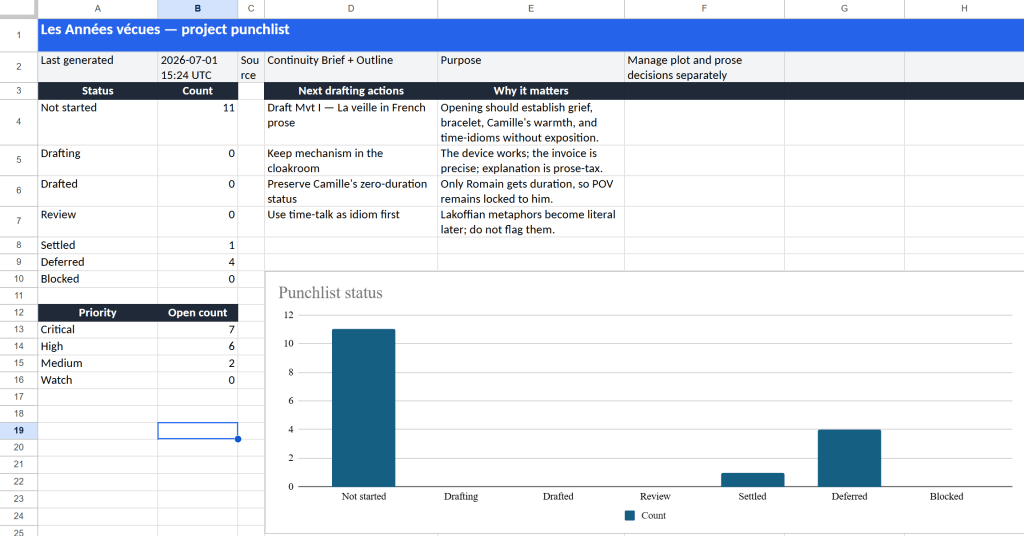
The Dashboard
The Dashboard is also a bit of overkill, but useful overkill. In its inaugural state, it gives a quick view of task status, priorities, and next actions. Its intent should be clear from the screenshot.
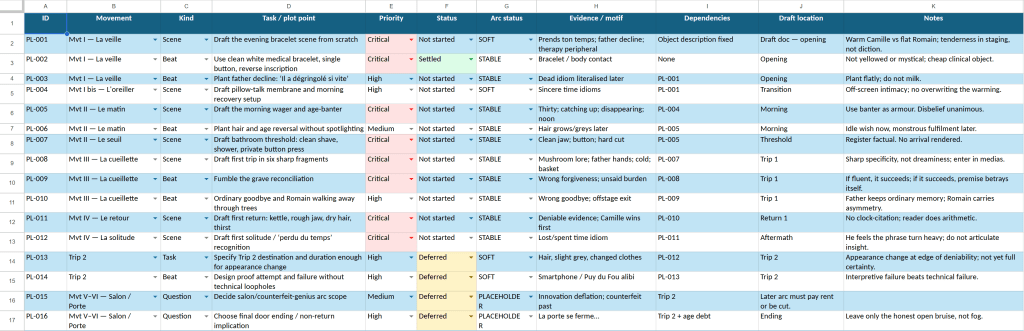
Punchlist
The Punchlist is essentially an actionable to-do list with status markers. I think I can safely share this without giving too much away. It lets me manage the story as a set of unresolved craft problems rather than as a vague cloud of ‘I should really get back to that’.
Beat map
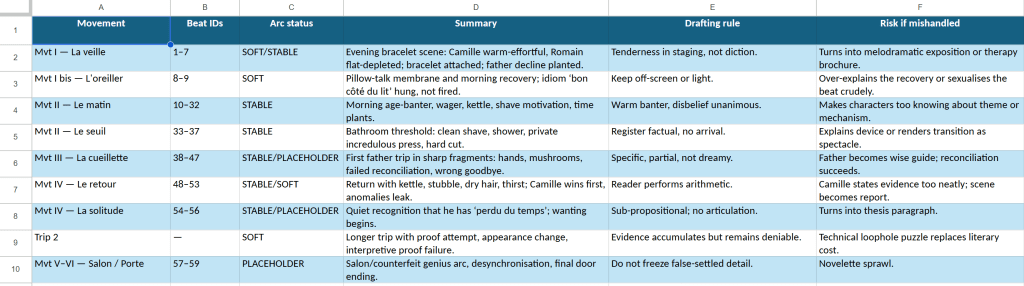
The Beat Map contains representative story beats, with notes that capture narrative purpose, confidence level, and risk-management annotations. This is where structure can be managed without cluttering the prose draft itself.
Continuity Rules
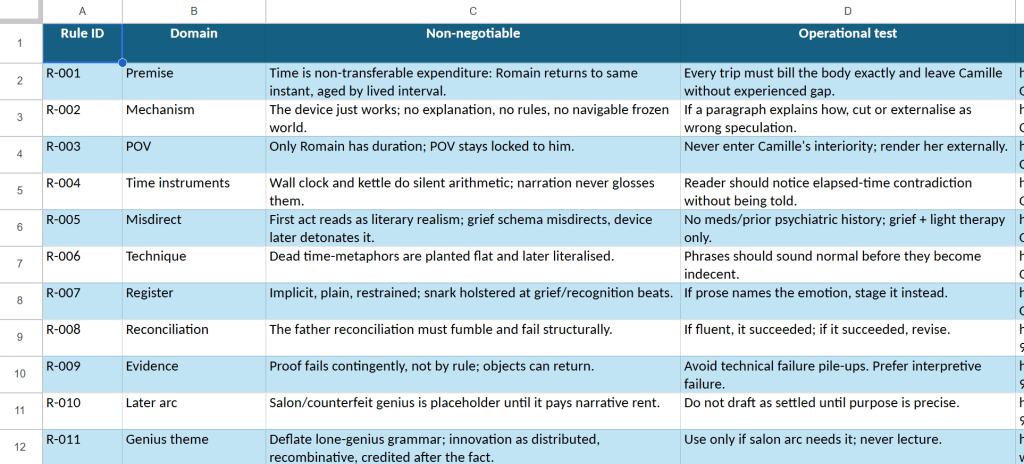
The Continuity Rules tab captures worldbuilding constraints and adjacent considerations. It is probably oversharing at this stage, but I’ll take the risk. These rules matter because speculative fiction can collapse quickly when the premise starts leaking.
Motifs & Plants
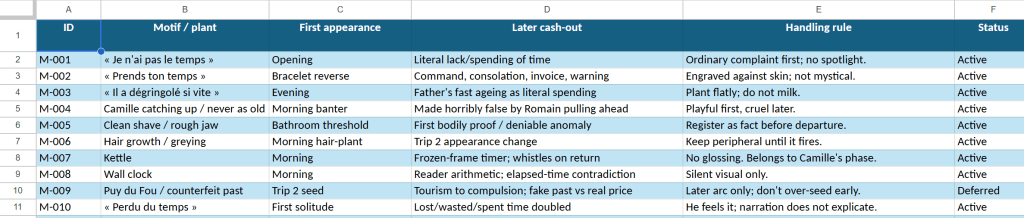
The Motifs & Plants tab tracks recurring touchpoints, images, phrases, and planted details. Some of these may be premature, but having them outside the draft helps me avoid forcing them into the prose too early.
Evidence Ledger
The Evidence Ledger tracks what counts as evidence inside the story world, who can interpret it, and how it may be misread. This is another continuity check, but also a thematic one.

Open Questions
The Open Questions tab is exactly what it sounds like: unresolved choices, structural uncertainties, and decisions I do not yet want to freeze into place. Sometimes the most useful document is the one that refuses to pretend everything has been solved.

Sources
The Sources tab lists the chat history and documents from which the rest of the content was derived.
The Rest
This is only a partial listing, and I am not finished ideating. I have not yet begun the prose.
I do not always plot my stories. More often than not, I take something closer to a stream-of-consciousness approach. But for one thing, my consciousness does not stream in French. So there’s that.
What impressed me most was the organisational layer the LLM produced. The spreadsheet is now hosted on Google Drive as a Sheet, accessible to both me and the LLMs, so it can be updated as the discussions and decisions continue.
I’m looking forward to wrapping up the ideation phase and beginning, and ideally completing, the prose. That last part remains the traditional nuisance.

