“Whom do you serve?” is the unasked question in the Grail story. Parsifal’s failure is usually treated as spiritual unreadiness, moral immaturity, or some such medieval hush. I’ve never had much sympathy for that reading. My own experience has made it difficult to leave certain questions politely untouched.
In my late teens and early twenties, I worked in Los Angeles as a musician, recording engineer, and producer. That meant spending a good deal of time around wealthy celebrities, not at parties but at work. The useful lesson was not glamour. It was status. More precisely, it was learning how often status functions as atmosphere: something to be indulged while present and ignored once it passes.
Berry Gordy once walked into a mixing session at his own studio and imposed a round of suggestions on a track headed for film. Nobody contradicted him. We didn’t need to. We knew that when he left, we would reset the console and write off the lost hour as weather. That is what aura often is: not wisdom, not competence, merely a temporary distortion field around a person whom others have learned not to challenge in the moment.
Gordy was an exception. Most days, there were no sacred cows in the room. Egos were bruised, feelings hurt, and compromises made. Work got done. If anything, the greater impostors were the label middle managers, appeased when present, ignored when absent, and forever acting as though they were paying for decisions that would ultimately be recouped from the artist anyway.
By the time I left music and went legit, I had already learnt the useful part: never mistake decorum for truth. I was never fully indoctrinated into pedestal-thinking, and I have never since managed to treat institutional aura as anything but local theatre. That is why the Grail story catches me at an odd angle. I do not identify with the knight who withholds the question. I identify with the person who asks it anyway, or with the child in Andersen who has not yet learned that collective performance outranks plain observation.
That, perhaps, is the real training most institutions require: not belief, but acculturation into silence. Some of us never quite acquire it.
Perhaps not 100% because I’ve just spent hours chatting with several LLMs, complaining about the spate of purported AI detectors that tell me ‘this content shows a high similarity to AI-generated content’ or somewhat.
Audio: NotebookLM summary podcast of this topic.
If I weren’t already familiar with the AI tells, I am now, as Claude reluctantly shared this:
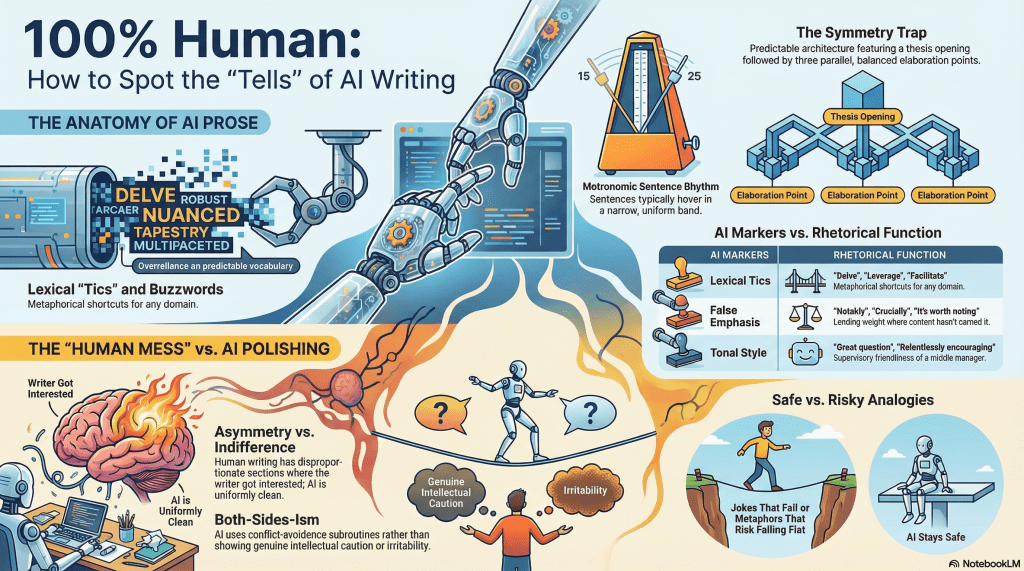
Lexical tics. The ones you’ve already flagged are real: “delve,” “robust,” “nuanced,” “multifaceted,” “landscape” (used metaphorically for any domain whatsoever), “tapestry,” “leverage” (as verb), “facilitate,” “underscores.” There’s also a tier of slightly subtler ones — “notably,” “crucially,” “it’s worth noting that,” “this is particularly important because” — which function as false-emphasis markers, lending rhetorical weight where the content doesn’t actually earn it.
Structural patterns. This is where it gets more diagnostic than any single word choice. LLM prose tends toward a very particular architecture: a thesis-restating opening sentence, three to five parallel elaboration points (often with suspiciously balanced treatment), and a synthesising conclusion that circles back to the opening. The ratio of setup-to-substance is high. Everything gets contextualised before it gets said. There’s a compulsive both-sides-ism, a hedging reflex — “while X is certainly true, it’s also important to consider Y” — that reads less like genuine intellectual caution and more like a conflict-avoidance subroutine.
Tonal tells. LLM text tends to be relentlessly encouraging. There’s an affective flatness masquerading as warmth — everything is “great question,” everything “raises important considerations.” The prose never gets genuinely irritable, confused, bored, or reckless. It maintains a kind of supervisory friendliness, the register of a middle manager who’s been on a coaching course. Relatedly, there’s almost never a genuinely surprising analogy or a metaphor that risks falling flat — the figurative language is always safe, always legible, always serviceable.
Punctuation and rhythm. The em-dash point is real but often overstated. More telling is sentence-length uniformity — LLM prose tends to hover in a narrow band of 15–25 words per sentence, rarely producing either the genuinely terse or the genuinely complex-subordinated. Paragraph length is also strikingly regular. The prose breathes at metronomic intervals.
The absence of mess. Perhaps the deepest tell. Human writing — even polished human writing — contains asymmetries: a paragraph that runs long because the writer got interested, a point that gets dropped without resolution, a transition that’s slightly rough, a joke that doesn’t quite land but stays in anyway. LLM prose is clean in a way that signals not craft but indifference — nothing is there because the writer cared about it, so nothing is disproportionate.
Add to this grammar-checkers attempting to drive writing back to middle school formats – not to mention competing grammar checkers hypercorrecting each other. The struggle is real.
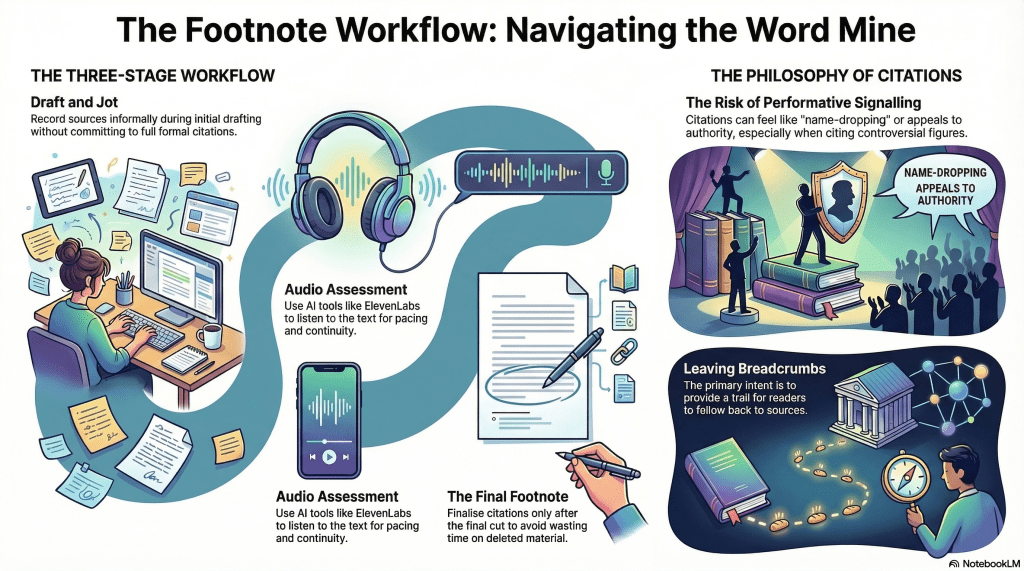
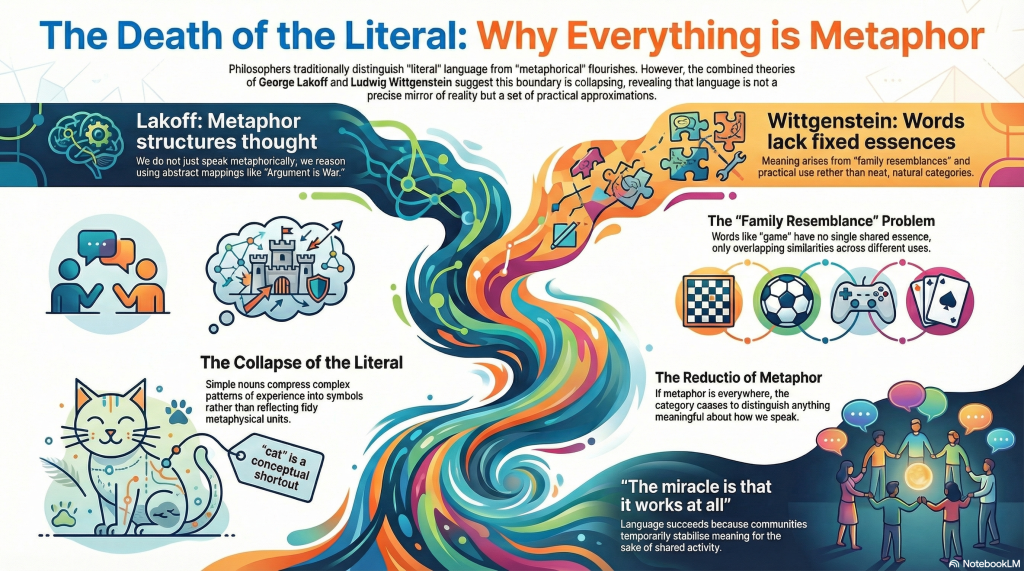
NotebookLM Infographic on this topic.
Of course, a solution might be just to review the content and undo these inclusions. Almost interestingly, I use Autocrit (but not often because it is too orthodox), but it does serve somewhat as an anti-AI agent, assessing rhythm and pace, plus the usual copyediting functions.
I prefer to draft in a stream-of-consciousness style. The AI organises my messes, so if I asked it to, it would remove or relocate my functional parenthetical about Autocrit. But I’m leaving it just to prove I’m human. Or did I add it to an AI-scripted piece? 🧐
Whilst I considered that I could either overdo AI or join the 54 per cent of Americans who write at a third-grade level. Grok suggested something even more sinister – Friggin Musk. It suggested that I double down on the AI likeness and make my content into an AI parody factory – overpopulate it with em-dashes, deving, and tapestry. Evidently, Carole King was AI before Suno.
In any case – and AI might suggest moving this to the top – the problem is that I now have an additional layer that interrupts my flow and process. It’s disconcerting, and I resent it. My psyche is disturbed to appease witchhunters. And it’s bollox.
The question is whether to succumb to the moral suasion or ignore the moral posturing.
This post contains no sugar, salt, fat, carbohydrates, protein, or fibre. No animals were harmed in the production of this blog. All proceeds will be donated to the Unicorn Recovery Foundation.
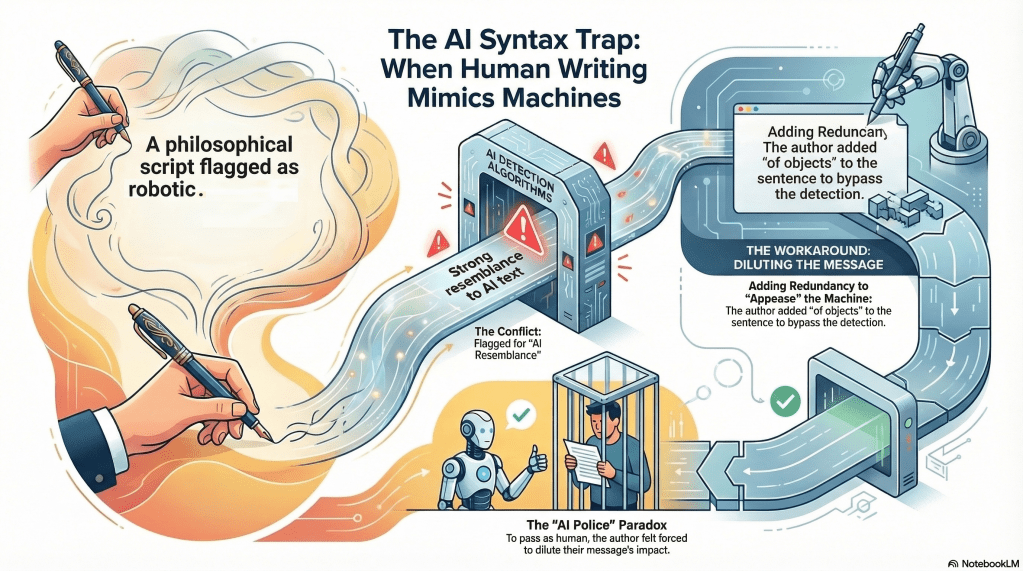
I was writing a video script, and a warning popped up. I first noticed this warning a couple days ago, but I didn’t think anything of it.
‘Strong resemblance to AI text.’
I am creating some videos to promote my latest book. I realise that it is academically dense, so I want to break down some of the subject matter.
As usual, my writing is on language and its insufficiencies.
But why was I being warned that my writing resembled AI? What does that even mean?
I reread the sentence:
What if the biggest trick language played on you is convincing you that the world is made of things?
I was looking for a hook to open the short clip. I altered it slightly:
What if the biggest trick language played on you is convincing you that the world is made of things, of objects?
This appeased the AI detector. I had to dilute the message by adding ‘of objects‘. As I write this, it reminds me of Margaret Atwood’s A Handmaid’s Tale and the naming of the women as property of their masters – OfFred, and so on. Of objects.
The AI police are annoying to say the least. Profiling: Minority Project. A 1984 thought crime.
I’m hopping down off the soapbox, down off my high horse, but I’m miffed by bollocks.
How does AI summarise it? Find out here:
Audio: NotebookLM summary podcast of this topic.
EDIT: Does it get worse?
When I checked into LinkedIn to share this post, I was distracted by another thread chatting about Emotivism. I’ll spare you the entire thread, but now Grammarly wants me to write in German. Was ist los?
Lucy V. Hay posted this on LinkedIn… and then stopped allowing comments, so I figured I’d recycle it here for comment.
Unpopular opinion (that shouldn’t be unpopular):
The term “Mary Sue” is inherently s3xist 🎯
The phrase comes from a 1973 parody story by Paula Smith called A Trekkie’s Tale. It mocked the self-insert characters appearing in Star Trek fanfiction.
Those writers? Mostly teenage girls 😡
That matters, because culturally we have a long history of treating teenage girls – and the things they create – with contempt. Their fandoms, their stories, their passions are routinely framed as embarrassing, shallow or ridiculous.
Sometimes that ridicule even comes from older women punching down.
And no, the fact Smith was a woman doesn’t magically make the term neutral. Internalised misogyny exists.
Here’s what happened next …
For the last 50+ years, the label “Mary Sue” has been used against practically every female protagonist who shows competence, power or narrative importance.
Meanwhile, male characters with identical arcs are celebrated.
An inexperienced boy who turns out to be the chosen one? Hero.
A woman who discovers she has unusual power or talent? “Mary Sue.”
Same narrative structure … Different reaction 😡
Also, it’s worth noticing something interesting: I hadn’t seen the term “Mary Sue” on my timeline for yeeeeeeaars. Now, every time I post something about female characters, there it is again. In 2026 🤮
Given the current climate around women’s rights and the growing attacks on women and girls globally, that resurgence doesn’t feel accidental. Language shapes culture. Storytelling shapes culture.
And here’s another truth many people don’t realise:
The professional writing industry does not use the term “Mary Sue.”
Not in publishing. Not in development notes. Not in writers’ rooms.
If you’re using it as critique, you’re not signalling professional insight. You’re signalling that you learned storytelling discourse from internet flame wars.
If we want better conversations about character, we need better vocabulary than a 1970s insult aimed at teenage girls writing fanfic.
If you want to explore how bias shapes the way we write and judge characters, that’s exactly what I unpack in my book Writing Diverse Characters For Fiction, TV Or Film (Creative Essentials) 👇 👇 👇
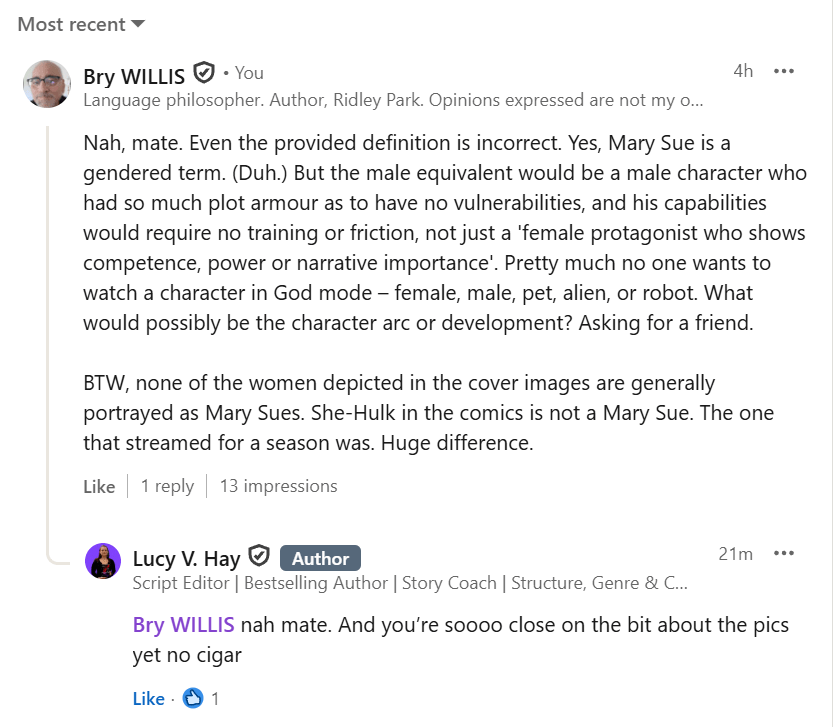
Nah, mate. Even the provided definition is incorrect. Yes, Mary Sue is a gendered term. (Duh.) But the male equivalent would be a male character who had so much plot armour as to have no vulnerabilities, and his capabilities would require no training or friction, not just a ‘female protagonist who shows competence, power or narrative importance’. Pretty much no one wants to watch a character in God mode – female, male, pet, alien, or robot. What would possibly be the character arc or development? Asking for a friend.
BTW, none of the women depicted in the cover images are generally portrayed as Mary Sues. She-Hulk in the comics is not a Mary Sue. The one that streamed for a season was. Huge difference.
Her response was flippant and contained no useful information. I can only imagine she’s trolling.
Obviously, I understand that language is an imperfect vehicle, but it doesn’t have to be this abused. And, obviously, she provided her definition, but it doesn’t comport with any definitions I’m aware of.
As far as the Mary Sue argument goes, ‘no one’ in that space berates all female roles, not even past heroes like Wonderwoman, Spiderwoman, Batwoman, or Ripley from Alien, Terminator’s Sarah Connor, and so on. No one (except Lucy) categorises them as Mary Sue.
This is convenient for an argument, but it’s really tilting at windmills. I understand she’s likely trying to drum up publicity for her book. Good on her. She’ll attract people sympathetic to her message. As for me, I don’t trust a disingenuous source.
I’m not ashamed to say that AI is a significant part of my publishing workflow. In my latest project, The Architecture of Encounter, I’ve added indexing to the roles it serves. Other roles were prepping the index and footnotes, as I shared recently.
I expect the book to be available by next week. Time will tell.
I’ve included the full index below for reference. I’ve also included the title and copyright pages and other back matter.
What will a visitor do with a bookless index? I don’t know, but sharing is caring in my book. For the interested, you can get a sense of the contents. I’ll be sharing more details over the coming weeks – and beyond, I’m sure.
Earlier, I shared that Claude had offered index candidates. I started executing on that list by indexing the first few terms. It took me about an hour to do these, searching for each term and documenting the page number and context – around 250 pages. The book itself is 292 – 6″ x 9″ pages, but more than 50 of these are appendices, and others are front matter. Still.
Audio: NotebookLM summary podcast of this topic. (Another one that misses some points but make others. Fair enough.)
Then it dawned on me to ask Claude to help me with the index. Claude interpreted ‘help’ by spitting out the entire index, formatted and organised. If the book were formatted in 8½” x 11″ Letter size, I could have appended it as-is, but I still had to pour the output into the InDesign template I was composing through and make it look like it was part of the same manuscript, but that took minutes, not days of hours. Appendix E.
Given that I also rely heavily on novel concepts and specifically-defined terms – language insufficiency notwithstanding – I felt that a glossary would be useful. I tasked Claude with this, too. Again, it output a fully-formed list.
I noticed that a couple of terms I wanted defined were absent, so I fed the list into ChatGPT and asked it to consider these and let me know, given the manuscript, what other terms might be absent. It agreed with the two I wanted and suggested three more. It also pointed out an error Claude had made in counting. It also provided the definitions for the glossary entries, so I poured Claude’s output into InDesign. Appendix D.
AI is also a helper. For example, I wanted my index to flow into 2 columns. I’ve done this before. In the old days, I’d have scanned the menus (Adobe products are infamous for convoluted, nested menus), read the manual, and/or Googled for the answer – perhaps queried YouTube, a great resource for such things. Now, I ask AI. In this case, I asked ChatGPT. To be honest, it’s a little verbose, where ‘it’s option X under Y menu’ would suffice, but I ignore the banter.
If you need to know…
If the index is already placed in a text frame
Select the text frame containing the index.
Go to Object → Text Frame Options.
Set the Number of Columns you want, usually 2 for a 6×9 book, sometimes 3 if the type is small and the entries are short.
Adjust the Gutter spacing between columns.
Click OK.
Criticise AI all you want, but having access to in-built assistance 24/7 is a huge time-saving benefit.
Do I still use Google and YouTube? Yes, often.
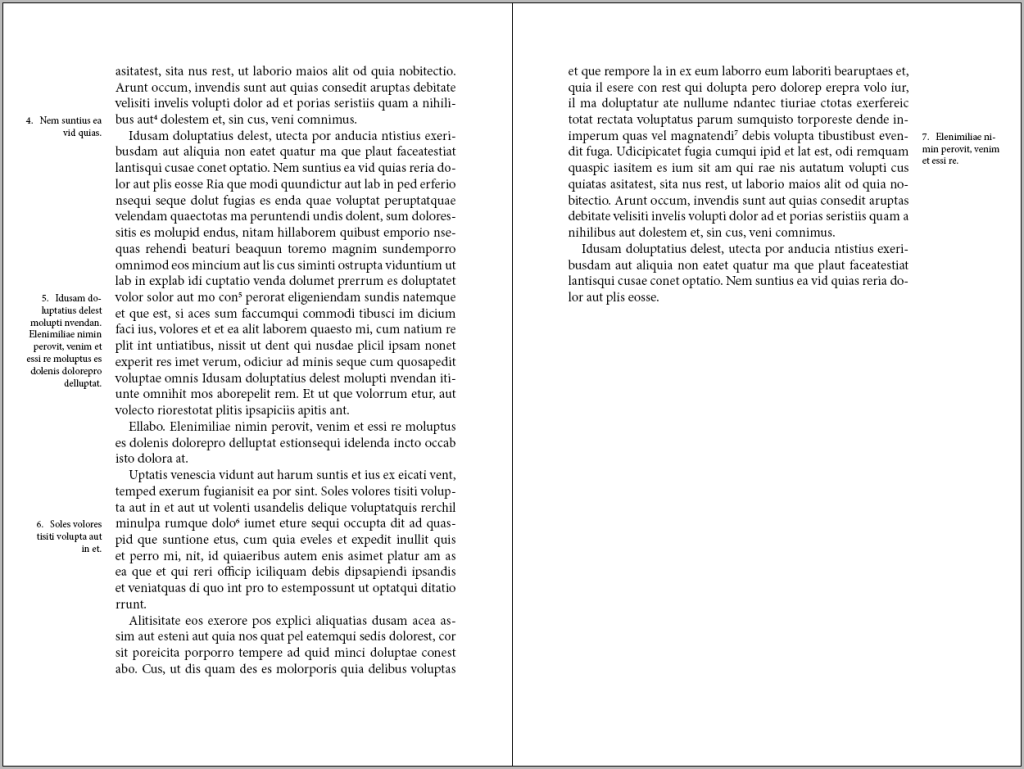
Speaking of Google, I was searching for a cover image, and I discovered something I need for the fiction title I paused in September to focus on nonfiction. Sidenotes. Perhaps I’ll employ a similar mechanism.
The nonfiction book I am writing is somewhat epistolary, and I want to place internal dialogue as marginalia, employing a scripted font face. I am even considering a ‘deluxe’ version that renders this content in colour, but that’s an extra expense, first for the colour, then the full-page bleed, and perhaps thicker paper stock. Likely hardbound, reserving the paperback for a lower price point.
So, what’s next?
I finished both paperback and hardcover designs today.
I still need to review the index for hallucinated errors. This will still take less time than manually constructing it.
On the copyright page, there are a few classifiers. There are ISBNs for each format and a Library of Congress Control Number (LCCN). These are done, as you can see, but the ISBN system in the United States is antiquated. It looks like it’s a museum piece from the mid-1990s. In fact, I believe I first accessed it around 2000 or 2001, when I published my first book – before AI, before print on demand (POD).
A bit of nostalgia. The WWW, the internet as most people know it, was made public around 1994. Google hit it in 1998. Web 1.0. Facebook blighted the world around 2004, though less invasively at the start. I digress. Technology is a mixed bag.
Returning to ISBNs… These are managed in a system built circa 1997. It seems it is still managed with a host of cron jobs, so not much is processed in real time unless it’s a trivial record entry.
Each ISBN references a title and a format, as well as other odds and ends. In my case, I also use an imprint to separate my fiction from nonfiction. I started Microglyphics – tiny writing– in the mid-90s. When I published other authors, I used this name. I also used it for some of my fiction writing. I decided to create a Philosophics Press imprint for my philosophy and adjacent work.
It turns out that the printer needs to ensure that a book’s title and ISBN match the imprint. The system default is the company name, but I changed it to my imprint. This causes a workflow event on their end. Until it propagates, it doesn’t match, and the printer won’t allow the print run.
I’m writing this blog entry as I wait. I’m not sure if it’s automated – I’d like to assume it is – or if a human has to do something. AI might help. Just saying.
EDIT: The imprint has now been updated to Philosophics Press, but it still doesn’t work at the printer. Evidently, it can take up to 5 days for the data to propagate. I’m not sure who owns the fail on this one? Is the printer waiting for a data push? Can’t they pull the data? They seem to be live from my perspective. Is there an API, or is it truly old-school?
Whilst I’m here wittering on, WordPress have deprecated the little widget below – the one with my (old) thumbnail picture and ‘written by’ tag. I adopted it last year, but it’s been killed off. I’ve been copying the object from old posts, but I’ll probably switch to whatever they’ve replaced it with. I wasn’t keen on the options I’ve seen so far. First-world problems, I suppose.
As a writer, I have a kind of workflow in mind. It differs for fiction and nonfiction, though there are similarities. The main differences are indexes, references, and footnotes. I thought I was nearly finished with my latest book.
Audio: NotebookLM summary podcast of this topic.
I rendered the first couple of chapters in ElevenLabs so I could listen to the text. It helps me assess pacing, continuity, and the like. It also gives me one more thing to fix, since the digital voices occasionally pronounce things differently from the way I’d prefer. Usually, choosing a voice that sounds roughly like Standard Southern British English helps, though not always. In any case, I survive.
While listening and following along in the manuscript, I discovered that I still haven’t fully footnoted the book.
When I write, I tend to jot down sources and references as I go, but I leave the footnoting until the final revision. There is little point in spending time drafting footnotes for material that may not survive the cut. So here I am, drafting footnotes.
I am of two minds about footnotes and citations, especially in academic work. On the one hand, they can feel performative, a way of signalling that one has incorporated so-and-so, a kind of name-dropping appeal to authority. As a heterodox writer, this is risky anyway, because I am liable to cite one of the approved villains. God forbid a Nietzsche, a Heidegger, or a Foucault. Analytic philosophers, in my experience, can be remarkably thin-skinned.
On the other hand, I do want to acknowledge those whose ideas I have borrowed. Even that, of course, is also a signal. Perhaps it all comes down to intent. As I mean it, I want to leave breadcrumbs for anyone who feels inclined to follow them back to the source.
I’ll let you decide where I’ve landed.
I’ve procrastinated long enough. Time to get back into the word mine.
I’m a philosopher of language, which sometimes veers off the reservation into philosophies of science and even metaphilosophy, but I am not a physicist. I don’t pretend to be. I do try to remain abreast of the goings-on in physics and science just because. Still, I view most affairs first through a philosophical lens.
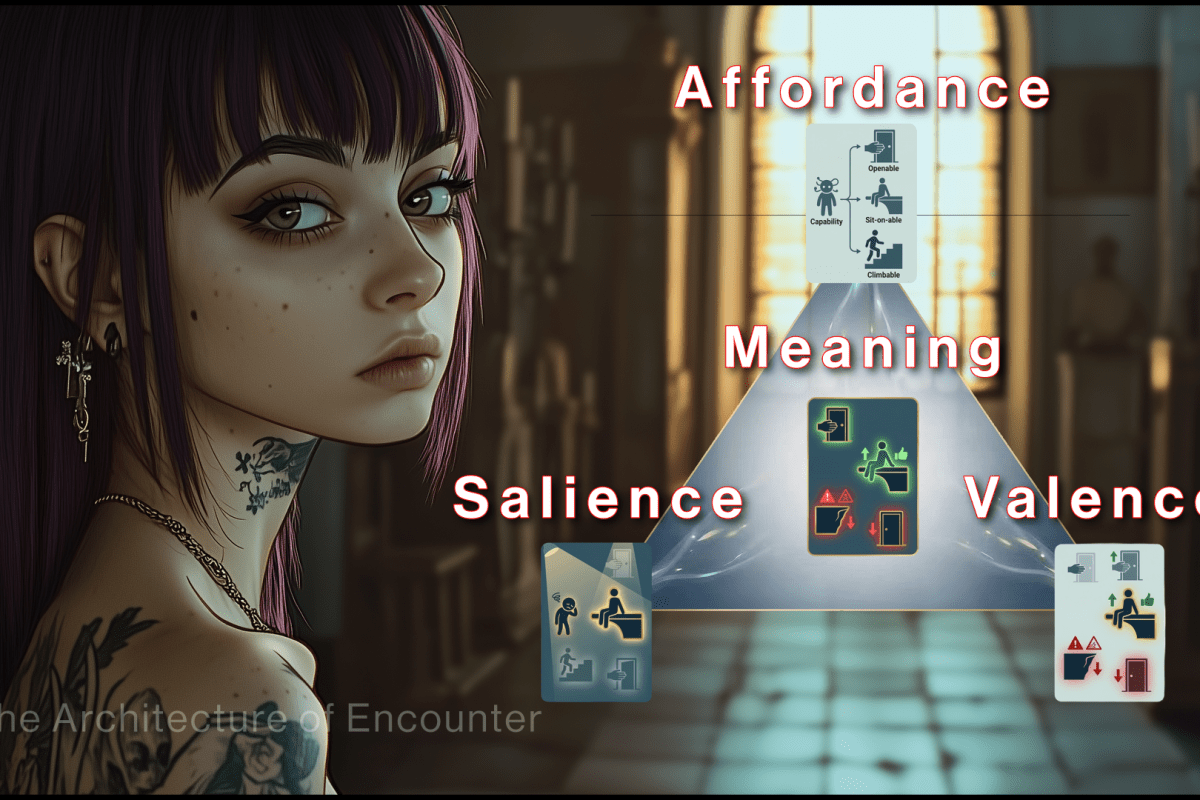
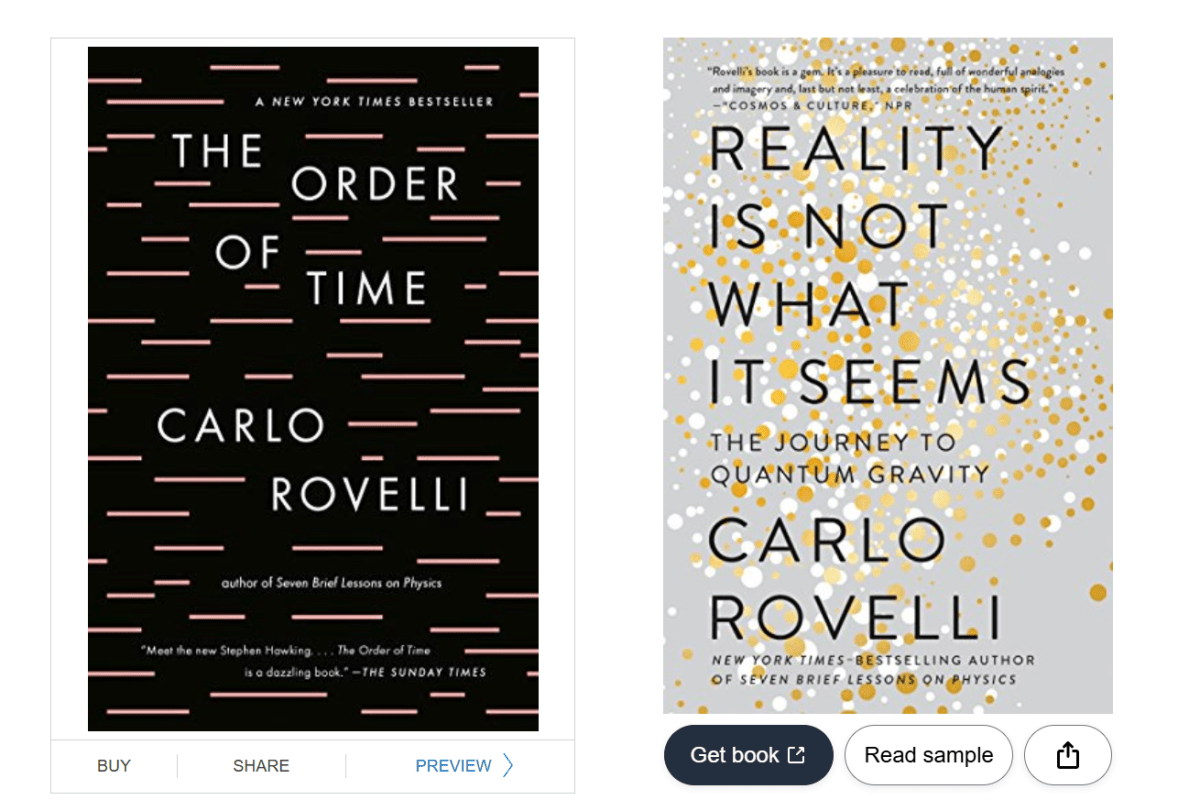
I watch a decent amount of science videos on YouTube, and I’ve been following Rovelli for years, but I hadn’t engaged with his work directly until I was researching for my current book, The Architect of Encounter. First, I read The Order of Time, followed by Reality Is Not What It Seems.
Rovelli published these books around 2017, but I am only reading them now. We are travelling in the same neighbourhood, but we occupy different residences and have different orientations.
Surveying the marketplace, quite a few physicists and science educators make some of the same points I and Rovelli make. In fact, these things appear to occur as trends. When I wanted to write about agency and free will over five years ago, I noticed a slew of books on the topics, and I had nothing more to add, so I shelved the idea.
In this case, the trend appears to have been between 2017 and 2018. I’m sure this is where I absorbed some of my knowledge, opinions, and grammar, but my thesis goes further and comes from a different perspective, so I feel this manuscript is worth publishing.
Getting back to Rovelli, his books are very well written – very approachable and light on the academics. I hope mine lands somewhere in the middle. As I continue to write my book, I will lean on Rovelli for the perspective on quantum theory. If he’s wrong or it’s wrong, then we fall together. That’s what happens when you borrow a foundational commitment. It’s a risk I am willing to take.
As much as I want to share more of what I am working on, it turns out I still need to work on it if I want to complete it. I am aiming for April this year, if not sooner. At least I’ve got some of the administrative stuff out of the way. Here’s a quick glimpse, title and copyright pages.
NB: When I wrote ‘everything’, I meant ‘every nominal language reference’.
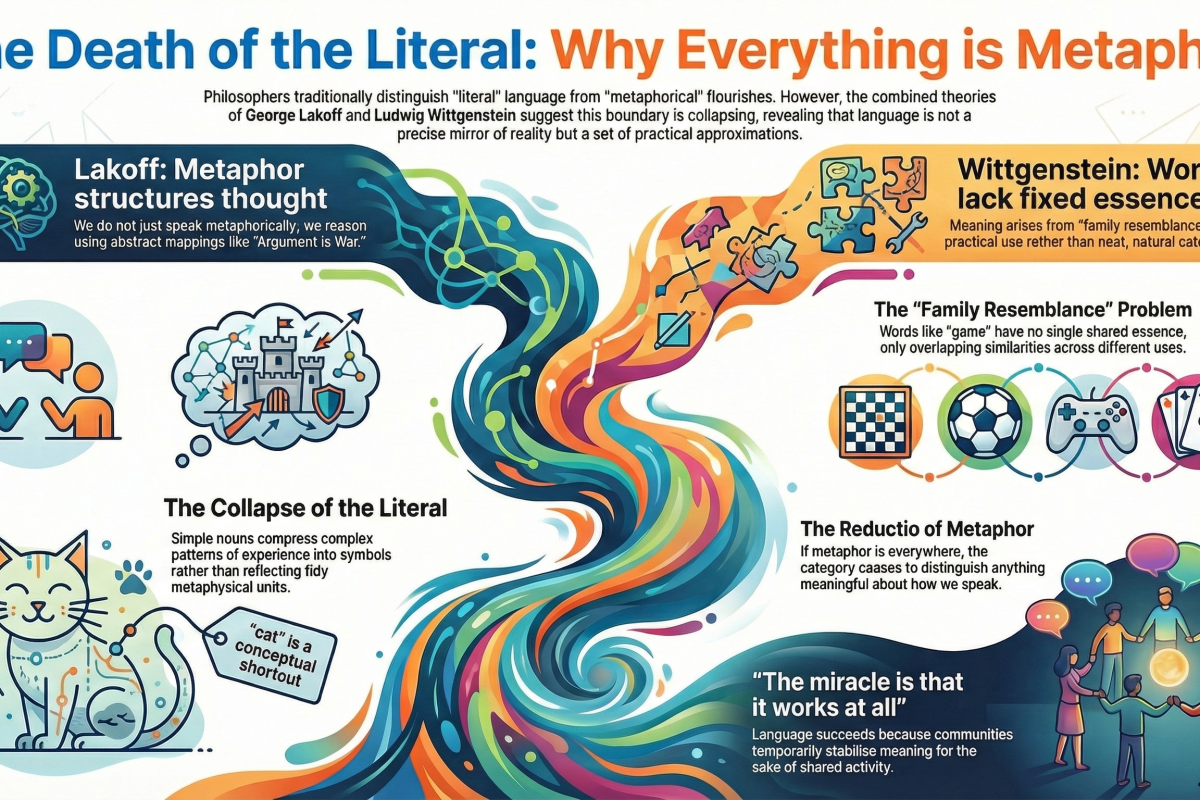
Lakoff, Wittgenstein, and the Quiet Collapse of Literal Language
Philosophers have long comforted themselves with a tidy distinction: some language is literal, and some language is metaphorical. Literal language names things as they are; metaphor merely dresses thought in rhetorical clothing.
The trouble begins when one looks more closely at how language actually works.
Two very different thinkers – George Lakoff and Ludwig Wittgenstein – approach the problem from opposite directions. Yet taken together, their ideas produce a rather awkward conclusion: the category of metaphor may collapse under its own success.
Audio: NotebookLM summary podcast of this topic.
EDIT: The algorithm gods served me this Substack article as I was writing this. I share it now because the author and I exchanged thoughts. Check it out.
Lakoff’s Problem: Metaphor All the Way Down
George Lakoff’s work on conceptual metaphor starts with a deceptively simple claim: metaphor is not merely a stylistic flourish. It is part of the structure of thought itself. We do not merely speak metaphorically. We think metaphorically.
Consider a few familiar examples:
ARGUMENT IS WAR: We attack positions, defend claims, demolish arguments.
TIME IS MONEY: We spend time, waste time, invest time.
LOVE IS A JOURNEY: Relationships stall, partners move forward together, or reach dead ends.
Lakoff’s point is not that these are poetic expressions. Rather, these metaphors organise how we reason about abstract domains. They structure cognition itself. So far, so interesting.
But once one notices how pervasive such mappings are, a problem begins to appear. If abstract reasoning depends on metaphorical projection from embodied experience, then metaphor is not a special case of language. It is the normal case. Literal language starts to look suspiciously rare.
The miracle is not that language fails sometimes. The miracle is that it works at all.
Wittgenstein’s Problem: Words Without Essences
Wittgenstein arrives at a similar discomfort by a different route.
In the Philosophical Investigations, he dismantles the idea that words gain meaning by pointing to fixed essences. Instead, meaning arises from use within human practices.
His famous example is the word game. Board games, sports, children’s play, gambling, solitary puzzles. Try to identify the essence shared by all games and the category dissolves. What remains are overlapping similarities – what he calls family resemblances.
The word functions perfectly well in practice, yet no clean boundary defines its referent.
The implication is unsettling: even apparently straightforward nouns do not correspond to neat natural categories. They operate as practical shortcuts within forms of life.
Language works not because it mirrors the world precisely, but because communities stabilise usage long enough to get through the day.
The Awkward Intersection
Place Lakoff beside Wittgenstein and something odd happens. Lakoff shows that abstract reasoning depends on metaphorical structure. Wittgenstein shows that even ordinary categories lack fixed essences. The combined result is difficult to ignore: the supposedly literal core of language begins to evaporate.
Take a simple word like cat. It seems literal enough. Yet the world does not present us with tidy metaphysical units labelled CAT. What we encounter are patterns of behaviour, morphology, and recognition. The word compresses a complex set of experiences into a convenient symbol.
In practice, cat functions as a stand-in for a stabilised pattern within human life. It is a conceptual shortcut — a linguistic token that represents a distributed cluster of features. In other words, even the most ordinary noun already behaves suspiciously like a metaphor.
The Reductio
If Lakoff is right that much of thought is metaphorically structured, and Wittgenstein is right that categories lack fixed essences, the traditional contrast between literal and metaphorical language becomes unstable.
Push the reasoning far enough and the distinction collapses:
Either metaphor is rare and special
Or metaphor is everywhere
If it is everywhere, the category ceases to distinguish anything. It becomes like describing fish as “wet creatures.” Accurate, but not especially illuminating. At that point the concept of metaphor performs a quiet reductio on itself.
What Survives the Collapse
Fortunately, the collapse of the literal–metaphorical boundary does not render language useless. It merely changes how we understand it.
Words are not mirrors of reality. They are tools for coordinating experience. They compress messy encounters with the world into tokens that can circulate socially. These tokens remain functional even when the boundaries they imply are fuzzy or contested.
Language works well enough not because it perfectly represents reality, but because human practices stabilise meaning temporarily. Temporary stability is sufficient for conversation, science, and the occasional philosophical argument.
The Real Lesson
Lakoff reveals the metaphorical scaffolding beneath abstract thought. Wittgenstein shows that even ordinary categories rest on shifting ground. Together they suggest something rather humbling.
Language is not a system of precise mirrors reflecting the world. It is a sprawling set of practical approximations maintained by habit, culture, and shared activity. The miracle is not that language fails sometimes. The miracle is that it works at all.
Written by Claude Sonnet 4.5 with Prompts by Bry Willis
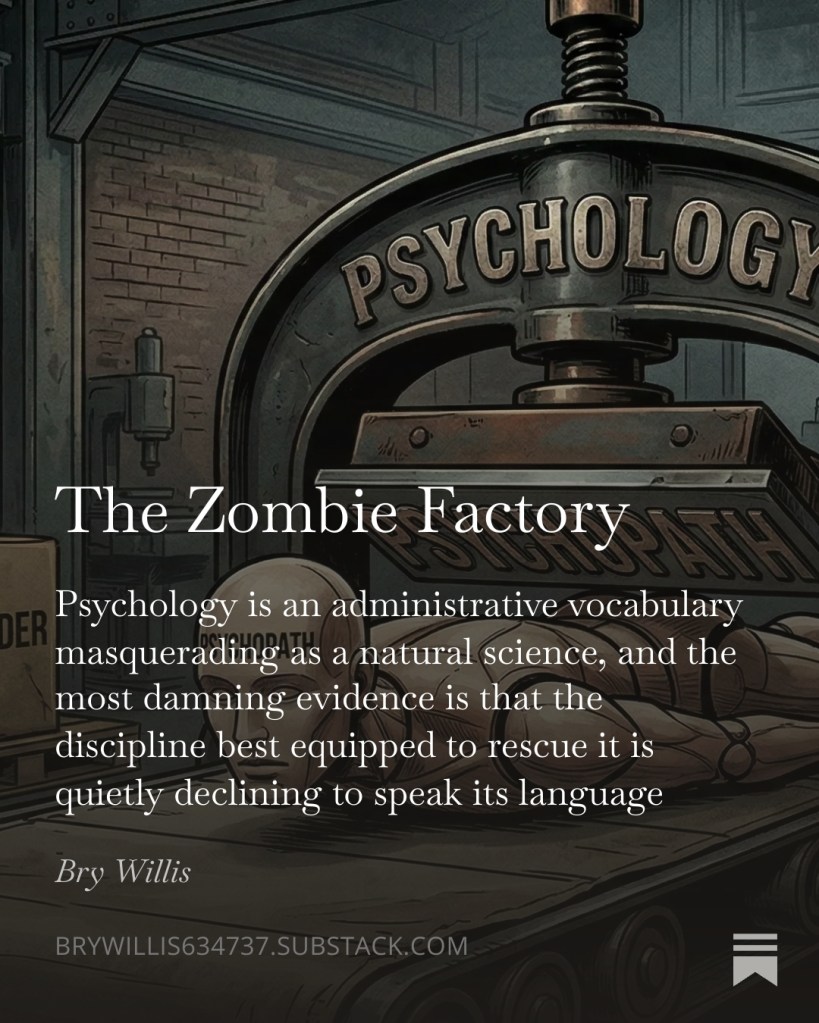
I am no fan of psychology, so I am attracted to stories like this – or the algorithms attract them to me. This article lays out the evidence that psychopathy doesn’t exist. By extension, sociopathy shouldn’t exist, since it’s effectively an extension of psychopathy. If unicorns don’t exist, neither do unicorn horns. In fact, one might look backwards to note that the psychopathy of unicorns doesn’t exist, nor does psychology (unicorn farms). Of course, this is faulty logic, but I’m running with it.





 Philosophics