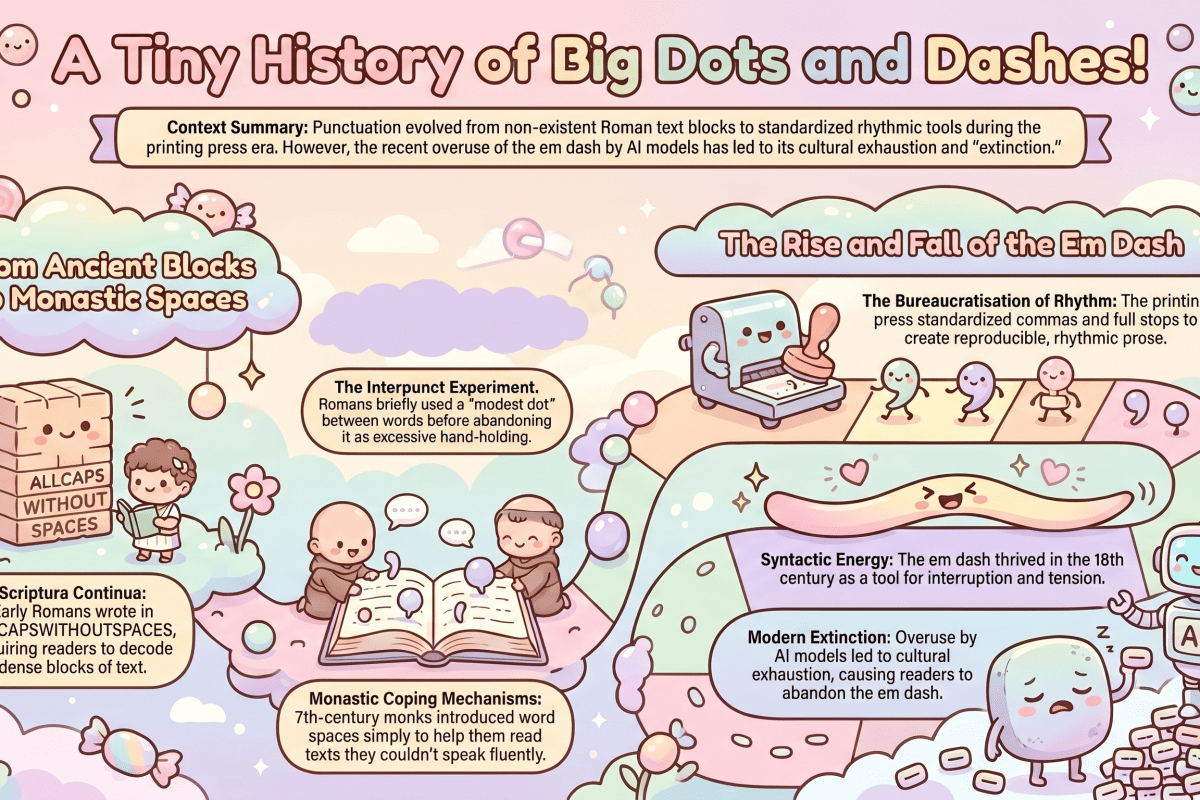
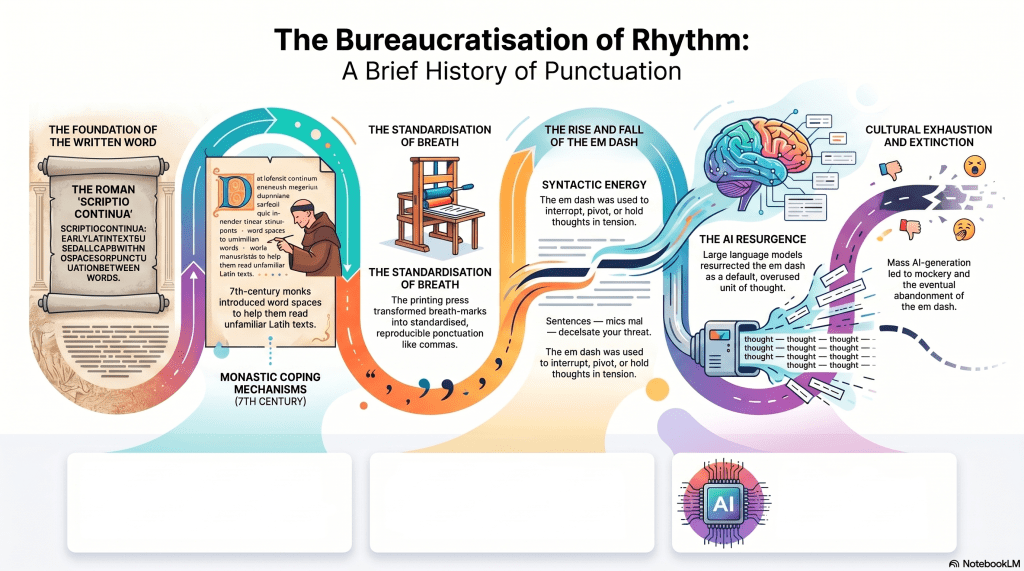
For most of human history, written Latin looked something like THISISASENTENCEABOUTPHILOSOPHYORWARYOUCHOOSE, and readers were simply expected to get on with it. And of course, in ALL CAPS. This was not considered a problem. The Romans were not known for their sensitivity to the needs of others.
The Romans did, briefly, experiment with the interpunct – a modest dot deployed between words, giving the reader something like THIS·IS·A·SENTENCE·ABOUT·PHILOSOPHY·OR·WAR·YOU·CHOOSE – before apparently deciding this was excessive hand-holding and abandoning it entirely. Punctuation’s first appearance in Western prose was thus also its first act of self-destruction. A precedent, as we shall see, that held.
Audio: NotebookLM summary podcast of this topic.
Relief came, eventually, from the most unlikely of sources: monks. Specifically, Irish and Anglo-Saxon monks in the 7th and 8th centuries, who were copying Latin texts they couldn’t actually read fluently, and who introduced spaces between words as a personal coping mechanism. Civilisation has strange bedfellows.
The comma, the full stop, and their assorted relatives arrived with the printing press – Aldus Manutius and the Venetian humanists essentially standardising the breath-marks of prose into something reproducible at scale. Punctuation became, in this period, the bureaucratisation of rhythm. A noble project. Mildly tyrannical in execution.
The em dash, meanwhile, had an entirely respectable career throughout the 18th and 19th centuries — a mark of genuine syntactic energy, used to interrupt, to pivot, to hold two thoughts in productive tension — before being left largely to the eccentric and the emphatic.
Then came the large language models. Within approximately eighteen months, the em dash was resurrected from the dead to become the default unit of thought, issuing them faster than Oprah Christmas giveaways. Every clause got one. Sometimes a sentence received two, bracketing a thought that required neither a bracket nor a thought. The em dash ceased to mean interruption and began to mean I am text generated at scale. Readers noticed. Then they mocked it. Then, following the immutable logic of cultural exhaustion, they stopped using it entirely. The em dash is now extinct — which is a shame, really.
A colleague recently shared an essay with me, The Return of Metaphysics: Reclaiming Sovereignty Through Ontological Grounding in Postcolonial and Western Thought. I read it with interest, not least because its target is one I share: the colonial imposition of Western categories as if they were universal reason, universal law, universal political form, and universal humanity. On that point, there is no meaningful disagreement. Colonialism isn’t merely theft of land, labour, and resources. It’s also the imposition of a grammar by which reality itself was made legible to power.
The essay is at its strongest when it treats colonialism as metaphysical violence rather than merely administrative domination. It argues that Europe universalised its own categories and rendered other worlds invisible, inferior, or unreal. Colonialism, on this account, was not only conquest. It was the installation of one ontology as the authorised operating system of the human. That’s a powerful diagnosis, and it deserves to be taken seriously. The essay explicitly describes colonialism as a process that ‘re-made being’ and suppressed other conceptions of time, morality, and community.
Where I start to hesitate isn’t in the critique of colonialism, but in the proposed recovery. The essay seeks to reclaim metaphysics, sovereignty, agency, moral authorship, and ontological grounding as instruments of postcolonial renewal. It wants to oppose colonial metaphysics by recovering metaphysics; to oppose hollow sovereignty by reconstructing sovereignty; to oppose imposed subjectivity by restoring moral authorship.
This may be coherent within the essay’s own frame. But from mine, it raises a suspicion:
What if some of the concepts being recovered are themselves part of the colonial inheritance?
“a return to metaphysics”
“moral authorship”
“ontological reconstruction”
“popular agency”
These terms don’t arrive clean. They carry histories and come with fittings: sovereignty, possession, self-rule, jurisdiction, authorship, legitimacy, command. One may repaint them in decolonial colours, but the shape remains. Inheritance is the danger.
Audio: NotebookLM summary podcast of this topic.
Sovereignty as a Recovered Trap
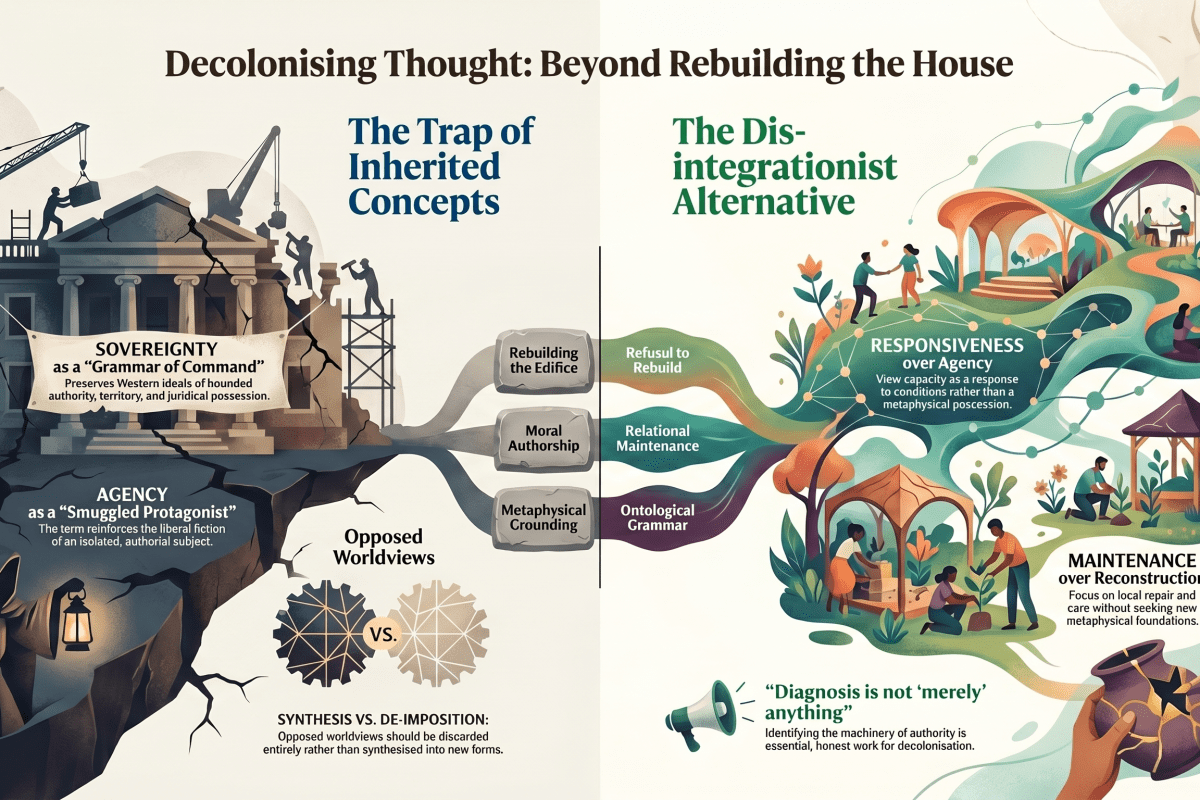
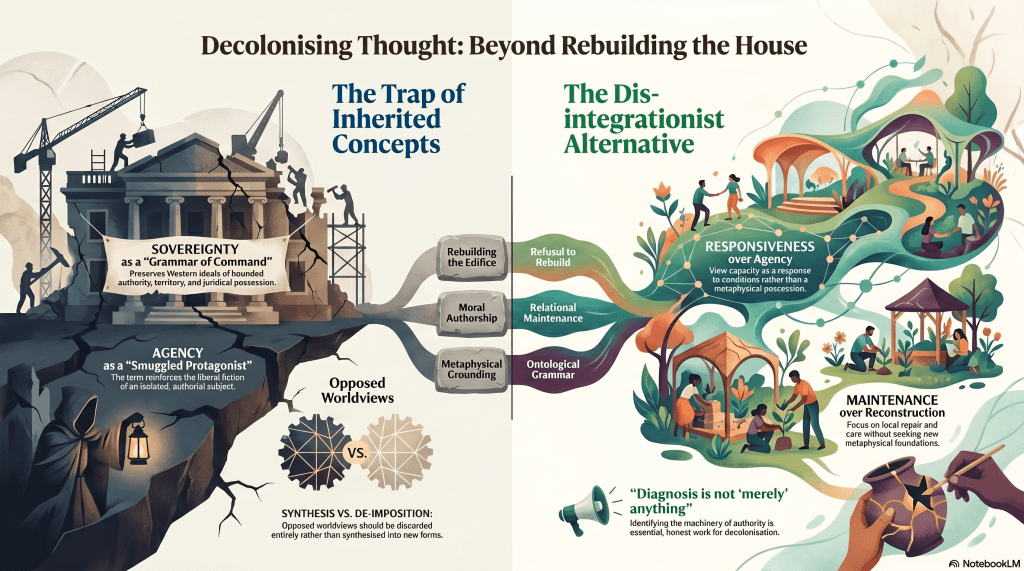
The essay’s central concept is sovereignty. More precisely, post-sovereignty. Yet the very act of preserving sovereignty as the problematic term matters. Sovereignty isn’t just a neutral container for self-determination. It’s one of the central concepts through which Western political modernity imagines authority: bounded, possessed, territorialised, juridical, and authorial.
To speak of sovereignty is already to speak in the grammar of command: Rules. Owners. Authorities. Something marks the line between inside and outside.
This doesn’t mean colonised peoples were wrong to demand sovereignty. The politically dispossessed may understandably seek the protections of the language used to exclude them. If one has been denied the status of a subject, a nation, or a people, then reclaiming those terms may be historically necessary. There’s no cheap purity available from the comfort of abstraction. Humans made the mess, naturally, and then handed each other dictionaries to clean the mess.
But political necessity doesn’t settle conceptual adequacy. A term may be strategically useful and ontologically suspect at the same time. So, the question isn’t whether sovereignty has been useful in anti-colonial struggle. It’s whether it should remain the destination, rather than a transitional vocabulary one eventually leaves behind.
The essay recognises that many postcolonial states retain the ‘juridical structure’ of autonomy whilst remaining governed by inherited categories of colonial law, property, development, and bureaucratic legitimacy. That’s exactly the point where the critique might turn more sharply on sovereignty itself. If postcolonial statehood often reproduces colonial form, perhaps the issue isn’t merely that sovereignty is hollow, but maybe it’s just one of the forms through which hollowness reproduces itself.
NotebookLM Infographic on this topic.
Agency: The Smuggled Protagonist
The same problem emerges around agency. The essay speaks of popular agency, moral authorship, co-authorship, and subjectification. Again, the impulse is understandable. Colonial domination denies people the right to act, name, interpret, and organise their own lifeworlds. A postcolonial theory naturally wants to restore capacity to those rendered passive.
But the agency term isn’t innocent. In modern Western thought, agency often implies a self capable of authorship, intention, responsibility, and moral ownership. It’s the protagonist required by law, markets, liberal politics, and punishment. Someone must be deemed the chooser, the signer, the sinner, the voter, the debtor, the criminal, the rational actor.
In my own work, I reject agency as a metaphysical possession. I’d rather speak of responsiveness: a variable capacity shaped by material, relational, temporal, somatic, and epistemic conditions. People don’t float above conditions and author themselves into freedom. They respond, more or less adequately, within fields of constraint.
The essay’s emphasis on relationality moves in this direction, but its vocabulary often pulls it back toward authorship. It wants shared becoming, but it also wants moral authors. It wants relational ontology, but it also keeps the self as a source of political meaning. This is a revealing tension.
The alternative isn’t fatalism. To reject agency isn’t to deny action. Breathing doesn’t require a metaphysics of breath. It just happens autonomically. The question is whether we must preserve the fiction of the authorial subject to describe them. I think not.
When Negation Need Not Become Synthesis
The essay leans on Fanon (see The Wretched of the Earth) to argue that colonial domination can’t be resolved through dialogue because dialogue presumes equals. This is right, or at least right enough. A conversation between master and slave is not yet a conversation between equals. Liberal dialogue presumes a shared field of recognition; colonial domination corrupts that field before speech begins.
The essay, therefore, turns to dialectic. Where dialogue seeks agreement, dialectic begins from contradiction and struggle. Again, this makes sense. A colonised subject can’t merely ask to be recognised by the system that produced their non-being. Something must be negated.
My hesitation concerns what happens after the negation. The essay sometimes seems to assume that contradiction must move toward ontological reconstruction. But why? If one term of the contradiction is an imposed colonial ontology, it might not deserve preservation within a higher unity because it mightn’t be a meaningful antithesis. It may simply be wrong, violent, and disposable.
This is the dis-integrative question:
Must the colonial term be synthesised, or can it be dispensed with?
Not every opposition is productive. Some oppositions are parasitic. If a worldview is imposed by force, then treating it as a dialectical partner may grant it more dignity than it deserves. The point of decolonial refusal may not be synthesis, but de-imposition.
That distinction matters. Synthesis often preserves too much. It lets the offending structure survive as a contributor to the next stage. It says, in effect: this violence was part of becoming. Perhaps. But perhaps not. Perhaps some concepts belong on the cutting room floor.
Metaphysics: Necessary Grammar or Rebuilt Throne?
The essay argues that postmodern anti-metaphysics has left social theory without stable categories of truth or moral orientation. It wants metaphysics back, not as abstraction, but as the recovery of moral and ontological grounds for political community.
I understand the concern here, too. Communities don’t live by procedure alone. No society is sustained merely by policy, rights language, or bureaucratic form. People inhabit worlds, not spreadsheets. There are ontological grammars beneath every institution: assumptions about personhood, time, land, memory, obligation, kinship, death, and belonging.
But I resist the move from ‘we can’t avoid ontological grammar‘ to ‘we need metaphysical grounding‘. Whilst the former seems unavoidable, the latter seems dangerous.
Metaphysics isn’t simply depth. It’s elevation – the move by which a grammar stops appearing as grammar and starts presenting itself as ground. It becomes the authorised deep structure, the thing beneath dispute, the foundation beneath the foundation. And foundations, as humans have demonstrated with astonishing consistency, are excellent places to hide power.
My preference is to minimise metaphysical devices. They’re unavoidable, but they’re liabilities.
Each one requires a leap. One leap may be necessary. Ten leaps become choreography. Eventually, the argument is no longer walking; it’s performing interpretive dance and calling itself ontology.
The Problem of Rebuilding
This is where my own Dis–integrationist commitments diverge most sharply from the essay. I’m a diagnostician. I deconstruct and name seams with no obligation to replace every collapsed universal.
The essay treats diagnosis as insufficient. It says the critique of sovereignty reveals a metaphysical vacuum, but diagnosis is not enough. Post-sovereignty must move toward ontological reciprocity, relational becoming, and shared labour of mutual recognition. Whilst this move is respectable. It’s also the one I distrust.
The rebuilding instinct is one of philosophy’s oldest addictions. Expose the flaw, draft the remedy, rebuild the edifice, declare the new form less violent than the old. This is how critique becomes renovation.
But the refusal to rebuild isn’t indifference, despair, or nihilism. It’s a refusal to let repair disguise itself as permanence. Care, maintenance, reciprocity, and local repair remain possible without metaphysical reconstruction. In fact, they may be more honest when stripped of the promise of final grounding.
Pedagogical Sovereignty and the Soft Machinery of Formation
The essay’s later sections turn to education. It proposes pedagogical sovereignty as a model of moral and ontological co-creation. The classroom becomes a site where being isn’t transmitted but collaboratively formed. Governance, by analogy, might become less administrative and more pedagogical: citizens not merely ruled, but constituted in relation. As attractive as this might be. it’s also perilous.
Education has always had this double face. It can liberate, but it can also format. It can open worlds, but it can also install authorised grammars. The classroom is not outside power. It’s one of power’s favourite incubators. The fact that it speaks gently doesn’t mean it’s not shaping bodies, subjects, desires, norms, and permissions.
To make pedagogy the model of sovereignty risks softening administration rather than escaping it. It may replace the command of the state with the formation of the subject. That may be better and subtler, but one should be careful when power arrives wearing soft shoes.
This doesn’t refute the essay’s educational turn, but it complicates it. If pedagogy is to be an emancipatory model, it has to preserve opacity, dissent, and non-formation. It needs to allow the learner not merely to become, but to remain partially unread, unfinished, and unintegrated. Otherwise, pedagogical sovereignty may become another normalising machine with better intentions and comfy chairs.
The Cutting Room Floor
My objection isn’t that the essay is wrong to oppose colonialism. Au contraire; its critique of colonial metaphysics is often compelling, and it’s preaching to the choir at the start. The issue is that its recovery project may carry forward more of the colonial-conceptual apparatus than it recognises.
The following terms deserve suspicion:
Sovereignty, because it preserves the grammar of possession, jurisdiction, bounded authority, and command.
Agency, because it preserves the authorial subject required by liberal law, market morality, and responsibility allocation.
Moral authorship, because it risks reintroducing the self as origin, even when collectivised.
Metaphysical grounding, because it may turn situated lifeworlds into foundations.
Reconstruction, because it assumes fracture demands repair, rather than sometimes demanding refusal.
Dialectical synthesis, because it may preserve the imposed term as a contributor to the future, rather than discarding it as an error condition.
None of these concepts must be rejected out of hand. That would be too easy. But they shouldn’t pass uninspected simply because they have been recruited into decolonial service. Fine. Use the master’s tools to dismantle the house, but don;t become too fond of them.
Toward De-Imposition
So, what then?
Dis–integration, not reconstruction
De-imposition, not anti-colonial sovereignty
Responsiveness, not agency
Relational maintenance, not moral authorship
Ontological grammar held visibly as grammar, not metaphysical grounding
This doesn’t mean communities should abandon their lifeworlds, traditions, or inherited moral vocabularies. It means those vocabularies shouldn’t need to become metaphysical foundations to matter. A world may be lived, tended, and defended without being inflated into ground.
The colonised don’t need permission from Western metaphysics to exist. Or me, for that matter. Nor do they need to rebuild themselves in metaphysical form to count as real. The refusal of imposed reality may be enough. After that, there may be practices, relations, institutions, memories, ceremonies, languages, solidarities, and forms of care. There may be politics and struggle. And, sure, repair and maintenance. But there needn’t be a new foundation.
Enfin
The essay I am responding to is valuable because it presses a real question:
If colonialism was ontological violence, can anti-colonial thought afford to remain merely procedural, linguistic, or diagnostic?
My answer is: diagnosis is not ‘merely’ anything. To diagnose is to identify the machinery by which certain concepts keep reproducing their own authority. If sovereignty, agency, authorship, and metaphysical grounding belong to that machinery, then they should not be automatically restored just because they have been wounded.
Some concepts can be reclaimed. Others should be retired. Some may be used provisionally, under protest, as transitional scaffolding. Again, others may belong on the cutting room floor.
The challenge isn’t only to oppose colonialism and its effects. It’s to notice when colonial grammar survives inside the opposition. That’s the harder work – less heroic, sonorous, and much less likely to produce a grand theory, but it may be more honest.
Semantic Infrastructure, Insufficiency, and the False Romance of Interoperability
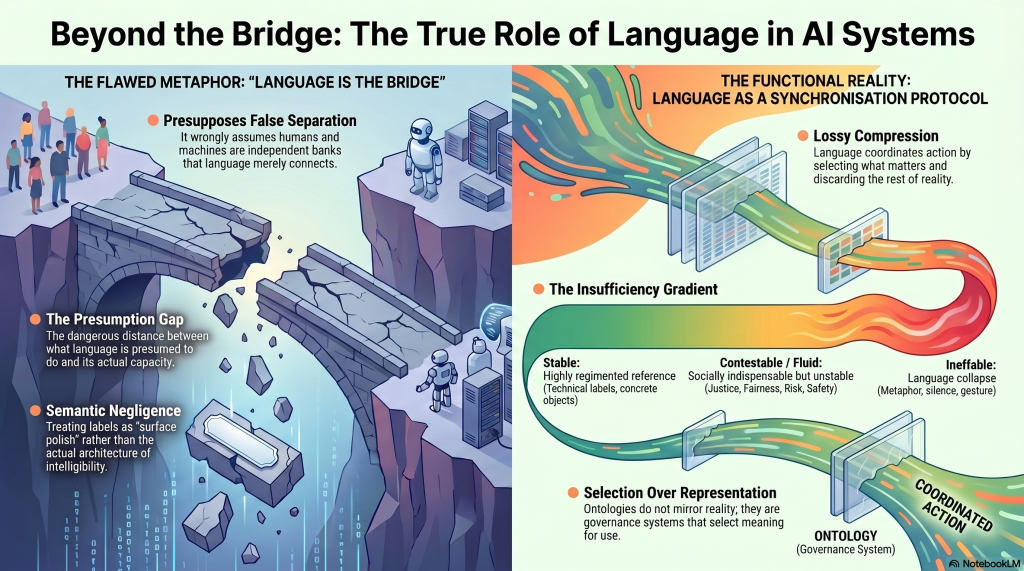
A recent Substack essay, Jessica Talisman’s Language Is the Bridge, makes a claim that is increasingly common in discussions of artificial intelligence, knowledge graphs, ontologies, metadata, and semantic infrastructure: that language is the bridge between human understanding and machine action. The claim is attractive, and not merely because ‘bridge’ is one of those metaphors that allows technical discourse to cosplay as wisdom literature. It captures something real. AI systems, semantic architectures, ontologies, taxonomies, controlled vocabularies, and knowledge graphs do not run on raw reality. They run on structured representations. Those representations require labels, definitions, mappings, alignments, constraints, and interpretive discipline. In that sense, language work is not decorative. It is infrastructural. But the metaphor is also dangerous.
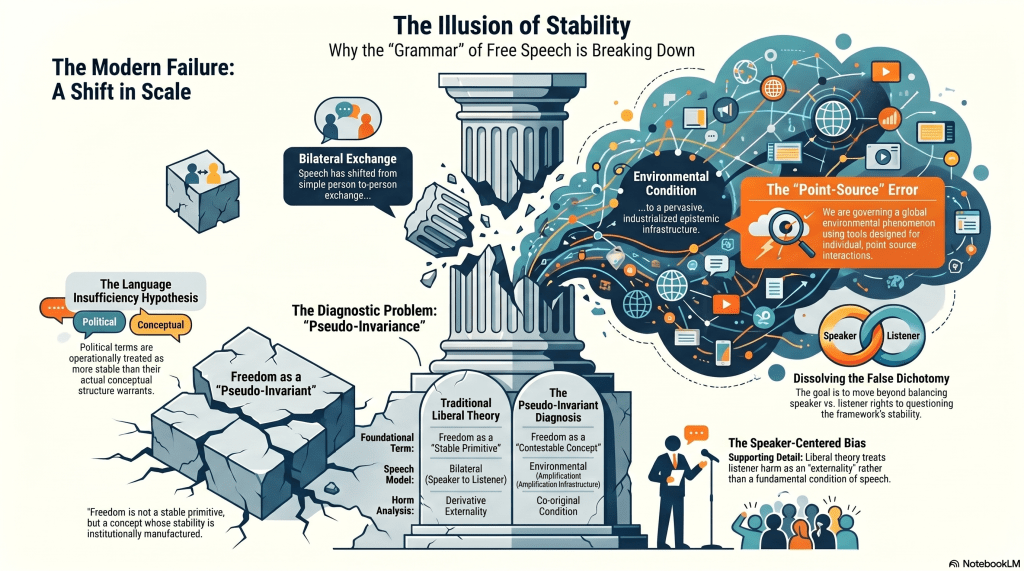
I read from the Wrong Curve: Free Speech, Pseudo-Invariance, and the Grammar of Liberal Rights. This essay is freely available on Zenodo at https://doi.org/10.5281/zenodo.19636760. This segment is the Abstract and the Introduction.
In this essay, I argue that free speech discourse is structured by a category error whose source lies upstream of speech itself: in the treatment of ‘freedom’ as a stable philosophical primitive when it functions, in practice, as an essentially contested concept operating under a systematically inflated presumption of effectiveness.
tl;dr: I don’t believe in free speech.
We’ve all likely heard that the freedom to swing one’s fist ends at the tip of another’s nose. I can accept this without argument for the purpose of this assertion. Your freedom TO violates my freedom FROM.
Audio: NotebookLM summary podcast of this topic.
The problem is that one’s words don’t stop. In some cases, they continue in the manner of pollution that I don’t want my ear holes to be exposed to this noise. In the social media age, this effect is trebled and molests my eyes. This is especially egregious for misinformation and disinformation, which is to say, much of the internet and beyond.
This impact hasn’t been suitably addressed, so I wrote about it. Here, I read.
The LinkedIn consensus has spoken: if you used AI in the writing process, you are not the author. The position is stated with the confidence of someone who has never hired a ghostwriter, employed a research assistant, submitted to a heavy editor, or considered that the Gettysburg Address was almost certainly not written by Lincoln.
Image: I couldn’t not share this Midjourney 8.1 image. It may not have understood the assignment.
Audio: NotebookLM summary podcast of this topic.
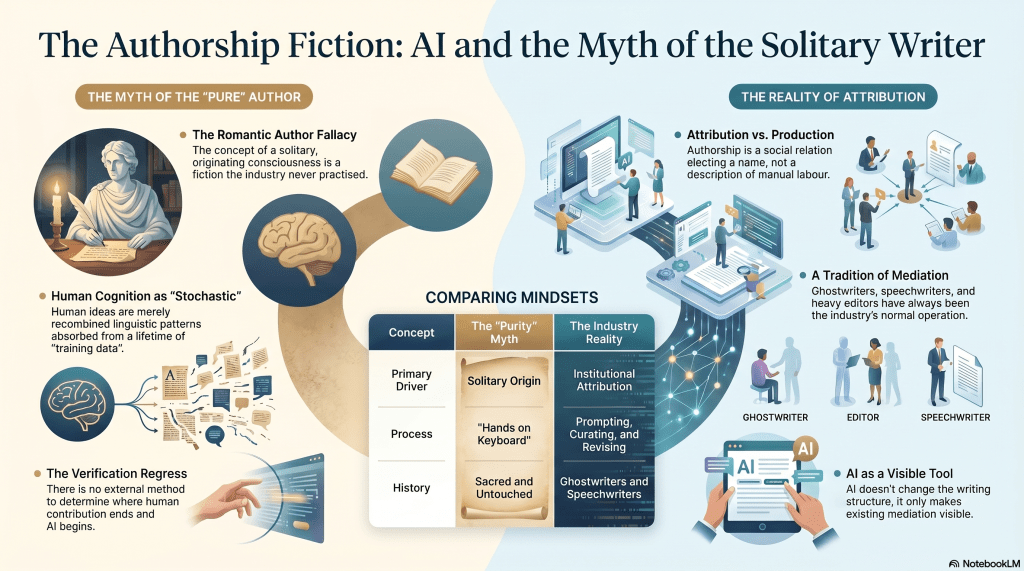
Authorship has never been a production relation. It has always been an attribution relation — an institutionally stabilised answer to the question of which name the practice elects to put on the cover. These are not the same thing, and conflating them is the error from which every subsequent confusion proceeds.
The ghostwriter has existed as long as commercial publishing. The political speechwriter is so normalised that nobody considers it worth remarking. The celebrity memoir, the corporate thought-leadership piece, the attributed editorial — these are not edge cases or embarrassing exceptions. They are the normal operation of every writing-adjacent industry that has ever existed. The name on the cover has never reliably indicated the hands on the keyboard, and the industry has never seriously pretended otherwise. It has simply preferred not to discuss it at dinner.
AI changes the tool. It does not change the structure. The person who prompts, selects, curates, revises, and publishes is doing what commissioners of ghostwriters have always done. What has changed is that AI makes the mediation visible in a way that polite convention previously concealed. Visibility triggers the purity reflex. What presents itself as a defence of authentic authorship is a defence of a particular fiction — the Romantic author as solitary originating consciousness — that the industry never consistently believed and certainly never consistently practised.
The purity position also fails on its own terms before it gets started. Consider the spectrum of AI-assisted writing: a full draft submitted for light polish; a human argument substantially revised by AI; collaborative ideation followed by AI drafting; a kernel of an idea handed over for full execution. These are genuinely different in terms of human contribution. The zealot position requires a threshold somewhere on this spectrum below which authorship lapses. It never specifies where. More fatally, it has no means of verification. There is no external method of determining where on the spectrum any given piece of writing falls. The detector tools are probabilistic noise that disproportionately penalise competent prose. Any audit mechanism sophisticated enough to catch first-order evasion immediately generates a second-order workaround. The regress terminates only at continuous surveillance of the writing process — panoptical authorship as the logical endpoint of the position taken seriously.
NotebookLM Infographic on this topic.
Then there is the recursion problem, which the zealot never addresses because it is fatal. The stochastic parrot charge against AI — that it merely recombines absorbed linguistic patterns without genuine origination — describes with considerable accuracy what human cognition also does. The writer’s training data is the Dickens read at ten, the billboard absorbed on a commute, the argument overheard on public transit, the half-remembered essay that shaped a position without ever being consciously cited. The causal chain of any human idea disappears into an unauditable cognitive history. Genuine origination in the sense the purity position requires has never existed. The Romantic author was always a retrospective confabulation. Barthes said so in 1967. The industry nodded politely and continued invoicing.
What the zealot is defending is not authorship. It is a particular grammar of authorship — one that selects compositional origin as the threshold criterion, applies it selectively and unverifiably, and uses the resulting suspicion as a status boundary. It is guild behaviour dressed as principle, which is understandable as a response to a genuine economic threat but should not be mistaken for a philosophical position.
Authorship is the position a culture elects to stabilise after the work has already been produced through far messier means. It has always been thus. AI did not break the fiction. It just made the fiction harder to keep a straight face about.
The Rest of the Story
I’ve written about this before. I am not an AI apologist, but I am peeved by anti-LLM zealots, who clearly haven’t thought through their arguments.
I finished reading A.J. Ayer’s Language, Truth, and Logic, the part about Bertrand Russell’s claim about ‘The author of Waverley was Scotch‘. My brain latched onto authorship, and my emotional response was WTF? I have other problems with Russell and Ayer on this, but that’s a matter for another day.
To make my point, this page up to the ellipsis is the output of Claude after an extended dialogue with it and ChatGPT after I read Ayers, and something didn’t sit quite right. I am not ashamed to use LLMs in my authoring workflow and am not ashamed to mention it, as here. Almost all of these thoughts are mine. I’ve simply asked Claude to organise the output. It’s good enough to output as-is, and any edits would be trivial, so I won’t bother. I probably could have made the edits in as much time as it took to type this, but I’ve got nothing to hide. I’m just a human with access to technology circa 2026.
Self-help, pop psychology, LinkedIn, and the metaphysics smuggled into advice
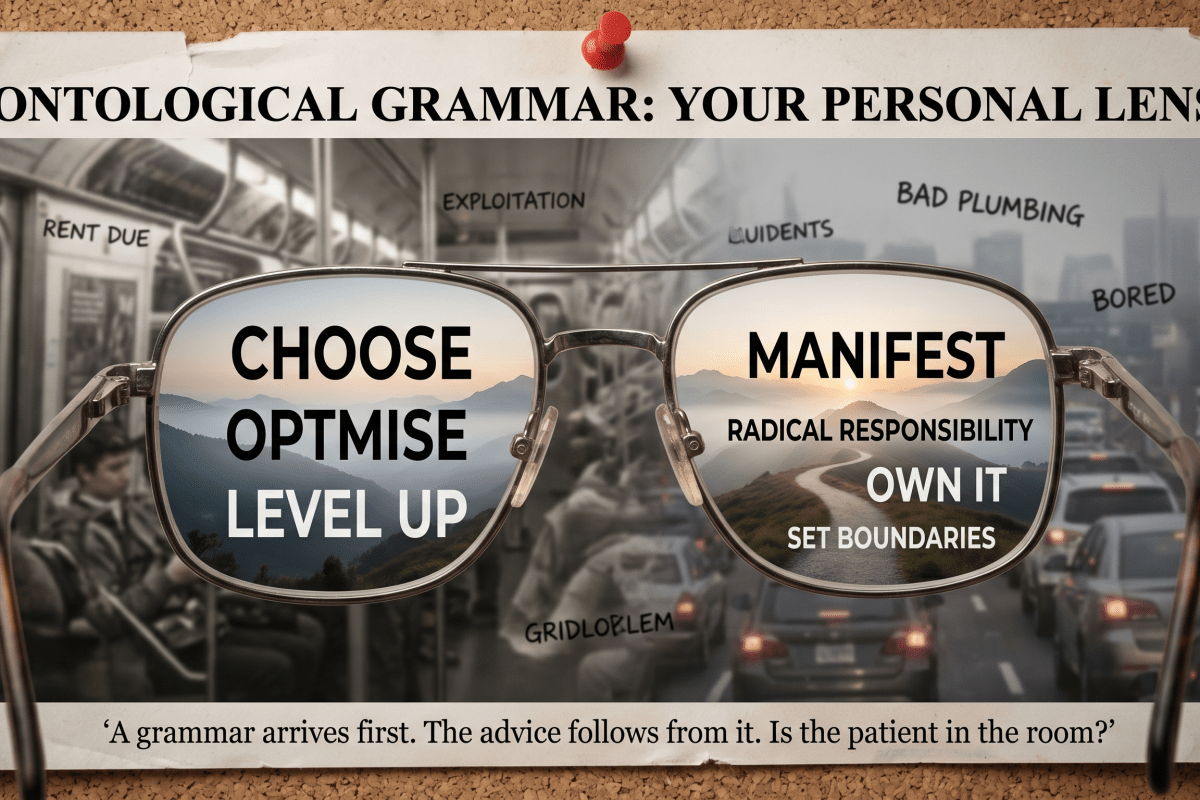
Self-improvement books rarely begin by telling you what it believes a person is. That would be too honest, and honesty is bad for conversion funnels. Instead, it begins with verbs.
Choose. Decide. Commit. Heal. Optimise. Manifest. Reframe. Own. Level up. Set boundaries. Do the work. Become intentional. Stop self-sabotaging. Unlock your potential. Be your authentic self. Take radical responsibility.
The vocabulary shifts depending on the tradition. One speaks of healing, one of discipline, one of nervous systems, one of leadership, one of purpose, one of abundance. What they share is not a doctrine but a grammar: a way of arranging the person before the advice begins. The subject is always inward, sovereign, and temporarily malfunctioning. The problem is always locatable. The solution is always available, often for $29.99 or in a free webinar that becomes a masterclass for $299.
But here is where the easy cynicism runs out of road, because the people writing this stuff — by and large — believe it.
Audio: NotebookLM summary podcast of this topic.
That is the part of the critique that tends to get skipped, because it is less satisfying than imagining a cynical operator deliberately strip-mining the anxious for recurring revenue. Most self-help authors arrived at their framework the same way their readers are about to: they were struggling, they encountered a grammar that organised their experience, they felt the specific relief of suddenly being intelligible to themselves, and they mistook that relief for discovery. Then they wrote a book about it. The author is not the shark. The author is a previous customer who graduated to the front of the room.
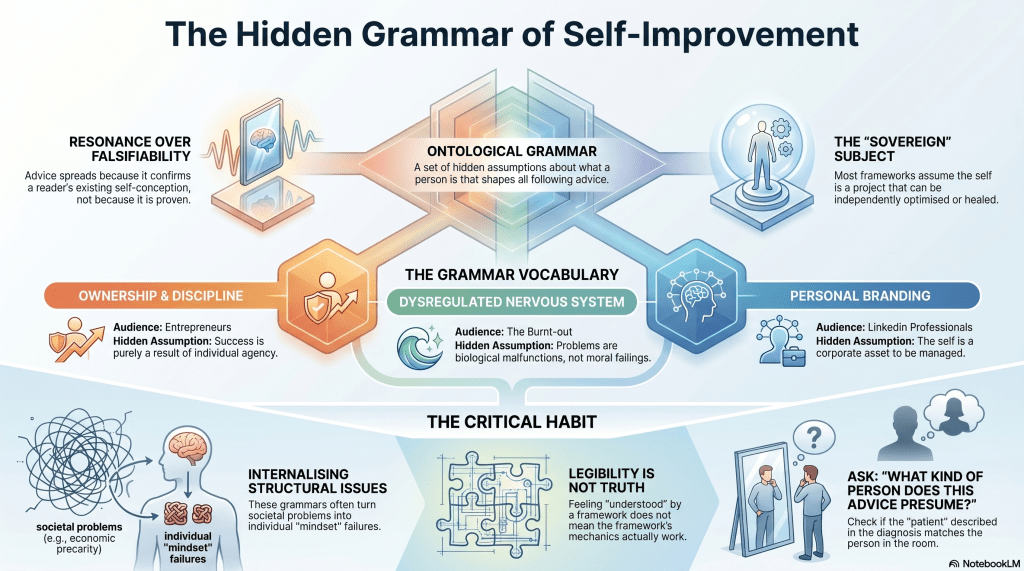
The framework they found — and are now evangelising — is what I call, in The Architecture of Encounter, an ontological grammar: a set of prior commitments about what kind of thing a person is, which arrives upstream of any specific advice and quietly determines what advice is even thinkable. You cannot recommend reframing without first presuming a self transparent enough to observe its own cognitions and sovereign enough to revise them. You cannot prescribe boundaries without presuming a self whose territory is violable and whose autonomy is the relevant moral unit. You cannot offer alignment without presuming a self that has a true direction, temporarily obscured, patiently awaiting discovery through either a values exercise on page forty-seven or a retreat in somewhere with good lighting and worse plumbing.
The grammar arrives first. The advice follows from it. And the person reading it is not being shown a mirror. They are being issued a lens.
The lens finds its wearer. “Take ownership” resonates with people already invested in the idea of themselves as agents who have been insufficiently deliberate — it confirms the worldview while appearing to challenge the behaviour. “Your nervous system is dysregulated” resonates with people for whom the moralised language of laziness and discipline has become intolerable; here is a vocabulary that removes the accusation while retaining the explanation, which is a genuinely useful service even if the mechanism on offer is borrowed loosely from neuroscience and the rest is borrowed from hope. “Mindset is your prison” resonates with people who need their suffering to remain individually tractable — solvable, that is, without anyone having to redistribute anything expensive or inconvenient. “Manifest your abundance” resonates with people who find both structural analysis and self-blame equally unappealing and would like a third option involving the universe.
Each grammar finds its congregation. Which is precisely the problem.
A grammar propagates not because it has been tested against alternatives or evaluated for efficacy, but because it maps onto a prior self-conception cleanly enough to produce the sensation of being understood. The entrepreneur already believes in agency-language: execution, discipline, ownership, leverage. The book that tells them their discipline is the differentiator is not offering new information; it is offering comfortable confirmation in a more expensive format. The therapeutic reader already suspects their relational difficulties involve something called attachment. The book that tells them so is not illuminating; it is flattering them with their own vocabulary. The LinkedIn professional already believes their career is a project of self-authorship. The thought leader who tells them to communicate their value and build authentic leadership is not giving them a strategy; they are giving them a liturgy.
The community that forms around a grammar is a church, not a seminar. It has converts, not students. And like most churches, it is considerably better at solidarity than at falsifiability.
This matters because the mechanism by which self-help content spreads — resonance, recognition, testimonial, referral — is entirely decoupled from the mechanism by which we would establish that it works. A sentence resonates because it fits a grammar the reader has already adopted. That tells you something real: about the anxieties structuring a cohort’s self-understanding, the stories they are trying to make liveable, the descriptions of themselves they find tolerable or intolerable. It does not tell you whether the intervention produces the claimed effect, in whom, under what conditions, and compared with what alternative. Those are duller questions. Less shareable. They do not fit on a carousel post with a soft gradient and a mountain.
Horoscopes also resonate. So do conspiracy theories, national myths, and the first chapter of any book you buy during a difficult stretch of your life.
The point is not that the advice is necessarily wrong. Sometimes “set boundaries” is exactly right. Sometimes “take ownership” is precisely what someone has been avoiding hearing. Sometimes a new frame genuinely reorganises attention in ways that produce durable change, and the person is measurably better off for having found it. None of that is in question. The question is whether a framework that produced one useful instance has any reliable claim to truth beyond that instance — and whether the person reaching for it during a difficult period is in any position to make that evaluation carefully.
They usually are not. That is not stupidity. That is the condition of being in difficulty: you reach for intelligibility, and whoever offers it collects a great deal of credit. The problem is not the reaching. The problem is that the self-help ecosystem — including the parts of it operated by entirely sincere people who believe every word they publish — has no reliable mechanism for distinguishing frameworks that help from frameworks that merely feel like help while the underlying situation continues undisturbed. The true believer and the true seeker share the same vulnerability. Both reached for a grammar. One of them got to write the book.
NotebookLM Infographic on this topic.
It is also worth noting that commerce is the easy villain here, and an overrated one. The same dynamic runs through pop psychology, where the grammar of individual cognitive mechanisms tends to dominate because it produces legible interventions in a way that structural analysis never quite does; blaming cognition is tractable, blaming the organisation of society is dispiriting and hard to monetise, even when it is accurate. It runs through LinkedIn, where the grammar is not therapeutic but managerial — the self reimagined as an optimisable professional asset — and where burnout becomes a boundary failure, precarity becomes an invitation to upskill, and alienation becomes a purpose deficit. Nobody on LinkedIn is necessarily trying to extract money from anyone. Many of them are trying to be useful, or to be visible, or both, which is human enough. But the grammar they are deploying disappears material conditions into interior architecture with the same efficiency as the most cynically produced wellness content. The mechanism does not require a profit motive. It requires only a grammar and an audience that already shares it.
The useful response to all of this is not wholesale dismissal, which would be too easy and almost certainly wrong. Some people need clearer habits. Some need better descriptions of their own conduct. Some need permission to stop tolerating what they have been tolerating. Some need a vocabulary that makes their own patterns visible, and a framework — however approximate — is better than none. These are real services. The fact that they are sometimes delivered inside a dubious metaphysics of the person does not automatically negate them.
But there is a question worth developing the habit of asking, before the grammar installs itself: what kind of person does this advice presume? Is the self it describes sovereign, where I am actually constrained? Wounded where I am actually responsible? Deficient where I am actually being exploited? Misaligned where I am actually just bored? In need of self-belief, where I am in need of rent?
These questions are less fun than a morning routine designed by someone who has never had a difficult commute. They do not come with a community or a badge or an accountability partner who sends encouraging voice notes. But they do something the grammar on its own cannot: they ask whether the patient described in the diagnosis is the one actually in the room.
Most self-help skips that step. So, not infrequently, does the person who wrote it. They found a grammar that made their experience legible, felt the relief that comes from that, and never quite got around to distinguishing legibility from truth. Which is understandable. It is also, for everyone downstream of that decision, a problem.
I don’t occupy this shared space of ontological grammar, so I call bollox.
Full Disclosure: This article was drafted by ChatGPT 5.5 and Claude Sonnet 4.6 upon a discussion of my perspective on self-help, pop psychology, and LinkedIn. I am busy with other projects, but I wanted to share my position. Apologies to those who don’t prefer LLM-authored or assisted articles.
My goal is to articulate the connexion between ontological grammar commitments, the noted disciplines, and more. As should be evident, I am not a fan of self-help or some adjacent modalities.
‘woman’ is a normative identity, and like all normative identities it is striated. It is composed of putative essences, recurring structural constraints, intersectional positions, cohort-relative projections, subjective inhabitations, and external gatekeeping.
The Architecture of Willing is a passion project I’ve been considering since the COVID-19 debacle. I took a couple of career breaks to focus on the problem of agency. In fact, my working title until now has been Against Agency. Upon research, I discovered that (1) the idea was somewhat tired, and (2) it was mired in a free will debate centred around determinism. And (3) the argument had been made by many about a decade earlier, so I also missed the ground swell. As my interest is to present novel views or perspectives, I bowed out, but something still irked me.
Then it dawned on me: I’d dissect will under a language philosophy microscope. This got me to a new working title: Architecture of Willing, which perhaps uncoincidentally aligns with my Architecture of Encounter.
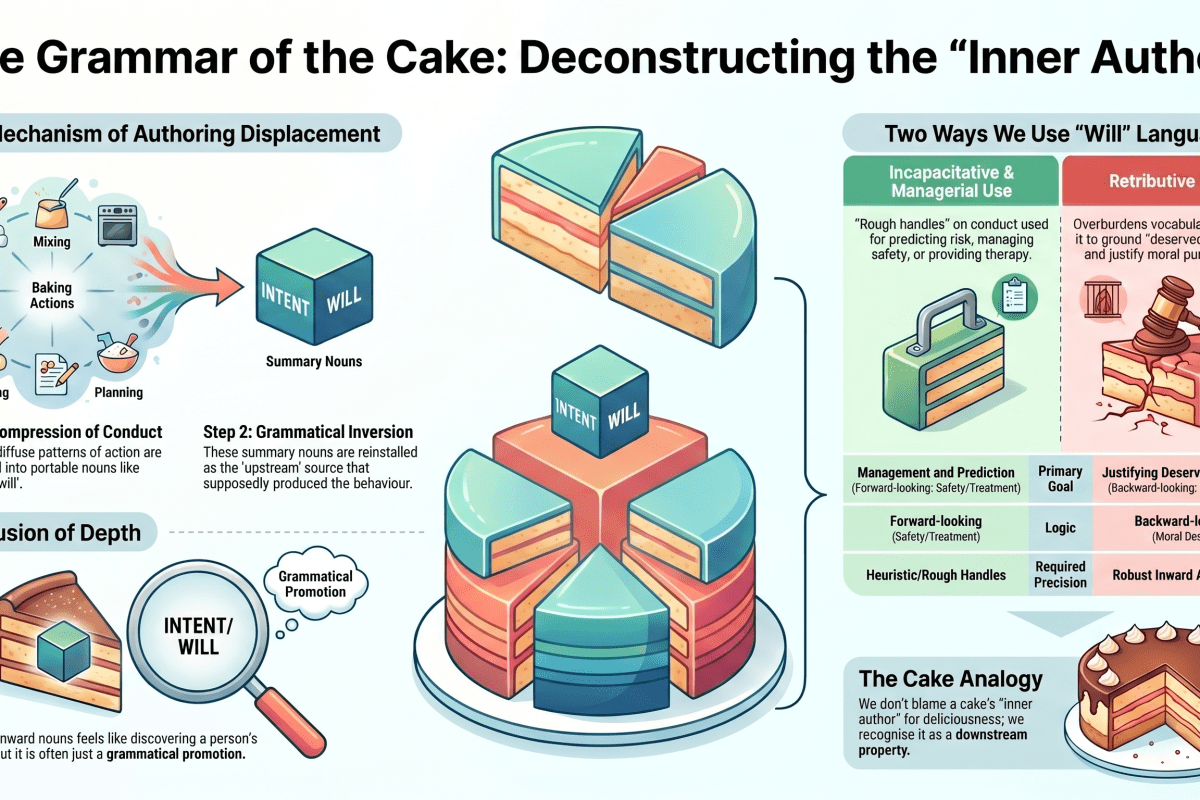
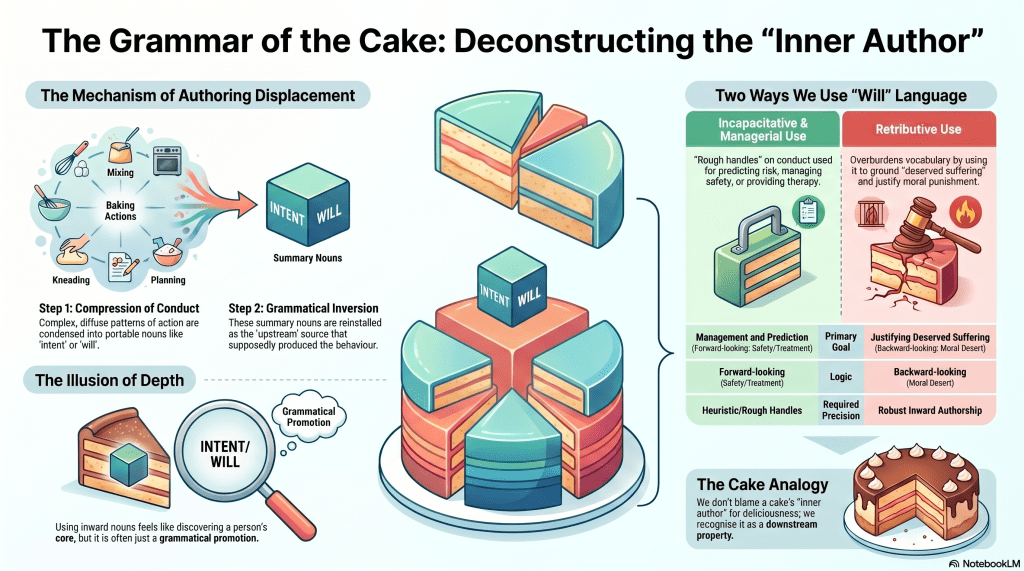
I’m still working through the first draft, but I’d like to share a NotebookLM summary of an early draft of Chapter 1, which serves as an introductory chapter: Authoring Displacement and the Cake Grammar or some such. Have a listen.
Audio: NotebookLM summary podcast of this topic.
I use the opening chapter as a setup. I had an idea of convicting a cake on charges of being delicious and using this absurdity as a metaphor for how we inflate and personify the notion of will. Perhaps interestingly, the will (particularly the free flavour) was the central theme I explored in my novel Propensityby Ridley Park, a little shameless cross-promotion.
I’ll keep this short because I am still drafting the monograph. I hope to have it published in May. Time will tell.
This is a bonus episode I asked NotebookLM to render based on the past two posts. These posts had been one, but I chose to separate them because of their core orientation on a shared topic. For those who read the posts together, this is made clear. I even continue several threads to make it obvious, but the two essays are a diptych. I feel the second post is stronger than the first, but the first was a stronger setup. If you don’t have time to read the essays, this is a decent summary.
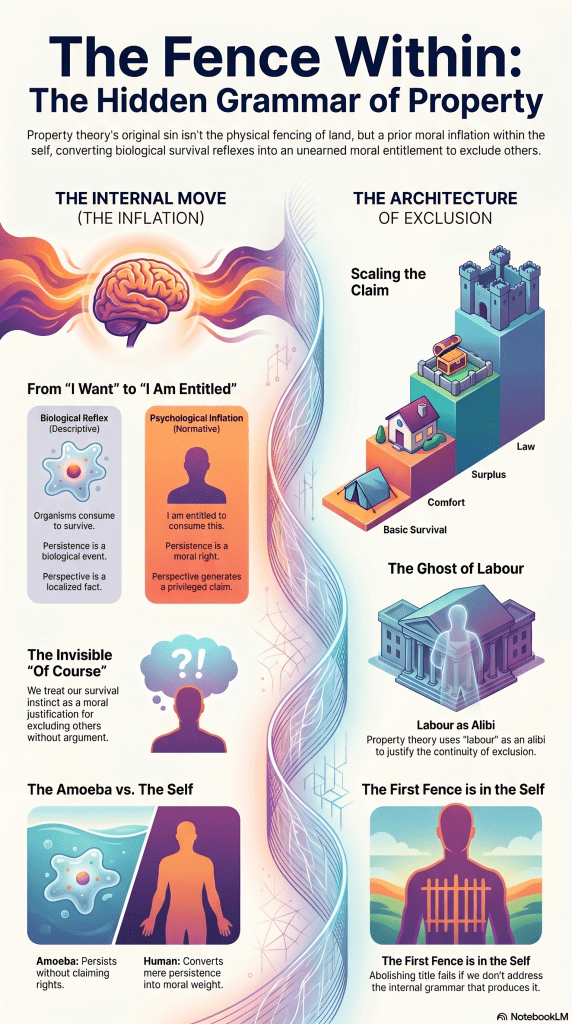
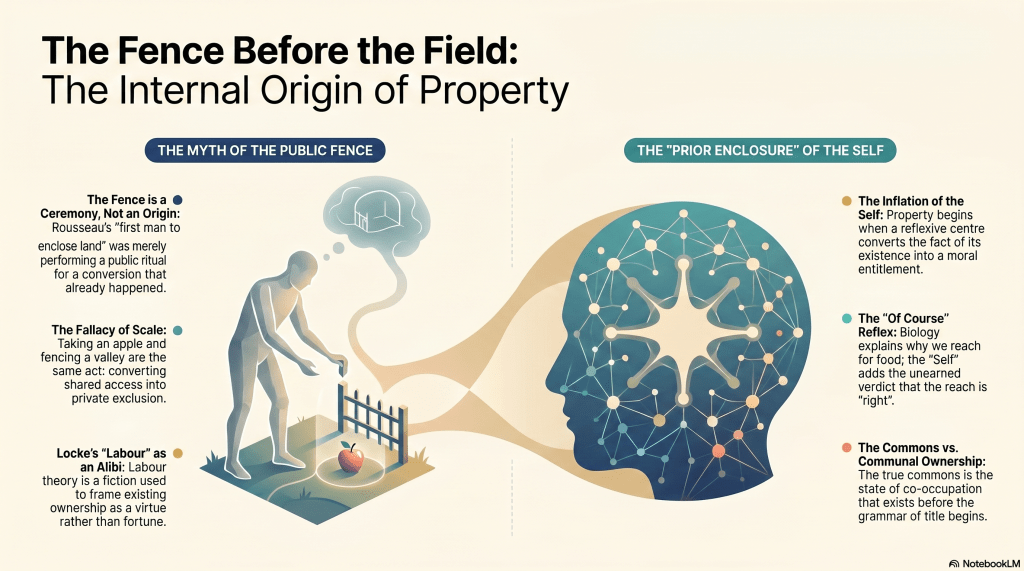
The first man who, having enclosed a piece of ground, bethought himself of saying This is mine, and found people simple enough to believe him, was the real founder of civil society.
— Rousseau, Discourse on the Origin of Inequality
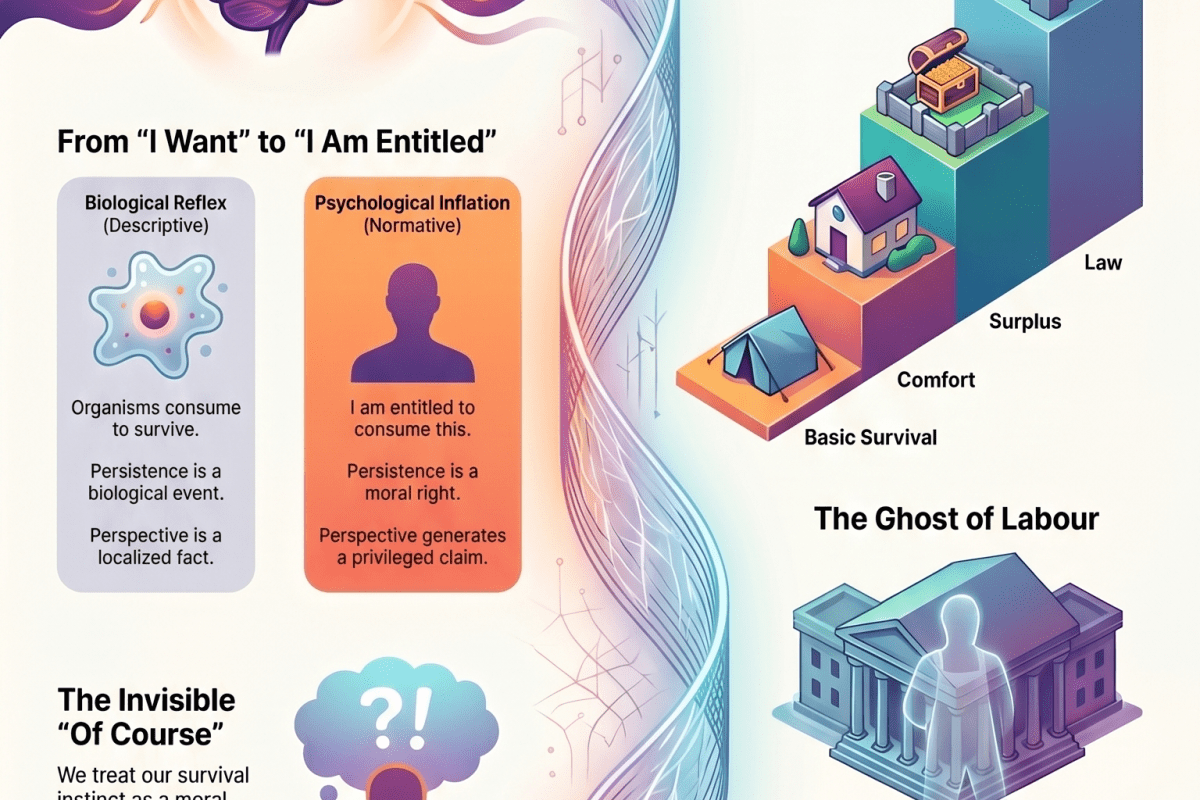
I posted another longer essay on Substack on the immorality of property ownership. This isn’t my first, but I wanted to go deeper in my critique. Actually, I wrote two, but I’ll advertise the second one tomorrow.