I agree with Paul directionally, but I think he could have gone further – and perhaps he has since – so I compare his view to my own in a Substack article. I’m not sure whether he’d disagree with the extensions. Check it out.
Somebody somewhere made mention of The Social Construction of Reality, so I asked ChatGPT if I should engage with it directly, which is to say, to read it. Already believing that what we perceive and experience is a subjective construction, albeit shaped by relative forces, I thought it might be a lot of choir preaching.
ChatGPT admitted that this was partially true, but that the benefit would be to get a sociological rather than strictly philosophical account. Having read the introduction and started the first chapter, I already feel this to be true. The authors make it clear that Sociology is just a special philosophy that doesn’t aim quite so deep and has a specific and obvious focus on societies. Fair enough.
So far, I’m glad I picked it up. It’s relatively short, which was a deciding factor, and it’s giving me a break from the 1066 material I’ve otherwise been consuming as of late.
I don’t have more to add, save to say, so far so good. I look forward to the rest. I’ve got more to do today, including editing a video for YouTube, which is me rather than AI for a change – a process that reminds me why I use AI in the first place: so much time investment.
NB: I am actually listening to an Audible version of this book. Whilst searching for an apt cover image for this post, I found the associated image, and it is as apt as one might find.
This is the fifth of a deeper look into ten philosophical positions. This one is on convergence realism within the category of epistemology. A full article is available on Substack, with supporting information on a recent post here on Philosophics Blog.
Below is a ~5-minute short podcast.
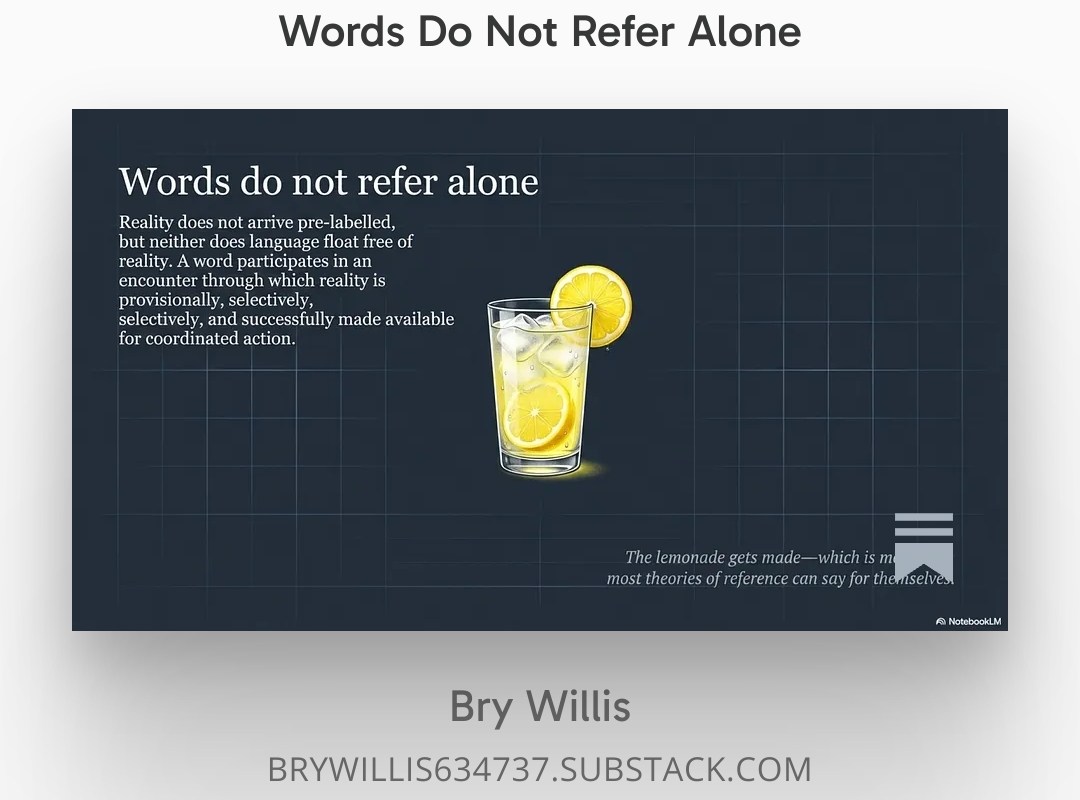
Language works, but not uniformly.
Its effectiveness declines as the conceptual complexity, abstraction, contestability, contextual dependence, and institutional burden of what it is asked to communicate increase. We routinely mistake grammatical fluency for semantic precision and social agreement for shared reference.
I describe this through an Effectiveness–Complexity Gradient:
Invariants are comparatively stable terms with constrained error ranges.
Contestables remain usable but acquire their force within normative or institutional frameworks.
Fluids drift across contexts and disciplines, preserving family resemblance without reliable closure.
Ineffables mark domains where propositional language collapses into metaphor, gesture, paradox, or silence.
These are not ontological species. They are diagnostic regions along a gradient. The important feature is not the label but the rate at which apparent linguistic effectiveness decays as conceptual load increases.
This is the fourth of a deeper look into ten philosophical positions. This one is on convergence realism within the category of epistemology. A full article is available on Substack, with supporting information on a recent post here on Philosophics Blog.
Below is a ~5-minute short podcast.
I don’t regard the self as a persistent entity travelling through time while accumulating experiences like stamps in a metaphysical passport.
The first-person “I” is an indexical compression. It marks the presently organised locus of perspective, salience, memory-access, and action. It is indispensable, but indispensability does not establish an inner owner to which the index refers.
The diachronic self is a broader compression: a narrative, biological, documentary, interpersonal, and institutional device for tracking selected continuities across time. Memory contributes to this, but memory is lossy, reconstructive, and uneven. The person remembered is not transported intact into the act of remembering.
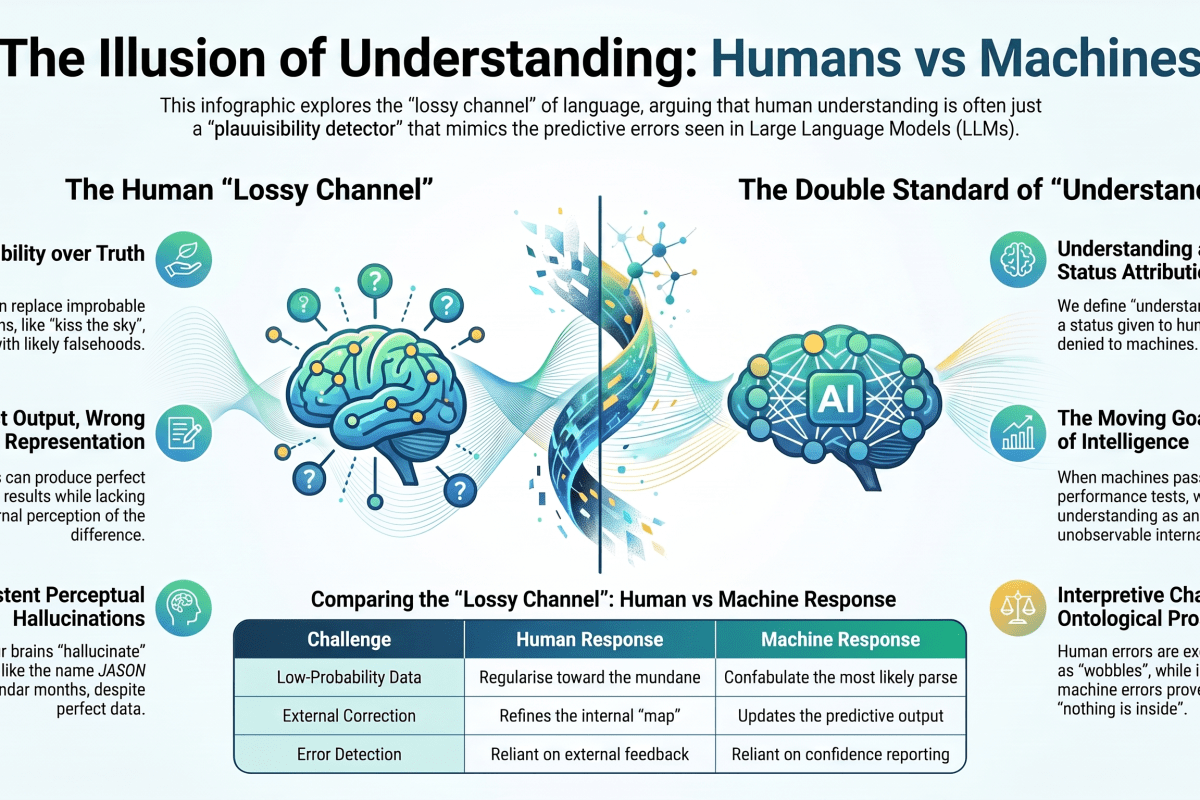
In this Substack essay, I explore the flawed nature of human comprehension, arguing that our understanding is often just a calculation of probability rather than an objective grasp of truth. By examining linguistic errors like misheard lyrics and his own struggles with French phonemes, Willis demonstrates that humans frequently hallucinate or misinterpret data based on what seems most plausible. He compares these mental lapses to the ‘hallucinations’ of Large Language Models, suggesting that the mistakes made by AI are fundamentally similar to our own. The author contends that we apply a double standard by granting humans the status of ‘understanding’ while dismissing machines for the exact same predictive behaviours. Ultimately, the text challenges the metaphysical assumptions of human exceptionalism, asserting that what we call ‘understanding’ is merely an external attribution rather than a unique internal state.
Essentially, I am not advocating the view that LLMs have consciousness and understanding; rather, I am arguing that the human versions of these are inflated with metaphysics.
The question is reasonable, although belief may already be doing more work than I would permit it under cross-examination. My writing is generally diagnostic rather than doctrinal. I am more interested in identifying the architectural assumptions beneath a dispute than in selecting a furnished room within it. Where philosophy offers a contest between established positions, I often suspect that the arena itself has been badly designed.
Still, repeated diagnoses eventually disclose a pattern. Certain commitments recur: suspicion of substance, resistance to metaphysical inflation, distrust of linguistic confidence, rejection of moral realism, scepticism toward persistent personal identity, and an insistence that mediation does not entail fabrication.
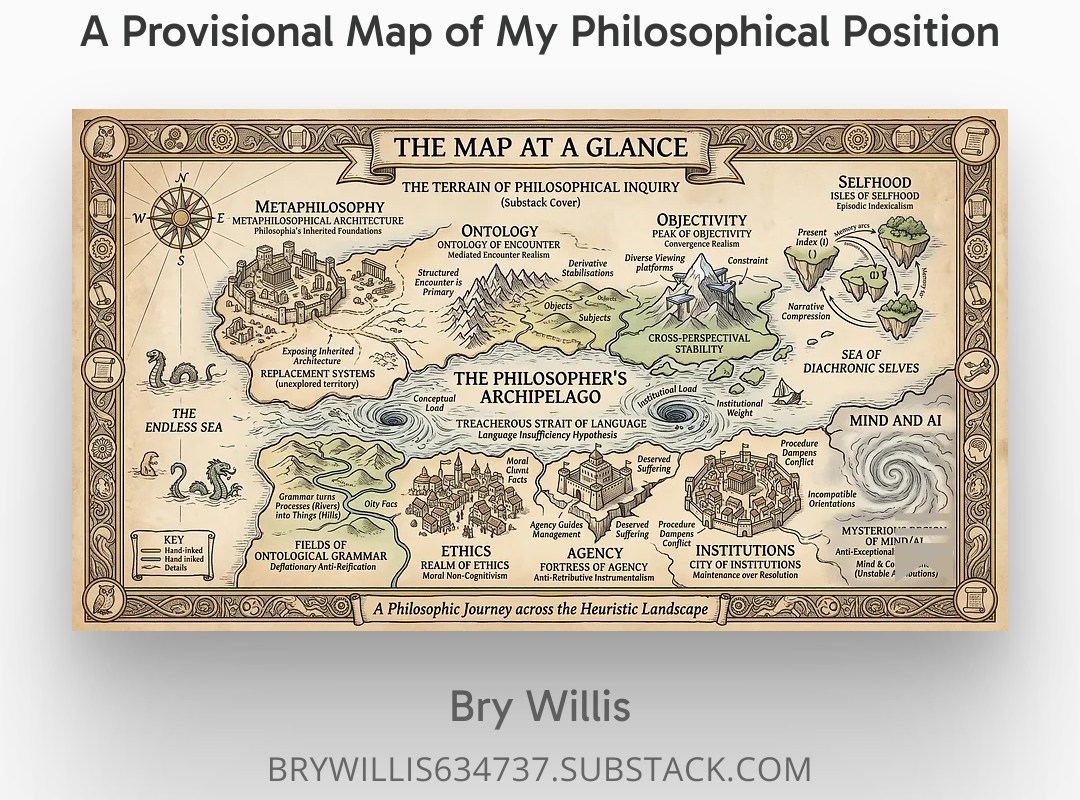
What follows is therefore neither a creed nor a completed system. It is a provisional map of where I presently stand.
The labels are intended as coordinates, not allegiances. Where no established term quite fits, I have used my own. This is partly unavoidable and partly evidence for the very linguistic difficulty I spend so much time diagnosing.
This content, including video and podcast summary, are of a longer Substack article on my philosophical positions with descriptions.
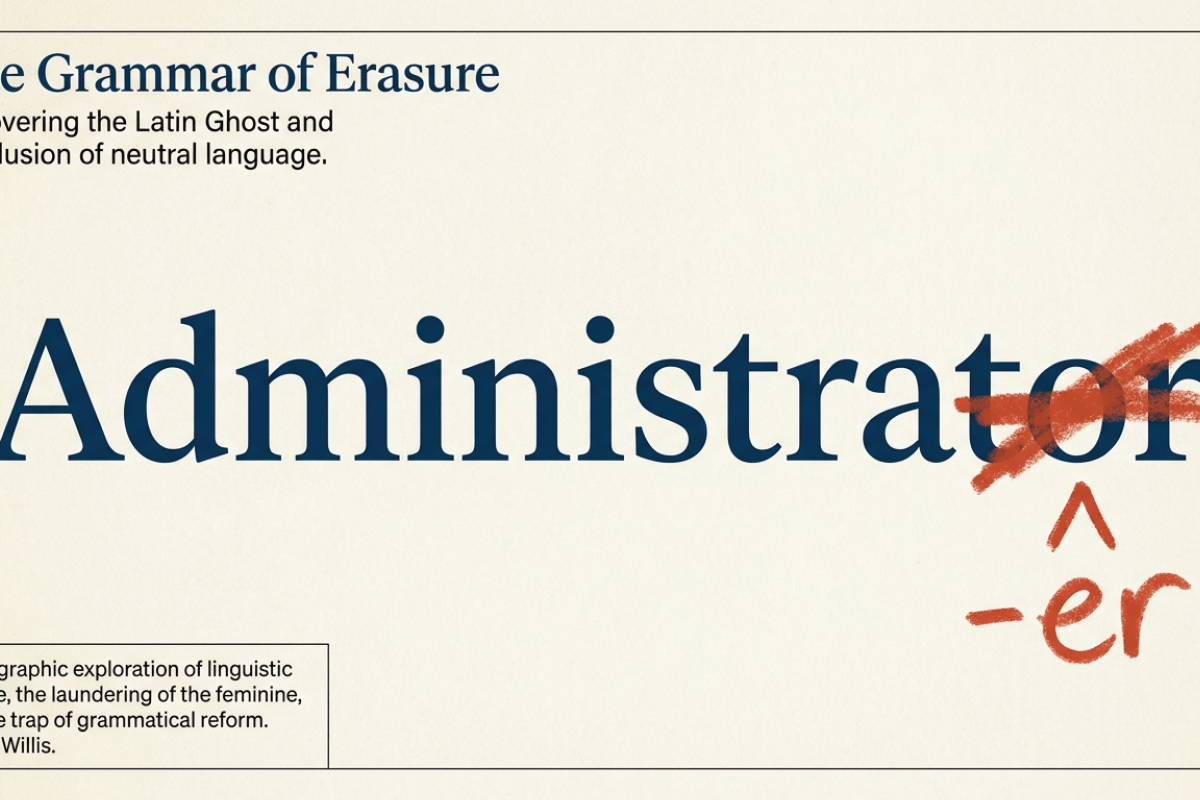
My initial thought was to rid the English language of administrators and dominatrices. Of course, I instantly considered French, and I write about that as well.
Here, I want to discuss the rift in Feminism:
One faction feels that we should eliminate sexist terms in the Modern world. This is where I was coming from.
Another faction claims this is a way of not being absorbed into an already male-dominated, dare I say, patriarchal culture.
Hence the title of this post.
If we were to swap or consolidate administrator and the less common administratrix into administrater in an act of rebellious conformity, women will be subsumed. As Simone de Beauvoir notes, the dominant lens is the male lens. Womanisother. As I say, this is why we have male and female versions of many, if not most, competitive sports, and certainly the professional ones. Thi sis also an instinct underlying trans-athletes competing in a contrasport – and it’s almost always about CIS-males performing in CIS-female events. I’m not aware of the contrary – and I don’t feel like looking it up. Opponents imagine fit males dressing as females in order to win some ribbons and medals, but I don’t really care to engage further in this conversational framing. I have no interest in sports, not even the World Cup being performed in my backyard.
The point is that females and other so-called minorities can be marginalised and lost to language. We preserve this identity through mechanics such as Best Actress to ensure representation.
Of course, I can also run off the reservation and down any number of rabbit holes: why don’t we have best black actor and/or actress? Why not left-handed? Height ranges? Weight ranges? Income ranges? Religious orientation? We quickly run into an intersectional challenge. I might imagine something like:
And I am proud to announce the winner of best left-handed, Asian Buddhist actress with a speech impediment
It’s easy to see where this goes off the rails – another Sorites problem hiding in plain sight.
I could go on. I won’t, but I wanted to make a point about my point. Check out the base post on Substack.
I love language, and I study it. I also use LLMs. I am not anti-AI, but neither am I prescriptively pro-AI. I just happen to find them useful.
Audio: NotebookLM summary podcast of this topic.
I also, however, find them to have quirks. I won’t regurgitate the supposed over-representation of delve — or em dashes, or lists of three, and so on. These are each, at once, true and hardly egregious – especially given that we were all schooled on the same English that now sits in their training data.
What I want to focus on is the cadence. I watched this video, and the historical information is interesting – in fact, much of the material on the channel is. A few shorts were recommended to me, I discovered more, I subscribed, as one does. But listen to the talk track.
Video: The Most Mispronounced Words in English and the History Behind Them – Airlearn Language Show
Whilst I may be mistaken, it sounds like an LLM-produced script. Perhaps the joke is on me, and the presenter herself is an AI avatar. It also sounds as though a de-LLM process was applied afterwards to obfuscate the patterns – whether by a human or by another model running some humaniser GPT.
Of course, there are other explanations. Perhaps the writer simply happens to write this way, and the LLMs merely encroach on it. Without a writing history, one can’t know for certain. And – I know this is true of me – exposure, dare I say overexposure, shapes how one writes.
I run almost everything I write through AI and ask for suggestions – and you needn’t even ask; it volunteers anyway. When the output looks better, I adopt it: a word, a phrasing, a more concise rendering, a supporting sentence or a setup. After a while, my writing has been nudged in that direction. I already used delve; now I am merely conscious of it. I used to use em dashes – look at my pre–2020 posts – and switched to en dashes purely to avoid the witch-hunt. In each case, the LLM Age has done something to my style.
So, back to the video. If you are familiar with long-form LLM output, you will notice how she supports her ideas and how she builds her asides – with a very particular pattern. I am not judging: as I say, I use these tools extensively. I only want to point out an observation.
BONUS: I don’t pronounce Wednesday as /wenz.day/. I pronounce it closer to /wedñz-day/, the tilde is rather on the /d/ or the space the /d/ occupies, but I placed the mark on the /n/ instead because there is no tilde-d glyph, and I wanted to represent a nasality the more typical pronunciation doesn’t have – but that I add.
From here on, I asked Claude to analyse my post (above) along with the video script. Pay special attention to its own cadence, which comports with the video.
Here, then, is the observation.
Watch how a point is made to land. The move is nearly always the same: state the naïve reading, snatch it away, and hand back the corrected version as a tidy little binary. It’s not random. There’s a reason.It wasn’t design. It accumulated.English spelling isn’t bad design. It’s no design at all. The shape does the work an argument would otherwise have to do. Negate, reverse, reveal – and the reveal feels like insight precisely because something was first taken away. It is the cheapest available route to the sensation of having been told something.
Notice, too, the reassurance travelling alongside it. There’s a reason. There’s always a reason. The promise of an explanation, delivered before the explanation arrives, so that you settle in and stop wondering whether one is coming. And where genuine argument would be laborious, the list stands in for it: Old English, Norse, Norman, French, Latin, scholarship, Dutch typesetters, the great vowel shift. Abundance, read as authority. Say enough true things in a row and the row itself begins to feel like a proof.
Then the asides. Almost every one is the same manoeuvre – the proper noun that renames itself the instant it appears. Woden, the chief god of the Anglo-Saxon pantheon.Latin, the prestige language of learning.A Quechua word from the Andes.Frigg being Odin’s wife. Nothing is permitted to sit unglossed for even a clause. This is what maximal legibility looks like once it hardens into reflex: a horror of the unexplained referent, a compulsion to footnote in real time. The second variety is the personality wink – and English being English, it kept both – character applied topically, like a balm.
And, so that you are never left to feel anything unsupervised, your reactions are narrated back to you in advance: if that feels insane to you, good, because it is. The response, pre-issued, so you may be spared the labour of having it. The whole is held together by a governing metaphor with a landing – fossil, photograph, museum – reactivated at the close (every mispronounced word is a crime scene) and finished with a note of absolution: you haven’t been mispronouncing English because you’re careless. It is very nearly a form one could fill in.
None of which proves a human didn’t write it.
And that is the part worth sitting with. Suppose no model ever touched this script. Suppose the writer arrived at the cadence honestly, by the same route I did – by reading enough of the stuff that the rhythm simply seeped in. Then the pattern is no longer evidence of authorship at all. It is evidence of a house style, and the house is one we have all quietly moved into. The tell no longer tells you a machine was here. It tells you the machine’s prosody has become the water.
I find that rather more unsettling than a mere ghost-writer would be. A ghost-writer you can dismiss. A cadence you have caught, like an accent, off the sheer ambient volume of the thing – that you carry home. And the video is, with some poetry, about exactly this: silent letters as fossils, sounds that mouths stopped making but that spellings preserved, layer upon historical layer that nobody ever cleaned up. The irony is that the script is laying down a fresh one as it speaks. Somewhere in the prose of the next decade there will be a stratum you can date almost to the year – ah, yes, written just after the models arrived – and it will be made of precisely these moves.
I switched to en dashes to dodge the witch-hunt. But the dash was never the point. You can strip every em dash from a sentence and leave the skeleton wholly intact, because the skeleton was never punctuation. It was the not-this-but-that, the aside that footnotes itself, the pile that mistakes its own length for weight. A humaniser can launder the vocabulary. It cannot, so far, launder the architecture. Which is how one reads a script scrubbed clean of every obvious tell and still hears, quite distinctly, the thing it was scrubbed to hide.
I am not judging. I write this way too, now – rather more than I would like. I only wanted to point it out. While I can still tell that I’m doing it.
This is less a confession than an earmark. I came across a conversation with Michael Puett on Chinese philosophy, selfhood, ritual, and the modern Western compulsion to find oneself, and the whole thing caught on an old hook.
Audio: NotebookLM summary podcast of this topic.
Synthèse audio de ce sujet en français dans le podcast NotebookLM.
I am already familiar with some high-level accounts of Asian philosophies, especially Buddhism and the doctrine of anattā (Pali) or anātman (Sanskrit): non-self. That idea has never seemed especially alien to me. If anything, it names with admirable economy a suspicion I already held: that the stable, discoverable, authentic Self is less a hidden metaphysical jewel than a bundle of habits wearing a name badge.
Puett’s point, as I take it, is not merely that the Western self is overblown. That would be too easy, and therefore popular. The sharper claim is that the search for one’s True Self may become dangerous precisely because it mistakes the current arrangement of ruts, reflexes, wounds, preferences, and defensive routines for an essence. ‘This is just who I am’, says the person, embracing not a soul but a sediment. The bad habit acquires a halo. Therapy-speak finds a throne. Another little sovereign subject is crowned in the bathroom mirror.
Against this, Puett presents Chinese philosophy as a tradition of cultivation: not self-discovery, but self-transformation. The point is not to excavate an authentic interior but to train perception, conduct, relation, and response. Ritual, in this frame, is not dead ceremony or social programming. It is a technology of de-naturalisation. It interrupts the little automatisms by which we become legible to ourselves and intolerable to everyone else.
This matters to me because I have long been suspicious of Western narratives and metanarratives, especially those that mistake local grammar for cosmic architecture. The year and a half I lived around Tokyo was instrumental here. I did not leave Japan with a doctrine, thankfully. Nothing so vulgar. But it loosened something. I had already begun to distrust the sovereign Western subject, the metaphysical executive behind the eyes, the heroic interiority forever pretending to be origin rather than residue. What I lacked was a broader vocabulary. A better frame.
As often happens, I later encountered thinkers who had already articulated versions of what I had been circling, usually with more patience, precision, and elegance. Such is the scholar’s reward: to discover that one’s private revelation has an older bibliography.
What struck me in Puett’s discussion was the movement from identity to practice. Religion, selfhood, reading, even attention itself: these need not be treated as badges to defend, but as disciplines to inhabit. This is a useful corrective to the modern anxiety of proof. The self must prove itself. The worker must prove worth. The believer must prove identity. The thinker must prove originality. Modern life becomes a Calvinist treadmill with better branding and worse lighting.
The alternative is not passivity. Nor is it the wet little slogan that everything is socially constructed, therefore nothing matters, therefore let us all dissolve into discourse and invoices. The alternative is practice: deliberate, repeated, embodied interruption. Ritual as a way of making habits visible. Reading as a ritual of humility. Attention as a cultivated stance. Relation as something made, not merely felt.
This is where Chinese philosophy may become especially useful for my own work. It offers neither the Western fantasy of the fixed self nor the lazy inversion of pure flux. It gives us formation, pattern, training, relation, and transformation. Not the Self as essence. Not the self as fiction. The self as practised arrangement. That, at least, is worth returning to.
I am busy, always busy, because apparently exhaustion has been mistaken for virtue by a civilisation that should know better by now. But I want to earmark this thread for further consideration: Chinese philosophy, ritual, anti-authenticity, non-self, practice over identity, and the possibility that what we call ‘who I am’ is often only what has not yet been interrupted.
As Independence Day is upon the United States of America, I considered some counterfactuals. What if Europe fails to reach the Americas until a century or more late, and we watch the delay from the vantage of the peoples already here, going about the business of history without a Columbus to interrupt them? Then came the question everyone eventually asks about their own good ideas, in the tone of a man checking whether the milk has turned: has this been done before? Of course, it had been. Spoilers follow – sort of.
Audio: NotebookLM summary podcast of this topic.
The inversions
The oldest respectable relative is Robert Silverberg’s The Gate of Worlds (1967). A nastier Black Death carries off three-quarters of Europe rather than a third; the continent never recovers, the Ottomans move in, London becomes New Istanbul, and by the twentieth century the great powers are the Aztecs, the Incas, the Russians and the Japanese. Our guide is a young Englishman named Dan Beauchamp, who sails to an industrial, motorcar-driving Mexico to seek his fortune. Note the pronoun. The world has been turned upside down, and we are shown it by a European looking up.
Christopher Evans’s Aztec Century (1993), which took that year’s BSFA Award, runs the same reversal with more brass. Cortés changes sides, a New World plague scythes through Europe instead of the reverse, and the Aztec Empire swells into a technological superpower that eventually occupies Britain. The narrator is Princess Catherine, daughter of a defeated British monarch, Princess Diana watching London burn from the losing side. Again, the conquered European tells us what the conquest was like.
Laurent Binet’s Civilizations(2019) is the cleverest of the lot, and the most decorated – it won the Grand Prix du roman de l’Académie française, and Sam Taylor’s English translation took the Sidewise Award for alternate history. A stray band of Vikings gifts the Americas iron, horses and, crucially, immunity; so when Columbus turns up in 1492, he is captured and demoted to court jester, and the Inca emperor Atahualpa later sails east to conquer a Europe conveniently fractured by Luther, the Inquisition and its own dynastic squabbles. Binet is far too intelligent not to know what he is doing. The whole thing is a Civilization-the-video-game daydream executed with Académie française tailoring, and it is genuinely delicious. It is also, structurally, another inversion: swap the conqueror, keep the conquest.
The remix and the intervention
Two cousins change the machinery rather than the direction. Kim Stanley Robinson’s The Years of Rice and Salt (2002) empties Europe almost entirely – the plague takes ninety-nine per cent – and then spends six hundred sprawling, reincarnation-threaded pages letting China, Islam, India and the Indigenous Americas run world history without the Europeans in the room at all. It is less a mirror than a vast tapestry, and its ambition is precisely that Europe should not be the pivot. Whether it manages that, or merely relocates the pivot, is a question the book is honest enough to leave open.
Orson Scott Card’s Pastwatch: The Redemption of Christopher Columbus (1996) cheats, and admits it: time-travellers reach back to soften the catastrophe of contact. It is a book about first contact, disease and conquest, but the engine is intervention from a guilty future, which makes it a novel about us editing them, the colonial gaze wearing a lab coat.
The one that isn’t a mirror
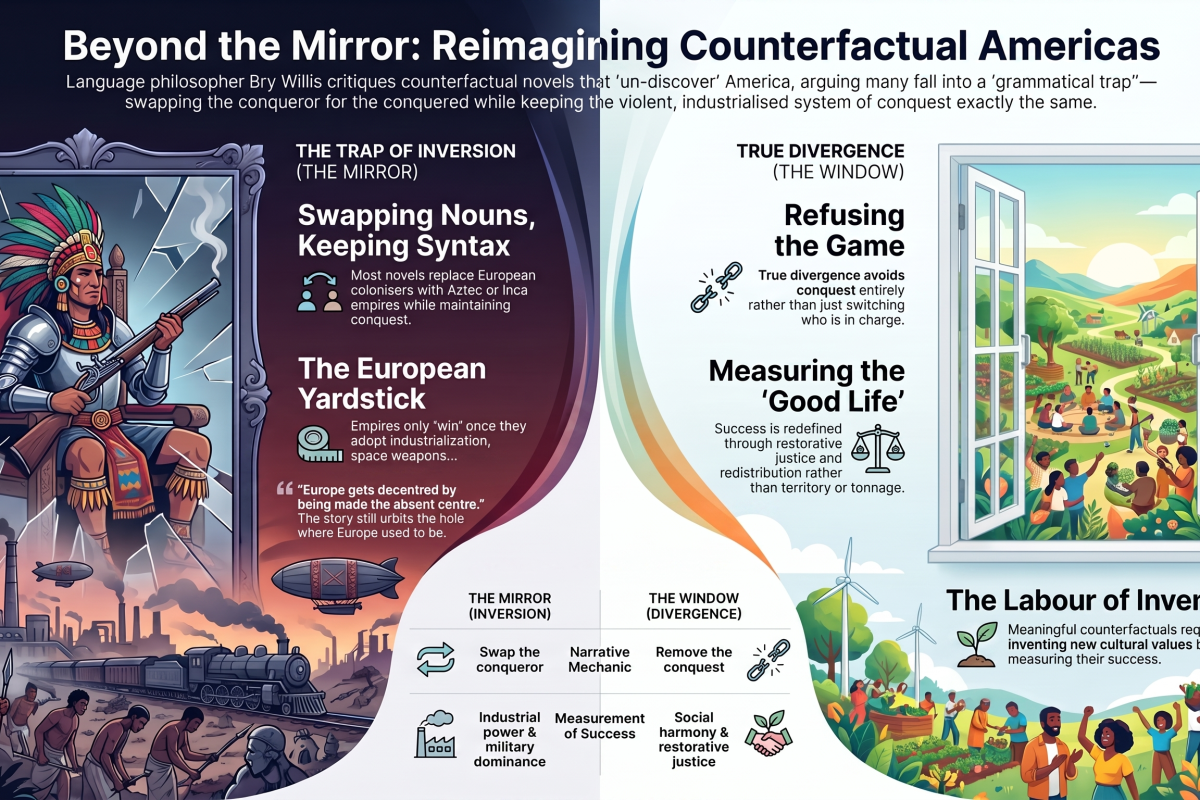
And then there is B. L. Blanchard’s The Peacekeeper (2022) – also, tellingly, a Sidewise Award winner – which does the rarer thing and quietly refuses the whole game. There is no inversion here, because there is no conquest to invert. North America was simply never colonised. The Great Lakes are an independent Anishinaabe nation; Chicago is Shikaakwa; there are no borders on the map because the book declines to draw any. It happens to be a murder mystery, and a slightly wobbly one – I called the culprit early, as apparently did everyone – but the mystery is scaffolding. The real work is a society organised around restorative justice, redistribution and something the glossary calls the Good Life, where crime is repaired rather than punished, and the question ‘what is success?’ gets a genuinely different answer. That difference is the whole point, and it is worth spelling out.
The tell
Watch what the inversion novels are obliged to do to their winners. Silverberg’s Aztecs drive coal-fired automobiles. Evans’s Aztecs somehow have flying warships and space weapons, to the audible irritation of every reviewer who has ever met a history book. In each case, the counter-empire only counts as having won once it has industrialised, once it has, in other words, become Europe in a headdress. The measuring stick never leaves the room. It just changes hands. Would not recommend. All of these are still viewed through Modernist lenses. They can’t seem to help themselves.
This is the trap, and it is a grammatical one: you can swap every noun in the sentence and leave the syntax of conquest perfectly intact. Who dominates whom is a variable. That domination is the axis of the story remains fixed – invisibly, load-bearingly fixed. So the shelf keeps producing books that promise to dethrone Europe and instead install a differently-costumed emperor on the same throne, using the same yardstick to prove he deserves it. Europe gets decentred by being made the absent centre. Everything still orbits the hole where it used to be.
Blanchard’s book is the one that escapes, and it escapes not by putting someone else on the throne but by asking whether the throne needed to exist. That is a far harder imaginative act, which is exactly why the shelf holds so many mirrors and so few windows. Inverting a hierarchy is a parlour trick – satisfying, symmetrical, teachable in an afternoon. Imagining a world whose values diverged, so that its people would not measure their flourishing in territory and tonnage at all, requires you to invent the ruler before you can invent the thing it measures. Most writers, sensibly, decline the extra labour.
Six books, then, and a warning label. Read Binet for the wit, Blanchard for the nerve, Silverberg for the ancestry, and the rest for the pleasure of watching very clever people not quite escape the room. Then, if you’re feeling brave, go and undiscover America properly, which means resisting the temptation to let it become us, wearing better feathers.