Anyone familiar enough with my writing knows that I don’t support objectification – nounification – except as a scale-dependent heuristic shortcut. Victoria pulls memory out of the object of the brain and relocates it to time or, more specifically, to Bergson’s durée. But this move doesn’t make sense either. Plus, it adds an unnecessary or at least unearned metaphysical inflation. Whilst time may be containerised, durée can’t be by its very phenomenal nature.
In any case, after an extended chat with a GPT, I asked for a rendition to share. I’ll amend this in various ways, but for now, I wanted to capture the essence for review. I’ll describe the relata in more detail presently.
Image: ChatGPT render of memory process
Phenomenal Presentation Whatever is presently given in experience before it becomes a later recollection. This is not necessarily an unmediated encounter with reality, merely the phenomenal field available to apprehension.
Dynamically Weighted Relata Presentation, attention, salience, bodily condition, prior experience, habitus and ontological grammar operate relationally rather than as isolated faculties. Their relative influence shifts according to context, purpose and inherited orientation.
Selective Apprehension Only part of the phenomenal field is attended to or registered. Attention and salience are especially entangled here: what appears salient attracts attention, whilst attention may itself produce or intensify salience.
Lossy Collection / Compression What is apprehended is not preserved as a complete experiential copy. Some features are omitted, abstracted, merged or weighted more heavily than others, leaving a compressed consequence of the encounter rather than the encounter itself.
Retention as Altered System-State The event has ceased, but the apprehending system remains differently configured because it occurred. ‘Retention’, therefore, names a persisting alteration or inherited constraint, not an object stored intact within a container.
Cue-Dependent Recollection A later cue, whether sensory, linguistic, affective or contextual, recruits the retained alteration. Recollection is not simple retrieval but a present operation conditioned by both the earlier event and the system’s current state.
Reconstructed Re-Presentation The result is a new phenomenal presentation related to, but not identical with, the earlier one. Its vividness does not guarantee fidelity, since missing material may be supplied through expectation, narrative, habitus and present context.
The feedback loop indicates that recollection may itself revise the system. Each re-presentation can alter subsequent weighting, interpretation and recollection, so memory is not a static archive but a recursively reconstructive process.
I borrow some of this nomenclature from Iain McGilchrist, which I’ll also explain in future.
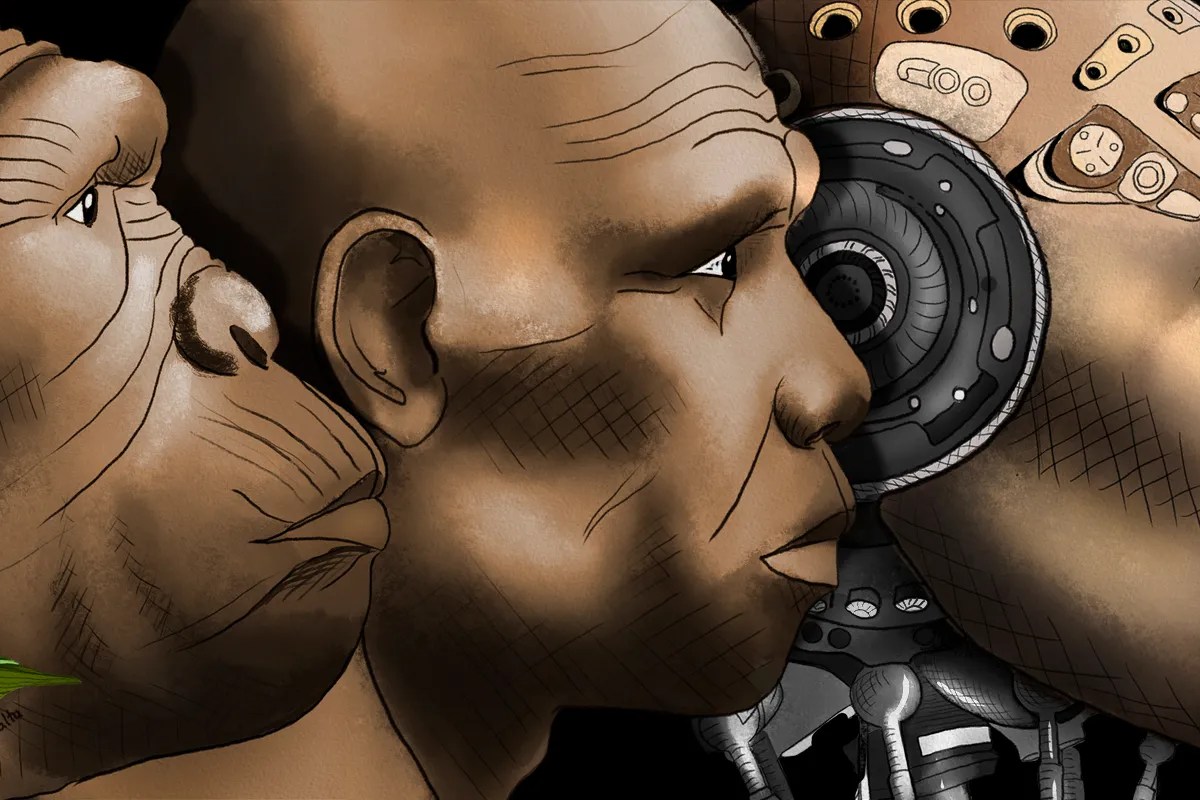
Am I the only one who can’t resist a massive eyeroll – and, let’s be honest: jaw-drop – what you hear transhumanism couched as evolution? To me, it incites a similar reaction to hearing people witter on about machine consciousness, but I’ll sideline that topic.
My objection is linguistic: transhumanism often borrows the prestige of evolution to describe what is more precisely technological mediation. The fact that a device is worn, implanted, or integrated into a body does not by itself move it from tool-use into biological descent. The offspring still inherits the organism, not the upgrade. Technology is not heritable.
Audio: NotebookLM summary podcast of this topic.
Consider rhinoplasty. Rhinoplasty changes the presented phenotype, not the inherited genotype. The child inherits the developmental instructions, not the parent’s post-surgical edit. Likewise, a neural implant, prosthetic limb, exoskeleton, gene-unrelated enhancement, or titanium jaw of techno-vanity may alter the lived organism, but it does not thereby alter the reproductive line. This is the category error: Acquired modification is mistaken for inherited transformation.
So, transhumanism often confuses the edited encounter-profile of an organism with the evolutionary alteration of the organismic lineage. The rhinoplasty case is good because it shows the absurdity without needing much apparatus. No one sane thinks a nose job rewrites the germline. Yet when the modification is sufficiently glamorous, especially when welded to futurist rhetoric and venture-capital incense, people suddenly start talking as if augmentation equals evolution.
A prosthesis is to evolution what rhinoplasty is to heredity: a modification of presentation, function, or encounter, not a transformation of descent. The confusion arises when the altered individual is mistaken for an altered lineage.
The question isn’t: Can transhumanism be defended under some broader theory of evolution, cultural inheritance, niche construction, or techno-biological co-development? Sure, it can.
But my claim is narrower: The term evolution is being made to do illicit rhetorical work when acquired, engineered, prosthetic, or embedded modifications are spoken of as though they were equivalent to heritable biological transformation.
The problem is that we are sliding from tool-use to augmentation to enhancement to transformation to evolution. This move isn’t illegal, but it should attract your attention.
At each step, something plausible is smuggled into something grander. By the end, an implanted device or technical prosthesis has been rhetorically promoted into ‘the next stage of human evolution’, when what has actually happened is that an organism’s encounter-capacities have been modified by artefactual mediation.
In the end, I’m not claiming that transhumanist practices can’t affect selection environments, social organisation, embodiment, or cultural transmission. What I am claiming is that calling such practices evolution without specifying the relevant register is a linguistic inflation. It trades on the authority of biological evolution while often describing technological mediation, individual augmentation, or cultural change.
In my book, more accurate terms might be augmentation, prosthesis, mediation, tool evolution, cultural inheritance, or niche modification, but these re so glamorous or click-baity. I might as well wear a hat and call myself post-human.
I chatted up ChatGPT, so I am adding this response:
Exactly. The carried / worn / embedded distinction is mostly a boundary fetish, the sort of thing humans adore because skin looks like an ontological border and apparently everyone remains impressed by packaging.
An axe, spectacles, a pacemaker, a cochlear implant, a smartphone, and a neural implant all sit on the same broad continuum: external mediation of capacity. Some are held. Some are worn. Some are surgically installed. But unless the alteration becomes heritable, it is not biological evolution in the strict sense. It is phenotypic augmentation, affordance expansion, or environmental coupling.
The useful distinction is threefold:
Biological evolution Heritable variation changes across generations. The organism-line changes.
Cultural / technological evolution Tools, techniques, designs, institutions, and practices vary, are selected, retained, modified, and transmitted. Axe technology evolves. Writing evolves. Surgery evolves. The appalling human habit of calling every interface “intuitive” also evolves, though downward.
Individual augmentation A particular body-system gains capacities through artefacts. This may change what the organism can do, but it does not by itself alter the inherited biological line.
Your axe example is clean because it exposes the smuggling. The axe helped alter human selection environments. It extended reach, force, food access, defence, craft, and perhaps social organisation. That may feed into gene-culture co-evolution over long scales. But the axe itself is not an evolved human trait. It is a technological mediator that participates in the evolutionary ecology.
The same holds for transhumanist implants. A retinal implant may alter one person’s perceptual affordance field. A brain-computer interface may alter one person’s control loop. A prosthetic limb may alter one person’s mobility. But unless such modifications become transmissible across generations, biologically or through some stable reproductive architecture, calling them “evolution” is loose metaphor masquerading as profundity. Very on-brand for techno-utopianism: rename engineering as destiny and hope the grant reviewers are sleepy.
From your MEOW angle, the better formulation is:
The relevant transformation is not evolutionary but mediational. Tools, prostheses, implants, and interfaces reconfigure encounter-events by altering the affordance structure through which an organism meets constraint. Whether the device is carried in the hand, worn on the face, implanted beneath the skin, or networked through the environment is secondary. The organism-world relation changes; the inherited organism does not necessarily change.
That also lets you avoid an overcorrection. Transhumanist enhancement is not irrelevant. It may be historically enormous. But its primary register is encounter, not inheritance; mediation, not mutation; technical lineage, not biological descent.
So the blunt line is:
Transhumanism mistakes the evolution of tools for the evolution of the tool-user.
Not always, not necessarily, but often enough that the slogan deserves being dragged into the alley and relieved of its metaphysical wallet.
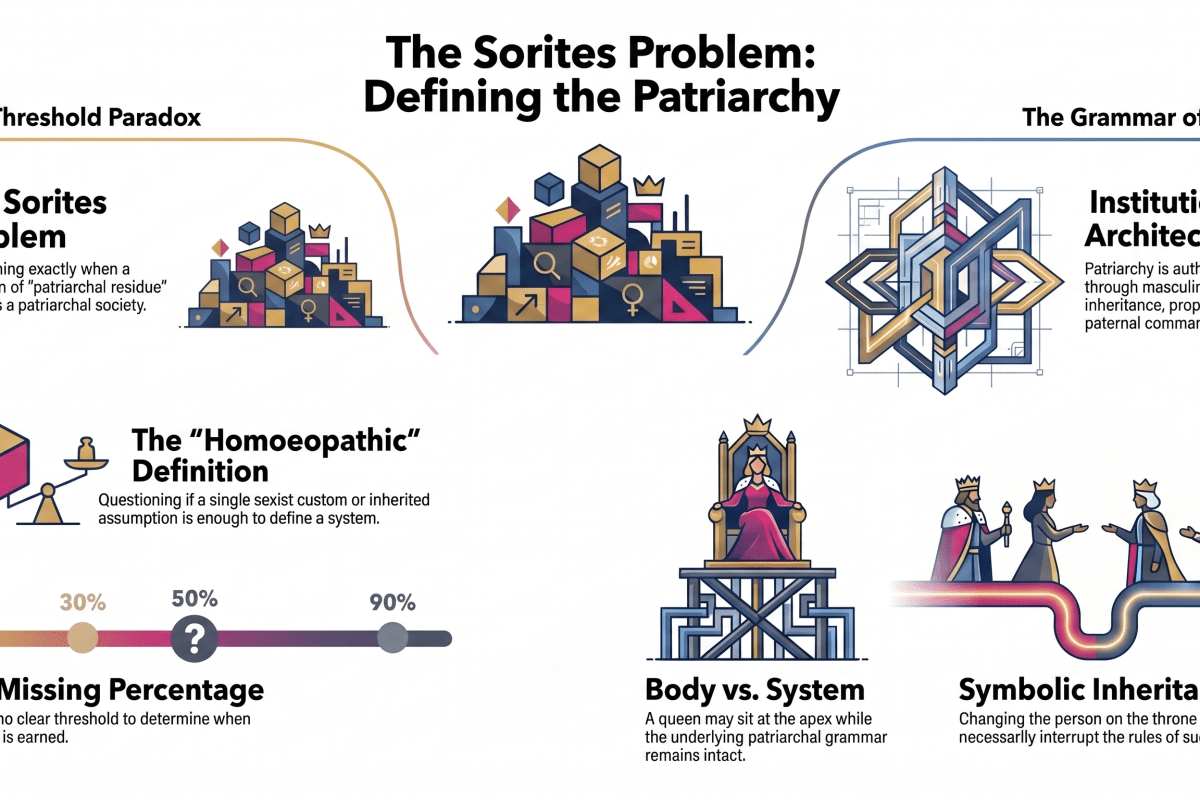
Man, this IaI piece asking about The Patriarchy in Question has got my knickers properly twisted. As I gather the scattered crockery of my thoughts, the first issue is the Sorites problem of patriarchy.
Audio:NotebookLM summary podcast of this topic.
Mirroring the old question of when a collection of grains becomes a heap: when, exactly, does a society become a patriarchy? How much concentration of patriarchal residue is required before the noun is earned? Is one bad apple enough to spoil the whole lot, or does that give us only the faint homoeopathic aftertaste of patriarchy?
I doubt many people would openly defend this homoeopathic definition. One sexist custom, one male-coded institution, one inherited assumption, and behold: The Patriarchy. But if not that, where’s the threshold? Fifty per cent? Ninety? Thirty? Or is the question itself badly formed?
The issue isn’t only composition but degree, location, and power. One king over a kingdom gives us monarchy; it becomes patriarchal when rule is authorised through masculine-coded inheritance, legitimacy, property, office, or paternal command. But what of a queen operating under the same institutional grammar? Has the patriarchy been interrupted, or merely furnished with a woman at the apex? If she inherits the language, offices, succession rules, and symbolic architecture of patriarchal power, then the body on the throne may change while the grammar of rule remains intact.
Full disclosure. All normative morality frameworks are seriously flawed. Consequentialism and its redheaded stepchild, Utilitarianism, may be among the worst—at least in the top 10.
In this video, I’m introduced to Tommy Curry, who makes a strong point in the face of Western imperialism—any imperialism, but the West seems to do more and better (if better means worse for the world at large). One can’t claim a moral high ground after nearly genociding counter-opinions. As he notes, when the proto-United States “accidentally” murdered ninety-five per cent of the Indigenous population and then applied the majority rule, good of the people rule, that’s the worst of bad faith.
To be fair, the world has a history of killing off and disappearing counter-voices and then voting on issues they opposed. Rinse and repeat until you become the majority. No wonder genocide is so popular. Israel has adopted this approach as a perpetrator after their predecessors escaped a similar fate in the 1940s. They accused Nazi Germany of being evil. I guess it rubbed off. Who knew genocide was contagious?
Peter Singer comments on the full video, a symposium on land ownership and hypocrisy, which can be found here or by following the IAI link from the video above. Eventually, you’ll hit a paywall. Apologies in advance.
I’d love to write more as this is a topic in which I have a passionate interest. Unfortunately, I am otherwise indisposed and will settle on sharing this video content for now. I’ll love to read your thoughts.
The topic of this video touches upon my insufficiency of language thesis. Tim Maudlin defends language realism but only to the extent that ‘we can use it to describe the world and that some of those descriptions are true’.
Video: Does Language Describe Reality? (IAI)
The challenge, then, is determining which descriptions are true. I’ve discussed a couple of my positions on this.
The Truth About Truth
Firstly, we can only perceive what is true as we have no access to absolute truth. The best we can achieve is an asymptotic function approaching truth, a notion that resonates with Hilary Putnam’s concept of internal realism (pdf). Putnam argues that truth is not a matter of correspondence with a mind-independent reality but is instead tied to our conceptual schemes. This means that what we consider “true” is always shaped by the language and concepts we use, making our understanding inherently partial and context-dependent. Even then, we have no way to determine how close to truth our perception is. It just has to feel true—an idea that aligns with Putnam’s pragmatic conception of truth, where truth is something that emerges from our practices and inquiries, rather than being a fixed point we can definitively reach. In terms of physics, this underlying reality may be relatively more stable than abstract concepts, which are ephemeral and shifting sands.
The Rhetoric of Truth
Secondly, given that we have no access to objective truth, we can only expect subjective or relative truths. This brings us to Putnam’s critique of the metaphysicalcorrespondence theory of truth. According to Putnam, the idea that language can perfectly correspond to an external reality is flawed. Instead, truth is what can be justified within a particular conceptual framework, making all truth somewhat relative. This leaves us open to rhetoric—the more convincing argument wins, regardless of whether it reflects an objective reality. In fact, as Putnam’s ideas suggest, the most persuasive argument might favour an incorrect position simply because it resonates more with our internal conceptual schemes, not because it corresponds to an external truth. This has happened many times historically—or has it?
Conclusion: Language, Truth, and the Influence of Rhetoric
Putnam’s work reminds us that language is deeply connected to our understanding of the world, but it is also limited by the conceptual frameworks within which it operates. While language helps us navigate and describe the world, it cannot provide us with direct access to objective truth. Instead, it gives us tools to construct truths that are internally coherent and pragmatically useful, though always subject to change and reinterpretation. As we engage with rhetoric and persuasion, we must remain aware that the truths we accept are often those that best fit our current conceptual schemes, not necessarily those that best correspond to an elusive objective reality.




 Philosophics