
I was inspired to write about affordances on Substack this afternoon.
I had already decided there were limitations to this notion, but I feel it’s still useful. The way I see it, affordance instantiates with an encounter. Stairs don’t have affordances as attributes absent interaction. Generalised, affordance is a function where one needs something like this
A = {subject:object:index:context}
where the subject is the sentient or animate entity, let’s say the chimps in this image; the object is the encountered item, say the bench; the index is the affordance, say sitting or standing, and the context is a salience (or valence or attention) modifier.
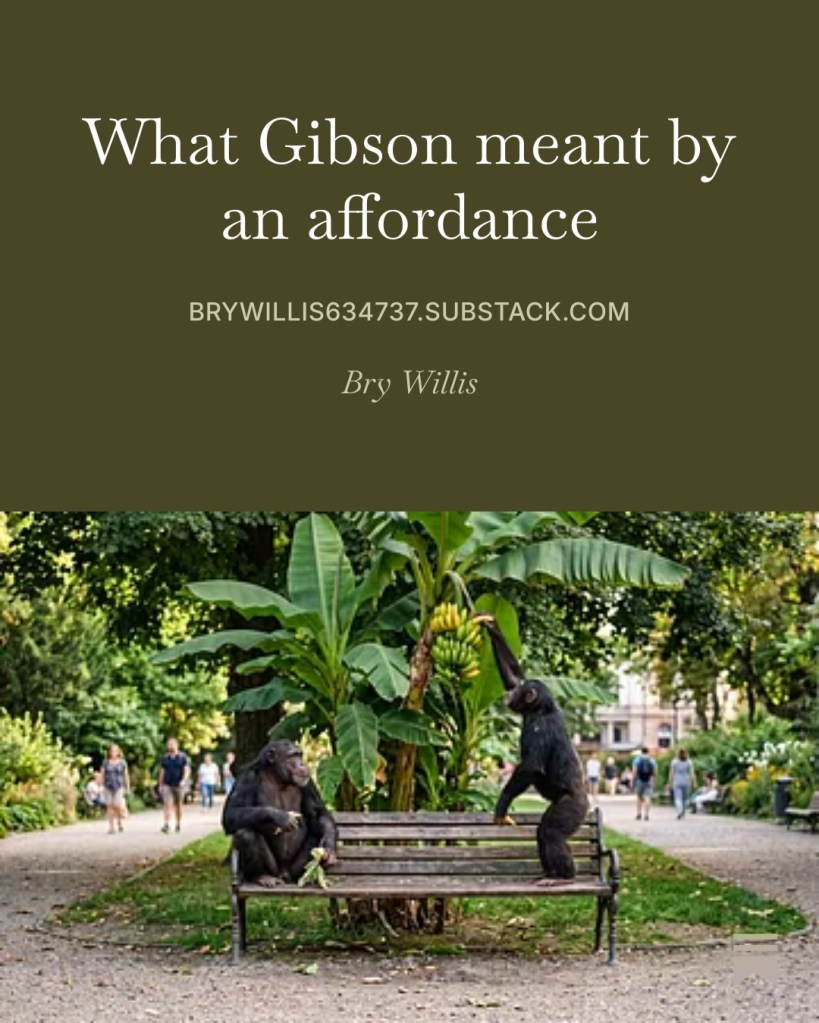
In the case of sitting, I may not be tired or particularly interested in sitting. The bench still affords sitting, but I don’t instantiate the act.
Taking stairs as a more common example, if I am a typically abled human adult, stairs afford climbing (ascending and descending), but if I am relegated to a wheelchair, no such affordance relationship exists. This helps to explain why affordance isn’t an attribute of the stairs, but rather of the encounter.
Water to a non-swimmer doesn’t afford swimming any more than a tree affords climbing for a fish – and yet does for a chimp.

