I have been developing my French, so I rely on several primary resources.
Myself
This includes grammar books, novels and the rest of the traditional fare, some of which I have listed below. Books remain useful, despite their regrettable inability to generate notifications, harvest engagement or insist that one more chapter will transform your life.
Audio: NotebookLM summary podcast of this topic.NotebookLM Infographic on this topic.
YouTube and Such
Social media is a time sink, and YouTube is no exception. This is not to argue that I derive no value from either. I do. It is merely to observe that the cost-benefit calculation may not always be in my favour.
That said, I encounter many useful tips, ideas and sources of general exposure to French. These help with learning, relearning and noticing gaps in what I thought I already knew.
There is, however, a risk. People teach and learn differently. Some teachers also believe they understand how they themselves learned and construct a method around that retrospective account. Memory being the immaculate scientific instrument that it is, this can create difficulties.
The first is obvious. A teacher may misattribute the cause of their own success and teach what is merely a covariant feature of the process. The method may have accompanied their learning without producing it. Remove the principal variable and the supposed method may accomplish very little.
A related problem arises when learners do not yet understand how they themselves learn. They may spend hours following a method that is suboptimal or even counterproductive. On the other hand, the method might happen to suit them perfectly. It can be difficult to know in advance.
A teacher may also be ideal for a learner at A1 or A2, but less appropriate at B1, B2 or beyond. By then, however, familiarity has become comfort, and comfort can masquerade as progress. This seems worth bearing in mind.
Even so, YouTube contains an enormous amount of material at nearly every level. The problem is not scarcity but selection.
Anki
Anki is excellent for repetitive learning tasks. It is essentially a flashcard system on steroids, although with fewer alarming side effects.
Many decks have already been constructed and made available online. I happen to use Anki for language learning, but it would be useful for almost any flashcard-oriented task, including academic study or memorising recipes, should that be your peculiar ambition.
This post is little more than a reference to Anki for context, but I recommend exploring it. There are also plenty of YouTube resources explaining how to use it for different purposes.
Anki supports text, images, audio and video, so it is genuinely multimedia rather than merely a digital imitation of index cards.
I have been using it to retain and expand my French vocabulary and grammar because I live somewhere French is not especially available. I would be better situated if I wanted to learn Spanish or Portuguese, and perhaps several other languages. For now, I shall pass.
Many of the cards I have imported come from decks with names such as “Top 1,000 Common Words”, “100 Conjugated Verbs” and “50 Useful Travel Phrases”. After enough examples involving “She has an apple”, “She gave him an apple” and “He would like her to give an apple to his father”, my mind wandered towards Snow White and poisoned apples.
In English, one may speak of a poison apple, treating poison as an attributive noun, or of a poisoned apple, in which poisoned describes what has happened to it. French does not ordinarily preserve the first construction unless one is deliberately inventing a literary compound. The natural French expression is:
Elle a mangé une pomme empoisonnée. She ate a poisoned apple.
I asked ChatGPT about this. I shall spare you the full forensic inquiry into the apple. What interested me more was its suggestion that I diversify the examples in my deck.
iTalki
I use iTalki for live conversation with native speakers. Although I am not formally endorsing the platform, I recommend investigating it and have found it useful.
I have interacted with only two teachers, but I enjoyed working with each of them for different reasons. Lessons are relatively inexpensive, although rates vary considerably between teachers. They are not as cheap as YouTube or Anki because they are not free, but, as an economist, I also take opportunity costs into account.
Spending hours on a free platform without acquiring any durable knowledge still entails a cost. Free is not synonymous with costless, despite what several business models would prefer us to believe.
I am not trying to sell anyone on iTalki or a similar service, but one can sample it fairly cheaply. A lesson might cost about the same as a cup or two of aggressively marketed coffee. Since I do not drink coffee, I already have the necessary budgetary fiction in place.
ChatGPT and Claude
I also use ChatGPT and Claude frequently. In this case, ChatGPT suggested several variations that retained the grammatical structure while making the sentences slightly less lifeless:
Elle a mangé une pomme empoisonnée. She ate a poisoned apple.
Elle a mangé une pomme pourrie. She ate a rotten apple.
Elle a mangé une pomme volée. She ate a stolen apple.
Elle a mangé une pomme interdite. She ate a forbidden apple.
Elle a mangé une pomme étrange. She ate a strange apple.
This is a minor use of a large language model, but a useful one. It can produce controlled variations, introduce vocabulary I have not encountered often and help prevent repetitive exercises from collapsing into grammatical wallpaper.
It can also explain why one construction sounds natural and another does not, generate examples at a particular level and create drills around a specific weakness. Naturally, its answers still require scrutiny. Confidently delivered nonsense remains nonsense, even when it arrives with immaculate formatting.
Taken together, these resources serve different functions. Books provide structure and depth. YouTube supplies exposure and ideas. Anki makes repetition tolerable. iTalki provides live interaction. Language models generate variations and explanations on demand.
None is sufficient by itself. Used together, however, they form a reasonably effective learning environment, provided one continues to distinguish activity from progress. The first is easy to measure. The second is what all the activity was supposedly for.
NB: I wrote this by hand and passed it through ChatGPT to clean it up. Let’s call it 95% human authored and call it a day.
Image: Gemini Nano Banana Pro’s first mis-render. This and the cover image are intentionally stereotypically satirical.
I don’t often respond to blog articles directly, but I read this and couldn’t seem to leave a comment locally, so here we are. Being a former educator, I think I can bring a certain perspective to the issue – or at least share my biases. Mainly, I have found that educational institutions earn their money by offering network access. This is why top-tier school can charge what they want. It also argues that other schools may now even be worth the price of admission. The student loan debate in the US may be Exhibit B.
I found this thoughtful and broadly persuasive, especially the treatment of education as a historically contingent field of selection rather than a neutral transmission of knowledge. I agree that institutions do not merely distribute information; they decide what counts as knowledge, competence, legitimacy, and intellectual seriousness.
My hesitation concerns the breadth of education as the organising term. Much of the critique seems directed more specifically at institutional schooling: curricula, examinations, credential hierarchies, universities, tuition, disciplinary structures, and labour-market preparation. Knowledge acquisition, inquiry, intellectual formation, credentialing, and institutional reproduction overlap, but I am not sure they should be treated as one object.
This distinction also sharpens the commodification argument. Elite institutions often charge not because they possess otherwise inaccessible knowledge, since much coursework is now available through books, lectures, open courses, and other online resources, but because they sell positional access: selected peers, faculty patronage, alumni networks, recruitment channels, prestige, and a credential recognised by other gatekeepers. In that sense, the scarce commodity is often less knowledge than institutional membership and social placement.
There are certainly exceptions involving laboratories, archives, specialist supervision, unpublished research, or unusually strong seminars. But these seem insufficient to explain most of the price premium attached to elite undergraduate education. The institution is often selling educational capital rather than education alone.
I also wonder whether the essay first dissolves education as a coherent ontology and then partially restores it through terms such as ‘genuine’ or ‘authentic education’, now defined as critical, emancipatory, interdisciplinary, and resistant to domination. I am sympathetic to that orientation, but it still seems to select one preferred practice from among several rather than recover the essence of education.
Perhaps the more diagnostic vocabulary would distinguish learning, schooling, credentialing, intellectual formation, network access, and institutional reproduction. This would preserve the force of the critique whilst making clearer which function is being criticised at each point.
I’ve shared another article on Substack about how the AI-authorship debate is bollox.
Audio: NotebookLM summary podcast of this topic.
The LLM-versus-human debate has been raging for several years now, and there seem to be two principal camps: human exceptionalists and agnostics. I suppose there may also be a small, misanthropic faction, but its members are either remarkably quiet or indistinguishable from everyone else online. If you are out there, do raise your voice.
If you want to witter on about other negative aspects of AI, have at it, but the authorship debate is weak tea.
A toy model of why purification is the wrong verb – offered for dissent.
Addendum: Please note that I have added an endnote to this post to explain the maths a bit better.
Preamble
I continue to press on colonialism, but this time I look at possibilities and probabilities of extricating colonial influences. I suggest that this is easier said than done. I am no expert in colonialism, post-colonialism, or decolonialism, but I have an interest in philosophical claims and maths, so here I am. Here, I attack a particular model using the metaphor of reconstituting from an alloy. This may be the wrong practical argument, but I address it all the same.
Decolonising decolonisation
There is a picture of decolonisation so intuitive that it barely announces itself as a picture. Something foreign was introduced. The task is to get it out. Sift the flour, strain the tea, remove the intruder, and what remains is ours again. The picture is tidy, it is emotionally satisfying, and it licenses a rule: identify the imports by provenance, discard them, keep the rest.
Let me say at the outset what this essay is not, because the register invites misreading. It is not a defence of the Enlightenment’s colonial rationale, which I regard as indefensible. It is not a claim that nothing should be dismantled. I hold no brief for borders, nations, or the machinery that enforces them, and I am not about to acquire one in the space of fifteen hundred words. The argument is narrower and, I think, more awkward: the subtraction rule cannot be applied, not because it is politically inconvenient but because it is arithmetically malformed. If you want to dismantle something, you need a rule that can actually be run. Provenance is not one.
Wrong metaphor, slightly better metaphor
The usual image is a solution – salt in water. Evaporate the water, and you get your salt back. The image quietly promises that separation is a matter of energy and patience.
Alloys are less accommodating. Steel is not iron with carbon loitering nearby; the hardness belongs to the compound, not to either constituent. Better still, steel’s properties depend on its thermal path as much as its composition. Identical carbon content, quenched rather than annealed, gives you a different material. The map from ingredients to properties is many-to-one and runs in one direction only. You cannot read the recipe off the blade.
That is the metaphor I want, and I want it because it makes a specific claim rather than a mood: the question which properties are the coloniser’s? is not hard to answer. It is malformed. The properties in dispute are compound properties. They have no constituent-level owner to be returned to.
So I built a small arithmetic model to see whether that claim survives being made precise, or whether it evaporates like most metaphors do when you make them count.
Not evidence. Let me be blunt about this, since it is the first objection and it is correct. The model demonstrates nothing about actual history. The numbers are invented. There is no dataset, no measurement, no claim about any real polity.
Its use is different and, I’d argue, more honest than a model pretending to measure. It converts a rhetorical position into a set of rules, so that anyone who wants to disagree has to say which rule they reject rather than merely disliking the conclusion. That is a better argument than either of us shouting about purity. It also has the pleasant property of being able to embarrass its author, since a model can fail to produce the result you wanted, which is more than can be said for an essay.
The rules
Take a polity’s stock of practices – institutions, techniques, concepts, forms of life, whatever you like. Sort every element into three registers:
E : endogenous-tagged. Arose from the inherited repertoire.
X : exogenous-tagged. Imposed or imported from outside.
J : joint. Generated by combining the two, and therefore tagged to neither.
Two rules govern the dynamics.
Recombination. Each period, new practice is generated by combining two elements drawn at random from the existing stock. The offspring is E only if both parents are E. It is X only if both are X. Otherwise – mixed parentage, or a parent that is itself already joint – it is J.
Injection. During the colonial window, a fixed quantity is added to X each period from outside. This is the imposition proper: it does not arise from the stock, it is put there.
Then run two timelines. B receives the injection. A does not – except that A receives a fraction of it anyway, because no polity in the relevant centuries was sitting outside the world colonialism was busy making. Meiji Japan was not a control group. It was adapting to a treated world. In the causal-inference idiom this is an interference violation; I have simply written it in as a leakage parameter rather than confessing it in a footnote.
Finally, a property index sits on top of composition: P = E + 0.6·X + 1.8·J. The large coefficient on J is the whole point of the alloy metaphor. The compound has properties neither constituent had.
Sample output
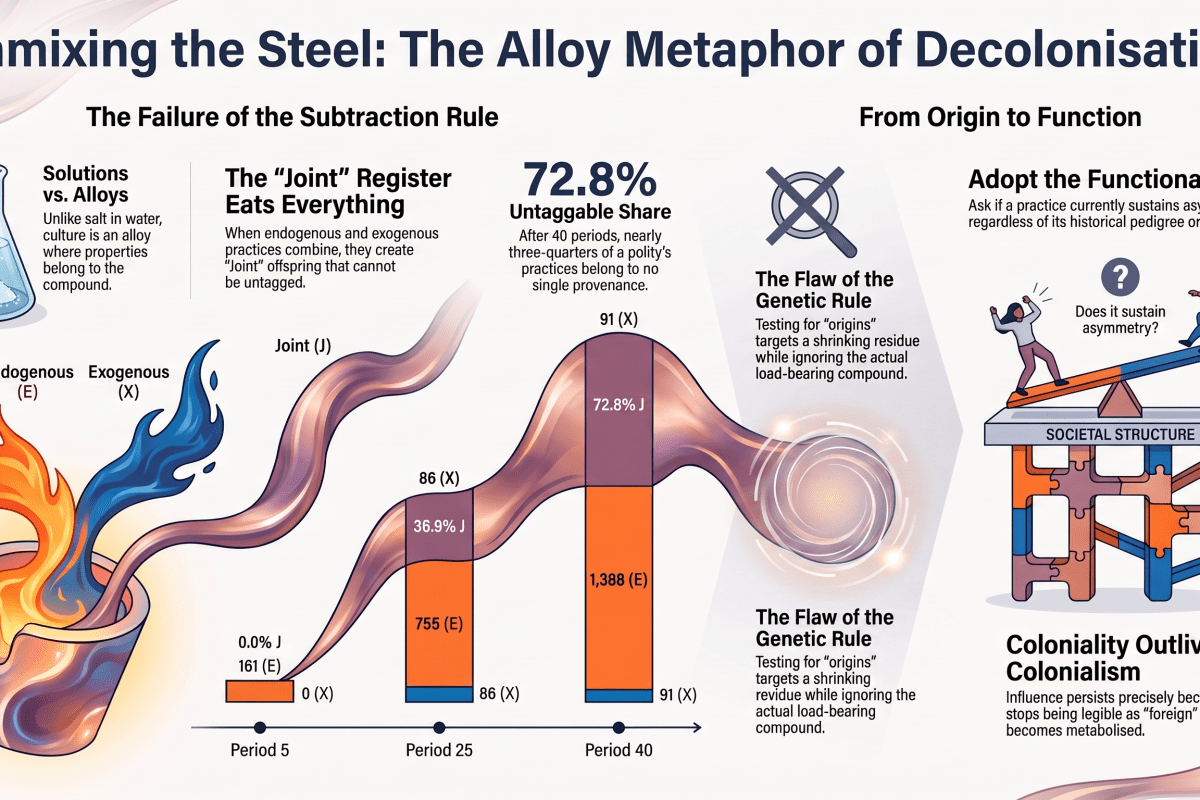
Forty periods, injection running from period 5 to 25, recombination at 10% of stock per period:
period
E
X
J
J-share
5
161
0
0
0.0%
10
254
20
9
3.2%
15
384
41
56
11.7%
20
552
63
184
23.0%
25
755
86
472
35.9%
30
977
89
1048
49.6%
40
1398
91
3994
72.8%
Three things fall out, and the first is not a parameter trick.
One: the joint register is absorbing, so it eats everything. Any element with a J parent produces J. J therefore never shrinks and its share rises monotonically toward unity. This is a theorem about the rules, not an artefact of my invented numbers – any contact at all, given recombination and sufficient time, drives the untaggable share to dominance. By period 40, roughly three-quarters of the stock belongs to no one’s provenance.
Watch the X column, which is where the model earned its keep. X stalls at 91 while the total stock climbs past five thousand. The provenance-visible residue shrinks to 1.7% – not because the imposition faded, but because it was metabolised. What persists of the imposition is precisely the part that has stopped being taggable. I find this the most interesting output, since it says something the metaphor alone did not: coloniality outlives colonialism because it stops being legible as colonial.
Two: subtraction barely moves anything. Strip out every X-tagged element – perfect execution of the purificatory programme, no enforcement problems, no disputes about the list. The property index falls from 8,642 to 8,587. Six-tenths of one per cent. The property lives in J, which the provenance rule cannot see, let alone reach. The purist gets to burn the 1.7% that remains legible and call it a restoration.
Three: the control timeline identifies nothing. Over two hundred stochastic runs, the uncolonised timeline A returns a mean of 8,336 with a standard deviation of 1,249 – a 5th-to-95th percentile band running from 6,276 to 10,173. Colonised timeline B returns 8,571. That is 0.19 standard deviations from A’s mean: sitting comfortably inside the distribution, indistinguishable from an ordinary draw. The decolonising intervention shifts things by about 0.04 sd. Even if you grant a counterfactual – which the previous essay in this sequence argued you cannot, there being no determinate nearest world and no transworld-identical bearer – the counterfactual’s own variance swallows the effect whole.
The rule that survives
If provenance cannot be run, something else has to be. The model points at the alternative rather than merely clearing the ground.
A genetic rule asks: where did this come from? It is an origin test. It requires a counterfactual to answer, has no truth-value when the counterfactual is undefined, and – as the X column shows – targets a shrinking sliver of legible residue whilst the compound does the actual work. Applied in practice, an inoperable rule gets applied by proxy, which means provenance is assigned by whoever holds the pen. The purity test cannot be corrected, because it has already assumed its own criterion.
A functional rule asks: is this presently load-bearing in the reproduction of the asymmetry? It is answerable from what is in front of you, revisable when the answer changes, and indifferent to pedigree. Railways and germ theory arrived with the apparatus and do not sustain it. A racialised labour hierarchy sustains it, whatever its vintage. The question is not what a thing’s parents were but what it is currently holding up.
This is not a concession wrung out of anyone. The better decolonial work got here first and by a different route – Mignolo’s delinking is explicitly not restoration, and Táíwò’s objection to purity-by-provenance is that it insults the appropriative agency it claims to restore. Fanon, whose practice was cheerfully larcenous with Hegel, Marx and Sartre, would have had little patience for a rule that condemned an idea by its passport. The purificatory picture I am attacking is the popular one, not the serious one, and I would rather say so than enjoy an easy win.
What I want dissent on
Three specific places, since general disagreement is no use to anyone.
The absorbing rule. Is it right that mixed parentage yields an untaggable offspring? A critic might say that provenance is heritable – that a practice built from a colonial institution and a local one remains colonial in the relevant sense, and my rule assumes away the answer. I think that reply reintroduces the genetic test by the back door, but it is the strongest objection and I would like it pressed properly.
The coefficient on J. Nothing forces the compound to have emergent properties, and if the property index were merely additive the whole result collapses. Is emergence the right assumption, or have I built the conclusion into the arithmetic?
Whether the generalisation holds. I take this to be one instance of a wider pattern: there is no un-enframed baseline against which to audit a technology, no pre-wage self whose unalienated labour the wage-form displaced, no pre-Norman England to compare the settlement against. Every member of the family runs the same undefined counterfactual, and every purificatory programme in the set is malformed the same way. That is either an elegant result or an overreach dressed as one, and I am genuinely unsure which.
Endnote: On the constants
Several readers have asked where the coefficients in the property index came from. The answer is that I chose them, and since a toy model’s only real virtue is that its assumptions are visible, it is worth saying exactly what they do, what other values would mean, and – the more useful question – which results depend on them. The short version: almost none do.
What the index is
The index sits on top of the composition and reads:
P = E + κX·X + κJ·J
where each coefficient is a weight declaring how much a unit of stock in that register contributes to whatever the index tracks. The reader may fill in ‘functional capacity’, ‘productive capability’, or simply ‘the thing about the arrangement anyone would care about’; the argument does not depend on the interpretation. What matters is that the index is a stipulated relation between composition and property, not a measurement of one.
The coefficient on E is fixed at 1 by normalisation. It sets the unit and carries no claim. The other two do carry claims.
κX : how imported practice performs in situ. An imported practice was selected somewhere else, under other conditions. κX asks whether that provenance costs it anything, or gains it anything, once it is running here.
κJ : whether the compound exceeds its parts. This is the emergence parameter, and it is what makes the model an alloy rather than a mixture. Steel is harder than iron or carbon; if the joint register merely inherited the average of its parents, the metaphor would be idle.
What different ranges mean
κX
reading
< 0
imports subtract: a harm model, coherent but a different argument from this one
0 – 1
mismatch: practices adapted elsewhere underperform in a setting that did not select them
= 1
neutral; provenance carries no functional consequence
> 1
selection: things get imported because they work, so imports outperform the average
κJ
reading
< 1
degradation: hybrids are incoherent, syncretism costs something
= 1
mixture, no emergence; the alloy metaphor abandoned
> 1
alloy proper; the compound has properties neither constituent had
On restricting the ranges
I was asked whether κX ≤ 1 and κJ > 1 can be justified as constraints. My answers differ.
κJ > 1 is defensible, but only as interpretation. It is what the alloy metaphor asserts, so imposing it is less an empirical claim than a declaration of which model one is running. There is suggestive support in accounts of recombinant innovation – new capability arising from combination rather than from either parent – but suggestive is the correct word, and a critic who holds that hybrids typically underperform is making a coherent rival claim, not an error. The honest form of the constraint is therefore the inequality itself, κJ > κE, stated as the model’s premise rather than as a finding. And, as below, nothing turns on it.
κX ≤ 1 I would not impose, and I no longer use it. There is an argument for it: a practice selected in another environment has no particular reason to fit this one, so friction should be expected on average. But there is an equally good argument against, since the practices that travel are often the ones that travel because they work, which biases the other way. Neither argument is decisive, and the tie-break is not epistemic but rhetorical. This essay’s conclusion is that removing the exogenous register barely changes anything. Setting κJ low makes that conclusion cheaper to reach. Conservative practice runs the other way: choose the value that makes your own result harder to obtain, and report what happens across the range. The original draft used κX = 0.6, which quietly asserted that imported practice underperforms – an unargued substantive claim with an unfortunate resonance, and a thumb on my own scale. I have replaced it with 1.0.
What the constants actually carry
Very little, which is the point of saying so.
Across κX from 0.2 to 5.0 and κJ from 0.5 to 3.0, the effect of stripping every exogenous-tagged element at period 40 ranges from 0.14% to 11.8%, and stays under 3% everywhere except the corner where imports are stipulated to be worth five times native practice. At the neutral setting (κX = 1, κJ = 1 – no penalty on imports and no emergence at all, the metaphor entirely surrendered) the effect is 1.66%. Granting the purist’s own premise instead, that mixture degrades (κJ = 0.5), it is 2.61%. The identification result is similarly indifferent: the colonised timeline sits between 0.16 and 0.41 standard deviations from the uncolonised distribution’s mean across every pairing tested. There is no setting of these constants at which subtraction works or the control group identifies anything.
What does carry the argument is the absorbing rule – the stipulation that mixed parentage yields untaggable offspring – and, downstream of it, elapsed time. Holding the coefficients neutral, the effect of stripping X depends almost entirely on when you strip:
strip at
X-share
ΔP
t=8
5.3%
5.3%
t=15
8.6%
8.6%
t=25
6.6%
6.6%
t=40
1.7%
1.7%
t=60
0.3%
0.3%
The curve rises while the injection continues and X accumulates faster than recombination metabolises it, peaks near the close of the colonial window, and decays thereafter toward nothing. This is the model’s substantive claim, and it needs no invented constant to make it: purificatory subtraction has a window, and the window closes on its own. Attempted immediately it is partially coherent. Attempted at generational distance it addresses a fraction of a per cent, not because the imposition faded but because it stopped being taggable.
Why they cannot simply be estimated
One might reasonably ask why I do not calibrate the coefficients against something rather than stipulating them. The reason is not laziness, and it is not incidental to the argument. To estimate κX and κJ empirically, one would have to measure the separate contributions of endogenous, exogenous, and joint practice to some outcome – which requires precisely the provenance attribution the essay argues is inoperable, assessed against precisely the counterfactual baseline it argues is undefined. The model cannot be calibrated for the same reason the programme it examines cannot be run.
I would rather state that plainly than have it discovered. It also means the appropriate dissent is not about the numbers. Anyone wishing to defeat the argument should attack the absorbing rule, where the whole weight rests; quarrelling with the constants defeats nothing, as the grid above concedes in advance.
I shared another Substack post, but I want to expand it a bit here. On the Substack version, I conspicuously didn’t name certain obvious names, but here, I shall. I also left out a reference to Plato’s Republic.
The current American regime is built on meritocracy, and – this is the part everyone misses – it would not deny the charge. It rather likes the word. It uses the reinterpreted version, the laundered one my other essay was about, in which merit means precisely whatever the sovereign has decided it should mean this morning. Accuse them of meritocracy, and they will thank you for noticing.
Take the man at the centre of it. Whether Donald Trump is meritorious is not, in the end, a question about Donald Trump. It is a question about which ontological grammar you happen to be speaking, because the grammar constitutes the object before a single fact is admitted into evidence. This is the whole Language Insufficiency point in miniature: the frame quietly does the work the facts are later congratulated for.
To Cohort A, he is a charismatic and self-made businessman. The six bankruptcies are not failures but proof of a shrewd operator who knows how to play the game and walk away intact – power-mind, killer instinct, the art of the deal. That he has a decades-long habit of not paying his contractors, and an even longer one of not paying his tax, does not indict him; it endears him. It makes him the everyman who beat the system the rest of us merely resent. A working-class hero, if you can manage it, descending on a golden escalator.
To Cohort B – and I’ll confess my membership, since honesty is cheaper than the pretence of the view from nowhere – he is a less likeable Forrest Gump: a man forever arriving at the centre of history without ever quite grasping how he got there, weaponising a charisma that works only on the already-mesmerised, and rebuilding the world with himself at the origin. He has a certain gravity. It attracts sycophants and rewards them, which is the only merit test his court reliably administers.
Same man. Two grammars. The ‘merit’ resides in neither the man nor the record; it is assigned by the frame and then invoiced to the evidence. Which is exactly the thesis of the parent essay, now wearing a name tag.
The downward stroke, said plainly
The parent essay left the reverse operation as a coy ‘phrase in current circulation’. I’ll say it here without the euphemism: DEI hire. The move is to take career civil servants – people with decades of demonstrable domain competence, whatever their private politics – and broad-brush them as diversity appointments, which is to say, unqualified by definition, arrived by an unauthorised route. The vacancies then fill with those who have pledged fealty and displayed the one indispensable qualification: a flexible integrity. The competent are marked down for being the wrong sort; the pliant are marked up for being biddable. ‘Incompetent’ has been quietly reissued to mean not ours, and ‘qualified’ to mean loyal. Same machine, thrown into reverse – now with a name engraved on the lever.
The cream, and the dimension it rose along
Which brings me, as these things do, to Plato. The Substack piece used his ship of state – the crew who master the mutiny rather than the sea. Here I want the other half of the same complaint: the comfortable conviction that the meritorious rise to the top like cream.
They do rise. That was never in dispute. What the metaphor conceals is the dimension along which they rose. These people are genuinely competent – at working the system, at the acquisition and retention of position – which is a wholly different skill from governing, and precisely the one we so conveniently assume we were measuring. Cream rises; so does scum; the trope declines to specify which, and physics is no help at all.
This is the standing problem of republicanism – and no, before anyone lunges for the comment box, I do not mean the Republican Party, which has its own well-stocked catalogue of failures, as do the Democrats, who would be unwise to feel smug reading this. Nor is any of it uniquely American. If you are somewhere else entirely, enjoying the spectacle from a safe distance, do put the popcorn down. The mechanism by which a society mistakes competence-at-ascending for competence-at-ruling is not a national defect. It is a design flaw in selection itself, and your country installed it too.
I will not, on this occasion, start in on the failings of democracy as a system. Been there; done that. There are only so many sacred cows a man can tip before lunch.
The question, once more
‘Meritocracy’ survives all of this the way it survives everything – by never once being asked the only question that matters: merit at what, judged by whom, to whose benefit? Put it to the present court, and the answer is almost embarrassingly legible. Which is, of course, exactly why the question is never put.
NB: The following post will be entirely human-generated, with no LLM involvement – except for the cover image rendered by Gemini. It will also be brief.
I am (still, perpetually) learning French, and I use Anki to help me. I recommend it for standard and non-standard flashcard uses. Recently, I asked ChatGPT to generate a CSV with phrases for the front and back of the cards, for example:
Front: I will be able to visit France next year.
Back: Je pourrai visiter la France l’année prochaine. (futur simple)
I found the pack useful, but a few days later (today), I asked for more than first-person perspectives, as well as additional tenses. I entered this prompt, which is what triggered this blog entry:
‘You’ rendered this for me. Might you generate a similar file that I can use to import to Anki that includes versions other than first-person singular? Future tenses would be helpful as well.
Notice the ‘you‘ in scare quotes – inverted commas.
It’s no secret that I am partial to the episodic selves of Galen Strawson in contrast with diachronic selves, which is to say that I don;t believe that the you or the I or yesterday – or even a second ago – is intrinsically the same person. I’ve explained this elsewhere, so I’ll leave it here.
As much as I feel this way, I don’t feel put off referring to myself as myself or I – me, myself, and I – or to you as you, but I am more consciously uncomfortable with addressing an LLM as you, as demonstrated.
I know full well that each prompt and response is to a different instance of the LLM – a different episode. Unless the LLM accesses an earlier conversation in memory – and I use this term loosely here, too – it would not retain context, and the absence of you-ness would be painfully obvious.
I don;t believe that the self of people is functionally any different. Obviously, humans are carbon-based rather than silicon-based, and storage and retrieval operate differently beyond the substrates, but the mechanism is metaphorically similar.
Does anyone else feel dis-ease in addressing an LLM in the second person? Or is it just me – or me?
I agree with Paul directionally, but I think he could have gone further – and perhaps he has since – so I compare his view to my own in a Substack article. I’m not sure whether he’d disagree with the extensions. Check it out.
Somebody somewhere made mention of The Social Construction of Reality, so I asked ChatGPT if I should engage with it directly, which is to say, to read it. Already believing that what we perceive and experience is a subjective construction, albeit shaped by relative forces, I thought it might be a lot of choir preaching.
ChatGPT admitted that this was partially true, but that the benefit would be to get a sociological rather than strictly philosophical account. Having read the introduction and started the first chapter, I already feel this to be true. The authors make it clear that Sociology is just a special philosophy that doesn’t aim quite so deep and has a specific and obvious focus on societies. Fair enough.
So far, I’m glad I picked it up. It’s relatively short, which was a deciding factor, and it’s giving me a break from the 1066 material I’ve otherwise been consuming as of late.
I don’t have more to add, save to say, so far so good. I look forward to the rest. I’ve got more to do today, including editing a video for YouTube, which is me rather than AI for a change – a process that reminds me why I use AI in the first place: so much time investment.
NB: I am actually listening to an Audible version of this book. Whilst searching for an apt cover image for this post, I found the associated image, and it is as apt as one might find.
Anyone familiar enough with my writing knows that I don’t support objectification – nounification – except as a scale-dependent heuristic shortcut. Victoria pulls memory out of the object of the brain and relocates it to time or, more specifically, to Bergson’s durée. But this move doesn’t make sense either. Plus, it adds an unnecessary or at least unearned metaphysical inflation. Whilst time may be containerised, durée can’t be by its very phenomenal nature.
In any case, after an extended chat with a GPT, I asked for a rendition to share. I’ll amend this in various ways, but for now, I wanted to capture the essence for review. I’ll describe the relata in more detail presently.
Image: ChatGPT render of memory process
Phenomenal Presentation Whatever is presently given in experience before it becomes a later recollection. This is not necessarily an unmediated encounter with reality, merely the phenomenal field available to apprehension.
Dynamically Weighted Relata Presentation, attention, salience, bodily condition, prior experience, habitus and ontological grammar operate relationally rather than as isolated faculties. Their relative influence shifts according to context, purpose and inherited orientation.
Selective Apprehension Only part of the phenomenal field is attended to or registered. Attention and salience are especially entangled here: what appears salient attracts attention, whilst attention may itself produce or intensify salience.
Lossy Collection / Compression What is apprehended is not preserved as a complete experiential copy. Some features are omitted, abstracted, merged or weighted more heavily than others, leaving a compressed consequence of the encounter rather than the encounter itself.
Retention as Altered System-State The event has ceased, but the apprehending system remains differently configured because it occurred. ‘Retention’, therefore, names a persisting alteration or inherited constraint, not an object stored intact within a container.
Cue-Dependent Recollection A later cue, whether sensory, linguistic, affective or contextual, recruits the retained alteration. Recollection is not simple retrieval but a present operation conditioned by both the earlier event and the system’s current state.
Reconstructed Re-Presentation The result is a new phenomenal presentation related to, but not identical with, the earlier one. Its vividness does not guarantee fidelity, since missing material may be supplied through expectation, narrative, habitus and present context.
The feedback loop indicates that recollection may itself revise the system. Each re-presentation can alter subsequent weighting, interpretation and recollection, so memory is not a static archive but a recursively reconstructive process.
I borrow some of this nomenclature from Iain McGilchrist, which I’ll also explain in future.
This is the fifth of a deeper look into ten philosophical positions. This one is on convergence realism within the category of epistemology. A full article is available on Substack, with supporting information on a recent post here on Philosophics Blog.
Below is a ~5-minute short podcast.
Language works, but not uniformly.
Its effectiveness declines as the conceptual complexity, abstraction, contestability, contextual dependence, and institutional burden of what it is asked to communicate increase. We routinely mistake grammatical fluency for semantic precision and social agreement for shared reference.
I describe this through an Effectiveness–Complexity Gradient:
Invariants are comparatively stable terms with constrained error ranges.
Contestables remain usable but acquire their force within normative or institutional frameworks.
Fluids drift across contexts and disciplines, preserving family resemblance without reliable closure.
Ineffables mark domains where propositional language collapses into metaphor, gesture, paradox, or silence.
These are not ontological species. They are diagnostic regions along a gradient. The important feature is not the label but the rate at which apparent linguistic effectiveness decays as conceptual load increases.