On Death and Dying

3–4 minutes

Disclaimer: I should be finishing my Language Insufficiency Hypothesis book, yet I am here writing about death and dying. Why? Because I was watching an interview with Neal Schon by Rick Beato. I should have been working on my book then, too. It seems I can write about death more easily than finish a book about the failure of language. Perhaps because death speaks fluently.

I haven’t produced music professionally since the mid-1980s, and I haven’t performed since 2012, yet I am still drawn to its intricacies. My fingers no longer allow me to play much of anything anymore. This is a sort of death. When the body forgets what the mind remembers, that’s a particular kind of death – one language dying while another can’t translate.

As Neal was walking Rick through his equipment and approach to music, I was taken back to a similar place. I wanted to plug into a Fender Twin or a Hi-Watt, a Lexicon 224 or a Cry Baby wah. I still have nightmares thinking of setting up a Floyd Rose.

Video: Rick Beato interviews Neal Schon

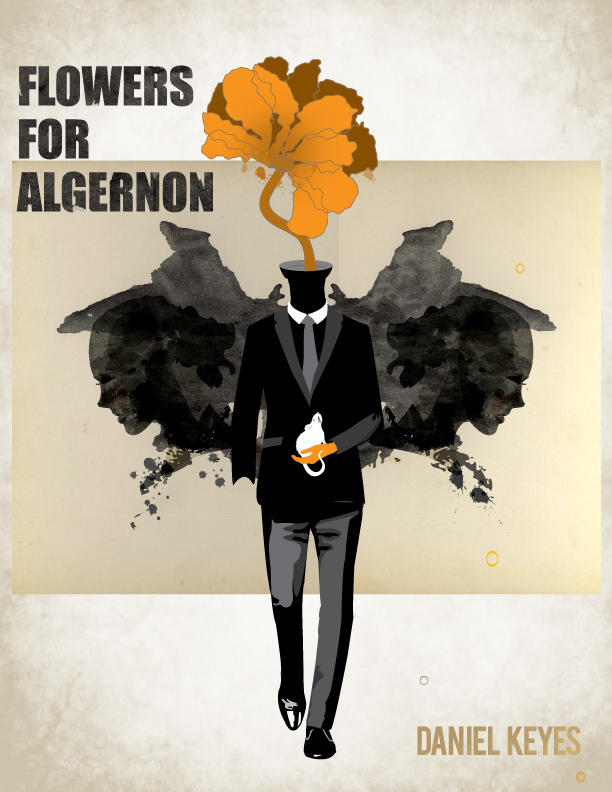
But I can’t go back. As for music, I can’t go forward either. I’m at a standstill, but in a regressed position. It’s uncomfortable. It feels a lot like Charlie in Flowers for Algernon. I used to be able to do that. Don’t get me wrong – I am not claiming to be on the level of Neal Schon, a man I remember from his days with Santana, but when you reach a level of proficiency and then lose it, it hurts; it can be devastating.

Audio: NotebookLM podcast on this topic.

I recall being in hospital in 2023 – a physical rehabilitation facility, really – and I found a piano in a vacant common room. Drawn to the instrument, I rolled over my wheelchair and played…nothing. My fingers wouldn’t work. The piano sat there like a relic of my former self. I rolled toward it as though approaching an altar. My fingers hovered, twitched, failed. The sound of nothing has never been so loud. I cried. I cried a lot those days. I was down to 58 kilos – at 182 cm, I weighed in at just over 9 stone. It wasn’t the best of times.

I still feel a certain nostalgia.

And then there are the people I’ve lost along the way – as another Neal reflected on – The Needle and the Damage Done.

Love and art are both acts of repetition. When one ends, the reflex remains – the impulse to reach, to share, to call out. Death doesn’t stop the motion, only the answer.

I’m lucky to have left Delaware. When a girlfriend died in 2020, I remained and connected with another until 2023, when she died, too. From 2020 to 2023, when I was out and about, something might have caught my eye, and I’d reflect on how Carrie might have liked that.

But it was different. It was more like, ‘I should let Carrie know about that,’ only to realise fractions of a second later that she wouldn’t see whatever it was; she couldn’t. And I’d carry on. I didn’t need to repeat this with Sierra. My relocation to Massachusetts solved this challenge – not so many triggers.

I’m not sure how the loss of ‘professional’ music relates to deceased partners, but it does – at least enough for me to make this connexion. Perhaps I’m just connecting arbitrary dots, but I’ll call it nostalgia.

I don’t play, but I still hear it. The song continues without me. Nostalgia is just rhythm without melody. Perhaps all nostalgia is epistemological error – the confusion of past fluency for present meaning.

L’Illusion de la lumière

1–2 minutes

Un court message aujourd’hui.

Je travaille à la traduction de The Illusion of Light : Thinking After the Enlightenment (L’Illusion de la lumière : Penser après les Lumières) en français, avec l’aide de quelques outils linguistiques et d’un peu d’intelligence artificielle. J’ai bon espoir que le processus sera fructueux. Souhaitez-moi bonne chance.

Je dois beaucoup aux penseurs français, d’hier comme d’aujourd’hui. Traduire ce texte est donc, à ma manière, une forme de reconnaissance. Mon plus grand défi sera de préserver un français à la fois contemporain et fidèle à ma voix – moins prosaïque que poétique.
Mes excuses d’avance aux Québécois.

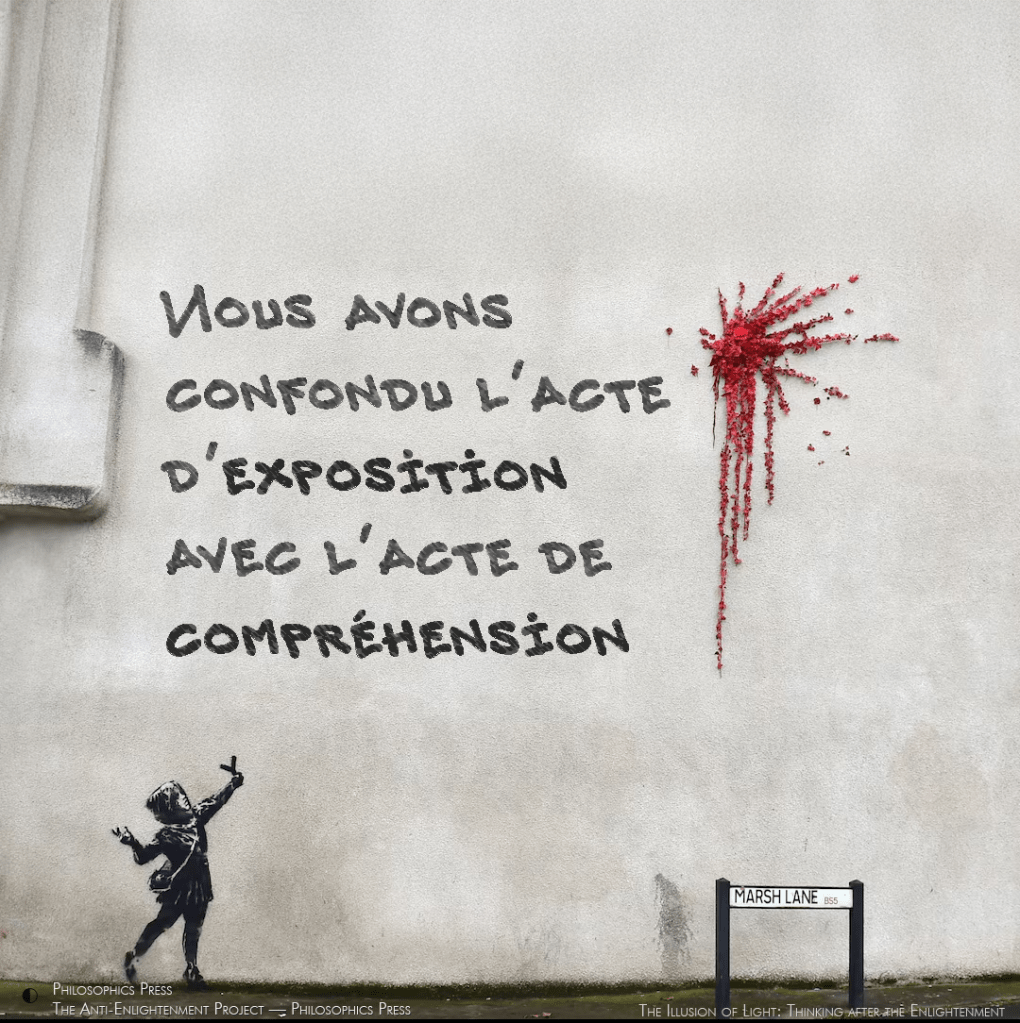
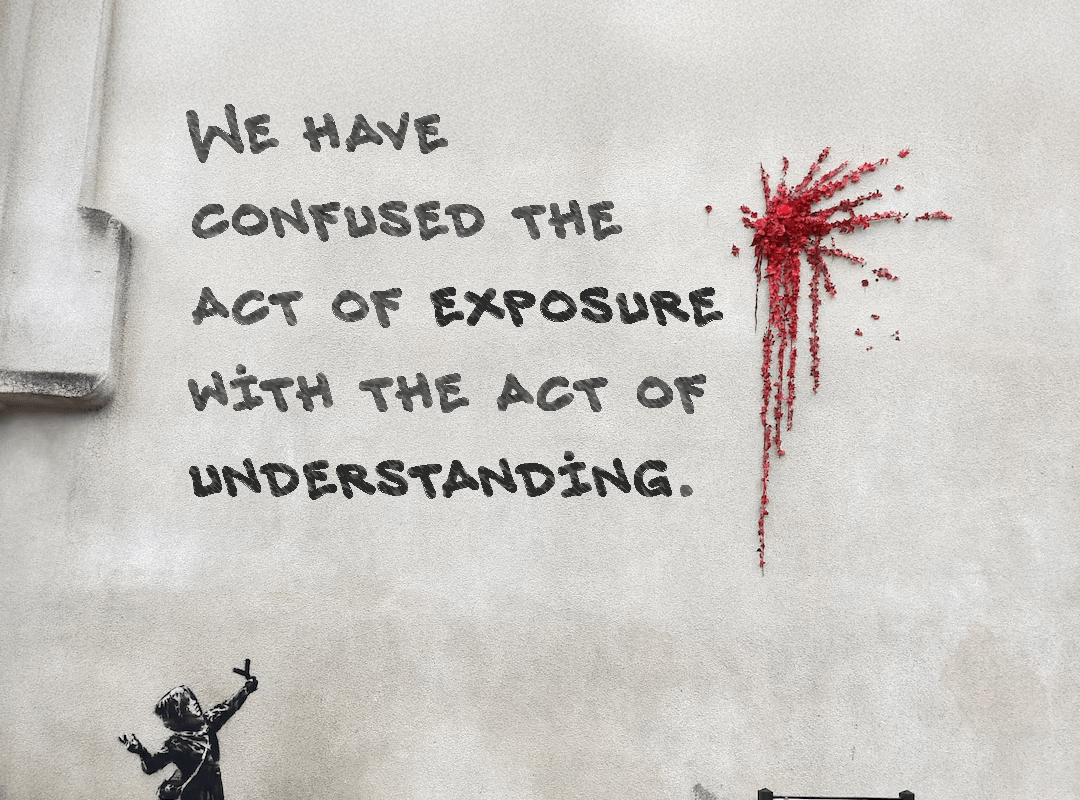
Image: “We have confused the act of exposure with the act of understanding.”

In English, I am translating The Illusion of Light into French, so I’m leaving just this short note today.

I don’t know any other languages well enough to attempt a translation myself, but with a few capable software partners, I’m confident the process will end well.

For the record, I’m using these tools:

  • Reverso — I’ve used it for years and still find it helpful. It provides plenty of contextual examples, which helps ensure I’ve captured the right nuance.
  • ChatGPT — My go-to AI partner; it gets the second pass.
  • Claude — I’m consistently impressed with its suggested amendments. Where Reverso is precise, Claude tends to catch idiomatic usage better.
  • Mistral — It’s French, after all. What can I say? A bit pedantic, perhaps, but another set of virtual eyes can’t hurt—can they?

Whilst I’m sure these tools could manage other languages, I want to be able to evaluate what they’re doing. In French, even if I don’t know a particular word, I can verify it, and I understand the grammar. With other languages, I’d simply be trusting a black box.

Besides, French culture and philosophy have influenced me so deeply that the least I can do is offer something back. As this translation is an overview of my English-language essays, I hope it provides some in-language context.

I know how difficult translated works can be to read, so if I’m overseeing the process, at least there’s one fewer filter between my thoughts and the reader.

Meditations On Nothing: Notes Before Existence

Meditations on Nothing has finally been published after an administrative glitch.

The core of this book consists of six “books” of aphorisms, each book comprising a single page, totalling 24 in all.

Why only 24 pages?

Couldn’t this have been a blog post? An email?

Fair enough, and yes, of course it could have. It could have been six – three sheets, front and back – but I wanted to share in the tradition of the Communist Manifesto by Karl Marx and Friedrich Engels, as well as Thomas Paine’s Common Sense. The content is not similar, but the format is shared.

Honestly, I printed a draft copy for myself on A4 paper, folded it to A5, and stapled it at the spine with a long stapler – sans a fancy cover. Perhaps, I’ll share the source PDF in future.

As I’ve written elsewhere, I was inspired by the aphorisms of Nietzsche, Schopenhauer, Pascale, Debord, and others. To be fair, I disliked Debord’s The Society of the Spectacle, but I was still inspired by it for the two or three things I got from it – each of which slips my mind as I write this.

Why a Companion Guide?

Twenty-four pages – really, only six that matter; why would someone want that?

You got me there, too. No, so Notes Before Existence is not a casual read. It’s logical and coherent, but it’s not standard exposition. It’s meant as a thinking tool. Also, the ideas are supported by those who came before me – Newton’s ‘standing on the shoulders of giants’ quip pertains.

The main body of the book comprises the same six books as Notes Before Existence, each printed on its own verso, opposite a recto page for personal annotation.

Whilst Meditations on Nothing: A Critical Companion does provide supporting context for Notes Before Existence, it doesn’t fully break it down. I expect to provide this context in a more comprehensive volume, both online and offline, primarily on this platform and on YouTube.

I Wonder what’s Next?

I’m putting the final touches on my next project. The Illusion of Light: Thinking after the Enlightenment is a sort of capstone to my Anti-Enlightenment Project. It provides context around this project as well as details about the underlying essays available on Zenodo at no cost.

And so it goes…

What I really came here for is to share the reason this book was hung up in queue. On the surface, everything checked. I uploaded the source files, entered the required metadata, and chose appropriate price points – which, for the record, is $4.99 USD for Notes*.

Other Prices as of 16/10/25

  • UK: £3.99
  • EU: €4.99 (except Belgium, €4.39)
  • Canada: $6.99 (CAD)
  • Australia: $10.99
  • Japan: ¥1000

As it turns out, this publishing business is data-driven, and some of the systems and validation rules, let’s say, are remnants of the 1970s. Some companies are better than others, but in the US, Bowker controls the ISBN numbers. The US is one – if not the only – of the countries to charge for these identifiers, because: Capitalism. Unfortunately, the printers need to access Bowker’s antiquated system to validate the pairing of the ISBN and the publishing organisation.

I publish under Microglyphics, an entity through which I published my first book in 2001. In 2025, I started using Philosophics Press as an imprint for philosophy materials. This created a snag. I had entered Philosophics Press, but it was expecting Microglyphics – even though I’d used Philosophics Press previously. Unfortunately, the error was not thrown on the page where this information had been entered and validated – that was passed – but on the last page, I was informed that something was wrong on that page.

In any case, after a couple of days of trying, I updated the Bowker record (just to be sure) and eventually entered Microglyphics. Voilà. It worked.

Since then, I’ve also secured a second printer and distributor, IngramSpark, so I’m interested to discover what they’re like.

#PSA

Meditations On Nothing: A Critical Companion

A funny thing happened on the way to the printer…

I’ve just released Meditations on Nothing: A Critical Companion to Meditations on Nothing: Notes Before Existence.

So, here’s the thing. As the title more than suggests, this is a companion guide to another. I reviewed the proofs the other day and submitted some corrections – oops. No worries; I approved the changes and submitted them for publication. Only the companion guide survived.

Historical Perspective

I wrote Meditations on Nothing: Notes Before Existence after thinking about – “meditating on, to borrow the fancy philosophical traditions of AureliusDescarteset al.” I was thinking more of Wittgenstein – more Philosophical Investigations (this version) than Tractatus – and Nietzsche, never far from my mind anyway.

I had read an article named Proudhon and the Critique of Immaterial Labor: Toward a Cognitive Rent? and considered it in terms of Marx. I’ve always favoured Proudhon over Marx, despite the infamy of the latter.

In any case, after some internal dialogue down a philosophical rabbit hole, I traversed to the core of being, to a meta-nihilistic origin: What if we don’t attribute any metaphysics to our origins? I didn’t want to say ‘beginnings,’ because ‘beginning’ is a loaded term that I didn’t want to presume anyway.

As humans – whether spiritual or not – we tend to think of the sanctity of life as sacred. But it just is. But the universe doesn’t care; it simply is. It has no worth – no value. Like beginning, these are terms we’ve invented.

I don’t deny we have an emotional attachment to life – some of us, sometimes. Practically speaking, we pathologise those who don’t. A human without these emotions is broken. Artificial intelligence is often classified as a threat, as numerous dystopian narratives remind us. But sentience is another of our inventions, a fuzzy stand-in for ‘something like us, but different enough to patronise’.

We still can’t define consciousness, and sentience ends up being ‘what the sentient recognise in one another‘. Which is to say—it’s undefined because it’s circular. Funny, that.

My Goal

Even Nihilists can have goals – the Existentialist in me.

What if we return to our starting point – like a novel, the start isn’t necessarily the beginning; it’s merely an arbitrary place reserved for content on page one. What if we don’t imbue the origin with hubris and self-importance? What do we get?

That’s what this is about.

I work through some syllogistic logic:

Syllogism A
P1. Consciousness seeks coherence.
P2. Continuation provides coherence.
∴ Consciousness declares continuation good.

Next follows.

Syllogism B
P1. Only beings who feel have value.
p2. We feel.
∴ We have value.

That’s not logic—it’s species-narcissism codified as ethics.

Finally, I circle around to this:

Syllogism C
P1. All moral axioms depend on the value of life.
P2. The value of life cannot be demonstrated without presupposing it.
∴ All moral axioms rest on circular reasoning.

But Wait, There’s More

I decided to write this in the form of aphorisms – a batch of sequentially connected themes. I ended up with a sequence of six books – because, why not be pretentious?

Life began its sermon long before there was a listener.

  • Book 1: The False Axiom
  • Book 2: Plastic Rationalisation
  • Book 3: The Reflex Loop
  • Book 4: The Pathology
  • Book 5: The Exposure
  • Book 6: Coda

Life began its sermon long before there was a listener.

Houston, We’ve Got a Problem

I am still working with the printers to fix the technical difficulties behind Meditations on Nothing: Notes Before Existence. Luckily, the core material from this is embedded into Meditations on Nothing: A Critical Companion. What’s missing is some metanarrative.

Meditations on Nothing: Notes Before Existence is essentially a 24-page pamphlet of sorts. Each ‘book’ occupies a single page and consists of between 15 and 23 aphorisms each.

In 58 pages, Meditations on Nothing: A Critical Companion also contains these aphorisms but with exegesis and connective tissue to the underlying source material, with references to the thinkers whose shoulders I stand on.

And So What?

Ultimately, this serves as a form of apologetic for nihilism. It gets a bad rap. Most people equate it with despair. As Nietzsche did when asking, “If God is dead, now what?” I take it back even further and don’t require an Übermench to resolve it.

I’ll be creating ancillary content on YouTube once I have the bandwidth, as I am wrapping up another project, scheduled for publication in November – The Illusion of Light: Thinking After the Enlightenment, which puts a wrapper around my Anti-Enlightenment Project.

Agency is Dead. Long Live Agency.

3–5 minutes

I’m not sure when I began to seriously consider the wrong path the Enlightenment took. Even before I had the nomenclature and conceptual framework to criticise it, I felt something wasn’t quite right since I was a child. But even then, acculturation and indoctrination are strong countercurrents. I’ve been labelled eccentric and contrarian for as long as I can remember. Most people were vocal in their disagreement.

I’m not oppositional for the sake of opposition, but I interpret the world as I do. As the years passed, I found kindred spirits – at least in dribs and drabs – from Spinoza to Hume, Nietzsche, Foucault, and Latour. In my purported contrarian nature, I rejected the Classics – SPA – preserving mere fragments. I still reject them as quaint, but I need to cite them because they have shaped much of the language intelligible to Moderns, making it uncomfortable for the so-called postmoderns to engage with the concepts. As with the others classified as Postmodern, I reject the label; still, I use it because it conveys meaning – much of it negative, like uttering the names of Nietzsche or Marx, which are forever caricatured by Moderns who are unlikely to have read either. Sort of like their Bibles – yet they maintain an opinion.

Audio: NotebookLM podcast on the underlying essay. (This podcast is a repost.)

All of this to say that during the COVID-19 debacle, I found myself employerless. I decided to take a sabbatical during quarantine and write a book on the absence of agency. Unfortunately, I discovered that many people had written about it less than a decade earlier, though the focus was more toward free will. I read it as input, but decided that I didn’t have anything to add to these authors, who have bigger names than me and stronger academic credentials. They’d been making the conference circuits. I opted out and turned to my Against Democracy project, another popular endeavour – I refer to it as Dumocracy. I did assemble enough material to publish as a book, but I had the misfortune of getting employed again – the bane of intellectual production – and the arts, and who knows what else.

I stopped being employed in March 2023 due to medical reasons. I didn’t stop working; people falsely connect work to employment, but this is a problem of class consciousness – or unconsciousness, as the case might be.

The rest of the story…

Fast forward to today. I had read tens of thousands of pages of material in and around the space I am now writing about. A review of the blog’s contents reveals glimpses and shadows, but now they’ve come into the light.

As I published more essays, I realised the connective tissues – The Anti-Enlightenment Project, I named it. Being near Hallowe’en, the first two share a ghost motif – Rational and Temporal Ghosts; the last is sardonic, but more orthodox. Against Agency is my best work yet – my most serious, escaping the nature of an extended blog article and into an academic space.

Against Agency was a side quest. I began to write a position piece on Dis-integrationism when I realised that this was foundational, so I should describe it first, and so I did.

I suppose this is where it all came together – or maybe where it came apart in a way that finally made sense. None of it was planned. Against Agency wasn’t meant to be a book, or even a thesis. It was an interruption, a side note that kept expanding until everything else had to make room for it.

When I started writing during lockdown, I was mostly arguing with myself – about free will, about why people insist on clinging to a story that clearly doesn’t hold up. I kept waiting for someone to show me the missing piece that made agency make sense again. No one did. So I wrote until I stopped expecting rescue.

It’s strange how a life leaves traces across ideas. Employment, illness, loss, boredom – they all press fingerprints into the page. Somewhere between those fingerprints, I stopped trying to rebuild the Enlightenment and started sweeping up its dust. That became the work.

Now, years later, the ghosts have names. Rational Ghosts, Temporal Ghosts, Against Agency. Each one came out of the same argument with a world that still thinks “choice” is proof of freedom. I guess that’s why I call this an aetiology – it’s not a manifesto; it’s a record of contagion.

I don’t know what comes next. Maybe Dis-Integrationism will, or maybe it already has. The Anti-Enlightenment project keeps pulling at the same loose thread, and I just follow where it frays. For now, that’s enough – to stay curious, to keep tracing the cracks, to let the light leak in where the structure failed.

Democracy and the Millions-Body Problem

2–3 minutes

In celestial mechanics, the three-body problem is notorious. Give Newton two bodies – a planet and a sun – and the equations sing. Add a third, and the song collapses into noise. No general solution exists. Even the smallest nudge in one orbit cascades unpredictably through the system.

Audio: NotebookLM podcast on this topic.

Now swap out planets for people. Not three, but millions. Each voter tugging with their own gravity – preferences, fears, biases, identities, the entire mess of human subjectivity. Democracy insists that by tallying these forces, we’ll arrive at something stable: the will of the people. But what we actually get is the millions-body problem: unstable coalitions, contradictory mandates, endlessly shifting orbits.

Condorcet’s Dilemma

The French mathematician Marquis de Condorcet spotted this flaw in the 18th century. His paradox showed that even if every individual voter ranks choices rationally, the group as a whole may not. Collective preferences can loop in circles: A beats B, B beats C, C beats A. It’s not dysfunction; it’s baked into the math.

Later, political scientists proved the paradox was only the beginning. McKelvey’s “chaos theorem” demonstrated that in a system with three or more options, almost any outcome can be engineered by manipulating the order of votes. In other words, democratic choice is not stable; it’s sensitive to framing, sequence, and agenda control.

Condorcet was brilliant enough to see the cracks, but like his Enlightenment peers, he decided that the fiction of order was preferable to the reality of chaos. Better to promise tidy majorities than to admit that majority rule is structurally incoherent.

The Tidy Lie

Why did majority rule catch on? Because it looked fair, even if speciously so. It gave the appearance of impartiality: count, declare, move on. It was simple enough to administer, and more palatable than monarchy or deadlock.

But neatness is not truth. If 51% of people vote for one candidate, 49% are compelled to live under a government they explicitly rejected. If a third of the population abstains altogether, the “winner” might rule with the backing of barely one-third of the country – yet claim a mandate.

This is what makes majority rule a ritual of laundered coercion. The losers are told, “next time you might win,” even though whole minorities may never win. Abstainers are scapegoated for outcomes they opposed. And everyone is asked to keep pretending that arithmetic equals legitimacy.

The Millions-Body Orbit

Elections give us final numbers – 34% here, 33% there – and we mistake them for laws of motion, as if the cosmos has spoken. But what we’re really seeing is a freeze-frame of chaos. The actual trajectories – coalitions, grievances, shifting identities – continue to wobble beneath the surface.

Like the three-body problem, democracy has no general solution. It isn’t clockwork; it’s turbulence. The miracle is not that it works, but that we pretend it does. Every “mandate” is a temporary illusion, a centre of gravity that exists only until the next disturbance knocks it off course.

And yet, the illusion persists. Because without it, the truth is unbearable: that there is no singular “will of the people,” only the millions-body problem, endlessly unstable, masked by the ritual of counting hands.

Missing White Supremacy’s Woods for the Tree

2–3 minutes

Radical Futures Studio’s “7 Signals” deck has been circulating widely. It’s a striking example of Storytelling 101: identify a villain, chart the signs of its decline, and point toward an eventual resolution. In this case, the villain is white supremacy. The signs are its institutional and cultural fray. The resolution is its collapse.

Audio: NotebookLM podcast on this topic.

As far as stories go, it’s effective. It provides a framework, some memorable imagery, and the reassurance that the ugliness on display today is a death rattle, not a resurgence. No wonder it resonates. People want to believe the noise means the monster is dying.

But as analysis, the frame is too tight. Racism is not the root structure; it is a symptom, a mask. White supremacy is real enough in its effects, but its persistence and decline are contingent. The deeper system – the scaffolding of late-stage capitalism, the Enlightenment’s brittle universalism, the institutions now staggering under their own contradictions – remains the host. When whiteness peels away, the system does not vanish. It simply rebrands.

To point to the peeling paint and say ‘the house is collapsing’ is to mistake surface for structure. Yes, the paint matters; it shapes how people experience the walls. But the real rot lies deeper, in the beams. The Enlightenment project promised seamless cloth: rationality, universality, permanence. Capitalism promised endless expansion and renewal. Both promises are faltering, and the cracks are visible everywhere – climate, finance, governance, identity. Racism, whiteness, supremacy: these are one set of cracks, not the foundation itself.

The risk of the ‘signals’ narrative is that it offers too neat a moral arc. It comforts the audience that the villain is cornered, that justice is baked into the future. But history is rarely so tidy. Supremacy does not die; it changes costumes. One mask slips, another is stitched on. If we mistake the collapse of whiteness for the collapse of the system, we blind ourselves to how easily the scaffolding survives in new guises.

None of this is to reject the cause. Racism is a systemic lie, and its decline is worth cheering. But it is not enough to track the noise of its death rattle. To understand the larger story, we need to step back and see the woods for the trees. The true collapse underway is broader: the exhaustion of capitalism’s last stage, the unravelling of Enlightenment’s promises, the loss of legitimacy in institutions that no longer hold. That is the forest in which the tree of whiteness withers.

If we focus only on the tree, we risk missing the landscape. And if we mistake peeling paint for the beams, we risk celebrating cosmetic decline while the house quietly reassembles itself under a different banner.

Anniversary of Sorts

1–2 minutes

WordPress has just informed me that my blog is having an anniversary. Technically true, though a little misleading: this blog has been around since 1 January 2017, but I’ve been loitering on the platform since 2006. Before that I dabbled in the great blog diaspora of the early internet—Google, Yahoo! 360, Blogger, and a few others that have long since evaporated into the ether.

Each space had its own flavour. One I recall from around 2010 was devoted to an experiment in World of Warcraft: levelling a pacifist character. The premise was simple—no violence allowed. My Human Priest, suitably named Passivefist, managed to crawl his way to level 7 before stalling out. The challenge was never to attack other NPCs, only to survive by gathering, healing, or sneaking through hostile terrain.

This was my grand opening statement back then:

I am creating this account to track my progress as a pacifist in World of Warcraft. Others have done this before me and are, in fact, way ahead of me. Nonetheless, it is the challenge I am setting. I have created a Human Priest on Kael’thas named Passivefist.

Of course, in later expansions Blizzard eventually added pacifist-friendly content, making my small crusade somewhat redundant.

As for this blog, it’s taken a different path. I’ve recently crossed the 100,000-word milestone—101.4K, to be precise. Not that I’ve been counting obsessively, but it’s a nice marker, even if much of my writing also leaks into other projects: other blogs, manuscripts, and workaday scribbling.

As for this blog…

The intent here remains the same as when I started in 2017: to keep a space for philosophic musings, digressions, and the occasional provocation. I’ll continue publishing when I have something worth saying—or at least something worth testing out in public.

Here’s to the next 100K.

Ground News

I like to stay updated on the news of the day, so I just registered for a Ground News account. Ground News is a news aggregator. They gather news and categorise it by political leaning and the publication’s record on factuality. Their claim is to reveal blind spots so help people not get caught in perspective bubbles. It also shows when a story is picked up predominantly by one side or another. I’ve seen ads for this on many channels and have for a while, so it’s likely that you have, too. This is not an ad.

This article attracted my attention, not because of the content but because of the headline. As a statistician, this bothers me. As a communicator, the damage is trebled. I don’t receive any compensation for clicking the link. I include it for reference for those who are not familiar with the service.

Image: Ground News Screengrab

Notice the choice of writing, ‘1-in-6 parents reject vaccine recommendations‘.

Two things shine through.

  1. The use of ‘reject’ – a negative verb.
  2. The use of ‘1-in-6’ – the figure accompanying the negative verb – 17%.

Statistically, this means that 5-in-6 parents follow vaccine recommendations – 83%.

This is the summary view. Scan down, and notice the Left-leaning Raw Story references a ‘staggering number’ of parents who reject vaccines. Notice also how the language softens – the claim is revised to ‘delay or reject’. Without clicking into the story, what is this breakdown? I’m not sure, but this is what sensationalism looks like to attract clicks.

Image: Ground News Summary View

Interestingly, the outlets tend to use different language and give different attention. What percentage of this is due to political bias and which is benign editorial licence is unclear.

On balance, the articles – Left, Right, and Centre – unanimously note that vaccine use is down, incidences of measles are up, RFK policies appear to be exacerbating the health management issue. The worst offenders are ‘very’ religious, white, politically conservative people. This cohort aligns with the RFK and the current administration.

The poll also found that parents who have postponed or avoided vaccinating their children tend to be white, conservative, and highly religious, and some choose to homeschool.

For this story, one of the sources was Greek and another French. Some claim to be behind a paywall, but this didn’t pose a problem for me. Perhaps they offer some complementary views.

Separately, on the right-hand side of the top image, there is a bias indicator: It shows that 57% of the reports were from Left-leaning journals, 36% Centre, leaving the remaining 7% to Right-leaning sources.

Image: Updated Bias Distribution

When I returned to write this post, I noticed that the reporting had changed as more Centre-focused reports picked up the story.

If I were to guess, this story shines a negative light on the Right, so they may just be waiting for the news cycle to pass.

In the (Right-facing) Greek story I read, the reporting wasn’t materially different to the other stories, which is to say they don’t try to render the story through rose-colour glasses.

Go Back Where You Came From (And Other Spells)

2–3 minutes

There’s a certain kind of rhetorical grenade people like to lob when their sense of ownership feels wobbly. You’ve heard it. You’ve maybe had it lobbed in your general direction.

It’s not an argument, of course. It’s a spell. A warding charm. The linguistic equivalent of hissing at a stray cat in the garden. The phrase carries the weight of assumed belonging: we are naturally here, you are obviously not. The incantation is meant to banish you with a puff of words.

The other day, I watched a black activist absorb this spell and toss it back with deadpan precision:

Cue awkward silence. The symmetry was perfect. Suddenly, the verbal hex had reversed polarity, exposing the hypocrisy built into the original curse. The power of the spell depends entirely on who gets to cast it. When it comes from the wrong mouth, the whole structure of “common sense” collapses into farce.

Another example: a Greek immigrant in my orbit, accent still clinging to every consonant, grumbling about a black family that had moved into his neighbourhood. Why didn’t they “go back to Africa”? This from a man who himself had gone “back” from nowhere, except a homeland he happily abandoned for better wages and better weather. Colonialism is apparently a one-way ticket: Europeans roam the globe and call it destiny, but when others move into their postcode, it’s treated like an invasion.

I confess, I once flirted with the same nonsense. Years ago in Japan, in my more callow phase, I asked – half in jest, wholly in arrogance – why these people didn’t have the decency to speak my language. The difference, such as it is, lay in my awareness that I was being ridiculous. My Greek neighbour, my activist’s heckler—no irony there. They were dead serious.

That’s the grotesque comedy of racism: its logic isn’t logic at all. It’s ritual. A mantra recited to reassure oneself of belonging by denying it to others. It dresses itself in the robes of rationality – “go back where you came from” sounds like geography, after all – but it’s closer to medieval exorcism than reasoned debate.

And when the cursed simply whispers the incantation back? The spell collapses. The supposed “truth” reveals itself for what it always was: a desperate attempt to maintain the fiction that one kind of stranger is native and another will always be alien.

Every empire tells its children they were born at home, and tells everyone else they were born trespassing.