This post is a bit different to the rest, though it is about language use. I’m not officially neurodiverse or on a spectrum – at least not this spectrum – but I know many who are, and so I advocate in my own way. Given that we are all neurodiverse, I suppose we all are unofficially so.
There’s a term currently doing heavy administrative labour in HR departments, disability frameworks, school inclusion policies, and the more compassionate corners of LinkedIn. We likely have already encountered this term: neurodivergent. It is, we’re assured, a kinder, more affirming way to describe people whose cognitive, sensory, attentional, or communicative profiles don’t quite fit the expected mould. It has replaced older, uglier vocabulary. It comes with badges and a flag. Cue Eddie Izzard. Workplaces run training sessions about it. People put it in their Twitter bios with quiet pride. 🏳️🌈🤔 No, a different sort of pride. It’s also, philosophically speaking, a mess – and not an innocent one.
The Grammar Problem
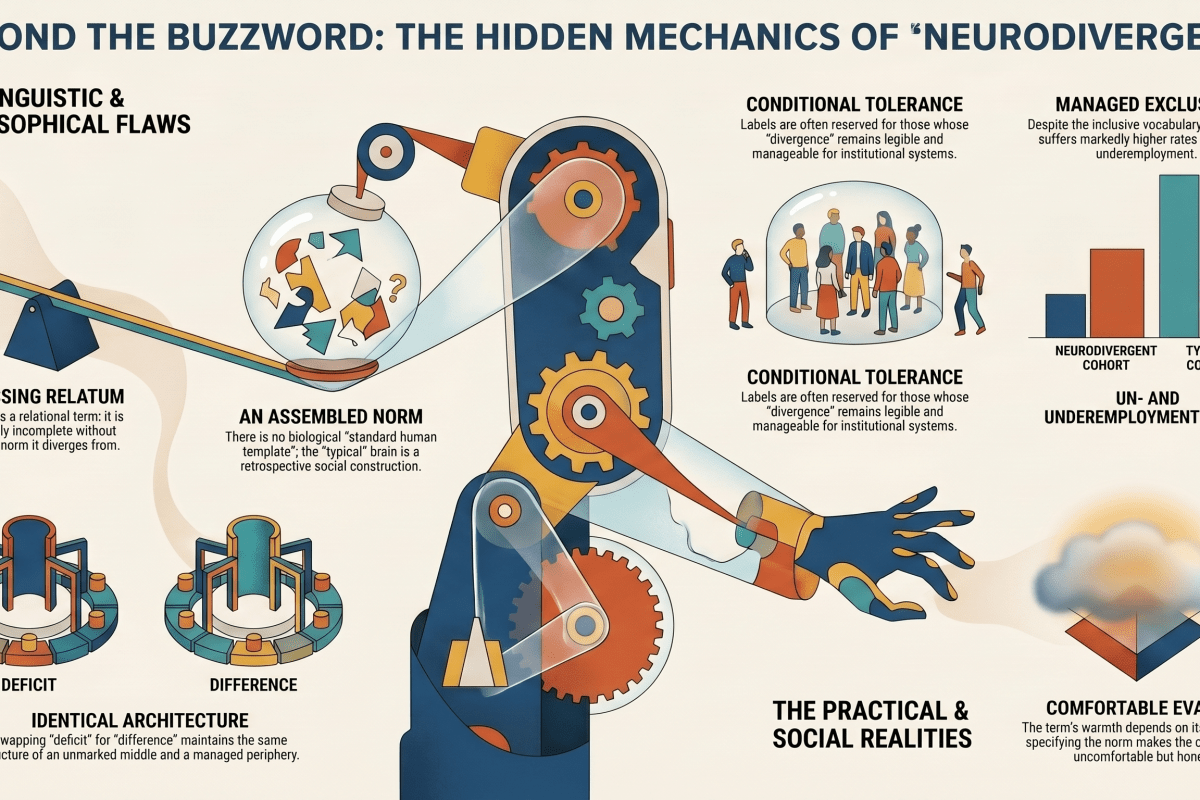
Start with the word itself. Neurodivergent is a compound: neuro, meaning something to do with the nervous system, and divergent, meaning departing from something. This second element is where the trouble begins, because divergent is a relational predicate. It cannot mean anything in isolation. To diverge is necessarily to diverge from something – a path, a norm, a baseline, a centre. The word is semantically incomplete without its relatum. So, ask yourself: divergent from what, exactly?
The term takes the Fifth. It presents divergence as though it were an intrinsic property of certain people – a fact about their neurology, full stop – rather than a relation between a person and an implied standard. The standard is left unnamed, unexamined, and serenely unaccountable. This isn’t a pedantic complaint. Suppressing the relatum is suppressing the normative commitment that does all the actual work. You can’t hide what you are measuring against and then claim to be merely describing what you find.
The Norm That Dare Not Speak Its Name
So what is the suppressed baseline? What is the nervous system that neurodivergent people are diverging from? It’s not a biological fact. There isn’t a neurologically standard human template, no Platonic baseline brain from which variation can be objectively measured. Every nervous system differs from every other nervous system. Neurological variation is not deviation; it’s quite literally the condition. If neurodivergent meant simply having a nervous system that differs from other nervous systems, it would apply to everyone and say nothing.
In practice, the implied norm is something far less neutral: a composite of statistical frequency, institutional convenience, behavioural compliance, and the tacit preferences of the systems – educational, occupational, social – built around a presumed cognitive majority. The neurotypical person – add scare quotes if you must – isn’t discovered. They’re assembled retrospectively. The centre is a construct. And the term neurodivergent relies entirely on this construction while refusing to acknowledge it.
This is the move that I, as a language philosopher, finds objectionable. The term behaves as though it were tracking a natural kind – a real biological category with a stable referent – when it’s actually encoding a social judgement: this person’s profile doesn’t pass through the normative aperture cleanly. Dressing this judgement in neurological vocabulary doesn’t make it scientific. It just makes it harder to argue with.
Euphemism With a Retention Problem
One might charitably read neurodivergent as a well-intentioned euphemism – an attempt to replace stigmatising diagnostic language with something that affirms rather than pathologises. Fair enough, as far as that goes. The older vocabulary was often brutal, and the intent to do better deserves acknowledgement before it receives its drubbing. But here’s the problem: it retains the entire logic it was meant to replace.
The old pathologising vocabulary said: these people deviate from normal, and that deviation is a deficit. The new vocabulary says: these people diverge from typical, and that divergence is a difference worth celebrating. The architecture is identical. There’s still a centre and a periphery remains. There are still people installed at the unmarked middle and others who are marked, managed, diagnosed, accommodated, sentimentalised, or quietly struggled with. The only thing that’s changed is the tone of the managing.
Euphemism of this kind isn’t neutral, for sure. It performs a service for the system it appears to critique. By making the language warmer, it makes the underlying structure harder to see and therefore harder to contest. As I note, neurodivergent isn’t a challenge to the norm. It’s just more photogenic with a soft filter.
The Tolerance Regime and Its Conditions
If we strip the euphemism back to its functional content, the term actually describes something like: a person whose failure to conform to the behavioural expectations of the statistical fiction called ‘normal’ has been traced, however loosely, to their nervous system, and who has been granted conditional tolerance on that basis.
Conditional tolerance becomes the operative phrase, a tolerance with terms, the primary term being legibility. The person must be divergent in a form the system can process: diagnosable, accommodatable, adaptable enough to participate in the institutions built around the norm they are diverging from. Masking – the performance of neurotypicality sufficient to pass institutional scrutiny – is the behavioural proof that the condition is being met.
Who Gets the Label, and Who Doesn’t
The term’s selectivity is its own quiet indictment. Neurodivergent, as socially deployed, doesn’t even cover the full range of neurological variation it nominally describes. It covers the functional end – those whose divergence is legible, manageable, and compatible, at least in principle, with participation in mainstream institutions. Those whose difference is more severe, more disruptive, more genuinely incompatible with the machinery of normal life don’t get the badge.
The term, then, extends its conditional warmth precisely to those who least require protection from the norm, whilst those most genuinely strained by it remain outside even the euphemism.
And within the group the term does cover, the employment picture is instructive. This cohort suffers markedly higher rates of un- and underemployment than the general population. Where employment is secured, it’s sometimes, if not usually, tokenistic – the divergent hire serving the firm’s reputational and fiscal interests as much as their own, their characteristic drive to succeed and conform exploited rather than accommodated. The vocabulary promises inclusion, but the outcomes record something closer to managed exclusion.
What an Honest Term Would Look Like
A more philosophically honest term would need to do three things the current one refuses:
- name the relational structure explicitly
- locate the norm rather than concealing it
- attribute the social judgement accurately rather than laundering it as biology
Something like norm-attributed divergence comes close inasmuch as it captures that the divergence is from a norm, and that the attribution to neurology is an explanatory move rather than a simple observation. However, it is a bit ungainly to the point of unusability by anyone not already beyond saving.
The more pointed observation may be that no honest replacement term could be as palatable as neurodivergent – and this may very well be self-indictment. The term’s warmth depends on its vagueness. Specify the norm, and you have to defend it. Specify the attribution, and you have to evidence it. Specify the conditionality of the tolerance, and you have to justify it. The language works precisely because it doesn’t do any of these things. It’s a vapid term meant not to offend. Neurodivergent is comfortable because it is evasive. Make it honest, and it becomes uncomfortable. Which is where the honest conversation was always waiting to begin.


 Philosophics