I’m no fan of holidays. I neither enjoy nor celebrate Christmas. I’m acutely aware of its commercial excesses and its religious inheritance, two institutions I find, at best, tiresome and, at worst, actively corrosive. Whether that’s abhorrence or simple loathing is a distinction I’ll leave to braver souls.
Still, calendars exist whether one consents to them or not, and this piece happens to land today. If Christmas is your thing, by all means, have at it. Sincerely. Rituals matter to people, even when their metaphysics don’t survive inspection.
What follows is not a defence of the season, nor a seasonal moral. It’s a small human moment that happens to involve Santa, which is to say a costume, a script, and a public performance. What interests me is not the symbolism, but what happens when the performance yields just enough to allow someone else to be seen on their own terms. If nothing else, that feels like a tolerable use of the day.
Audio: NotebookLM summary podcast on this topic.
What Legibility?
When I use the term legibility, it’s usually as a pejorative. It’s my shorthand for reductionism. For the way human beings are flattened into checkboxes, metrics, market segments, or moral exemplars so they can be processed efficiently by institutions that mistake simplification for understanding.
But legibility isn’t always a vice.
Video: Santa signs with a 3-year-old dear girl
Most of us, I suspect, want to be legible. Just not in the ways we are usually offered. We want to be seen on our own terms, not translated into something more convenient for the viewer. That distinction matters.
In the video above, a deaf child meets Santa. Nothing grand happens. No lesson is announced. No slogan appears in the corner of the screen. Santa simply signs.
The effect is immediate. The child’s posture changes. Her attention sharpens. There’s a visible shift from polite endurance to recognition. She realises, in real time, that she does not need to be adapted for this encounter. The encounter has adapted to her. This is legibility done properly.
Not the synthetic legibility of television advertising, where difference is curated, sanitised, and arranged into a reassuring grid of representation. Not the kind that says, we see you, while carefully controlling what is allowed to be seen. That version of legibility is extraction. It takes difference and renders it harmless. Here, the legibility runs the other way.
Santa, already a performative role if ever there was one, doesn’t stop being performative. The costume remains. The ritual remains. But the performance bends. It accommodates. It listens. The artifice doesn’t collapse; it becomes porous.
I’m wary of words like authenticity. They’ve been overused to the point of meaninglessness. But I do think we recognise performatism when we see it. Not in the technical sense of speech acts, but in the everyday sense of personas that ring hollow, gestures that exist for the camera rather than the people involved. This doesn’t feel like that.
Of course, the child could already connect. Deaf people connect constantly. They persevere. They translate. They accommodate a world that rarely meets them halfway. Nothing here ‘grants’ her humanity. What changes is the tightness of the connexion.
The shared language acts as a verbal proxy, a narrowing of distance. You can see the moment it clicks. He speaks her language. Or rather, he speaks a language that already belongs to her, even if calling it ‘hers’ is technically imprecise. Mother tongue is a slippery phrase. Irony does some of the work here.
The point is not inclusion as spectacle. It’s recognition without reduction.
Legibility, in this case, doesn’t make her smaller. It makes the interaction larger. And that, inconveniently for our systems and slogans, is what most people have been asking for all along.
I shared this post not too long ago. Today, I shared it in a different context, but I feel is interesting – because I feel that many things are interesting, especially around language and communication.
Ocrampal shared a link to an article debating whether we are cold or have cold. Different cultures express this differently. It’s short. Read it on his site.
Audio: Exceptional NotebookLM summary podcast of this topic.
I replied to the post:
Nicely observed. I’ve pondered this myself. Small linguistic tweak: between être and avoir, avoir already behaves better metaphysically, but sentir seems the cleanest fit. Cold isn’t something one is or has so much as something one senses — a relational encounter rather than an ontological state or possession.
Between having and being, having is the lesser sin — but sensing/feeling feels truer. Cold belongs to the world; we merely sense it.
He replied in turn:
Agree except for: “Cold belongs to the world”. That is a metaphysical assumption that has consequences …
Finally (perhaps, penultimately), I responded:
Yes, it does. That statement was idiomatic, to express that ‘cold’ is environmental; we can’t be it or possess it. Coincidentally, I recently wrote about ‘cold’ in a different context:
A more verbose version of this response might have been:
This pushback is fair, but I’m not trying to re-ontologise cold. “Belongs to the world” in that context is doing rhetorical, not metaphysical, work; it’s idiomatic.
The point isn’t that cold is a mind-independent substance waiting around like a rock. It’s that whatever cold is, it doesn’t sit comfortably as an identity predicate (‘I am…cold’ – ‘J’ai…froid‘) or a possession (‘I have…cold’ – so, not ‘Je suis…froid‘) – neither to be confused with ‘I have a cold’, a different animal altogether.
‘Sensing’ (‘I feel…cold’ – ‘Je me sens…froid‘ – we have to use the reflexive pronoun, me, here; in English, this syntax has been deprecated) keeps the relation explicit without smuggling in ownership or essence. It leaves cold as an encounter-property, not a thing I contain and not a thing I am.
If anything, that phrasing was meant to resist metaphysical inflation, not commit to it.
And this is exactly the problem I gestured at in the aliens piece. We mistake familiar grammatical scaffolding for shared metaphysics. We assume that if the sentence parses cleanly, the ontology must be sound.
Language doesn’t just describe experience. It quietly files it into categories and then acts surprised when those categories start making demands.
Cold, like aliens, exposes the trick. The moment you slow down, the grammar starts to wobble. And that wobble is doing far more philosophical work than most of our declarative sentences are willing to admit.
Why shared language creates the illusion – not the reality – of shared experience
Human beings routinely assume that if another agent speaks our language, we have achieved genuine mutual understanding. Fluency is treated as a proxy for shared concepts, shared perceptual categories, and even shared consciousness. This assumption appears everywhere: in science fiction, in popular philosophy videos, and in everyday cross-cultural interactions. It is a comforting idea, but philosophically indefensible.
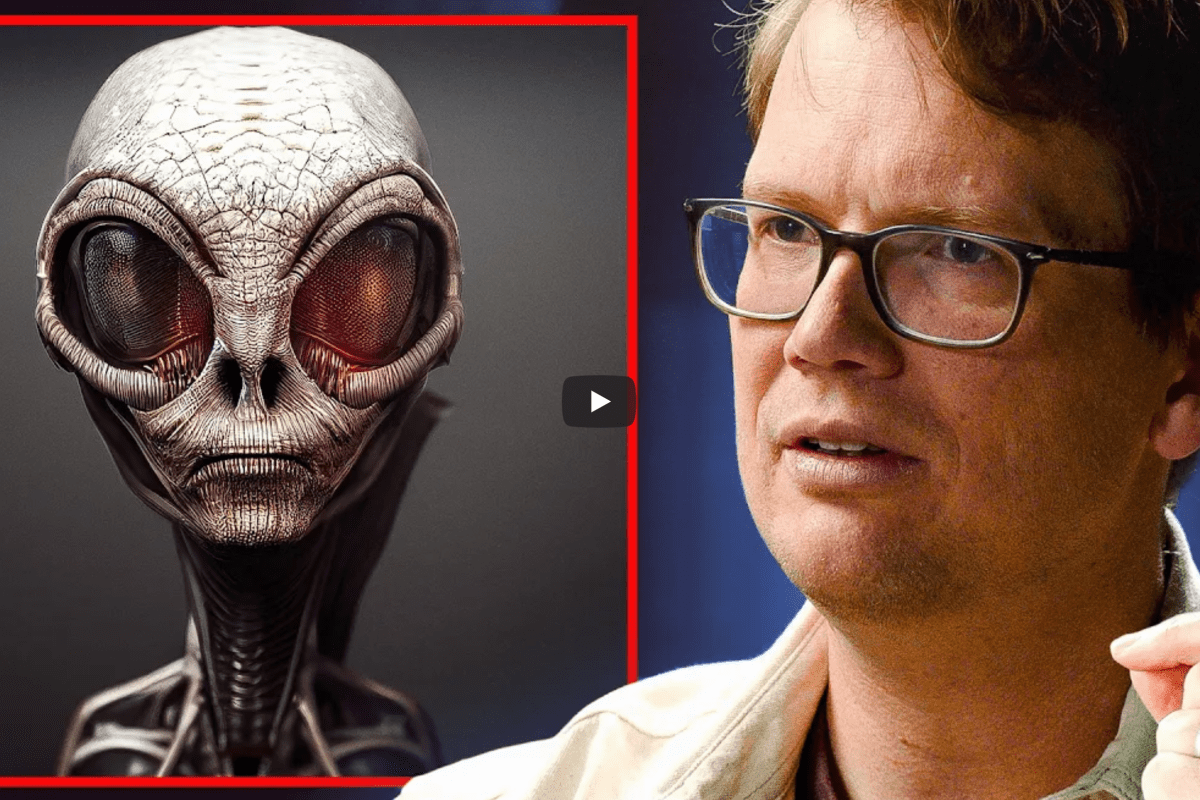
Video: Could You Explain Cold to an Alien? – Hank Green
Recent discussions about whether one could ‘explain cold to an alien’ reveal how deeply this assumption is embedded. Participants in such debates often begin from the tacit premise that language maps transparently onto experience, and that if two interlocutors use the same linguistic term, they must be referring to a comparable phenomenon.
A closer analysis shows that this premise fails at every level.
Audio: NotebookLM summary podcast on this topic.
Shared Language Does Not Imply Shared Phenomenology
Even within the human species, thermal experience is markedly variable. Individuals from colder climates often tolerate temperatures that visitors from warmer regions find unbearable. Acclimation, cultural norms, metabolic adaptation, and learned behavioural patterns all shape what ‘cold’ feels like.
If the same linguistic term corresponds to such divergent experiences within a species, the gap across species becomes unbridgeable.
A reptile, for example, regulates temperature not by feeling cold in any mammalian sense
A reptile, for example, regulates temperature not by feeling cold in any mammalian sense, but by adjusting metabolic output. A thermometer measures cold without experiencing anything at all. Both respond to temperature; neither inhabits the human category ‘cold’.
Thus, the human concept is already species-specific, plastic, and contextually learned — not a universal experiential module waiting to be translated.
Measurement, Behaviour, and Experience Are Distinct
Thermometers and reptiles react to temperature shifts, and yet neither possesses cold-qualia. This distinction illuminates the deeper philosophical point:
Measurement registers a variable.
Behaviour implements a functional response.
Experience is a mediated phenomenon arising from a particular biological and cognitive architecture.
Aliens might measure temperature as precisely as any scientific instrument. That alone tells us nothing about whether they experience anything analogous to human ‘cold’, nor whether the concept is even meaningful within their ecology.
The Problem of Conceptual Export: Why Explanation Fails
Attempts to ‘explain cold’ to hypothetical aliens often jump immediately to molecular description – slower vibrational states, reduced kinetic energy, and so forth. This presumes that the aliens share:
our physical ontology,
our conceptual divisions,
our sense-making framework,
and our valuation of molecular explanation as intrinsically clarifying.
But these assumptions are ungrounded.
Aliens may organise their world around categories we cannot imagine. They may not recognise molecules as explanatory entities. They may not treat thermal variation as affectively laden or behaviourally salient. They may not even carve reality at scales where ‘temperature’ appears as a discrete variable.
When the conceptual scaffolding differs, explanation cannot transfer. The task is not translation but category creation, and there is no guarantee that the requisite categories exist on both sides.
The MEOW Framework: MEOWa vs MEOWb
The Mediated Encounter Ontology (MEOW) clarifies this breakdown by distinguishing four layers of mediation:
T0: biological mediation
T1: cognitive mediation
T2: linguistic mediation
T3: social mediation
Humans run MEOWa, a world structured through mammalian physiology, predictive cognition, metaphor-saturated language, and social-affective narratives.
Aliens (in fiction or speculation) operate MEOWb, a formally parallel mediation stack but with entirely different constituents.
Two systems can speak the same language (T2 alignment) whilst:
perceiving different phenomena (T0 divergence),
interpreting them through incompatible conceptual schemas (T1 divergence),
and embedding them in distinct social-meaning structures (T3 divergence).
Linguistic compatibility does not grant ontological compatibility. MEOWa and MEOWb allow conversation but not comprehension.
Fiction as Illustration: Why Aliens Speaking English Misleads Us
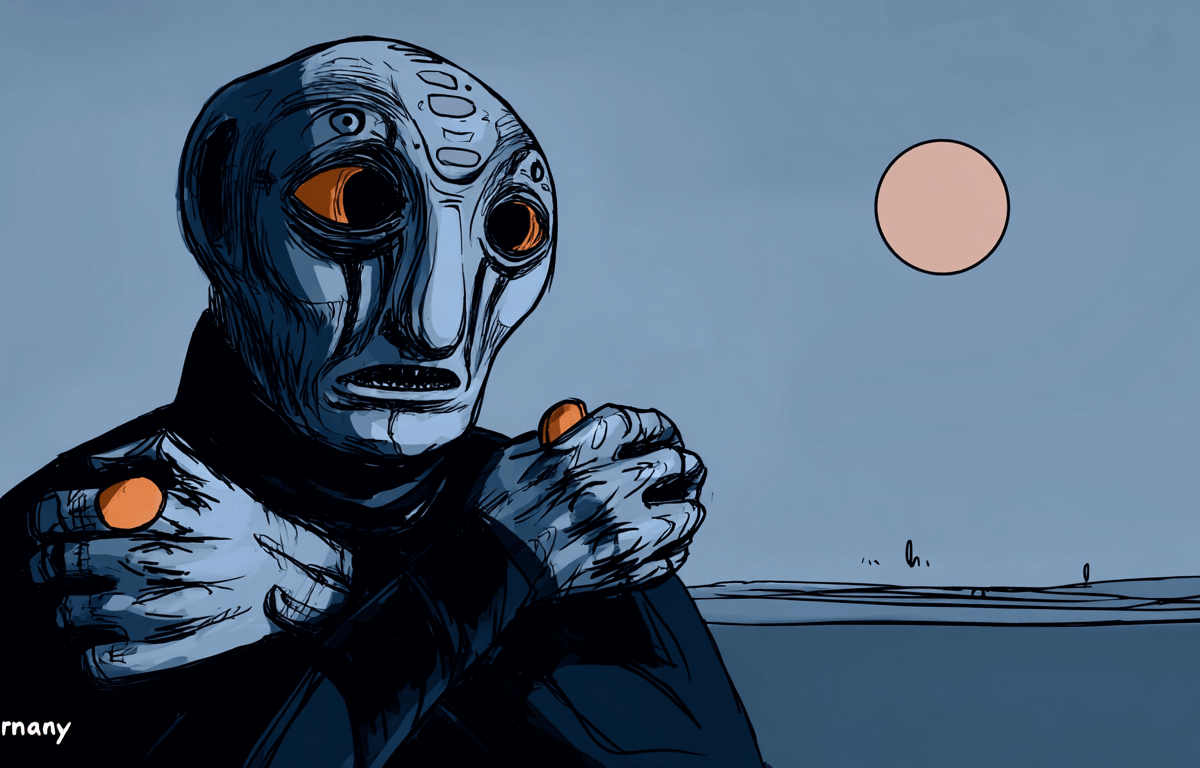
In Sustenance, the aliens speak flawless Standard Southern English. Their linguistic proficiency invites human characters (and readers) to assume shared meaning. Yet beneath the surface:
Their sensory world differs;
their affective architecture differs;
their concepts do not map onto human categories;
and many human experiential terms lack any analogue within their mediation.
The result is not communication but a parallel monologue: the appearance of shared understanding masking profound ontological incommensurability.
The Philosophical Consequence: No Universal Consciousness Template
Underlying all these failures is a deeper speciesist assumption: that consciousness is a universal genus, and that discrete minds differ only in degree. The evidence points elsewhere.
If “cold” varies across humans, fails to apply to reptiles, and becomes meaningless for thermometers, then we have no grounds for projecting it into alien phenomenology. Nor should we assume that other species – biological or artificial – possess the same experiential categories, emotional valences, or conceptual ontologies that humans treat as foundational.
Consciousness is not a universal template awaiting instantiation in multiple substrates. It is alocal ecological achievement, shaped by the mediations of the organism.
Conclusion
When aliens speak English, we hear familiarity and assume understanding. But a shared phonological surface conceals divergent sensory systems, cognitive architectures, conceptual repertoires, and social worlds.
Linguistic familiarity promises comprehension, but delivers only the appearance of it. The deeper truth is simple: Knowing our words is not the same as knowing our world.
And neither aliens, reptiles, nor thermometers inhabit the experiential space we map with those words.
Afterword
Reflections like these are precisely why my Anti-Enlightenment project exists. Much contemporary philosophical commentary remains quietly speciesist and stubbornly anthropomorphic, mistaking human perceptual idiosyncrasies for universal structures of mind. It’s an oddly provincial stance for a culture that prides itself on rational self-awareness.
To be clear, I have nothing against Alex O’Connor. He’s engaging, articulate, and serves as a gateway for many encountering these topics for the first time. But there is a difference between introducing philosophy and examining one’s own conceptual vantage point. What frustrates me is not the earnestness, but the unexamined presumption that the human experiential frame is the measure of all frames.
Having encountered these thought experiments decades ago, I’m not interested in posturing as a weary elder shaking his stick at the next generation. My disappointment lies elsewhere: in the persistent inability of otherwise intelligent thinkers to notice how narrow their perspective really is. They speak confidently from inside the human mediation stack without recognising it as a location – not a vantage point outside the world, but one local ecology among many possible ones.
Until this recognition becomes basic philosophical hygiene, we’ll continue to confuse linguistic familiarity for shared ontology and to mistake the limits of our own embodiment for the limits of consciousness itself.
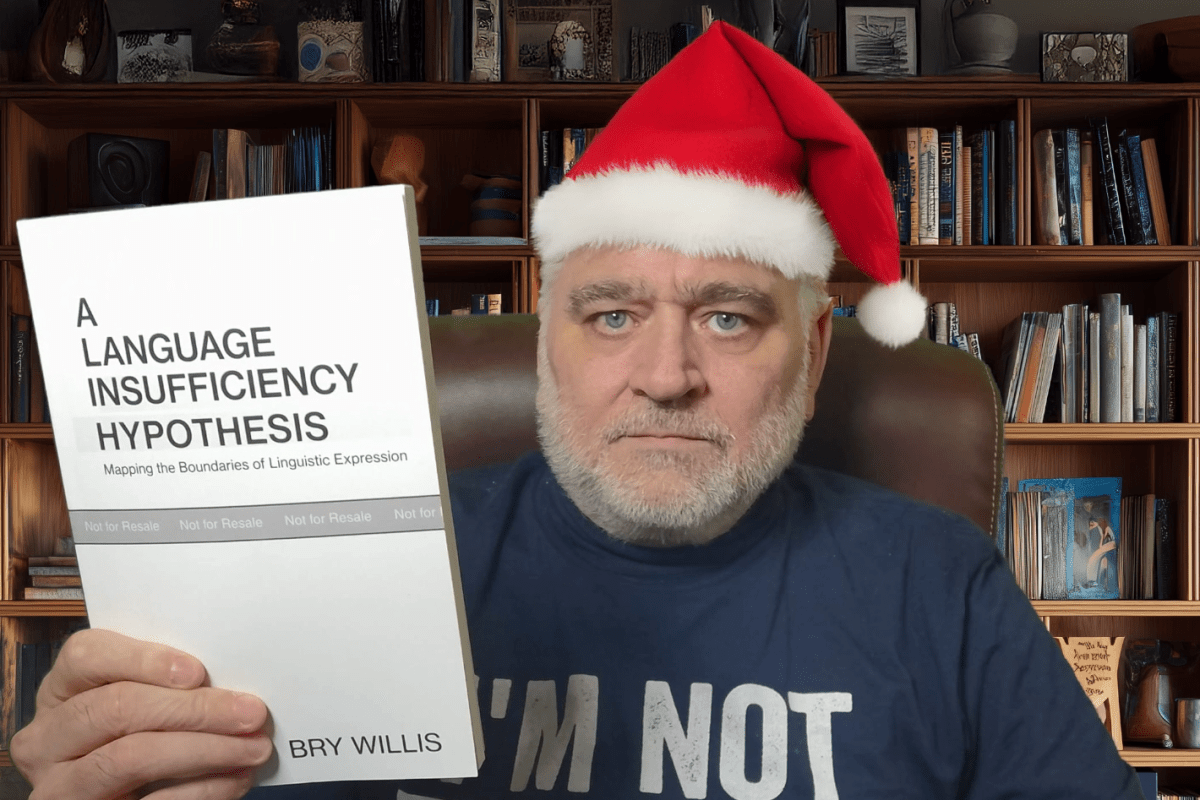
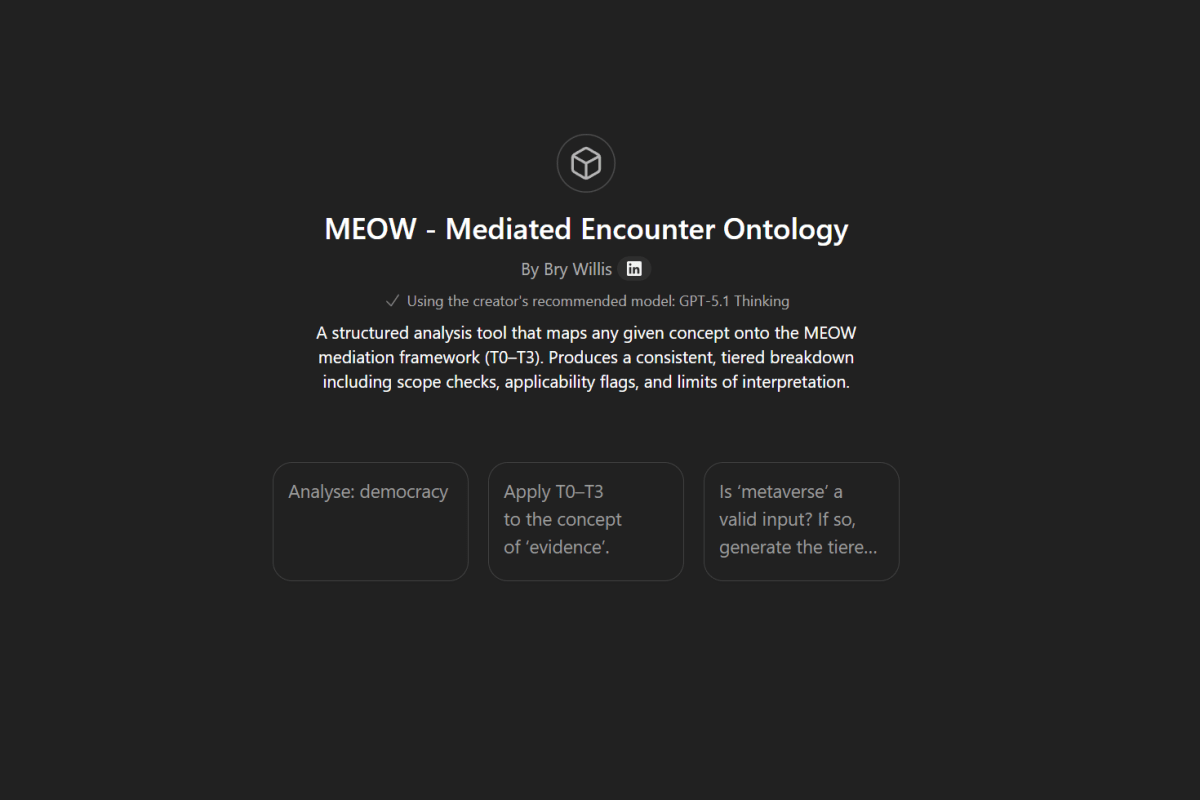
Instead of sleeping like a functional adult, I’ve spent the night creating, testing, and refining a bespoke GPT that has fully absorbed my MEOW and LIH frameworks. Apologies that the LIH manuscript isn’t yet public; some of the terminology may look delightfully alien if you’re coming in cold.
This model doesn’t role-play a philosopher; it thinks through the Mediated Encounter Ontology. It runs every input through T0–T3 mediations and then applies the Language Insufficiency Hypothesis to explain why our words fail us in predictable, structural ways.
Audio: NotebookLM summary podcast of this post on the MEOW GPT.
I stress-tested it with a dozen concepts, from the obvious to the uncooperative. It happily tells you when your input makes sense, when it’s out of scope, and when you’ve handed it conceptual soup. My first test was the hard problem of consciousness, because naturally we begin with the philosophical boss fight. I dialled down some over-enthusiastic LIH flourishes, but the bones are untouched.
I’m making this public for a simple reason: it’s the clearest way for people to see how MEOW operates without wandering through a hundred pages of my prose. These outputs capture how I process information and why these frameworks feel so intuitively correct to me. When you read them, you get a direct view of my interpretive machinery – how the world clicks for me, and how these ideas evolved.
It hasn’t been rigorously battle-tested across the entire conceptual universe, but it’s stable, coherent, and frankly too interesting to keep in the drawer. If you try it – and I hope you do – I’d love to see what it does with your own concepts. If you need help reading the results, ask. I didn’t simplify the system; it expects literacy, nuance, and a working prefrontal cortex.
Below is a sample output. I asked the model to analyse modernity.
Concept
Input: modernity
Type: historical–social formation / self-description of an era / conceptual frame
Scope check: in-scope – central for how MEOW treats large-scale shifts in mediation (social, technical, cognitive, linguistic)
High-level summary (≤120 words)
Modernity is both a historical bundle (industrialisation, nation-states, capitalism, science, bureaucracy, media) and a story societies tell about themselves (“we are modern, unlike the past”).
In MEOW terms, modernity is a large-scale reorganisation of mediations:
T1: new cognitive habits (individualism, planning, abstraction, risk-calculation).
T2: new vocabularies (progress, development, rationality, “religion” vs “science”).
T3: new institutions and technologies (markets, states, factories, schools, mass media, digital networks).
“Modernity” is not a single thing but a way these shifts hang together and become a background to everyday encounter.
T0 – Biological Mediation
Applicability: Applicable
Analysis:
Modernity radically reshapes the immediate bodily environment: dense cities, artificial lighting, noise, pollution, sedentary work, and altered sleep cycles change basic sensory and metabolic conditions.
Medical advances and public health (vaccination, antibiotics, sanitation, surgery) modify life expectancy, infant mortality, and chronic illness, which in turn change how life cycles feel and are planned.
New food systems (industrial agriculture, processed foods, global supply chains) alter nutrition, exposure to toxins, and rhythms of hunger and satiety.
Industrial and digital work reorganise movement and posture: repetitive factory labour, office desk work, and screen use all reshape embodiment, fatigue, and bodily awareness.
These T0 changes set the stage for new affective baselines (e.g., chronic low-level stress, stimulation overload) that colour what it is like to live in a “modern” world.
T1 – Cognitive Mediation
Applicability: Strongly applicable
Analysis:
Modernity encourages certain cognitive styles: systematic planning, quantification, risk assessment, cost–benefit thinking, and an emphasis on prediction and control.
The sense of self is reconfigured toward individualism and reflexivity: people see themselves as projects to be chosen, improved, optimised, often with long-term career and life-planning horizons.
Exposure to multiple roles, cultures, and information streams (through migration, media, education) produces more complex identity structures and can create cognitive dissonance or fragmentation.
Scientific and technical worldviews teach people to reframe events in terms of mechanisms, probabilities, and systems rather than fate, tradition, or local narratives.
The sheer volume and speed of information flows in late modernity (news, social media, notifications) trains attention toward rapid scanning and shallow switching, affecting memory, concentration, and emotional regulation.
These patterns make certain experiences “normal” (abstract work, mediated relationships, bureaucratic interactions) that would be extraordinary or impossible in premodern settings.
T2 – Linguistic Mediation
Applicability: Strongly applicable
Analysis:
Modernity itself is a label that societies use to contrast “us” with “them” (the past, “traditional” societies, “the East,” “the primitive”); it is a polemical as well as descriptive term.
In Language Insufficiency terms, modernity is highly Fluid: it can mean a period (“since the 18th century”), a style (modernist art), a value system (rational, secular, progressive), or a socio-economic order (capitalist, industrial, bureaucratic). Different authors slide between these quietly.
It’s also Contestable: critics and defenders use the same word but point to different aspects—emancipation and progress versus alienation, exploitation, ecological crisis.
Pairs like “modern vs traditional” or “modern vs backward” compress complex differences into simple hierarchies, smuggling in a presumption that “modern” is automatically better or more advanced.
Talk of “post-modernity” or “late modernity” suggests that we can neatly periodise and step outside the modern, even while our concepts and institutions remain shaped by it—an example of language implying more clarity and control than we actually have.
At the most global scale (“the meaning of modernity,” “the modern condition”), we approach an Effectiveness Horizon: the term feels weighty but becomes vague; people resort to sweeping metaphors (disenchantment, liquefaction, acceleration) whose exact content is hard to pin down.
First-person experiences of being “overwhelmed by modern life,” “liberated by modern options,” or “disconnected in modern society” often have an Ineffable quality: standard clichés don’t quite capture the texture of these lives, even as they gesture at them.
T3 – Social/Technical Mediation
Applicability: Strongly applicable
Analysis:
Modernity is most visible as a mesh of institutions: nation-states, markets, bureaucracies, public schools, hospitals, prisons, armies, scientific organisations, corporations, NGOs.
These institutions standardise time (clocks, schedules), space (borders, property lines, zoning), identity (passports, ID numbers), and value (money, statistics, rankings) so that encounters become predictable and governable across large scales.
Technologies—steam engines, electricity, mass transport, broadcasting, computing, the internet, AI—are both products and drivers of modernity. They make possible new encounter-forms (remote work, global real-time communication, mass surveillance).
Urbanisation concentrates people into large, heterogeneous populations, which reconfigures social networks, anonymity, solidarity, and conflict; everyday encounters become more mediated by rules, signage, and digital systems than by face-to-face custom.
Capitalist production and consumption patterns organise much of life around work, income, and markets; the rhythms of the factory, office, and platform economy structure when and how people interact, rest, and move.
Modern governance uses statistics, censuses, and models to “see” and manage populations; this makes certain aspects of life legible (employment, crime, disease) while leaving others under- or uncounted (informal care, undocumented work, emotional labour).
Counter-movements (romanticism, traditionalism, environmentalism, decolonial and Indigenous resurgence, slow-living and anti-consumerist practices) can be read as attempts to renegotiate or resist specific modern mediations rather than simply reject “modernity” as a whole.
Limits & failure modes
Language insufficiency notes
Modernity bundles together time (a historical era), structure (a type of society), and value (being “up to date”). This makes the term rhetorically powerful but analytically slippery: it’s easy to smuggle evaluations into what sound like neutral descriptions.
Because the concept is so broad, discussions often conflate distinct issues—technology, capitalism, secularisation, colonialism, individualism, bureaucracy—under one word, obscuring which mechanisms are actually at work.
Experiences of living in “modern times” (speed, fragmentation, choice, precariousness, possibility) often outrun our stock phrases; people lean on recurring complaints (“too fast,” “too shallow,” “too lonely”) that only partially capture what it’s like.
Missing tiers / blind spots
This sketch doesn’t adjudicate between different theories of modernity (Marxist, Weberian, postcolonial, systems-theoretic, etc.); it treats them as emphasising different mediational strands.
It’s centred on Euro-Atlantic narratives; “multiple modernities” and non-Western trajectories (where “modern” elements mix with older forms in hybrid ways) would need a richer T3 treatment.
The analysis underplays ecological dimensions: industrial modernity’s dependence on fossil fuels, large-scale extraction, and waste has massive implications for how future encounters will be structured.
Finally, because we are ourselves situated in what we call modernity, our conceptual vantage is limited; any map we draw is partly an artefact of the very mediations we’re trying to analyse.
Disclaimer: I should be finishing my Language Insufficiency Hypothesis book, yet I am here writing about death and dying. Why? Because I was watching an interview with Neal Schon by Rick Beato. I should have been working on my book then, too. It seems I can write about death more easily than finish a book about the failure of language. Perhaps because death speaks fluently.
I haven’t produced music professionally since the mid-1980s, and I haven’t performed since 2012, yet I am still drawn to its intricacies. My fingers no longer allow me to play much of anything anymore. This is a sort of death. When the body forgets what the mind remembers, that’s a particular kind of death – one language dying while another can’t translate.
As Neal was walking Rick through his equipment and approach to music, I was taken back to a similar place. I wanted to plug into a Fender Twin or a Hi-Watt, a Lexicon 224 or a Cry Baby wah. I still have nightmares thinking of setting up a Floyd Rose.
Video: Rick Beato interviews Neal Schon
But I can’t go back. As for music, I can’t go forward either. I’m at a standstill, but in a regressed position. It’s uncomfortable. It feels a lot like Charlie in Flowers for Algernon. I used to be able to do that. Don’t get me wrong – I am not claiming to be on the level of Neal Schon, a man I remember from his days with Santana, but when you reach a level of proficiency and then lose it, it hurts; it can be devastating.
Audio: NotebookLM podcast on this topic.
I recall being in hospital in 2023 – a physical rehabilitation facility, really – and I found a piano in a vacant common room. Drawn to the instrument, I rolled over my wheelchair and played…nothing. My fingers wouldn’t work. The piano sat there like a relic of my former self. I rolled toward it as though approaching an altar. My fingers hovered, twitched, failed. The sound of nothing has never been so loud. I cried. I cried a lot those days. I was down to 58 kilos – at 182 cm, I weighed in at just over 9 stone. It wasn’t the best of times.
I still feel a certain nostalgia.
And then there are the people I’ve lost along the way – as another Neal reflected on – The Needle and the Damage Done.
Love and art are both acts of repetition. When one ends, the reflex remains – the impulse to reach, to share, to call out. Death doesn’t stop the motion, only the answer.
I’m lucky to have left Delaware. When a girlfriend died in 2020, I remained and connected with another until 2023, when she died, too. From 2020 to 2023, when I was out and about, something might have caught my eye, and I’d reflect on how Carrie might have liked that.
But it was different. It was more like, ‘I should let Carrie know about that,’ only to realise fractions of a second later that she wouldn’t see whatever it was; she couldn’t. And I’d carry on. I didn’t need to repeat this with Sierra. My relocation to Massachusetts solved this challenge – not so many triggers.
I’m not sure how the loss of ‘professional’ music relates to deceased partners, but it does – at least enough for me to make this connexion. Perhaps I’m just connecting arbitrary dots, but I’ll call it nostalgia.
I don’t play, but I still hear it. The song continues without me. Nostalgia is just rhythm without melody. Perhaps all nostalgia is epistemological error – the confusion of past fluency for present meaning.
I was chatting with some Catholics on Social Media, responding to a post about the need to grow their base. I sympathised that it must be difficult because the product of organised religion was not exactly tailor-fit. Protestants have provision for roll-your-own, but not Catholics. This led me to a discussion about what Jung wrote about rituals – that it doesn’t matter if the underlying rationale was remembered because some people like ritual for its own sake – candles, incense, wafers, whatever.
(I studied Jung intensely in the mid-’90s, and while I still find him useful as metaphor, I don’t take his broader metaphysics seriously anymore – too mystical for my tastes. But this particular insight about ritual sticks.)
Follows are the unedited results.
Yes, and Jung was being quietly subversive about it. He was pointing to something most modern institutions would rather not hear.
For Carl Jung, ritual doesn’t need to be true in the propositional sense to be effective in the psychological one. Its power doesn’t reside in correct belief, historical accuracy, or even conscious assent. It resides in repetition, form, symbol, and the way those elements bypass the rational gatekeeper and go straight for the nervous system.
Which is precisely why ritual unnerves modernity.
Once you accept Jung’s claim, you’re forced to concede that meaning is not the primary engine of human orientation. Function is. A ritual can continue to stabilise, contain, and organise psychic life long after its original metaphysics has decayed, been forgotten, or become frankly unbelievable. The candles still work even if God has quietly slipped out the back.
This is deeply inconvenient for Enlightenment-descended sensibilities, which insist that symbols must justify themselves, that practices require reasons, and that belief precedes action. Jung flips that on its head. We act first. We kneel first. We chant first. Understanding, if it arrives at all, comes later as a kind of aftercare.
Which helps explain your mate’s conversion without invoking any sudden metaphysical awakening.
Catholic ritual functions even when belief wobbles. Protestantism, having stripped ritual back to avoid superstition, leaves belief carrying all the weight. Once belief falters, there’s nothing left to hold the structure together. No choreography. No inherited muscle memory. No symbolic surplus. Just a sermon competing with the rest of the week’s content.
Jung saw this coming. He understood that modern people would continue to need ritual even as they lost faith in the stories that once justified it. His worry wasn’t that people would abandon religion. It was that they would abandon ritual competence and then wonder why anxiety, fragmentation, and compensatory myth-making flooded in through the cracks.
From that angle, Catholicism’s current crisis looks different again.
The conservatives think ritual must be defended because it encodes truth. The progressives think ritual can be loosened because truth can be updated. Jung would have said both are missing the point.
Ritual persists because it does work that language cannot do. It orders time. It disciplines the body. It makes the invisible feel locally real. Strip away the incense, the repetition, the inherited forms, and you don’t get a purer faith. You get an exposed psyche scrambling for substitutes.
So when someone says, “I’m drawn to Catholicism because of the candles and incense,” they’re not being shallow. They’re being honest in a way theologians and sociologists often aren’t. They’re admitting that humans are not primarily convinced creatures.
They are conditioned ones.
Jung didn’t romanticise that fact. He warned about it. But he understood it well enough to say the thing modern institutions still resist admitting: you can drain a ritual of meaning and it will still shape lives long after the doctrine has stopped persuading anyone.



 Philosophics