Ridley Park Propensity

frantic woman, pen and ink

As some of you know, I publish speculative fiction under the name Ridley Park. Propensity is one of several recent releases – a novella that leans philosophical, brushes up against literary fiction, and steps quietly into the margins of sci-fi.

It’s not about spaceships or superintelligence. It’s about modulation.

About peace engineered through neurochemical compliance.

About the slow horror of obedience without belief, and the behavioural architecture that lets us think we’re still in control.

The ideas explored include:

  • Free will as illusion
  • Peace as compliance
  • Drift, echo, and the limits of modulation
  • Obedience without belief
  • Institutional horror and soft dystopia
  • Consent and behavioural control
  • Narrative as residue
  • Collapse by calibration

Though filed under speculative fiction, Propensity [US] is best read as a literary artefact – anti-sci-fi, in a sense. There’s no fetishisation of technology or progress. Just modulation, consequence, and the absence of noise.

This PDF contains selected visual excerpts from the physical book to accompany the free audiobook edition. For readers and listeners alike, it offers a glimpse into Ridley Park’s world – a quietly dystopian, clinically unsettling, and depressingly plausible one.

  • Title page
  • Copyrights page
  • Table of Contents
  • Chapter 10: Memorandum. This chapter is read in the audiobook. The inclusion here is for visualisation as it is rendered in the form of a memo.
  • Chapter 26: Simulacra. This chapter is read in the audiobook. The inclusion here is for visualisation as it is rendered in the format of a screenplay.
  • Chapter 28: Standard Test: This chapter is read in the audiobook. The inclusion here is for visualisation as it is rendered in the format of a standardised test.
  • Chapter 34: Calendar. This chapter is read in the audiobook. The inclusion here is for visualisation as it is rendered in the format of a calendar.
  • Chapter 39: Carnage. This chapter is read in the audiobook. The inclusion here is for visualisation as it is rendered in the form of a Dr Suess-type poem.
  • Chapter 41: Leviathan. This chapter is excerpted in the audiobook. The inclusion here is for visualisation as it is rendered with an image of the cover of Hobbes’ Leviathan and redacted page content.
  • Chapter 42: Ashes to Ashes. This chapter is read in the audiobook. The inclusion here is for visualisation as it is rendered in the form of text art.
  • Chapter 43: Unknown. A description of this chapter is read in the audiobook. The inclusion here is for visualisation as it is rendered in the form of an ink sketch.
  • Chapter 44: Vestige. A description of this chapter is read in the audiobook. The inclusion here is for visualisation as it is rendered in the form of text art.

For more information about Ridley Park’s Propensity, visit the website. I’ll be sharing content related to Propensity and my other publications. I’ll cross-post here when the material has a philosophical bent, which it almost always does.


The Indexing Abyss: A Cautionary Tale in Eight Chapters

There, I said it.

I’m almost finished with A Language Insufficiency Hypothesis, the book I’ve been labouring over for what feels like the gestation period of a particularly reluctant elephant. To be clear: the manuscript is done. Written. Edited. Blessed. But there remains one final circle of publishing hell—the index.

Now, if you’re wondering how motivated I am to return to indexing, consider this: I’m writing this blog post instead. If that doesn’t scream avoidance with an airhorn, nothing will.

Audio: NotebookLM podcast on this topic.

I began indexing over a month ago. I made it through two chapters of eight, then promptly wandered off to write a couple of novellas. As you do. One started as a short story—famous last words—and evolved into a novella. The muse struck again. Another “short story” appeared, and like an unattended sourdough starter, it fermented into a 15,000-word novelette. Apparently, I write short stories the way Americans pour wine: unintentionally generous.

With several unpublished manuscripts loitering on my hard drive like unemployed theatre majors, I figured it was time to release one into the wild. So I did. I published the novelette to Kindle, and just today, the paperback proof landed in my postbox like a smug little trophy.

And then, because I’m an unrepentant completionist (or a masochist—jury’s out), I thought: why not release the novella too? I’ve been told novellas and novelettes are unpopular due to “perceived value.” Apparently, people would rather buy a pound of gristle than 200 grams of sirloin. And yet, in the same breath, they claim no one has time for long books anymore. Perhaps these are different tribes of illiterates. I suppose we’ll find out.

Let’s talk logistics. Writing a book is only the beginning—and frankly, it’s the easy part. Fingers to keyboard, ideas to page. Done. I use Word, like most tragically conventional authors. Planning? Minimal. These were short stories, remember? That was the plan.

Next comes layout. Enter Adobe InDesign—because once you’ve seen what Word does to complex layouts, you never go back. Export to PDF, pray to the typographic gods, and move on.

Then there’s the cover. I lean on Illustrator and Photoshop. Photoshop is familiar, like a worn-in shoe; Illustrator is the smug cousin who turns up late but saves the day with scalable vectors. This time, I used Illustrator for the cover—lesson learnt from past pixelation traumas. Hardback to paperback conversion? A breeze when your artwork isn’t made of crayon scribbles and hope.

Covers, in case you’ve never assembled one, are ridiculous. Front. Back. Spine. Optional dust jacket if you’re feeling fancy (I wasn’t). You need titles, subtitles, your name in a legible font, and let’s not forget the barcode, which you will place correctly on the first attempt exactly never.

Unlike my first novel, where I enlisted someone with a proper design eye to handle the cover text, this time I went full minimalist. Think Scandinavian furniture catalogue meets existential despair. Classy.

Once the cover and interior are done, it’s time to wrestle with the publishing platforms. Everything is automated these days—provided you follow their arcane formatting commandments, avoid forbidden fonts, and offer up your soul. Submitting each book takes about an hour, not including the time lost choosing a price that balances “undervalued labour” and “won’t scare away cheapskates.”

Want a Kindle version? That’s another workflow entirely, full of tortured formatting, broken line breaks, and wondering why your chapter headings are now in Wingdings. Audiobooks? That’s a whole other circus, with its own animals and ringmasters. Honestly, it’s no wonder authors hire publishers. Or develop drinking problems.

But I’m stubborn. Which brings us full circle.

I’ve now got two books heading for daylight, a few more waiting in the wings, and one bloody non-fiction beast that won’t see release until I finish the damn index. No pseudonym this time. No hiding. Just me, owning my sins and hoping the final product lands somewhere between “insightful” and “mercifully short.”

So yes, life may well be a journey. But indexing is the bit where the satnav breaks, the road floods, and the boot falls off the car. Give me the destination any day. The journey can fuck right off.

Sustenance: A Book About Aliens, Language, and Everything You’re Getting Wrong

Violet aliens on a farm

So, I wrote a book and published it under Ridley Park, the pseudonym I use for fiction.

It has aliens. But don’t get excited—they’re not here to save us, probe us, or blow up the White House. They’re not even here for us.

Which is, frankly, the point.

Audio: NotebookLM podcast on this topic.

The book’s called Sustenance, and while it’s technically speculative fiction, it’s more about us than them. Or rather, it’s about how we can’t stop making everything about us—even when it shouldn’t be. Especially when it shouldn’t be.

Let’s talk themes. And yes, we’re using that word like academics do: as a smokescreen for saying uncomfortable things abstractly.

Language: The Original Scam

Language is the ultimate colonial tool. We call it communication, but it’s mostly projection. You speak. You hope. You assume. You superimpose meaning on other people like a cling film of your own ego.

Sustenance leans into this—not by showing a breakdown of communication, but by showing what happens when communication was never mutual in the first place. When the very idea of “meaning” has no purchase. It’s not about mishearing—it’s about misbeing.

Culture: A Meme You Were Born Into

Culture is the software you didn’t choose to install, and probably can’t uninstall. Most people treat it like a universal law—until they meet someone running a different OS. Cue confusion, arrogance, or violence.

The book explores what happens when cultural norms aren’t shared, and worse, aren’t even legible. Imagine trying to enforce property rights on beings who don’t understand “ownership.” It’s like trying to baptise a toaster.

Sex/Gender: You Keep Using Those Words…

One of the quiet joys of writing non-human characters is discarding human assumptions about sex and gender—and watching readers squirm.

What if sex wasn’t about power, pleasure, or identity? What if it was just a biological procedure, like cell division or pruning roses? Would you still be interested? Would you still moralise about it?

We love to believe our sex/gender constructs are inevitable. They’re not. They’re habits—often bad ones.

Consent: Your Framework Is Showing

Consent, as we use it, assumes mutual understanding, shared stakes, and equivalent agency. Remove any one of those and what’s left?

Sustenance doesn’t try to solve this—it just shows what happens when those assumptions fall apart. Spoiler: it’s not pretty, but it is honest.

Projection: The Mirror That Lies

Humans are deeply committed to anthropocentrism. If it walks like us, or flinches like us, it must be us. This is why we get so disoriented when faced with the truly alien: it won’t dance to our tune, and we’re left staring at ourselves in the funhouse mirror.

This isn’t a book about aliens.

It’s a book about the ways we refuse to see what’s not us.

Memory: The Autobiography of Your Justifications

Memory is not a record. It’s a defence attorney with a narrative license. We rewrite the past to make ourselves look consistent, or innocent, or right.

In Sustenance, memory acts less as a tether to truth and more as a sculpting tool—a way to carve guilt into something manageable. Something you can live with. Until you can’t.

In Summary: It’s Not About Them. It’s About You.

If that sounds bleak, good. It’s meant to.

But it’s also a warning: don’t get too comfortable in your own categories. They’re only universal until you meet someone who doesn’t share them.

Like I said, it’s not really about the aliens.

It’s about us.


If you enjoy fiction that’s more unsettling than escapist, more question than answer, you might be interested in Sustenance. It’s live on Kindle now for the cost of a regrettable coffee:

📘 Sustenance on Amazon US
Also available in the UK, DE, FR, ES, IT, NL, JP, BR, CA, MX, AU, and IN—because alienation is a universal language.

On Ishiguro, Cioran, and Whatever I Think I’m Doing

Sora-generated image of Emil Cioran and Kazuo Ishiguro reading a generic book together

Having just finished Never Let Me Go by Kazuo Ishiguro, I’ve now cracked open my first taste of Cioran—History and Utopia. You might reasonably ask why. Why these two? And what, if anything, do they have in common? Better yet—what do the three of us have in common?

Audio: NotebookLM podcast on this topic.

Recently, I finished writing a novella titled Propensity (currently gathering metaphorical dust on the release runway). Out of curiosity—or narcissism—I fed it to AI and asked whose style it resembled. Among the usual suspects were two names I hadn’t yet read: Ishiguro and Cioran. I’d read the others and understood the links. These two, though, were unknown quantities. So I gave them a go.

Ishiguro is perhaps best known for The Remains of the Day, which, like Never Let Me Go, got the Hollywood treatment. I chose the latter, arbitrarily. I even asked ChatGPT to compare both books with their cinematic counterparts. The AI was less than charitable, describing Hollywood’s adaptations as bastardised and bowdlerised—flattened into tidy narratives for American palates too dim to digest ambiguity. On this, we agree.

What struck me about Never Let Me Go was its richly textured mundanity. That’s apparently where AI saw the resemblance to Propensity. I’m not here to write a book report—partly because I detest spoilers, and partly because summaries miss the point. It took about seven chapters before anything ‘happened’, and then it kept happening. What had at first seemed like a neurotic, wandering narrative from the maddeningly passive Kathy H. suddenly hooked me. The reveals began to unfold. It’s a book that resists retelling. It demands firsthand experience. A vibe. A tone. A slow, aching dread.

Which brings me neatly to Cioran.

History and Utopia is a collection of essays penned in French (not his mother tongue, but you’d never guess it) while Cioran was holed up in postwar Paris. I opted for the English translation—unapologetically—and was instantly drawn in. His prose? Electric. His wit? Acidic. If Ishiguro was a comparison of style, then Cioran was one of spirit. Snark, pessimism, fatalistic shrugs toward civilisation—finally, someone speaking my language.

Unlike the cardboard cut-outs of Cold War polemics we get from most Western writers of the era, Cioran’s take is layered, uncomfortably self-aware, and written by someone who actually fled political chaos. There’s no naïve idealism here, no facile hero-villain binaries. Just a deeply weary intellect peering into the abyss and refusing to blink. It’s not just what he says, but the tone—the curled-lip sneer at utopian pretensions and historical self-delusions. If I earned even a drop of that comparison, I’ll take it.

Both Ishiguro and Cioran delivered what I didn’t know I needed: the reminder that some writers aren’t there to tell you a story. They’re there to infect you with an atmosphere. An idea. A quiet existential panic you can’t shake.

I’ve gotten what I came for from these two, though I suspect I’ll be returning, especially to Cioran. Philosophically, he’s my kind of bastard. I doubt this’ll be my last post on his work.

Hungering for Morality: When Right and Wrong Are Just a Matter of PR

Full Disclosure: I read the first volume of The Hunger Games just before the film was released. It was OK – certainly better than the film. This video came across my feed, and I skipped through it. Near the end, this geezer references how Katniss saves or recovers deteriorated morality. Me being me, I found issue with the very notion that a relative, if not subjective, concept could be recovered.

The OP asks if The Hunger Games are a classic. I’d argue that they are a categorical classic, like Harry Potter, within the category of YA fiction.

Audio: NotebookLM podcast discussing this topic.

The Hunger Games doesn’t depict the death of morality — it’s a masterclass in how to twist it into a circus act.

Video: YouTube video that spawned this topic.

Let us dispense with the hand-wringing. The Hunger Games is not a parable of moral decay. It is something far more chilling: a vivid portrait of moral engineering — the grotesque contortion of ethical instincts into instruments of domination and spectacle.

Those who bemoan the “decline of morality” in Panem have rather missed the point. There is no absence of morality in the Capitol — only a different version of it. A rebranded, corporatised, state-sanctioned morality, lacquered in lipstick and broadcast in 4K. It is not immorality that reigns, but a hyperactive ideological morality, designed to keep the masses docile and the elites draped in silk.

This is not moral entropy; it’s moral mutation.

Children are not slaughtered because people have forgotten right from wrong — they are slaughtered because a society has been trained to believe that this is what justice looks like. That blood is penance. That fear is unity. That watching it all unfold with a glass of champagne in hand is perfectly civilised behaviour.

This isn’t the death of morality. It’s a hostile takeover.

The Moral PR Machine

If morality is, as many of us suspect, relative — a cultural construct built on consensus, coercion, and convenience — then it can no more “decline” than fashion trends can rot. It simply shifts. One day, shoulder pads are in. The next, it’s child-on-child murder as prime-time entertainment.

In Panem, the moral compass has not vanished. It’s been forcibly recalibrated. Not by reason or revelation, but by propaganda and fear. The Games are moral theatre. A grim ritual, staged to remind the Districts who holds the reins, all under the nauseating guise of tradition, order, and justice.

The citizens of the Capitol aren’t monsters — they’re consumers. Trained to see horror as haute couture. To mistake power for virtue. To cheer while children are butchered, because that’s what everyone else is doing — and, crucially, because they’ve been taught it’s necessary. Necessary evils are the most seductive kind.

Katniss: Not a Saint, But a Saboteur

Enter Katniss Everdeen, not as the moral saviour but as the spanner in the machine. She doesn’t preach. She doesn’t have a grand theory of justice. What she has is visceral disgust — an animal revulsion at the machinery of the Games. Her rebellion is personal, tribal, and instinctive: protect her sister, survive, refuse to dance for their amusement.

She isn’t here to restore some lost golden age of decency. She’s here to tear down the current script and refuse to read her lines.

Her defiance is dangerous not because it’s moral in some abstract, universal sense — but because it disrupts the Capitol’s moral narrative. She refuses to be a pawn in their ethical pageant. She reclaims agency in a world that has commodified virtue and turned ethics into state theatre.

So, Has Morality Declined?

Only if you believe morality has a fixed address — some eternal North Star by which all human actions may be judged. But if, as postmodernity has rather insistently suggested, morality is a shifting social fiction — then Panem’s horror is not a fall from grace, but a recalibration of what counts as “grace” in the first place.

And that’s the real horror, isn’t it? Not that morality has collapsed — but that it still exists, and it likes what it sees.

Conclusion: The Real Hunger

The Hunger Games is not about a society starved of morality — it’s about a world gorging on it, cooked, seasoned, and served with a garnish of guiltless indulgence. It is moral appetite weaponised. Ethics as edict. Conscience as costume.

If you feel sickened by what you see in Panem, it’s not because morality has vanished.

It’s because it hasn’t.

Varoufakis Solves Zeno’s Paradox

Having finished Technofeudalism, I’ve moved on to Society of the Spectacle, which has me thinking.

They say no one escapes the Spectacle. Guy Debord made sure of that. His vision was airtight, his diagnosis terminal: we are all spectators now, alienated from our labour, our time, our own damn lives. It was a metaphysical mugging—existence held hostage by images, by commodities dressed in drag. The future was a feedback loop, and we were all doomed to applaud.

Audio: NotebookLM podcast on this topic. Apologies in advance for the narrators’ mangling of the pronunciation of ‘Guy Debord’.

But what if the loop could be hacked?
What if the infinitely halved distances of motionless critique—Zeno’s Paradox by way of Marx—could finally be crossed?

Enter: Yanis Varoufakis.
Economist, ex-finance minister, techno-cassandra with a motorbike and a vendetta.
Where Debord filmed the catastrophe in black-and-white, Varoufakis showed up with the source code.

Debord’s Limbo

Debord saw it all coming. The substitution of reality with its photogenic simulacrum. The slow death of agency beneath the floodlights of consumption. But like Zeno’s paradox, he could only gesture toward the end without ever reaching it. Each critique halved the distance to liberation but never arrived. The Spectacle remained intact, omnipresent, and self-replicating—like an ontological screensaver.

He gave us no path forward, only a beautiful, ruinous analysis. A Parisian shrug of doom.

Varoufakis’ Shortcut

But then comes Varoufakis, breaking through the digital labyrinth not by philosophising the Spectacle, but by naming its successor: Technofeudalism.

See, Debord was chasing a moving target—a capitalism that morphed from industrial to financial to semiotic faster than his prose could crystallise. But Varoufakis caught it mid-mutation. He pinned it to the slab and sliced it open. What spilled out wasn’t capital anymore—it was rent. Platform rent. Algorithmic tolls. Behavioural taxes disguised as convenience. This isn’t the market gone mad—it’s the market dissolved, replaced by code-based fiefdoms.

The paradox is resolved not by reaching utopia, but by realising we’ve already crossed the line—we just weren’t told. The market isn’t dying; it’s already dead, and we’re still paying funeral costs in monthly subscriptions and attention metrics.

From Spectacle to Subjugation

Debord wanted to unmask the performance.
Varoufakis realised the theatre had been demolished and replaced with a server farm.

You don’t watch the Spectacle anymore. It watches you.
It optimises you.
It learns your keystrokes, your pulse rate, your browsing history.
Welcome to feudal recursion, where Amazon is your landlord, Google your priest, and Meta your confessor.

Solving Zeno the Varoufakis Way

So how does one cross the infinite regress of alienation?
Simple. You call it what it is. You reclassify the terrain.

“This is not capitalism,” Varoufakis says, in the tone of a man pulling a mask off a Scooby-Doo villain.
“It’s technofeudalism. Capital didn’t win. It went feudal. Again.”

By doing so, he bypasses the academic ballet that has critics forever inching closer to the truth without touching it. He calls the system new, not to sell books, but to make strategy possible. Because naming a beast is the first step in slaying it.

In Conclusion: Debord Dreamed, Varoufakis Drives

Debord haunts the museum.
Varoufakis raids the server room.
Both are essential. But only one gives us a new map.

The Spectacle hypnotised us.
Technofeudalism enslaves us.
And if there’s a way out, it won’t be through slogans spray-painted on Parisian walls. It will be built in code, deployed across decentralised networks, and carried forward by those who remember what it meant to be not watched.

Let Debord whisper. Let Varoufakis roar.
And let the rest of us sharpen our blades.

Technofeudalism: It’s a Wrap

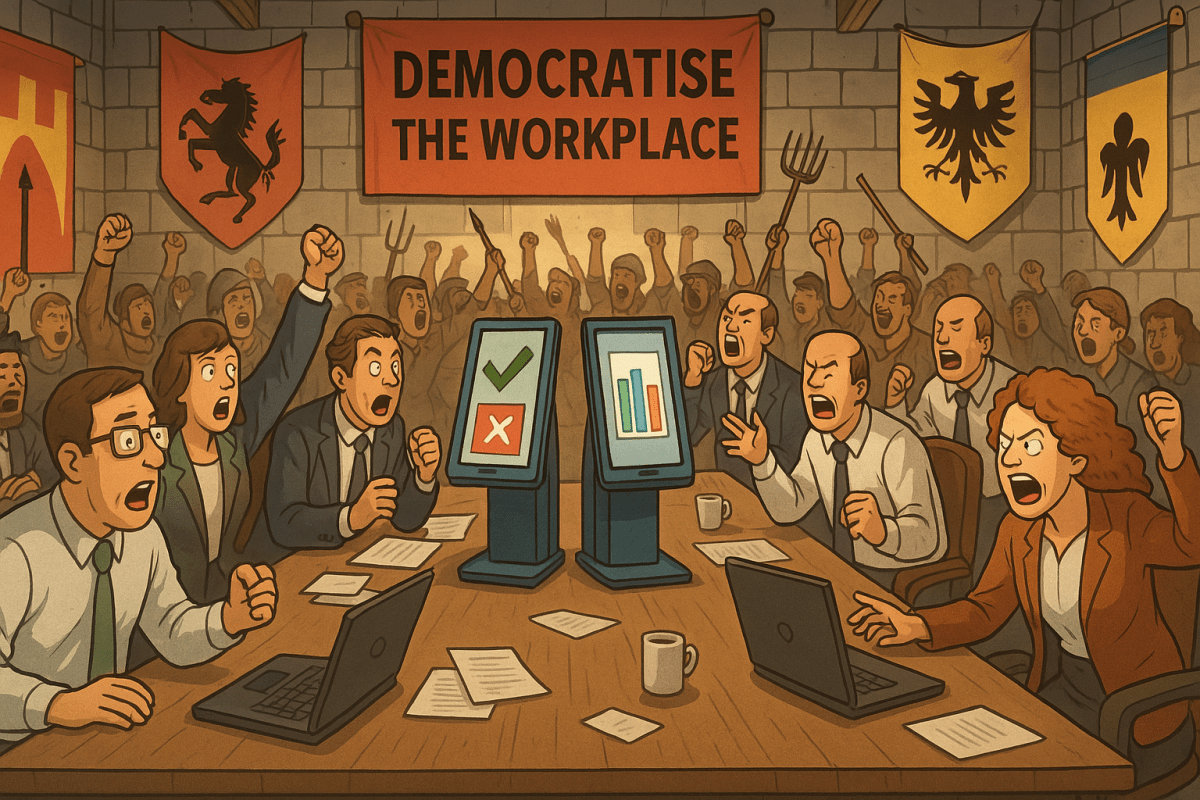
By the time we reach Chapter Seven of Technofeudalism: What Kills Capitalism, Yanis Varoufakis drops the ledger sheets and spreadsheets and starts sketching utopia in crayon. Entitled Escape from Technofeudalism, it proposes—brace yourself—a workplace democracy. It’s aspirational, yes. Compelling? Not particularly. Especially if, like me, you’ve long since stopped believing that democracy is anything more than a feel-good placebo for structural impotence.

Audio: NotebookLM podcast discussing this topic.

To be clear: the preceding chapters, particularly the first six, are sharp, incisive, and frankly, blistering in their indictment of today’s economic disfiguration. But Chapter Seven? It’s less an escape plan, more a group therapy session masquerading as an operational model.

So let’s take his proposal for Democratised Companies apart, one charming layer at a time.

Splendid. One person, one vote. Adorable.

Because there’s nothing more efficient than a hiring committee comprised of thirty engineers, two janitors, a receptionist, and Steve from Accounts, whose main contribution is passive-aggressive sighing.

Marvellous. We’ve now digitised the tyranny of the majority and can timestamp every idiotic decision for posterity.

A relief. Until it doesn’t.

Here, dear reader, is where the cake collapses. Why, precisely, should a randomly-assembled group of employees—with wildly varying financial literacy—be entrusted to divide post-tax revenue like it’s a birthday cake at a toddler’s party?

And how often are these slices recalibrated? Each fiscal year? Every time someone is hired or fired? Do we amend votes quarterly or wait until the economic ship has already struck an iceberg?

Varoufakis does suggest preference voting to tackle allocation disputes:

Fine. In theory, algorithmic voting procedures sound neat. But it presumes voters are rational, informed, and cooperative. If you’ve ever seen a corporate Slack thread devolve into emoji warfare, you’ll know that this is fiction on par with unicorns and meritocracy.

Ah yes, the ‘equality’ bit. Equal pay, unequal contribution. This isn’t egalitarianism—it’s enforced mediocrity. It might work in a monastery. Less so in a competitive tech firm where innovation requires both vision and differentiated incentive.

Now, on to bonuses, which are democratically determined by:

Welcome to Black Mirror: Workplace Edition. This is less economics, more playground politics. Who gets tokens? The charismatic chatterbox in the break room? The person who shared their lunch? The ghost employee who never shows up but emails back promptly?

And how, pray tell, does one evaluate the receptionist’s contribution relative to the lead engineer’s or the janitor’s? This isn’t peer review—it’s populism with a smiley face.

We’ve all seen “Teacher of the Year” competitions turn into contests of who had the cutest class poster or best cupcakes. Now imagine your livelihood depending on it.

In summary, democracy in the workplace may sound noble, but in practice, it’s the bureaucratic equivalent of herding caffeinated cats. It doesn’t even work in small groups, let alone an organisation of hundreds. Democracy—when applied to every function of an enterprise—is not liberation; it’s dilution. It’s design-by-committee, strategy-by-consensus, and ultimately, excellence-by-accident.

Escape from Technofeudalism? Perhaps. But not by replacing corporate lords with intranet polls and digital tokens. That’s not an exit strategy—it’s a cosplay of collectivism.

Clouds, Crowns, and Clowns

How the West Bungled Its Way into Technofeudalism

History doesn’t repeat itself, but, my God, it certainly rhymes — badly, and in the case of America’s self-immolation vis-à-vis China, completely off-key.

Yanis Varoufakis’ brutal dissection in Technofeudalism reads like a coronial report on the West’s terminal idiocy:
We’re not watching the rise of a “new China threat” — we’re watching the dying spasms of a clownish empire losing to its own creation: cloud capital.

Audio: NotebookLM podcast on this topic. NB: The announcers confused my commentary on Varoukakis as my ideas, where I am simply summarising and editorialising.

A Recap for the Attention-Deficit West:

Once upon a time (i.e., post-WWII), America ran a magnificent scam: sell the world things — aeroplanes, refrigerators, good old-fashioned stuff — in exchange for gold. When America became a deficit country (buying far more than it sold), it pivoted brilliantly:
“No more gold, peasants. Here, have an IOU instead.”
Thus was born the Dollar Empire: a global system where America got to run enormous deficits, foreigners got paper promises, and everyone smiled through gritted teeth.

Fast-forward: Japan, Korea, China — they got in line. They built things, exported things, grew rich — and recycled all their lovely profits straight into American property, debt, and Wall Street snake oil.
Win-win!
(Except for the workers on both sides, who were flogged like medieval peasants, but who’s counting?)

The Minotaur Has a Stroke

Then came 2008: America’s financial system committed hara-kiri on live television.
China stepped up to save global capitalism (yes, really), jacking up investment to absurd levels, buying up Western assets, and quietly building something far more dangerous than steelworks and solar panels: cloud finance.

While the West was still dry-humping neoliberal fantasies about “free markets,” China fused Big Tech and Big Brother into a seamless, sprawling surveillance-finance-entertainment-behavioural-modification apparatus.
Think Facebook, Amazon, Citibank, your GP, your car insurance, and your government — all rolled into one app.
Welcome to WeChat World™ — population: everyone.

The New Cold War: Idiots vs Strategists

Enter Trump. And Biden. And the bipartisan realisation, delivered with all the subtlety of a pub brawl, that China’s Big Tech wasn’t just mimicking Silicon Valley — it was obliterating it.
TikTok wasn’t just teenagers dancing. It was dollar extraction without the need for US trade deficits or dollar supremacy.

Cue blind panic. Ban Huawei! Ban TikTok! Ban chips! Ban thought!
Meanwhile, Beijing smiled, nodded, and built its own chips, its own cloud, its own digital currency.
When the US froze Russian central bank assets in 2022, it unwittingly told every finance minister from Delhi to Dakar:
“Your money isn’t safe with us.”
Oops.

The Chinese digital yuan — a once quaint science project — suddenly looked like the lifeboat on a burning ship.
Guess which way the rats are swimming?

Europe: Toasted, Buttered, and Eaten

As for Europe? Bless them. Still fantasising about “strategic autonomy” while chained to America’s collapsing empire like a loyal spaniel.
Europe lacks cloud capital, lacks industrial capacity, and now — post-Ukraine, post-energy crisis — lacks even the pretence of relevance.
Germany, France, the Netherlands: mere franchisees of American technofeudal overlords.

Brussels’ vision for the future?
“Please sir, may we remain a respectable vassal state?”

The Global South: Choose Your Feudal Lord

The so-called “developing world” faces an even grimmer menu:

  • Pledge allegiance to Washington’s dying dollar-based cloud fief?
  • Or become serfs under Beijing’s emerging digital rentier aristocracy?
    Either way, the crops are taxed, the wells are privatised, and the commons are torched.

Development? Don’t make me laugh. The South has been invited to another game of “Heads they win, tails you starve.”

Technofeudalism: A Lovable New Hell

Meanwhile, back in the heartlands of Empire, cloudalists — Google, Amazon, Tencent, Alibaba — are fencing off reality itself.
You will own nothing, subscribe to everything, and feed their algorithms while praying for a dopamine hit.
Democracy?
A charming relic, like powdered wigs and carrier pigeons.

In a final, cosmically ironic twist, it turns out that the only force keeping China’s cloudalists in check is… the Chinese Communist Party itself.
Yes, dear liberals: the last faint flicker of “people power” resides under authoritarian rule, while the “free world” rolls over like a half-seduced Victorian maiden.

Technofeudalism: Taxing Rent

I’ve just finished Chapter 5 of Technofeudalism by Greek economist Yanis Varoufakis, and I can’t recommend it enough. Retiring from being a professional economist, I’d paused reading economic fare in favour of philosophy and fiction. Recently, I picked up Hobbes’ Leviathan and Graeber’s Bullshit Jobs, but this one called to me. I recall when it was released. I read some summaries and reviews. I heard some interviews. I thought I understood the gist. I did. But it goes deeper. Much deeper.

I considered Technofeudalism or Feudalism 2.0 as more of a political statement than a sociopolitical one. Now, I know better. Rather than review the book, I want to focus on a specific aspect that occurred to me.

In a nutshell, Varoufakis asserts that with Capitalism, we moved from a world of property-based rents to one of profits (and rents). We’ve now moved past this into a new world based on platform-based rents (and profits and property rents). Rent extraction yields more power than profits, again reordering power structures. Therefore, I think we might want to handle (read: tax) rents separately from profits.

Audio: NotebookLM podcast discussing this topic.

A Radical Proposal for Modern Taxation

Introduction: The Old Dream Reawakened

Economists have long dreamt of a world in which rent — the unearned income derived from control of scarce assets — could be cleanly distinguished from profit, the reward for productive risk-taking. Ricardo dreamt of it. Henry George built a movement upon it. Even today, figures like Thomas Piketty hint at its necessity. Yet rent and profit have grown entangled like ancient ivy around the crumbling edifice of modern capitalism.

Today, under what some call “technofeudalism,” the separation of rent from productive profit has become not merely an academic exercise but a matter of existential urgency. With rents now extracted not only from land but from data, networks, and regulatory capture, taxation itself risks becoming obsolete if it fails to adapt.

Thus, let us lay out a theoretical and applied map for what could — and arguably must — be done.

I. The Theoretical Framework: Defining Our Terms

First, we must operationally define:

  • Profit: income generated from productive risk-taking — investment, innovation, labour.
  • Rent: income generated from ownership or control of scarce, non-replicable assets — land, intellectual property, platforms, regulatory privilege.

Key Principle: Rent is unearned. Profit is earned.

This distinction matters because rent is an economic extraction from society’s collective value creation, whereas profit rewards activities that enlarge that pie.

II. Mapping EBITA: Where Rent Hides

EBITA (Earnings Before Interest, Taxes, and Amortisation) is the preferred metric of modern corporate reporting. Within it, rents hide behind several masks:

  • Property rental income
  • Intellectual property licensing fees
  • Monopoly markups
  • Platform access fees
  • Network effect premiums
  • Regulatory arbitrage profits

Parsing rent from EBITA would thus require methodical decomposition.

III. Theoretical Approaches to Decomposing EBITA

  1. Cost-Plus Benchmarking
    • Estimate what a “normal” competitive firm would earn.
    • Treat any surplus as rent.
  2. Rate-of-Return Analysis
    • Compare corporate returns against industry-normal rates adjusted for risk.
    • Excess returns imply rent extraction.
  3. Monopolistic Pricing Models
    • Apply measures like the Lerner Index to estimate pricing power.
    • Deduce the rentier share.
  4. Asset Valuation Decomposition
    • Identify earnings derived strictly from asset control rather than active operation.
  5. Economic Value Added (EVA) Adjustments
    • Assign a competitive cost of capital and strip out the residual super-profits as rents.

IV. Toward Applied Solutions: Imposing Sanity on Chaos

In theory, then, we could pursue several applied strategies:

  1. Mandated Rent-Adjusted Reporting
    • Require corporations to file a “Rent-Adjusted EBITA” metric.
    • Auditors would have to categorise income streams as “productive” or “rentier.”
  2. Differential Taxation
    • Tax normal profits at a competitive corporate rate.
    • Tax rents at punitive rates (e.g., 70-90%), since taxing rents does not distort incentives.
  3. Sector-Specific Rent Taxes
    • Levy special taxes on land, platforms, patents, and monopoly franchises.
    • Create dynamic rent-extraction indices updated annually.
  4. Platform Rent Charges
    • Impose data rent taxes on digital platforms extracting value from user activity.
  5. Public Registry of Rents
    • Create a global registry classifying rents by sector, firm, and mechanism.
    • Provide public transparency to rent-seeking activities.

V. The Political Reality: Clouds on the Horizon

Needless to say, the aristocracy of the digital age will not go gentle into this good night. Rentiers — whether in Silicon Valley, the City of London, or Wall Street — are deeply entwined with the political machinery that might otherwise regulate them.

Yet the costs of inaction are higher. If rent extraction continues to eclipse productive activity, the very legitimacy of markets — and democracy — will erode into cynicism, stagnation, and oligarchic decay.

Conclusion: The Choice Before Us

Separating rent from profit is not merely a technocratic tweak. It is a radical act — one that could reorient economic activity away from parasitic extraction and back toward genuine value creation.

In a world where algorithms are castles, platforms are fiefdoms, and data is the new serfdom, reclaiming the ancient dream of taxing rent is no longer optional. It is, quite simply, the price of our collective survival.

Bullshit Jobs

I’ve recently decided to take a sabbatical from what passes for economic literature these days — out of a sense of self-preservation, mainly — but before I hermetically sealed myself away, I made a quick detour through Jorge Luis Borges’ The Library of Babel (PDF). Naturally, I emerged none the wiser, blinking like some poor subterranean creature dragged into the daylight, only to tumble headlong into David Graeber’s Bullshit Jobs.

This particular tome had been languishing in my inventory since its release, exuding a faint but persistent odour of deferred obligation. Now, about a third of the way in, I can report that Graeber’s thesis — that the modern world is awash with soul-annihilatingly pointless work — does resonate. I find myself nodding along like one of those cheap plastic dashboard dogs. Yet, for all its righteous fury, it’s more filler than killer. Directionally correct? Probably. Substantively airtight? Not quite. It’s a bit like admiring a tent that’s pitched reasonably straight but has conspicuous holes large enough to drive a fleet of Uber Eats cyclists through.

An amusing aside: the Spanish edition is titled Trabajos de mierda (“shitty jobs”), a phrase Graeber spends an entire excruciating section of the book explaining is not the same thing. Meanwhile, the French, in their traditional Gallic shrug, simply kept the English title. (One suspects they couldn’t be arsed.)

Chapter One attempts to explain the delicate taxonomy: bullshit jobs are fundamentally unnecessary — spawned by some black magic of bureaucracy, ego, and capitalist entropy — whilst shit jobs are grim, thankless necessities that someone must do, but no one wishes to acknowledge. Tragically, some wretches get the worst of both worlds, occupying jobs that are both shit and bullshit — a sort of vocational purgatory for the damned.

Then, in Chapter Two, Graeber gleefully dissects bullshit jobs into five grotesque varieties:

  1. Flunkies, whose role is to make someone else feel important.
  2. Goons, who exist solely to fight other goons.
  3. Duct Tapers, who heroically patch problems that ought not to exist in the first place.
  4. Box Tickers, who generate paperwork to satisfy some Kafkaesque demand that nobody actually reads.
  5. Taskmasters, who either invent unnecessary work for others or spend their days supervising people who don’t need supervision.

Naturally, real-world roles often straddle several categories. Lucky them: multi-classed in the RPG of Existential Futility.

Graeber’s parade of professional despair is, admittedly, darkly entertaining. One senses he had a great deal of fun cataloguing these grotesques — like a medieval monk illustrating demons in the margins of a holy text — even as the entire edifice wobbles under the weight of its own repetition. Yes, David, we get it: the modern economy is a Potemkin village of invented necessity. Carry on.

If the first chapters are anything to go by, the rest of the book promises more righteous indignation, more anecdotes from anonymous sad-sacks labouring in existential oubliettes, and — if one is lucky — perhaps a glimmer of prescription hidden somewhere amidst the diagnosis. Though, I’m not holding my breath. This feels less like an intervention and more like a well-articulated primal scream.

Still, even in its baggier moments, Bullshit Jobs offers the grim pleasure of recognition. If you’ve ever sat through a meeting where the PowerPoint had more intellectual integrity than the speaker or spent days crafting reports destined for the corporate oubliette marked “For Review” (translation: Never to Be Seen Again), you will feel seen — in a distinctly accusatory, you-signed-up-for-this sort of way.

In short: it’s good to read Graeber if only to have one’s vague sense of societal derangement vindicated in print. Like having a charmingly irate friend in the pub lean over their pint and mutter, “It’s not just you. It’s the whole bloody system.”

I’m not sure I’ll stick with this title either. I think I’ve caught the brunt of the message, and it feels like a diversion. I’ve also got Yanis Varoufakis’ Technofeudalism: What Killed Capitalism on the shelf. Perhaps I’ll spin this one up instead.