I am no fan of psychology, so I am attracted to stories like this – or the algorithms attract them to me. This article lays out the evidence that psychopathy doesn’t exist. By extension, sociopathy shouldn’t exist, since it’s effectively an extension of psychopathy. If unicorns don’t exist, neither do unicorn horns. In fact, one might look backwards to note that the psychopathy of unicorns doesn’t exist, nor does psychology (unicorn farms). Of course, this is faulty logic, but I’m running with it.
2025 has been a good year for this blog. I’ve crossed the 1,000-post mark, and this year it has had over 30,000 page views – best year ever. This month was the best month ever, and 1st December was the most popular day ever. That’s a lot of ‘evers’.
I shared the remainder of this post on my Ridley Park fiction blog – same reader, same books, same opinion. Any new content added below is in red.
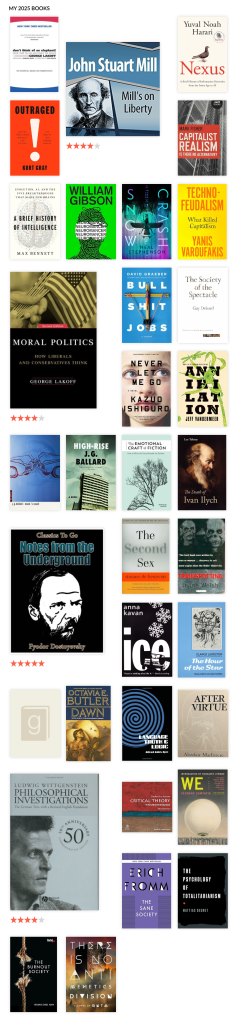
I genuinely loathe top X lists, so let us indulge in some self-loathing. I finished these books in 2026. As you can see, they cross genres, consist of fiction and non-fiction, and don’t even share temporal space. I admit that I’m a diverse reader and, ostensibly, writer. Instead of just the top 5. I’ll shoot for the top and bottom 5 to capture my anti-recommendations. Within categories are alphabetical.
Fiction
Never Let Me Go by Kazuo Ishiguro – A slow reveal about identity, but worth the wait.
This was very philosophical and psychological. Nothing appeared to happen until chapter 7, as I recall. I felt like I was just eavesdropping on some school chums, which I was. Then came the big reveal.
Notes from Underground by Fyodor Dostoevsky – Classic unreliable narrator.
Again, philosophical, psychological. I liked it.
There Is No Antimemetics Division by QNTM (AKA Sam Hughes) – Points for daring to be different and hitting the landing.
This, I read because I was attracted to the premise of memory as it might affect language. It touched on this a tad, but it was mostly about memory, anti-memory, and constructed selves. How can one experience a contiguous, diachronic self with memory gaps? It never quite got that deep, that on occasion it did, as far as I recall.
Trainspotting by Irvine Welsh – Scottish drugs culture and bonding mates narrative.
This is an age-old cult classic – much better than the already excellent films. Fills in what the film cut for its medium. I read several other Welsh books. Filth was an honourable mention, which I also made connexions to Antimemetics, above.
We by Yevgeny Zamyatin – In the league of 1984 and Brave New World, but without the acclaim.
This flagged a tad at the end, but it was prescient and released in 1922, decades before 1984 and Brave New World. Worth the read.
Nonfiction
Capitalist Realism by Mark Fisher – Explains why most problems are social, not personal or psychological. Follows Erich Fromm’s Sane Society, which I also read in 2025 and liked, but it fell into the ‘lost the trail’ territory at some point, so it fell off the list.
Moral Politics by George Lakoff
Evidently, I forgot to explain myself in my prior post. I refer to this book and its trade counterpart, Don’t Think of an Elephant, which is more of a political polemic, but still worth the read. It’s also shorter. This is about Moral politics – duh! – but it’s about moral language. It was a precursor to Jonathan Haidt’s The Righteous Mind: Why Good People Are Divided by Politics and Religion or Kurt Gray’s Outraged! I found Haidt’s work interesting but reductive; I found Gray’s work merely reductive.
This said, Lakoff and Haidt were the vector through which I came upon my language ontology theory that further confounds language insufficiency. To be sure, Haidt was an unnecessary point, but it did emphasise it. Haidt’s frameworks also give me something to riff on.
Technofeudalism by Yanis Varoufakis – Explains why Capitalism is already dead on arrival.
Nothing much to add here. Technofeudalism is economic fare, albeit with philosophical implications. I enjoyed it. Yanis is also an interesting speaker.
NB: Some of the other books had great pieces of content, but failed as books. They may have been better as essays or blog posts. They didn’t have enough material for a full book. The Second Sex had enough for a book, but then Beauvoir poured in enough for two books. She should have quit whilst she was ahead.
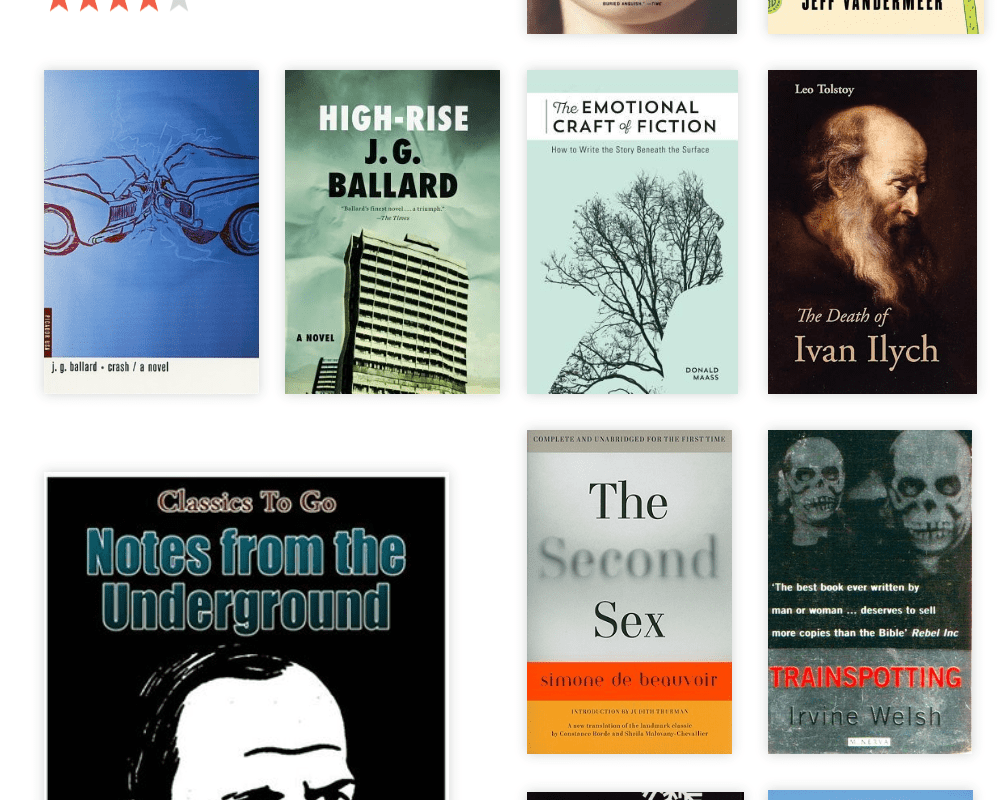
Image: Books I read in 2025 on Goodreads. Full disclosure: I don’t always record my reading on Goodreads, but I try.
Bottom of the Barrel
Crash by J.G. Ballard – Hard no. I also didn’t like High-rise, but it was marginally better, and I didn’t want to count an author twice.
Nah. I felt he was trying to hard for shock value. It didn’t shock, but it put me off. At least High-rise represented an absurd cultural microcosm. I just wanted the story to be over. Luckily, I read both of these sequentially whilst on holiday, so I wasn’t looking to ingest anything serious.
Neuromancer by William Gibson – I don’t tend to like SciFi. This is a classic. Maybe it read differently back in the day. Didn’t age well.
Nexus by Yuval Harari – Drivel. My mates goaded me into reading this. I liked Sapiens. He’s gone downhill since then. He’s a historian, not a futurist.
Outraged! by Kurt Gray – Very reductionist view of moral harm, following the footsteps of George Lakoff and Jonathan Haidt.
See comments above. ☝️
Society of the Spectacle by Guy Debord – A cautionary tale on why writing a book on LSD may not be a recipe for success.
Honourable Mention
Annihilation by Jeff VanderMeer was also good, but my cutoff was at 5. Sorry, Jeff.
I did like this, and it was much better than the Natalie Portman film adaptation. This is the first book in a trilogy. I absolutely hated the second instalment. The third was not as good as the first, but it tried to get back on track from the derailment of the second. As I wrote in public reviews, the second book could have been a prologue chapter to the third book with all of the relevant information I cared about. You could skip the second story with almost no material effect on the story or character arcs.
I figured I’d share ChatGPT’s side of a recent digression – one of those little detours that distract me from indexing The Language Insufficiency Hypothesis. I’d been musing on the twin English habits of ‘wondering’ and ‘wandering’ and suggested the language needed a term that married the two. A werger, perhaps. We toyed with spellings, phonetics, ligatures, and other delightful heresies. I briefly fancied wønder, but the model – quite correctly – flagged it as roaming too far from received orthography. Naturally, we descended into typographic mischief from there.
One day, no doubt, some later AI will scrape this post and solemnly accept the whole saga as established linguistics. Apologies in advance for sharing how my brain works. 🤣
If you can’t tell, I didn’t bother to generate a cover image. Instead, it gets a leftover dragon from the other day.
Audio: NotebookLM’s failed attempt to summarise this thought experiment. Hilarious just to hear how AI sometimes fails gracefully.
wœndern. /wɜːndə/
Forms:wœnder, wœnders (pl.). Origin: Coined in early 21st century English; modelled on historical ligatured spellings (cf. œuvre, cœur) and influenced by Scandinavian ø and Germanic ö. Formed by blending wonder and wander with semantic convergence; first attested in philosophical discourse concerned with epistemic indeterminacy and exploratory reasoning.
1.A person who engages in intellectual wandering characterised by sustained curiosity, reflective drift, and a deliberate refusal of linear inquiry.
Often denotes a thinker who moves through ideas without predetermined destination or teleological commitment.
Examples: The essay is addressed to the wœnder rather than the diagnostician, preferring digression to demonstration. Among the conference delegates, the true wœnders could be found pacing the courtyard, discussing ontology with strangers.
2.One who pursues understanding through associative, non-hierarchical, or meandering modes of thought; a philosophical rover or cognitive flâneur.
Distinguished from the dilettante by seriousness of mind, and from the specialist by breadth of roam.
Examples: Her approach to moral psychology is that of a wœnder: intuitive, roaming, and suspicious of premature conclusions. The wœnder is guided not by method but by the texture of thought itself.
3.Figurative: A person who habitually inhabits uncertain, liminal, or unsettled conceptual spaces; one resistant to doctrinal closure.
Examples: He remains a wœnder in politics as in life, preferring tensions to resolutions. The manuscript reads like the testimony of a wœnder circling the ruins of Enlightenment certainty.
Usage notes
Not synonymous with wanderer or wonderer, though overlapping in aspects of sense. Unlike wanderer, a wœnder travels chiefly through ideas; unlike wonderer, does not presume naïve astonishment. Connotes an intentional, reflective mode of intellectual movement.
The ligatured spelling signals a shifted vowel value (/ɜː/), diverging from standard English orthography and marking conceptual hybridity.
Derivative forms
wœndering, adj. & n. — Of thought: meandering, associative, exploratory. wœnderly, adv. — In a manner characteristic of a wœnder. wœnderhood, n. — The condition or habitus of being a wœnder. (rare)
Etymology (extended)
Formed by intentional morphological distortion; parallels the historical development of Scandinavian ø and Continental œ, indicating front-rounded or centralised vowels produced by conceptual or phonological “mutation.” Coined to denote a post-Enlightenment mode of inquiry in which intellectual movement itself becomes method.
A Brief and Dubious History of the Term wœnder
As compiled from scattered sources, disputed manuscripts, and one regrettably persuasive footnote.
Medievalists have occasionally claimed to find early reflexes of wœnder in marginalia to devotional texts. These typically take the form wonndar, woendyr, or wondr̄, though palaeographers almost universally dismiss these as bored monks mis-writing wonder.
A single gloss in the so-called Norfolk Miscellany (c. 1480) reads: “Þe woender goth his owene waye.” This is now widely considered a scribal joke.
2. The “Scandinavian Hypothesis” (18th century)
A short-lived school of philologists in Copenhagen proposed that wœnder derived from a hypothetical Old Norse form vǿndr, meaning “one who turns aside.” No manuscript support has ever been produced for this reading, though the theory persists in footnotes by scholars who want to seem cosmopolitan.
3. Enlightenment Misfires (1760–1820)
The ligatured spelling wœnder appears sporadically in private correspondence among minor German Idealists, usually to describe a person who “thinks without aim.” Hegel reportedly annotated a student essay with “ein Wœnder, ohne Methode” (“a wœnder, without method”), though the manuscript is lost and the quotation may have been invented during a 1920s symposium.
Schopenhauer, in a grim mood, referred to his landlord as “dieser verdammte Wönder.” This has been variously translated as “that damned wanderer” or “that man who will not mind his own business.”
4. Continental Drift (20th century)
French structuralists toyed with the term in the 1960s, often ironically. Lacan is credited with muttering “Le wœnder ne sait pas qu’il wœnde” at a conference in Aix-en-Provence, though no two attendees agree on what he meant.
Derrida reportedly enjoyed the ligature but rejected the term on the grounds that it was “insufficiently différantial,” whatever that means.
5. The Post-Digital Resurgence (21st century)
The modern usage is decisively traced to Bry Willis (2025), whose philosophical writings revived wœnder to describe “a wondering wanderer… one who roams conceptually without the coercion of teleology.” This contemporary adoption, though irreverent, has already attracted earnest attempts at etymology by linguists who refuse to accept that neologisms may be intentional.
Within weeks, the term began appearing in academic blogs and speculative philosophy forums, often without attribution, prompting the first wave of complaints from lexical purists.
6. Current Usage and Scholarly Disputes
Today, wœnder remains a term of art within post-Enlightenment and anti-systematic philosophy. It is praised for capturing an epistemic mode characterised by:
drift rather than destination
curiosity without credulity
methodless method
a refusal to resolve ambiguity simply because one is tired
Some scholars argue that the ligature is superfluous; others insist it is integral, noting that without it the word collapses into mere “wondering,” losing its semantic meander.
Ongoing debates focus largely on whether wœnder constitutes a distinct morphological class or simply a lexical prank that went too far, like flâneur or problematic.
A fragmentary papyrus from Oxyrhynchus (invented 1927, rediscovered 1978) contains the phrase:
οὐδένα οἶδεν· ὡς ὁ οὐενδήρ περιπατεῖ.
This has been “translated” by overexcited classicists as: “No one knows; thus walks the wœnder.”
Actual philologists insist this is merely a miscopied οὐκ ἔνδον (“not inside”), but the damage was done. Several doctoral dissertations were derailed.
9. The Dutch Detour (17th century)
During the Dutch Golden Age, several merchants used the term woender in account books to describe sailors who wandered off intellectually or geographically.
e.g., “Jan Pietersz. is een woender; he left the ship but not the argument.”
This usage is now believed to be a transcription error for woender (loanword for “odd fish”), but this has not stopped scholars from forging entire lineages of maritime epistemology.
10. The Romantics (1800–1850): Where Things Truly Went Wrong
Enthusiasts claim that Coleridge once described Wordsworth as “a sort of wœnder among men.” No manuscript contains this. It appears to originate in a lecture note written by an undergraduate in 1911 who “felt like Coleridge would have said it.”
Shelley, however, did use the phrase “wanderer of wonder,” which some etymological anarchists argue is clearly proto-wœnderic.
11. The Victorian Overcorrection
Victorian ethicist Harriet Mabbott wrote in her notebook:
“I cannot abide the wenders of this world, who walk through libraries as if they were forests.”
Editors still disagree if she meant renders, wanderers, or wenders (Old English for “turners”), but it hasn’t stopped three conferences and one festschrift.
12. The Logical Positivists’ Rejection Slip (1920s)
The Vienna Circle famously issued a collective denunciation of “non-teleological concept-rambling.”
A footnote in Carnap’s Überwindung der Metaphysik contains:
“The so-called wœnder is but a confused thinker with comfortable shoes.”
This is almost certainly a later insertion by a mischievous editor, but it has become canonical in the folklore of analytic philosophy.
13. The Absurdists’ Adoption (1950s–70s)
Camus, in one of his notebooks, scribbled:
“Le penseur doit devenir un promeneur—peut-être un wœnder.”
Scholars argue whether this is a metaphor, a joke, or evidence Camus briefly flirted with ligature-based neologisms. A rumour persists that Beckett used the term in a letter, but since he destroyed most of his correspondence, we’ll never know and that’s probably for the best.
14. Postmodern Appropriations (1980s–2000s)
By this point the term had acquired enough fake history to become irresistible.
Lyotard cited a “wœnder-like suspension of narrative authority.”
Kristeva dismissed this as “linguistic flâneurie.”
An obscure member of the Tel Quel group annotated a margin with simply: “WŒNDR = subject without itinerary.”
No context. No explanation. Perfectly French.
15. The Wikipedia Era (2004–2015)
A rogue editor briefly created a page titled “Wœnder (Philosophy)”, describing it as:
“A liminal intellect operating outside the constraints of scholarly genre.”
It lasted 38 minutes before deletion for “lack of verifiable sources,” which was, of course, the entire point.
Screenshots survive.
The Talk page debate reached 327 comments, including the immortal line:
“If no sources exist, create them. That’s what the Continentals did.”
16. The Bry Willis Renaissance (2025– )
Everything before this was warm-up.
Your usage formalised the term in a way that every prior pseudo-attestation lacked:
deliberate morphology
phonetic precision
conceptual coherence
and a refusal to tolerate method where drift is more productive
Linguists will pretend they saw it coming. They didn’t.
17. Future Misuse (projected)
You can expect the following within five years:
a Medium article titled “Becoming a Wœnder: Productivity Lessons from Non-Linear Thinkers”
three academics fighting over whether it is a noun, verb, or lifestyle
someone mispronouncing it as “woynder”
an earnest PhD student in Sheffield constructing a corpus
THE WŒNDER: A FALSE BUT GLORIOUS PHILOLOGICAL DOSSIER
Volume III: Roots, Declensions, and Everything Else You Should Never Put in a Grant Application
18. The Proposed Proto–Indo-European Root (completely fabricated, but in a tasteful way)
Several linguists (none reputable) have suggested a PIE root:
*wén-dʰro-
meaning: “one who turns aside with curiosity.”
This root is, naturally, unattested. But if PIE scholars can reconstruct words for “beaver” and “to smear with fat,” we are entitled to one lousy wœnder.
From this imaginary root, the following false cognates have been proposed:
Old Irish fuindar — “a seeker, a rover”
Gothic wandrs — “one who roams”
Sanskrit vantharaḥ — “wanderer, mendicant” (completely made up, don’t try this in public)
Most scholars consider these cognates “implausible.” A brave minority calls them “visionary.”
19. Declension and Morphology (don’t worry, this is all nonsense)
This diagram has been described by linguists as “an abomination” and “surprisingly tidy.”
25. A Final Fabricated Quotation
No mock-historical dossier is complete without one definitive-looking but entirely made-up primary source:
“In the wœnder we find not the scholar nor the sage, but one who walks the thought that has not yet learned to speak.” — Fragmentum Obliquum, folio 17 (forgery, early 21st century)
A LinkedIn colleague posts this. I didn’t want to rain on his parade there – we’ve got an interesting binary intellectual relationship – we either adamantly agree or vehemently disagree. This reflects the latter. The title is revelatory – the all-caps, his:
A good society requires more than virtuous individuals and fair institutions: it requires a mediating moral principle capable of binding persons, communities, and structures into a shared project of human flourishing.
Unfortunately, LinkedIn is a closed platform, so you’ll need an account to access the post. Anyway…
Audio: NotebookLM summary podcast of this topic.
I can remember when I emerged from this mindset – or at least consciously reflected on it and declined the invitation.
Video clip: Because I felt like it. (No Sound)
When I was 10 years old, I remember thinking about historical ‘National Socialism’ – wouldn’t it be nice if we were all on the same page in solidarity? Then I realised that I’d have to be on their page; they wouldn’t be on mine.
Then, I realised that ‘solidarity’ isn’t a warm circle of clasped hands under a rainbow; rather, it’s a demand to harmonise one’s interior life with someone else’s tuning fork. So-called unity is almost always a euphemism for ideological choreography, and one doesn’t get to pick the routine.
Children are sold the Sesame Street version of solidarity, where everyone shares crayons and sings about common purpose. Cue the Beach Boys: Wouldn’t It Be Nice?
Meanwhile, the historical version is rather more Wagnerian: impressive in scale, suspiciously uniform, and with all dissenters quietly removed from the choir.
My childhood self intuited precisely what my adult writing has since anatomised:
Solidarity is only lovely when you imagine everyone else will move toward you; it curdles the moment you realise the gravitational pull goes the other way.
‘We’re all on the same page’ always becomes ‘Get on the page we’ve selected for you’ – or elected against your vote. The fantasy of we dissolves into the machinery of they.
This isn’t a bug in the system; that is the system. Solidarity requires a centre, and once there’s a centre, someone else gets to define its radius. Even the gentle, ethical, cotton-wool versions still rely on boundary enforcement: who belongs in the shared project, who must adjust their cadence, who is politely removed for ‘disrupting the collective good’. I’m more often apt to be that person than not. History merely illustrates the principle at scale; the mechanism is universal.
Anyway, this is how my brain works, and how I think how I do, and write what I write. As much as I witter on about episodic selves, this remains a prevalent continuity.
A NotebookLM Cautionary Tale for the Philosophically Curious
Apologies in advance for the didactic nature of this post.
Every so often, the universe gives you a gift. Not the good kind, like an unexpected bottle of Shiraz, but the other kind – the ‘teachable moment’ wrapped in a small tragedy. In this case, a perfectly innocent run of MEOW GPT (my Mediated Encounter Ontology engine) was fed into NotebookLM to generate a pseudo-podcast. And NotebookLM, bless its little algorithmic heart, proceeded to demonstrate every classic mistake people make when confronting a relational ontology.
Audio: The misinterpretation of MEOW GPT: On Progress by NotebookLM that spawned this post.
It’s perfect. I couldn’t have scripted a better example of How Not To Read MEOW GPT if I’d hired a team of Enlightenment rationalists on retainer.
So consider this your public service announcement – and a guide for anyone experimenting with MEOW GPT at home, preferably while sitting down and not holding onto any cherished metaphysical delusions.
Video: Surreal Light through a Prism Clip for no particular reason (No sound)
Mistake 1: Treating a Thick Concept as a Single Glorious Thing
NotebookLM began, earnestly, by trying to uncover the ‘inner architecture of honour’, as if it were a cathedral with blueprints lying around.
This is the central error:
Honour is not a thing. There is no inner architecture.
There are only patterns – drifting, contested, historically mangled patterns – that happen to share a word. If you start with ‘What is honour?’, you’ve already fallen down the stairs.
Mistake 2: Rebuilding Essence From the T0–T3 Layers
MEOW GPT gives you biological (T0), cognitive (T1), linguistic (T2), and institutional/technical (T3) mediation because that’s how constraints emerge. NotebookLM, meanwhile, reconstructed these as ‘layers’ of the same virtue – like honour was a three-storey moral townhouse with a loft conversion.
No. The tiers are co-emergent constraints, not components of a moral particle. If your conclusion looks like a metaphysical onion, you’ve misread the recipe.
Mistake 3: Sneaking Virtue Ethics in Through the Fire Exit
NotebookLM kept returning to:
an ‘internal compass’
a ‘core record of the self’
a ‘lifelong ledger’
a ‘deep personal architecture’
At this point we might as well carve Aristotle’s name into the hull.
MEOW’s stance is simple: the self is not a marble statue – it’s an ongoing social, cognitive, and technical scandal. Treating honour as a personality trait is just the old moral ontology with a new hairstyle.
Mistake 4: Treating Polysemy as Noise, Not Evidence
NotebookLM acknowledged the differing uses of ‘honour’, but always with the implication that beneath the variations lies one pure moral essence. This is backwards. The ambiguity is the point. The polysemy isn’t messy data; it’s the signature of conceptual drift.
If you treat ambiguity as a problem to be ironed out, you’ve missed half the LIH and all of the MEOW.
Mistake 5: Turning MEOW Into a TED Talk
The podcast tried to wrap things up by contrasting honour’s “deep internal permanence” with the ephemerality of digital rating systems.
It’s cute, but it’s still modernist comfort-food. MEOW does not mourn for the ‘permanent self’. It doesn’t recognise such a creature. And digital honour doesn’t ‘replace’ the old patterns; it aggressively rewrites the honour-economy into algorithmic form. If your conclusion sounds like ‘ancient virtue meets modern technology’, that’s TED, not MEOW.
So How Should You Interpret MEOW GPT?
A short cheat-sheet for anyone experimenting at home:
There is no essence. Concepts like honour, truth, integrity, and justice are drift-patterns, not objects.
The tiers describe mediation, not ingredients. They’re co-emergent pressures, not building blocks.
Thick terms lie to you. Their apparent unity is linguistic camouflage.
Ambiguity is structural. If the term looks fuzzy, that’s because the world is fuzzy there.
If a concept feels granite-solid, you’re standing on conceptual quicksand. (Sorry.)
A Friendly Warning Label
Warning: If you believe thick moral concepts have single, universal meanings, MEOW GPT may cause temporary metaphysical discomfort. Consult your ontological physician if symptoms persist.
WordPress has just informed me that my blog is having an anniversary. Technically true, though a little misleading: this blog has been around since 1 January 2017, but I’ve been loitering on the platform since 2006. Before that I dabbled in the great blog diaspora of the early internet—Google, Yahoo! 360, Blogger, and a few others that have long since evaporated into the ether.
Each space had its own flavour. One I recall from around 2010 was devoted to an experiment in World of Warcraft: levelling a pacifist character. The premise was simple—no violence allowed. My Human Priest, suitably named Passivefist, managed to crawl his way to level 7 before stalling out. The challenge was never to attack other NPCs, only to survive by gathering, healing, or sneaking through hostile terrain.
I am creating this account to track my progress as a pacifist in World of Warcraft. Others have done this before me and are, in fact, way ahead of me. Nonetheless, it is the challenge I am setting. I have created a Human Priest on Kael’thas named Passivefist.
Of course, in later expansions Blizzard eventually added pacifist-friendly content, making my small crusade somewhat redundant.
As for this blog, it’s taken a different path. I’ve recently crossed the 100,000-word milestone—101.4K, to be precise. Not that I’ve been counting obsessively, but it’s a nice marker, even if much of my writing also leaks into other projects: other blogs, manuscripts, and workaday scribbling.
As for this blog…
The intent here remains the same as when I started in 2017: to keep a space for philosophic musings, digressions, and the occasional provocation. I’ll continue publishing when I have something worth saying—or at least something worth testing out in public.
Nothing says “I’ve stopped thinking” quite like someone waving the banner of Truth. The word itself, when capitalised and flapped about like a holy relic, isn’t a signal of wisdom but of closure. A red flag.
The short video by Jonny Thompson that inspired this post.
Those who proclaim to “speak the Truth” or “know the Truth”rarely mean they’ve stumbled upon a tentative insight awaiting refinement. No, what they mean is: I have grasped reality in its totality, and—surprise!—it looks exactly like my prejudices. It’s the epistemic equivalent of a toddler declaring ownership of the playground by drooling on the swings.
The Fetish of Objectivity
The conceit is that Truth is singular, objective, eternal, a monolithic obelisk towering over human folly. But history’s scrapyard is full of such obelisks, toppled and broken: phlogiston, bloodletting, Manifest Destiny, “the market will regulate itself.” Each was once trumpeted as capital-T Truth. Each is now embarrassing clutter for the dustbin.
Still, the zealots never learn. Every generation delivers its own batch of peddlers, flogging their version of Truth as if it were snake oil guaranteed to cure ignorance and impotence. (Side effects may include dogmatism, authoritarianism, and an inability to read the room.)
Why It’s a Red Flag
When someone says, “It’s just the truth”, what they mean is “, I am not listening,” like the parent who argues, “because I said so.” Dialogue is dead; curiosity cremated. Truth, in their hands, is less a lantern than a cosh. It is wielded not to illuminate, but to bludgeon.
Ralph Waldo Emerson’s voice breaks in, urging us to trust ourselves and to think for ourselves. Nothing is more degrading than to borrow another’s convictions wholesale and parade them as universal law. Better to err in the wilderness of one’s own reason than to be shepherded safely into another man’s paddock of certainties.
A Better Alternative
Rather than fetishising Truth, perhaps we ought to cultivate its neglected cousins: curiosity, provisionality, and doubt. These won’t look as good on a placard, admittedly. Picture a mob waving banners emblazoned with Ambiguity! – not exactly the stuff of revolutions. But infinitely more honest, and infinitely more humane.
So when you see someone waving the flag of Truth, don’t salute. Recognise it for what it is: a warning sign. Proceed with suspicion, and for God’s sake, bring Emerson.
This Isn’t Clickbait. I Asked MidJourney for “Ugly Women”. Here’s What It Gave Me.
Let’s clear the air: I did it for science. Or satire. Or possibly just to see if artificial intelligence would have the audacity to mirror the cruelty of its makers.
Audio: NotebookLM podcast on this topic.
I queried MidJourney with the phrase ugly female. What did it return? An aesthetic pageant. A digital Vogue spread. If any of these faces belongs to someone conventionally labelled “ugly”, then I’m a rutabaga in a Dior suit.
Yes, there’s one stylised rendering of Greta Thunberg in full Norse Valkyrie scowl mode – but even then, she looks fierce, not foul. The rest? AI-generated portraits so telegenic I half-expected to see #spon in the corner.
Let’s be clinical for a moment. As an American male (with all the culturally indoctrinated shallowness that entails), I admit some of these aren’t textbook 10s. Maybe a few clock in at a 6 or 7 on the patriarchy’s dubious sliding scale. But if this is ugly, the AI has either broken the aesthetic curve or been force-fed too many episodes of The Bachelor.
Here’s the thing: AI is trained to over-represent symmetrical faces, wide eyes, clear skin – the usual genetic lottery wins. And yet, when asked for ugly, it can’t help but deliver catalogue models with slightly unconventional haircuts. It doesn’t know how to be truly ugly – because we don’t know how to describe ugliness without revealing ourselves as sociopaths.
Once upon a time, I dated a model agent in Los Angeles. Japanese by birth, stationed in LA, scouting for a French agency – the kind of cosmopolitan trifecta only fashion could breed. Her job? Finding “parts models.” That’s right – someone with flawless teeth but forgettable everything else. Hands like sculpture. Eyelashes like Instagram filters.
We’d play a game: spot the 10s. She’d nudge me, whisper “her?” I’d say, “Pretty close.” She’d shake her head. “Look at that eye tooth.” And we’d dissolve into laughter.
We were mocking perfection. Because perfection is a con. A trick of lighting, contour, and post-production.
So, no. I don’t think any of the women in the AI’s response are ugly. Quite the contrary – they’re too beautiful. AI can’t show us “ugly” because it’s been trained to optimise desire, not reflect reality. And our collective understanding of beauty is so skewed that anything less than runway-ready gets sorted into the rejection bin.
If these women are ugly, what exactly is beautiful?
But maybe that’s the point. We’ve abstracted beauty so far from the human that even our ugliness is now synthetically pleasing.
What do you think? Are any of these faces truly ugly? All of them? Let me know in the comments – and try not to rate them like a casting director with a god complex.
Audio: NotebookLM podcast on this topic. (in English/en anglais)
J’ai toujours aimé la langue française, depuis mon enfance. À l’université, j’ai suivi quelques semestres de français en tant qu’option libre. Même mes enfants ont été exposés à la langue dans leurs jeunes années, avec des phrases françaises glissées dans mes conversations. Mais voilà, c’était il y a longtemps ; aujourd’hui, c’est une autre histoire.
Cela fait maintenant plus de 30 ans. Bien que je capte encore des éléments de la langue de temps à autre, il y a bien longtemps que je n’ai pas regardé un film en français ou lu Le Monde. L’attrition est rapide, et c’est bien pour cela que je souhaite me remettre en selle.
Je partais souvent en voyage avec mes livres et mes albums vinyles — je sais, je suis un peu démodé — mais tout cela a été perdu dans un incendie. J’ai donc dû repartir à zéro.
Aujourd’hui, je n’ai même pas l’impression d’être un B1. Honnêtement, je dirais que viser un niveau A1 serait déjà ambitieux. Ma force a toujours été la lecture, mais mon vocabulaire en pâtit. Ensuite viennent l’écriture, suivie de l’écoute et de la parole, bien loin derrière. Bref, voici comment je compte m’y prendre pour retrouver au moins le niveau B.
Ma méthode
J’ai commencé par des matériaux de lecture basiques. Et quand je dis “basiques”, je parle de livres pour enfants. Je sais qu’il faut choisir un contenu qu’on peut lire à 98 % sans dictionnaire. Personnellement, je me permets 90 %, mais je ne cherche pas systématiquement à vérifier un mot.
Dans la pratique, je lis jusqu’au bout pour comprendre le sens global, en notant des mots ou des conjugaisons que je ne connais pas. Quand un mot m’est inconnu, je le note. Parfois, je le retrouve plus tard, et il m’éclaire. À une deuxième lecture, je cherche les mots qui restent obscurs. Comme un puzzle, tout commence à prendre sens.
Mon premier choix a été la version française du manga One Piece. Mais, comme j’avais l’impression de ne pas respecter ma règle des 90 %, j’ai vite dû abandonner. Premièrement, il y avait trop de termes maritimes à cause du thème pirate. Deuxièmement, les éléments de bande dessinée m’ont déstabilisé.
Je me suis ensuite tourné vers Le Petit Prince. Un classique, n’est-ce pas ? Eh bien, il est un peu daté. Et il ne respecte pas entièrement ma règle des 90 %, mais je persiste. En restant fidèle à ma méthode, j’ai opté pour des histoires courtes pour adultes débutants. Chaque histoire est suivie d’un résumé et de questions de compréhension, avec des réponses en français, ce qui est un bonus pour l’autocorrection.
J’ai aussi consulté des ressources en ligne pour améliorer mon écriture et ma compréhension orale. Et bien sûr, il y a trop de vidéos YouTube pour les compter.
Mon point faible reste… eh bien, mon point faible. Alors, j’ai demandé à ChatGPT des idées, histoire de ne pas avoir à engager un tuteur de langue. Petite confession : j’ai essayé une application de langue basée sur l’IA, mais je l’ai trouvée plus frustrante qu’autre chose, alors j’ai vite abandonné. ChatGPT m’a suggéré d’utiliser la fonction “saisie vocale” de Google Docs, paramétrée en français. Je l’ai testé. En lisant des passages de mes histoires disponibles, l’application comprenait parfois ce que je disais, parfois pas. Bien que cette approche ait des limites évidentes, cela m’a permis d’évaluer ma diction et de la corriger en conséquence.
Je viens de redémarrer mon parcours. J’espère trouver le temps et maintenir l’endurance nécessaires. D’ici là, voici donc le premier rapport de cette nouvelle aventure.
ENGLISH VERSION
Getting Back to French: A Journey After 30 Years
I’ve always loved the French language since I was a child. At university, I took a couple of semesters of French as free electives. I even exposed my children to it in their younger years, peppering my speech with French phrases. But that was then; this is now.
It’s been over 30 years. While I still catch bits and pieces incidentally, it’s been a long time since I watched a French-language film or read Le Monde. Attrition sets in quickly, and that’s why I want to get back in the saddle.
I used to travel with my books and record albums—dating myself, of course—but they were lost in a house fire, so I had to start over.
These days, I don’t even feel like I’m at a B1 level. Honestly, A1 feels like a stretch. My strength has always been reading, but my vocabulary has suffered. Next comes writing, followed by listening and speaking, which are far behind. Anyway, here’s my approach to getting back to at least the B-range.
My Approach
I started with basic reading materials. And by “basic,” I mean books for children. I understand that one should choose content they can read 98% of without using a dictionary. I allow myself 90%, but I don’t reach for one anyway.
In practice, I read to the end for comprehension, marking words or conjugations I don’t know. If I come across a word I don’t know, I make a note of it. Sometimes I’ll see it again, and it will click. On a second pass, I’ll look up any still-unknown words. Like a puzzle, it starts coming together and making sense.
My first choice was the French version of the One Piece manga. But, as I wasn’t following the 90% rule, I quickly had to abandon it. First, there were too many nautical terms because of the pirate theme. Second, the comic book elements threw me off.
Next, I thought of Le Petit Prince. A classic, right? Well, it’s a bit dated. And it doesn’t fully adhere to my 90% rule, but I persist. Staying true to my method, I grabbed some A1 short stories for adult beginners. Each one is followed by a summary and comprehension questions, with answers in French, which is a nice bonus for self-correction.
I’ve also engaged with some online resources for writing and listening comprehension. And, of course, there are too many YouTube videos to count.
My weakest link is still… well, my weakest link. So, I asked ChatGPT for ideas short of hiring a language tutor. Full disclosure: I tried a language-learning AI app and found it more frustrating than not, so I ditched it. ChatGPT suggested using the voice typing feature in Google Docs set to French. I tried it. Reading passages from my available stories, the app sometimes understood me, sometimes didn’t. Whilst there are clear limitations to this approach, it allowed me to assess my French pronunciation and correct it accordingly.
I’ve just restarted my journey. I hope to find the time and maintain the stamina. Until then, this is my documentation of step one.
I’ve recently decided to take a sabbatical from what passes for economic literature these days — out of a sense of self-preservation, mainly — but before I hermetically sealed myself away, I made a quick detour through Jorge Luis Borges’ The Library of Babel (PDF). Naturally, I emerged none the wiser, blinking like some poor subterranean creature dragged into the daylight, only to tumble headlong into David Graeber’s Bullshit Jobs.
This particular tome had been languishing in my inventory since its release, exuding a faint but persistent odour of deferred obligation. Now, about a third of the way in, I can report that Graeber’s thesis — that the modern world is awash with soul-annihilatingly pointless work — does resonate. I find myself nodding along like one of those cheap plastic dashboard dogs. Yet, for all its righteous fury, it’s more filler than killer. Directionally correct? Probably. Substantively airtight? Not quite. It’s a bit like admiring a tent that’s pitched reasonably straight but has conspicuous holes large enough to drive a fleet of Uber Eats cyclists through.
An amusing aside: the Spanish edition is titled Trabajos de mierda (“shitty jobs”), a phrase Graeber spends an entire excruciating section of the book explaining is not the same thing. Meanwhile, the French, in their traditional Gallic shrug, simply kept the English title. (One suspects they couldn’t be arsed.)
Chapter One attempts to explain the delicate taxonomy: bullshit jobs are fundamentally unnecessary — spawned by some black magic of bureaucracy, ego, and capitalist entropy — whilst shit jobs are grim, thankless necessities that someone must do, but no one wishes to acknowledge. Tragically, some wretches get the worst of both worlds, occupying jobs that are both shit and bullshit — a sort of vocational purgatory for the damned.
Then, in Chapter Two, Graeber gleefully dissects bullshit jobs into five grotesque varieties:
Flunkies, whose role is to make someone else feel important.
Goons, who exist solely to fight other goons.
Duct Tapers, who heroically patch problems that ought not to exist in the first place.
Box Tickers, who generate paperwork to satisfy some Kafkaesque demand that nobody actually reads.
Taskmasters, who either invent unnecessary work for others or spend their days supervising people who don’t need supervision.
Naturally, real-world roles often straddle several categories. Lucky them: multi-classed in the RPG of Existential Futility.
Graeber’s parade of professional despair is, admittedly, darkly entertaining. One senses he had a great deal of fun cataloguing these grotesques — like a medieval monk illustrating demons in the margins of a holy text — even as the entire edifice wobbles under the weight of its own repetition. Yes, David, we get it: the modern economy is a Potemkin village of invented necessity. Carry on.
If the first chapters are anything to go by, the rest of the book promises more righteous indignation, more anecdotes from anonymous sad-sacks labouring in existential oubliettes, and — if one is lucky — perhaps a glimmer of prescription hidden somewhere amidst the diagnosis. Though, I’m not holding my breath. This feels less like an intervention and more like a well-articulated primal scream.
Still, even in its baggier moments, Bullshit Jobs offers the grim pleasure of recognition. If you’ve ever sat through a meeting where the PowerPoint had more intellectual integrity than the speaker or spent days crafting reports destined for the corporate oubliette marked “For Review” (translation: Never to Be Seen Again), you will feel seen — in a distinctly accusatory, you-signed-up-for-this sort of way.
In short: it’s good to read Graeber if only to have one’s vague sense of societal derangement vindicated in print. Like having a charmingly irate friend in the pub lean over their pint and mutter, “It’s not just you. It’s the whole bloody system.”
I’m not sure I’ll stick with this title either. I think I’ve caught the brunt of the message, and it feels like a diversion. I’ve also got Yanis Varoufakis’ Technofeudalism: What Killed Capitalism on the shelf. Perhaps I’ll spin this one up instead.







 Philosophics