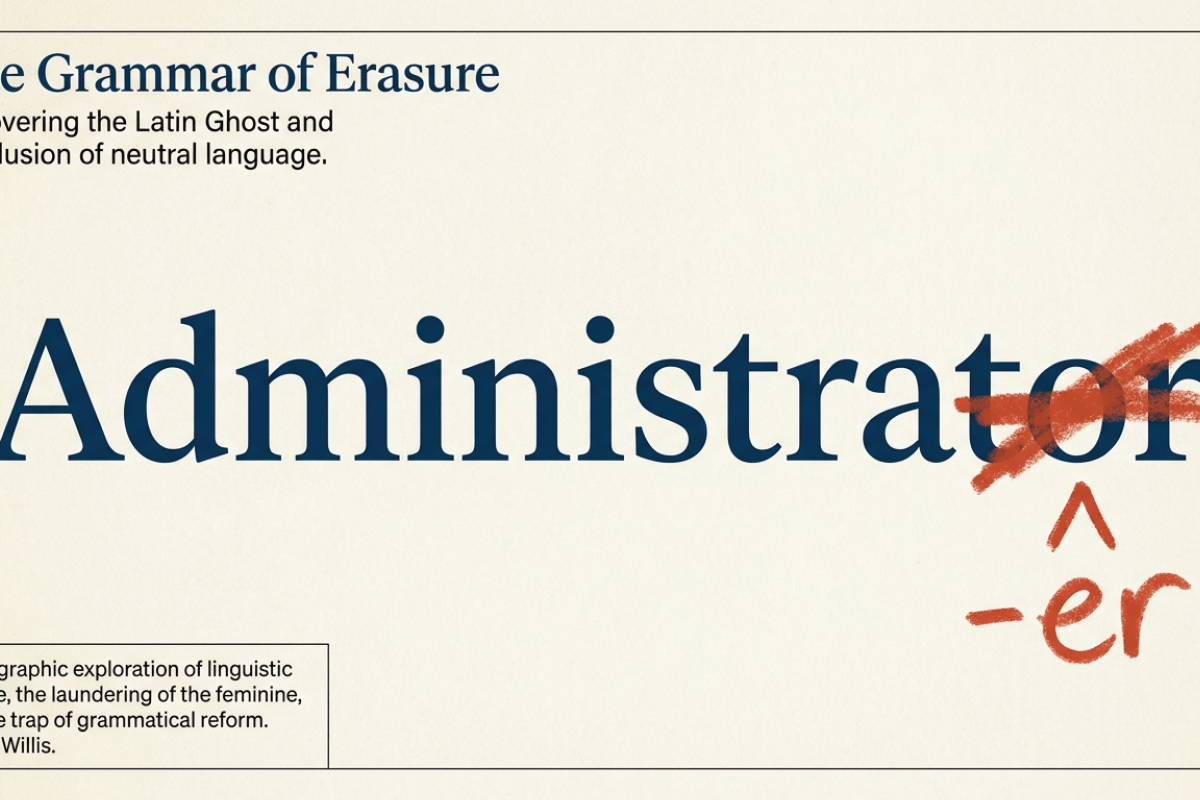
My initial thought was to rid the English language of administrators and dominatrices. Of course, I instantly considered French, and I write about that as well.
Here, I want to discuss the rift in Feminism:
One faction feels that we should eliminate sexist terms in the Modern world. This is where I was coming from.
Another faction claims this is a way of not being absorbed into an already male-dominated, dare I say, patriarchal culture.
Hence the title of this post.
If we were to swap or consolidate administrator and the less common administratrix into administrater in an act of rebellious conformity, women will be subsumed. As Simone de Beauvoir notes, the dominant lens is the male lens. Womanisother. As I say, this is why we have male and female versions of many, if not most, competitive sports, and certainly the professional ones. Thi sis also an instinct underlying trans-athletes competing in a contrasport – and it’s almost always about CIS-males performing in CIS-female events. I’m not aware of the contrary – and I don’t feel like looking it up. Opponents imagine fit males dressing as females in order to win some ribbons and medals, but I don’t really care to engage further in this conversational framing. I have no interest in sports, not even the World Cup being performed in my backyard.
The point is that females and other so-called minorities can be marginalised and lost to language. We preserve this identity through mechanics such as Best Actress to ensure representation.
Of course, I can also run off the reservation and down any number of rabbit holes: why don’t we have best black actor and/or actress? Why not left-handed? Height ranges? Weight ranges? Income ranges? Religious orientation? We quickly run into an intersectional challenge. I might imagine something like:
And I am proud to announce the winner of best left-handed, Asian Buddhist actress with a speech impediment
It’s easy to see where this goes off the rails – another Sorites problem hiding in plain sight.
I could go on. I won’t, but I wanted to make a point about my point. Check out the base post on Substack.
Audio: NotebookLM podcast on this topic. (in English/en anglais)
J’ai toujours aimé la langue française, depuis mon enfance. À l’université, j’ai suivi quelques semestres de français en tant qu’option libre. Même mes enfants ont été exposés à la langue dans leurs jeunes années, avec des phrases françaises glissées dans mes conversations. Mais voilà, c’était il y a longtemps ; aujourd’hui, c’est une autre histoire.
Cela fait maintenant plus de 30 ans. Bien que je capte encore des éléments de la langue de temps à autre, il y a bien longtemps que je n’ai pas regardé un film en français ou lu Le Monde. L’attrition est rapide, et c’est bien pour cela que je souhaite me remettre en selle.
Je partais souvent en voyage avec mes livres et mes albums vinyles — je sais, je suis un peu démodé — mais tout cela a été perdu dans un incendie. J’ai donc dû repartir à zéro.
Aujourd’hui, je n’ai même pas l’impression d’être un B1. Honnêtement, je dirais que viser un niveau A1 serait déjà ambitieux. Ma force a toujours été la lecture, mais mon vocabulaire en pâtit. Ensuite viennent l’écriture, suivie de l’écoute et de la parole, bien loin derrière. Bref, voici comment je compte m’y prendre pour retrouver au moins le niveau B.
Ma méthode
J’ai commencé par des matériaux de lecture basiques. Et quand je dis “basiques”, je parle de livres pour enfants. Je sais qu’il faut choisir un contenu qu’on peut lire à 98 % sans dictionnaire. Personnellement, je me permets 90 %, mais je ne cherche pas systématiquement à vérifier un mot.
Dans la pratique, je lis jusqu’au bout pour comprendre le sens global, en notant des mots ou des conjugaisons que je ne connais pas. Quand un mot m’est inconnu, je le note. Parfois, je le retrouve plus tard, et il m’éclaire. À une deuxième lecture, je cherche les mots qui restent obscurs. Comme un puzzle, tout commence à prendre sens.
Mon premier choix a été la version française du manga One Piece. Mais, comme j’avais l’impression de ne pas respecter ma règle des 90 %, j’ai vite dû abandonner. Premièrement, il y avait trop de termes maritimes à cause du thème pirate. Deuxièmement, les éléments de bande dessinée m’ont déstabilisé.
Je me suis ensuite tourné vers Le Petit Prince. Un classique, n’est-ce pas ? Eh bien, il est un peu daté. Et il ne respecte pas entièrement ma règle des 90 %, mais je persiste. En restant fidèle à ma méthode, j’ai opté pour des histoires courtes pour adultes débutants. Chaque histoire est suivie d’un résumé et de questions de compréhension, avec des réponses en français, ce qui est un bonus pour l’autocorrection.
J’ai aussi consulté des ressources en ligne pour améliorer mon écriture et ma compréhension orale. Et bien sûr, il y a trop de vidéos YouTube pour les compter.
Mon point faible reste… eh bien, mon point faible. Alors, j’ai demandé à ChatGPT des idées, histoire de ne pas avoir à engager un tuteur de langue. Petite confession : j’ai essayé une application de langue basée sur l’IA, mais je l’ai trouvée plus frustrante qu’autre chose, alors j’ai vite abandonné. ChatGPT m’a suggéré d’utiliser la fonction “saisie vocale” de Google Docs, paramétrée en français. Je l’ai testé. En lisant des passages de mes histoires disponibles, l’application comprenait parfois ce que je disais, parfois pas. Bien que cette approche ait des limites évidentes, cela m’a permis d’évaluer ma diction et de la corriger en conséquence.
Je viens de redémarrer mon parcours. J’espère trouver le temps et maintenir l’endurance nécessaires. D’ici là, voici donc le premier rapport de cette nouvelle aventure.
ENGLISH VERSION
Getting Back to French: A Journey After 30 Years
I’ve always loved the French language since I was a child. At university, I took a couple of semesters of French as free electives. I even exposed my children to it in their younger years, peppering my speech with French phrases. But that was then; this is now.
It’s been over 30 years. While I still catch bits and pieces incidentally, it’s been a long time since I watched a French-language film or read Le Monde. Attrition sets in quickly, and that’s why I want to get back in the saddle.
I used to travel with my books and record albums—dating myself, of course—but they were lost in a house fire, so I had to start over.
These days, I don’t even feel like I’m at a B1 level. Honestly, A1 feels like a stretch. My strength has always been reading, but my vocabulary has suffered. Next comes writing, followed by listening and speaking, which are far behind. Anyway, here’s my approach to getting back to at least the B-range.
My Approach
I started with basic reading materials. And by “basic,” I mean books for children. I understand that one should choose content they can read 98% of without using a dictionary. I allow myself 90%, but I don’t reach for one anyway.
In practice, I read to the end for comprehension, marking words or conjugations I don’t know. If I come across a word I don’t know, I make a note of it. Sometimes I’ll see it again, and it will click. On a second pass, I’ll look up any still-unknown words. Like a puzzle, it starts coming together and making sense.
My first choice was the French version of the One Piece manga. But, as I wasn’t following the 90% rule, I quickly had to abandon it. First, there were too many nautical terms because of the pirate theme. Second, the comic book elements threw me off.
Next, I thought of Le Petit Prince. A classic, right? Well, it’s a bit dated. And it doesn’t fully adhere to my 90% rule, but I persist. Staying true to my method, I grabbed some A1 short stories for adult beginners. Each one is followed by a summary and comprehension questions, with answers in French, which is a nice bonus for self-correction.
I’ve also engaged with some online resources for writing and listening comprehension. And, of course, there are too many YouTube videos to count.
My weakest link is still… well, my weakest link. So, I asked ChatGPT for ideas short of hiring a language tutor. Full disclosure: I tried a language-learning AI app and found it more frustrating than not, so I ditched it. ChatGPT suggested using the voice typing feature in Google Docs set to French. I tried it. Reading passages from my available stories, the app sometimes understood me, sometimes didn’t. Whilst there are clear limitations to this approach, it allowed me to assess my French pronunciation and correct it accordingly.
I’ve just restarted my journey. I hope to find the time and maintain the stamina. Until then, this is my documentation of step one.

 Philosophics