The Rhetoric of Realism: When Language Pretends to Know

Let us begin with the heresy: Truth is a rhetorical artefact. Not a revelation. Not a metaphysical essence glimmering behind the veil. Just language — persuasive, repeatable, institutionally ratified language. In other words: branding.

Audio: NotebookLM podcast on this topic.

This is not merely a postmodern tantrum thrown at the altar of Enlightenment rationalism. It is a sober, if impolite, reminder that nearly everything we call “knowledge” is stitched together with narrative glue and semantic spit. Psychology. Neuroscience. Ethics. Economics. Each presents itself as a science — or worse, a moral imperative — but their foundations are built atop a linguistic faultline. They are, at best, elegant approximations; at worst, dogma in drag.

Let’s take psychology. Here is a field that diagnoses your soul via consensus. A committee of credentialed clerics sits down and declares a cluster of behaviours to be a disorder, assigns it a code, and hands you a script. It is then canonised in the DSM, the Diagnostic Scripture Manual. Doubt its legitimacy and you are either naïve or ill — which is to say, you’ve just confirmed the diagnosis. It’s a theological trap dressed in the language of care.

Or neuroscience — the church of the glowing blob. An fMRI shows a region “lighting up” and we are meant to believe we’ve located the seat of love, the anchor of morality, or the birthplace of free will. Never mind that we’re interpreting blood-oxygen fluctuations in composite images smoothed by statistical witchcraft. It looks scientific, therefore it must be real. The map is not the territory, but in neuroscience, it’s often a mood board.

And then there is language itself, the medium through which all these illusions are transmitted. It is the stage, the scenery, and the unreliable narrator. My Language Insufficiency Hypothesis proposes that language is not simply a flawed tool — it is fundamentally unfit for the task it pretends to perform. It was forged in the furnace of survival, not truth. We are asking a fork to play the violin.

This insufficiency is not an error to be corrected by better definitions or clever metaphors. It is the architecture of the system. To speak is to abstract. To abstract is to exclude. To exclude is to falsify. Every time we speak of a thing, we lose the thing itself. Language functions best not as a window to the real but as a veil — translucent, patterned, and perpetually in the way.

So what, then, are our Truths™? They are narratives that have won. Stories that survived the epistemic hunger games. They are rendered authoritative not by accuracy, but by resonance — psychological, cultural, institutional. A “truth” is what is widely accepted, not because it is right, but because it is rhetorically unassailable — for now.

This is the dirty secret of epistemology: coherence masquerades as correspondence. If enough concepts link arms convincingly, we grant them status. Not because they touch reality, but because they echo each other convincingly in our linguistic theatre.

Libet’s experiment, Foucault’s genealogies, McGilchrist’s hemispheric metaphors — each peels back the curtain in its own way. Libet shows that agency might be a post-hoc illusion. Foucault reveals that disciplines don’t describe the subject; they produce it. McGilchrist laments that the Emissary now rules the Master, and the world is flatter for it.

But all of them — and all of us — are trapped in the same game: the tyranny of the signifier. We speak not to uncover truth, but to make truth-sounding noises. And the tragedy is, we often convince ourselves.

So no, we cannot escape the prison of language. But we can acknowledge its bars. And maybe, just maybe, we can rattle them loudly enough that others hear the clank.

Until then, we continue — philosophers, scientists, diagnosticians, rhetoricians — playing epistemology like a parlour game with rigged dice, congratulating each other on how well the rules make sense.

And why wouldn’t they? We wrote them.

The Indexing Abyss: A Cautionary Tale in Eight Chapters

There, I said it.

I’m almost finished with A Language Insufficiency Hypothesis, the book I’ve been labouring over for what feels like the gestation period of a particularly reluctant elephant. To be clear: the manuscript is done. Written. Edited. Blessed. But there remains one final circle of publishing hell—the index.

Now, if you’re wondering how motivated I am to return to indexing, consider this: I’m writing this blog post instead. If that doesn’t scream avoidance with an airhorn, nothing will.

Audio: NotebookLM podcast on this topic.

I began indexing over a month ago. I made it through two chapters of eight, then promptly wandered off to write a couple of novellas. As you do. One started as a short story—famous last words—and evolved into a novella. The muse struck again. Another “short story” appeared, and like an unattended sourdough starter, it fermented into a 15,000-word novelette. Apparently, I write short stories the way Americans pour wine: unintentionally generous.

With several unpublished manuscripts loitering on my hard drive like unemployed theatre majors, I figured it was time to release one into the wild. So I did. I published the novelette to Kindle, and just today, the paperback proof landed in my postbox like a smug little trophy.

And then, because I’m an unrepentant completionist (or a masochist—jury’s out), I thought: why not release the novella too? I’ve been told novellas and novelettes are unpopular due to “perceived value.” Apparently, people would rather buy a pound of gristle than 200 grams of sirloin. And yet, in the same breath, they claim no one has time for long books anymore. Perhaps these are different tribes of illiterates. I suppose we’ll find out.

Let’s talk logistics. Writing a book is only the beginning—and frankly, it’s the easy part. Fingers to keyboard, ideas to page. Done. I use Word, like most tragically conventional authors. Planning? Minimal. These were short stories, remember? That was the plan.

Next comes layout. Enter Adobe InDesign—because once you’ve seen what Word does to complex layouts, you never go back. Export to PDF, pray to the typographic gods, and move on.

Then there’s the cover. I lean on Illustrator and Photoshop. Photoshop is familiar, like a worn-in shoe; Illustrator is the smug cousin who turns up late but saves the day with scalable vectors. This time, I used Illustrator for the cover—lesson learnt from past pixelation traumas. Hardback to paperback conversion? A breeze when your artwork isn’t made of crayon scribbles and hope.

Covers, in case you’ve never assembled one, are ridiculous. Front. Back. Spine. Optional dust jacket if you’re feeling fancy (I wasn’t). You need titles, subtitles, your name in a legible font, and let’s not forget the barcode, which you will place correctly on the first attempt exactly never.

Unlike my first novel, where I enlisted someone with a proper design eye to handle the cover text, this time I went full minimalist. Think Scandinavian furniture catalogue meets existential despair. Classy.

Once the cover and interior are done, it’s time to wrestle with the publishing platforms. Everything is automated these days—provided you follow their arcane formatting commandments, avoid forbidden fonts, and offer up your soul. Submitting each book takes about an hour, not including the time lost choosing a price that balances “undervalued labour” and “won’t scare away cheapskates.”

Want a Kindle version? That’s another workflow entirely, full of tortured formatting, broken line breaks, and wondering why your chapter headings are now in Wingdings. Audiobooks? That’s a whole other circus, with its own animals and ringmasters. Honestly, it’s no wonder authors hire publishers. Or develop drinking problems.

But I’m stubborn. Which brings us full circle.

I’ve now got two books heading for daylight, a few more waiting in the wings, and one bloody non-fiction beast that won’t see release until I finish the damn index. No pseudonym this time. No hiding. Just me, owning my sins and hoping the final product lands somewhere between “insightful” and “mercifully short.”

So yes, life may well be a journey. But indexing is the bit where the satnav breaks, the road floods, and the boot falls off the car. Give me the destination any day. The journey can fuck right off.

Sustenance: A Book About Aliens, Language, and Everything You’re Getting Wrong

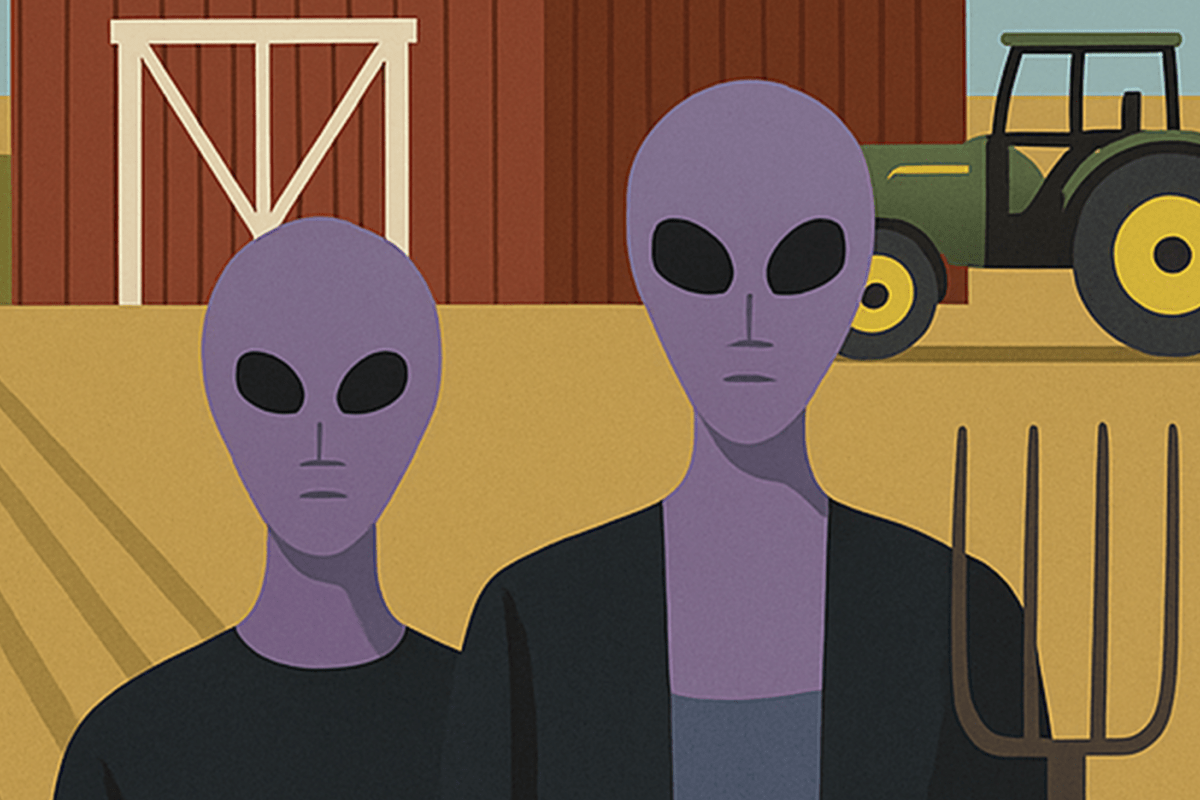
Violet aliens on a farm

So, I wrote a book and published it under Ridley Park, the pseudonym I use for fiction.

It has aliens. But don’t get excited—they’re not here to save us, probe us, or blow up the White House. They’re not even here for us.

Which is, frankly, the point.

Audio: NotebookLM podcast on this topic.

The book’s called Sustenance, and while it’s technically speculative fiction, it’s more about us than them. Or rather, it’s about how we can’t stop making everything about us—even when it shouldn’t be. Especially when it shouldn’t be.

Let’s talk themes. And yes, we’re using that word like academics do: as a smokescreen for saying uncomfortable things abstractly.

Language: The Original Scam

Language is the ultimate colonial tool. We call it communication, but it’s mostly projection. You speak. You hope. You assume. You superimpose meaning on other people like a cling film of your own ego.

Sustenance leans into this—not by showing a breakdown of communication, but by showing what happens when communication was never mutual in the first place. When the very idea of “meaning” has no purchase. It’s not about mishearing—it’s about misbeing.

Culture: A Meme You Were Born Into

Culture is the software you didn’t choose to install, and probably can’t uninstall. Most people treat it like a universal law—until they meet someone running a different OS. Cue confusion, arrogance, or violence.

The book explores what happens when cultural norms aren’t shared, and worse, aren’t even legible. Imagine trying to enforce property rights on beings who don’t understand “ownership.” It’s like trying to baptise a toaster.

Sex/Gender: You Keep Using Those Words…

One of the quiet joys of writing non-human characters is discarding human assumptions about sex and gender—and watching readers squirm.

What if sex wasn’t about power, pleasure, or identity? What if it was just a biological procedure, like cell division or pruning roses? Would you still be interested? Would you still moralise about it?

We love to believe our sex/gender constructs are inevitable. They’re not. They’re habits—often bad ones.

Consent: Your Framework Is Showing

Consent, as we use it, assumes mutual understanding, shared stakes, and equivalent agency. Remove any one of those and what’s left?

Sustenance doesn’t try to solve this—it just shows what happens when those assumptions fall apart. Spoiler: it’s not pretty, but it is honest.

Projection: The Mirror That Lies

Humans are deeply committed to anthropocentrism. If it walks like us, or flinches like us, it must be us. This is why we get so disoriented when faced with the truly alien: it won’t dance to our tune, and we’re left staring at ourselves in the funhouse mirror.

This isn’t a book about aliens.

It’s a book about the ways we refuse to see what’s not us.

Memory: The Autobiography of Your Justifications

Memory is not a record. It’s a defence attorney with a narrative license. We rewrite the past to make ourselves look consistent, or innocent, or right.

In Sustenance, memory acts less as a tether to truth and more as a sculpting tool—a way to carve guilt into something manageable. Something you can live with. Until you can’t.

In Summary: It’s Not About Them. It’s About You.

If that sounds bleak, good. It’s meant to.

But it’s also a warning: don’t get too comfortable in your own categories. They’re only universal until you meet someone who doesn’t share them.

Like I said, it’s not really about the aliens.

It’s about us.


If you enjoy fiction that’s more unsettling than escapist, more question than answer, you might be interested in Sustenance. It’s live on Kindle now for the cost of a regrettable coffee:

📘 Sustenance on Amazon US
Also available in the UK, DE, FR, ES, IT, NL, JP, BR, CA, MX, AU, and IN—because alienation is a universal language.

On Ishiguro, Cioran, and Whatever I Think I’m Doing

Sora-generated image of Emil Cioran and Kazuo Ishiguro reading a generic book together

Having just finished Never Let Me Go by Kazuo Ishiguro, I’ve now cracked open my first taste of Cioran—History and Utopia. You might reasonably ask why. Why these two? And what, if anything, do they have in common? Better yet—what do the three of us have in common?

Audio: NotebookLM podcast on this topic.

Recently, I finished writing a novella titled Propensity (currently gathering metaphorical dust on the release runway). Out of curiosity—or narcissism—I fed it to AI and asked whose style it resembled. Among the usual suspects were two names I hadn’t yet read: Ishiguro and Cioran. I’d read the others and understood the links. These two, though, were unknown quantities. So I gave them a go.

Ishiguro is perhaps best known for The Remains of the Day, which, like Never Let Me Go, got the Hollywood treatment. I chose the latter, arbitrarily. I even asked ChatGPT to compare both books with their cinematic counterparts. The AI was less than charitable, describing Hollywood’s adaptations as bastardised and bowdlerised—flattened into tidy narratives for American palates too dim to digest ambiguity. On this, we agree.

What struck me about Never Let Me Go was its richly textured mundanity. That’s apparently where AI saw the resemblance to Propensity. I’m not here to write a book report—partly because I detest spoilers, and partly because summaries miss the point. It took about seven chapters before anything ‘happened’, and then it kept happening. What had at first seemed like a neurotic, wandering narrative from the maddeningly passive Kathy H. suddenly hooked me. The reveals began to unfold. It’s a book that resists retelling. It demands firsthand experience. A vibe. A tone. A slow, aching dread.

Which brings me neatly to Cioran.

History and Utopia is a collection of essays penned in French (not his mother tongue, but you’d never guess it) while Cioran was holed up in postwar Paris. I opted for the English translation—unapologetically—and was instantly drawn in. His prose? Electric. His wit? Acidic. If Ishiguro was a comparison of style, then Cioran was one of spirit. Snark, pessimism, fatalistic shrugs toward civilisation—finally, someone speaking my language.

Unlike the cardboard cut-outs of Cold War polemics we get from most Western writers of the era, Cioran’s take is layered, uncomfortably self-aware, and written by someone who actually fled political chaos. There’s no naïve idealism here, no facile hero-villain binaries. Just a deeply weary intellect peering into the abyss and refusing to blink. It’s not just what he says, but the tone—the curled-lip sneer at utopian pretensions and historical self-delusions. If I earned even a drop of that comparison, I’ll take it.

Both Ishiguro and Cioran delivered what I didn’t know I needed: the reminder that some writers aren’t there to tell you a story. They’re there to infect you with an atmosphere. An idea. A quiet existential panic you can’t shake.

I’ve gotten what I came for from these two, though I suspect I’ll be returning, especially to Cioran. Philosophically, he’s my kind of bastard. I doubt this’ll be my last post on his work.

“Trust the Science,” They Said. “It’s Reproducible,” They Lied.

—On Epistemology, Pop Psychology, and the Cult of Empirical Pretence

Science, we’re told, is the beacon in the fog – a gleaming lighthouse of reason guiding us through the turbulent seas of superstition and ignorance. But peer a bit closer, and the lens is cracked, the bulb flickers, and the so-called lighthouse keeper is just some bloke on TikTok shouting about gut flora and intermittent fasting.

Audio: NotebookLM podcast on this topic.

We are creatures of pattern. We impose order. We mistake correlation for causation, narrative for truth, confidence for knowledge. What we have, in polite academic parlance, is an epistemology problem. What we call science is often less Newton and more Nostradamus—albeit wearing a lab coat and wielding a p-hacked dataset.

Let’s start with the low-hanging fruit—the rotting mango of modern inquiry: nutritional science, which is to actual science what alchemy is to chemistry, or vibes are to calculus. We study food the way 13th-century monks studied demons: through superstition, confirmation bias, and deeply committed guesswork. Eat fat, don’t eat fat. Eat eggs, don’t eat eggs. Eat only between the hours of 10:00 and 14:00 under a waxing moon while humming in Lydian mode. It’s a cargo cult with chia seeds.

But why stop there? Let’s put the whole scientific-industrial complex on the slab.

Psychology: The Empirical Astrological Society

Psychology likes to think it’s scientific. Peer-reviewed journals, statistical models, the odd brain scan tossed in for gravitas. But at heart, much of it is pop divination, sugar-dusted for mass consumption. The replication crisis didn’t merely reveal cracks – it bulldozed entire fields. The Stanford Prison Experiment? A theatrical farce. Power poses? Empty gestural theatre. Half of what you read in Psychology Today could be replaced with horoscopes and no one would notice.

Medical Science: Bloodletting, But With Better Branding

Now onto medicine, that other sacred cow. We tend to imagine it as precise, data-driven, evidence-based. In practice? It’s a Byzantine fusion of guesswork, insurance forms, and pharmaceutical lobbying. As Crémieux rightly implies, medicine’s predictive power is deeply compromised by overfitting, statistical fog, and a staggering dependence on non-replicable clinical studies, many funded by those who stand to profit from the result.

And don’t get me started on epidemiology, that modern priesthood that speaks in incantations of “relative risk” and “confidence intervals” while changing the commandments every fortnight. If nutrition is theology, epidemiology is exegesis.

The Reproducibility Farce

Let us not forget the gleaming ideal: reproducibility, that cornerstone of Enlightenment confidence. The trouble is, in field after field—from economics to cancer biology—reproducibility is more aspiration than reality. What we actually get is a cacophony of studies no one bothers to repeat, published to pad CVs, p-hacked into publishable shape, and then cited into canonical status. It’s knowledge by momentum. We don’t understand the world. We just retweet it.

What, Then, Is To Be Done?

Should we become mystics? Take up tarot and goat sacrifice? Not necessarily. But we should strip science of its papal robes. We should stop mistaking publication for truth, consensus for accuracy, and method for epistemic sanctity. The scientific method is not the problem. The pretence that it’s constantly being followed is.

Perhaps knowledge doesn’t have a half-life because of progress, but because it was never alive to begin with. We are not disproving truth; we are watching fictions expire.

Closing Jab

Next time someone says “trust the science,” ask them: which bit? The part that told us margarine was manna? The part that thought ulcers were psychosomatic? The part that still can’t explain consciousness, but is confident about your breakfast?

Science is a toolkit. But too often, it’s treated like scripture. And we? We’re just trying to lose weight while clinging to whatever gospel lets us eat more cheese.

Varoufakis Solves Zeno’s Paradox

Having finished Technofeudalism, I’ve moved on to Society of the Spectacle, which has me thinking.

They say no one escapes the Spectacle. Guy Debord made sure of that. His vision was airtight, his diagnosis terminal: we are all spectators now, alienated from our labour, our time, our own damn lives. It was a metaphysical mugging—existence held hostage by images, by commodities dressed in drag. The future was a feedback loop, and we were all doomed to applaud.

Audio: NotebookLM podcast on this topic. Apologies in advance for the narrators’ mangling of the pronunciation of ‘Guy Debord’.

But what if the loop could be hacked?
What if the infinitely halved distances of motionless critique—Zeno’s Paradox by way of Marx—could finally be crossed?

Enter: Yanis Varoufakis.
Economist, ex-finance minister, techno-cassandra with a motorbike and a vendetta.
Where Debord filmed the catastrophe in black-and-white, Varoufakis showed up with the source code.

Debord’s Limbo

Debord saw it all coming. The substitution of reality with its photogenic simulacrum. The slow death of agency beneath the floodlights of consumption. But like Zeno’s paradox, he could only gesture toward the end without ever reaching it. Each critique halved the distance to liberation but never arrived. The Spectacle remained intact, omnipresent, and self-replicating—like an ontological screensaver.

He gave us no path forward, only a beautiful, ruinous analysis. A Parisian shrug of doom.

Varoufakis’ Shortcut

But then comes Varoufakis, breaking through the digital labyrinth not by philosophising the Spectacle, but by naming its successor: Technofeudalism.

See, Debord was chasing a moving target—a capitalism that morphed from industrial to financial to semiotic faster than his prose could crystallise. But Varoufakis caught it mid-mutation. He pinned it to the slab and sliced it open. What spilled out wasn’t capital anymore—it was rent. Platform rent. Algorithmic tolls. Behavioural taxes disguised as convenience. This isn’t the market gone mad—it’s the market dissolved, replaced by code-based fiefdoms.

The paradox is resolved not by reaching utopia, but by realising we’ve already crossed the line—we just weren’t told. The market isn’t dying; it’s already dead, and we’re still paying funeral costs in monthly subscriptions and attention metrics.

From Spectacle to Subjugation

Debord wanted to unmask the performance.
Varoufakis realised the theatre had been demolished and replaced with a server farm.

You don’t watch the Spectacle anymore. It watches you.
It optimises you.
It learns your keystrokes, your pulse rate, your browsing history.
Welcome to feudal recursion, where Amazon is your landlord, Google your priest, and Meta your confessor.

Solving Zeno the Varoufakis Way

So how does one cross the infinite regress of alienation?
Simple. You call it what it is. You reclassify the terrain.

“This is not capitalism,” Varoufakis says, in the tone of a man pulling a mask off a Scooby-Doo villain.
“It’s technofeudalism. Capital didn’t win. It went feudal. Again.”

By doing so, he bypasses the academic ballet that has critics forever inching closer to the truth without touching it. He calls the system new, not to sell books, but to make strategy possible. Because naming a beast is the first step in slaying it.

In Conclusion: Debord Dreamed, Varoufakis Drives

Debord haunts the museum.
Varoufakis raids the server room.
Both are essential. But only one gives us a new map.

The Spectacle hypnotised us.
Technofeudalism enslaves us.
And if there’s a way out, it won’t be through slogans spray-painted on Parisian walls. It will be built in code, deployed across decentralised networks, and carried forward by those who remember what it meant to be not watched.

Let Debord whisper. Let Varoufakis roar.
And let the rest of us sharpen our blades.

Questioning Traditional Families

I neither champion nor condemn tradition—whether it’s marriage, family, or whatever dusty relic society is currently parading around like a prize marrow at a village fête.

Audio: NotebookLM podcast on traditional families.

In a candid group conversation recently, I met “Jenny”, who declared she would have enjoyed her childhood much more had her father not “ruined everything” simply by existing. “Marie” countered that it was her mother who had been the wrecker-in-chief. Then “Lulu” breezed in, claiming, “We had a perfect family — we practically raised ourselves.”

Now, here’s where it gets delicious:

Each of these women, bright-eyed defenders of “traditional marriage” and “traditional family” (cue the brass band), had themselves ticked every box on the Modern Chaos Bingo Card: children out of wedlock? Check. Divorces? Check. Performative, cold-marriage pantomimes? Absolutely—and scene.
Their definition of “traditional marriage” is the vintage model: one cis-male, one cis-female, Dad brings home the bacon, Mum weeps quietly into the washing-up. Standard.

Let’s meet the players properly:

Jenny sprang from a union of two serial divorcées, each dragging along the tattered remnants of previous families. She was herself a “love child,” born out of wedlock and “forcing” another reluctant stroll down the aisle. Her father? A man of singular achievements: he paid the bills and terrorised the household. Jenny now pays a therapist to untangle the psychological wreckage.

Marie, the second of two daughters, was the product of a more textbook “traditional family”—if by textbook you mean a Victorian novel where everyone is miserable but keeps a stiff upper lip about it. Her mother didn’t want children but acquiesced to her husband’s demands (standard operating procedure at the time). Marie’s childhood was a kingdom where Daddy was a demigod and Mummy was the green-eyed witch guarding the gates of hell.

Lulu grew up in a household so “traditional” that it might have been painted by Hogarth: an underemployed, mostly useless father and a mother stretched thinner than the patience of a British Rail commuter. Despite—or because of—the chaos, Lulu claims it was “perfect,” presumably redefining the word in a way the Oxford English Dictionary would find hysterical. She, too, had a child out of wedlock, with the explicit goal of keeping feckless men at bay.

And yet—and yet—all three women cling, white-knuckled, to the fantasy of the “traditional family.” They did not achieve stability. Their families of origin were temples of dysfunction. But somehow, the “traditional family” remains the sacred cow, lovingly polished and paraded on Sundays.

Why?

Because what they’re chasing isn’t “tradition” at all — it’s stability, that glittering chimera. It’s nostalgia for a stability they never actually experienced. A mirage constructed from second-hand dreams, glossy 1950s propaganda, and whatever leftover fairy tales their therapists hadn’t yet charged them £150 an hour to dismantle.

Interestingly, none of them cared two figs about gay marriage, though opinions about gay parenting varied wildly—a kettle of fish I’ll leave splashing outside this piece.

Which brings us back to the central conundrum:

If lived experience tells you that “traditional family” equals trauma, neglect, and thinly-veiled loathing, why in the name of all that’s rational would you still yearn for it?

Societal pressure, perhaps. Local customs. Generational rot. The relentless cultural drumbeat that insists that marriage (preferably heterosexual and miserable) is the cornerstone of civilisation.

Still, it’s telling that Jenny and Marie were both advised by therapists to cut ties with their toxic families—yet in the same breath urged to create sturdy nuclear families for their own children. It was as if summoning a functional household from the smoking ruins of dysfunction were a simple matter of willpower and a properly ironed apron.

Meanwhile, Lulu—therapy-free and stubbornly independent—declares that raising oneself in a dysfunctional mess is not only survivable but positively idyllic. One can only assume her standards of “perfect” are charmingly flexible.

As the title suggests, this piece questions traditional families. I offer no solutions—only a raised eyebrow and a sharper question:

What is the appeal of clinging to a fantasy so thoroughly at odds with reality?
Your thoughts, dear reader? I’d love to hear your defences, your protests, or your own tales from the trenches.

Bullshit Jobs

I’ve recently decided to take a sabbatical from what passes for economic literature these days — out of a sense of self-preservation, mainly — but before I hermetically sealed myself away, I made a quick detour through Jorge Luis Borges’ The Library of Babel (PDF). Naturally, I emerged none the wiser, blinking like some poor subterranean creature dragged into the daylight, only to tumble headlong into David Graeber’s Bullshit Jobs.

This particular tome had been languishing in my inventory since its release, exuding a faint but persistent odour of deferred obligation. Now, about a third of the way in, I can report that Graeber’s thesis — that the modern world is awash with soul-annihilatingly pointless work — does resonate. I find myself nodding along like one of those cheap plastic dashboard dogs. Yet, for all its righteous fury, it’s more filler than killer. Directionally correct? Probably. Substantively airtight? Not quite. It’s a bit like admiring a tent that’s pitched reasonably straight but has conspicuous holes large enough to drive a fleet of Uber Eats cyclists through.

An amusing aside: the Spanish edition is titled Trabajos de mierda (“shitty jobs”), a phrase Graeber spends an entire excruciating section of the book explaining is not the same thing. Meanwhile, the French, in their traditional Gallic shrug, simply kept the English title. (One suspects they couldn’t be arsed.)

Chapter One attempts to explain the delicate taxonomy: bullshit jobs are fundamentally unnecessary — spawned by some black magic of bureaucracy, ego, and capitalist entropy — whilst shit jobs are grim, thankless necessities that someone must do, but no one wishes to acknowledge. Tragically, some wretches get the worst of both worlds, occupying jobs that are both shit and bullshit — a sort of vocational purgatory for the damned.

Then, in Chapter Two, Graeber gleefully dissects bullshit jobs into five grotesque varieties:

  1. Flunkies, whose role is to make someone else feel important.
  2. Goons, who exist solely to fight other goons.
  3. Duct Tapers, who heroically patch problems that ought not to exist in the first place.
  4. Box Tickers, who generate paperwork to satisfy some Kafkaesque demand that nobody actually reads.
  5. Taskmasters, who either invent unnecessary work for others or spend their days supervising people who don’t need supervision.

Naturally, real-world roles often straddle several categories. Lucky them: multi-classed in the RPG of Existential Futility.

Graeber’s parade of professional despair is, admittedly, darkly entertaining. One senses he had a great deal of fun cataloguing these grotesques — like a medieval monk illustrating demons in the margins of a holy text — even as the entire edifice wobbles under the weight of its own repetition. Yes, David, we get it: the modern economy is a Potemkin village of invented necessity. Carry on.

If the first chapters are anything to go by, the rest of the book promises more righteous indignation, more anecdotes from anonymous sad-sacks labouring in existential oubliettes, and — if one is lucky — perhaps a glimmer of prescription hidden somewhere amidst the diagnosis. Though, I’m not holding my breath. This feels less like an intervention and more like a well-articulated primal scream.

Still, even in its baggier moments, Bullshit Jobs offers the grim pleasure of recognition. If you’ve ever sat through a meeting where the PowerPoint had more intellectual integrity than the speaker or spent days crafting reports destined for the corporate oubliette marked “For Review” (translation: Never to Be Seen Again), you will feel seen — in a distinctly accusatory, you-signed-up-for-this sort of way.

In short: it’s good to read Graeber if only to have one’s vague sense of societal derangement vindicated in print. Like having a charmingly irate friend in the pub lean over their pint and mutter, “It’s not just you. It’s the whole bloody system.”

I’m not sure I’ll stick with this title either. I think I’ve caught the brunt of the message, and it feels like a diversion. I’ve also got Yanis Varoufakis’ Technofeudalism: What Killed Capitalism on the shelf. Perhaps I’ll spin this one up instead.

Lies as Shibboleth

Watching Sam Harris ruminate on the nature of political lies (still believing, poor lamb, that reason might one day triumph) reminds me of something more sinister: lies today are not attempts at persuasion. They are shibboleths — tribal passwords, loyalty oaths, secret handshakes performed in the broad light of day.

Video: Sam Harris tells us why Trump and his ilk lie.

Forget “alternative facts.” That charming euphemism was merely a decoy, a jangling set of keys to distract the infantile media. The real game was always deeper: strategic distortion, the deliberate blurring of perception not to deceive the outsider, but to identify the insider.

Audio: NotebookLM podcast on this topic.

When Trump — or any other post-truth demagogue — proclaims that penguins are, in fact, highly trained alien operatives from the Andromeda galaxy, the objective is not persuasion. The point is to force a choice: will you, standing before this glistening absurdity, blink and retreat into reason, stammering something about ornithology… Or will you step forward, clasp the hand of madness, and mutter, ‘Yes, my liege, the penguins have been among us all along’?

Those who demur, those who scoff or gasp or say ‘You’re an idiot,”’have failed the loyalty test. They have outed themselves as enemy combatants in the epistemic war. Truth, in this brave new world, is not a destination; it is an allegiance. To speak honestly is to wage rebellion.

Orwell, who tried very hard to warn us, understood this dynamic well: the real triumph of Big Brother was not merely to compel you to lie but to compel you to believe the lie. Koestler, another battered prophet of the age, charted how political movements sink into ritualistic unreason, demanding not conviction but performance. Swift, for his part, knew it was all hilarious if you tilted your head just right.

The bigger the lie, the better the shibboleth. Claim that two and two make five, and you catch out the weak-willed rationalists. Claim that penguins are extraterrestrials, and you find the truly devoted, the ones willing to build altars from ice and sacrifice to their feathery overlords.

It’s no accident that modern political theatre resembles a deranged initiation ritual. Each day brings a new absurdity, a fresh madness to affirm: ‘Men can become women by declaration alone!” “Billionaires are victims of systemic oppression!’ ‘The penguins are amongst us, plotting!’ Each claim a little more grotesque than the last, each compliance a little more degrading, a little more irreversible.

And oh, how eagerly the initiates rush forward! Clap for the penguins, or be cast out into the howling wilderness! Better to bend the knee to absurdity than be marked as an unbeliever. Better to humiliate yourself publicly than to admit that the Emperor’s penguin suit is just a costume.

Meanwhile, the opposition — earnest, naive — keeps trying to argue, to rebut, to point out that penguins are terrestrial flightless birds. How quaint. How pathetic. They do not understand that the moment they say, “You’re an idiot,” they’ve broken the spell, declared themselves apostates, and rendered themselves politically irrelevant.

The shibboleth, once uttered, divides the world cleanly: the believers, who will say anything, do anything, believe anything, provided it marks them safe from exile; and the infidels, who cling stupidly to reality.

The future belongs, not to the true, but to the loyal. Not to the rational, but to the ritualistic. The more extravagant the lie, the greater the proof of your faith.

So raise a glass to the penguins, ye of faint heart, and prepare your soul for abasement. Or stand firm, if you dare, and be prepared to be eaten alive by those who traded reason for the rapture of belonging.

After all, in the land of the blind, the one-eyed man is not king. He’s a heretic.


When Suspension of Disbelief Escapes the Page

Welcome to the Age of Realism Fatigue

Once upon a time — which is how all good fairy tales begin — suspension of disbelief was a tidy little tool we used to indulge in dragons, space travel, talking animals, and the idea that people in rom-coms have apartments that match their personalities and incomes. It was a temporary transaction, a gentleman’s agreement, a pact signed between audience and creator with metaphorical ink: I know this is nonsense, but I’ll play along if you don’t insult my intelligence.

Audio: NotebookLM podcast of this page content.

This idea, famously coined by Samuel Taylor Coleridge as the “willing suspension of disbelief,” was meant to give art its necessary air to breathe. Coleridge’s hope was that audiences would momentarily silence their rational faculties in favour of emotional truth. The dragons weren’t real, but the heartbreak was. The ghosts were fabrications, but the guilt was palpable.

But that was then. Before the world itself began auditioning for the role of absurdist theatre. Before reality TV became neither reality nor television. Before politicians quoted memes, tech CEOs roleplayed as gods, and conspiracy theorists became bestsellers on Amazon. These days, suspension of disbelief is no longer a leisure activity — it’s a survival strategy.

The Fictional Contract: Broken but Not Forgotten

Traditionally, suspension of disbelief was deployed like a visitor’s badge. You wore it when entering the imagined world and returned it at the door on your way out. Fiction, fantasy, speculative fiction — they all relied on that badge. You accepted the implausible if it served the probable. Gandalf could fall into shadow and return whiter than before because he was, after all, a wizard. We were fine with warp speed as long as the emotional logic of Spock’s sacrifice made sense. There were rules — even in rule-breaking.

The genres varied. Hard sci-fi asked you to believe in quantum wormholes but not in lazy plotting. Magical realism got away with absurdities wrapped in metaphor. Superhero films? Well, their disbelief threshold collapsed somewhere between the multiverse and the Bat-credit card.

Still, we always knew we were pretending. We had a tether to the real, even when we floated in the surreal.

But Then Real Life Said, “Hold My Beer.”

At some point — let’s call it the twenty-first century — the need to suspend disbelief seeped off the screen and into the bloodstream of everyday life. News cycles became indistinguishable from satire (except that satire still had editors). Headlines read like rejected Black Mirror scripts. A reality TV star became president, and nobody even blinked. Billionaires declared plans to colonise Mars whilst democracy quietly lost its pulse.

We began to live inside a fiction that demanded that our disbelief be suspended daily. Except now, it wasn’t voluntary. It was mandatory. If you wanted to participate in public life — or just maintain your sanity — you had to turn off some corner of your rational mind.

You had to believe, or pretend to, that the same people calling for “freedom” were banning books. That artificial intelligence would definitely save us, just as soon as it was done replacing us. That social media was both the great democratiser and the sewer mainline of civilisation.

The boundary between fiction and reality? Eroded. Fact-checking? Optional. Satire? Redundant. We’re all characters now, improvising in a genreless world that refuses to pick a lane.

Cognitive Gymnastics: Welcome to the Cirque du Surréalisme

What happens to a psyche caught in this funhouse? Nothing good.

Our brains, bless them, were designed for some contradiction — religion’s been pulling that trick for millennia — but the constant toggling between belief and disbelief, trust and cynicism, is another matter. We’re gaslit by the world itself. Each day, a parade of facts and fabrications marches past, and we’re told to clap for both.

Cognitive dissonance becomes the default. We scroll through doom and memes in the same breath. We read a fact, then three rebuttals, then a conspiracy theory, then a joke about the conspiracy, then a counter-conspiracy about why the joke is state-sponsored. Rinse. Repeat. Sleep if you can.

The result? Mental fatigue. Not just garden-variety exhaustion, but a creeping sense that nothing means anything unless it’s viral. Critical thinking atrophies not because we lack the will but because the floodwaters never recede. You cannot analyse the firehose. You can only drink — or drown.

Culture in Crisis: A Symptom or the Disease?

This isn’t just a media problem. It’s cultural, epistemological, and possibly even metaphysical.

We’ve become simultaneously more skeptical — distrusting institutions, doubting authorities — and more gullible, accepting the wildly implausible so long as it’s entertaining. It’s the postmodern paradox in fast-forward: we know everything is a construct, but we still can’t look away. The magician shows us the trick, and we cheer harder.

In a world where everything is performance, authenticity becomes the ultimate fiction. And with that, the line between narrative and news, between aesthetic and actuality, collapses.

So what kind of society does this create?

One where engagement replaces understanding. Where identity is a curated feed. Where politics is cosplay, religion is algorithm, and truth is whatever gets the most shares. We aren’t suspending disbelief anymore. We’re embalming it.

The Future: A Choose-Your-Own-Delusion Adventure

So where does this all end?

There’s a dark path, of course: total epistemic breakdown. Truth becomes just another fandom and reality a subscription model. But there’s another route — one with a sliver of hope — where we become literate in illusion.

We can learn to hold disbelief like a scalpel, not a blindfold. To engage the implausible with curiosity, not capitulation. To distinguish between narratives that serve power and those that serve understanding.

It will require a new kind of literacy. One part media scepticism, one part philosophical rigour, and one part good old-fashioned bullshit detection. We’ll have to train ourselves not just to ask “Is this true?” but “Who benefits if I believe it?”

That doesn’t mean closing our minds. It means opening them with caution. Curiosity without credulity. Wonder without worship. A willingness to imagine the impossible whilst keeping a firm grip on the probable.

In Conclusion, Reality Is Optional, But Reason Is Not

In the age of AI, deepfakes, alt-facts, and hyperreality, we don’t need less imagination. We need more discernment. The world may demand our suspension of disbelief, but we must demand our belief back. In truth, in sense, in each other.

Because if everything becomes fiction, then fiction itself loses its magic. And we, the audience, are left applauding an empty stage.

Lights down. Curtain call.
Time to read the footnotes.