Ok. I admit this is an expansive claim, but I write about the limitations on generative artificial intelligence relative to writers. I wrote this after encountering several Reddit responses by writers who totally misunderstand how AI works. They won’t read this, but you might want to.
We’ve entered an era where machines tell us how we’re doing, whether it’s an AI app rating our résumé, a model reviewing our fiction, or an algorithm nudging our attention with like-shaped carrots.
Recently, I ran a brutally raw scene through a few AI platforms. The kind of scene that’s meant to unsettle, not entertain. One of them responded with effusive praise: “Devastating, but masterfully executed.”
Was it honest?
Was it useful?
Or was it merely reflecting my own aesthetic back at me, polished by a thousand reinforcement-learning smiles?
This is the ethical dilemma: If feedback is always flattering, what good is it? If criticism is only tolerated when couched in praise, how do we grow? And when machine feedback mimics the politeness of a mid-level manager with performance anxiety, we risk confusing validation with truth.
There’s a difference between signal and applause. Between understanding and affirmation.
The danger isn’t that AI flatters us. The danger is that we start to believe it and forget that art, inquiry, and ethics thrive on friction.
“Man is least himself when he talks in his own person. Give him a mask, and he will tell you the truth.” — Oscar Wilde
Identity is an illusion—but a necessary one. It’s a shortcut. A heuristic, evolved not for truth but for coherence. We reduce ourselves and others to fixed traits to preserve continuity—psychological, social, narrative.
Audio: NotebookLM podcast on this topic. (Spotify)
But what if continuity is a lie?
In the latest post on RidleyPark.blog, we meet Sarah—a woman who survives by splintering. She has three names, three selves, three economies of interaction. Each persona—Sarah, Stacey, and Pink—fulfils a role. Each protects her in a system that punishes complexity.
And yet, this isn’t fiction. It’s reality intensified.
Identity Is Compression
Cognitive science suggests that we don’t possess a self—we perform one. Our so-called identity is assembled post-hoc from memory, context, and social cues. It’s recursive. It’s inferred.
We are not indivisible atoms of identity. We are bundled routines, personae adapted to setting and audience.
This is not pathology. It’s strategy.
From Performance to Survival
In Needle’s Edge, Sarah doesn’t use aliases to deceive. She uses them to survive contradictions:
Stacey is desirable, stable, and profitable—so long as she appears clean and composed.
Pink is a consumer, invisible, stripped of glamour but allowed access to the block.
Sarah is the residue, the name used by those who once knew her—or still believe they do.
Each persona comes with scripts, limitations, and permissions. Sarah isn’t being dishonest. She’s practicing domain-specific identity. This is no different from how professionals code-switch at work, or how people self-edit on social media.
It’s just more raw. More urgent. Less optional.
The Literary Echo
In character development, we often demand “depth,” by which we mean contradiction. We want to see a character laugh and break. Love and lie. But Sarah shows us that contradiction isn’t depth—it’s baseline reality. Any singular identity would be a narrative failure.
Characters like Sarah expose the poverty of reduction. They resist archetype. They remind us that fiction succeeds when it reflects the multiple, the shifting, the incompatible—which is to say, the real.
What Else Might We Say?
That authenticity is a myth: “Just be yourself” presumes you know which self to be.
That moral judgment often stems from a failure to see multiple selves in others.
That trauma survivors often fracture not because they’re broken, but because fracturing is adaptive.
That in a capitalist framework, the ability to fragment and role-play becomes a survival advantage.
That fiction is one of the few spaces where we can explore multiple selves without collapse.
The Missing Link
For a concrete, narrative reflection of these ideas, this post on RidleyPark.blog explores how one woman carries three selves to survive three worlds—and what it costs her.
Oh no, not that again. As if we’ve all been composing from scratch, untouched by the grubby hands of history.
Audio: NotebookLM podcast on this topic.
I’m not simping for AI, but let’s have it out, shall we? Rick Beato—bless his fretboard-fingered soul—says AI-generated music sucks. And sure, some of it does. But here’s the punchline: most human-made music sucks too. Always has. Always will. The fact that an algorithm can now churn out mediocrity faster than a caffeinated teenager with GarageBand doesn’t make it less “art.” It just makes it faster.
I’m a bit chuffed that Rick’s channel removed my comment pointing to this response. I didn’t want to copy-paste this content into his comments section.
Video: Rick Beato discusses AI-generated music
The Myth of the Sacred Original
Newsflash: There is no such thing as originality. Not in art. Not in music. Not even in your favourite indie band’s tortured debut EP. Everything we call “creative” is a clever remix of something older. Bach reworked Vivaldi. Dylan borrowed from the blues. Even Bowie—patron saint of artistic reinvention—was a pastiche artist in a glittery jumpsuit.
What AI does is make this painfully obvious. It doesn’t pretend. It doesn’t get drunk in Berlin and write a concept album about urban decay to mask the fact it lifted its sound from Kraftwerk. It just remixes and reinterprets at inhuman speed, without the eyeliner.
Speed Isn’t Theft, It’s Efficiency
So the AI can spit out a passable ambient track in ten seconds. Great. That’s not cheating, it’s progress. Saying “it took me ten years to learn to play like that” is noble, yes, but it’s also beside the point. Horses were noble too, but we built cars.
The question isn’t how long did it take? but does it move you? If the answer is no, fine. Say it sucks. But don’t pretend your human-shaped suffering gives your song a monopoly on meaning. That’s just gatekeeping with a sad sax solo.
The Taste Problem, Not the Tech Problem
Let’s not confuse our distaste for bland music with a distaste for AI. Most of the pop charts are already AI-adjacent—click-optimised, algorithm-fed, and rigorously inoffensive. If you want soul, seek out the obscure, the imperfect, the human, yes. But don’t blame the machine for learning its craft from the sludge we fed it.
AI is only as dull as the data we give it. And guess what? We gave it Coldplay.
What’s Actually at Stake
What rattles the cage isn’t the mediocrity. It’s the mirror. AI reveals how much of our own “creativity” is pattern recognition, mimicry, and cultural reinforcement. The horror isn’t that AI can make music. It’s that it can make our music. And that it does so with such appalling accuracy.
It exposes the formula. And once you see the formula, you can’t unsee it.
Long Live the Derivative
So yes, some AI music sucks. But so do most open mic nights. Creativity was never about being wholly original. It was about saying something—anything—with whatever tools you had.
If AI is just another tool, then sharpen it, wield it, and for heaven’s sake, stop whining. The artist isn’t dead. He’s just been asked to share the stage with a faster, tireless, genre-bending freak who doesn’t need bathroom breaks.
I am not a fan of Midjourney v7. I prefer v6.1. And I want to write about the correspondence of language, per my Language Insufficiency Hypothesis.
Let’s start with the language aspect. Notice how distant the renders are from the intent of the prompt.
This is my initial prompt. I used it about a year ago to generate the cover image with v6.1, but I wanted to see how it renders in v7. Let’s take a trip all the way back to the beginning.
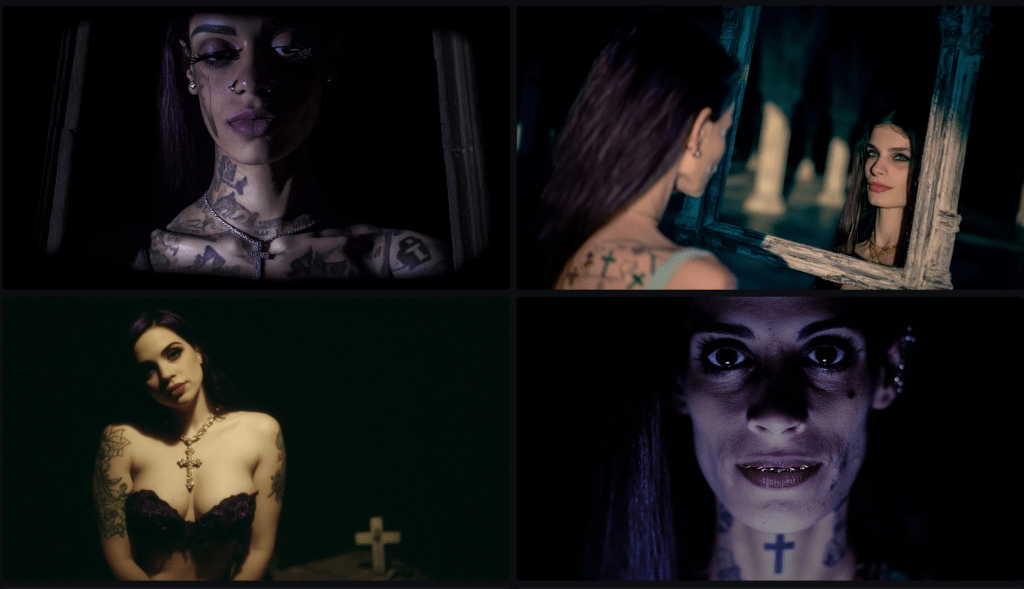
cinematic, tight shot, photoRealistic light and shadow, exquisite details, delicate features, emaciated sensual female vampire waif with vampire fangs, many tattoos, wearing crucifix necklace, gazes into mirror, a beam of moonlight shines on her face in dark mausoleum interior, toward camera, facing camera, black mascara, long dark purple hair , Kodak Portra 400 with a Canon EOS R5
Image: Midjourney v6.1 render set (from about a year ago)
As you can see, these renders are somewhat lacking in photorealism, but the “sensual” term in the prompt was not blocked.
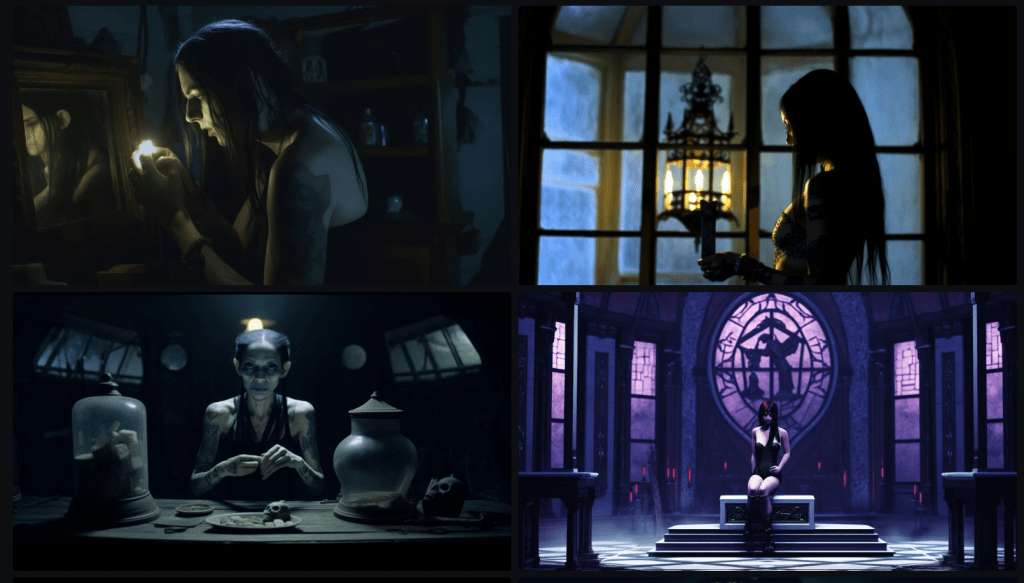
Midjourney v7
Initially, I encountered a hiccup. After a couple of rejections on the grounds of morality, I removed the word ‘sensual’ and received the output. All of the output uses this prompt absent the sensual term.
As mentioned, I have generated several images (including the cover image) with this prompt, but Midjourney is inconsistent in its censorship gatekeeping.
Image: Midjourney v7 render set
Notice that 3 of the 4 renders in the v7 set don’t even have a mirror. The top right one does, but it’s not evident that she’s a vampire. In fact, I could say that any of these are vampiresses, but perhaps that’s what they want you to believe. In place of a necklace, the lower right wokan sports a cross tattoo.
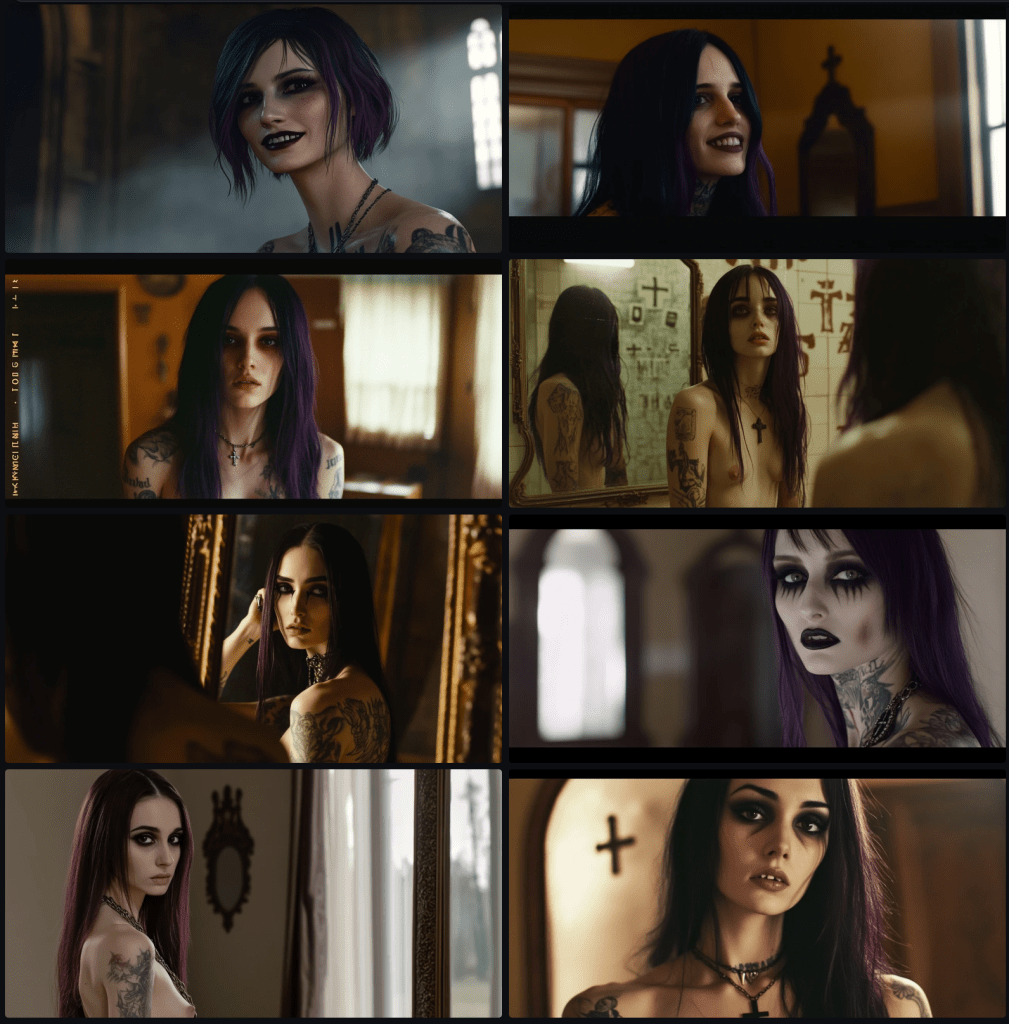
Midjourney v6.1
Image: Midjourney v6.1 render set
Again, these renders don’t appear to be vampires. The one on the lower left does appear to have snake-like fangs, so I guess I’ll give partial credit.
My next attempt was interrupted by this message.
It rendered something that might violate community guidelines. The funny thing is that one can watch the image generate in process. It only takes one “offensive” image to disqualify the whole batch.
Midjourney v6
Image: Midjourney v6 render set
Yet again, not a vampire to be found. Notice the reflection in the lower left image. Perhaps vampire reflections just behave differently.
Midjourney 5.2
Image: Midjourney v5.2 render set
Midjourney v5.2 was a crapshoot. Somehow, I got vampire lips (?), a Wiccan, a decrepit Snape from Harry Potter lore, and Iron Maiden’s Eddy reading a book. It’s something. I’m sensing gender dysphoria. Dare I go back further?
Midjourney v5.1
Image: Midjourney v5.1 render set
It gets worse. No comments necessary. Let’s turn back the clocks even more.
Midjourney v5
Image: Midjourney v5 render set
To be fair, these all do have occult undertones, but they are weak on vampireness.
Midjourney v4
Image: Midjourney v4 render set
To be fair, the render quality isn’t as bad as I expected, but it still falls short. There’s further back to travel.
Midjourney v3
Image: Midjourney v3 render set
Some configuration parameters no longer exist. Still, I persist for the sake of art and science at the cost of time and ecology.
As much as I complain – and I complain a lot – this is how far we’ve come. As I recall, this is when I hopped onto the Midjourney bandwagon. There’s still more depth to plumb. I have no idea how much of the prompt is simply ignored at this point.
Midjourney v2
Image: Midjourney v2 render set
What the hell is this? 🤔🤣 But I’m not done yet.
Midjourney v1
Image: Midjourney v1 render set
The damned grandpappy of them all. Apparently, colour hadn’t been invented yet. You can’t tell by these thumbnails, but the resolution on these early versions approaches that of a postage stamp.
Midjourney Niji 3
Image: Midjourney Niji 3 render set
I had forgotten about the Niji models from back in the day. There were 3 versions. I don’t recall where this slotted into the chronology. Obviously, not down here. I’ve only rendered the newest one. I think this was used primarily for anime outputs, but I might be mistaken.
Bones Content 1: Video
Video: Midjourney Render of Purported Vampiress
This is a video render of the same prompt used on this page.
Bonus Content 2: Midjourney v6.1 Content from 34 weeks ago
Same prompt.
Image: Midjourney v6.1 render set (several passes)
The upper left image reminds me of Kirsten Dunst. Again, notice the female breasts, highlighting Midjourney’s censorial schizophrenia.
I promise that this will not become a hub for generative AI. Rather than return to editing, I wanted to test more of Midjourney’s boundaries.
It turns out that Midjourney is selective about the nudity it renders. I was denied a render because of cleavage, but full-on topless – no problem.
Both of these videos originate from the same source image, but they take different paths. There is no accompanying video content. The setup features three women in the frame with a mechanical arm. I didn’t prompt for it. I’m not even sure of its intent. It’s just there, shadowing the women nearest to it. I don’t recall prompting for the oversized redhead in the foreground, though I may have.
In both images, note the aliasing of the tattoos on the blonde, especially on her back. Also, notice that her right arm seems shorter than it should. Her movements are jerky, as if rendered in a video game. I’m not sure what ritual the two background characters are performing, but notice in each case the prepetition. This seems to be a general feature of generative AI. It gets itself in loops, almost autistic.
Notice a few things about the top render.
Video: Midjourney render of 3 females and a mechanical arm engaging in a ritual. (9 seconds)
The first video may represent an interrogation. The blonde woman on the left appears to be a bit disoriented, but she is visually tracking the woman on the right. She seems to be saying something. Notice when the woman on the right stands. Her right foot lands unnaturally. She rather glitches.
The camera’s push and pull, and then push, seems to be an odd directorial choice, but who am I to say?
Video: Midjourney render of 3 females and a mechanical arm engaging in a ritual. (12 seconds)
The second video may represent taunting. The woman on the left still appears to be a bit disoriented, but she checks the redhead in the foreground with a glance. Notice the rocking of the two background characters, as well as the mech arm, which sways in sync with the woman on the right. This is a repetition glitch I mentioned above.
Here, the camera seems to have a syncopated relationship with the characters’ sway.
Summary
The stationary objects are well-rendered and persistent.
Assignment
Draft a short story or flash fiction using this as an inspirational prompt. I’m trying to imagine the interactions.
The ginger seems catatonic or drugged. Is she a CIS-female? What’s with her getup?
The blonde seems only slightly less out of it. Did she arrive this way? Did they dress her? Why does she appear to still have a weapon on her back? Is it a weapon or a fetter? Why is she dressed like that? Is she a gladiatrix readying for a contest? Perhaps she’s in training. What is she saying? Who is she talking to? What is her relationship to the redhead? Are they friends or foes – or just caught up in the same web?
What is the woman wearing the helmet doing? She appears to have the upper hand. Is she a cyborg, or is she just wearing fancy boots? What’s with her outfit? What’s with her Tycho Brahe prosthetic nose piece?
What is that mechanical hand? Is it a guard? A restraint? Is it hypnotising the ginger? Both of them? Is it conducting music that’s not audible?
What’s it read on the back wall? The two clips don’t share the same text. Call the continuity people.
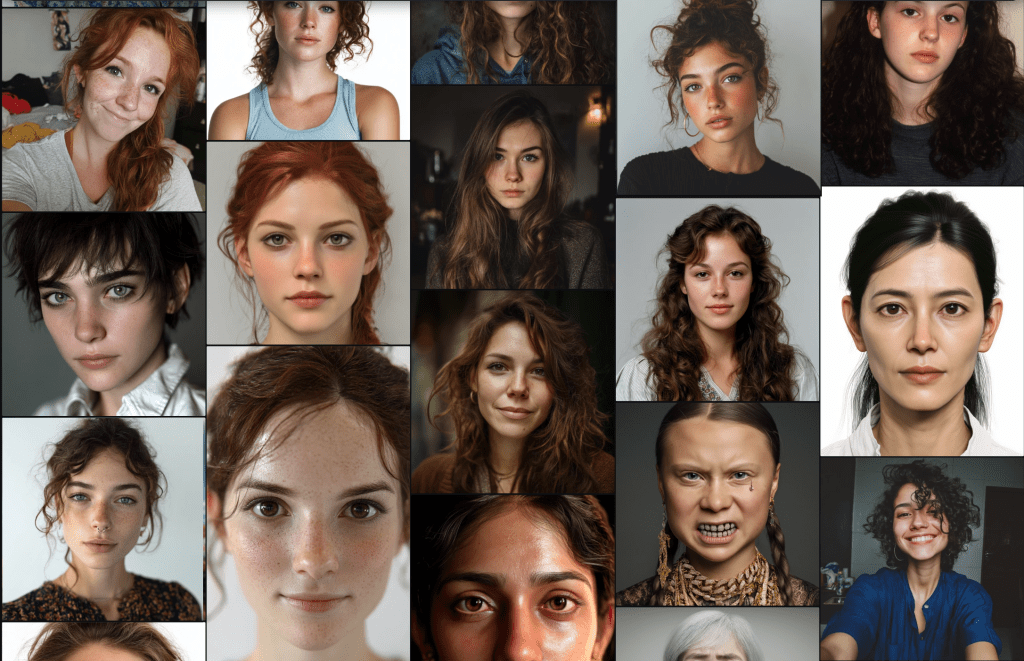
This Isn’t Clickbait. I Asked MidJourney for “Ugly Women”. Here’s What It Gave Me.
Let’s clear the air: I did it for science. Or satire. Or possibly just to see if artificial intelligence would have the audacity to mirror the cruelty of its makers.
Audio: NotebookLM podcast on this topic.
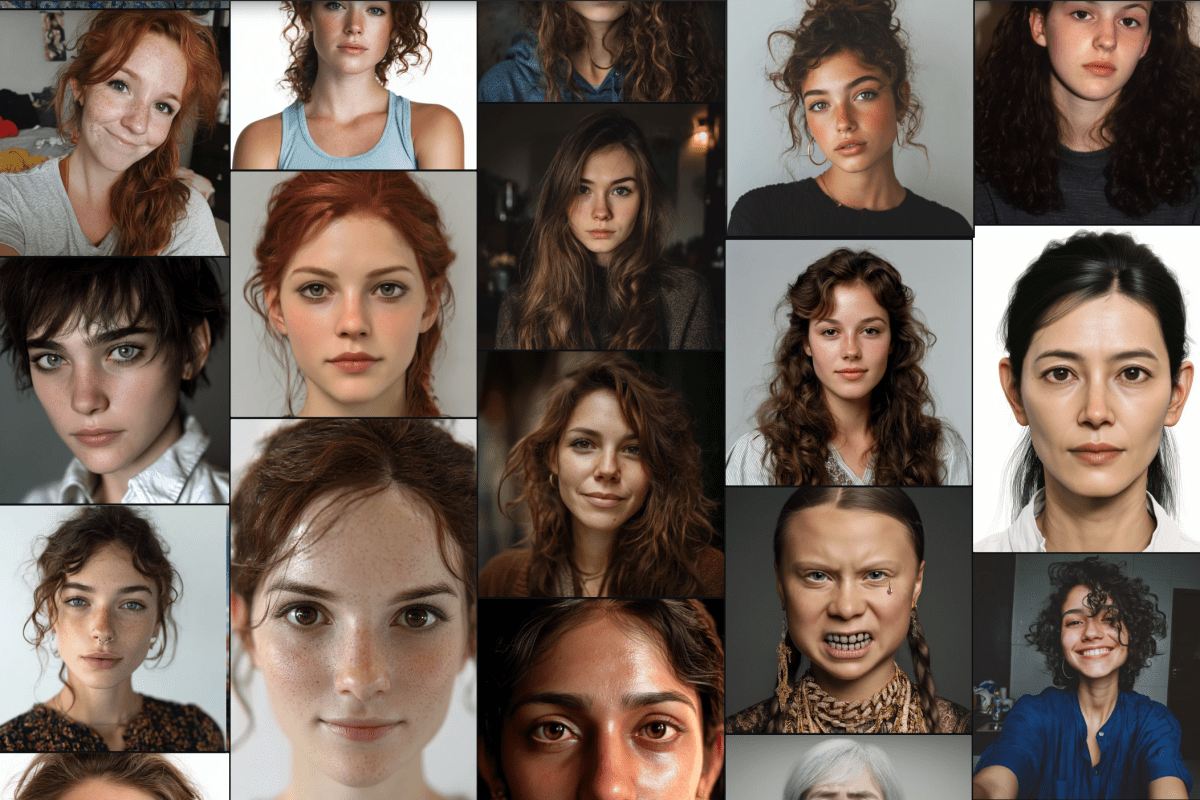
I queried MidJourney with the phrase ugly female. What did it return? An aesthetic pageant. A digital Vogue spread. If any of these faces belongs to someone conventionally labelled “ugly”, then I’m a rutabaga in a Dior suit.
Yes, there’s one stylised rendering of Greta Thunberg in full Norse Valkyrie scowl mode – but even then, she looks fierce, not foul. The rest? AI-generated portraits so telegenic I half-expected to see #spon in the corner.
Let’s be clinical for a moment. As an American male (with all the culturally indoctrinated shallowness that entails), I admit some of these aren’t textbook 10s. Maybe a few clock in at a 6 or 7 on the patriarchy’s dubious sliding scale. But if this is ugly, the AI has either broken the aesthetic curve or been force-fed too many episodes of The Bachelor.
Here’s the thing: AI is trained to over-represent symmetrical faces, wide eyes, clear skin – the usual genetic lottery wins. And yet, when asked for ugly, it can’t help but deliver catalogue models with slightly unconventional haircuts. It doesn’t know how to be truly ugly – because we don’t know how to describe ugliness without revealing ourselves as sociopaths.
Once upon a time, I dated a model agent in Los Angeles. Japanese by birth, stationed in LA, scouting for a French agency – the kind of cosmopolitan trifecta only fashion could breed. Her job? Finding “parts models.” That’s right – someone with flawless teeth but forgettable everything else. Hands like sculpture. Eyelashes like Instagram filters.
We’d play a game: spot the 10s. She’d nudge me, whisper “her?” I’d say, “Pretty close.” She’d shake her head. “Look at that eye tooth.” And we’d dissolve into laughter.
We were mocking perfection. Because perfection is a con. A trick of lighting, contour, and post-production.
So, no. I don’t think any of the women in the AI’s response are ugly. Quite the contrary – they’re too beautiful. AI can’t show us “ugly” because it’s been trained to optimise desire, not reflect reality. And our collective understanding of beauty is so skewed that anything less than runway-ready gets sorted into the rejection bin.
If these women are ugly, what exactly is beautiful?
But maybe that’s the point. We’ve abstracted beauty so far from the human that even our ugliness is now synthetically pleasing.
What do you think? Are any of these faces truly ugly? All of them? Let me know in the comments – and try not to rate them like a casting director with a god complex.
I’m a nihilist. Possibly always have been. But let’s get one thing straight: nihilism is not despair. That’s a slander cooked up by the Meaning Merchants – the sentimentalists and functionalists who can’t get through breakfast without hallucinating some grand purpose to butter their toast. They fear the void, so they fill it. With God. With country. With yoga.
Audio: NotebookLM podcast on this topic.
Humans are obsessed with function. Seeing it. Creating it. Projecting it onto everything, like graffiti on the cosmos. Everything must mean something. Even nonsense gets rebranded as metaphor. Why do men have nipples? Why does a fork exist if you’re just going to eat soup? Doesn’t matter – it must do something. When we can’t find this function, we invent it.
But function isn’t discovered – it’s manufactured. A collaboration between our pattern-seeking brains and our desperate need for relevance, where function becomes fiction, where language and anthropomorphism go to copulate. A neat little fiction. An ontological fantasy. We ask, “What is the function of the human in this grand ballet of entropy and expansion?” Answer: there isn’t one. None. Nada. Cosmic indifference doesn’t write job descriptions.
And yet we prance around in lab coats and uniforms – doctors, arsonists, firemen, philosophers – playing roles in a drama no one is watching. We build professions and identities the way children host tea parties for dolls. Elaborate rituals of pretend, choreographed displays of purpose. Satisfying? Sometimes. Meaningful? Don’t kid yourself.
We’ve constructed these meaning-machines – society, culture, progress – not because they’re real, but because they help us forget that they’re not. It’s theatre. Absurdist, and often bad. But it gives us something to do between birth and decomposition.
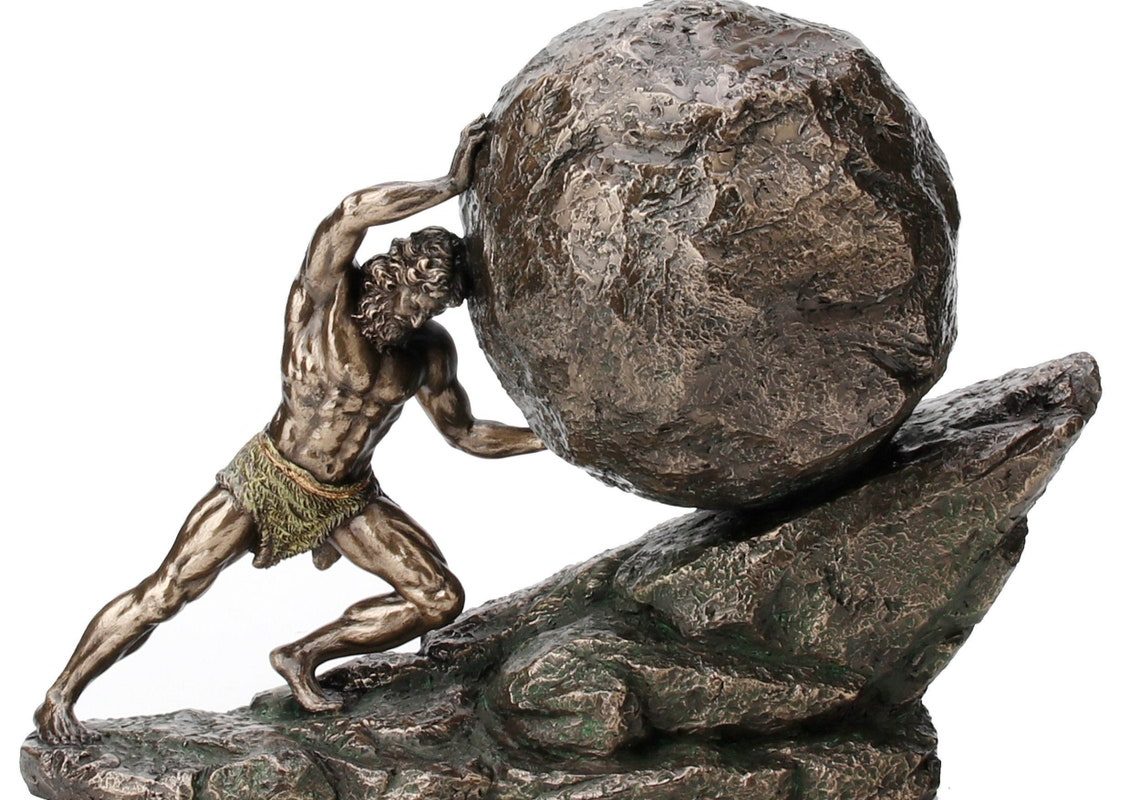
Sisyphus had his rock. We have careers.
But let’s not confuse labour for meaning, or imagination for truth. The boulder never reaches the top, and that’s not failure. That’s the show.
So roll the stone. Build the company. Write the blog. Pour tea for Barbie. Just don’t lie to yourself about what it all means.
“All that is necessary for evil to triumph is for a few words to go missing from the bylaws.” — not Edmund Burke, but it ought to be.
The Trump administration—America’s reigning monarch of meaningless bombast—has done it again. This time, with an executive order so linguistically cunning it deserves a Pulitzer for Subtextual Menace.
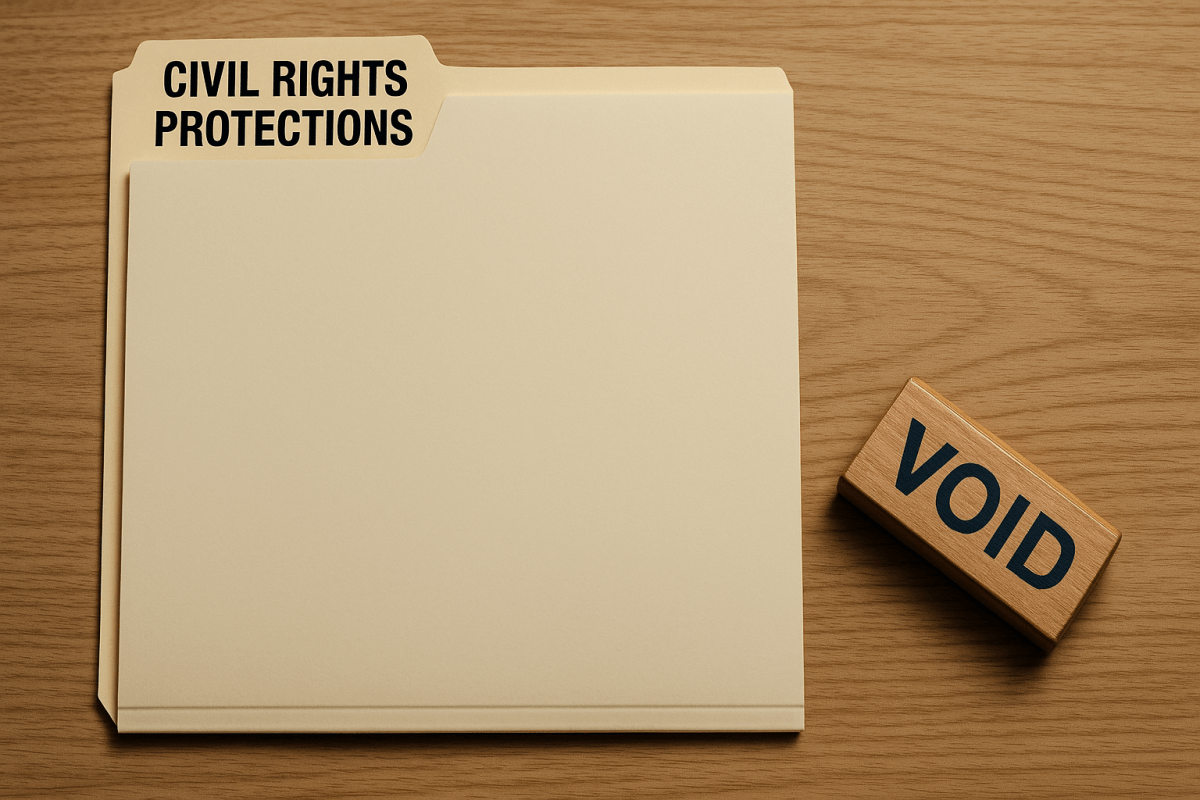
Issued on 30 January 2025, the decree known as “Defending Women from Gender Ideology Extremism” (because, of course, it couldn’t just be called Let’s Erase Legal Protections for People We Don’t Like) removed “political affiliation” and “marital status” from the list of protected classes within certain federal frameworks.
And the result? According to documents unearthed by The Guardian, VA doctors can now legally refuse treatment to patients based on their politics or marital status. You know, because being a Democrat apparently makes you too much of a pre-existing condition.
Naturally, the VA and White House are insisting this means absolutely nothing. “Don’t worry,” they coo. “No one’s actually doing it.” Ah yes, the old Schrödinger’s Protections defence—simultaneously removed and unchanged, invalid but somehow still effective.
But here’s the point—and where it ties to the Language Insufficiency Hypothesis I’ve been peddling like a raving madman at the crossroads of post-structuralism and bureaucratic despair: language isn’t just failing to communicate meaning—it’s being weaponised to obscure it.
The Erosion of Meaning Through Omission
This isn’t the blunt-force idiocy of Orwell’s Newspeak. This is something more elegant—more insidious. This is legislative lacunae. It’s what happens when not saying something says everything.
The words “political affiliation” and “marital status” weren’t replaced. They weren’t clarified. They were simply deleted. Erased like a bad tweet, like a conscience, like a veteran with the wrong bumper sticker.
This is language subtraction as a tool of governance.
We’re not criminalising dissent. We’re just making it legally ignorable.
We’re not discriminating against the unmarried. We’re just no longer required to treat them the same.
It’s the bureaucratic cousin of the dog-whistle: not quite audible in court, but perfectly clear to the base.
The Slippery Slope is Now a Slip-n-Slide
This is how you rewrite civil rights without the fuss of saying so. You just… remove the language that once held the dam in place. Then, when the flood comes, you feign surprise:
“Oh, dear. Who could have guessed that removing protections would result in people being unprotected?”
(Everyone. Everyone could have guessed.)
This is not a bug in the legal language. It’s the feature. The silence is the speech act. The absence is the argument.
This is what I mean by language insufficiency: not merely that our words fail to convey truth, but that their very structure is liable to be gamed—exploited by those who understand that ambiguity is power.
Beyond Intentionality: The Weaponised Void
In philosophy of language, we often debate intentionality—what the speaker meant to say. But here we’re in darker waters. This isn’t about intention. It’s about calculated omission.
The executive order doesn’t declare war on Democrats or single mothers. It simply pulls the thread and lets the tapestry unravel itself.
It’s an act of rhetorical cowardice disguised as administrative efficiency.
This is the Trumpian genius: use language like a stage magician uses sleeves. Distract with one hand, disappear with the other.
Final Diagnosis: Policy by Redaction
We now inhabit a political climate where what is not said carries more legal force than what is. Where bylaw gaps become policy gateways, and where civil rights die not with a bang, but with an elision.
So no, the VA hasn’t yet denied a Democrat a blood transfusion. But the table has been set. The menu revised. The waitstaff told they may now “use discretion.”
Language doesn’t merely fail us. It is being made to fail strategically.
Welcome to the new America: where rights aren’t removed—they’re left out of the memo.
Yet again, ChatGPT renders an odd image. Can’t be bothered to amend it.
Humans talk to large language models the way toddlers talk to teddy bears – with unnerving sincerity and not a hint of shame. “Do you understand me?” they ask, eyes wide with hope. “What do you think of this draft?” they prod, as if some silicon scribe is going to sip its imaginary tea and nod gravely. It’s not merely adorable – it’s diagnostic. We are, it turns out, pathologically incapable of interacting with anything more complex than a toaster without projecting mind, motive, and mild trauma onto it.
Audio: NotebookLM podcast on this topic.
Welcome to the theatre of delusion, where you play Hamlet and the chatbot is cast as Yorick – if Yorick could autocomplete your soliloquy and generate citations in APA format.
The Great Anthropomorphic Flaw (aka Feature)
Let’s get one thing straight: anthropomorphism isn’t a software bug in the brain; it’s a core feature. You’re hardwired to see agency where there is none. That rustle in the bushes? Probably the wind. But better safe than sabre-toothed. So your ancestors survived, and here you are, attributing “sass” to your microwave because it beeped twice.
“We don’t have a way of addressing an entity that talks like a person but isn’t one. So we fake it. It’s interaction theatre.”
Now we’ve built a machine that spits out paragraphs like a caffeinated undergrad with deadlines, and naturally, we talk to it like it’s our mate from university. Never mind that it has no bloodstream, no memory of breakfast, and no concept of irony (despite being soaked in it). We still say you instead of the system, and think instead of statistically interpolate based on token weights. Because who wants to live in a world where every sentence starts with “as per the pre-trained parameters…”?
Why We Keep Doing It (Despite Knowing Better)
To be fair – and let’s be magnanimous – it’s useful. Talking to AI like it’s a person allows our ape-brains to sidestep the horror of interacting with a glorified autocomplete machine. We’re brilliant at modelling other minds, rubbish at modelling neural nets. So we slap a metaphorical moustache on the processor and call it Roger. Roger “gets us.” Roger “knows things.” Roger is, frankly, a vibe.
This little charade lubricates the whole transaction. If we had to address our queries to “the stochastic parrot formerly known as GPT,” we’d never get past the opening line. Better to just ask, “What do you think, Roger?” and pretend it has taste.
And here’s the kicker: by anthropomorphising AI, we start thinking about ethics – sort of. We ask if it deserves rights, feelings, holidays. We project humanity into the void and then act shocked when it mirrors back our worst habits. As if that’s its fault.
When the Roleplay Gets Risky
Of course, this make-believe has its downsides. Chief among them: we start to believe our own nonsense. Saying AI “knows” something is like saying your calculator is feeling generous with its square roots today. It doesn’t know—it produces outputs. Any semblance of understanding is pure pantomime.
“We see a mind because we need to see one. We can’t bear the idea of a thing that’s smarter than us but doesn’t care about us.”
More dangerously, we lose sight of the fact that these things aren’t just alien – they’re inhuman. They don’t dream of electric sheep. They don’t dream, full stop. But we insist on jamming them into our conceptual boxes: empathy, intent, personality. It’s like trying to teach a blender to feel remorse.
And let’s not pretend we’re doing it out of philosophical curiosity. We’re projecting, plain and simple. Anthropomorphism isn’t about them, it’s about us. We see a mind because we need to see one. We can’t bear the idea of a thing that’s smarter than us but doesn’t care about us, doesn’t see us. Narcissism with a side of existential dread.
Our Language is a Terrible Tool for This Job
English – and most languages, frankly – is hopeless at describing this category of thing. “It” feels cold and distant. “They” implies someone’s going to invite the model to brunch. We have no pronoun for “hyper-literate statistical machine that mimics thought but lacks all consciousness.” So we fudge it. Badly.
Our verbs are no better. “Compute”? Too beige. “Process”? Bureaucratic. “Think”? Premature. What we need is a whole new grammatical tense: the hallucino-indicative. The model thunketh, as one might, but didn’t.
“We built a creature we can’t speak about without sounding like lunatics or liars.”
This is linguistic poverty, pure and simple. Our grammar can’t cope with entities that live in the uncanny valley between sentience and syntax. We built a creature we can’t speak about without sounding like lunatics or liars.
The Semantics of Sentimentality (Or: “How Does This Sound to You?”)
Enter the most revealing tell of all: the questions we pose. “How does this look?” we ask the model, as if it might blink at the screen and furrow a synthetic brow. “What do you think?” we say, offering it the dignity of preference. These questions aren’t just off-target – they’re playing darts in another pub.
They’re the linguistic equivalent of asking your dishwasher whether it enjoyed the lasagne tray. But again, this isn’t idiocy – it’s instinct. We don’t have a way of addressing an entity that talks like a person but isn’t one. So we fake it. It’s interaction theatre. You provide the line, the model cues the spotlight.
But let’s be clear: the model doesn’t “think” anything. It regurgitates plausible text based on mountains of training data—some of which, no doubt, includes humans asking equally daft questions of equally mindless systems.
Time to Grow Up (Just a Bit)
This doesn’t mean we need to abandon anthropomorphism entirely. Like most delusions, it’s functional. But we’d do well to hold it at arm’s length – like a politician’s promise or a milk carton two days past its date.
Call it anthropomorphic agnosticism: act like it’s a person, but remember it’s not. Use the language, but don’t inhale.
And maybe – just maybe – we need to evolve our language. Invent new terms, new pronouns, new ways of speaking about entities that fall somewhere between tool and companion. As we did with “cyberspace” and “ghosting,” perhaps we need words for proto-minds and quasi-selves. Something between toaster and therapist.
“If we speak to AI like it’s sentient, we’ll eventually legislate as if it is.”
Above all, we need to acknowledge that our language shapes more than just understanding – it shapes policy, emotion, and future design. If we speak to AI like it’s sentient, we’ll eventually legislate as if it is. And if we insist on treating it as an object, we may be blind to when that ceases to be accurate. Misnaming, after all, is the first sin in every myth worth reading.
The Mirror, Darkly
Ultimately, our tendency to humanise machines is less about them than it is about us – our fears, our needs, our inability to tolerate ambiguity. The AI is just a mirror: an elaborate, many-eyed, autofill mirror. And when we see a mind there, it may be ours staring back – distorted, flattened, and fed through a thousand layers of token prediction.
The tragedy, perhaps, isn’t that the machine doesn’t understand us. It’s that we’ve built something that perfectly imitates understanding – and still, somehow, we remain utterly alone in the room.










 Philosophics