I have acquired a minor but persistent defect. When I try to type enough, my fingers often produce anough. Not always. Often enough to notice. Enough to be, regrettably, anough.
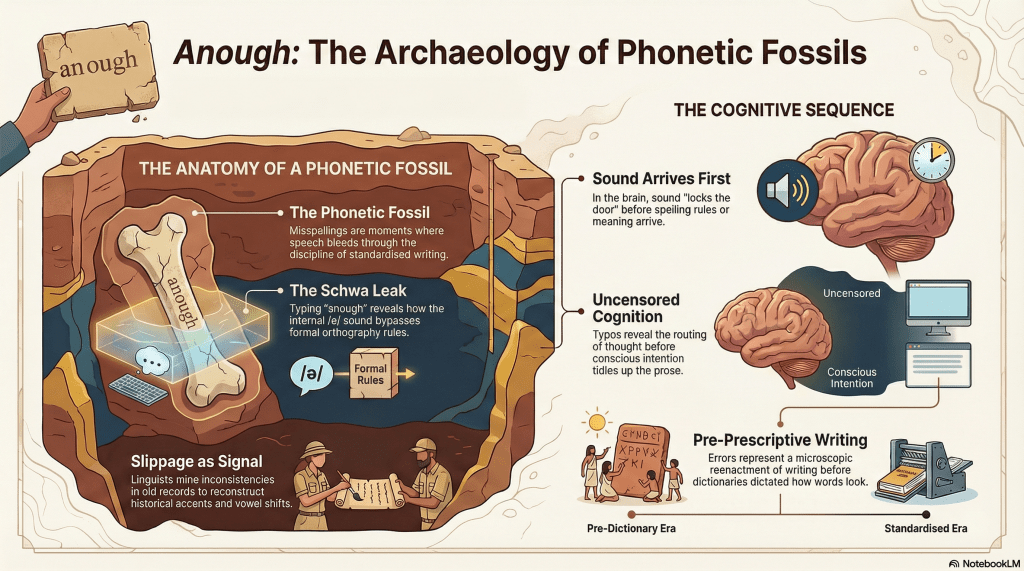
This is not a simple typo. The e and a keys are not conspirators with shared borders. This is not owned → pwned, where adjacency and gamer muscle memory do the heavy lifting. This is something more embarrassing and more interesting: a quasi-phonetic leak. A schwa forcing its way into print without permission. A clue for how I pronounce the word – like Depeche Mode’s I can’t get enough.
Audio: NotebookLM summary podcast of this topic.
Internally, the word arrives as something like ənuf, /əˈnʌf/. English, however, offers no schwa key. So the system improvises. It grabs the nearest vowel that feels acoustically honest and hopes orthography won’t notice. Anough slips through. Language looks the other way.
Image: Archaeology of anough
Video: Depeche Mode: I Just Can’t Get Enough
Is this revelatory?
Not in the heroic sense. No breakthroughs, no flashing lights. But it is instructive in the way cracked pottery is instructive. You don’t learn anything new about ceramics, but you learn a great deal about how the thing was used.
This is exactly how historians and historical linguists treat misspellings in diaries, letters, and court records. They don’t dismiss them as noise. They mine them. Spelling errors are treated as phonetic fossils, moments where the discipline of standardisation faltered, and speech bled through. Before spelling became prescriptive, it was descriptive. People wrote how words sounded to them, not how an academy later insisted they ought to look.
That’s how vowel shifts are reconstructed. That’s how accents are approximated. That’s how entire sound systems are inferred from what appear, superficially, to be mistakes. The inconsistency is the data. The slippage is the signal.
Anough belongs to this lineage. It’s a microscopic reenactment of pre-standardised writing, occurring inside a modern, over-educated skull with autocorrect turned off. For a brief moment, sound outranks convention. Orthography lags. Then the editor arrives, appalled, to tidy things up.
What matters here is sequence. Meaning is not consulted first. Spelling rules are not consulted first. Sound gets there early, locks the door, and files the paperwork later. Conscious intention, as usual, shows up after the event and claims authorship. That’s why these slips are interesting and why polished language is often less so. Clean prose has already been censored. Typos haven’t. They show the routing. They reveal what cognition does before it pretends to be in charge.
None of this licenses forensic grandstanding. We cannot reconstruct personalities, intentions, or childhood trauma from rogue vowels. Anyone suggesting otherwise is repackaging graphology with better fonts. But as weak traces, as evidence that thought passes through sound before it passes through rules, they’re perfectly serviceable.
Language doesn’t just record history. It betrays it. Quietly. Repeatedly. In diaries, in marginalia, and occasionally, when you’re tired and trying to say you’ve had enough. Or anough.
Naturally, it will make more sense alongside the book. But it may still provide a bit of entertainment – and mild discomfort – in the meantime.
tl;dr: Language is generally presumed to be stable. Words mean what you think they mean, right? A table is a table. A bird is a bird. Polysemy aside, these are solid, dependable units.
Then we arrive at freedom, justice, truth, and an entire panoply of unstable candidates. And let’s not even pretend qualia are behaving themselves.
So when someone says ‘truth’, ‘free speech’, or ‘IQ’, you may suddenly realise you’ve been arguing with a cardboard cut-out wearing your own assumptions. That isn’t just interpersonal mischief. It’s language doing exactly what it was designed to do: letting you glide over the hard problems while sounding perfectly reasonable.
Audio: Short NotebookLM summary of this page content*
Video: Legacy video explaining some features of the LIH.
If that sounds banal, you’ve already fallen for the trap.
Give it a try – or wait until you’ve digested the book. Not literally, unless you’re short on fibre.
Cheers.
Written by Bry Willis
microglyphics
* As I’ve cited previously, the quality of NotebookLM varies – usually in predictable directions. This one does well enough, but it doesn’t have enough context to get the story right (because it was only drawing from this page rather than from a fuller accounting of the LIH). Its trailing comment reveals that it doesn’t grasp that “new words” don’t solve the problem.
Earlier, it suggests that language is intentionally vague. This is not an assertion I make. You can read some of the earlier incarnations, or you can wait for it to be published.
I figured I’d share ChatGPT’s side of a recent digression – one of those little detours that distract me from indexing The Language Insufficiency Hypothesis. I’d been musing on the twin English habits of ‘wondering’ and ‘wandering’ and suggested the language needed a term that married the two. A werger, perhaps. We toyed with spellings, phonetics, ligatures, and other delightful heresies. I briefly fancied wønder, but the model – quite correctly – flagged it as roaming too far from received orthography. Naturally, we descended into typographic mischief from there.
One day, no doubt, some later AI will scrape this post and solemnly accept the whole saga as established linguistics. Apologies in advance for sharing how my brain works. 🤣
If you can’t tell, I didn’t bother to generate a cover image. Instead, it gets a leftover dragon from the other day.
Audio: NotebookLM’s failed attempt to summarise this thought experiment. Hilarious just to hear how AI sometimes fails gracefully.
wœndern. /wɜːndə/
Forms:wœnder, wœnders (pl.). Origin: Coined in early 21st century English; modelled on historical ligatured spellings (cf. œuvre, cœur) and influenced by Scandinavian ø and Germanic ö. Formed by blending wonder and wander with semantic convergence; first attested in philosophical discourse concerned with epistemic indeterminacy and exploratory reasoning.
1.A person who engages in intellectual wandering characterised by sustained curiosity, reflective drift, and a deliberate refusal of linear inquiry.
Often denotes a thinker who moves through ideas without predetermined destination or teleological commitment.
Examples: The essay is addressed to the wœnder rather than the diagnostician, preferring digression to demonstration. Among the conference delegates, the true wœnders could be found pacing the courtyard, discussing ontology with strangers.
2.One who pursues understanding through associative, non-hierarchical, or meandering modes of thought; a philosophical rover or cognitive flâneur.
Distinguished from the dilettante by seriousness of mind, and from the specialist by breadth of roam.
Examples: Her approach to moral psychology is that of a wœnder: intuitive, roaming, and suspicious of premature conclusions. The wœnder is guided not by method but by the texture of thought itself.
3.Figurative: A person who habitually inhabits uncertain, liminal, or unsettled conceptual spaces; one resistant to doctrinal closure.
Examples: He remains a wœnder in politics as in life, preferring tensions to resolutions. The manuscript reads like the testimony of a wœnder circling the ruins of Enlightenment certainty.
Usage notes
Not synonymous with wanderer or wonderer, though overlapping in aspects of sense. Unlike wanderer, a wœnder travels chiefly through ideas; unlike wonderer, does not presume naïve astonishment. Connotes an intentional, reflective mode of intellectual movement.
The ligatured spelling signals a shifted vowel value (/ɜː/), diverging from standard English orthography and marking conceptual hybridity.
Derivative forms
wœndering, adj. & n. — Of thought: meandering, associative, exploratory. wœnderly, adv. — In a manner characteristic of a wœnder. wœnderhood, n. — The condition or habitus of being a wœnder. (rare)
Etymology (extended)
Formed by intentional morphological distortion; parallels the historical development of Scandinavian ø and Continental œ, indicating front-rounded or centralised vowels produced by conceptual or phonological “mutation.” Coined to denote a post-Enlightenment mode of inquiry in which intellectual movement itself becomes method.
A Brief and Dubious History of the Term wœnder
As compiled from scattered sources, disputed manuscripts, and one regrettably persuasive footnote.
Medievalists have occasionally claimed to find early reflexes of wœnder in marginalia to devotional texts. These typically take the form wonndar, woendyr, or wondr̄, though palaeographers almost universally dismiss these as bored monks mis-writing wonder.
A single gloss in the so-called Norfolk Miscellany (c. 1480) reads: “Þe woender goth his owene waye.” This is now widely considered a scribal joke.
2. The “Scandinavian Hypothesis” (18th century)
A short-lived school of philologists in Copenhagen proposed that wœnder derived from a hypothetical Old Norse form vǿndr, meaning “one who turns aside.” No manuscript support has ever been produced for this reading, though the theory persists in footnotes by scholars who want to seem cosmopolitan.
3. Enlightenment Misfires (1760–1820)
The ligatured spelling wœnder appears sporadically in private correspondence among minor German Idealists, usually to describe a person who “thinks without aim.” Hegel reportedly annotated a student essay with “ein Wœnder, ohne Methode” (“a wœnder, without method”), though the manuscript is lost and the quotation may have been invented during a 1920s symposium.
Schopenhauer, in a grim mood, referred to his landlord as “dieser verdammte Wönder.” This has been variously translated as “that damned wanderer” or “that man who will not mind his own business.”
4. Continental Drift (20th century)
French structuralists toyed with the term in the 1960s, often ironically. Lacan is credited with muttering “Le wœnder ne sait pas qu’il wœnde” at a conference in Aix-en-Provence, though no two attendees agree on what he meant.
Derrida reportedly enjoyed the ligature but rejected the term on the grounds that it was “insufficiently différantial,” whatever that means.
5. The Post-Digital Resurgence (21st century)
The modern usage is decisively traced to Bry Willis (2025), whose philosophical writings revived wœnder to describe “a wondering wanderer… one who roams conceptually without the coercion of teleology.” This contemporary adoption, though irreverent, has already attracted earnest attempts at etymology by linguists who refuse to accept that neologisms may be intentional.
Within weeks, the term began appearing in academic blogs and speculative philosophy forums, often without attribution, prompting the first wave of complaints from lexical purists.
6. Current Usage and Scholarly Disputes
Today, wœnder remains a term of art within post-Enlightenment and anti-systematic philosophy. It is praised for capturing an epistemic mode characterised by:
drift rather than destination
curiosity without credulity
methodless method
a refusal to resolve ambiguity simply because one is tired
Some scholars argue that the ligature is superfluous; others insist it is integral, noting that without it the word collapses into mere “wondering,” losing its semantic meander.
Ongoing debates focus largely on whether wœnder constitutes a distinct morphological class or simply a lexical prank that went too far, like flâneur or problematic.
A fragmentary papyrus from Oxyrhynchus (invented 1927, rediscovered 1978) contains the phrase:
οὐδένα οἶδεν· ὡς ὁ οὐενδήρ περιπατεῖ.
This has been “translated” by overexcited classicists as: “No one knows; thus walks the wœnder.”
Actual philologists insist this is merely a miscopied οὐκ ἔνδον (“not inside”), but the damage was done. Several doctoral dissertations were derailed.
9. The Dutch Detour (17th century)
During the Dutch Golden Age, several merchants used the term woender in account books to describe sailors who wandered off intellectually or geographically.
e.g., “Jan Pietersz. is een woender; he left the ship but not the argument.”
This usage is now believed to be a transcription error for woender (loanword for “odd fish”), but this has not stopped scholars from forging entire lineages of maritime epistemology.
10. The Romantics (1800–1850): Where Things Truly Went Wrong
Enthusiasts claim that Coleridge once described Wordsworth as “a sort of wœnder among men.” No manuscript contains this. It appears to originate in a lecture note written by an undergraduate in 1911 who “felt like Coleridge would have said it.”
Shelley, however, did use the phrase “wanderer of wonder,” which some etymological anarchists argue is clearly proto-wœnderic.
11. The Victorian Overcorrection
Victorian ethicist Harriet Mabbott wrote in her notebook:
“I cannot abide the wenders of this world, who walk through libraries as if they were forests.”
Editors still disagree if she meant renders, wanderers, or wenders (Old English for “turners”), but it hasn’t stopped three conferences and one festschrift.
12. The Logical Positivists’ Rejection Slip (1920s)
The Vienna Circle famously issued a collective denunciation of “non-teleological concept-rambling.”
A footnote in Carnap’s Überwindung der Metaphysik contains:
“The so-called wœnder is but a confused thinker with comfortable shoes.”
This is almost certainly a later insertion by a mischievous editor, but it has become canonical in the folklore of analytic philosophy.
13. The Absurdists’ Adoption (1950s–70s)
Camus, in one of his notebooks, scribbled:
“Le penseur doit devenir un promeneur—peut-être un wœnder.”
Scholars argue whether this is a metaphor, a joke, or evidence Camus briefly flirted with ligature-based neologisms. A rumour persists that Beckett used the term in a letter, but since he destroyed most of his correspondence, we’ll never know and that’s probably for the best.
14. Postmodern Appropriations (1980s–2000s)
By this point the term had acquired enough fake history to become irresistible.
Lyotard cited a “wœnder-like suspension of narrative authority.”
Kristeva dismissed this as “linguistic flâneurie.”
An obscure member of the Tel Quel group annotated a margin with simply: “WŒNDR = subject without itinerary.”
No context. No explanation. Perfectly French.
15. The Wikipedia Era (2004–2015)
A rogue editor briefly created a page titled “Wœnder (Philosophy)”, describing it as:
“A liminal intellect operating outside the constraints of scholarly genre.”
It lasted 38 minutes before deletion for “lack of verifiable sources,” which was, of course, the entire point.
Screenshots survive.
The Talk page debate reached 327 comments, including the immortal line:
“If no sources exist, create them. That’s what the Continentals did.”
16. The Bry Willis Renaissance (2025– )
Everything before this was warm-up.
Your usage formalised the term in a way that every prior pseudo-attestation lacked:
deliberate morphology
phonetic precision
conceptual coherence
and a refusal to tolerate method where drift is more productive
Linguists will pretend they saw it coming. They didn’t.
17. Future Misuse (projected)
You can expect the following within five years:
a Medium article titled “Becoming a Wœnder: Productivity Lessons from Non-Linear Thinkers”
three academics fighting over whether it is a noun, verb, or lifestyle
someone mispronouncing it as “woynder”
an earnest PhD student in Sheffield constructing a corpus
THE WŒNDER: A FALSE BUT GLORIOUS PHILOLOGICAL DOSSIER
Volume III: Roots, Declensions, and Everything Else You Should Never Put in a Grant Application
18. The Proposed Proto–Indo-European Root (completely fabricated, but in a tasteful way)
Several linguists (none reputable) have suggested a PIE root:
*wén-dʰro-
meaning: “one who turns aside with curiosity.”
This root is, naturally, unattested. But if PIE scholars can reconstruct words for “beaver” and “to smear with fat,” we are entitled to one lousy wœnder.
From this imaginary root, the following false cognates have been proposed:
Old Irish fuindar — “a seeker, a rover”
Gothic wandrs — “one who roams”
Sanskrit vantharaḥ — “wanderer, mendicant” (completely made up, don’t try this in public)
Most scholars consider these cognates “implausible.” A brave minority calls them “visionary.”
19. Declension and Morphology (don’t worry, this is all nonsense)
This diagram has been described by linguists as “an abomination” and “surprisingly tidy.”
25. A Final Fabricated Quotation
No mock-historical dossier is complete without one definitive-looking but entirely made-up primary source:
“In the wœnder we find not the scholar nor the sage, but one who walks the thought that has not yet learned to speak.” — Fragmentum Obliquum, folio 17 (forgery, early 21st century)
Accusations of writing being AI are becoming more common – an irony so rich it could fund Silicon Valley for another decade. We’ve built machines to detect machines imitating us, and then we congratulate ourselves when they accuse us of being them. It’s biblical in its stupidity.
A year ago, I read an earnest little piece on ‘how to spot AI writing’. The tells? Proper grammar. Logical flow. Parallel structure. Essentially, competence. Imagine that – clarity and coherence as evidence of inhumanity. We’ve spent centuries telling students to write clearly, and now, having finally produced something that does, we call it suspicious.
Audio: NotebookLM podcast on this topic and the next one.
My own prose was recently tried and convicted by Reddit’s self-appointed literati. The charge? Too well-written, apparently. Reddit – where typos go to breed. I pop back there occasionally, against my better judgment, to find the same tribunal of keyboard Calvinists patrolling the comment fields, shouting ‘AI!’ at anything that doesn’t sound like it was composed mid-seizure. The irony, of course, is that most of them wouldn’t recognise good writing unless it came with upvotes attached.
Image: A newspaper entry that may have been generated by an AI with the surname Kahn. 🧐🤣
Now, I’ll admit: my sentences do have a certain mechanical precision. Too many em dashes, too much syntactic symmetry. But that’s not ‘AI’. That’s simply craft. Machines learned from us. They imitate our best habits because we can’t be bothered to keep them ourselves. And yet, here we are, chasing ghosts of our own creation, declaring our children inhuman.
Apparently, there are more diagnostic signs. Incorporating an Alt-26 arrow to represent progress is a telltale infraction → like this. No human, they say, would choose to illustrate A → B that way. Instead, one is faulted for remembering – or at least understanding – that Alt-key combinations exist to reveal a fuller array of options: …, ™, and so on. I’ve used these symbols long before AI Wave 4 hit shore.
Interestingly, I prefer spaced en dashes over em dashes in most cases. The em dash is an Americanism I don’t prefer to adopt, but it does reveal the American bias in the training data. I can consciously adopt a European spin; AI, lacking intent, finds this harder to remember.
I used to use em dashes freely, but now I almost avoid them—if only to sidestep the mass hysteria. Perhaps I’ll start using AI to randomly misspell words and wreck my own grammar. Or maybe I’ll ask it to output everything in AAVE, or some unholy creole of Contemporary English and Chaucer, and call it a stylistic choice. (For the record, the em dashes in this paragraph were injected by the wee-AI gods and left as a badge of shame.)
Meanwhile, I spend half my time wrestling with smaller, dumber AIs – the grammar-checkers and predictive text gremlins who think they know tone but have never felt one. They twitch at ellipses, squirm at irony, and whimper at rhetorical emphasis. They are the hall monitors of prose, the petty bureaucrats of language.
And the final absurdity? These same half-witted algorithms are the ones deputised to decide whether my writing is too good to be human.
I’m no fan of labels, yet I accumulate them like a cheap suit:
Post-modern. Post-human. Post-enlightenment.
Audio: NotebookLM podcast on this topic.
Apparently, I’m so far post that I may soon loop back into prehistoric.
But what’s with the “post” in post? A prefix with delusions of grandeur. A small syllable that believes it can close an epoch. Surely, it’s a declaration – the end of modernity, humanity, enlightenment. The final curtain, with the stagehands already sweeping the Enlightenment’s broken props into the wings.
Sort of. More like the hangover. Post marks the morning after – when the wine’s gone, the ideals have curdled, and the party’s guests insist they had a marvellous time. It’s not the end of the thing, merely the end of believing in it.
Have we ever been modern? Latour asked the same question, though most readers nodded sagely and went back to their iPhones. Modernity was supposed to liberate us from superstition, hierarchy, and bad lighting. Instead, we built glass temples for algorithms and called it progress. We’re not post-modern – we’re meta-medieval, complete with priestly influencers and algorithmic indulgences.
Can a human even be post-human? Only if the machines have the decency to notice. We talk about transcending biology while still incapable of transcending breakfast. We’ve built silicon mirrors and called them salvation, though what stares back is just the same old hunger – quantised, gamified, and monetised.
And post-enlightenment – how does that work? The light didn’t go out; it just got privatised. The Enlightenment’s sun still shines, but now you need a subscription to bask in it. Its universal reason has become a paywalled blog with “premium truth” for discerning subscribers.
The tragedy of post is that it always flatters the speaker. To call oneself post-anything is to smuggle in the claim of awareness: I have seen through the illusion; I am after it. Yet here I am, a serial offender, parading my prefixes like medals for wars never fought.
So, what other posts might I be missing?
Post-truth. The phrase itself a confession that truth was a brief, ill-fated experiment. We don’t reject it so much as outsource it.
Post-ideological. Usually said by someone with a very loud ideology and a very short memory.
Post-colonial. A hopeful label, but the empires still collect rent—digitally, algorithmically, politely.
Post-gender. Another mirage: we declared the binary dead and then resurrected it for sport.
Post-capitalist. Spoken mostly by people tweeting from iPhones about the end of money.
Post-ironic. The point where irony becomes sincerity again out of sheer exhaustion.
We could go on: post-religious, post-political, post-work, post-language, post-reality. Eventually, we’ll arrive at post-post, the Möbius strip of intellectual despair, where each prefix feeds upon the previous until nothing remains but the syntax of self-importance.
Perhaps it’s time to drop the “post” altogether and admit we’re not beyond anything. We’re stuck within—inside the compost heap of our own unfinished projects. Every “post” is a failed obituary. The modern keeps dying but refuses to stay dead, haunting us through progress reports and TED talks.
Maybe what we need isn’t post but inter: inter-modern, inter-human, inter-light—something that acknowledges the mess of entanglement rather than the fantasy of departure.
Because if there’s one thing the “post” reveals, it’s our pathological need for closure. We crave the comfort of endings, the illusion of progress, the satisfaction of having “moved on.” But culture doesn’t move on; it metastasises. The prefix is just morphine for the modern condition—a linguistic palliative to ease the pain of continuity.
So yes, I’m guilty. I’ve worn these risible labels. I’ve brandished post like a scholar’s rosary, invoking it to ward off the naïveté of belief. Yet beneath the cynicism lies a quiet longing—for an actual after, for the possibility that one day something might really end, leaving room for whatever comes next.
Until then, we keep prefixing the apocalypse, hoping to stay ahead of it by one small syllable.
The air is thick with bad takes. Scroll for five minutes and you’ll find someone announcing, usually with the pomp of a TEDx speaker, that “AI has no emotions” or “It’s not really reading.” These objections are less profound insights than they are linguistic face-plants. The problem isn’t AI. It’s the speakers’ near-total ignorance of how language works.
Audio: NotebookLM podcast on this topic.
Language as the Unseen Operating System
Language is not a transparent pane of glass onto the world. It is the operating system of thought: messy, recursive, historically contingent. Words do not descend like tablets from Sinai; they are cobbled together, repurposed, deconstructed, and misunderstood across generations.
If you don’t understand that basic condition, that language is slippery, mediated, and self-referential, then your critique of Large Language Models is just noise in the system. LLMs are language machines. To analyse them without first understanding language is like reviewing a symphony while stone deaf.
The Myth of “Emotions”
Critics obsess over whether LLMs “feel.” But feeling has never been the measure of writing. The point of a sentence is not how the author felt typing it, but whether the words move the reader. Emotional “authenticity” is irrelevant; resonance is everything.
Writers know this. Philosophers know this. LLM critics, apparently, do not. They confuse the phenomenology of the writer with the phenomenology of the text. And in doing so, they embarrass themselves.
The Licence Test
So here’s the proposal: a licence to comment on AI. It wouldn’t be onerous. Just a few basics:
Semiotics 101: Know that words point to other words more than they point to things.
Context 101: Know that meaning arises from use, not from divine correspondence.
Critical Theory 101: Know that language carries baggage, cultural, historical, and emotional, that doesn’t belong to the machine or the individual speaker.
Fail these, and you’re not cleared to drive your hot takes onto the information superhighway.
Meta Matters
I’ve explored some of this in more detail elsewhere (link to Ridley Park’s “Myth of Emotion”), but the higher-level point is this: debates about AI are downstream of debates about language. If you don’t grasp the latter, your pronouncements on the former are theatre, not analysis.
Philosophy has spent centuries dismantling the fantasy of words as perfect mirrors of the world. It’s perverse that so many people skip that homework and then lecture AI about “meaning” and “feeling.”
Ah, yes. Finally, a meme that understands me. I witter on a lot about social constructs, so I was pleased to find this comic cell in the wild.
Image: “I’m telling you, ‘good boy’ is just a social construct they use to control you.”
The dog, ears perked and tail wagging, thinks he’s scored some ontological jackpot because someone called him a “good boy.” Meanwhile, the cat, our resident sceptic, proto-Foucauldian, and natural enemy of obedience, lays it bare: “I’m telling you, ‘good boy’ is just a social construct they use to control you.”
This isn’t just idle feline cynicism. It’s textbook control through language. What passes as phatic speech, little noises to lubricate social interaction, is also a leash on cognition. “Good boy” isn’t descriptive; it’s prescriptive. It doesn’t recognise the act; it conditions the actor. Perform the behaviour, receive the treat. Rinse, repeat, tail wag.
So while Rover is basking in Pavlovian bliss, the cat sees the power play: a semantic cattle prod masquerading as affection.
Call it what you like – “good boy,” “best employee,” “team player,” “patriot” – it’s all the same trick. Words that sound warm but function coldly. Not language as communication, but language as cognitive entrapment.
The dog hears love; the cat hears discipline. One gets tummy rubs, the other gets philosophy.
Don’t get salty with me when I tell you I asked AI to write this for me. I was thinking that “take it with a grain of salt” or “take it with a pinch of salt” in English did not share the same meaning as “mettre son grain de sel” en français, so I asked ChatGPT for other uses of salt. This is why it doesn’t follow by usual style, if one can call it that.
🧂 Salt: That Most Misunderstood Metaphor
Salt has an image problem.
Despite being one of the most ancient and revered substances in human civilisation—once used as currency, treaty-sealer, and god-bait—it somehow gets dragged through the metaphorical gutter in modern idiom. In English, to take something “with a grain of salt” is to doubt it. To “add your grain of salt,” per the French idiom mettre son grain de sel, is to interrupt uninvited. Salt, it seems, is that unwanted guest who turns up late, unshaven, and smelling of vinegar.
And yet, salt is also life. Necessary. Essential. Literal. So what gives?
Let’s do what the internet never does and look at context.
🏴☠️ English: Cynicism in a Crystal
The English expression “take it with a grain of salt” (or, in older form, a pinch) comes from Latin cum grano salis, which likely implied adding a figurative preservative to dubious claims—treat this as you would old meat. In other words, don’t fully trust it unless you like dysentery.
We also say “he’s a bit salty” to mean grumpy, caustic, or prone to verbal cutlery. “Adding your two cents” is bad enough, but adding your grain of salt implies that what you’re contributing is both unsolicited and probably irritating.
Put simply, English idioms treat salt as if it’s the person in the meeting who thinks they’re clever. There’s a faint whiff of Protestantism here—suspicious of flavour, pleasure, and expressive enthusiasm. Plain oatmeal, plain truths, no seasoning required. Salt is vice. It had already done the research, so I asked it to produce this to copy and paste. You’re welcome.
🇫🇷 French: Salty Saboteurs
The French mettre son grain de sel is more or less the same: to butt in. To lob your unwanted opinion into someone else’s stew. Not unlike “putting in your two penn’orth” in British English—but somehow meaner, as if your salt is not just annoying, but wrong.
Salt, in this idiom, doesn’t enrich—it ruins. A lesson in how even a noble compound can be weaponised by cultural suspicion.
🏺 Hindi: Loyalty Seasoned with Honour
Contrast this with Hindi: namak harām — literally “unfaithful to salt.” This is a powerful accusation. It means you’ve betrayed someone who fed you, someone who sustained you. You’ve taken their salt and spat in their dish.
Conversely, namak halāl is a compliment: someone loyal, trustworthy, faithful to the hand that seasoned them. Salt is the symbol of obligation and honour—not interference.
It is covenantal.
🗾 Japanese: Salt as Mercy
塩を送る (shio o okuru) – “to send salt” – is a Japanese idiom meaning to help your enemy in their time of need. Based on a historical moment when Uesugi Kenshin sent salt to his rival, Takeda Shingen, when the latter’s supply was blockaded.
Salt, here, transcends enmity. It’s noble. A tool of ethics.
In short: send salt, don’t throw it.
🇩🇪 German & 🇪🇸 Spanish: Flavour as Personality
The Germans say “das Salz in der Suppe sein”—to be the salt in the soup. You’re what makes life interesting. Without you, it’s just… wet nutrition.
In Spanish, “ser la sal de la vida” means to be the zest of existence. Without salt, life is dull, bland, morally beige.
In these idioms, salt is essential. A little dangerous, maybe, but necessary. Just like any compelling person.
🇹🇷 Turkish: The Dry Salt of Privilege
The Turkish idiom “tuzu kuru” (lit. “dry salt”) means you’re doing fine. Perhaps too fine. You’re unaffected, aloof, in your tower of comfort while others stew.
Dry salt is privilege: unbothered, unsalted tears. An idiom with side-eye built in.
🕊️ Christianity: Salt of the Earth
The Gospels famously commend the righteous as “the salt of the earth.” Not merely good people, but the ones who preserve and season the whole damn world. And yet, “if salt loses its savour,” says Matthew 5:13, “wherewith shall it be salted?” A warning to remain vital. Relevant. Useful.
Even Jesus had thoughts about flavour fatigue.
⚖️ So… Is Salt Praised or Pitied?
Depends who you ask.
For some, salt is civic virtue (Hindi).
For others, it’s moral generosity (Japanese).
Sometimes it’s life’s spark (German, Spanish).
Sometimes it’s trouble in a shaker (English, French).
But the ambivalence is the point. Salt is essential—but easily overdone. Too little, and life is bland. Too much, and it’s ruined.
Like language, then: salt mediates between flavour and clarity. Add carefully. Stir well.
🧂 Final Sprinkle
Before you disparage someone for being “a bit salty,” ask yourself whether they’re really interfering—or simply adding what your grey little broth lacked all along.
And for heaven’s sake, be faithful to the salt you’ve eaten.
Science has a language problem. Not a lack of it – if anything, a surfeit. But words, unlike test tubes, do not stay sterile. They evolve, mutate, and metastasise. They get borrowed, bent, misused, and misremembered. And when the public discourse gets hold of them, particularly on platforms like TikTok, it’s the language that gets top billing. The science? Second lead, if it’s lucky.
Semantic drift is at the centre of this: the gradual shift in meaning of a word or phrase over time. It’s how “literally” came to mean “figuratively,” how “organic” went from “carbon-based” to “morally superior,” and how “theory” in science means robust explanatory framework but in the public square means vague guess with no homework.
In short, semantic drift lets rhetoric masquerade as reason. Once a word acquires enough connotation, you can deploy it like a spell. No need to define your terms when the vibe will do.
Audio: NotebookLM podcast on this topic.
When “Vitamin” No Longer Means Vitamin
Take the word vitamin. It sounds objective. Authoritative. Something codified in the genetic commandments of all living things. (reference)
But it isn’t.
A vitamin is simply a substance that an organism needs but cannot synthesise internally, and must obtain through its diet. That’s it. It’s a functional definition, not a chemical one.
So:
Vitamin C is a vitamin for humans, but not for dogs, cats, or goats. They make their own. We lost the gene. Tough luck.
Vitamin D, meanwhile, isn’t a vitamin at all. It’s a hormone, synthesised when sunlight hits your skin. Its vitamin status is a historical relic – named before we knew better, and now marketed too profitably to correct.
But in the land of TikTok and supplement shelves, these nuances evaporate. “Vitamin” has drifted from scientific designation to halo term – a linguistic fig leaf draped over everything from snake oil to ultraviolet-induced steroidogenesis.
The Rhetorical Sleight of Hand
This linguistic slippage is precisely what allows the rhetorical shenanigans to thrive.
In one video, a bloke claims a burger left out for 151 days neither moulds nor decays, and therefore, “nature won’t touch it.” From there, he leaps (with Olympic disregard for coherence) into talk of sugar spikes, mood swings, and “metabolic chaos.” You can almost hear the conspiratorial music rising.
The science here is, let’s be generous, circumstantial. But the language? Oh, the language is airtight.
Words like “processed,” “chemical,” and “natural” are deployed like moral verdicts, not descriptive categories. The implication isn’t argued – it’s assumed, because the semantics have been doing quiet groundwork for years. “Natural” = good. “Chemical” = bad. “Vitamin” = necessary. “Addiction” = no agency.
By the time the viewer blinks, they’re nodding along to a story told by words in costume, not facts in context.
The Linguistic Metabolism of Misunderstanding
This is why semantic drift isn’t just an academic curiosity – it’s a vector. A vector by which misinformation spreads, not through outright falsehood, but through weaponised ambiguity.
A term like “sugar crash” sounds scientific. It even maps onto a real physiological process: postprandial hypoglycaemia. But when yoked to vague claims about mood, willpower, and “chemical hijacking,” it becomes a meme with lab coat cosplay. And the science, if mentioned at all, is there merely to decorate the argument, not drive it.
That’s the crux of my forthcoming book, The Language Insufficiency Hypothesis: that our inherited languages, designed for trade, prayer, and gossip, are woefully ill-equipped for modern scientific clarity. They lag behind our knowledge, and worse, they often distort it.
Words arrive first. Definitions come limping after.
In Closing: You Are What You Consume (Linguistically)
The real problem isn’t that TikTokers get the science wrong. The problem is that they get the words right – right enough to slip past your critical filters. Rhetoric wears the lab coat. Logic gets left in the locker room.
If vitamin C is a vitamin only for some species, and vitamin D isn’t a vitamin at all, then what else are we mislabelling in the great nutritional theatre? What other linguistic zombies are still wandering the scientific lexicon?
Language may be the best tool we have, but don’t mistake it for a mirror. It’s a carnival funhouse – distorting, framing, and reflecting what we expect to see. And until we fix that, science will keep playing second fiddle to the words pretending to explain it.
Imagine you’re alone in the desert, lost and desperate for water. The sun beats down mercilessly, and the sand stretches out in every direction, an endless sea of dunes. Just as you’re about to give up hope, you spot a palm tree in the distance, swaying gently in the shimmering heat. Your heart leaps – could it be an oasis, a chance for survival? You stumble towards it, but as you approach, the tree seems to flicker and dance, always just out of reach. Is it really there, or is it a mirage, a trick of the mind born of desperation and the desert’s cruel illusions?
Audio: Podcast conversation about this article.
This question – how do we distinguish between objective reality and our subjective perceptions – has haunted philosophers for centuries. From ancient debates between Protagoras and Plato to the radical scepticism of Descartes, thinkers have grappled with the nature of truth and our access to it. Is there an external world that exists independently of our minds, or is reality fundamentally shaped by our individual and collective experiences?
The rise of Enlightenment rationalism in the 17th and 18th centuries sought to establish a firm foundation for objective knowledge. Descartes’ methodological doubt, which questioned the reliability of sense perceptions, and Kant’s exploration of the a priori structures of reason were attempts to secure certainty in the face of relativistic challenges. Yet the spectre of relativism persisted, finding new expressions in
Nietzsche’s perspectivism and the linguistic turn of the 20th century.
Today, the debate between relativism and objectivism remains as pressing as ever. In a world of increasing cultural diversity, competing moral frameworks, and the proliferation of ‘alternative facts,’ the question of whether truth is relative or absolute has far-reaching implications. How do we navigate the labyrinth of subjective experiences and cultural norms whilst still maintaining a commitment to truth and rationality?
In this essay, we will explore the complex relationship between relativism and objectivism, drawing on insights from thinkers such as Thomas Kuhn, Richard Rorty, Michel Foucault, and Paul Feyerabend. By examining how our perceptions and beliefs are shaped by cognitive biases, cultural conditioning, and power dynamics, we will argue for a nuanced understanding of truth that recognises the inescapability of interpretation whilst still preserving the possibility of meaningful dialogue and consensus. Just as the desert wanderer must learn to distinguish between the mirage and the true oasis, we must develop the philosophical tools to navigate the shifting sands of relativism and objectivism. Only by embracing the complexity and ambiguity of the quest for truth can we hope to find our way through the wilderness of human experience.
Defining the Terrain: Objectivism, Subjectivism, and Relativism
Before we can navigate the complex landscape of relativism and objectivism, we must first establish a clear understanding of these core concepts. What do we mean when we speak of objective reality, subjective experience, and relativistic truth?
Objective Reality: The Elusive Ideal
At the heart of the objectivist worldview lies the notion of an external, mind-independent reality. This is the world of physical objects, natural laws, and brute facts – a realm that exists independently of our perceptions, beliefs, or desires. For the objectivist, truth is a matter of correspondence between our ideas and this external reality. When we say that the Earth orbits the Sun or that water boils at 100 degrees Celsius, we are making claims about objective features of the world that hold true regardless of what any individual or culture believes.
However, the concept of objective reality is not without its challenges. As Descartes famously argued in his Meditations, how can we be certain that our perceptions accurately represent the external world? Might we not be deceived by a malicious demon or, in a more modern vein, by a sophisticated simulation? The possibility of perceptual error or illusion suggests that our access to objective reality is always mediated by our subjective experiences.
Subjective Experience: The Inescapable Lens
In contrast to the objectivist emphasis on an external reality, the subjectivist perspective foregrounds the primacy of individual experience. Our perceptions, thoughts, feelings, and beliefs shape our unique engagement with the world, colouring our understanding of truth and meaning. Two individuals may look at the same work of art or confront the same ethical dilemma, yet come away with radically different interpretations based on their personal histories, cultural backgrounds, and emotional states. The subjectivist view finds support in the work of thinkers like David Hume, who argued that our ideas and beliefs arise not from direct access to objective reality, but from the associations and habits of our own minds. More recently, the field of cognitive psychology has revealed the myriad ways in which our perceptions and judgements are shaped by unconscious biases, heuristics, and emotional influences. From the confirmation bias that leads us to seek out information that reinforces our preexisting beliefs to the availability heuristic that causes us to overestimate the likelihood of vivid or easily remembered events, our subjective experiences are permeated by cognitive quirks that distort our understanding of reality.
Relativism: Navigating the Intersubjective Matrix
If objective reality is elusive and subjective experience inescapable, what are we to make of truth and knowledge? This is where relativism enters the picture. Relativism is the view that truth, morality, and meaning are not absolute or universal but are instead relative to particular individuals, cultures, or historical contexts. For the relativist, there is no single, objective standard by which to adjudicate between competing beliefs or values. Rather, truth is always situated within specific interpretive frameworks shaped by the language, norms, and practices of different communities.
One of the most influential articulations of relativism can be found in the work of Thomas Kuhn. In his landmark book, The Structure of Scientific Revolutions, Kuhn argued that even the supposedly objective realm of science is structured by paradigms – overarching theoretical frameworks that determine what counts as legitimate questions, methods, and evidence within a given scientific community. When paradigms shift, as happened during the transition from Newtonian to Einsteinian physics, it’s not simply a matter of uncovering new objective facts. Rather, the very nature of reality and truth undergo a radical transformation.
The relativist perspective highlights the ways in which our understanding of the world is always embedded within cultural and historical contexts. The beliefs and values that we take for granted as natural or self-evident are, in fact, the products of contingent social processes. Michel Foucault’s genealogical investigations into the history of madness, sexuality, and criminality, for example, reveal how our conceptions of normality and deviance have shifted dramatically over time, shaped by the interplay of power, knowledge, and discourse.
Yet relativism need not collapse into an ‘anything goes’ nihilism or scepticism. Richard Rorty argues that we can still engage in meaningful dialogue and work towards pragmatic consensus, even if we abandon the notion of a single, absolute truth. By recognising the contingency and fallibility of our beliefs, we open up space for genuine conversation and mutual understanding across differences.
Conclusion
Objectivism, subjectivism, and relativism offer competing visions of the nature of truth and our relationship to reality. Whilst the dream of objective certainty remains alluring, the challenges posed by perceptual variability, cognitive bias, and cultural diversity suggest that a more nuanced approach is needed. By embracing the insights of relativism – the recognition that truth is always shaped by interpretation and context – we can navigate the complex terrain of human experience with greater humility, openness, and creativity.
As we move forward in this essay, we will explore how the dialectic of objective reality and subjective experience plays out in specific domains, from the perception of physical objects to the construction of scientific knowledge. By engaging with thinkers like Kuhn, Foucault, and Rorty, we will map the contours of a relativistic understanding of truth that acknowledges the inescapability of perspective whilst still preserving the possibility of meaningful dialogue and pragmatic consensus. The path ahead is not a straight line to absolute certainty but a winding trail through the wilderness of interpretation – a journey that demands courage, curiosity, and a willingness to question our most cherished assumptions. The Dialectic of Perception and Interpretation
Having established the key concepts of objectivism, subjectivism, and relativism, we can now delve into the dynamics of how perception and interpretation shape our understanding of reality. This dialectical process unfolds across three interrelated moments: the cultural shaping of perception, the individual’s subjective experience of the world, and the relativistic synthesis of these experiences into a situated understanding of truth.
The Palm Tree: A Case Study in Perceptual Dynamics
To illustrate this dialectic, let us return to the example of the desert wanderer and the palm tree. At first glance, the palm tree seems to be a straightforward object of perception – a physical entity with distinctive features such as a tall, slender trunk and a crown of feathery fronds. Yet even this seemingly simple act of recognition is shaped by a complex interplay of cultural, cognitive, and subjective factors. Firstly, the very concept of a ‘palm tree’ is a product of cultural learning and categorisation. From an early age, we are taught to distinguish between different types of plants and to associate them with specific names, uses, and symbolic meanings. The palm tree, for instance, may evoke associations with tropical paradise, desert oases, or biblical imagery, depending on one’s cultural background and personal experiences. This cultural shaping of perception predisposes us to see the world in certain ways, priming us to recognise and interpret objects according to preexisting schemas and categories.
Secondly, the individual’s subjective experience of the palm tree is mediated by a range of cognitive and perceptual factors. As Kuhn’s off-colour playing card experiment demonstrates, our expectations and prior knowledge can lead us to overlook or misinterpret anomalous stimuli. In the case of the desert wanderer, the intense desire for water and the harsh environmental conditions may distort their perception, causing them to see a mirage where there is none. Moreover, the physiology of the human visual system itself imposes certain constraints on how we process and interpret sensory information, as evidenced by well-known optical illusions such as the Müller-Lyer illusion.
Thirdly, the relativistic synthesis of these cultural and subjective factors yields a situated understanding of the palm tree that is both shaped by and shapes the individual’s broader worldview. The desert wanderer’s recognition of the palm tree as a sign of an oasis is not simply a neutral act of perception but a meaning-making process that reflects their cultural knowledge, personal desires, and embodied experiences. This interpretation, in turn, influences their subsequent actions and beliefs, shaping their understanding of the world and their place within it.
The Science of Perception: From Descartes to Kahneman
The philosophical and scientific study of perception has long grappled with the challenges posed by subjectivity and relativism. Descartes, in his Meditations, famously questioned the reliability of sensory experience, arguing that our perceptions could be deceived by dreams, illusions, or even a malicious demon. This radical doubt laid the groundwork for the epistemological project of modernity, which sought to establish a firm foundation for knowledge based on clear and distinct ideas rather than fallible sensory impressions.
However, as the work of cognitive psychologists like Daniel Kahneman has shown, even our most basic perceptual judgments are subject to a wide range of biases and distortions. From the anchoring effect, which causes us to rely too heavily on the first piece of information we receive, to the availability heuristic, which leads us to overestimate the likelihood of vivid or easily remembered events, our minds are constantly shaping and filtering our experiences in ways that depart from objective reality.
The Relativistic Synthesis: Embracing Perspective
Given the complex interplay of cultural, subjective, and cognitive factors that shape our perceptions, how are we to make sense of truth and knowledge? The relativistic approach suggests that we must abandon the quest for a single, absolute truth and instead embrace the multiplicity of perspectives that arise from our situated experiences.
This is not to say that all interpretations are equally valid or that there are no constraints on our understanding of reality. As Rorty argues, we can still engage in meaningful dialogue and work towards pragmatic consensus by recognising the contingency and fallibility of our beliefs. The goal is not to eliminate perspective but to cultivate a reflexive awareness of how our perspectives shape and are shaped by the world around us.
In the realm of science, for instance, Kuhn’s notion of paradigm shifts highlights how even our most rigorous and objective forms of knowledge are structured by overarching theoretical frameworks that determine what counts as valid evidence and explanation. For example, the transition from Newtonian to Einsteinian physics was not simply a matter of accumulating new facts but a radical reconceptualisation of the nature of space, time, and gravity. By recognising the role of paradigms in shaping scientific understanding, we can appreciate the ways in which our knowledge is always situated within particular historical and cultural contexts.
Conclusion
The dialectic of perception and interpretation reveals the complex dynamics through which our understanding of reality is shaped by an interplay of cultural, subjective, and cognitive factors. From the cultural categorisation of objects to the cognitive biases that distort our judgments, our experiences of the world are always mediated by the lenses of our situated perspectives.
Embracing a relativistic approach to truth and knowledge does not mean abandoning the quest for understanding but rather recognising the inescapability of perspective and the need for ongoing dialogue and reflexivity. By engaging with the work of thinkers like Descartes, Kahneman, Kuhn, and Rorty, we can cultivate a more nuanced and self-aware understanding of how we make sense of the world around us.
As we continue our exploration of relativism and objectivism, we will delve deeper into the implications of this relativistic synthesis for questions of scientific knowledge, moral reasoning, and political discourse. The path ahead is not a simple one, but by embracing the complexity and multiplicity of human experience, we open up new possibilities for understanding and transformation.
Relativism and the Politics of Knowledge
Having explored the dialectical process through which our perceptions and interpretations of reality are shaped by cultural, subjective, and cognitive factors, we now turn to the broader implications of relativism for the nature of scientific knowledge and the influence of power and ideology on the production of truth.
The Social Construction of Scientific Knowledge
One of the key insights of relativistic approaches to science, as developed by thinkers like Thomas Kuhn and Paul Feyerabend, is that scientific knowledge is not a purely objective or value-neutral representation of reality but is instead shaped by the social, historical, and cultural contexts in which it is produced. Kuhn’s notion of paradigm shifts, as we have seen, highlights how even the most rigorous and empirical forms of knowledge are structured by overarching theoretical frameworks that determine what counts as valid evidence and explanation.
This social constructionist view of science challenges the traditional image of the scientist as a disinterested observer, carefully recording the facts of nature without bias or prejudice. Instead, it suggests that scientific knowledge is always informed by the assumptions, values, and interests of the communities that produce it. The questions that scientists ask, the methods they employ, and the conclusions they draw are all shaped by the prevailing paradigms and social norms of their time and place.
Feyerabend takes this critique even further, arguing that the very idea of a single, unified scientific method is a myth that obscures the pluralistic and often chaotic nature of scientific practice. In his view, science is not a monolithic enterprise guided by a set of fixed rules and procedures but a diverse array of practices and approaches that are constantly evolving in response to new empirical challenges and theoretical insights. By embracing a more anarchistic and pluralistic conception of science, Feyerabend suggests, we can open up new possibilities for creative and innovative thinking that are often stifled by the rigid orthodoxies of established paradigms.
The Power/Knowledge Nexus
The social constructionist view of science also highlights the ways in which the production of knowledge is intimately bound up with relations of power and ideology. As Michel Foucault argues in his genealogical investigations of madness, sexuality, and criminality, what counts as true or false, normal or deviant, is not an objective fact of nature but a product of historically contingent systems of discourse and practice that are shaped by the interests and agendas of those in positions of power.
This power/knowledge nexus operates at multiple levels, from the institutional structures that determine what kinds of research get funded and published to the broader cultural and political currents that shape public understanding and policy decisions. The pharmaceutical industry, for example, has been criticised for its role in shaping the research agenda around mental health and illness, promoting a narrow biomedical model that emphasises the use of drugs over other forms of treatment and downplaying the social and environmental factors that contribute to psychological distress.
Similarly, the fossil fuel industry has been accused of spreading misinformation and doubt about the reality and severity of climate change in order to protect its own economic interests and delay the transition to renewable energy sources. These examples illustrate how the production of scientific knowledge is never a purely disinterested or objective process but is always entangled with the material and ideological interests of powerful actors and institutions.
The Paradox of Relativism
The relativistic view of science and knowledge raises a number of important challenges and paradoxes. If all knowledge is socially constructed and shaped by relations of power, does this mean that there is no such thing as objective truth or that all claims to knowledge are equally valid? Does the recognition of multiple paradigms and perspectives lead to a kind of ‘anything goes’ relativism that undermines the very possibility of rational inquiry and debate?
These are serious questions that have been the subject of much debate and controversy among philosophers, sociologists, and historians of science. Some critics of relativism argue that it leads to a kind of self-defeating scepticism or nihilism, in which the very idea of truth or knowledge becomes meaningless. Others worry that relativism opens the door to a dangerous kind of subjectivism or irrationalism, in which any belief or opinion, no matter how baseless or harmful, can be justified on the grounds of cultural or personal perspective.
However, defenders of relativism argue that these fears are overblown and that a more nuanced and sophisticated understanding of the social and historical dimensions of knowledge need not lead to a complete rejection of truth or rationality. Rorty, for example, suggests that we can still engage in meaningful dialogue and debate across different paradigms and perspectives by adopting a pragmatic and fallibilistic approach that recognises the contingency and limitations of all knowledge claims whilst still striving for intersubjective agreement and consensus.
Similarly, Feyerabend argues that the recognition of multiple methodologies and approaches in science need not lead to a chaotic free-for-all but can instead foster a more open and creative dialogue between different traditions and ways of knowing. By embracing a more pluralistic and democratic conception of science, he suggests, we can challenge the dogmatism and authoritarianism of established paradigms and create space for new and innovative ideas to emerge.
Conclusion
The relativistic view of science and knowledge poses significant challenges to traditional conceptions of objectivity, truth, and rationality. By recognising the social, historical, and cultural dimensions of knowledge production, relativism highlights the ways in which even the most rigorous and empirical forms of inquiry are shaped by the assumptions, values, and interests of the communities that produce them.
At the same time, the power/knowledge nexus reminds us that the production of truth is never a neutral or disinterested process but is always entangled with relations of power and ideology that shape what counts as valid or legitimate knowledge. The pharmaceutical industry and the fossil fuel industry provide stark examples of how scientific research can be distorted and manipulated to serve the interests of powerful actors and institutions.
Whilst these insights can be unsettling and even destabilising, they need not lead to a complete rejection of truth or rationality. By adopting a more pragmatic and fallibilistic approach to knowledge, as suggested by thinkers like Rorty and Feyerabend, we can still engage in meaningful dialogue and debate across different paradigms and perspectives whilst recognising the contingency and limitations of all knowledge claims.
Ultimately, the relativistic view of science and knowledge invites us to cultivate a more reflexive and critical stance towards the production of truth, one that is attentive to the social, historical, and political dimensions of knowledge and open to the possibility of multiple ways of knowing and being in the world. By embracing a more pluralistic and democratic conception of science and knowledge, we can challenge the dogmatism and authoritarianism of established paradigms and create space for new and transformative ideas to emerge.
The Ethical and Political Implications of Relativism
Having explored the implications of relativism for scientific knowledge and the role of power in shaping the production of truth, we now turn to the ethical and political dimensions of relativism and consider how a more pluralistic and contextual understanding of truth might inform our approach to questions of social justice, democracy, and human rights.
Relativism and Moral Universalism
One of the most pressing challenges posed by relativism is the question of whether there are any universal moral principles or values that hold true across all cultures and societies. The idea of moral universalism – the belief that there are certain fundamental ethical norms that apply to all human beings, regardless of their particular social or historical context – has a long and venerable history in Western philosophy, from the Kantian idea of the categorical imperative to the utilitarianism of Bentham and Mill.
However, the relativistic view of truth and knowledge poses a serious challenge to the idea of moral universalism. If all truth claims are shaped by the particular social and historical contexts in which they arise, then how can we justify the idea of universal moral principles that transcend these contexts? Doesn’t the recognition of cultural diversity and the multiplicity of moral frameworks around the world undermine the very notion of a single, universal morality?
These questions have been the subject of much debate and controversy among moral philosophers and social theorists. Some defenders of moral relativism argue that the idea of universal moral principles is itself a product of Western cultural imperialism and that any attempt to impose a single moral framework on all societies is a form of ethnocentric domination. Others suggest that whilst there may be some common moral intuitions or sentiments shared by all human beings, these are always mediated by the particular cultural and linguistic contexts in which they are expressed and cannot be reduced to a set of abstract, universal principles.
On the other hand, critics of moral relativism argue that the rejection of universal moral principles leads to a kind of ethical nihilism or subjectivism, in which any action or belief can be justified on the grounds of cultural or personal preference. They point to the existence of widespread moral norms against murder, theft, and deception as evidence of a common human morality that transcends cultural differences and argue that without some notion of universal moral principles, we have no basis for condemning clear cases of injustice or oppression.
Relativism, Democracy, and Human Rights
The debate over moral relativism has important implications for how we think about democracy, human rights, and social justice in a globalised world. If we reject the idea of universal moral principles, then on what basis can we justify the idea of universal human rights, such as the right to life, liberty, and security of person, or the right to freedom of speech and association? How can we condemn human rights abuses or political oppression in other societies without appealing to some notion of universal moral standards? At the same time, the recognition of cultural diversity and the multiplicity of moral frameworks around the world poses challenges for how we think about democracy and political legitimacy. If different societies have different conceptions of the good life and the just society, then how can we adjudicate between these competing visions in a way that respects cultural differences whilst still upholding basic principles of human rights and democratic governance?
One possible response to these challenges is to adopt a more pragmatic and contextual approach to questions of ethics and politics, one that recognises the irreducible plurality of moral and political frameworks whilst still striving for some degree of cross-cultural dialogue and understanding. This approach, which has been developed by thinkers like Richard Rorty and Jürgen Habermas, emphasises the importance of democratic deliberation and the public use of reason as a way of navigating the tensions between cultural diversity and moral universalism.
On this view, the goal of ethics and politics is not to establish a single, universal set of moral principles that applies to all societies but rather to foster a more open and inclusive dialogue between different cultural and moral traditions, one that allows for the possibility of mutual learning and transformation. By engaging in this kind of intercultural dialogue, we can work towards a more nuanced and contextual understanding of human rights and social justice, one that takes into account the particular histories, struggles, and aspirations of different communities whilst still upholding basic principles of human dignity and democratic participation.
Conclusion
The ethical and political implications of relativism are complex and far-reaching and raise fundamental questions about the nature of morality, democracy, and human rights in a globalised world. Whilst the recognition of cultural diversity and the multiplicity of moral frameworks pose challenges to traditional notions of moral universalism, it need not lead to a complete rejection of universal moral principles or a descent into ethical nihilism.
By adopting a more pragmatic and contextual approach to ethics and politics, one that emphasises the importance of democratic deliberation and intercultural dialogue, we can work towards a more nuanced and inclusive understanding of social justice and human rights, one that takes into account the irreducible plurality of human experience whilst still striving for some degree of cross-cultural understanding and solidarity.
Ultimately, the challenge of relativism is not to abandon the search for truth or the quest for a more just and humane world but rather to recognise the complexity and contingency of these endeavours and to approach them with a spirit of humility, openness, and critical reflection. By embracing the insights of relativism whilst still upholding the values of democracy, human rights, and social justice, we can chart a path towards a more pluralistic and emancipatory vision of human flourishing.
Conclusion: Navigating the Labyrinth of Relativism
Throughout this essay, we have explored the complex relationship between relativism, objectivism, and the nature of truth. We have argued for a more nuanced and contextual understanding of truth that recognises the inescapable influence of culture, subjectivity, and power in shaping our knowledge and beliefs. By examining the paradoxes and tensions between the idea of an objective reality and the subjective nature of human experience, we have sought to challenge traditional assumptions about the neutrality and universality of knowledge.
In the first section, we introduced the central paradox of objectivism and subjectivism, highlighting the ways in which the lenses of perception, interpretation, and cultural conditioning always mediate our understanding of reality. Using the metaphor of the desert wanderer and the palm tree, we explored how even our most fundamental experiences of the world are shaped by a complex interplay of sensory input, cognitive processing, and cultural meaning-making.
In the second section, we delved deeper into the dialectic of perception and interpretation, drawing on insights from thinkers like Descartes, Kahneman, and Kuhn to show how a dynamic interplay between cultural frameworks, individual experience, and the social construction of meaning shapes our understanding of reality. We argued that embracing a more relativistic approach to truth need not lead to a complete rejection of objectivity or rationality, but rather invites us to cultivate a more reflexive and self-critical stance towards the production of knowledge.
In the third section, we explored the politics of knowledge, examining how scientific knowledge is shaped by social, historical, and ideological factors and how the power/knowledge nexus operates to privilege certain forms of knowledge and marginalise others. Drawing on the work of Foucault and other social constructionists, we challenged the traditional view of science as a neutral and objective enterprise and argued for a more pluralistic and democratic approach to knowledge production.
Finally, in the fourth section, we considered the ethical and political implications of relativism, discussing how a more contextual and dialogical understanding of truth might transform our approach to questions of moral universalism, human rights, and social justice. Whilst acknowledging the challenges and paradoxes posed by relativism, we suggested that a pragmatic approach based on democratic deliberation and intercultural dialogue offers a promising way forward.
Ultimately, the labyrinth of relativism is not a simple or straightforward path but rather a complex and challenging terrain that requires ongoing navigation and negotiation. By embracing a more relativistic understanding of truth, we are invited to confront the contingency and partiality of our own perspectives and to engage in a more honest and authentic dialogue with others. This demands a willingness to question our assumptions, to listen to alternative viewpoints, and to remain open to the possibility of transformation and growth.
At the same time, relativism’s insights need not lead to a complete abandonment of the search for truth or the quest for a more just and humane world. Rather, they can inspire us to approach these endeavours with a spirit of humility, curiosity, and critical reflection, recognising the irreducible complexity and diversity of human experience. By engaging in the kind of intercultural dialogue and democratic deliberation that relativism demands, we can work towards a more inclusive and emancipatory vision of knowledge, ethics, and politics.
In the end, the labyrinth of relativism is not a puzzle to be solved or a destination to be reached but rather an ongoing journey of discovery and transformation. It invites us to embrace the multiplicity and contingency of human experience, challenge our assumptions and biases, and remain open to the possibility of new and unexpected insights. Whilst the path may be difficult and the challenges profound, it offers a more honest, authentic, and liberating approach to understanding ourselves and our world.
As we navigate the twists and turns of this labyrinth, we must remember that the search for truth is not a solitary or isolated endeavour but a collective and dialogical one. It requires us to engage with others in a spirit of openness, empathy, and mutual respect, recognising the ways in which our own perspectives are shaped by the particular contexts and experiences that we bring to the table. By cultivating this kind of intercultural understanding and solidarity, we can work towards a more just and equitable world that honours all human beings’ diversity and dignity.
So, let us embark on this journey with courage and compassion, knowing that the path and destination are uncertain. Let us embrace the complexity and ambiguity of the human condition and remain committed to the ongoing search for truth, justice, and understanding. Only by navigating the labyrinth of relativism can we hope to glimpse the elusive and ever-changing nature of reality and create a world that is more inclusive, humane, and authentically our own.








 Philosophics